Proposal to cut up to P400B out of proposed budget 2026
My hypothesis on the ongoing corruption scandal in the country: As the size of the budget goes up yearly, the extent of corruption and waste also increases at a proportional rate (if not at higher proportion) as the overall budget expansion.
The reason why I make this hypothesis — it is an unproven theory — is because the budget deficit and the public debt keep rising. Meaning past spending did not result in higher productivity of our people and government institutions that are supposed to “outgrow the debt.”
If past spending on public physical infrastructure (roads, bridges, irrigation canals, etc.) and social infrastructure (education, healthcare, monthly cash, free seeds, etc.) were not wasted or inefficient, the resulting productivity increase would have allowed our economy to grow faster, with revenues larger to control the deficit and pay back the debt. This did not happen.
See also recent reports in BusinessWorld on the subject: “Corruption issues hurting US investor interest in the Philippines — Romualdez” (Oct. 10), “Analysts call for more transparency in bicameral committee meetings for budget bill” (Oct. 13), “House approves P6.793-trillion budget bill on final reading” (Oct. 14), “Flood control scam derails S&P credit rating upgrade for Philippines” (Oct. 15), and, “Corruption scandal to slow Philippine growth, says Recto” (Oct. 15).
With the above hypothesis, I make this proposal — that the budget for 2026 and the next few years be curtailed so that the annual budget deficit is not larger than P1 trillion a year, and the deficit/GDP ratio move towards a maximum of 3.5% by 2028.
This is a tough goal since the current average budget deficit is around P1.55 trillion a year. So, I propose cutting the budget of certain agencies based on these considerations.
First, consider that the overall budget has nearly doubled from P3.61 trillion in the pre-lockdown year 2019 to P6.33 trillion in post-lockdown 2025. Interest payments alone for our public debt are projected to more than double from P361 billion to P848 billion over the same period.
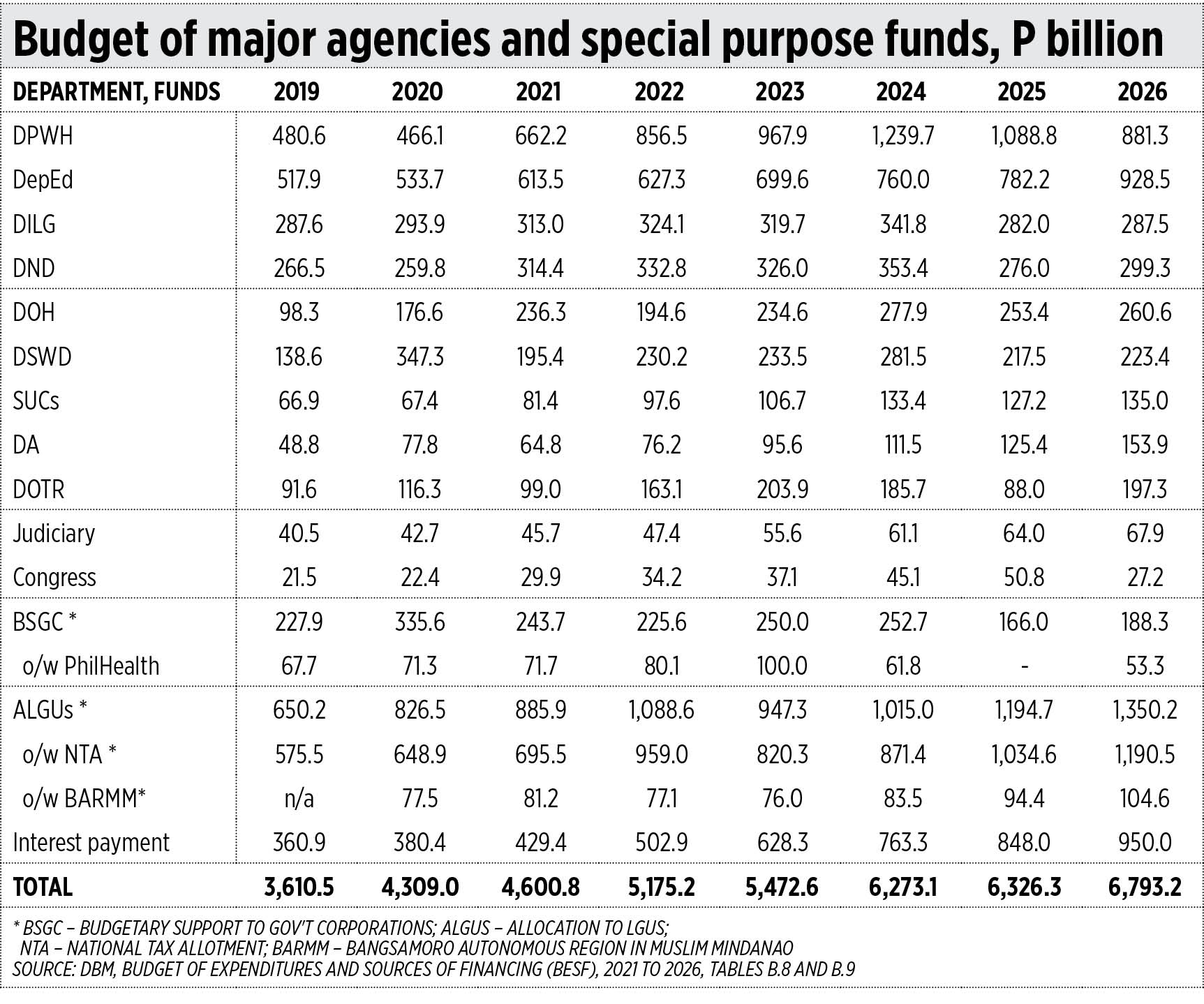
So, agencies and departments with 2025 budgets that are twice their 2019 level are candidates for spending cuts because the virus crisis, which was used as the basis for the huge rise in their budgets, is no longer here. These include the Departments of Public Works and Highways (DPWH), Health (DoH), Social Work and Development (DSWD), Agriculture (DA), and state universities and colleges (SUCs). See the table for details.
Thus for 2026, the Senate may consider limiting the budget of these agencies: the DoH to P230 billion while the Philippine Health Insurance Corp. or PhilHealth subsidy is kept at around P60 billion, leading to savings of P25 billion; the DSWD up to P200 billion, with savings of P23 billion; the DA up to P130 billion, with savings of P24 billion; the SUCs up to P130 billion, with savings of P5 billion; the Department of Transportation up to P190 billion, with savings of P7 billion. This leads to a savings sub-total of P84 billion.
The rest of the departments may have to deal with across-the-board reductions in their budgets of 5% to 8% — that would come to around P150-P200 billion in additional savings.
Then cut the subsidies to government corporations like the National Irrigation Administration (NIA) from an average of around P60 billion/year to only P30 billion; remove the Power Sector Assets and Liabilities Management Corp. (PSALM) subsidy of P8 billion/year; and the National Electrification Administration (NEA) subsidy of around P4 billion/year. This will result in around P42 billion in savings.
The Bangko Sentral ng Pilipinas’ cut in interest rate should help reduce our interest payment to not more than the programmed P950 billion.
Overall, a spending cut of up to P400 billion can be made in the 2026 budget. This will be a big respite in our budget deficit and annual borrowings.
I hope that President Ferdinand R. Marcos, Jr., Budget Secretary Amenah F. Pangandaman, and Senate President Tito Sotto would consider these proposals. Also, the rest of the economic team, and the House leadership when the Bicameral Committee is formed for this.
When agencies feel the tightness in overall spending and their agency budget, they will tend to be more careful, more efficient, and less wasteful in their spending to avoid another round of public backlash.
Bienvenido S. Oplas, Jr. is the president of Bienvenido S. Oplas, Jr. Research Consultancy Services, and Minimal Government Thinkers. He is an international fellow of the Tholos Foundation.