Home Blog Page 826

The Philippine judiciary, the best system that money can buy

STOCK PHOTO | Image by Fabrikasimf from Freepik

The Philippines has the best justice system that money can buy, according to Jose Almonte, national security adviser during President Cory Aquino’s term. It is not even a question of having good and pricey lawyers. It is about direct transactions with the judges or justices who can be depended upon to justify their decisions even if it means turning logical cartwheels and relying on technicalities.

Joseph “Erap” Estrada called the members of the judicial system “hoodlums in robes.” He coined the term back in 1993 when he was vice-president and head of the Presidential Anti-Crime Commission (PACC). He alleged that 80% of the cases filed in court by the PACC were dismissed summarily by corrupt judges.

In a strange turn of events, the members of the Supreme Court unanimously considered Erap “constructively resigned” as president of the Philippines on Jan. 20, 2001 solely on the basis of an entry in Executive Secretary Edgardo Angara’s diary that Erap had left Malacañang without indicating he was coming back. As if to avoid being dubbed by Erap as the “supreme hoodlums in robe,” the Supreme Court justices wore barong Tagalog instead of their traditional robes when they convened to declare the Office of the President vacant.

Corruption, influence peddling, and case-fixing in the judiciary have been acknowledged by practicing lawyers as the reality since the postwar years. Lawyers speak of judges with “open back door” — the point of entry to the judge’s chambers. The implication is that a favorable decision can be obtained not by a skillful presentation of the case before the judge in the open court but by enticements offered to the judge in their chambers or retiring room at the back of the court. Court decisions and temporary restraining orders have long been known to be for sale, earning for the judicial branch of the Philippine government the dubious reputation of being the best judiciary money can buy.

Because many had made similar accusations, the Supreme Court was prodded to conduct an investigation of “corruption in the judiciary.” But no evidence of judicial malfeasance was found, and the allegations were declared as pure gossip.

But in 2013, the Supreme Court confirmed the reported influence-peddling of one Arlene Lerma, who was said to have paid for court decisions favoring her clients. She was also said to have funded the campaigns of certain candidates for president of the Philippine Judges Association and gifting them expensive items and plane tickets for trips abroad.

In 2014, The Supreme Court dismissed Sandiganbayan Associate Justice Gregory Ong after he was found guilty of “gross misconduct, dishonesty, and impropriety” for acquitting pork barrel fund scam queen Janet Lim Napoles in a malversation case involving the sale in 1998 of 500 Kevlar helmets to the Philippine Marines. An investigation revealed that Ong visited Napoles at her office on two occasions after participating in the Kevlar helmet case.

The investigation into corruption in the judicial branch of the government is long overdue.

People wonder if corrupt public officials charged with plunder or amassing millions gained acquittals by sharing their enormous loot with the Sandiganbayan justices.

In April 2001, Jinggoy Estrada, along with his father Joseph, was accused of plunder for pocketing P183 million in kickbacks from his Priority Development Assistance Fund or PDAF, the discretionary funds for lawmakers which were corrupted using bogus nongovernmental organizations (NGOs) owned by Janet Lim Napoles. The projects turned out to be fake. But Jinggoy was acquitted of plunder by the Sandiganbayan Fifth Division because the verified transactions only amounted to P9.875 million, which is way lower than the threshold of P50 million to convict someone of plunder.

The Sandiganbayan Special Fifth Division granted Estrada’s motion for reconsideration, “there is reasonable doubt as to the presence of the second element — or the fact of receiving the bribe by the accused Estrada — as there is no proof of his actual receipt thereof.”

In 2014, Juan Ponce Enrile, the former Senate president, was charged with plunder for allegedly amassing P172.8 million in kickbacks or commissions from his pork barrel from 2004 to 2010. In October 2024, the Sandiganbayan dropped the plunder case, saying the prosecution submitted insufficient evidence and failed to show that the kickbacks he allegedly received from his pork barrel when he was a senator reached the minimum P50-million threshold for the crime. It noted that none of the prosecution witnesses testified that they handed the alleged pork barrel kickbacks directly to the accused.

Also in 2014, the Office of the Ombudsman filed a graft case against Senator Bong Revilla for allegedly getting “kickbacks” amounting to more than P200 million, by allegedly diverting his PDAF to the NGOs of Napoles, in exchange, supposedly, for a 50% kickback from the projects.

Revilla was acquitted of plunder but was required to return to the government P124.5 million in civil liability. However, he has yet to return the required amount that he was asked to give back before his acquittal. Why he was released from jail before complying with all the Court’s conditions, the Court did not explain.

He was acquitted in December 2018 after the Sandiganbayan First Division found no single direct evidence to establish he received the rebate, commission, or kickback from his PDAF projects, and that circumstantial evidence was not enough to prove his guilt beyond a reasonable doubt.

In 2016, The Office of the Ombudsman filed multiple charges of graft, malversation, and violations of banking regulations against Prospero Pichay in relation to the Express Savings Bank, Inc. acquisition. According to then-Ombudsman Conchita Carpio-Morales, the government “effectively lost at least P80,003,070.51” in the acquisition. The Sandiganbayan said the conspiracy angle was “only bare and unfounded allegation by the Ombudsman.”

In July 2016, former Vice-President Jejomar “Jojo” Binay, Sr. and his son, former Makati Mayor Junjun, were charged with graft, malversation, and falsification of public documents for overpricing the P2.2 billion construction of the Makati City Hall Parking Building. But in August this year, the Sandiganbayan cleared them of criminal charges. The antigraft court’s Third Division said the prosecution failed to prove their guilt beyond a reasonable doubt.

In 2016, Ombudsman Conchita Carpio Morales ordered the dismissal from service of Senator Joel Villanueva after finding him guilty of grave misconduct, serious dishonesty, and conduct prejudicial to the interest of service over his alleged involvement in a P10-million pork barrel scam as the congressional representative of CIBAC party-list. Ironically, CIBAC stands for Citizens’ Battle Against Corruption.

The senator was charged before the Sandiganbayan for two counts of violation of Section 3(e) of the Anti-Graft and Corrupt Practices Act or Republic Act No. 3019, one count each for malversation of public funds and malversation through falsification of public documents. The charges were based on the supposed irregularities that the Ombudsman found regarding the utilization of the P10-M PDAF allocation that the Department of Budget and Management released on June 10, 2008 for the implementation of agri-based livelihood projects in various congressional districts in Region XI.

Villanueva said he would leave it to Senate President Koko Pimentel to act on the Ombudsman’s order. However, the Senate did not implement the dismissal order issued by the Office of the Ombudsman against Villanueva because the Office lacks jurisdiction over members of Congress.

In contrast is the case of Rodolfo “Jun” Lozada, who served as the president and chief executive officer of the government-controlled Philippine Forest Corp. under the Department of Environment and Natural Resources from 2007 to 2008. An electronics engineer, he also served as a technical consultant to former socioeconomic planning secretary Romulo Neri on the Philippine national broadband project in 2007.

Lozada is best known for being the whistleblower behind the botched $329-million (P17-billion) National Broadband Network (NBN) deal with Chinese telecommunications giant ZTE, from 2007. He testified in the Senate hearings that First Gentleman Mike Arroyo, Comelec Chair Benjamin Abalos, and other Cabinet officials had accepted bribes from ZTE. His exposé led to one of the biggest scandals that hit President Gloria Macapagal Arroyo’s administration.

Lozada was charged with two counts of graft, and his brother Orlando with one, by the Office of the Ombudsman over the grant of leasehold rights over a 6.59-hectare piece of public land to his brother and a private firm linked to him under a program of PhilForest, when he was still president and CEO of the government corporation. The sole complainant was Lozada’s successor as president of PhilForest.

The Sandiganbayan’s 4th Division found them guilty of violating the Anti-Graft and Corrupt Practices Act and sentenced them to six to 10 years in prison. They surrendered to the NBI after their appeal with the Supreme Court was denied.

How curious.


Oscar P. Lagman, Jr. has been a keen observer of Philippine politics since the mid-1950s.

Peso weakens after narrower BoP surplus

BW FILE PHOTO

THE PHILIPPINE PESO weakened slightly against the dollar on Monday as investors digested the country’s narrower balance of payment (BoP) surplus, renewed global growth concerns and persistent US-China trade tensions.

It closed at P58.17 a dollar, slipping by a centavo from P58.16 on Friday. It was the peso’s weakest finish since P58.125 on Oct. 14.

The peso opened at P58.19, strengthened to as much as P58.065 and hit an intraday low of P58.195 before settling weaker. Trading volume fell to $1.13 billion from $1.43 billion in the previous session, based on Bankers Association of the Philippines data posted on its website.

Michael L. Ricafort, chief economist at Rizal Commercial Banking Corp., said the peso softened after the release of the Philippine central bank’s BoP data showing a smaller surplus.

The BoP surplus narrowed to $82 million in September, compared with $3.5 billion a year earlier and $359 million in August. The Bangko Sentral ng Pilipinas said the slimmer surplus reflected lower foreign exchange inflows from National Government deposits and investment income overseas.

The smaller BoP surplus and weaker external buffers contributed to the peso’s mild weakness, Mr. Ricafort said, adding that global risk aversion also pushed investors toward safe-haven assets.

Concerns resurfaced over the health of US regional banks after Reuters reported rising stress across smaller lenders. Shares of Zions Bancorporation and Western Alliance rebounded on Friday after steep losses earlier in the week, easing fears of a repeat of last year’s banking turmoil.

Meanwhile, investors also weighed geopolitical risks as US President Donald J. Trump renewed threats of a 100% tariff on Chinese imports and potential export curbs on rare earth minerals, raising the risk of escalation in trade tensions.

At home, sentiment was dented by comments from Economy Secretary Arsenio M. Balisacan, who said the Philippines might only hit the lower end of its 5.5% to 6.5% growth target this year due to slower public spending tied to corruption probes and the impact of recent typhoons.

Budget Secretary Amenah F. Pangandaman maintained that the 2025 growth goal remains “attainable,” citing planned spending acceleration and improving private demand.

The peso’s direction this week may hinge on the upcoming US inflation report, delayed by the recent government shutdown. Analysts expect the Federal Reserve to cut rates by 25 basis points at its Oct. 28-29 meeting after weak job data.

In the Philippines, BSP Governor Eli M. Remolona, Jr. said further rate cuts remain possible to sustain domestic demand, following the 25-bp policy reduction earlier this month that brought the benchmark rate to 4.75%, the lowest in more than three years.

Both Mr. Ricafort and the trader expect the peso to trade from P58.05 to P58.30 a dollar on Tuesday. — Aubrey Rose A. Inosante

MREIT seeks SEC nod for P8-B capital stock hike

SEC.GOV.PH

LISTED MREIT, Inc., the real estate investment trust sponsored by Megaworld Corp., has filed with the Securities and Exchange Commission (SEC) to increase its authorized capital stock to P8 billion from P5 billion to P8 billion, following a memorandum of understanding with its sponsor.

In a disclosure to the stock exchange on Monday, MREIT said the increase, with a par value of P1 per share, is meant to support its growth by enabling the acquisition of additional income-generating assets.

Under the agreement, both parties will exchange shares involving certain Megaworld properties that qualify as MREIT’s target growth assets.

“MREIT intends to acquire the target growth assets to secure income growth and provide a competitive investment return to its shareholders,” the company said.

Megaworld will subscribe to 25% of the P3-billion increase, or P750 million in new shares, paying 25% of its subscription, equivalent to P187.5 million, as required by law. The subscription price will be at least P14.39 per share, higher than MREIT’s 30-day average market price.

In August, MREIT said the capital hike would accelerate its plan to reach one million square meters (sq.m.) of gross leasable area (GLA) by 2027, advancing the target by three years.

The company has said it plans to gradually infuse mall and retail assets into its portfolio to diversify holdings and capture growing consumer demand.

Currently, MREIT owns 24 prime office properties across five Megaworld townships, including Eastwood City in Quezon City, McKinley Hill and McKinley West in Taguig, Iloilo Business Park in Iloilo City, and Davao Park District in Davao City. Megaworld holds 1 million sq.m. of office GLA and 500,000 sq.m. of retail GLA that may be added to MREIT over time.

On Monday, MREIT shares slipped 0.14% or 2 centavos to P13.96, while Megaworld shares fell 0.51% or 1 centavo to P1.97. — Alexandria Grace C. Magno

Fisher Mall plans to add 5,000 sq.m. of retail space to meet tenant demand

FACEBOOK.COM/FISHERMALL

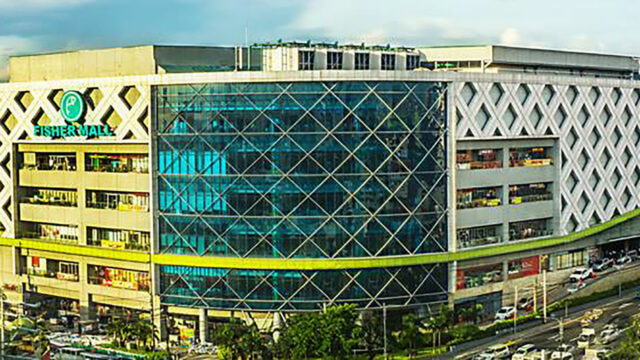
THE FISHER MALL group is planning to expand its Quezon City mall by adding 3,000 to 5,000 square meters (sq.m.) of new retail space to accommodate tenants seeking to widen their footprint.

“Our leasing tenants right now, who are existing international players in the area — are looking for a bigger spot and larger footprint to accommodate the growing demand,” Fisher Mall Group of Companies President Robert Raymond B. del Rosario said in an interview with BusinessWorld.

Mr. Del Rosario said the company is looking at adding between five and six floors, which will feature a mix of local and international retail and dining establishments.

Groundbreaking for the expansion of the Quezon Avenue mall is targeted by mid-2026.

He said the additional structure will be built beside the existing mall along Quezon Avenue, near the parkway area that houses international tenants such as Uniqlo.

“We’re looking at ways to accommodate and to expand where it fits, not just in our timeline, but to address the current needs and wants of both our customers and our future tenants,” he said.

The company is also planning to make the expansion more accessible to public utility vehicles (PUVs), Mr. Del Rosario said.

Fisher Mall, which has a gross floor area of about 120,000 sq.m., is located at the corner of Quezon Avenue and Roosevelt Avenue in Quezon City. The site was formerly occupied by the Pantranco bus terminal but continues to serve as a hub for public transport.

The mall hosts a mix of dining, retail, leisure, entertainment, and government service tenants.

Mr. Del Rosario said mall foot traffic has remained steady, rising by 8% to 12% year on year.

He added that Fisher Mall is also planning to repurpose some of its existing cinemas into event or multi-sport areas.

“We plan to start construction by the first quarter next year and finish by the third quarter,” Mr. Del Rosario said.

Fisher Mall is operated by Mallers Investments Corp., which currently has two branches — one in Quezon City and another in Malabon City.

The company is also planning to build up to three new malls within the next two to three years. — Beatriz Marie D. Cruz

On IPRI 2025, power exchange, and the energy mix

On Oct. 15, the Property Rights Alliance (PRA, US) — a sister free-market think tank of the Tholos Foundation of which I am among the international fellows — released the International Property Rights Index (IPRI) 2025, holding its global launch in Brussels, Belgium at the EU Parliament. The report was authored by Dr. Sary Levy-Carciente, a Hernando de Soto Fellow, and edited by Lorenzo Montanari, Executive Director of the PRA.

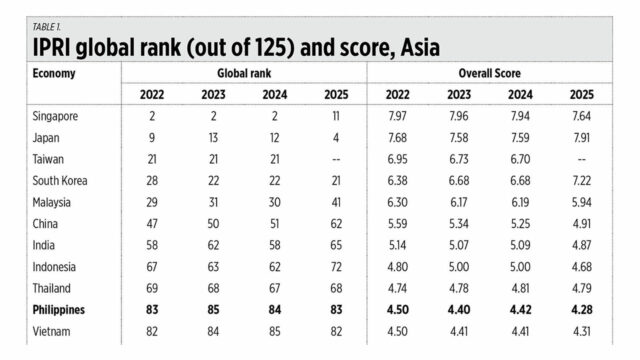
The IPRI is composed of three core components: Legal and Political Environment (LP), Physical Property Rights (PPR), and Intellectual Property Rights (IPR). I included the results for 2025 and the results of the previous three years in the accompanying table. The Philippines is not faring well mainly due to our low score in LP, meaning the legal and institutional issues that cover the extent of corruption, among other factors. So far, we are at similar level as Vietnam. (See Table 1.)

The ongoing large-scale corruption scandal involving just the Department of Public Works and Highways (DPWH) and not including — yet — many other departments with their own skeletons in the closet, is adversely affecting the country’s investment environment, credibility of other reform programs especially in fiscal economics, and the public’s declining respect for both the Executive and Legislative branches.

CALAMITIES AND POWER EXCHANGE
There have been many strong storms then big earthquakes (especially in Cebu and Davao) this month alone. There is a need for energy independence of certain island-provinces in case the transmission lines and cables serving the Panay-Negros-Cebu, Leyte-Bohol sub-grids, and the Mindanao-Visayas grid, are damaged or destroyed.

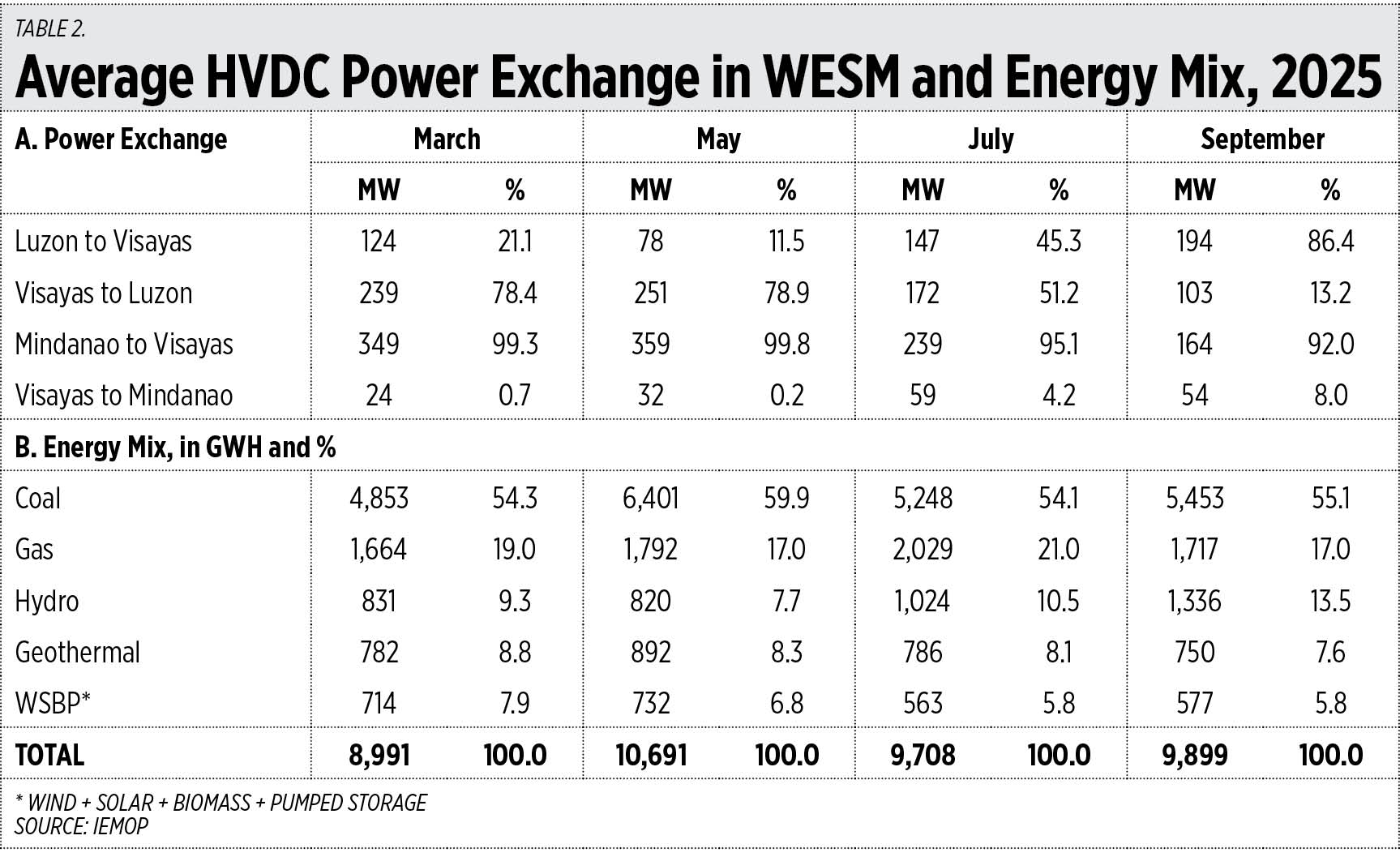
I checked the power exchange among the three grids in Luzon, Visayas, and Mindanao. Last September (and likely until early October), Visayas was importing more power from both Luzon and Mindanao.

Last month, the Luzon to Visayas transfer occurred 86% of all time while that of power from Mindanao to Visayas occurred 92% of all time (see Table 2).

Visayas has recently been importing power almost 24/7, but power demand in both Luzon and Mindanao is also rising. Within the Visayas, Cebu and Panay islands are coal-powered and they export extra power to Negros which has zero coal and plenty of solar power.

Anti-coal sentiment, especially from the multilaterals like the United Nations and ADB continues through their Energy Transition Mechanism (ETM) program — see these reports in BusinessWorld: “DoE, UN agency studying impact of energy transition on coal industry” (Sept. 3), “Power plant retirement to be eligible for carbon credits” (Oct. 13), “DoE clarifies coal moratorium rules; allows new capacity only in exceptional cases” (Oct. 17).

The ADB’s anti-coal sentiment should inspire them to move their headquarters from the Philippines (which uses coal for 55% in total power generation) to Myanmar or Nepal which use coal for only 4% and 7% of their total generation, respectively.

I bumped into the president and CEO of Meralco Power Gen (MGEN), Manny Rubio, and I asked him about the recent pronouncement by the Department of Energy (DoE). He optimistically replied that “The DoE’s clarification of the coal moratorium provides a pragmatic approach to balancing the country’s energy transition with the realities of our supply reliability. By allowing limited exemptions for off-grid areas, industrial own-use, and critical mineral processing, the policy recognizes the need for dependable baseload power in regions still facing transmission and supply constraints.”

This week the Energy Regulatory Commission (ERC) held a press conference about their accomplishments over the last two months and their targets until end-2025. Among the papers released by the ERC that caught my attention was the increase in the Feed in Tariff Allowance (FIT-All) in our monthly electricity bill to 20.73 centavos/kWh, to be collected starting next month.

The FIT-All rates in centavos per kWh were: 18.3 in 2017, 22.3 in 2019, 9.8 in 2021, zero in 2023, 8.4 in 2024, and 11.9 until this October. See Table 2 of this column last week, “Coal for energy security, infrastructure for energy resilience” (Oct. 14).

So, an increase from 11.9 to 20.7 centavos/kWh next month is high and most of this will go to wind and solar-eligible plants. The owners of these plants are not the ordinary rich, but the super-rich conglomerates that own no coal plants (which are cheap, stable, and reliable energy sources).

In a few years, we will pay not just FIT-All but also GEA-All in our monthly electricity bills, especially to huge offshore wind farms under the green energy auction (GEA) program. This GEA-All will be much higher than FIT-All. One ADB estimate quoted by a friend and fellow columnist Myrna Velasco showed that offshore wind will charge P12-P15/kWh.

If this number is correct, compared with the current WESM average price of P4/kWh, then the GEA difference will be P12-15 minus P4 equals P8-11/kWh multiplied by their GWH generation. That guaranteed high price GEA minus WESM price will be the GEA-All and we will pay more for electricity.

The anti-inflation policies of the economic team and the Bangko Sentral will be cancelled by the expensive wind projects and lobby. Woe unto us consumers.


Bienvenido S. Oplas, Jr. is the president of Bienvenido S. Oplas, Jr. Research Consultancy Services, and Minimal Government Thinkers. He is an international fellow of the Tholos Foundation.

minimalgovernment@gmail.com

Report: Philippines lags in resilient healthcare

The Philippines placed 87th out of 110 countries, scoring 32.55 out of 100 in the 2025 Health Care Index by CEOWORLD Magazine. The index measures the healthcare resilience of a country based on five variables: healthcare infrastructure, medical professionals, medicine availability and cost, government readiness, and environment and lifestyle factors.

Report: Philippines lags in resilient healthcare

Political spectacle at full force

JERICHO ROSALES as Quezon.

Movie Review
Quezon
Directed by Jerrold Tarog

By Brontë H. Lacsamana, Reporter

TO DEEPEN the deconstruction of the national hero, TBA Studios and director Jerrold Tarog’s Bayaniverse series have turned their attention to Manuel L. Quezon. Set in the American occupation, Quezon depicts the political squabbles and brutal manipulation that its titular figure must resort to in order to attain independence for the Philippines.

Played with magnetic force by Jericho Rosales, the Manuel L. Quezon we see here is a ringleader of the circus known as Philippine politics, its familiar shape still ringing true to what we experience today.

The rest of the characters are chess pieces to him — from Governor Leonard Wood (an amusing appearance by Game of Thrones actor Iain Glen), Sergio Osmeña (an entertaining supporting role brought to life by Romnick Sarmenta), journalist Joven Hernando (a supposedly enlightened stand-in for the audience played by Cris Villanueva), or sympathetic antagonist Emilio Aguinaldo (with which Mon Confiado continues to steal scenes).

Coming from the unbridled fury of Heneral Luna and the reflective nature of Goyo, this installment in the series takes us to the performance of nation-building, set not in battlefields but at podiums and facing cameras. Quezon, as the third larger-than-life figure in the Bayaniverse (a portmanteau of bayani or hero and universe), enjoys high production values as well, even if the centerpieces are explosive conversations and political machinations rather than fight scenes. Philippine history is interpreted through the lens of the journalist Joven character, who has a front seat to Luna*, Goyo**, and Quezon’s biggest successes and failures.

What this set of films does is expose the folly in the notion of a hero who will save the Philippines from itself. In Quezon, it in fact proposes that the very hero being revered may be the catalyst for the worst of our country’s flaws.

Rosales as Quezon is a spectacle, with his high-pitched Tagalog-accented voice that mimics the gravitas of a transatlantic declamatory statesman. It matches, too, with the crux of his character being that of a man who learned from the Americans’ game of politics, and brought it back home. His performance and chemistry with the rest of the cast (namely his toxic push-and-pull with Sarmenta’s Osmeña and his dogged face-off with Confiado’s Aguinaldo) make a strong case for this film being the most entertaining of the three.

Unfortunately, it may also be the one with the least heart in it. The senseless politicking and pandering to the promise of independence (at any cost) includes a pessimistic, self-referential plot point for the journalist character and his filmmaker daughter. The two fall prey to making propaganda for Quezon but ultimately can’t make any definitive, concrete stand. It succeeds at holding up a mirror to the audience members watching, who decry corruption and bad governance, but cannot suggest or invoke any alternative. It’s true, yes, but it could be much more.

Quezon is a strong biopic and historical drama that satirizes politics through sensational slapstick moments starring some of the Philippines’ best known figures from the American period. For a dialogue-heavy film, it’s thrilling to follow thanks to its playful structure, making it stand out from its two predecessors which were mainly linear and battle-focused. It is a film with a deeply cynical take on a nation’s coming-of-age. There is also the questioning of the truth behind the murders of Andres Bonifacio and Antonio Luna, putting to the test our belief in historical narratives.

What it didn’t really account for was the impact of Quezon’s actions. It only focused on the political spectacle that worsens the state of the nation and makes the dream of independence unreachable, even laughable. There’s a small scene where a farmer reveals that most people don’t understand what independence means. The film doesn’t explore beyond that — how the Filipino politicians and the American occupiers take advantage of this ignorance, what the average Filipino’s life is like, and why independence is such a pipe dream. Perhaps there we could have found the film’s heart.

* Antonio Luna, who led the Philippine Republican Army during the early phases of the Philippine-American War. The first film in the Bayaniverse, Heneral Luna (2015), picks up just at the end of the Philippine Revolution against Spain and covers the machinations of the central figures in the aborted first republic and provincial rivalries, including the first Philippine President Emilio Aguinaldo, Felipe Buencamino, Pedro Paterno, Pedro Janolino, and Luna, ending with the assassination of Luna and his aides-de-camp. Gregorio del Pilar, the subject of the second film in the Bayaniverse, makes an appearance in the middle of the film.

** Gregorio del Pilar or the “Boy General” of the Philippine-American War. The second film in the Bayaniverse, Goyo: Ang Batang Heneral (2018), tackles his rise right after Luna’s assassination, to his death at the Battle of Tirad Pass against the Americans, and sets up the appearance of Quezon who is the subject of the third film.

StanChart grants $75-M social loan to Asialink Group

STANDARD CHARTERED PLC (StanChart) on Monday signed a $75-million social financing deal with Asialink Group, marking a milestone that could expand the local lender’s loan capacity and bring its initial public offering (IPO) timeline forward to 2027.

Ana Maria Alba, Standard Chartered head of bank and broker dealers for the Philippines, said the facility aims to fund Asialink Finance Corp.’s socially inclusive lending initiatives, particularly for micro, small and medium enterprises (MSME).

“By directing at least 70% of the facility to MSMEs, the facility directly supports growth of small businesses and female entrepreneurs in the Philippines, fostering job creation and economic development,” she said at the signing ceremony in Pasig City.

The deal represents Standard Chartered’s first syndicated social loan to a nonbank financial institution in the country. Its co-lenders include Bank of China (Hong Kong) Ltd. – Manila Branch, Bank of China (Malaysia) Berhad, Chang Hwa Bank – Manila Branch, First Commercial Bank – Manila Branch, Hua Nan Commercial Bank – Manila Branch and Taichung Commercial Bank.

Asialink Group Chief Executive Officer Robert B. Jordan, Jr. said the financing highlights global investors’ confidence in the company and in the Philippines’ financial system.

“Strengthening our balance sheet directly creates opportunities for small businesses, communities, and the local economy,” he said. “Partnering with Standard Chartered connects Asialink to global best practices in sustainability, risk management and governance, aligning perfectly with our long-term strategy.”

Mr. Jordan said Asialink targets to disburse P4 billion to P4.5 billion monthly from the funding by 2026, with a stronger push into SME lending. “We haven’t really pushed that product in the past for the simple reason that we didn’t have the money.”

Asialink Group Finance Director Meynard M. Mendoza said the company expects the funding to lift its loan portfolio to about $48.7 billion by yearend, from P41.9 billion as of the second quarter, 57% of which served MSMEs. The group’s bad loan ratio remained below 2% as of June.

“With competitive interest rates coupled with fast processing time, the Group is poised to serve a larger share of the market while continuing to help its core clients in the unbanked and underserved sector,” Asialink said in a statement.

Mr. Jordan said Asialink’s IPO plans remain on track, noting that debt covenants with creditors could push the company to tap equity markets by 2027.

“By that time, we [might] explore ways of raising more capital to be able to bring back our debt accumulation to an acceptable level,” he added.

Asialink Finance Corp., one of the Philippines’ biggest nonbank lenders, serves people and MSMEs through its more than 500 branches nationwide. It financed 159,523 accounts in April to June. — Katherine K. Chan

Alsons Dev to start Aldevinco site redevelopment by end-October

“THE AGING BUILDINGS will be cleared to make way for a redevelopment that continues to cultivate Davao’s growth.” — ALSONS DEVELOPMENT AND INVESTMENT CORP.

THE redevelopment of the Aldevinco Shopping Center site in downtown Davao City is set to begin by the end of October, according to Alsons Development and Investment Corp. (Alsons Dev).

In a statement on Monday, the Alcantara Group’s property arm said the site, located at the corner of C.M. Recto and Roxas Avenue, will be transformed into a flagship mixed-use development that reflects the company’s vision for “vibrant, sustainable, and people-centric spaces.”

The project will start with the phased demolition of existing structures, which Alsons Dev described as outdated and no longer structurally sound.

The company said it has coordinated with the Office of the City Building Official and other agencies to comply with all regulatory requirements.

While redevelopment plans are being finalized, the 5,106-square-meter property will temporarily serve as a paid parking facility by the second quarter of 2026.

The interim site will include areas for food trucks and small vendors to keep the property active.

“Our vision is to build developments that balance heritage and progress, ensuring that every project we undertake supports the city’s growth,” Alsons Dev President and Chief Executive Officer Miguel A. Dominguez said.

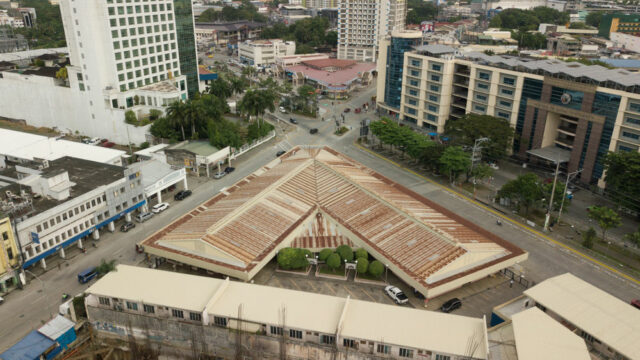
Opened in 1965, Aldevinco Shopping Center was one of the city’s earliest commercial hubs and became known for showcasing Mindanao’s crafts, textiles, and antiques. It closed in December 2021, with many of its tenants relocating to Poblacion Market Central, which Alsons Dev opened in 2022 as a modern replacement.

Alsons Dev, with more than six decades of experience in real estate development, has projects including Ladislawa Garden Village, Woodridge Park, Las Terrazas, and Northcrest in Davao City, as well as the 121-hectare Avia Estate in Sarangani. — Alexandria Grace C. Magno

Alba Viento Power plans P34-B wind farm in Zambales

FREEPIK

RENEWABLE ENERGY developer Alba Viento Power Corp. is proposing to build a 300-megawatt (MW) wind farm in Zambales with an estimated cost of $600 million (P34 billion).

In a filing with the Department of Environment and Natural Resources, the company said the project will cover 4,698 hectares across Botolan and Cabangan municipalities.

Construction is targeted to begin in the first quarter of 2027, with commercial operations expected by the first quarter of 2029.

“The proposed wind power plant will help augment the demand for reliable and affordable power supply,” Alba Viento said. “The project will not only supply electricity to Filipino households and businesses but will also contribute to national development.”

The company said it plans to use higher-capacity wind turbine generators to maximize output while minimizing land disturbance within the contract area. The facility is expected to connect to the Botolan substation of the National Grid Corp. of the Philippines.

Alba Viento said the project aligns with the Philippines’ renewable energy transition and supports the country’s clean energy goals.

Alba Viento Power is a special purpose vehicle wholly owned by Alba Renewables Philippines Corp., which in 2024 secured a 25-year wind energy service contract from the Department of Energy to develop and utilize wind energy in Zambales.

Alba Renewables aims to become the leading independent power producer in Southeast Asia within the next five years. While focusing on the Philippines, it is expanding into Thailand and plans to enter a third regional market within 24 months. The company is targeting a multi-gigawatt portfolio of operational, under-construction, and advanced-stage development assets. — Sheldeen Joy Talavera

Entertainment News (10/21/25)


K-drama hits come alive in PPO concert

THE magic of Korean drama is set to return to the concert stage as the Cultural Center of the Philippines, the Korean Cultural Center in the Philippines, and the National Commission for Culture and the Arts present OST Symphony II: K-Drama in Concert. It will take place on Oct. 25 at the Samsung Hall, SM Aura, Taguig City, with two shows at 2 and 6:30 p.m. It will star the Philippine Philharmonic Orchestra (PPO) led by Herminigildo Ranera. The setlist will include the music of KPop Demon Hunters, Crash Landing on You, and When Life Gives You Tangerines. There will also be guest performers: Korean singer-songwriter Hong Isaac, rising artist YEGNY, and Filipino performers Kyline Alcantara and Angel Guardian. The concert is free and open to the public, with tickets available at smtickets.com.


GMA, FILSCAP renew alliance to protect music rights

GMA NETWORK and the Filipino Society of Composers, Authors, and Publishers, Inc. (FILSCAP) have renewed their partnership in protecting and upholding the rights of artists behind original musical works. The contract signing was held last week in Quezon City, with the goal to help artists be aware of and be active in upholding the rights of their musical compositions.


Dusit Thani will have a tree lighting celebration

DUSIT THANI is having its tree lighting celebration in time for the holiday season. It will take place on Nov. 6 starting at 6 p.m. The ceremony will feature a performance by Christian Bautista. The event will be at the hotel lobby of the Dusit Thani Manila at the Ayala Center, Makati City.


Pink glitter edition of Maya Visa card released

THIS November, K-pop girl group BLACKPINK is holding its DEADLINE World Tour in Manila. In line with this, payment platform Maya is offering VIP tickets, exclusive perks, and concert seats which fans can avail themselves of using the pink glitter edition of the Maya Visa card. From Oct. 1 to Nov. 11, daily spend using the card can earn participants raffle entries for the giveaways. A minimum spend of P500 in a single transaction qualifies for one daily entry.


ENHYPEN’s first VR concert to visit Manila

K-POP boy group ENHYPEN’s first-ever VR concert, IMMERSION, will tour many countries, including the Philippines. It will be shown in Manila exclusively at the Gateway Cineplex in Cubao, Quezon City from Nov. 20 to Dec. 6. Tickets will be available starting Nov. 8 at 12 p.m. via gatewayImmersive.com.ph. The concert is presented by Wilbros Live.


McDonald’s Stripes Run set for December

THE 2025 McDonald’s Stripes Run marks the 14th year of the event. This year’s race kit includes a shirt, race bib, race socks, tote bag, and goodies from partner brands. Aside from the race kit, everyone will get freebies at the finish line. It will take place on Dec. 7 at the SM Mall of Asia Concert Grounds in Pasay City. Proceeds from the run will go to the programs of Ronald McDonald House Charities of the Philippines, a non-profit organization that supports Filipino children by providing better access to education and healthcare. To register, visit https://bit.ly/McDonaldsStripesRun2025.


The Fray, December Avenue to perform at Araneta

AMERICAN band The Fray and Filipino band December Avenue will be sharing the spotlight at the Smart Araneta Coliseum in Quezon City on Dec. 12.  Fans can expect a setlist of both international and local favorites from both bands, performed live at the venue. Tickets are available via Ticketnet at https://www.ticketnet.com.ph/event-detail/the-fray.


Tame Impala releases 5th album

SINGER-SONGWRITER Tame Impala (real name: Kevin Parker) has released his fifth full-length album, Deadbeat, via Columbia Records. The album opener, “My Old Ways,” has also dropped its music video, directed by Kristofski and featuring cinéma vérité footage the director took throughout the process of Mr. Parker making the record in various locations around the world. The album is inspired by Australian bush doof culture and particularly the local scene centered around Margaret River in Western Australia in the 1990s. It is out now on all digital music streaming platforms.


Bryan Adams to tour in Manila

GRAMMY-WINNING singer-songwriter Bryan Adams has announced the Asia leg of his newest tour, Roll With The Punches. The Manila concert will be held at the SM Mall of Asia Arena on Jan. 31, 2026, presented by Wilbros Live. Tickets are now available via SMTickets.com and SM Tickets outlets nationwide.

A new populist tool

Students attend online classes in Baseco, Tondo, Manila. — PHILIPPINE STAR/EDD GUMBAN

By Jam Magdaleno and Cesar Ilao III

LAST WEEK, Laguna Governor Marisol “Sol” Aragones announced a blanket suspension of in-person classes at all levels, shifting all schools — public and private alike — to online learning. The reason? The “possible” occurrence of a strong earthquake within two weeks, following the tremors that recently hit Cebu and Mindanao.

To many parents, the announcement sounded reassuring: better safe than sorry. To students, it meant almost a month of flexible learning, reminiscent of the pandemic experience. To politicians, it was a masterstroke of populist signaling: quick, visible action that pleases an anxious public.

The rush to suspend in-person classes reveals how, in post-pandemic Philippines, class suspensions have become the new populist tool. What used to be a last-resort response to typhoons and calamities is now wielded as a political reflex, an easy way to appease fearful constituents while avoiding deeper, structural questions.

But what do we mean when we say “populist?” We use the term in its broadest sense: politicians appealing to public sentiment as the highest virtue, while overriding other bases for policy decisions, such as science and data. Populism thrives on a binary framing that leaves little room for nuance.

One familiar refrain captures it well: “Ang klase na mawawala ay maaaring mahabol, ngunit ang buhay ay iisa (One can catch up a missed class, but you only have one life).” Such rhetoric turns complex policy trade-offs into moral absolutes.

The suspension was premised on the “precautionary” need to conduct structural checks on school buildings. Yet this raises a fundamental question: Why only now? Earthquakes in the Philippines are not new; they are regular features of our geography. The National Building Code of the Philippines (Republic Act No. 6541) already mandates that all public and private buildings be properly maintained to ensure structural safety and integrity. If safety inspections were a true priority, shouldn’t they have been scheduled routinely, not triggered by social media panic? In other words, the decision is reactive, not proactive.

Instead of institutionalizing safety through preparedness and infrastructure investment, officials resort to what communication scholars describe as symbolic action — temporary closures, online classes, and “monitoring” announcements — that perform concern and signal action but deliver little in the long term. To borrow from French thinker Guy Debord, we are witnessing a spectacle of safety.

Two days after Laguna’s announcement, the Department of Education (DepEd) issued “a reminder” that class suspensions should be “exercised with balance and prudence,” signaling that the measure may have gone too far.

The most troubling assumption behind such decisions is that learning can be replicated online without compromising its quality. The pandemic normalized a reliance on digital platforms among schools and local officials: an approach often mistaken for a genuine, science-backed education policy.

What began as a temporary emergency response in 2020 has since become a perverse incentive. one that allows decision-makers to suspend in-person learning at the slightest “hint” of danger, even after seismologists have disproved rumors that recent the earthquakes were related to one another.

Let’s look at the facts: For millions of students, “online learning” means poor connectivity, unaffordable devices, and parents forced into the role of teachers. For younger pupils, it means lost social interaction, the foundation of real learning. The abrupt shift also presumes that teachers and professors can instantly rework lesson plans, laboratory activities, and fieldwork schedules without disruption.

To assume that schools can switch back to online mode overnight, with no preparation, is to ignore the very crisis policymakers claim to address.

Every day of lost classroom instruction further widens the gap in reading, math, and science — areas in which Filipino students already perform among the world’s weakest. In the 2022 PISA assessment, the Philippines scored 355 points in mathematics (versus the OECD average of 472) and 347 points in reading (versus 476). The science result was approximately 373 points (against an OECD average of 485). Because each 20-point shortfall is roughly equivalent to one year of schooling, this implies that Filipino 15-year-olds could be as much as five to six years behind their international peers.

Education officials and local executives appear to have forgotten that physical classes remain the irreplaceable venue of instruction. Every canceled class, every day of lost interaction, compounds the learning crisis the country already faces.

Beyond education, these suspensions reverberate through the local economy. The small karinderya (food stall) beside the school, the jeepney and tricycle drivers who ferry students, and the sari-sari (sundry) stores that sell snacks all lose income when classrooms are empty.

According to a 2021 study by the Asian Development Bank (ADB), a full year of school closures could cost the Philippine economy up to P1.15 trillion in lost output as parents withdraw from work and productivity declines. Meanwhile, the Philippine Statistics Authority (PSA) reported in 2023 that Laguna’s economy surpassed P1.03 trillion in gross provincial output, making it the first province in the country to cross the trillion-peso mark. Given this scale, even short-term disruptions in in-person learning can ripple through local communities with significant economic consequences.

While future studies have yet to quantify how much small enterprises lose during prolonged suspensions, the scale of Laguna’s economy and its dependence on service and transport livelihoods make such disruptions far from trivial.

The move also sets a worrying precedent. If one province can cancel in-person learning for almost a month on the basis of a possible earthquake, what will stop other local executives from doing the same?

Laguna’s case is a symptom of a larger national problem: the ease with which we suspend learning, and with it, progress itself. When short-term political optics replace long-term investment in schools and safety, we tell an entire generation of students and parents that disruption is normal and that education is negotiable.

Populism always exacts a price beyond the next election — it is society that ultimately pays. In this case, the cost is a weaker education system, deeper learning losses, and an economy made ever more fragile by political performance.


Jam Magdaleno is a political and economic researcher, writer, and communication strategist. He is the Head of Information and Communications of the Foundation for Economic Freedom (FEF), a Philippine-based think tank. Cesar Ilao III is a lecturer at the University of the Philippines and a researcher and communications specialist for the FEF. He was formerly a researcher at Monash University, Australia.

ADVERTISEMENT
ADVERTISEMENT