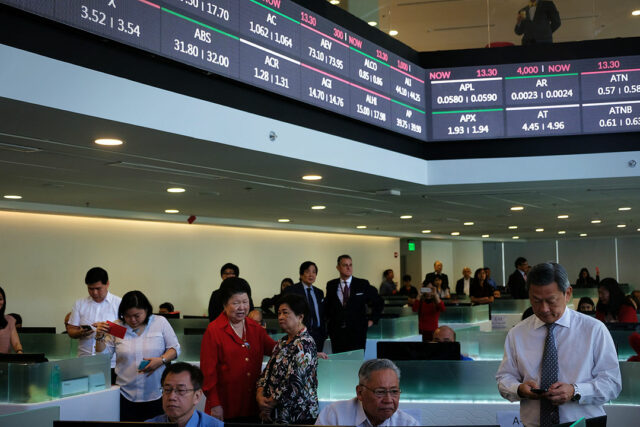
PHILIPPINE STOCKS recovered on Thursday, with buyers stepping in late in the trading session to take advantage of lower share prices.
The benchmark Philippine Stock Exchange index (PSEi) rose by 0.38% or 23.09 points to close at 6,053.96, while the broader all-share index climbed 0.28% or 10.20 points to 3,637.58.
“The index closed in positive territory after bargain hunting kicked in when the market touched an intraday low of 6,006.60,” AP Securities, Inc. said in a market note.
The PSEi opened Thursday’s session at 6,024.51, slightly lower than Wednesday’s close of 6,030.87. It hit an intraday low of 6,006.60, but buying helped the index recoup its losses to close nearer to its best showing for the session, which was logged at 6,055.75.
“The Philippine market went up, driven by late bargain hunting toward the end of the trading day as investors sought opportunities after recent declines. However, overall sentiment remained cautious as the peso continued to weaken against the US dollar,” Luis A. Limlingan head of sales at Regina Capital Development Corp. said in a Viber message.
The peso plunged by 20 centavos to close at P58.61 against the dollar on Thursday from Wednesday’s finish of P58.41, Bankers Association of the Philippines data showed. This was a fresh near nine-month low for the local unit.
Sectoral indices closed mixed. Financials dropped by 0.56% or 11.26 points to 1,999.66; holding firms retreated by 0.12% or 6.30 points to 4,870.87; and property decreased by 0.09% or 2.21 points to 2,226.43.
Meanwhile, services jumped by 1.71% or 39.30 points to 2,330.54; mining and oil rose by 1.26% or 167.82 points to 13,446.31; and industrials climbed by 0.52% or 46.54 points to 8,925.86.
Decliners narrowly outnumbered advancers, 99 to 92, while 68 names closed unchanged.
Value turnover declined to P4.80 billion with 1.42 billion shares traded on Thursday from Wednesday’s P10.81 billion with 12.06 billion shares changing hands.
Net foreign buying was P5.43 million on Thursday versus the P104.43 million in net selling recorded on Wednesday.
Meanwhile, Asian stocks fell for a second day on Thursday as lackluster earnings from tech megacaps deepened a selloff on Wall Street, while US sanctions against Russia and possible new export controls on China revived geopolitical worries, Reuters reported.
MSCI’s broadest index of Asia-Pacific shares outside Japan was last off 0.4%, while Japan’s Nikkei 225 sank 1.5%.
Chinese stocks fell as much as 1.1% after sources said the White House is considering a plan to curb an array of software-powered exports to China to retaliate against Beijing’s latest round of rare earth export restrictions.
Global markets are easing off record highs as corporate earnings season kicks off and investors take profits. While results or outlooks from megacaps have disappointed investors, most of the companies that have reported so far have beaten estimates. — Alexandria Grace C. Magno with Reuters
Games on Friday (Ynares Center-Antipolo) 5:15 p.m. – Blackwater vs Rain or Shine 7:30 p.m. – TNT vs Titan
WITH GUNS still warm from its shooting spree in Vigan, TNT hunts for back-to-back wins and the solo lead in the PBA Philippine Cup on Friday at Ynares Center-Antipolo against Titan Ultra.
The Tropang 5G made it rain in their previous 110-103 victory over Converge on the road, with RR Pogoy (six), Calvin Oftana (four), Kelly Williams (four), Simon Enciso (three), Kevin Ferrer (two) and Brandon Rosser (one) combining for 20 triples and Rey Nambatac rifling in a pair of four-pointers.
The combined output of 22 conversions from beyond the arc, according to PBA stats chief Fidel Mangonon, marked the fifth all-time most in a game and third in TNT franchise history.
And Chot Reyes’ crew is expected to continue tapping this weapon, in addition to its stifling defense and hustle plays, as it shoots for a followup win and a leading 3-1 record in the 7:30 p.m. encounter.
If successful, the Tropang 5G will sit at the summit by their lonesome, leaving behind idle co-leaders Magnolia, Converge and NLEX at 2-1.
The Giant Risers are reeling from a two-game skid, unable to rise to the challenge in the absence of Calvin Abueva, who was sidelined by a hamstring injury after leading them to victory in their maiden PBA appearance, 100-96 over Meralco.
Meanwhile, Rain or Shine (1-1) and Blackwater (1-1) clash at 5:15 p.m. with the victor returning to the win column after coming up short in their respective preceding matches. — Olmin Leyba
ALEX EALA (left) and Nadiia Kichenok — WTATENNIS.COM
ALEXANDRA “ALEX” EALA and partner Nadiia Kichenok of Ukraine stunned the fourth-seeded duo of Great Britain’s Emily Appleton and home bet Qianhui Tang, 6-4, 6-2, for a roaring start in the WTA250 Guangzhou Open on Thursday at the Nansha International Tennis Center in China.
The Filipina-Ukrainian duo staged a 5-0 closeout from 1-2 deficit in the second set to complete a sweep in only 68 minutes of play and advance to the quarterfinals of the short 16-pair field.
While Ms. Kichenok is a double expert at No. 58 in the world, Ms. Eala is way behind at No. 207 compared to the. No. 80 Ms. Appleton and No. 69 Ms. Tang, making it a huge upset to barge into the next round.
This marked Ms. Eala’s sweet return in the doubles play after a first-round loss with Eva Lys of Germany in the Wimbledon last July.
Ms. Eala, 20, and Ms. Kichenok, 33, will shoot for a Final Four seat against the Russian duo of Polina Kudermetova and Kamilla Rakhimova at a still-to-be-determined game time on Friday.
The Kudermetova-Rakhimova pair escaped with a 2-6, 6-2, 10-3 comeback win over Peangtarn Plipuech of Thailand and Chinese Wushuang Zheng.
It’s a redemption of sorts for Ms. Eala after an early exit in the singles with a 6-2, 4-6, 4-6 defeat to lower-ranked and unseeded American foe Claire.
Ms. Eala, No. 53, wasted big leads in the second and third sets against Ms. Liu, No. 305 and had to go through the qualifiers, for her third straight quick elimination.
She previously bowed out in the qualifiers of the W100 Wuhan Open and the first round of the WTA250 Japan Open.
Her next single stop for a second WTA crown after her WTA125 Guadalajara Open conquest last month in Mexico is the Hong Kong Open on Oct. 27 to Nov. 2 approaching a possible national team return for the 33rd Southeast Asian Games (SEAG) this December in Thailand.
Ms. Eala, winner of three bronze medals in the 2022 SEAG in Vietnam, is also slated to play in her first tournament at home when the country hosts a WTA Tour leg early next year to be branded as the Manila or Philippine Open. — John Bryan Ulanday
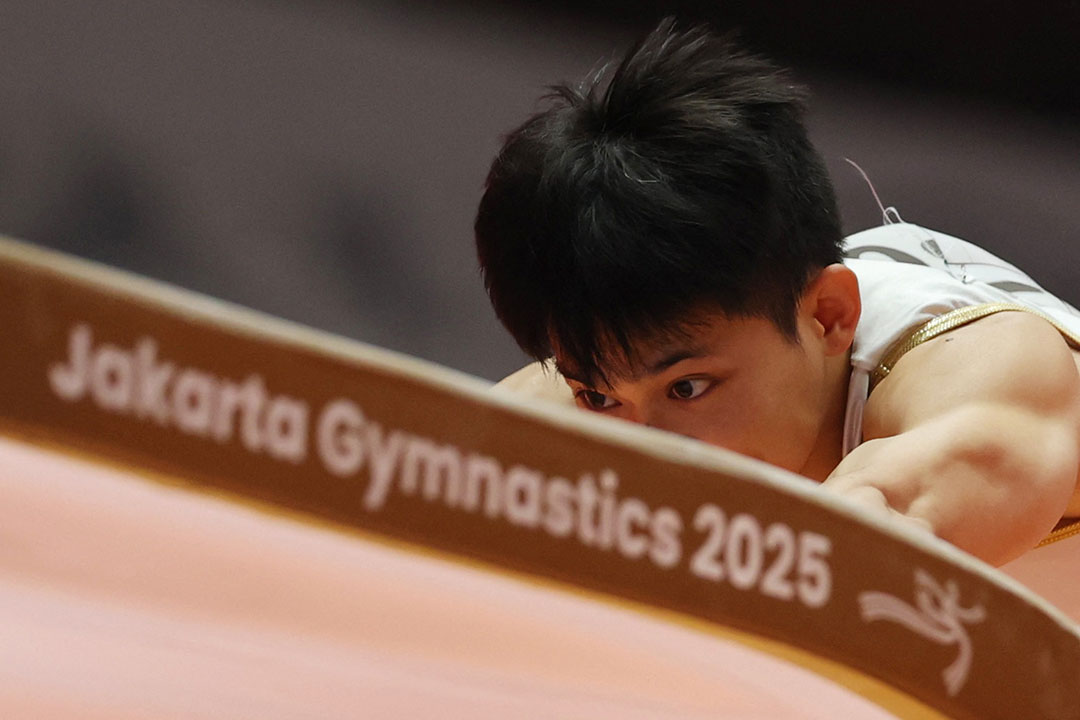
CARLOS YULO in vault actions — REUTERS/AJENG DINAR ULFIANA
1 of 2
CARLOS YULO in vault actions — REUTERS/AJENG DINAR ULFIANA
CARLOS YULO in floor exercise — REUTERS/AJENG DINAR ULFIANA
THE Philippines’ golden boy Carlos Yulo carries out the first part of his mission in the 53rd FIG Artistic Gymnastics World Championships as he vies for the floor exercise mint on Friday in Jakarta.
Mr. Yulo attempts to annex the world crown in floor after his dazzling double triumph at the Paris Olympics at 2 p.m. (3 p.m. Manila time), aiming to overcome wrist issues in battling a mix of old and new rivals.
British Jake Jarman, who captured the bronze in the 2024 Olympiad behind Mr. Yulo and Israel’s Artem Dolgopyat, looms as the main threat as he topped Sunday’s qualifications at 14.70 ahead of the Filipino star’s second-best 14.566.
Mr. Dolgopyat, the winner in the 2023 worlds, is unable to defend his title as host Indonesia denied him and other Israeli gymnasts entry visas due to Israel’s military offensive in Gaza.
Aside from Mr. Jarman, expected to challenge for top honors are Kazuki Minami of Japan and Milad Karimi of Kazakhstan, who pocketed the silver and bronze, respectively, two years ago in the Antwerp edition of the global meet, where Mr. Yulo finished fourth.
Luke Whitehouse of Britain, a finalist in Paris, is likewise making a serious bid as do Kameron Nelson of the US, Krisztofer Meszaros of Hungary and Tikumporn Surintornta of Thailand.
Mr. Yulo, who ruled the vault competition of the last Olympiad side by side with the floor event, is gunning for the vault gold as well in the Indonesian capital. He ranked first in the qualifying with 14.750 ahead of Saturday’s finale.
“The results of Carlos (Yulo) in both the men’s floor exercise and vault events during the qualifying round were pretty encouraging so we hope and pray he can match his golden double in the Paris Olympics,” said gymnastics chief Cynthia Carrion. — Olmin Leyba
THE Philippine men’s softball team will train in Ishikawa, Japan for two weeks as it embarks on a mission to reclaim the Southeast Asian Games (SEAG) gold medal it lost when the country hosted the biennial event six years ago in Clark, Pampanga.
There, Amateur Softball Association of the Philippines Chief Jean Henri Lhuillier said the Blu Boys would play a series of tune up games as part of their preparation for the Thailand SEA Games set Dec. 9 to 20 in Thanyaburi, Pathum Thani.
Teams that the country will face there are from Japan, Hong Kong and Singapore, which stole the gold from the Filipinos the last time the sport was held in the SEA Games in Clark.
“This Japan training camp is a vital step in strengthening the RP Blu Boys’ skills and teamwork as they prepare to represent the country in the SEA Games,” said Lhuillier. “Playing against world-class teams will not only boost their confidence but also refine their strategies for regional competition.”
The Blu Girls are also in the heat of their preparation as they try to extend their reign in Thanyaburi. — Joey Villar
Kevin Durant has always been at war with circumstance. His uniforms have changed, but the consistency of his stat lines comes with a familiar undercurrent: The quest for control in a league that treats it like currency. Taken in this context, his move to the Rockets is more reflective of reclamation than of relocation. And, yes, he appears to have latched on to a situation where he can finally be at peace with the terms.
Think about it. The Warriors gave him titles but little contentment. The Suns promised partnership but provided prostration. So, in retrospect, when he spoke of the need to “wash my hands” of both, it was laced not with bitterness but fatigue; for all intents, he sought to get away from systems he believed did not accord him respect. The irony, of course, is that his very quest for autonomy often isolated him; the brilliance that made him a singular force also hindered his assimilation.
In any case, the Rockets seem to have caught him at the right time. They may be laced with youth, but, under head coach Ime Udoka, they’re likewise disciplined. Which means they want him to set a standard, not be a savior. His return to Texas, where he first tested his gifts as a Longhorn, thus gives the latest chapter of his career no small measure of symmetry. Ambition continues to meet form, but his pursuit of success is now narrower and less forgiving given his losing battle with Father Time.
Significantly, his debut with the Rockets left much to be desired: a double-overtime loss off a handful of critical blunders. That said, the fact that they came close to prevailing against the vaunted Thunder cannot but be viewed as a positive. There are 81 more games to negotiate in the regular season, during which they fully expect to be much, much better. And, throughout the journey, he envisions being the anchor and not necessarily the face. Presence, and not profile, is what matters for all to be right in his world.
Anthony L. Cuaycong has been writing Courtside since BusinessWorld introduced a Sports section in 1994. He is a consultant on strategic planning, operations and human resources management, corporate communications, and business development.
President Donald Trump addresses the 80th United Nations General Assembly at UN headquarters in New York City, Sept. 23, 2025. REUTERS/MIKE SEGAR TPX IMAGES OF THE DAY
MOSCOW/KYIV/WASHINGTON — The United States hit Russia’s major oil companies with sanctions on Wednesday and accused the Russians of a lack of commitment toward ending the war in Ukraine, as Moscow conducted a major training exercise involving nuclear arms.
The new sanctions were unveiled one day after plans for a summit between US President Donald J. Trump and Russian President Vladimir Putin fell apart. Mr. Trump told reporters he cancelled the meeting because “it didn’t feel right to me.”
The US Treasury Department said Russia’s two largest oil companies, Rosneft and Lukoil, were targeted in a bid to damage Moscow’s ability to fund its war machine.
The move marked a sharp turnaround for the White House, which has veered between pressuring Moscow and taking a more conciliatory approach aimed at securing peace in Ukraine. Only last week Mr. Trump appeared ready to hold off on new actions targeting Moscow.
“Now is the time to stop the killing and for an immediate ceasefire,” US Treasury Secretary Scott Bessent said. Oil prices extended gains after Mr. Bessent’s comments, rising by more than $2 a barrel.
For months, Mr. Trump has resisted pressure from US lawmakers to impose energy sanctions, hoping that Mr. Putin would agree to end the fighting. But with no end in sight, he said he felt it was time.
Mr. Trump said he was still not ready to provide Ukraine with long-range Tomahawk missiles, which Kyiv has requested. Talking to reporters as he met North Atlantic Treaty Organization (NATO) Secretary General Mark Rutte, Mr. Trump said it would take the Ukrainians at least six months to learn how to use them.
Ahead of a meeting next week with Chinese President Xi Jinping in South Korea, Mr. Trump said he would like to see Mr. Xi use his influence on Mr. Putin to halt the fighting. Mr. Xi and Mr. Putin have formed a strategic alliance between their countries.
In a fresh show of force, the Kremlin released a video showing General Valery Gerasimov, head of the General Staff, reporting to Mr. Putin on the drills. Russia said it fired missiles from ground launchers, submarines and aircraft, including intercontinental ballistic weapons capable of striking the United States.
Russia’s Defense Ministry said its long-range Tu-22M3 strategic bombers flew over the Baltic Sea, escorted at various points by fighter jets from foreign — presumably NATO — states.
At key moments in the war in Ukraine, Mr. Putin has issued reminders of Russia’s nuclear might as a warning to Kyiv and its Western allies. NATO has also been conducting nuclear deterrence exercises this month.
European Union (EU) countries also approved a 19th package of sanctions against Russia for its war against Ukraine, which includes a ban on Russian liquefied natural gas imports, the Danish rotating presidency of the EU said on Wednesday.
The Wall Street Journal said the United States lifted a restriction on Ukraine’s use of some long-range missiles provided by Western allies, which would allow Ukraine to increase attacks on targets inside Russia. In a social media post, Mr. Trump denied the report.
On Wednesday, Sweden said it had signed a letter of intent to export Gripen fighter jets to Ukraine, as European governments act to boost Kyiv’s defenses in a war that has ground on for three years and eight months since Russia’s full-scale invasion, and shows no sign of ending soon.
Ukrainian pilots have been in Sweden to test the Gripen, a rugged and relatively low-cost option compared to aircraft such as the US F-35.
Kyiv aimed to receive and start using Gripens next year and expected to acquire at least 100, President Volodymyr Zelensky said during a visit to Swedish defense manufacturer Saab.
TRUMP DOESN’T WANT WASTED MEETING Russia and Ukraine pounded each other with heavy overnight missile attacks as renewed uncertainty enveloped the US-led peace effort.
After months of stalled diplomacy, Mr. Putin and Mr. Trump spoke last week and unexpectedly announced they would hold a summit in Hungary soon.
But following a phone call on Monday between the two countries’ top diplomats, the White House said the next day that Mr. Trump had no plans to meet Mr. Putin “in the immediate future.” Mr. Trump said he did not want to have a wasted meeting — something the Kremlin said Mr. Putin also wanted to avoid.
US Secretary of State Marco Rubio, departing Washington for the Middle East on Wednesday, told reporters the United States would still like to meet with Russia.
Russian officials said that preparations continued for a summit. “The dates haven’t been set yet, but thorough preparation is needed before then, and that takes time,” Kremlin spokesperson Dmitry Peskov told reporters.
The summit delay came after Russia reiterated to the US its previous terms for reaching a peace deal, including that Ukraine cede control of the whole of the southeastern Donbas region, three sources told Reuters.
That amounted to a rejection of Mr. Trump’s statement last week that both sides should stop at the current front lines.
Russian Deputy Foreign Minister Sergei Ryabkov was quoted by state news agency RIA as saying he could not confirm that Moscow had conveyed its position as reported by Reuters.
SHARES IN EUROPEAN DEFENSE COMPANIES RISE Through the first nine months of his second term, Mr. Trump has pressed for an end to the conflict, the deadliest in Europe since World War II.
Sharply critical at times of Mr. Zelensky, he has also expressed frustration with Mr. Putin.
European defense shares rose on the delay to the Putin-Trump summit. Most European governments strongly back Kyiv and have pledged to raise military spending to help Ukraine meet its defense needs.
European Union leaders are due on Thursday to discuss a proposal to use frozen Russian assets to extend a $163-billion loan to Ukraine. Moscow says the scheme amounts to theft and has vowed to retaliate. — Reuters
A SWEDISH FLAG hangs outside a store on a busy street in Stockholm, Sweden, July 14, 2023. — REUTERS
STOCKHOLM — When Sweden’s then-Finance Minister Goran Persson dashed to New York during the country’s early 1990s financial crisis to plead with Wall Street investors to keep buying its debt, he stayed in a budget hotel infested with cockroaches.
That reflected the Finance Ministry’s strict “absolutely no extravagance” policy, Mr. Persson, who later became prime minister, wrote in his 1997 book Those Who Are in Debt Are Not Free.
Penny-pinching on ministerial travel was one small part of a decades-long austerity drive, which has created fiscal leeway much of the belt-tightening Europe is lacking, allowing Sweden this year to pledge billions for defense, energy and tax cuts in its largest public spending package in decades.
The lessons for other countries, especially France, deep in its own budget crisis, are simple, if not easy:
First, things may need to get really bad before politicians are ready to act.
Secondly, buy-in from voters, unions and opposition parties is crucial for long-term success.
Finally, a strong global economy and a slice of luck on timing really help.
LIVING BEYOND THEIR MEANS After decades of living beyond its means, Sweden’s debt had by 1994 roughly doubled to around 80% of gross domestic product (GDP) from 44% in 1990. At worst, the budget deficit hit 12%, and investor confidence collapsed, and the Riksbank briefly hiked interest rates to 500%.
The government responded with cuts in spending on welfare, defense and education worth 8% of GDP. The economy shrank more than 1% three years in a row, unemployment soared and bank credit losses piled up in Sweden’s worst downturn since the 1930s Great Depression.
“We had a banking crisis, a foreign exchange crisis and a debt crisis,” said Stefan Ingves, a former central bank governor who oversaw the cleanup of Sweden’s “bad banks” after the crash.
“In some sense, we were at the end of the road,” he told Reuters.
The government set a spending ceiling and budgeted for surpluses over the economic cycle. Pensions were reformed to encourage private savings and deepen capital markets, while labor unions and employers agreed to limit wage growth.
Gradually those reforms, helped by the fact that a weakened currency was boosting exports, started to work: the economy grew 4.1% in 1994, and debt fell below 50% of GDP within a decade.
“In an open economy, structural change pays,” Mr. Ingves said.
Among the most critical changes was a shift to a pension system where payments are adjusted for market returns and life expectancy, easing the pressure on the budget from the aging population and passing the shortfall risk onto individuals.
France, where the retirement age remains a hot-button issue, spends just over 13% of its GDP on pensions compared with 10.7% in Sweden, according to Eurostat data, and the gap gets bigger when healthcare and other social benefits are included.
NO FREE LUNCH To be sure, it came at a price: thousands of public employees lost their jobs, and Sweden was left with a legacy of underinvestment in infrastructure, from energy and transport networks to hospital beds.
But painful memories of the crisis have ensured there has been no backsliding.
“Government after government has held the line,” Finance Minister Elisabeth Svantesson told Reuters. “There is a consensus, which is a strength for Sweden.”
Decades of frugality are now paying dividends.
With public debt now at just over a third of GDP, Sweden was able to hike defense spending to 3.5% of GDP, pump up to 440 billion crowns ($46.73 billion) into nuclear power expansion and provide 105 billion crowns to support Ukraine.
At the same time, the government cut income taxes and VAT on food and raised spending on job measures and yet its borrowing costs remain lower than Germany’s SE10YT=RR.
Unlike many other developed nations, Sweden also managed to ride out the financial crisis of 2008-2009 and the COVID pandemic without piling on much new debt.
Replicating Sweden’s path, however, will be hard for France and other euro zone countries faced with rising debt. ($1 = 9.4155 Swedish crowns).
Sweden’s exporters operated in a buoyant 1990s world economy fueled by an IT boom and rapid globalization — a far cry from the protectionist tilt seen from Washington to Beijing now.
“Sweden was not okay, but the rest of the world was reasonably okay,” noted Mr. Ingves.
Moreover, since the 1990s the political landscape has become more fragmented with the rise of far-right parties across Europe — including in Sweden — making it much harder to build consensus on unpopular measures, such as tax hikes or welfare cuts.
Ultimately, some argue, France has not yet reached a tipping point like Sweden did in the 1990s and Ireland, Portugal, Italy and Greece two decades later during the euro zone sovereign debt crisis, which forced them to repair their public finances.
Despite all its woes, France still has access to borrowing at a reasonably affordable 3.35% FR10YT=RR, allowing it to muddle through.
“Things will need to get a lot worse before France is forced to confront its fiscal problems in the same way other European countries have,” said Adrian Prettejohn, European economist at Capital Economics. ($1 = 9.4155 Swedish crowns). — Reuters
PEOPLE AND CARS can be seen passing Taipei 101 in Taipei, Taiwan, April 17, 2025. — REUTERS/ANN WANG
TAIPEI — Taiwan is warily watching whether China could seek to try and exert economic control over sensitive frontline Taiwanese islands in a key development plan being discussed in Beijing this week, officials familiar with the matter said.
China’s ruling Communist Party, at its closed-door meeting ending on Thursday known as a plenum, is going to discuss, among other things, the country’s 15th five-year development plan, which will formally begin next year and be unveiled in detail at March’s annual meeting of parliament.
Two officials briefed on the matter told Reuters that Taiwan is paying particular attention to whether the new five-year plan makes any mention of deepening economic integration with the Taiwan-controlled Kinmen islands that sit just off China’s coast.
China has long taken a carrot and stick approach to Kinmen, threatening it with frequent coast guard incursions into its waters while dangling perks from gas and electricity supply to bring the islands of 140,000 closer to China.
For policy makers in Taipei, Kinmen’s proximity to China makes it extra vulnerable to Beijing’s economic and political clout, especially when many residents there have close family and business ties with China, whose Xiamen city is a short boat ride away for work or shopping.
Kinmen also gets regular water supply from China, a deal secured under the previous government led by the Kuomintang party which favors close relations with Beijing.
China, which has not ruled out using force to seize democratically governed Taiwan, could seek to gain de facto jurisdiction over Kinmen if it includes it in its economic development plan, a move that would further escalate Taipei-Beijing tensions, the officials told Reuters.
“Cross-strait relations could shift from past sovereignty disputes to a contest over jurisdiction,” said one of the sources, a senior Taiwan official briefed on the matter, speaking on condition of anonymity given the sensitivity of discussing security assessments.
A second source, an official in the region looking into the issue, said with a new economic blueprint China could try to exert “de facto administrative power” over Kinmen and push for its unification agenda.
Taiwan’s Mainland Affairs Council said it would not comment on the story before any Chinese policy details from the plenum are released later this week. China’s Taiwan Affairs Office did not respond to a request for comment.
Jessica Chen, Kinmen’s Kuomintang member of parliament, told Reuters that China indeed wanted closer economic integration for Kinmen, but that sovereignty could not be compromised.
“Kinmen is the territory of the Republic of China. Its jurisdiction belongs to the Republic of China — this is beyond doubt,” she added, referring to Taiwan’s formal name.
Five-year plans have previously mentioned Taiwan in a vague way, though in 2016 the 13th five-year plan proposed a tunnel to the island and opening of a high-speed rail line. Taiwan rejected that idea.
‘NEXT CRIMEA’ China’s still-in-construction bridge to Kinmen is a major concern for Taiwan, a project Taipei has not approved, as is the new Xiamen airport slated to open next year and which is only around 3 km (1.9 miles) at its closest point from Kinmen, the officials said.
Taiwan officials worry greater integration could chip away at Taiwanese sovereignty. China says Taiwan is not a country, only a Chinese province, and that it has no sovereignty.
“What if they try to press ahead with the bridge, which carries national security concerns for us?” The Taiwan official said, adding such a proposal could also sow division between local residents and central government as well as the military.
“If they dare to invade (Kinmen), we will become the next Crimea,” the official said, referring to Russia’s annexation of Crimea in 2014 after people there voted in a disputed referendum to become part of Russia.
To be sure, there are differences with Crimea, where many people identify as Russian, not Ukrainian, whereas in Kinmen most people identify as being Chinese, albeit from the Republic of China.
Xiamen’s new airport is so close to Kinmen it could pose an aviation safety risk, and China has not reached out to discuss the issue, the official said.
China last year opened a new air route from Xiamen which Taiwan said was done without consultation and brought aircraft too close to Kinmen airspace, posing aviation and security concerns.
The new airport could offer another way for China to further jurisdiction claims over Kinmen, the official added.
“Mutual development is not a bad thing,” the Taiwan official said. “But if this is for the purpose of annexation, that’s a problem.” — Reuters
SYDNEY — A bill to restrict social media for children under 16 will be introduced in the New Zealand parliament, officials said on Thursday, building momentum for parliament’s efforts to prevent young people from being harmed while online.
The proposed legislation will require social media platforms to conduct an age verification process, similar to Australia’s world-first teen social media ban law passed in 2024.
A member’s bill submitted in May by ruling National Party lawmaker Catherine Wedd to restrict children using social media was selected on Thursday to be introduced in the parliament.
The bill has received support from National Party members, but its coalition partners have not confirmed whether they will support the bill.
Members’ bills can be introduced by any lawmaker not in the cabinet and are selected after a ceremonial lottery.
It is not immediately clear when the bill will be introduced in parliament.
A New Zealand parliamentary committee has been looking at the impact of social media harm on young people and the roles that government, business, and society should play in addressing those harms. A report is due in early 2026, according to a statement from the committee last week.
Prime Minister Christopher Luxon has been raising concerns about harms to mental health from the overuse of social media among young teens, including misinformation, bullying and harmful depictions of body image.
Civil-liberties organization PILLAR said the bill would not protect children online and instead would create serious privacy risks and restrict online freedom for New Zealanders.
“Aligning with international efforts may sound responsible, but it is lazy policymaking,” PILLAR Executive Director Nathan Seiuli said in a statement. — Reuters
Standard Chartered Bank reinforces partnership with SMC Group as it facilitates BankCom’s P18-B bond
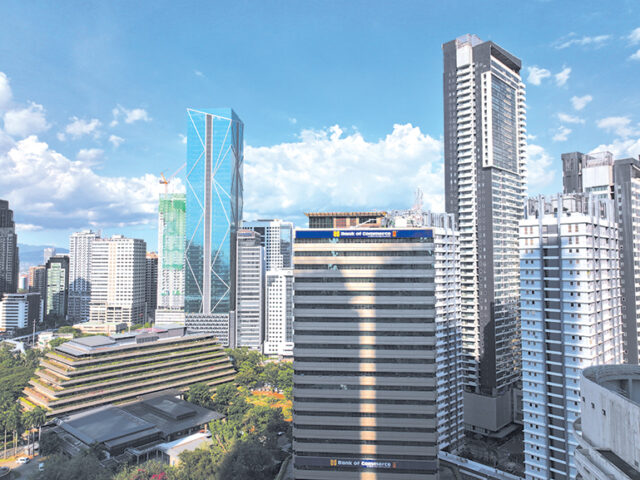
In February this year, Bank of Commerce (BankCom) listed its largest bond nearly four times its original target at P18 billion. An affiliate of the San Miguel Corporation (SMC) since 2008, BankCom has since reported a strong first-half performance, driven by its core business growth, strategic tech investments and expanding digital offerings.
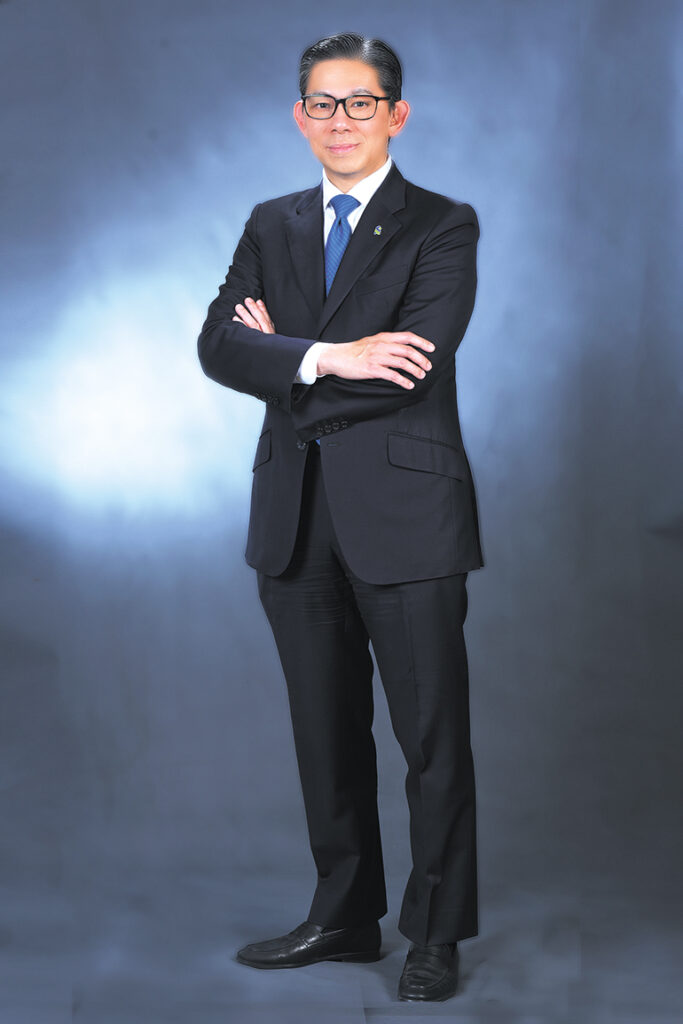
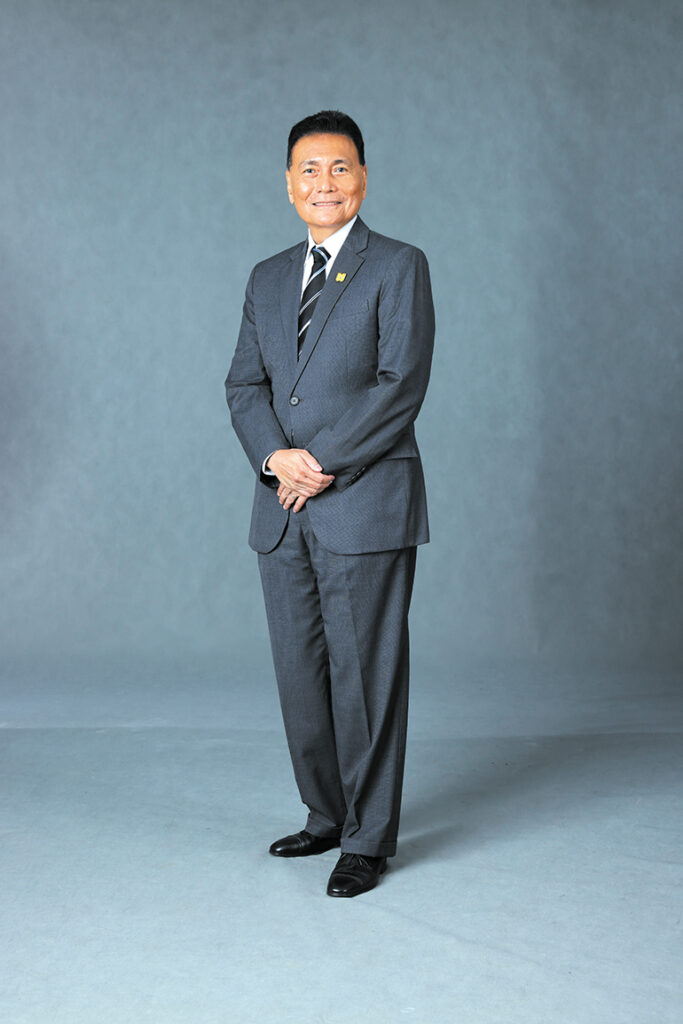
“The successful bond issuance marks a pivotal milestone for the bank. This milestone is not just a financial achievement, but more importantly, it is the catalyst that launches our trajectory of future growth in focal areas, which our clients deem to matter most to achieving their success,” BankCom President and CEO (PCEO) Michelangelo R. Aguilar said in an interview with BusinessWorld.
Mr Aguilar noted that the bond issuance is an asset-liability exercise to match and manage long-term assets (i.e., consisting of term loans, mortgages, and auto loans) with long-term funds. While that may sound like the company’s fiduciary duty from the get-go, he said nothing about the transaction can be called routine.
“Given its size, which was achieved within the shortest selling period in our bond history, this issuance validates the strong vote of confidence from investors in BankCom’s financial strength, strategic direction, astute management, and future prospects,” Mr Aguilar said.
To facilitate the bond listing, Standard Chartered acted as Joint Lead Arranger, Joint Bookrunner, and Selling Agent for BankCom’s P18 billion dual-tranche 2-year and 5.25-year fixed-rate bonds.
“Standard Chartered assisted BankCom in being deal-ready to quickly seize conducive market conditions. BankCom’s offering is also the first public bond issuance in 2025, and they were able to reap the benefits of it, drawing on the robust onshore liquidity and demand for high-yielding investments,” Standard Chartered Bank Philippines CEO Mike Samson said in a separate interview.
Mike Samson, Standard Chartered Bank Philippines CEO
Mr Samson added that the transaction was structured as a dual-tranche offering, with BankCom issuing a 5.25-year tranche, to align with investor tenor preferences and take advantage of the regulatory landscape then that allowed for tax incentives to eligible Filipino individuals who hold long-term bank bonds. He said strong demand allowed BankCom to raise a record P18 billion, 3.6 times oversubscribed, while meeting its sizing and pricing goals and securing its tightest spreads to date.
Building on a trusted partnership, Mr Aguilar emphasised BankCom’s familiarity with Standard Chartered, which previously served as Sole Bookrunner and Joint Lead Arranger for its maiden P5.03 billion Long-Term Negotiable Certificates of Time Deposit (LTNCTDs) in March 2020, a deal completed despite the onset of the pandemic, and which once again played a key role in ensuring the smooth and successful execution of this latest bond offering.
“Standard Chartered’s global expertise, strong local presence, and deep understanding of fixed-income markets made them ideal partners for a successful transaction. The collaboration ensured a smooth and efficient execution of the bond offering,” he added.
Building growth backed by strengths
The issuance shows investor confidence in BankCom’s financial strength and strategy, while also positioning the bank to use the proceeds on growth initiatives.
“The proceeds from the largest bond issuance with the shortest selling period ever in BankCom history provides us a solid foundation for accelerated growth as it allows us to significantly bolster our ability to extend credit and expand our market share within the SMC ecosystem,” Mr Aguilar said.
Michelangelo R. Aguilar, Bank of Commerce President and CEO
According to BankCom’s PCEO, the capital gained from the listing will scale the bank’s lending capacity through more competitive and accessible financing solutions offered to a wider range of clients. The listing is also expected to deepen the company’s relationship with the San Miguel Group, of which it has accessed 40% and continues to penetrate for deposit, cash management, or financing solutions.
“Our growth strategy significantly emphasises nurturing the San Miguel Group, comprised of its business units, subsidiaries, and affiliates. We recognise that SMC is one of the largest and most diversified conglomerates in the Philippines by revenues and total assets,” Mr Aguilar expounded.
As the main cash management bank of SMC, BankCom holds the operating account of SMC, making it a natural fit to do the same for the 4,000 small and medium enterprises, mid-sized suppliers, and distributors within the SMC ecosystem. This relationship allows BankCom to extend tailored loan and financing solutions, provide quicker access to capital, deliver financial literacy programmes, foster stronger client partnerships through dedicated relationship managers, and enhance services with innovative digital and technological tools.
“BankCom believes that supporting the broader population of local partners, suppliers and entrepreneurs is crucial for long-term success and sustainable growth through strengthening the value chain; supporting economic development and social impact through job creation; diversification and reduced risk by not only relying on a single client; and enhanced reputation and brand loyalty through its commitment to the wider community which leads to attracting new clients and talent,” Mr Aguilar said.
This landmark transaction strengthened BankCom’s ties within the San Miguel Group while also reinforcing Standard Chartered’s long-standing partnership with SMC.
“Standard Chartered has been a strong and long-time partner of San Miguel Corp. in its financing initiatives and as advisor for its various projects. This issuance further strengthened our relationship with the San Miguel Group, effectively supporting BankCom’s aspiration to be the Best Conglomerate Bank in the Philippines,” Mr Samson commented.
Improved performance
The strong capital raised from the listing has already translated into improved financial performance, with BankCom reporting robust earnings growth in the first half of the year. Compared to P1.42 billion in the first half of 2024, the bank posted an unaudited net income of P1.86 billion in 2025, a 31% surge. Similarly, net interest income reached P5.15 billion, 14% higher than P4.53 billion in the same period last year, while non-interest income at P912.52 million, P214.15 million higher than P698.37 million in the prior year.
“The robust performance was underpinned by sustained growth across core revenue streams, driven by net interest income, gains from trading securities, and foreign exchange transactions. Furthermore, the bank’s strategy of improving its revenue streams and prudent spending resulted in a lower cost-to-income ratio of 59%,” Mr Aguilar said.
BankCom has also undergone digital transformation through its partnership with Infosys Finacle to modernise and replace legacy core banking systems with a customer-focused infrastructure. Alongside this, the bank has introduced cash kiosks, upgraded its ATM network, and launched the Personal Online Banking QRPH, bringing its total network to 272 machines as of June. Complementing this digital push, BankCom is also innovating its physical presence with “Branch Lite Units” (BLUs), opening its first in Caticlan Airport and securing approvals for six locations with more expansions planned.
“These initiatives are part of BankCom’s IT investment programme and branch banking strategy, designed to provide customers with a secure and efficient banking experience, enabling them to manage their finances anytime and anywhere,” Mr Aguilar concluded.
Spotlight is BusinessWorld’s sponsored section that allows advertisers to amplify their brand and connect with BusinessWorld’s audience by publishing their stories on the BusinessWorld Web site. For more information, send an email to online@bworldonline.com.
Join us on Viber at https://bit.ly/3hv6bLA to get more updates and subscribe to BusinessWorld’s titles and get exclusive content through www.bworld-x.com.
Do artificial intelligence recommendation systems reflect Filipino consumer preferences, or are they actively shaping them? Sara Jane S. Cruz, growth and partnership manager for Southeast Asia at Technedify, an edtech platform, weighs in.