Home Blog Page 7952

Design bids solicited for PNR Bicol project

PHILSTAR

THE Transportation department has started seeking bidders for the detailed design and construction contract of the China-funded Philippine National Railways (PNR) South Long Haul Project (Banlic to Daraga package).

“The Department of Transportation of the Republic of the Philippines intends to apply a loan to People’s Republic of China amounting to P142.481 billion being the approved budget of the contract to payments under the design and build contract for PNR South Long Haul Project (Package 1, Banlic to Daraga),” the department said in its invitation to bid.

“Bidders shortlisted by the government of the People’s Republic of China may obtain further information from the Department of Transportation,” it added.

The P175-billion PNR South Long Haul Project, also known as PNR Bicol, is a 639-kilometer railway system connecting  Manila to Legazpi, Matnog, Sorsogon, and Batangas City. 

The Transportation department said shortlisted bidders may obtain a complete set of bid documents on June 4 upon payment of the applicable fees.

A pre-bid conference will be conducted on June 11.

The Bids and Awards Committee Secretariat will accept bids on or before 10 a.m., June 25, 2021, at its office in Paco, Manila. 

Bid opening will be conducted immediately after the deadline for submission of bids lapses.

The bidding format was described as “limited competitive bidding” using non-discretionary “pass/fail” criterion.

“Only those bids that passed the technical proposals criteria will be subjected to the second step of evaluation or the opening of financial proposals,” it said.

The department requires completion of the works within 36 months. 

Bidders should have completed a contract similar to the project within the last 20 years.

The department, according to its website, expects partial operations in the second quarter of 2022, while full operability is expected in 2025.

The project, once completed, will support economic growth and benefit 100,000 passengers per day, the department said.

“It will cut travel time from Manila to Bicol from 12 hours via car to just six hours,” it added. — Arjay L. Balinbin

Customs orders inspections for goods movements in New Clark City 

THE Bureau of Customs (BoC) ordered the goods of registered locators in New Clark City undergo inspection, and required shippers to coordinate movements with the bureau and obtain transit permits. 

Joint Memorandum Order (JMO) 01-2021 issued by the BoC and Bases Conversion and Development Authority (BCDA) on June 10 laid down guidelines and safeguard measures covering the movement of goods by locators in New Clark City. 

Since the New Clark City is newly established, the BoC had to issue new rules covering the movement of goods in the zone since this was not covered by the guidelines for Clark Freeport and Special Economic Zone, Customs Assistant Commissioner Vincent Philip C. Maronilla said by phone Thursday. 

“Because they are going to operate, build structures and there’s business activity already, we needed to issue a JMO on all Customs practices with the BCDA, (similar to our processes in) other freeport areas as well,” he said. 

Mr. Maronilla said the bureau regularly issues these orders for new economic zones to formally establish its audit powers over locators and ensure that Customs laws are observed. 

“A lot of locators are looking for a definite rule on how to go about their import business with New Clark City,” he added. 

Under JMO 01-2021, duties and taxes will not be collected from goods going into the New Clark City, but Customs is requiring prior coordination by locators with the bureau when they are shipping goods. 

There should also be a dedicated loading and unloading bays in secure areas, monitored by closed circuit television (CCTV). 

Imported items require goods declarations for admission. This, along with other requirements, should be electronically lodged with the agency and the New Clark City, according to the JMO. 

In moving goods within the city, the estate manager has the authority to monitor their status and report to the BoC accordingly. 

Transferring goods from the New Clark city to another free zone requires a transit permit, while those coming from a different customs territory will be subject to “non-intrusive inspection” at the Customs clearance area. 

“In cases where the image analysis inspectors determine that further physical examination shall be conducted, the physical examination shall likewise be conducted at the Customs clearance area,” according to the JMO. 

For consumption goods such as agricultural products, physical examinations can be done at the locator’s site to prevent possible damage or deterioration of goods. 

Locators also have to keep three years worth of records of all their activities, including the goods they imported, since Customs has the power to conduct post-clearance audits. 

“Failure to keep the required records shall constitute a waiver of the right to contest the results of the audit based on records kept by the bureau,” it said. — Beatrice M. Laforga 

1M more Chinese vaccines arrive

PHOTO COURTESY OF NATIONAL TASK FORCE AGAINST COVID-19

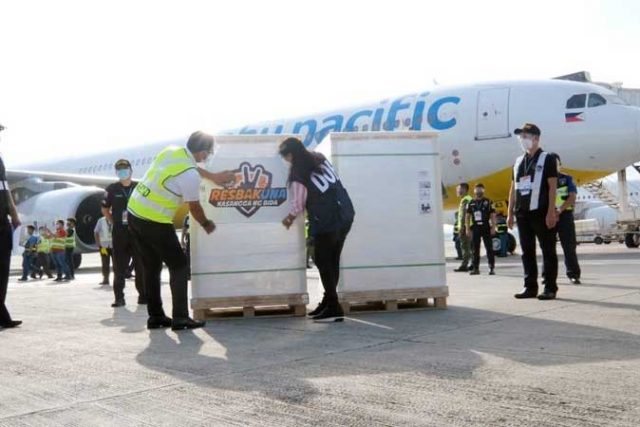
THE PHILIPPINES on Thursday took delivery of a million more doses of CoronaVac from China — the biggest single-day delivery so far — as the government expands its vaccination drive against the coronavirus, according to the presidential palace.

The government paid for the vaccines from Sinovac Biotech Ltd., presidential spokesman Herminio L. Roque, Jr. told a televised news briefing.

About 2.2 million doses of the vaccine made by Pfizer, Inc. under a global initiative for equal access were also set to arrive on Thursday night.

The second shipment of Pfizer vaccines would be used for health frontliners, senior citizens and seriously ill people, according to a report by the state news agency.

The government is also set to take delivery of 1.5 million more doses of CoronaVac on June 17, it said, citing vaccine czar Carlito G. Galvez, Jr.

Mr. Galvez earlier said the country would take delivery of as many as 40 million vaccine shots from June to August.

The Philippines, which started its vaccination drive on March 1, seeks to inoculate as many as 70 million Filipinos this year to achieve herd immunity.

The Department of Health (DoH) reported 7,485 coronavirus infections on Thursday, bringing the total to 1.3 million.

The death toll rose by 122 to 22,312, while recoveries increased by 4,504 to 1.21 million, it said in a bulletin.

There were 56,921 active cases, 1.3% of which were critical, 92.6% were mild, 3.2% did not show symptoms, 1.7% were severe and 1.18% were moderate.

The agency said 15 duplicates had been removed from the tally, 12 of which were tagged as recoveries. Sixty-five recoveries were reclassified as deaths. Four laboratories failed to submit data on June 8.

About 13 million Filipinos have been tested for the coronavirus as of June 8, according to DoH’s tracker website.

The coronavirus has sickened about 175.2 million and killed 3.8 million people worldwide, according to the Worldometers website, citing various sources including data from the World Health Organization.

About 158.7 million people have recovered, it said.

Meanwhile, Mr. Roque said about 58% of intensive care unit (ICU) beds in the country have been used.

About 49% of isolation beds and 49% of ward beds had been occupied as of Wednesday. About 38% of ventilators nationwide have been used.

Mr. Roque said about 53% of ICU beds and 39% of isolation beds in the capital region have been occupied. About 37% of ward beds and 35% of ventilators have been used.

The government placed Metro Manila and nearby provinces under a strict lockdown from March to mid-May after a fresh surge in coronavirus infections. The restrictions have since been eased.

Philippine authorities earlier said the southern and central parts of the Philippines were experiencing a surge in infections.

The Philippines started immunizing its labor force against the coronavirus on Monday as government seeks to further reopen its economy after imposing one of the strictest and longest lockdowns in the world.

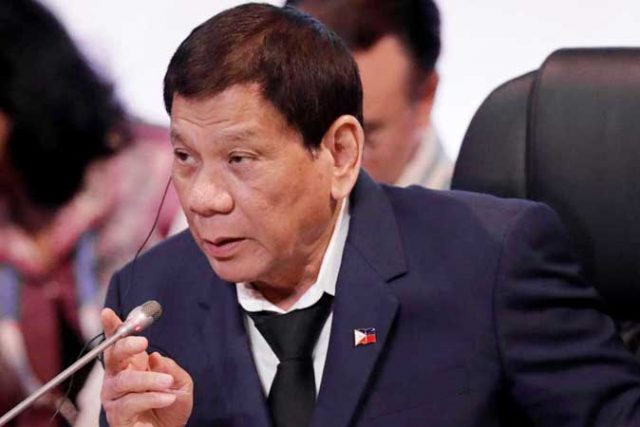
President Rodrigo R. Duterte said the vaccination of essential workers in the private and public sectors was a “major milestone” in the fight against the pandemic.

The inoculation of private workers, government employees, and informal sectors workers is being carried out first in Metro Manila and other key economic hubs due to limited supply.

The Philippines aims to inoculate at least 500,000 people daily in Metro Manila, Rizal, Bulacan, Cavite, Laguna, Metro Cebu, and Metro Davao to achieve herd immunity by Nov. 27. — Kyle Aristophere T. Atienza and Vann Marlo M. Villegas

NEDA wants pilot for face-to-face classes to start this August

BW FILE PHOTO

THE NATIONAL Economic and Development Authority (NEDA) wants the government to pilot face-to-face classes in August to help the economy recover from a coronavirus pandemic.

The government should also gradually relax quarantines to boost economic activities, NEDA Undersecretary Mercedita A. Sombilla told an online forum on Thursday.

“Containing the spread of the virus will enable us to shift to a modified general community quarantine, with lockdowns localized only to specific areas where needed,” she said.

President Rodrigo R. Duterte locked down the entire Luzon island in March last year, shutting schools and public transportation to contain the pandemic. The lockdown has since been eased but physical classes remain banned.

NEDA Secretary Karl Kendrick T. Chua early this month said face-to-face classes should be allowed again because remote learning has affected the quality of education. He had warned about the long-term impact of the pandemic on the economy.

Ms. Sombilla said they expect the economy to go back to pre-crisis levels by the middle of next year if lockdown restrictions are eased, more businesses are allowed to operate and more people get vaccinated.

Economic managers expect economic output to grow by 6-7% this year and by 7-9% in 2022.

Recovery programs such as the second stimulus package, enforcement of a law that lowered the corporate income tax and streamlined incentives and the passage of other key economic bills are crucial to growth, Ms. Sombilla said.

The Commission on Higher Education has allowed some universities and colleges to hold limited face-to-face classes in the second semester of the current school year for third and fourth year medical students.

Several lawmakers in March filed a resolution asking the government to begin the pilot tests for face-to-face classes in 1,065 schools in areas with a low infection rate. — Beatrice M. Laforga

‘Sara for President’ movement endorsed by palace spokesman

Davao Mayor Sara Duterte-Carpio

PRESIDENT Rodrigo R. Duterte’s spokesman on Thursday endorsed a movement seeking to persuade his daughter to run for President next year.

“I support the Run Sara Run movement,” presidential spokesman Herminio L. Roque, Jr. told a televised news briefing after attending a meeting of local officials in Bulacan where they urged Davao City Mayor Sara Duterte-Carpio to run.

“But I respect that the decision will have to be made by Mayor Sara herself.”

Mr. Roque, who earlier asked the opposition to stop politicking amid a coronavirus pandemic, added: “I’ve added my voice to the voices of many who believe that she should be the next president of the country.”

The Palace spokesman on Wednesday said he would only run for a national position next year if Ms. Carpio decides to run for President.

He also said he would support a possible bid by Senator Lawrence T. Go for the presidency, with Mr. Duterte as his running mate, if Ms. Carpio rejects the calls of her supporters.

Ms. Carpio is among those being considered by the President to become the ruling party’s standard bearer in the 2022 elections, Mr. Roque said last week.

Mr. Duterte on Tuesday night claimed to have discouraged his daughter from running for the post.

Also included on the list of Mr. Duterte’s presidential bets are former Senator Ferdinand R. Marcos, Jr., Manila Mayor Francisco M. Domagoso, Senators Christopher Lawrence T. Go and boxing champion Senator Emmanuel “Manny” D. Pacquiao, Mr. Roque said. — Kyle Aristophere T. Atienza

Duterte may prioritize law on baselines

REUTERS

THE PRESIDENTIAL Palace is reviewing a bill that seeks to change the Philippines’ 13-year old law on baselines so the country could better assert its rights in the South China Sea.

President Rodrigo R. Duterte might certify the measure as urgent and endorse it for congressional approval at his last state of the nation address (SONA) next month, his spokesman said on Thursday.

“It’s subjected now to complete staff work,” presidential spokesman Herminio L. Roque, Jr. told a televised news briefing. “I made the additional request that if the President so agrees, then it should also be included in the SONA so the message to Congress is loud and clear.”

Retired Supreme Court Justice Francis H. Jardeleza earlier asked the Executive branch to draft a measure on the country’s sea borders so it could better enforce a 2016 Hague ruling that invalidated China’s claim to more than 80% of the South China Sea.

Mr. Roque said the President was “very appreciative” of the suggestion.

The law declares the Philippines as an archipelagic state and uses the straight baseline method to set up sea boundaries with neighboring coastal states.

Mr. Roque has said the law, passed in 2009 to comply with the United Nations Convention on the Law of the Sea (UNCLOS), cut the area of the country’s territorial sea.

He added that UNCLOS had not been effective in deterring Chinese presence in the South China Sea because it only covers territorial waters, not islands. — Kyle Aristophere T. Atienza

Too much expected, too little given to local governments in waste management — PIDS study

DENR.GOV.PH

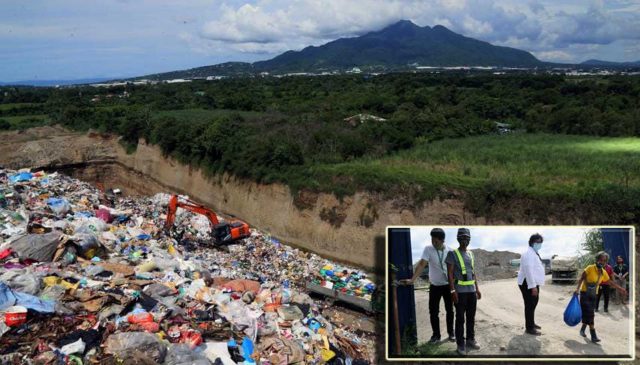
WASTE management has been simply dumped on the shoulders of local government units (LGUs) while they lack resources, resulting in the poor implementation of the Ecological Solid Waste Management Act of 2000, a Philippine Institute for Development Studies (PIDS) report said.

“Communities are passive. Barangays are heavily dependent on cities and municipal governments,” Sonny N. Domingo, one of the authors of the report, said at a webinar on Thursday.

“Barangays are also given so much in terms of mandate and responsibility, but they are the least empowered in terms of capacity and resource.”

The report undertaken with Arvie Joy A. Manejar looked into the implementation of Republic Act 9003 or the Ecological Solid Waste Management Act of 2000 through case studies.

“Among (the law’s) critical provisions were the formal devolution of waste management to local levels, the forced closure of illegal dumpsites and investment on facilities; and the reduction and proper treatment of solid wastes,” the report published in January said.

“The overly simplistic transfer of responsibility to LGUs have largely resulted to two decades of mediocre policy grounding.”

The report said that barangays would handle waste segregation and collection, while municipalities handled hazardous waste.

“It was apparent that although much responsibility was expected from the barangay level, limitations in resources made them dependent on municipal initiatives,” the report said.

“Funding for waste collection equipment, wages of personnel, and the establishment of MRFs (materials recovery facilities) most often came from the city/municipal governments.”

Various LGUs, particularly small towns, have in the past defended their non-compliance to the law due to financial as well as technical capacity limitations on setting up required waste management facilities such as sanitary landfill.

Mr. Domingo said that local government reliance on policy grounding should be revisited. “LGU full autonomy is not working,” he said.

The pandemic, he added, created new requirements for more worker safety protection and strict waste handling. — Jenina P. Ibañez

Senators want to give coconut farmers more time to register

PHILSTAR FILE PHOTO

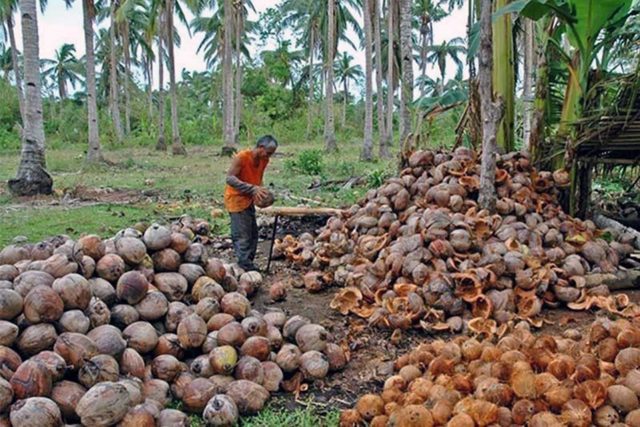
SENATORS want to extend the deadline for the registration of coconut farmers who will benefit from the trust fund law and allow continuing registration for those who will not meet the set date.

The Senate committee on agriculture on Thursday tackled the status of the Coconut Farmers Registry, which under Republic Act No. 11524 or the Coconut Farmers and Industry Trust Fund Act should be completed by the Philippine Coconut Authority (PCA) in 90 days or by June 11.

Senator Risa N. Hontiveros-Baraquel proposed an extension of another 90 days to Sept. 9.

Senator Cynthia A. Villar, chairperson of the committee on agriculture, recommended to altogether lift the deadline and make the registration for the coco levy funds “continuing.”

Registration has reached more than 50% of the around 3.5 million target, Ms. Villar said. “My suggestion is it is a continuing registry since we have achieved ‘yung (the) more than 50% then we can go ahead with our coco levy fund distribution,” she said in the hearing.

Senator Francis N. Pangilinan, meanwhile, suggested maintaining a deadline to compel coconut farmers to register, but would still have continuous registration for those who cannot meet it.

PCA Administrator Benjamin R. Madrigal, Jr. said a total of 2.8 million farmers have been registered as of June 8.

He said this is composed of around 2.5 million farmers on record from 2015 to 2018 and around 315,000 new registrants. About 14,000 of those in the list were undergoing validation.

President Rodrigo R. Duterte in February signed RA 11524 which allows coconut farmers to benefit from the taxes collected from them totaling about P76 billion during the Marcos administration. The law also sought to declare coconut levy assets as trust funds to modernize and rehabilitate the coconut industry. — Vann Marlo M. Villegas

Appeals court orders gov’t agencies to remove solon in narco-list 

PHILSTAR

THE COURT of Appeals (CA) has ordered government agencies to remove the name of Leyte Rep. Vicente S.E. Veloso in a so-called “narco list” that tags personalities allegedly involved in the illegal drug trade.

In a ruling dated June 8, the appellate court granted Mr. Veloso’s petition for a writ of habeas data.

The order also directs agencies to destroy all related documents, records, and information relating to the petitioner.

The court said it “carefully scrutinized the documents submitted by the respondents and found no basis to hold them and the information contained therein to be matters of national security.”

The respondents include the Philippine Drug Enforcement Agency (PDEA), Philippine National Police (PNP), Armed Forces of the Philippines (AFP), National Intelligence Coordinating Agency, and Department of the Interior and Local Government.

In addition, the court said “(t)he respondents failed to establish the presence of any such lawful defense that would bar the availment of the writ of habeas data.”

Presidential Spokesperson Herminio L. Roque Jr. said in a televised press briefing on Thursday that they leave the ruling “for the PNP to comply with because that is a lawful order from the Courts.”   

Police chief Guillermo T. Eleazar, meanwhile, said the PNP Directorate for Intelligence had previously informed the court that Mr. Veloso “is not a subject of any information report.”

“Thus, as far as the PNP is concerned, we are not affected by the CA order since we have no record on Veloso’s inclusion in the so-called ‘narco list’,” he said in a statement on Thursday.

Mr. Veloso, who filed the petition in March 2019, is the current House justice committee chair and a former CA justice.

He had denied any involvement in the narcotics trade and said the PDEA had cleared him of any drug links. — Bianca Angelica D. Añago

Supreme Court to set up ICT infra, beef up manpower to improve judicial system

BW FILE PHOTO

THE COUNTRY’S top magistrate has committed continued improvements in the judicial system, including the establishment of an information and communication technology infrastructure (ICT) “to improve case management and court administration,” according to the business sector-led Judicial Reform Initiative (JRI).

In a statement on Thursday, JRI said they met with Supreme Court Chief Justice Alexander G. Gesmundo on June 7, where they discussed programs for speeding up legal processes.

The court plans to create new positions such as Judicial Region Court Administrators and Trial Court Managers to complement the planned migration to a more digital system.

JRI also pushed for the implementation of mandated periods on the resolution of cases as provided under the Constitution. Article VIII, Section 15 of the Constitution states that “all cases or matters…must be decided or resolved within (24) months from date of submission for the (Supreme Court), and, unless reduced by the (Supreme Court), (12) months for all lower collegiate courts, and three months for all other lower courts.”

JRI said the Supreme Court also “plans to complete the revision and consolidation of the Rules of Court within a two-year time frame.”

JRI Chairperson Sherisa P. Nuesa and President Jose Jerome R. Pascual said these plans demonstrate “the serious commitment of the (Supreme Court) to improve court governance and speed up delivery of justice, which should contribute to a positive economic climate and the attainment of related United Nations Sustainable Development Goals.” — Bianca Angelica D. Añago

Cebu stands firm on shortened quarantine rules as it touts support from legislators, lawyers

PPP.GOV.PH

THE CEBU provincial government is standing firm on its local quarantine rules for returning overseas workers and other residents, which do not strictly follow protocols set by the national task force on coronavirus management.

Members of the provincial board asserted the validity of the local rules, initially contained in an executive order from the governor and later passed as an ordinance.

Board Member John Ismael B. Borgonia, in an interview with local media, said the national task force should file a legal complaint if it believes that local officials must be held liable for overstepping their authority.

The national government has ordered all international flights bound for Cebu to be diverted to Manila. It took effect May 29 and has been extended to June 12.

The Cebu board is set to hold a special meeting Friday to assert the legality of the local policy.

Meanwhile, the Integrated Bar of the Philippines’ Cebu chapter issued a resolution on June 8 supporting the province’s stance.

The lawyers’ group said the local ordinance is “consistent with the constitutional mandate of providing adequate social services and an improved quality of life for all as well as the protection and promotion of the right to health and of health consciousness of the people in this time of the COVID-19 (coronavirus disease 2019) pandemic.”

“It is respectfully submitted that there is a need to reconcile and harmonize the policies, rules, regulations and procedures as regards arriving OFWs (overseas Filipino workers) and ROFs (returning overseas Filipinos) in order to enable the bar to discharge its public responsibility more effectively and to uphold the Constitution, obey the laws of the land and promote respect for law and of legal processes,” the resolution stated.

Senate President Vicente C. Sotto and at least four other senators have also expressed support to Cebu’s policy.

“This is an innovative, safe and reasonable protocol especially for our OFWs. I’m looking forward that this best practice will be implemented throughout the country,” Mr. Sotto said in a statement.

Congressmen representing Cebu’s seven districts and the Ako Bisaya Party-list signed a manifesto on June 6 supporting Cebu’s policy and the exercise of local autonomy.

Cebu requires a swab upon arrival for free and immediate release from quarantine facility if the result is negative, and continue the isolation period at home. Another swab will be taken on the 7th day from arrival in the respective localities.

The national policy mandates a 14-day stay in a quarantine facility for all international arrivals. — MSJ

Transport infra projects ease traffic jams in EDSA, says Palace

Presidential Spokesperson Harry L. Roque, Jr. — PHILSTAR

THE PALACE on Thursday defended President Rodrigo R. Duterte’s claim that his government has solved the traffic congestion along the country’s main thoroughfare, citing that the newly opened road linking the southern and northern expressways has cleared EDSA of about 30% of vehicles.

Presidential spokesman Herminio L. Roque, Jr. said Mr. Duterte’s claim was correct because more vehicles are now passing through the road connector built by San Miguel Corporation (SMC).

“Mahigit kumulang 30% ay dumadaan na sa connector at hindi sa EDSA, so hindi po ‘yan haka-haka (About 30% now pass through the connector instead of EDSA, so that is not speculation),” he said, citing SMC President and Chief Executive Officer Ramon S. Ang.

“Itinayo nila iyan kasi alam nila na mayroong dadaan maski magbabayad sila dahil mas mabilis nga (They built that because they know that motorists will use it even if it is a tollroad because it will be faster),” he added.

“That’s based on a business decision.”

Aside from the road connector, the Palace official said the creation of more bus lanes eased the traffic jams in EDSA.

Mr. Duterte earlier said his government exhausted public funds to fix the traffic problem in the capital.   

Road safety advocate James Deakin, however, said the EDSA situation could be better assessed by calculating empirical data.

“You can pick and choose where you can get the figure from. Let’s say we pick Monday to Friday, these and then we work out, what’s the average kilometer per hour on these routes, and that’s a bit more of a fairer way of saying whether we improved the traffic or not,” he told OneNewsPH on Wednesday night. “But then again, it’s not really fair to be doing these under pandemic conditions.”

Mr. Deakin said the “information coming in” is not accurate because the government is “not really being transparent with the problems.”

Infrastructure think-tank InfrawatchPH convenor Terry L. Ridon earlier said the President, who admitted in 2019 that he failed to solve his campaign promise of addressing traffic woes in EDSA, should “stop deluding the public about the real accomplishments of his administration” in the last months of his presidency. — Kyle Aristophere T. Atienza

ADVERTISEMENT
ADVERTISEMENT