Home Blog Page 7659

Principles for positive impact finance

As former Chief Development Officer at the Development Bank of the Philippines, this writer had the privilege of representing the bank, and the country, at the United Nations Environment Program Finance Initiatives or UNEP-FI. It is a partnership between UN Environment and the global finance sector with a mission to promote sustainable finance. Over 200 financial institutions, including banks, work with UN Environment to understand today’s environmental challenges, why they matter to finance and how to actively participate in addressing them. During my stint, DBP was the only active Philippine member included in UNEP-FI activities.

Sometime in April 2020, the Bangko Sentral ng Pilipinas issued the country’s first Sustainable Finance Framework in recognition of climate change and other environmental and social risks that may pose financial stability concerns. Banks are expected “to embed sustainability principles, including those covering environmental and social risks areas, in their corporate governance framework, risk management systems and the strategic objectives consistent with their size, risk profile and complexity of operations.” The BSP set a three-year timeline for compliance per its Circular No. 1085.

Allow me to share the UNEP-FI Principles for Positive Impact Finance which was developed to guide financiers and investors in their efforts to increase their positive impact on the economy, society, and the environment. The principles are to help make connection between the estimated $5-7 trillion a year needed to fund the Sustainable Development Goals (SDG) until 2030 and the implementors. The principles are applicable to all forms of financial institutions and financial instruments.

Principle One is the definition. Positive Impact Finance is that which serve to finance Positive Impact Business. Its intention is to deliver a positive contribution to one or more of the three pillars of sustainable development (economic, environmental, and social), once any potential negative inputs to any of the pillars have been duly identified and mitigated.

Principle Two is framework. To promote the delivery of Positive Impact Finance, entities (financial or nonfinancial) need adequate processes, methodologies, and tools, to identify and monitor the positive impact of the activities, projects, programs and/or entities to be financed or invested on.

Principle Three tackles transparency. Entities (financial or nonfinancial) providing Positive Impact Finance should provide transparency and disclosure on: (1) the activities, projects, programs and/or entities financed intended positive impact; (2) the processes they have in place to determine eligibility, and to monitor and verify impacts; and (3) the impacts achieved.

Principle Four is assessment. The assessment should be based on actual impacts achieved. The delivery is reliant on the integration of impact analysis in the financial institutions’ existing business processes. These processes can be the object of external assessments leading to qualified third-party certification.

These principles are designed to help shift business and finance away from harmful activity and create more positive impact, as opposed to just identifying and communicating existing impact. A roadmap will be developed that will focus on solution–building and business model development. The principles provide flexibility for market dynamics to develop and white at the same time they carry the necessary checks and balances to ensure that they serve the end goals for the attainments of SDGs.

Framers of the Principles assert that financial returns will not be compromised. Their proposition is that sustainability objectives and the business constraints on risk and return need not be opposition. It is based on the view that societies and the planet’s needs can be met within commercial boundaries by developing new business models that are directly based on impacts and thereby create efficiencies and reduce cost to beneficiaries. It is in no way synonymous to concessionary finance and is not positioned in opposition with the quest for good returns.

Competitive advantage will be a function of the capacity and skills of the businesses, leaders and investors to develop and deliver new solutions. Increased transparency and disclosure is not meant to diminish competitiveness. More transparent players are expected to be more competitive in the market.

The local banking community faces a big challenge in addressing the requirements of BSP Circular 1085 by 2023. The UNEP-FI Principles are designed to propose a holistic approach to the sustainability issue by providing a common language to the finance community and for a broader set of stakeholders.

The information shared here is widely disseminated by its presence in various social media platforms. Based on my experience, the UNEP-FI is open to queries and consultations. It has published a number of guidelines and framework useful to practitioners. Interested parties can easily check its website for more details. We need not reinvent our process change.  We should check on published best practices.


Benel Dela Paz Lagua was previously Executive Vice-President and Chief Development Officer at the Development Bank of the Philippines.  He is an active FINEX member and an advocate of risk-based lending for SMEs. The views expressed herein are his own and does not necessarily reflect the opinion of his office as well as FINEX.
A diligent but absentee worker

Carlo (not his real name) has been my executive assistant for close to five years now. He’s diligent, hard-working, and reliable, until one month ago when he absented himself for several days. Most of Carlo’s absences were one-day emergency leaves because of a family problem which he refuses to discuss. While we can’t exactly declare him absent without official leave, Carlo is causing many operational issues. How do we solve a problem like this? — Rainbow Connection.

A man was driving alone in the countryside when his car stopped running. He pulled over and lifted the hood just as a horse was trotting by. The horse never slowed down, but glanced at the man and said: “Check the gas!”

Shocked at encountering a talking horse, the man ran to a nearby farmhouse and knocked on the door. A farmer opened the door and heard the man’s story. “Was this a brown horse with floppy ears?” the farmer asked. “Yes!” the man replied.

“Oh, well,” the farmer sighed. “Don’t believe everything he says. He doesn’t know anything about cars.”

It’s the same advice I would give you. Don’t believe in everything that your habitually-absent worker tells you. It could be something else. But even if it is a family problem, then the next step is to arrange face-to-face meeting with him right away. Explore all possible issues he may be encountering. If he’s on a work-from-home arrangement, invite him to be physically present in the office under the pretext of a department meeting where all workers are also present.

Arrange the department meeting early in the morning, say at 9 a.m. Then in the late afternoon when everybody has settled down to their work and you’ve completed many of your tasks, “surprise” Carlo with a one-on-one meeting, one hour before closing time. This is to ensure that the issue is settled before everyone goes home for the day.

ENGAGEMENT QUESTIONS
When preparing for an engagement dialogue with Carlo, anticipate all the possible issues that may come up and be hopeful as well. Prepare a list of questions that you’ll explore and anticipate all of Carlo’s answers. Commit the questions to memory, or list them down on your computer screen.

But first, you need to establish rapport with Carlo, who may have an inkling of what you’re trying to do. You have to open with an accommodating gesture, starting with being friendly. Then, take up the most important project he is working on and ask for an update. Here are some suggested questions:

One, how are you doing with Project XYZ? What resources you want from me, if any? What are the causes of delay? Whatever questions you ask, don’t be accusatory; instead, offer as much assistance you can. If he’s not too forthcoming with his answers, follow up by reformulating your questions in more palatable form.

Two, would you like to explore other tasks? If you think Project XYZ is making Carlo miserable, offer to take it away from him. Give him other tasks. If not, prepare to hear his suggestions on how to make his work on Project XYZ easy. Sometimes, people don’t want to admit they can’t accomplish something despite clear signs that they’re in trouble. If that’s the case, give Carlo a reasonable timeline within which to get the project over the line.

Three, would you like to be assigned to a location near home? The word “home” may make him more willing to open up on his “family problems.” Try to explore how such a geographical reassignment might help him adjust and deal better with his problems than taking one-day emergency leave. This may help Carlo level with you on the real reason behind his absences.

POSITIVE FEEDBACK
People management is an act of kindness. Let Carlo know that you’re sincere in helping him resolve his “family problems.” Praise him whenever you can and recall all the good things he has done for the organization. Even people with personal problems will respond positively when they are assured that the boss recognizes their efforts.

Trust Carlo’s promises to improve his attendance. Workers who are similarly situated are more likely to make you aware of their problems if they know it won’t result in management disapproval, as long as the infractions are not excessive.

Whatever you do, don’t come in with negative assumptions. Just because Carlo isn’t keeping up with attendance doesn’t mean he’s lazy or incompetent. All workplace problems can be solved easily if you’re accessible to Carlo and other employees. People are reassured when they feel free to approach you with their problems (personal or otherwise) at any time.


Have a consulting chat with Rey Elbo on Facebook, LinkedIn, or Twitter or you can send anonymous questions to

elbonomics@gmail.com or via https://reyelbo.consulting

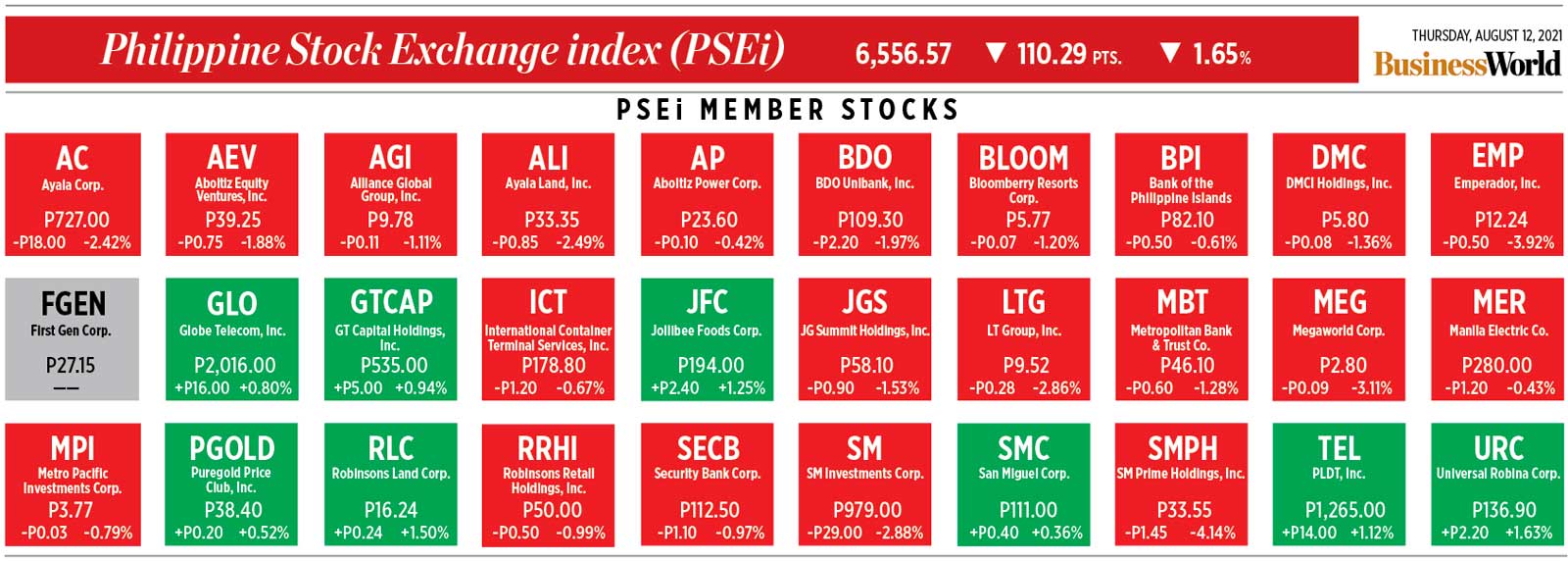
How PSEi member stocks performed — August 12, 2021

Here’s a quick glance at how PSEi stocks fared on Thursday, August 12, 2021.


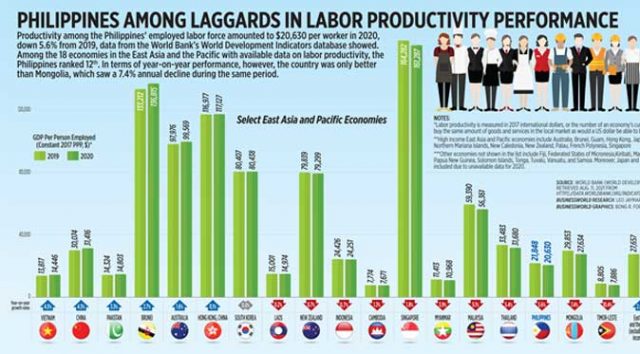
Philippines among laggards in labor productivity performance

Productivity among the Philippines’ employed labor force amounted to $20,630 per worker in 2020, down 5.6% from 2019, data from the World Bank’s World Development Indicators database showed. Among the 18 economies in the East Asia and the Pacific with available data on labor productivity, the Philippines ranked 12th. In terms of year-on-year performance, however, the country was only better than Mongolia, which saw a 7.4% annual decline during the same period.

Philippines among laggards in labor productivity performance

PSE index sinks on lockdown fears, rebalancing

REUTERS

PHILIPPINE shares sank on Thursday as the country’s coronavirus disease 2019 (COVID-19) situation affected sentiment and as investors adjusted their portfolios to prepare for the index’s rebalancing.

The Philippine Stock Exchange index (PSEi) shed 110.29 points or 1.65% to close at 6,556.57 on Thursday, while the broader all shares index went down by 51.68 points or 1.25% to end at 4,059.93.

“The local bourse plunged this Thursday… as COVID-19 cases in the country continue to surge,” Philstocks Financial, Inc. Senior Research Analyst Japhet Louis O. Tantiangco said in a Viber message.

“The surge in cases raises the risk of extending the strict quarantine measures implemented in selected areas in the Philippines, and expanding it to other areas. Trading weakened,” he added.

On Wednesday, the country logged 12,021 new infections, bringing the total to 1,688,040, Health department data showed. Active cases stood at 81,399.

“Philippine shares fell after the latest announcement of the MSCI rebalancing results influences active funds to make the necessary adjustments before the close of August,” Regina Capital Development Corp. Head of Sales Luis A. Limlingan said in a separate Viber message.

“[Others] decided to keep in cash ahead of the PSEi rebalancing,” Mr. Limlingan said.

The Philippine Stock Exchange recently conducted its regular review of the 30-member index and sectoral indices. As a result, AC Energy Corp. and Converge Information and Communications Technology Solutions, Inc. will be joining the benchmark index, replacing DMCI Holdings, Inc. and Emperador, Inc.

These changes will take effect on Monday, Aug. 16.

Majority of sectoral indices closed lower except for mining and oil, which gained 141.93 points or 1.47% to end at 9,781.80.

Meanwhile, property dropped 98.90 points or 3.13% to 3,055.03; holding firms shaved off 142.90 points or 2.14% to 6,529.01; financials went down by 18.51 points or 1.28% to finish at 1,419.40; industrials declined by 52.95 points or 0.56% to close at 9,328.30; and services inched down by 2.75 points or 0.17% to 1,614.28.

Value turnover tripled to P18.23 billion with 4.16 billion shares switching hands on Thursday, from the P6.83 billion with 1.82 billion issues logged the previous day.

Decliners outnumbered advancers, 133 against 66, while 51 names closed unchanged.

Net foreign buying slowed to P50 million on Thursday from the P513.87 million logged on Wednesday.

“The bourse may have also hit a technical resistance area around the 6,680 area,” Timson Securities, Inc. Trader Darren Blaine T. Pangan said in a separate Viber message.

“Support may be placed at the 6,270 level,” he added. — Keren Concepcion G. Valmonte

Peso slips ahead of BSP meeting

THE PESO inched down against the greenback on Thursday ahead of the central bank’s policy review.

The local unit ended at P50.39 per dollar, shedding one centavo from Wednesday’s close of P50.38, based on Bankers Association of the Philippines data.

The local currency opened the session at P50.35 versus the dollar. Its weakest point was at P50.46, while its intraday best was at P50.34 against the greenback.

Dollars traded on Thursday fell to $723.3 million from $896.6 million on Wednesday.

Rizal Commercial Banking Corp. Chief Economist Michael L. Ricafort said the peso ended weaker versus the greenback during the final trading hour ahead of the central bank’s rate-setting meeting later in the day.

A trader likewise said the peso weakened as investors were cautious ahead of the Monetary Board’s meeting.

The Bangko Sentral ng Pilipinas (BSP) kept benchmark interest rates steady for the six straight meeting on Thursday to support the economy’s recovery. The rate on the BSP’s overnight reverse repurchase facility was kept at 2%. The yields on the overnight deposit and lending facilities were also unchanged at 1.5% and 2.5%, respectively.

“Peso weaker after the latest decline in the local stock market, more dovish signals from most [US Federal Reserve] officials recently on possible tapering of Fed bond purchases as early as later this year after stronger US jobs data,” Mr. Ricafort added.

The Philippine Stock Exchange index fell by 110.29 points or 1.65% to close at 6,556.57 on Thursday, while the all shares index went down by 51.68 points or 1.25% to close at 4,059.93.

“The local currency might weaken [on Friday] after the central bank revised up its inflation projections citing various upward price pressures,” the trader added.

The trader expects the peso to move between P50.30 and P50.50 per dollar on Friday, while Mr. Ricafort gave a narrower forecast range of P50.35-50.45 against the greenback. — BML

More FDI seen needed to plug current account deficit by 2022

PHILIPPINE STAR/ MICHAEL VARCAS

THE CURRENT account deficit is likely to widen starting in 2022, pressing home the need for reforms to attract more foreign direct investment (FDI) rather than more transitory forms of inflows, Fitch Solutions Country Risk and Industry Research said.

“Policymakers will have to manage the economy’s external financing needs over the long term, with a need for foreign direct investment (FDI) over ‘hot money’ inflows for economic stability,” it said in a note Thursday.

Hot money or foreign portfolio investment tends to enter and leave an economy with fewer constraints, unlike FDI, which results in the establishment of fixed assets, which are not easily abandoned.

Fitch Solutions said it expects the current account to remain in surplus this year equivalent to 1.3% of gross domestic product (GDP), much less than the 3.6% surplus last year. The thinning of the surplus this year will be due to the moderate recovery in import demand.

The central bank expects the current to post a $10-billion surplus this year, equivalent to 2.5% of GDP.

The current account was in surplus by $12.979 billion in 2020, a turnaround from the $3.047-billion deficit in 2019.

Last year’s surplus was the highest since at least 2005 mainly due to the import slump as restrictions hampered the movement of goods during the pandemic.

“However, as the economy gradually climbs back to pre-pandemic output levels in 2022, we anticipate the current account to slip back into deficit,” Fitch Solutions said.

“Over the coming years we forecast this deficit to widen as demand for goods imports rebound, driven in particular for a rising need for commodity imports as the country’s infrastructure needs to grow,” it added.

For 2021, the government is targeting infrastructure spending of P1.02 trillion. It expects spending on the sector of P1.29 trillion and P1.28 trillion in the next two years, respectively.

Remittance flows and exports could be offsetting factors. Fitch Solutions noted that how much exports will mitigate any deficits will depend on how industry is spurred by expected improvements in infrastructure and the effectiveness of reforms.

The report noted that remittances are expected to be buoyed by heightened demand for healthcare workers and caregivers for the elderly. It added that “high domestic unemployment rates” may also spur migration.

With the country likely to run a wider current account deficit due to imports for the infrastructure program, Fitch Solutions said the reliance on external financing will be greater. The report noted how the government is already pushing for reforms to relax foreign ownership restrictions and attract more FDI.

The amendments to the Public Service Act and the Foreign Investment Act are still pending in the Senate, while the Bicameral Conference Committee has not yet finalized the revised Retail Trade Liberalization Act. These bills are expected to drive foreign investment growth.

Meanwhile, Fitch Solutions noted the low level of foreign ownership in peso-denominated government bonds.

“Low foreign ownership of local-currency government bonds — at an estimated 2.9% as of end-2020, compared to 13.6% in Thailand and 9.7% in China — could increase over time, as the Philippines’ growth outperforms regional peers over the next decade,” it said.

Fitch Solutions on Wednesday reduced its GDP growth forecast for the Philippines this year to 4.2% from 5.3% previously. It said the emergence of more infectious coronavirus variants and muted consumption due to the Metro Manila lockdown could hinder the recovery. — Luz Wendy T. Noble

DENR orders release of non-environmentally acceptable product list

By Angelica Y. Yang, Reporter

THE ENVIRONMENT department has ordered the National Solid Waste Management Commission (NSWMC) and the Solid Waste Management Division to release the list of products deemed damaging to the environment.

Such items, known as non-environmentally acceptable products (NEAP) which will be banned in compliance with the Ecological Solid Waste Management Act of 2000.

“(The NSWMC Secretariat and Solid Waste Management Division are) hereby directed to publish the list of NEAP in two newspapers of national circulation and provide a copy of the NSWMC Resolution (declaring plastic soft drink straws and plastic coffee stirrers part of the NEAP) to the Office of the National Administrative Registry at the University of the Philippines Law Center for their information and appropriate action,” Department of Environment and Natural Resources (DENR) Undersecretary Benny D. Antiporda said in a letter obtained by BusinessWorld.

The letter also directed the two agencies to begin drafting the guidelines of the NEAP, including phase-out timelines, which must be issued “one year after” the release of the list.

Asked when the NEAP will be out, Mr. Antiporda said he is sure it will be released by next week.

“Within next week iyan, sigurado meron na iyan (I’m sure it will be out),” he told BusinessWorld via Viber.

He added that the Science department is still evaluating other possible products.

DENR Secretary Roy A. Cimatu chairs the NSWMC, while Mr. Antiporda serves as the commission’s alternate chairman.

Under the Ecological Solid Waste Management Act or Republic Act No. 9003, the NSWMC must prepare the NEAP within a year of the law’s enactment and provide yearly updates.

Non-government organizations have declared their intent to press charges against the NSWMC, DENR, and other government agencies over their “inaction” on the list.

“We are preparing the lawsuit. The NSWMC or the member agencies have not responded to the notice(s) to sue,” Oceana Vice-President Gloria Estenzo Ramos told BusinessWorld in an e-mail Thursday.

Political will is needed for the commission to perform its 20-year-old mandate, she added.

Duterte approves P3.9 billion in additional cash assistance for Bataan, Laguna, NCR

PHILIPPINE STAR/ BOY SANTOS

PRESIDENT RODRIGO R. Duterte approved an additional P3.873 billion for cash aid to poor families in the National Capital Region (NCR), Bataan and Laguna, which have been placed under the strictest lockdown settings, known as enhanced community quarantine (ECQ).

Budget Assistant Secretary Rolando U. Toledo said Thursday that “we just received this morning the approval of the President for the cash aid for Bataan and Laguna plus the additional cash aid for NCR.”

In a Viber message, Mr. Toledo said the Department of Budget and Management (DBM) is currently preparing the documents needed to release the funds from the Bureau of the Treasury to local government units (LGUs) which will distribute them.

In a separate interview at the Laging Handa briefing Thursday, Mr. Toledo said the DBM hopes to release the funds by Friday. The department will also issue a local budget circular to guide LGUs on how the funds should be used and distributed.

The government is set to distribute P1,000 per person or up to P4,000 per household to low-income families in areas under ECQ as relief to compensate for loss of livelihood while movement restrictions are in force.

Of the new money, an additional P368 million will be given to the NCR to augment the P10.894 billion previously released to the region to cover more affected families, Mr. Toledo said.

This will bring the financial aid set aside for the capital to P11.262 billion, which he said will be enough to cover the list of beneficiaries the LGUs used when they rolled out a similar cash aid program in April.

Of the remainder, Laguna will get P2.715 billion and Bataan P700 million.

The two provinces were also placed under ECQ on Aug. 6-15. The lockdown in the NCR runs between Aug. 6 and Aug. 20.

Budget Undersecretary Tina Rose Marie L. Canda has said that other areas under ECQ like Iloilo and Cagayan de Oro were given financial assistance by the Department of Social Welfare and Development last month.

While the regional Inter-Agency Task Force in the Cagayan Valley region agreed to place Tuguegarao City under ECQ for 10 days, the DBM’s Mr. Toledo said providing cash aid to the city is still being studied by the Office of the President.

“If the decision is final… the DBM will look for a potential source of funds to give out cash aid to the citizens of Tuguegarao City,” he said.

The government has been giving out cash handouts to low-income families affected by quarantine since the pandemic started last year. The last two rounds were in April, which was worth P23 billion. The first disbursement starting in April 2020 was worth P205 billion under the social amelioration program. — Beatrice M. Laforga

Imported liquor market forecast at P50 billion

PHILSTAR

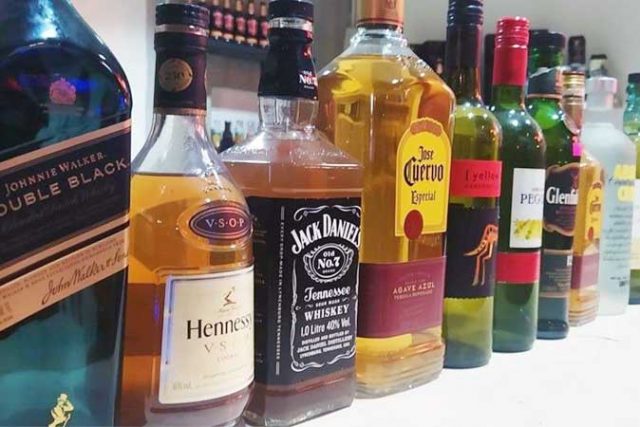
THE MARKET for imported spirits in the Philippines has been estimated at up to P50 billion at retail prices by 2025, The Keepers Holdings, Inc. (KEEPRS) said, citing a global report.

The trend would imply a market share for imported spirits segment of about 35%, and a 14.9% compound annual growth rate (CAGR) between 2021 and 2025.

IWSR Drinks Market Analysis Ltd. expects the overall consumption of spirits in the Philippines to grow 5.2% on a CAGR basis during the period, while domestic spirits growth was estimated at 1.3%, KEEPRS said in a statement Thursday.

By retail value, consumption of spirits has grown to P116.3 billion in 2020 from P91.7 billion in 2017.

Spirits retail sales in 2020 rose 1.9%, while the overall alcohol beverage market declined 6.3%.

KEEPRS accounts for 74% of imported spirits by volume, and 66.9% by retail sales value.

“KEEPR anticipates that the forecasted growth in the imported spirits segment translates to direct growth opportunities for its business and operations,” the company said.

The largest distributor of imported spirits in the Philippines, KEEPRS said last month that it was keen on expanding its imported spirits portfolio.

Previously known as Da Vinci Capital Holdings, the Securities and Exchange Commission recently approved the name change for the Lucio L. Co-controlled company to The Keepers Holdings, Inc.

KEEPRS was formed after the acquisition of Montosco, Inc., Meritus Prime Distributions, Inc., and Premier Wine and Spirits, Inc. through a share-swap deal with Mr. Co’s other company, Cosco Capital, Inc. — Jenina P. Ibañez

‘Gap’ noted in ASEAN, European Union views on sustainability amid hopes for trade deal

REUTERS

THE EUROPEAN Union (EU) said differences with ASEAN on sustainability matters must be resolved as the two blocs seek to revive free trade talks, the EU Ambassador said, adding that “gaps” between the two sides must also be addressed in terms of government procurement policies.

The EU and the Association of Southeast Asian Nations (ASEAN) started talks on a free trade agreement (FTA) in 2007, pausing negotiations two years later, after which the EU pursued bilateral deals with individual ASEAN member-states.

“There is still a bit of an ambition gap between what we see as a region-to-region FTA and what ASEAN would have in mind, including on issues such as sustainability, including on issues such as government procurement and so on,” EU Ambassador to ASEAN Igor Driesmans said in a virtual event Thursday.

“I think if we want to make progress on this, we will need to try to close a little bit this ambition gap, and at the same time accelerate on our bilateral negotiations because these will obviously be the building blocks for a region-to-region FTA.”

The EU has FTAs with two ASEAN countries, Singapore and Vietnam.

Mr. Driesmans said that the EU is actively negotiating trade deals with a number of other ASEAN states.

“We continue to enhance this region-to-region engagement in trade and investment, including this possible region-to-region trade agreement. Actually, over the last couple of years, we’ve been exchanging… proposals on what is also called framework for a possible future region-to-region FTA.”

Kok Li Peng, Singapore Permanent Representative to ASEAN, said the regional FTA is still on the table.

“The road to one will be long. From Singapore’s experience negotiating our FTA with the EU, it is complex, but I think that the rewards are worth it,” she said.

“I think there’s renewed interest among EU member states and in the European Commission to look at this prospect carefully, especially since ASEAN concluded the Regional Comprehensive Economic Partnership last year.”

The Philippines has signed the Regional Comprehensive Economic Partnership (RCEP), a trade pact that includes China, Australia, New Zealand, Japan, South Korea and all 10 ASEAN members.

The first round of FTA negotiations between the Philippines and the EU was held in May 2016. An EU-ASEAN Business Sentiment Survey in 2019 said that enthusiasm from businesses on the potential trade deal has waned since talks stalled. — Jenina P. Ibañez

Agriculture dep’t forms anti-red tape committee

PHILSTAR

THE DEPARTMENT of Agriculture (DA) has formed a committee to deal with streamlining its processes in compliance with a government mandate across all agencies to reduce red tape.

Agriculture Secretary William D. Dar signed Special Order No. 576 on Aug. 11 creating the committee, adding that it will ensure the DA’s compliance with Republic Act No. 11032 or the Ease of Doing Business and Efficient Government Service Delivery Act and its implementing rules and regulations.  

According to the special order, Undersecretary for Administration and Finance Roldan G. Gorgonio will chair the committee.

Mr. Dar said the committee will conduct a compliance cost analysis, time and motion studies, and evaluate areas of improvement for DA services.

He said the committee is also subject to a national policy on regulatory management systems to be issued by the Anti-Red Tape Authority (ARTA), which includes notifying ARTA of every creation, revision, and repeal of regulations, ordinances or other related issuances. The DA is also obliged to conduct post-implementation assessments of current regulations; prepare preliminary impact assessments; and produce a regulatory impact assessment.

It is also required to refer ARTA policy recommendations to the officials concerned and submit an inventory of all current regulations and issuances.

Mr. Dar also ordered the committee to guarantee effective information dissemination on ARTA-related training; register new regulations and issuances with the University of the Philippines Office of the National Administrative Register or the Official Gazette; create updated service standards; and periodically review and update the DA’s citizen’s charter.

He said the committee must also ensure DA compliance on the zero-contact policy and the prescribed processing times for applications, and to develop a client feedback mechanism and measure their satisfaction.

A further task is to establish a Public Assistance Complaints Desk or ARTA help desk to receive and address complaints, serve as the overall coordinating unit for the creation of an electronic business one-stop shop, and help in the dissemination of ARTA information materials for public use.

“All heads of DA regional field offices, bureaus, and attached agencies and corporations are hereby directed to create and designate a sub-committee on anti-red tape in their respective offices,” Mr. Dar said. — Revin Mikhael D. Ochave  

ADVERTISEMENT
ADVERTISEMENT