Home Blog Page 728

Peso to remain under pressure as growth slows

PHILSTAR FILE PHOTO

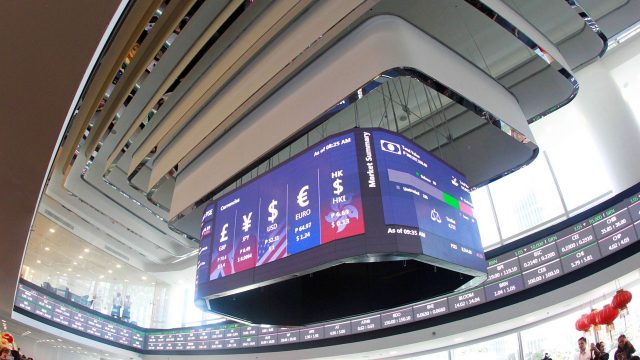
THE PESO could stay under pressure against the dollar this week as the market continues to react to data showing a sharp slowdown in Philippine economic growth last quarter.

On Friday, the local unit closed at P59.04 versus the greenback, weakening by 10 centavos from its P58.94 finish on Thursday, Bankers Association of the Philippines data showed.

Week on week, the peso sank by 19 centavos from its P58.85 close on Oct. 30.

The local unit returned to the P59 level after the release of a report showing a weaker-than-expected third-quarter gross domestic product (GDP) growth print, Rizal Commercial Banking Corp. Chief Economist Michael L. Ricafort said in a Viber message.

“The peso weakened on expectations of softer third quarter GDP and lingering fallout from the flood control scandal. Add a strong dollar and hawkish Federal Reserve signals, and you’ve got pressure from both ends,” Jonathan L. Ravelas, senior adviser at Reyes Tacandong & Co., said in a Viber message.

Philippine GDP expanded by an annual 4% in the three months through September, sharply decelerating from the 5.5% growth in the second quarter and the 5.2% clip in the same quarter in 2024, the Philippine Statistics Authority (PSA) reported on Friday.

This was significantly lower than the 5.3% median estimate in a BusinessWorld poll of 18 analysts and economists.

This brought the nine-month average to 5%, slower than 5.9% in the same period last year and well below the government’s 5.5%-6.5% full-year GDP growth target.

Public construction in the quarter was hit by a corruption scandal involving state infrastructure projects that has dampened both consumer and investor sentiment, officials said. Analysts said growth is unlikely to rebound in the near term unless these governance issues are resolved.

Meanwhile, in the Asian session on Friday, the US dollar was on track for a modest weekly gain on Friday as investors sought to balance the Federal Reserve’s hawkish tilt against lingering concerns over the US economy, Reuters reported.

For this week, the peso may continue to move lower against the dollar, Mr. Ravelas said.

“Continue to expect cautious trading. Investors will be watching GDP results and any hints from the BSP (Bangko Sentral ng Pilipinas) on rate cuts. If the Fed stays hawkish and local growth disappoints, the peso could drift lower.”

Analysts said following the GDP report’s release that manageable inflation and soft growth prospects would give the BSP ample room to continue its easing cycle.

“The weaker growth numbers when combined with softer inflation print of 1.7% year on year for October suggests that the bias for the BSP continues to be for rate cuts, and with BSP also far less active in capping the peso as it weakened past the P59 level,” Michael Wan, senior currency analyst at MUFG Global Markets Research, said in a report.

MUFG Global Markets Research expects another 25-basis-point rate cut at the Monetary Board’s Dec. 11 policy meeting.

Mr. Ravelas said the peso could move from P58.70 to P59 against the greenback this week.

“Volatility remains, but [there should be] no sharp breakouts unless there’s a major surprise,” he said.

Meanwhile, Mr. Ricafort sees the local unit trading between P58.75 and P59.25 versus the dollar. — Katherine K. Chan

Hyundai presents referral program for new Stargazer

The updated Stargazer X (left) and Stargazer — PHOTO BY KAP MACEDA AGUILA

HYUNDAI MOTOR PHILIPPINES, INC. (HMPH) said recently that it will reward loyal Hyundai owners through its first-ever Hyundai Referral Program — an opportunity for them to earn exclusive prizes by referring family or friends to purchase the new Hyundai Stargazer MPV.

Flaunting a new Sheriff-style exterior while maintaining “signature Hyundai design elements, interior, and technology,” the new Stargazer is said to have a best-in-class wheelbase measuring 2,870mm — translating to generous legroom and space in the cabin. The Stargazer X also has added safety features such as six SRS air bags and a more comprehensive Hyundai SmartSense suite of driver-assistive tech. Its sportier design is geared for more active lifestyles, and the Stargazer also gets 17-inch alloy wheels and a functional roof rail that holds up to 100kg of cargo.

Until Nov. 30, 2025, existing Hyundai owners aged 18 years and above can join the program and receive a P5,000 e-gift certificate for every successful referral. Participants simply need to provide their vehicle identification number (VIN) to verify their eligibility and referral entry.

“The Hyundai Referral Program is our way of showing appreciation and giving back to our valued customers. We believe that great experiences are best shared, and through this program, we’re giving our Hyundai family the chance to extend that experience to others,” stated HMPH Managing Director Cecil Capacete.

For the full mechanics and details on how to join, visit https://www.hyundai.com/ph/en/build-a-car/promotion/hyundai-referral-program. For more info, follow HMPH through @HyundaiMotorPhilippines on Facebook and Instagram.

Gates Foundation pledges $1.4 billion to help farmers adapt to extreme weather

REUTERS

SAO PAULO — Billionaire Bill Gates’ foundation will spend at least $1.4 billion over the next four years to help farmers in sub-Saharan Africa and Asia access technologies for adapting to extreme weather, the organization’s chief executive officer (CEO) told Reuters.

Speaking ahead of next week’s COP30 climate summit in Brazil, Mark Suzman, head of the Gates Foundation, said the funding would go toward innovations like mapping soil health and biofertilizers that use microorganisms rather than chemicals to promote plant growth.

Mr. Gates called last week for a pivot in climate strategy away from focusing on emissions targets and toward helping the poor, who are increasingly bearing the brunt of erratic weather and other climate extremes.

“These are the people who have contributed such a minimal fraction to the greenhouse gas emission that is causing climate change, but they are the most affected because those climate impacts actually hit them in terms of their ability to feed themselves and their families,” Mr. Suzman told Reuters in an interview before the funding was announced.

Noting that climate-fueled weather extremes are posing an increasing threat to crop yields and food security, the United Nations has urged more protection for agriculture as global warming intensifies.

A report by more than 20 organizations including consultants Systemiq found that crop resilience was one of the most impactful areas of investment. The report, released on Tuesday, said there was a widespread need for climate-resilient crop varieties, improved weather forecasts and innovations such as AI-enabled mapping and guidance.

FARMING TECHNOLOGIES FOR THE FUTURE
The International Potato Center, one of the organizations to previously benefit from Gates Foundation funding, unveiled on Thursday a newly cultivated variety of potato that is resistant to blight, a disease that is spreading to higher altitudes as global temperatures rise.

“This new potato was developed in Peru by identifying wild potatoes with resistance to the disease and incorporating this resistance into cultivated varieties,” said one of the company’s researchers, Thiago Mendes.

Another recipient, TomorrowNow, sends weather updates by text message to farmers in African countries including Kenya and Rwanda, helping to prevent them from wasting seeds and supplies by planting or harvesting at the best times, CEO Wanjeri Mbugua told Reuters.

Mr. Suzman said there was robust research and development for agricultural solutions, but that the goal for the world should be to deliver those solutions to the world’s poorest.

“The jury is still out on if we’re going to see that,” he said. — Reuters

SEC to release REIT amendments exposure draft, targets January implementation

SEC.GOV.PH

THE SECURITIES and Exchange Commission (SEC) is set to release an exposure draft for amendments to the real estate investment trust (REIT) rules within the next few weeks, with implementation aimed for January.

“Maybe two weeks before we release the exposure draft. If I were to decide, it should be effective sometime in January, preferably Jan. 1, but as I said, there is a process,” SEC Chairperson Francisco Ed. Lim told reporters on Friday last week.

The draft seeks to expand and clarify the definition of income-generating assets under the REIT rules, which would allow more companies — including those in power, infrastructure, and telecommunications — to list. Among the proposed amendments is the enumeration of asset types to avoid confusion and disputes over what constitutes an income-generating property.

In earlier statements, Mr. Lim said the commission planned to revise REIT rules to bolster the Philippine capital market by widening the range of eligible assets, extending the reinvestment period, and encouraging broader participation.

Republic Act No. 9856, or the REIT Act of 2009, provides tax incentives to REITs, which are companies that invest in income-producing properties. Under the REIT framework, at least 75% of a REIT’s deposited property must consist of income-generating real estate, including those held under freehold or leasehold arrangements.

Mr. Lim also highlighted broader efforts by the SEC to liberalize benefits for the market.

Last month, the commission said it awarded more than P80 million in fee discounts across 40,157 transactions processed under three memorandum circulars issued between July and October, with over half of the total savings going to micro, small, and medium enterprises (MSMEs).

In September, the SEC approved rules extending the validity period of shelf registration up to five years from three, and simplifying requirements for subsequent tranches for listed companies.

Mr. Lim also noted that he is reviewing a draft on financial literacy aimed at high school students and plans to finish by next week.

“I intend to propose it as a law,” he said. — Alexandria Grace C. Magno

Style (11/10/25)


SM launches plushies for a cause

SM CARES introduces the SM Besties of Joy 2025 — four bunny toys for SM Cares’ annual Buy-One-Donate-One initiative. For every Bestie of Joy purchased, SM Cares donates another plush toy to a child from one of the 72 SM partner communities nationwide. Now available until Dec. 25, each Bestie of Joy is priced at P330. With every purchase, keep one plush toy while the other is donated to a child in need.


Hoka has first Gore-Tex collaboration

HOKA announces its latest collaboration with Haven, a Canadian-based technical apparel label, which is a reinterpretation of the Stinson EVO. This is the first time the silhouette features Gore-Tex. “We wanted to create something that lives naturally between the outdoors and the city,” says Arthur Chmielewski, Haven Co-Founder and Creative Director. The Haven x Hoka Stinson EVO GTX features clean lines, tonal color palettes, and a mix of premium technical materials. Nubuck and suede textures are paired with durable ripstop, bonded overlays, and a waterproof yet breathable Gore-Tex membrane. Hoka’s signature cushioning and Zero Gravity midsole with Adaptive Tuning offer lightweight comfort and stability for both daily wear and outdoor movement. The collection is available globally at Hoka.com, and retails at P14,495.


Katre opens #MakeYourMark pop-up

MANILA leather and lifestyle brand Katre has opened #MakeYourMark, a limited-time pop-up, at Greenbelt 5 in Makati. Specializing in personalized leather goods, Katre encourages guests to express themselves using classic fonts, playful emojis, and their own handwriting. Katre is a leather goods brand founded in Manila by stylist and makeup artist Kat Erro in 2009. After years in hiatus due to the pandemic, Katre came back in 2024. Visit the website at KATREMNL.com for details.


COS expands COS.com to customers in the Philippines

COS announces the launch of COS.com in the Philippines and Taiwan, as part of the brand’s continued digital expansion strategy across the Asia Pacific region. Customers in these markets can now directly shop for the full range of COS products. With strong and growing demand for the brand in the Philippines and Taiwan, COS is further strengthening its presence in the Asia Pacific region while enhancing the full brand experience for shoppers in these fast-growing markets. Building on the success of its partnership with regional e-commerce platform Zalora, the launch of the official website further consolidates the brand’s digital footprint. The official site, now live at https://www.cos.com/en-ph/, offers exclusive collections, iconic styles, and the latest designs from the brand.


Montblanc comes out with digital paper

MONTBLANC celebrates the physical feeling of traditional handwriting with the introduction of the Montblanc Digital Paper, which was developed and tested by craftsmen at the maison’s Hamburg headquarters. “While digital tools provide efficiency and convenience, handwriting offers a more immersive, reflective, and emotionally rich experience. It can ground us and inspire us in an increasingly fast-paced world. With the Montblanc Digital Paper, we have found a way to retain all the special qualities of writing by hand, while recognizing the need for boundless space and effortless digital collaboration,” said Felix Obschonka, Montblanc Director New Technologies, in a statement. At the heart of the experience is the Montblanc Digital Pen, which accompanies the Digital Paper. Modelled on the ergonomic design of the Meisterstück, the Digital Pen echoes some of its most recognizable features, such as the three metal rings and the Montblanc emblem crowning the pen. The Digital Pen comes equipped with three distinct interchangeable pen tips, each of which emulates a different paper texture, allowing users to adapt the pen to suit their personal handwriting preference. Writing on the Montblanc Digital Paper’s high-resolution electronic ink display delivers a realistic feel of paper and a haptic experience that embodies the tactile feeling of handwriting with a traditional Montblanc writing instrument. Each handwritten note, marked-up page or document is searchable and can be found via an intuitive search function with handwriting recognition. Thoughts and ideas can be structured with templates such as calendars, planners and journaling templates, while files can be seamlessly shared and received via e-mail, USB-C, or by using the companion apps connected to the Montblanc Cloud. Montblanc Digital Paper comes with a lightweight metal case available in Mystery Black, Elixir Gold, and Cool Grey colors, as well as a calf leather side bar debossed with the Montblanc emblem. Optional smart leather covers are available in seasonal colors and can be customized. Montblanc is available at Rustans Makati, Rustans Shangri-La, Rustan’s Cebu, Greenbelt 5, and Solaire Resort Entertainment City. For more information, visit Rustans.com.

Fostering supportive workplaces for people living with diabetes

STOCK PHOTO | Image from Freepik

Every day, millions of Filipinos living with diabetes navigate not only the physical demands of their condition but also the social and emotional challenges that accompany it. An estimated 4.73 million Filipino adults have diabetes mellitus — a number that continues to rise. The relentless need for daily self-management can take an emotional toll, leading to what experts now call diabetes distress. For many employees, balancing work responsibilities with diabetes care becomes a constant source of stress, stigma, and fear, according to the International Diabetes Federation (IDF).

Diabetes stigma refers to the negative attitudes, judgments, or prejudices directed at someone because they have diabetes. The US Centers for Disease Control and Prevention (CDC) notes that many people mistakenly assume type 2 diabetes is solely the result of poor lifestyle choices. Such misconceptions can lead to unfair views that people with diabetes are lazy, undisciplined, or irresponsible.

In the workplace, these attitudes can translate into discrimination. Employees living with diabetes may be perceived as less capable or as burdens to their teams. Some report being overlooked for promotions or treated unfairly simply because of their condition. This misunderstanding often forces individuals to hide their diagnosis or to overcompensate at work, sometimes at the expense of their health.

Diabetes management requires careful monitoring of blood sugar, medication, diet, and physical activity. Work demands and rigid schedules can disrupt these routines, leading to what experts describe as intentional hyperglycemia at work (IHW) — a coping strategy where individuals deliberately maintain high blood sugar levels to avoid potentially dangerous episodes of hypoglycemia (low blood sugar).

Hypoglycemia, common among those who use insulin or certain oral medications, can cause shaking, sweating, dizziness, confusion, and, in severe cases, seizures or loss of consciousness. Because its symptoms might be mistaken for fatigue or incompetence, employees may hesitate to manage their blood sugar properly at work, putting their long-term health at risk.

On Nov. 14, the world marks World Diabetes Day, with this year’s theme: “Diabetes and the Workplace.” The IDF calls for greater awareness and supportive environments that empower employees to manage their health confidently. It emphasizes that the ongoing struggle of people with diabetes to balance their health and work expectations affects not only their well-being but also their career growth.

“It’s time to eliminate misconceptions, educate employers, and foster environments where employees with diabetes can manage their condition without fear,” the IDF said. “By strengthening awareness and understanding, we can ensure workplaces where people living with diabetes feel safe, valued, and empowered to thrive.”

PRACTICAL STEPS FOR EMPLOYERS
Employers play a critical role in fostering a culture of care. Diabetes UK and Workplace Options recommend strategies to build inclusive and health-promoting workplaces.

First is to offer accommodations. Provide private spaces for blood sugar testing and insulin administration, access to healthy snacks, flexible working hours, and time off for medical appointments. Small adjustments help employees manage their health while staying productive.

Second, hold education and awareness campaigns. Organize diabetes-focused wellness activities to dispel myths and reduce stigma. Promote knowledge about risk factors, symptoms, and prevention.

Third, encourage regular health checks. Support annual physical exams and preventive screenings. Offer healthy food options in canteens and opportunities for physical activity.

Fourth, provide emotional support. Recognize that stress can raise blood sugar levels. Encourage open communication and empathy from supervisors and co-workers.

Supporting diabetes management in the workplace is both compassionate and strategic. According to the CDC, small environmental or scheduling adjustments can reduce absenteeism and presenteeism, enhance concentration and energy, lower the risk of on-the-job injury, and keep companies compliant with occupational health laws.

The CDC also encourages employers to invest in worksite-based diabetes clinics that offer lifestyle interventions, health education, adult immunization, and professional medical support. Such clinics remove barriers to care, leading to improved employee health, better blood sugar control, and reduced healthcare costs for employers.

In the Philippines, the Department of Health’s National Diabetes Prevention and Control Program (NDPCP) and the Department of Labor and Employment’s Workplace Wellness Framework both emphasize chronic disease prevention as part of occupational safety and health standards. These programs highlight that protecting employees’ health is not just a personal responsibility, it’s an organizational one.

Meanwhile, non-communicable diseases (NCDs) such as diabetes, cardiovascular disease, cancer, and chronic respiratory conditions remain the leading causes of illness and economic loss. Diabetes, in particular, can weaken the immune system, making individuals more vulnerable to infections such as influenza and pneumonia. Vaccination is therefore a vital part of workplace health programs, helping prevent serious illness and costly hospitalizations.

Beyond developing new medicines and vaccines, the research-based pharmaceutical industry contributes to diabetes prevention and control by strengthening health systems, supporting sustainable financing, and improving access to care across the country.

Creating diabetes-friendly workplaces is both a moral imperative and a sound business strategy. By promoting understanding, flexibility, and access to preventive health services, employers can cultivate healthier and more resilient teams — where every employee, regardless of health condition, can reach their full potential.

As the world observes World Diabetes Day, let us reaffirm our commitment to support people living with diabetes — at work, at home, and in our communities. Through partnerships, we can build a future where inclusion, health, and productivity thrive side by side.


Teodoro B. Padilla is the executive director of Pharmaceutical and Healthcare Association of the Philippines, which represents the biopharmaceutical medicines and vaccines industry in the country. Its members are at the forefront of developing, investing and delivering innovative medicines, vaccines, and diagnostics for Filipinos to live healthier and more productive lives.

Debt yields fall on BSP bets after GDP, inflation

By Abigail Marie P. Yraola, Deputy Research Head

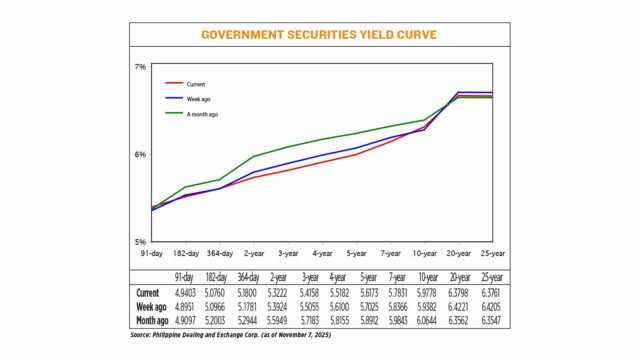
YIELDS on government securities (GS) traded in the secondary market fell last week on expectations of more rate cuts by the Bangko Sentral ng Pilipinas (BSP) following data showing weaker economic growth and below-target inflation.

GS yields, which move opposite to prices, declined by 3.74 basis points (bps) on average week on week, based on PHP Bloomberg Valuation Service Reference Rates data as of Nov. 7 published on the Philippine Dealing System’s website.

At the short end, yields on the 91- and 364-day Treasury bills (T-bills) went up by 4.52 bps and 0.19 bp week on week to 4.9403% and 5.1800%, respectively. Meanwhile, the 182-day T-bill went down by 2.06 bps to yield 5.0760%.

At the belly, rates declined across all tenors. The two-, three-, four-, five-, and seven-year Treasury bonds (T-bond) saw their yields decrease by 7.02 bps (to 5.3222%), 8.97 bps (5.4158%), 9.18 bps (5.5182%), 8.52 bps (5.6173%), and 5.35 bps (5.7831%), respectively.

At the long end, the rates of the 20- and 25-year debt papers dropped by 4.23 bps (to 6.3798%) and 4.44 bp (6.3761%), respectively, while the 10-year bond climbed by 3.96 bps to yield 5.9778%.

GS volume traded reached P132.81 billion on Friday, significantly higher from the P70.02 billion recorded a week earlier.

Bonds rallied following the weaker-than-expected third quarter gross domestic product (GDP) data, Alessandra P. Araullo, chief investment officer at ATRAM Trust Corp., said in a Viber message.

“The slower growth reinforced expectations that the BSP may deliver another 25-bp rate cut at its upcoming meeting,” she said.

“Market sentiment was largely driven by the disappointing 4% GDP print, which solidified expectations for another BSP rate cut in December. Some market participants even floated the possibility of a larger 50 bps “jumbo cut,” though this will depend on the Federal Reserve’s policy direction during the same period.”

Ms. Araullo said the belly of the curve led the rally, with trading activity also picking up on strong buying momentum.

Noel S. Reyes, chief investment officer for Trust and Asset Management Group at Security Bank Corp., likewise said that bond yields moved lower over the past week in anticipation of a slowdown in GDP growth.

“Weak third-quarter GDP was being priced by the market as a result of a number of analysts flagging drastic reduced spending by both government and households as a result of the plunder scandal… Its actual release increased the belief of more cuts and led to further buying that saw above average volume being traded,” he said in a Viber message.

Philippine economic growth slowed to a more than four-year low of 4% in the third quarter, the government reported on Friday, due to slower public spending amid a corruption scandal that highlighted governance issues, and as typhoons also affected household consumption.

This was sharply slower than the 5.5% growth in the second quarter and the 5.2% clip in the same period in 2024. This was also well below the 5.3% median estimate in a BusinessWorld poll of 18 analysts and economists.

The third-quarter clip brought the nine-month average to 5%, slower than 5.9% in the same period last year and putting the government’s 5.5%-6.5% full-year GDP growth goal further out of reach.

Meanwhile, headline inflation stood at 1.7% in October, unchanged from September’s print but easing from 2.3% a year ago.   

This was a tad slower than the 1.8% median forecast from a BusinessWorld poll of 17 analysts, but was within the BSP’s 1.4-2.2% forecast for the month.

In the first 10 months, the consumer price index averaged 1.7%, matching the central bank’s full-year forecast and falling below its 2-4% target.

Analysts said benign inflation and weak economic growth would give the BSP space to continue its easing cycle.

In October, the BSP trimmed benchmark rates by 25 bps for fourth straight meeting to bring the policy rate to 4.75%. It has now lowered borrowing costs by a total of 175 bps since its rate-cut cycle began in August 2024.

BSP Governor Eli M. Remolona, Jr. has signaled further easing until next year to help support domestic demand as the corruption mess has hit investor sentiment and economic prospects.

Meanwhile, Ms. Araullo added that market players also monitored global developments, especially in the United States, with the release of key economic data amid a government shutdown there expected to affect global yield movements.

For this week, domestic bond yields may continue to go down as the market digests the economic reports and their potential impact on monetary policy.

“Yields are likely to drift lower next week as investors continue to position ahead of an anticipated BSP rate cut. The softer GDP data supports a constructive view on duration, particularly in the belly to long end of the curve,” Ms. Araullo said.

“The risk though is such a rally could trigger risk-off to take profits ahead of market concerns that the plunder mess is taking a while to be addressed by the government,” Mr. Reyes added, noting this could affect the peso.

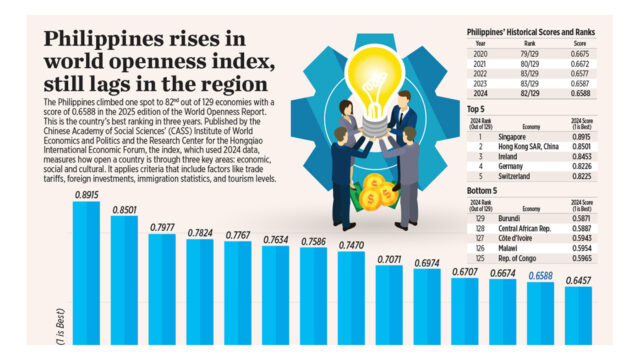
Philippines rises in world openness index, still lags in the region

The Philippines climbed one spot to 82nd out of 129 economies with a score of 0.6588 in the 2025 edition of the World Openness Report. This is the country’s best ranking in three years. Published by the Chinese Academy of Social Sciences’ (CASS) Institute of World Economics and Politics and the Research Center for the Hongqiao International Economic Forum, the index, which used 2024 data, measures how open a country is through three key areas: economic, social and cultural. It applies criteria that include factors like trade tariffs, foreign investments, immigration statistics, and tourism levels.

Philippines rises in world openness index, still lags in the region

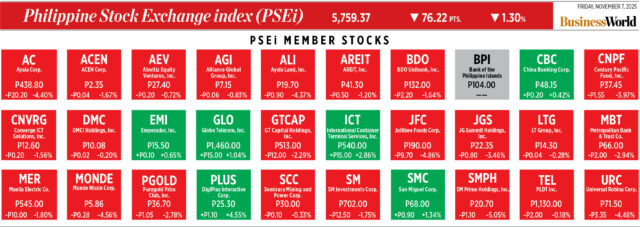
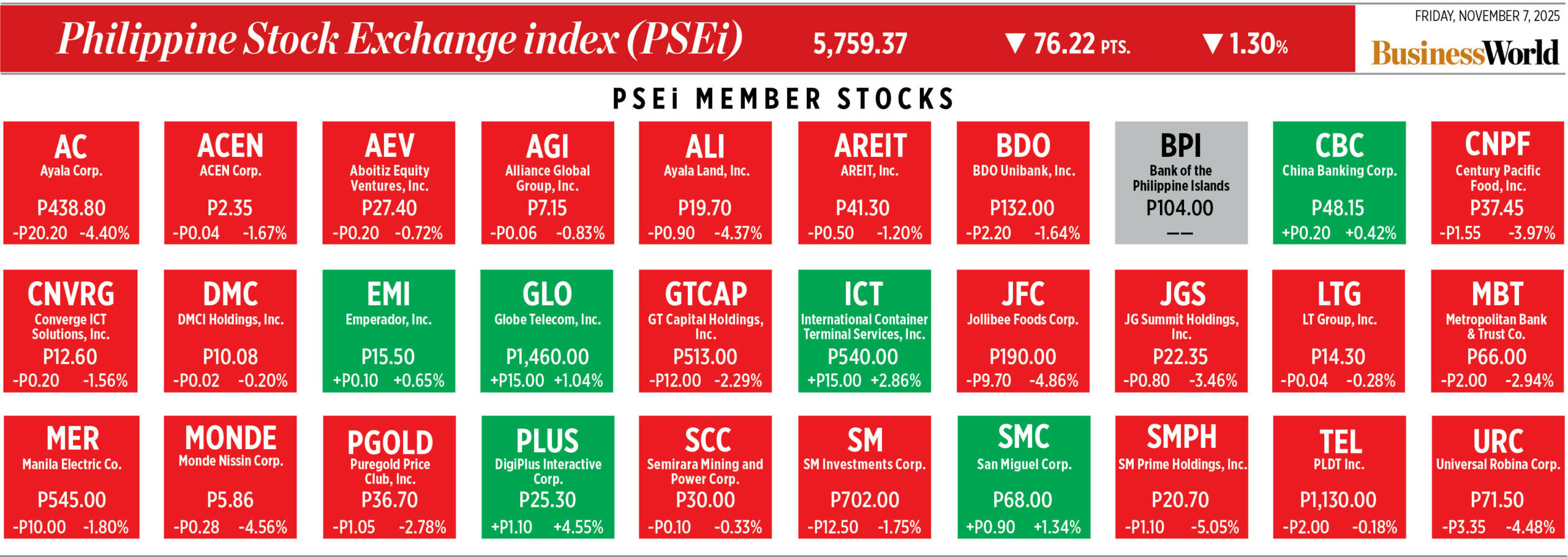
How PSEi member stocks performed — November 7, 2025

Here’s a quick glance at how PSEi stocks fared on Friday, November 7, 2025.


Stocks to move sideways amid weak GDP, FDI watch

PHILIPPINE STAR/KRIZ JOHN ROSALES

PHILIPPINE shares are expected to move sideways this week as investors digest the slower-than-expected third-quarter economic growth and await the release of foreign direct investment (FDI) data.

On Friday, the benchmark Philippine Stock Exchange index (PSEi) declined by 1.31% or 76.22 points to close at 5,759.37, while the broader All Shares index slipped by 0.81% or 28.86 points to 3,514.57. This marked the PSEi’s lowest finish in more than three years, or since it closed at 5,783.15 on Oct. 3, 2022.

“The Philippine market ended lower as selling pressure persisted following the release of GDP (gross domestic product) data, which came in widely below consensus,” said Regina Capital Development Corp. Head of Sales Luis A. Limlingan in a Viber message.

“Corporate earnings were not strong enough to offset the negative impact of the weaker GDP print and the depreciation of the peso to P59 per US dollar.”

Data from the Philippine Statistics Authority (PSA) showed that GDP expanded by 4% year on year in the third quarter, slowing sharply from 5.5% in the previous quarter and 5.2% in the same period a year earlier.

This was the weakest pace of growth in more than four years, as the economy was weighed down by weak capital spending and typhoon damage to agriculture, while public construction was affected by a corruption scandal involving state infrastructure projects that dampened sentiment.

Online brokerage 2TradeAsia.com said the economy’s slowdown reflected the combined impact of these domestic headwinds, although resilient 5.5% growth in services, led by finance and trade, together with expected holiday spending, could help cushion fourth-quarter activity.

“Sessions breached their lowest since October 2022 after the GDP came in less than expected at 4%,” the brokerage said. “The PSEi’s muted dip masks rotation potential — we reiterate safe plays for now, such as banks and dividend portfolios.”

For this week, Philstocks Financial, Inc. Assistant Manager for Research and Online Engagement Claire T. Alviar said the local bourse is likely to move sideways as cautious sentiment continues to weigh on investors.

“A strong FDI print could help lift confidence, but a disappointing result may reinforce the prevailing bearish mood,” Ms. Alviar said in a market note.

“Locally, the potential impact of an approaching super typhoon could further dampen sentiment, especially after the recent destructive typhoon in the Visayas.”

Last week, the government declared a state of national calamity after Typhoon Kalmaegi (locally named Tino) caused widespread damage in the Visayas and Mindanao. On Sunday, Super Typhoon Uwan was expected to hit areas still recovering from the previous storm.

Ms. Alviar added that concerns over a possible “AI-driven tech bubble” in overseas markets are also affecting risk appetite.

“Meanwhile, the local index failed to sustain its position above the 5,800 support level. Bargain hunting may help it retest this level, although strong resistance at the 6,000 mark remains,” she said. 

2TradeAsia noted that third-quarter corporate earnings calls could offer selective trading opportunities but said a stronger market recovery would likely hinge on fiscal reforms and clearer signs of economic rebound by early next year.

“Recent themes underscore a low-conviction rate environment merging with domestic fiscal headwinds, tilting toward selective positioning over broad bets,” it said. “Expect funds to trim duration and rotate into defensive sectors — financials and consumer staples — which offer yield cushions amid GDP softness that risks spilling into the fourth quarter.”

The brokerage pegged the PSEi’s immediate support at 5,600 and resistance at 5,900 to 6,000. — Alexandria Grace C. Magno

PHL evacuates over 1M, suspends class and gov’t work as Uwan threatens Bicol

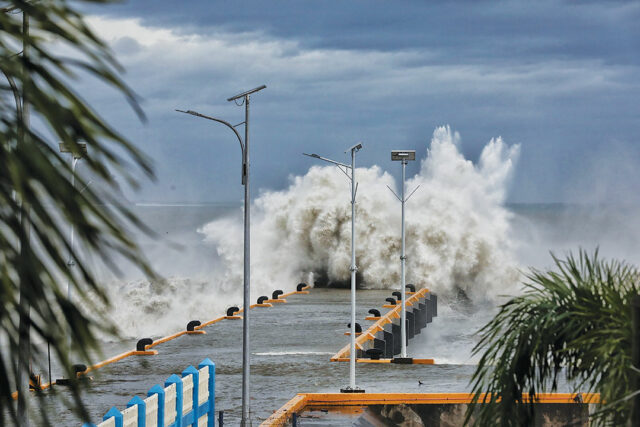
HIGH WAVES hit a dock in Aurora as Super Typhoon Fung-Wong (locally called Uwan) moves closer to the northern part of Luzon. The central portion of the province has been placed under wind signal No. 5, while the rest of Aurora is under signal No. 4, as of Sunday afternoon. — PHILIPPINE STAR/WALTER BOLLOZOS

THE PHILIPPINE government pre-emptively evacuated about 1.18 million individuals as Super Typhoon Fung-Wong, locally called Uwan, intensified on Sunday, placing Catanduanes and nearby areas under Signal No. 5.

As of 4 p.m., the Office of Civil Defense (OCD) reported the government pre-emptively evacuated 1.18 million individuals, mainly from Bicol region (671,254), eastern Visayas (259,145) and Calabarzon (95,665). Other evacuees were from the Cordillera Administrative Region (CAR), Ilocos Region, Cagayan Valley, Central Luzon, Calabarzon, Metro Manila, Western Visayas, Negros Island Region and Central Visayas.

“In Region 5, they are currently experiencing strong winds with moderate to heavy rains, particularly in Camarines Norte, Camarines Sur, and Catanduanes. Albay is experiencing moderate to strong winds with moderate rain,” OCD Deputy Administrator Bernardo Rafaelito Alejandro IV said in mixed English and Filipino in a briefing, streamed live on Facebook, on Sunday.

“All provinces have no power, except Sorsogon, as of 3 p.m.”

Mr. Alejandro said the OCD has received reports from the Bicol Region of one casualty due to drowning. He noted this is still for validation.

The state weather bureau reported Uwan continues to bring “life-threatening conditions” over Camarines Norte on Sunday, prompting it to raise tropical cyclone wind signal No. 5 over the northern portion of Catanduanes, Polillo Islands, the northern portion of Camarines Norte and the eastern portion of Camarines Sur.

It is also in effect over the southern portion of Quirino, the southeastern portion of Nueva Vizcaya, the northeastern portion of Nueva Ecija, and the central portion of Aurora.

In its 5 p.m. bulletin, the Philippine Atmospheric, Geophysical and Astronomical Services Administration (PAGASA) also placed surrounding provinces, including parts of Bicol, Calabarzon, and parts of Central Luzon and Northern Luzon under Signal No. 4, facing winds up to 184 kilometers per hour (kph).

Metro Manila, neighboring areas in Calabarzon, Central Luzon, other parts of Northern Luzon are under lower signals but remain at risk of storm-force winds, heavy rains, and coastal flooding as Uwan approaches.

Uwan was packing maximum sustained winds of 185 kilometers per hour near the center and gusts reaching 230 kph, making it one of the most powerful storms to hit the country this year.

The system was last located 110 kilometers north of Daet, Camarines Norte, moving west-northwestward at 30 kph.

The super typhoon is expected to make landfall over the central portion of Aurora province late on Sunday or early on Monday, possibly at peak intensity, before weakening as it crosses Northern Luzon’s mountainous terrain. It is, however, expected to remain as a typhoon throughout its passage over Northern Luzon.

PAGASA warned that due to its proximity, a direct hit over Calaguas and Polillo Islands is possible.

It added that heavy rainfall, storm surges, and strong gusts could persist even in areas outside the storm’s direct path.

CLASS AND WORK SUSPENSION
This prompted Malacañang and local government units to suspend government work and classes for Monday, Nov. 10

Malacañang ordered the suspension of work in state offices and classes across large parts of the country as Uwan is expected to bring widespread disruption, heavy rains, and strong winds.

Executive Secretary Lucas P. Bersamin signed Memorandum Circular No. 106 by authority of President Ferdinand R. Marcos, Jr., suspending government work in Metro Manila, CAR, Ilocos Region, Cagayan Valley, Central Luzon, Calabarzon, Mimaropa, Bicol Region, and Eastern Visayas on Monday.   

Classes at all levels in those regions, as well as Western Visayas, Central Visayas, and the Negros Island Region, will also be suspended for two days, from Nov. 10 to 11.

The move follows the recommendation of the National Disaster Risk Reduction and Management Council amid forecasts of Uwan’s “major impacts.”

Government agencies providing essential services — such as health, disaster response, and other vital operations — will continue to function, while others may adopt alternative work arrangements to maintain essential services, the circular stated.

Local governments outside the affected areas may issue separate suspension orders as needed, while work in private offices remains subject to the discretion of company heads, the Palace said.

The Philippines — one of the world’s most disaster-prone countries — faces around 20 tropical cyclones each year.

Uwan comes as authorities continue relief efforts for areas still recovering from Typhoon Kalmaegi (Tino), which caused deadly flash floods in the Visayas and Mindanao earlier this month.

President Ferdinand R. Marcos, Jr. last Thursday placed the country under a state of calamity to allow for the easier disbursement of funds. — Chloe Mari A. Hufana

Support for Marcos admin falls to 18% in Q3 amid flood control scandal, survey says

PRESIDENT Ferdinand R. Marcos, Jr. led the launch of phases 2 and 3 of the National Fiber Backbone project in Palo, Leyte on Monday. — PHILIPPINE STAR/NOEL PABALATE

SUPPORT for the government of President Ferdinand R. Marcos, Jr. fell to 18% in the third quarter, a pollster said on Sunday, as a widening flood control scandal continues to erode public confidence amid corruption allegations, governance lapses and political infighting.

In a statement, pollster Publicus Asia, Inc. said that support for the Marcos administration dropped from 21% in the second quarter of this year, as voters increasingly turned to opposition and independent politicians over lack of trust in the government.

More Filipinos warmed to opposition politicians, with neutral sentiment rising to 46% from 42%, while anti-opposition views fell to 29% from 40%, according to the survey.

“This shift reflects growing political moderation and voter fatigue with partisan conflict,” Publicus said. “The decline in hostility toward the opposition may be attributed to the fragmentation of opposition groups, the public’s focus on governance issues over political divisions and the rise of younger, centrist voices promoting pragmatic, solution-based politics.”

Corruption allegations are nothing new in the Philippines, but the flood control controversy has struck a chord with Filipinos due to the scale of the alleged fraud and the shock over how politicians and contractors colluded to siphon off billions of pesos from infrastructure projects widely seen as a necessity in the flood-prone country.

About 53% of Filipinos in Mindanao and 52% in the Visayas said they do not support the Marcos administration, according to the survey, showing simmering regional discontent and the sharpening of political divides amid the widening flood control controversy.

“Pro-administration support, however, remains strongest in North-Central Luzon (25%), the Marcos family’s bailiwick,” Publicus added. “The Visayas now emerges as a key battleground — leaning both anti-administration and pro-opposition — while the National Capital Region and South Luzon exhibit high neutrality.”

Dissatisfaction against the Marcos administration was highest among upper- and middle-income earners at 46%, as low-income households remained largely neutral, which the pollster attributed to “political disengagement or lack of perceived benefit” in the issue.

In terms of educational attainment, Publicus found graduates of vocational programs leaned towards neutral or opposition figures (45–58%), while those with no formal education were more likely to be anti-administration (46%).

Religion also emerged as a key factor in shaping sentiment, the pollster said, with most Catholics sharing anti-administration views (44%), while non-Catholics (40–48%) tended to lean nonpartisan, suggesting greater political caution.

“Government employees (40%) remain mostly pro-administration, whereas private-sector workers lean anti-administration (47%) and politically independent (40%),” it added. “Voters from OFW families (46–49%) tend to be more anti-establishment, both anti-administration and anti-opposition, reflecting global exposure and political awareness.”

Support for the Marcos administration fell to the second-lowest level in the July-to-September period, slightly above the 15% low recorded in the first quarter of 2025, when former President Rodrigo R. Duterte was arrested and flown to The Hague to face crimes against humanity charges over his bloody war on drugs.

“This period also marked the sharpest increase in anti-administration sentiment, which rose dramatically from 30% to 45% — reflecting growing public dissatisfaction and political polarization,” Publicus said. — Kenneth Christiane L. Basilio

ADVERTISEMENT
ADVERTISEMENT