Home Blog Page 720

Analysts warn of corruption risk over the Philippines’ year-long calamity declaration
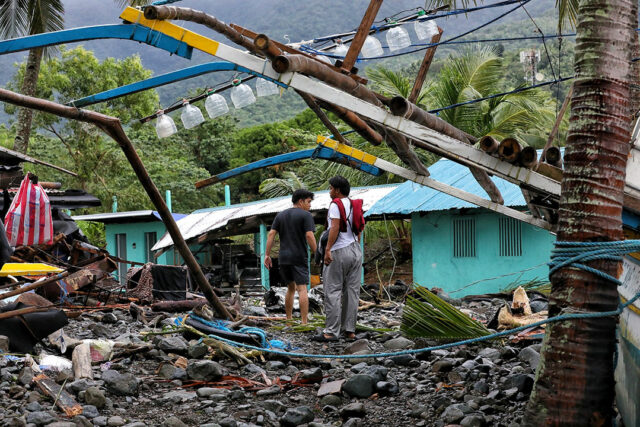
Strong winds and heavy rains brought by Super Typhoon Uwan caused damage to various structures in Barangay Aplaya, Dingalan, Aurora, Nov. 10, 2025. — PHILIPPINE STAR/WALTER BOLLOZOS

By Kenneth Christiane L. Basilio, Reporter

PRESIDENT Ferdinand R. Marcos, Jr.’s year-long national calamity declaration will fast-track rehabilitation efforts across typhoon-ravaged regions in the country, but it may also carry corruption risks, analysts said on Monday.

While the declaration may accelerate fund disbursement and disaster recovery, they warned that relaxed bidding rules could expose an already corruption-prone procurement process to further abuse.

“Calamity declarations usually have two-fold effects — make available the resources and funds over and above that are regularly appropriated, and ensure that their processing is easier and faster than normal,” Nigel Paul C. Villarete, a senior adviser at technical advisory group Libra Konsult, Inc., said in a Viber message.

Mr. Marcos last week placed the Philippines under a year-long state of national calamity after two successive typhoons that left hundreds dead swept across the country. Damage valuation is still underway, but losses to infrastructure and agriculture often run into hundreds of millions, if not billions, of pesos.

The Southeast Asian nation is hit by an average of 20 typhoons a year, and a 2017 World Bank report estimates the country suffers $3.5 billion (P206 billion) in annual asset losses from typhoons and earthquakes.

Typhoon Kalmaegi, locally known as Tino, brought “torrential rains, widespread flooding and multiple landslide incidents” across the Philippines, according to Proclamation No. 1077, which authorizes streamlined procurement rules to fast-track recovery efforts, among others.

But the move may trigger a wave of corruption as authorities are empowered to bypass regular bidding and directly negotiate with suppliers, analysts said.

“During time of emergencies, the government can use negotiated procurement that has less checks and controls,” Joy G. Aceron, convenor-director of government watchdog G-Watch, said via Messenger.

Officials can directly negotiate with suppliers instead of undergoing competitive bidding, she said, often in ways that are vague and opaque to the public.

“In competitive bidding, there are transparency measures, such as civil society observers and the Commission on Audit (CoA) attending the biddings,” said Ms. Aceron, noting that watchdog participation under negotiated procurement is unclear, with auditors only able to review contracts after they are awarded.

Authorities are empowered to enter into negotiated deals under the 2024 New Government Procurement Act, which allows direct engagements with suppliers without bidding during times of “imminent danger to life or property during a state of calamity,” according to Section 35 of the law.

Party-list Rep. Terry L. Ridon said that while agencies are allowed to engage in negotiated procurement, “they must still uphold the core principles of competitive bidding,” like securing the lowest possible price and dealing only with firms that have an established track record.

Contracts are also limited to goods and services related to rescue, rehabilitation and rebuilding activities, he added.

“These safeguards are essential to ensure transparency and accountability in disaster response,” said Mr. Ridon, who headed the infrastructure watchdog InfraWatchPH before being elected as congressman.

Still, the process leaves room for authorities to engage in corruption and collude with suppliers, said Jean S. Encinas-Franco, a University of the Philippines political science professor.

“This gives a lot of discretion to authorities, and this is where corruption might take place,” she said in a phone call in mixed English and Filipino. “When discretion is too broad — as we’ve seen in the flood control program… it creates the perfect setup for corruption.”

The Philippines is facing a scandal over flood control projects that has sparked widespread public outrage due to the scale of the alleged corruption and the revelation that government officials, lawmakers and private contractors colluded to divert billions of pesos from critical infrastructure,

“Given the recent corruption scandal, this flexibility must come with strict transparency and accountability safeguards,” John Paolo R. Rivera, a senior research fellow at the Philippine Institute for Development Studies, said in a Viber message. “Without strong oversight, relaxed procurement rules can be abused.”

He said authorities should ensure that emergency procurement is traceable and reported in real time, with independent auditors granted access to contracts to help restore public trust.

Yet the procurement process remains vulnerable to corrupt practices, Arjan P. Aguirre, who teaches political science at the Ateneo de Manila University, said.

“There are still areas that could be gamed by individuals,” he said in a phone call, referring to weak disclosure mechanisms for government officials who may have ties to businesses despite being prohibited by law.

“Laws meant to mitigate corrupt practices… still have gaps that some individuals exploit to advance their business or profit-driven interests.”

Some would likely still attempt to engage in corruption, even as the country faces calamities, as the system can easily be manipulated, Mr. Aguirre said. “As long as there is an opportunity to do it, they will do it.”

“The Marcos government must ensure that all its actions are transparent, that responses are appropriate and adequate — not excessive or reckless — because the system is prone to abuse,” he added.

The House of Representatives joint committee on infrastructure, which investigated the multibillion-peso flood control scandal, will continue to monitor potential violations of negotiated procurement rules,” its chairman Mr. Ridon said.

Meralco rates up 15 centavos/kWh in Nov.

Manila Electric Co. (Meralco) workers conduct maintenance work along Magallanes Drive in Manila, June 28, 2025. — PHILIPPINE STAR/NOEL B. PABALATE

TYPICAL HOUSEHOLDS in areas served by Manila Electric Co. (Meralco) will see an increase in their electricity bills this month, mainly due to higher pass-through charges.

In a statement on Monday, Meralco said the overall rate will increase by P0.1520 per kilowatt-hour (kWh) to P13.4702 per kWh in November from P13.3182 per kWh in October.

Households consuming 200 kWh will have to pay an additional P30 in their November electricity bills.

Meanwhile, households consuming 300 kWh, 400 kWh, and 500 kWh will see their monthly bills go up by P46, P61, and P76, respectively.

“The increase is primarily driven by the transmission charge and the FIT-All (feed-in tariff allowance),” Meralco Vice-President and Head of Corporate Communications Joe R. Zaldarriaga said at a news briefing.

The transmission charge rose by P0.1468 per kWh due to higher ancillary service costs from the reserve market incurred by the National Grid Corp. of the Philippines.

Ancillary services are deployed by the grid operator to support the transmission of power from generators to consumers and to maintain reliable operations.

The upward adjustment in Meralco rates was also attributed to the P0.0884 per kWh increase in FIT-All as the Energy Regulatory Commission recently approved a new rate of P0.2073 per kWh.

The new FIT-All rate will be collected starting this month. It is a uniform charge billed to all on-grid electricity consumers to support the development and promotion of renewable energy sources.

However, the rise in November rates was partially offset by the decrease in the generation charge, which went down by P0.1008 per kWh, due to lower charges from power supply agreements (PSA) and the Wholesale Electricity Spot Market (WESM).

PSA charges declined by P0.2985 mainly due to the reduction in fuel costs, which more than offset the impact of the peso depreciation.

The WESM rate likewise decreased by P0.6273 per kWh despite tighter supply conditions last month.

“There were negative billing adjustments from prior months that were reflected in the WESM bill. These negative adjustments more than offset the increase in WESM charges,” said Lawrence S. Fernandez, Meralco’s vice-president and head of utility economics.

Meanwhile, charges from independent power producers (IPPs) increased by P0.2481 per kWh due to the peso’s weakness, as their costs are mostly dollar-denominated.

The peso closed at P58.85 per dollar on Oct. 30, weakening by P0.654 from its P58.196 finish on Sept. 30.

PSAs, IPPs, and WESM accounted for 77%, 20%, and 3%, respectively, of the power distributor’s total energy requirement for the month.

Other charges including system loss, subsidies, taxes, and universal charges registered a net increase of P0.0176 per kWh.

“Pass-through charges for generation and transmission are paid by Meralco to the power suppliers and the grid operator, respectively; while taxes, universal charges, and FIT-All are all remitted to the government,” the company said.

Meralco’s distribution charge has not been adjusted since the P0.0360 per kWh reduction in August 2022.

Meralco’s controlling stakeholder, Beacon Electric Asset Holdings, Inc., is partly owned by PLDT Inc. Hastings Holdings, Inc., a unit of PLDT Beneficial Trust Fund subsidiary MediaQuest Holdings, Inc., has an interest in BusinessWorld through the Philippine Star Group, which it controls. — Sheldeen Joy Talavera

SM Prime posts P12.8-B Q3 income as malls, convention centers drive growth

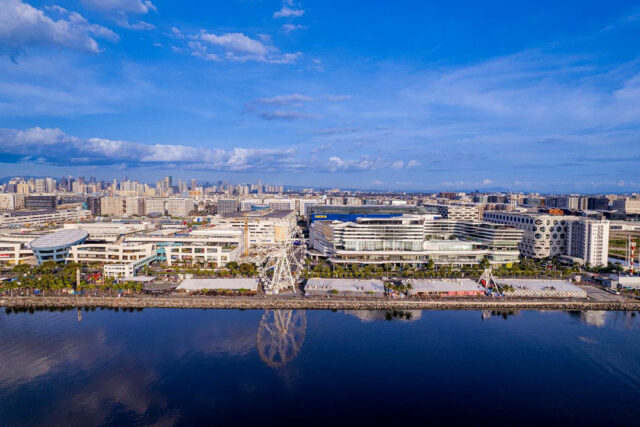
Mall of Asia Complex: SM Prime’s flagship integrated property development

SY-LED property developer SM Prime Holdings, Inc. (SM Prime) posted an 8% year-on-year increase in third-quarter (Q3) net income to P12.8 billion from P11.8 billion in the same period last year, lifted by contributions from its mall and hotel and convention center businesses.

“I think we should still be able to grow our Q4 numbers, although it might not be the same level as what we have seen in the past due to slower economic growth in the Philippines,” SM Prime President Jeffrey C. Lim said during a briefing on Monday.

“Our malls remain strong anchors for growth,” he added. “Their performance was driven by regional expansion, the upgrading of flagship malls, and the introduction of more experiential retail and dining concepts.”

Total revenues for Q3 were not disclosed in the press release, and the company has yet to release its full quarterly report.

For the first nine months of 2025, SM Prime’s net income grew 10% to P37.2 billion from P33.9 billion a year earlier, with total revenues rising 4% to P103.4 billion from P99.8 billion.

Malls accounted for 59% of consolidated revenues, posting 7% growth to P61 billion due to additional tenants and leasable space.

“The residential and office segments were tempered by macroeconomic conditions, but recovery initiatives are underway,” Mr. Lim said.

The residential segment, covering both core and leisure projects, contributed P32.6 billion, down 2% from P33.1 billion.

SM Prime currently has 26,000 residential units, split roughly evenly between high-rise and mid-rise buildings, Chief Financial Officer John Nai Peng C. Ong said.

Hotels and convention centers rose 9% to P6 billion, nearly 6% of total revenues.

Revenues from offices and warehouses remained steady at P4 billion, roughly 4% of the total.

“Hopefully, the government will start to work on improving economic growth moving forward, and we expect that SM Prime will be able to meet its objective for the full-year of 2025,” Mr. Lim said. The company remains on track to meet or exceed its P45-billion full-year 2024 net income, he added.

SM Supermalls President Steven T. Tan noted that phase four of SM City Xiamen’s redevelopment is set for completion in early 2026, while SM City Xiamen Haicang is currently 90% occupied.

Capital expenditures in the first nine months totaled P59.3 billion, up 11% from the previous year, largely directed toward ongoing mall and residential projects, with the remainder allocated to estate, hotel, and convention center developments.

SM Prime ended September with a net debt-to-equity ratio of 46:54 and an interest coverage ratio of 7.1x. Total assets reached P1.08 trillion, with investment properties representing 60% of the total, while cash and cash equivalents stood at P33.2 billion.

On the local bourse on Monday, SM Prime shares fell 1.45% or P0.30 to close at P20.40 apiece. — Beatriz Marie D. Cruz

December BSP cut almost certain after Q3 GDP miss

BW FILE PHOTO

THE BANGKO SENTRAL ng Pilipinas (BSP) is almost sure to deliver a fifth straight cut next month as the third-quarter gross domestic product (GDP) data showed the need for economic stimulus.

“The soft inflation backdrop and weak third-quarter GDP print strengthens the case for reducing borrowing costs further to support domestic demand,” Moody’s Analytics Assistant Director and Economist Sarah Tan said in an e-mail. “We expect a 25-basis-point (bp) cut in December.”

Ms. Tan said the weak growth seen last quarter was worrying as the slowdown came from sectors that typically drive expansion, like household consumption.

“Consumers remained cautious despite easing inflation and lower borrowing costs, suggesting that wage gains have not kept pace with price pressures in recent years, and that recent weather disruptions have encouraged households to build precautionary savings,” she said.

“The third-quarter GDP disappointment suggests BSP will need to move in December, regardless of any potential Federal Reserve moves,” Nicholas Antonio T. Mapa, chief economist at Metropolitan Bank & Trust Co., said in a Viber message “The below consensus print indicates that growth has been in need of support for some time.”

He said the BSP will likely lower benchmark borrowing costs by just 25 bps next month “given its preference for baby steps.”

Philippine GDP grew at an over four-year low of 4% in the third quarter, the government reported last week. This was sharply slower than the 5.5% expansion in the second quarter and the 5.2% clip in the same quarter in 2024.

This was also significantly lower than the 5.3% median estimate in a BusinessWorld poll of 18 analysts and economists.

Officials attributed the weakness to increased cautiousness in government spending amid a corruption scandal involving state infrastructure projects, which they said also affected consumer and investor confidence.

The third-quarter clip brought the nine-month average to 5%, putting the government’s 5.5%-6.5% full-year GDP growth target further out of reach.

Last month, the BSP reduced benchmark rates by 25 bps for a fourth straight meeting to bring the policy rate to 4.75%, bringing total cuts since August 2024 to 175 bps.

BSP Governor Eli M. Remolona, Jr. has said that another cut is possible at the Monetary Board’s Dec. 11 meeting, with further reductions until next year also on the table as they want to support domestic demand amid softening growth prospects.

Security Bank Corp. Chief Economist Angelo B. Taningco said they expect the BSP to deliver a 25-bp cut next month and another 25-bp reduction early next year.

“These additional albeit modest rate cuts are warranted to underpin GDP growth, which was tepid last quarter; temper inflation expectations; and manage foreign exchange volatility,” he said in an e-mail.

JUMBO OR OFF-CYCLE CUT?
BDO Securities Corp., a BDO Capital & Investment Corp. subsidiary, said in a note on Monday that the weak GDP print could fuel more cuts, possibly even “jumbo” reductions.

“Despite the narrowing gap between Fed and BSP policy rates, expectations of slower economic growth have fueled speculation that the BSP may adopt a more dovish stance. Some analysts are even suggesting a 50-bp cut at the December meeting,” it said.

“While such moves could weaken the peso, the BSP appears willing to tolerate depreciation toward P60, prioritizing economic recovery over currency strength or stability.”

Pantheon Macroeconomics Chief Emerging Asia Economist Miguel Chanco and Asia Economist Meekita Gupta said in a report on Monday that the “ugly” third-quarter economic performance that showed weakening domestic demand could give the BSP a reason to frontload its policy easing with a 50-bp reduction next month if inflation stays manageable.

Meanwhile, Security Bank’s Mr. Taningco said an outsized or off-cycle cut is unlikely “so as not to exert sharp peso depreciation pressure especially with Fed Chair [Jerome H.] Powell’s hawkish guidance.”

“At this stage, however, we see BSP sticking to 25-bp increments as opposed to delivering 50-bp in one go, given currency weakness (USD/PHP hit a record high after the Q3 GDP data release) and our view of a Fed pause in December,” Nomura Global Markets Research analysts Euben Paracuelles and Yiru Chen likewise said in a note on Monday.

“Still, we continue to see a risk of BSP delivering additional policy rate cuts next year, if the more “severe scenario” materializes, including a delay in the enactment of the 2026 budget and/or a slow resolution to the scandal.”

The peso hit a record low of P59.13 on Oct. 28. Prior to the GDP report, it rebounded to the P58 level, but slid to the P59 range anew following the data release, closing at P59.04 on Friday.

The Fed last month cut rates by 25 bps for a second time in a row to bring its target rate to the 3.75%-4% range. However, Mr. Powell said another reduction in December remains up in the air amid the lack of clarity about the economy due to the lack of data amid the US government shutdown.

This widened the differential between the US central bank and the BSP’s key rates to 75 bps.

Metrobank’s Mr. Mapa said that while another cut from the BSP next month could again narrow the rate gap and put pressure on the currency, “we believe this is one development monetary authorities would need to weather as the economy appears in need of as much support it can get.”

“(This) is something BSP will be willing to deal with in order to support moderating growth momentum.”

Moody’s Analytics’ Ms. Tan said the BSP is expected to adjust its policy settings only during its scheduled meeting “to maintain clarity and market stability.”

She added that the Fed’s hawkish stance and the weak peso could give the BSP less elbow room to ease.

“Another rate cut could add downward pressure on the currency, as lower yields make peso assets less attractive to investors. The BSP will likely continue easing, but it will do so cautiously, supporting growth while guarding against excessive peso volatility.” — Katherine K. Chan

RLC Q3 profit up 19% on strong residential, leasing gains

ROBINSONSLAND.COM

GOKONGWEI-LED Robinsons Land Corp. (RLC) reported a 19% increase in its third-quarter (Q3) attributable net income to P3.30 billion, driven by higher residential sales and steady leasing revenues from malls and office properties.

Revenues for Q3 rose 25% to P12.58 billion, the company said in a disclosure on Monday.

“Excluding its one-time gain due to the reclassification of its GoTyme investment last year, attributable income rose by 10% year on year, reflecting the underlying strength of RLC’s core operations,” it said.

As of end-September, RLC’s nine-month attributable net income was up 2% to P10.17 billion, while consolidated revenues increased 13% year on year to P35.61 billion.

The company said its development portfolio grew by 28% in the first nine months, driven by a 76% jump in organic residential sales, while its investment portfolio, which includes malls and offices, expanded by 9%.

Robinsons Residences recorded a 30% increase in net sales to P4.06 billion from organic projects, while joint ventures contributed an additional P2.29 billion.

In the first nine months, Robinsons Malls reported an 11% increase in total revenues to P14.55 billion, with rental revenues up 10% to P10.27 billion, supported by 7% same-mall rental growth and higher foot traffic. The segment maintained a 94% occupancy rate across 1.7 million square meters of leasable space.

Robinsons Offices recorded a 5% rise in revenues to P6.24 billion as of end-September, backed by rental escalations and new IT-BPM tenants. Q3 office occupancy improved quarter on quarter to 88%.

“Our performance this quarter underscores the strength and resilience of our core businesses,” RLC President and Chief Executive Officer Mybelle V. Aragon-GoBio said.

“Despite a more competitive environment and strategic reinvestments, we sustained healthy profitability and expanded our revenue base,” she added.

The hospitality segment, Robinsons Hotels and Resorts (RHR), posted a 10% increase in nine-month revenues to P4.74 billion, following strong performances in flagship five-star properties such as Fili and NUSTAR. RHR currently manages 4,000 room keys across 27 hotels.

Robinsons Logistics and Facilities posted a 2% increase in nine-month revenues to P661 million, operating 13 industrial facilities across key logistics hubs in Luzon.

Robinsons Destination Estates reported P674 million in property development revenues from deferred land sales to joint ventures.

As of end-September, RLC’s consolidated assets rose 4% to P273.2 billion, while loans payable fell 21% to P41.91 billion, following the settlement of P13.8 billion in maturing debt during the nine-month period.

In September, RLC raised P7.75 billion from an overnight block placement of shares in its real estate investment trust unit, RL Commercial REIT, Inc. (RCR), which will be used to fund capital expenditures under its reinvestment plan. Its total market capitalization reached P141.92 billion after the infusion of nine mall assets into RCR.

At the local bourse on Monday, RLC shares rose 0.82% or P0.12 to close at P14.80 each. — Beatriz Marie D. Cruz

BankCom’s third-quarter net income climbs to P884 million

BANKCOM.COM.PH

BANK of Commerce (BankCom) saw its net income rise by 11.47% in the third quarter amid higher revenues.

Its net profit climbed to P884.39 million in the three months through September from P793.38 million in the same period last year, its financial statement disclosed to the stock exchange on Monday showed.

“BankCom’s strong third-quarter performance in 2025 was driven by robust revenue growth across key business segments, led by higher net interest income and gains from foreign exchange transactions,” the bank said.

For the first nine months, BankCom’s net income stood at P2.745 billion, climbing by 24.11% from P2.21 billion a year ago.

This translated to a return on equity of 10.63% and a return on assets of 1.35%.

BankCom’s net interest income rose by 23.38% to P2.749 billion in the third quarter from P2.228 billion in the same period last year. Broken down, interest income climbed by 19.5% to P3.82 billion from P3.28 billion, outpacing the 11.33% increase in its interest expense to P1.18 billion from P1.056 billion.

As a result, its net interest margin was at 4.34% as of September, down from 4.48% a year ago.

The bank’s non-interest income likewise jumped by 15.17% year on year to P3.24 billion in the three months through September from P2.81 billion.

Meanwhile, BankCom’s operating expenses rose by 10.85% to P1.99 billion in the third quarter from P1.798 billion in the same period last year amid its efforts to widen its market share through investments in human capital and technology.

This resulted in a cost-to-income ratio of 59%, down from 62% a year ago.

BankCom’s total loans and receivables grew by 10.02% to P150.18 billion as of end-September from P136.51 billion at end-December 2024.

Its gross nonperforming loan (NPL) ratio stood at 1.34% and its net NPL ratio was at 0.55% in the period, up slightly from 1.25% and 0.49%, respectively, at the end of 2024.

The bank increased provisioning for credit and impairment losses by 16.51% to P113.81 million in the third quarter from P97.68 million a year ago. This led to an NPL coverage ratio of 79.89%.

On the funding side, total deposits decreased by 1.8% to P208.19 billion in the first nine months of 2025 from P212.01 billion at end-2024.

“The deposit mix includes P186.18 billion in current account and savings account and P22 billion in time deposits,” it added.

Its loan-to-deposit ratio was at 79%.

BankCom’s total assets stood at P276.25 billion at end-September, growing by 4.07% from P265.44 billion as of end-2024.

Its total capital funds were at P35.64 billion in the first nine months, up by 7.24% from P33.23 billion.

Capital adequacy ratio was at 16.97% as of September, down from 17.58% at the end of last year.

BankCom’s shares closed at P8.20 apiece on Monday, up by five centavos or 0.61% from the previous day. — Aaron Michael C. Sy

Video games’ hottest new platform is an old one: Websites

BW FILE PHOTO

VIDEO GAME players are returning to an old technology to get their dopamine fix: websites.

While much of the $189-billion video game industry is stagnant or shrinking, the appetite for web-based games like GeoGuessr and chess is soaring. Sales for such titles — advertising and the sums players spend for in-game items, were expected to triple from 2021 to 2028, reaching $3.09 billion, according to data from Google and Kantar, a market researcher.

The reason is simple: For time-pressed people, visiting a website — whether it’s on a PC or mobile phone — is fast and easy. No one has to boot up a console or download an app, and games can be picked up at any time, at home or between work shifts. Game creators get to keep more of their proceeds by cutting out revenue-skimming app-store owners and can attract their own advertisers.

“Newcomers are coming to the web,” said Dmitry Kachmar, founder of the web-games company Playgama, an online mall for browser titles that’s based in Dubai. Developers “don’t need publishers. It’s easier to get traffic,” he said.

Web games’ easy accessibility partly explains the success of intergenerational hits like the New York TimesWordle, which was originally posted on its own website. Microsoft Corp.’s LinkedIn and Reddit, Inc. have followed suit with trivia and puzzle games like Sudoku.

It takes only a few seconds to drop into Vortella’s Dress Up, a game on the Poki BV service that has been attracting 16 million plays a month and 460,000 daily active users, according to an online posting by one of the developers.

Early in the 2000s, developers were happy to share simple games featuring stick-figure protagonists and poorly animated cars straight to websites. These titles, made using Adobe Flash, were accessible to anyone who could type an address in a browser.

Over the years, Flash was replaced by better technologies. Popular web games like Zynga’s FarmVille transitioned to smartphone apps. Gamers who developed an appetite for sleek, detailed graphics purchased consoles.

“Developers followed the money, and players followed the quality,” said Chris Hewish, president of Xsolla, which processes consumers’ payments for game companies.

Today, players want to get to their games as cheaply and quickly as possible. Consoles cost more than $450. Players in the $103-billion smartphone game market are experiencing “app fatigue,” downloading less and less, according to data from Sensor Tower, an industry researcher.

That’s why some game makers are going back to the basics and making titles for the open internet again. Electronic Arts, Inc. founder Trip Hawkins recently predicted web games will be “one of the next waves.”

“I’m encouraged by the landscape of web games,” Matthew Bromberg, chief executive officer of Unity Software, Inc., said in an interview. Unity’s software powers more than half of today’s web games, he said.

According to a report from Playgama, an estimated 15,000 games launched in 2025 that use HTML5, the most popular underlying web game technology. That’s 2.7 times more than a year ago.

“It’s an exciting new platform that’s open, which is really good for developers and consumers,” Mr. Bromberg said.

One reason for the shift is the hurdles posed by platform gatekeepers and fees taken by software distributors. Steam, a storefront for PC games, and Apple take 30% of most dollars spent on their platforms. After recent regulatory action forced open the mobile-gaming market, developers are looking for ways to earn money without paying such fees.

“Policy changes in regions such as the European Union have reduced reliance on app stores and opened up direct access to users through web apps,” Xsolla’s Mr. Hewish said. “At the same time, rising user acquisition costs and persistent store fees have encouraged developers to look for alternative, higher-margin channels.”

Web-game companies are beefing up. Amsterdam-based Poki, the host of Vortella’s Dress Up and a top web-game company, has more than doubled its employee count to 70 since 2020, while revenue has grown by roughly 50% annually. The added manpower supports an expanding ecosystem that draws 100 million monthly active users. A top-10 game developer in 2020 would have earned $50,000 in yearly revenue, while today that number is about $1 million, according to the company.

Web games make money primarily through advertising. While some developers opt to host them on their own websites, others turn to aggregators like Poki, Playgama, or Crazygames.com. Belgium-based Crazygames increased its revenue by 43% annually over the last four years and expects to hit $100 million in 2027, according to Raf Mertens, who founded the company a decade ago.

Crazygames and Poki charge more than app stores’ 30% revenue fee for developers on the site. But the companies help developers connect their games to users and make money. Mr. Mertens also doesn’t restrict creators from hosting their games themselves elsewhere.

“You can invite people by sharing a link, and they click it and they’re playing,” he said. — Bloomberg

Ayala Land says nine-month income hit P21.4B on property, leasing

AYALALAND.COM.PH

AYALA LAND, INC. (ALI) reported a net income of P21.4 billion for the first nine months of 2025, up from P21.2 billion in the same period in 2024.

Consolidated revenues for the period totaled P121.8 billion, the company said in a press release on Monday. ALI has yet to release its full report for the third quarter.

Revenues from the property development segment reached P75.9 billion, compared with P76.6 billion in the same period last year.

Combined revenues from the sale of offices and commercial and industrial (C&I) lots were P12.8 billion, up from P10.4 billion in the first nine months of 2024, driven by lot sales in the first semester and bookings at Makati Central Business District, Vertis North, and Arca South, the company said.

Total sales reservations for residential products and C&I lots amounted to P111.7 billion, compared with P100.5 billion in the same period last year.

The company launched P51.3 billion worth of property development projects in the first nine months, with 91% allocated to vertical and horizontal residential projects and 9% to commercial and industrial lots across Ayala Land estates.

Revenues from the leasing and hospitality portfolio were P35.1 billion, up from P33.2 billion a year earlier.

Shopping center revenues totaled P17.4 billion, compared with P16.7 billion in the same period last year. Office leasing revenues were P9 billion, down from P9.4 billion, while hospitality revenues amounted to P7.4 billion, up from P7.1 billion, including contributions from the recently acquired New World Makati Hotel and temporary closures for renovation.

“Ayala Land continues to navigate market challenges with discipline and focus,” said ALI President and Chief Executive Officer Anna Ma. Margarita Bautista-Dy.

“We remain committed to expanding our leasing portfolio, enhancing property development fundamentals, and driving disciplined execution and capital efficiency. These, together with our quality improvements, are the key ingredients that will enable Ayala Land to sustain long-term growth,” she added.

Total capital expenditures for the first nine months reached P65.5 billion, with 40% allocated to residential projects, 26% to leasing and hospitality assets, 20% to mixed-use estates, and 13% for ongoing land acquisition commitments.

The company maintained a net gearing ratio of 0.77:1 and an interest coverage ratio of 4.9x.

ALI said it will return a combined P15.7 billion to shareholders in 2025, including P8.5 billion in cash dividends and P7.2 billion via ongoing share buybacks.

Ayala Land shares closed at P19.42, down P0.28 or 1.42% on Monday. — Alexandria Grace C. Magno

Bank of Japan saw growing case for near-term hike — summary

THE JAPANESE national flag is hoisted atop the headquarters of Bank of Japan in Tokyo, Japan Sept. 20, 2023. — REUTERS

TOKYO — Bank of Japan (BoJ) policymakers saw a growing case to raise interest rates in the near term, with some calling for the need to ensure companies’ wage-hike momentum will be sustained, a summary of opinions at the October meeting showed on Monday.

Of the 13 opinions on monetary policy from the nine-member board, eight called for the need to raise interest rates soon or laid out specific conditions to hike borrowing costs in the near-term horizon, the summary showed.

The discussions heighten the chance the BoJ could hike rates next month or in January, with the timing dependent on whether earnings and comments from executives give policymakers enough conviction that firms will keep increasing pay next year.

“While the current situation may not require immediate action, the bank should not miss the timing to raise the policy interest rate,” one member was quoted as saying in the summary.

The BoJ is likely to raise rates if there is “no negative news” regarding the global economy or markets, and if it can confirm that firms’ active wage-setting behavior will be maintained, another opinion showed.

“It is likely that conditions for taking a further step toward normalizing the policy rate have almost been met. But the Bank needs to examine to what extent the underlying inflation rate has become entrenched,” a third opinion showed.

At the two-day meeting through Oct. 30, the BoJ kept interest rates steady at 0.5%. Two board members, Naoki Tamura and Hajime Takata, dissented to the decision and instead proposed hiking rates to 0.75%.

In a news briefing after the meeting, BoJ Governor Kazuo Ueda said he wanted to await “a bit more data” to confirm whether companies will keep raising wages despite pressure from higher US tariffs.

BoJ board member Junko Nakagawa offered few hints on the timing of the next rate hike in a speech on Monday, but warned of soft consumption and concern over the US economic outlook.

While the BoJ will continue to raise interest rates, it will carefully scrutinize data given “high uncertainties” surrounding the impact of US trade policy, she said.

The summary showed several opinions pointing to the fallout from higher US tariffs and Japanese companies’ wage momentum as key factors in deciding the timing of the next rate hike.

One member said the BoJ needs to take “a little more time” to examine the economic situation due to uncertainty over US tariffs and the economic policy of Japan’s new administration.

Another said raising the policy rate now would be part of a process of normalization that would help curb economic distortions for the future.

The BoJ ended a decade-long, massive stimulus last year and raised short-term rates to 0.5% in January on the view Japan was on the cusp of durably achieving its 2% inflation target.

While Mr. Ueda has signaled his readiness to raise rates further, the BoJ faces political challenges after Prime Minister Sanae Takaichi, an advocate of expansionary fiscal and monetary policy, became the nation’s prime minister last month.

Underscoring her preference for loose monetary policy, the Ms. Takaichi administration will urge the BoJ to focus on achieving strong economic growth accompanied by stable prices in an outline of its stimulus package, a draft seen by Reuters showed.

A majority of economists polled by Reuters last month forecast the BoJ will raise interest rates in the current quarter with nearly 96% of them expecting a hike by end-March. — Reuters

PLDT adds HBO Max to upgraded Fiber Unli All plans

FIBER Unli All plans, which provide internet service and monthly access to Netflix and Cignal, have been upgraded by PLDT Home to include a standard subscription to HBO Max.

PLDT executives gave a rundown of the expanded packages that combine internet connectivity with streaming subscriptions at a press event in Pasay City on Nov. 5. Two of its available variations are part of the upgrade: Fiber Unli All Plans 2499 and 3199.

John Y. Palanca, PLDT’s senior vice-president and head of consumer business, said at the launch that these plans are their flagship offerings due to their “fast, reliable speeds, leveled up with entertainment through Cignal’s local and international channels and the Netflix subscription for multiple screens.”

“Now, we are adding and bringing to your homes HBO Max. It gives you all of their beloved franchises and properties, HBO’s prestige TV, and movies you normally wouldn’t be able to watch,” he explained.

“PLDT Home is the first telco in the Philippines to bundle HBO Max,” Mr. Palanca said.

For the company, this move “reinforces PLDT Home’s standing as the Philippines’ leading telco and digital entertainment provider, bringing Filipino families a world of endless streaming possibilities under one powerful connection.”

Some of HBO Max’s popular titles are series like Game of Thrones, Succession, The White Lotus, and The Last of Us. There are also franchises such as Harry Potter and blockbusters like Superman.

Another addition to the two upgraded plans is the free, one-year IGV Game Pass. Here, subscribers gain access to over 200 games, both indie and AAA titles, like Baldur’s Gate and the NBA Games.

“Why else do we use connectivity at home other than work and education, other than content and streaming? For all the gaming enthusiasts among our customers, we’re giving access to over 200 PC games through the IGV Game Pass — not just for one month, not just for two months, but free for the entire year,” Mr. Palanca said.

Both new and existing subscribers of the enhanced Fiber Unli All Plans 2499 and 3199 will now enjoy the HBO Max standard subscription and the IGV Game Pass bundled with their internet service, in addition to their monthly access to Netflix and Cignal.

These plans combine unlimited internet with speeds of up to 700Mbps (megabits per second) for Plan 2499 and up to 1Gbps (gigabit per second) for Plan 3199.

Mr. Palanca pointed out that these are part of PLDT Home’s plan to “continue to have the dominant market share in the Philippines, raising the bar for connectivity.”

“Our plan is really to make PLDT Home the ultimate home lifestyle partner for every Filipino home at all budgets,” he said. “We will not stop there. We will continue to keep adding and adding to these plans as we build up the lifestyle brand to make sure that we become the key entertainment hub at home, coupled with our fiber fast connectivity.”

He added that Filipinos can now avoid the hassle of managing multiple subscriptions thanks to their expanded all-in-one offerings.

“We look forward to introducing more exciting partnerships and innovations that make Filipino homes more connected than ever,” Mr. Palanca said.

More information on PLDT Home’s Fiber Unli All plans, now featuring HBO Max and the IGV Game Pass, can be found at pldthome.com.

Hastings Holdings, Inc., a unit of PLDT Beneficial Trust Fund subsidiary MediaQuest Holdings, Inc., has a majority stake in BusinessWorld through the Philippine Star Group, which it controls. — B. H. Lacsamana

Manila Water sewer connections reach more than 360,000

MANILA WATER CO., INC.

EAST ZONE concessionaire Manila Water Co., Inc. said its sewer connections have reached over 360,000, covering residential, commercial, and industrial accounts.

The company added 43,604 new accounts in September, one of the highest monthly gains this year, it said in a statement on Monday.

To support its sewer coverage targets, Manila Water is accelerating key infrastructure projects across Mandaluyong, Marikina, Taguig, Quezon City, and Antipolo, the company said.

These include the Aglipay Sewage Treatment Plant (STP) and network in Mandaluyong, which is already undergoing commissioning and operational testing, and the Hinulugang Taktak STP in Antipolo, which is already physically completed and slated for inauguration this November.

Other ongoing works include the Marikina North-Batasan diversion project, and critical segments of the Taguig North Network and the Quezon City East Network.

“Sewer infrastructure like the Hinulugang Taktak STP and the Aglipay STP are key to protecting our waterways and improving sanitation in our communities. These milestones reflect our commitment to expanding coverage and delivering long-term environmental benefits,” said Dittie Galang, Manila Water corporate communications department head.

In September, the company emptied 11,013 septic tanks across the East Zone, serving both scheduled customers under the desludging program and those who requested the service outside their assigned schedule.

The company said these ongoing efforts support its mandate to ensure comprehensive sewer and sanitation coverage throughout the East Zone, as required by regulators, and contribute to healthier communities and cleaner waterways. — Sheldeen Joy Talavera

People at the heart of ASEAN

STOCK PHOTO | Image from Freepik

In 2024, the ASEAN Secretariat estimated the total population of the 10 ASEAN member-states at 676.6 million. The ASEAN is the third most populous region in the world, after China and India. With this large population, the ASEAN has made their well-being a priority, echoed in the ASEAN Community Vision 2045 — Resilient, Innovative, Dynamic, and People-Centered ASEAN.

Officially, however, there are only 81 ASEAN entities registered with the ASEAN under Annex 2 of its charter, of which 48 are classified as civil society organizations (CSOs). These 81 entities cannot encompass the challenges, priorities, and interests of 676.6 million people. While a people-centered ASEAN is a noble ambition, there is a long path ahead for this goal to become reality.

CSOS AND ASEAN
When asked about “ASEAN,” the ordinary Filipino would look at you in confusion and a shrug. ASEAN awareness is low, regrettably so in the Philippines, where students and many sectors have little to no understanding of what the ASEAN is and what it does. An organization that wants to become people-centered must be known to the people and have considerable levels of impact on their lives.

The 2025 Baseline Study of the ASEAN Socio-Cultural Community Blueprint looked at how the ASEAN and its member states have carried out the visions and plans for 2021-2025. What is most noticeable is that the people-centered aspect only seems to apply to what governments do for their citizens. The limited participation and low visibility of CSOs in decision-making and community building is apparent. Connections are not made with CSOs throughout the region, and engagement remains rather vertical.

GEOCIVIC DIPLOMACY IN ASEAN
Foreign Policy Community Indonesia (FPCI) Founder and Chair, Dr. Dino Patti Djalal, has said that more than geopolitics, there needs to be a “geocivic” approach to the ASEAN. FPCI is an independent foreign policy organization based in Jakarta, Indonesia that conducts research on Southeast Asian foreign policies and organizes grassroots conferences in the region.

The goal of geocivic diplomacy in the ASEAN is to build a bottom-up ASEAN community and make the ASEAN process a two-way street, based on concrete and real issues among ASEAN communities.

There needs to be continuous engagement that results in actual results. CSOs advocate for issues they believe need to be addressed. These issues include gender, climate change, labor, corruption, good governance, MSMEs and entrepreneurship, access to education, access to affordable healthcare, the digital economy, migrant workers, and many more. The issues mentioned are not present in just one member state in the ASEAN, but across the region. Cross-pillar and cross-cutting challenges need regional solutions and cooperation, and this can only work when CSOs, those at the grassroots level and have personal experience, are able to provide inputs and contribute to policies and strategies that the ASEAN creates.

Geocivic diplomacy engages the very people the ASEAN is said to be centering. FPCI believes that greater involvement of CSOs, who are extensions of its people in the ASEAN, will make the ASEAN more known and respected in the region.

INCREASED ENGAGEMENT
Recently, the Philippine Women’s Economic Network (PhilWEN) was invited to participate in the first-ever ASEAN for the Peoples Conference, a flagship conference organized by FPCI that envisions itself as the premier forum for people-to-people dialogue in Southeast Asia. It gathered over 100 CSOs to align advocacies and initiatives and let the ASEAN know that CSO presence in the region is a force to be reckoned with; Southeast Asia’s Greatest Resource, as the theme of the conference states.

As the Founding Chair and President of PhilWEN, I had the privilege of representing the organization by speaking in a panel entitled “Closing the Gender Gap in Southeast Asia.” In the panel, I echoed the Philippines’ progress in gender equality and how PhilWEN and Philippine Business Coalition for Women Empowerment (PBCWE) push for women’s economic empowerment and workplace gender equality in the private sector.

I stressed that our work also extends in the region as our membership in the ASEAN Women Entrepreneurs Network (AWEN), an entity under the ASEAN Committee on Women, is valuable and opens many opportunities that we can utilize. During the Philippine chairing of the ASEAN in 2017, AWEN, which the Philippines also chaired then, participated in crafting the Action Agenda on Mainstreaming Women’s Economic Empowerment in ASEAN, which the leaders of the ASEAN adopted and signed. This action agenda aims to mainstream women’s economic empowerment through innovation, trade and inclusive business, and human capital development.

Our inclusion and participation in ASEAN entities was borne out of the will to contribute meaningfully to ASEAN community building which began in 2014 when AWEN was organized.

MAKING ASEAN PEOPLE-CENTERED
As the ASEAN continues to build its community and envisions the creation of a community that is inclusive and resilient, it is important to reach out to the people of the ASEAN and listen to what they have to say. After having participated in the ASEAN for some years now and with my experience leading CSOs, here are some recommendations:

1. Civil society organizations need to be included in decision-making. Currently, CSOs are under the purview of the ASEAN Foundation, which has limited resources to become the hub of all CSO activity in the region. There must be an evaluation of ASEAN mechanisms and where best to put CSOs.

2. CSOs should be given easier access to the ASEAN. The process of applying as an ASEAN entity is tedious, which prevents the CSOs from having meaningful participation and contribution. ASEAN entities are allowed to use the ASEAN name and are given access to the ASEAN Project Cooperation system, which has funding mechanisms as well as access to ASEAN member states and external partners.

3. ASEAN bodies should consider CSOs as implementing agencies for their plans and programs. As they have a presence and familiarity with their home countries, they can be the focal points for action lines related to their advocacies, whether environment, energy, or women and children.

4. The ASEAN must enhance people-to-people connectivity and foster a sense of community for the future that they are building. While the top-down approach can work to a certain extent, it is important to also consider the bottom-up approach. CSOs are a vital tool and resource for the ASEAN to reach out to its citizens.

CSOs want to be included. They are representations of the aspirations of the people of the ASEAN: to live in a region where their needs are met and their voices valued. We all need to do more and work to put our people at the heart of the ASEAN.


Ma. Aurora “Boots” D. Geotina-Garcia is a member of the MAP Diversity, Equity & Inclusion Committee and the MAP Education Committee. She is founding chair and president of PhilWEN and chair of the Governing Council of the Philippine Business Coalition for Women Empowerment. She was the first female chair of the Bases Conversion & Development Authority. She is president of Mageo Consulting, Inc., a corporate finance advisory and consulting firm.

map@map.org.ph

magg@mageo.net

ADVERTISEMENT
ADVERTISEMENT