Home Blog Page 6859

ACEN, partner to build 420-MWp solar farm in India

AC ENERGY Corp. (ACEN) and its joint venture partner have started building their largest solar farm in India with a capacity of 420-megawatt peak (MWp) at an estimated cost of $220 million, the Ayala-led company said on Sunday.

In a media release, the listed energy platform said the Masaya Solar project in the Khandwa District, State of Madhya Pradesh is through UPC-AC Energy Solar Ltd., its partnership with UPC Solar Asia Pacific Pte. Ltd. It will have a power output of 300 MW of alternating current.

“Though the pandemic continues to present challenges, we are confident that we will complete the construction of this solar development safely and at the earliest possible time, to contribute even more meaningfully to India’s renewable energy goals,” said Patrice R. Clausse, head of ACEN’s international group.

ACEN said UPC-AC Energy Solar is in the process of securing a 20-year loan from the State Bank of India to fund the project under a 75:25 debt-to-equity financing scheme. The joint venture is expected to supply electricity at 2.71 Indian Rupee per kilowatt-hour (kWh) fixed over a 25-year period under a power supply agreement with the Solar Energy Corporation of India, it added.

The Masaya Solar farm, the third solar project of the joint venture company, is expected to produce 691 gigawatt hours (GWh) of clean power and avoid approximately 635,720 metric tons of carbon dioxide emissions every year. The joint venture’s latest project is expected to generate 500 jobs during the construction phase. 

In 2021, UPC-AC Energy Solar turned on its first two solar farms in India — the 140 MWp Sitara Solar and 70 MWp Paryapt Solar.

In the media release, it quoted Pranab Kumar Sarmah, chief executive officer of UPC-AC Energy Solar and co-founder of UPC Solar Asia-Pacific, as saying: “Working hand-in-hand with an extremely competent and enthusiastic team in India and beyond, I am confident that this project will stand the test of both time and budget in this challenging COVID scenario. India is one of the world’s largest consumers of energy and producers of renewable energy. We understand the country’s urgency to increase its production of renewables to help meet the demand and support the country’s progress.”

“This landmark development will be a significant addition to the country’s renewables capacity,” the company official added.

ACEN is targeting to become the biggest listed energy platform in Southeast Asia as it eyes to put up 5,000 MW of renewable energy capacity by 2025.

Across Asia-Pacific, it has more than 3,000 MW of attributable capacity and an 18,000-MW pipeline of renewable energy projects being developed in the region with various partners. ACEN expects around 500 MW of these projects to reach their financial close by the first quarter of 2022.

On Friday, shares in the company slipped by a centavo or 0.11% to close at P9.49 each. — M.C. Lucenio

Paris Fashion Week: Dior showcases glittering craftsmanship on Paris runway

ELIE SAAB — ELIESAAB.COM

PARIS — Christian Dior took to the runway with sparkles and tailoring on Monday for the first day of Paris’ Haute Couture week, sending models down the catwalk in strapless dresses and neat winter jackets.

While the fashion world is still wavering on how to cope with the coronavirus outbreak, Dior decided to stage an in-person catwalk show for one of the most anticipated events of the season.

Masked guests included actresses Rosamund Pike, Madelaine Petsch and Claire Foy along with influencer Chiara Ferragni, and Vogue editor-in-chief Anna Wintour.

Rhinestone and pearl embroideries dominated the collection on ankle-length dresses, shimmering tights paired with glitter bodysuits, sleeveless jackets and low-heel shoes.

The profusion of glitter was broken with neutral tones that ranged from black to off-white. Designs included ecru cashmere capes, grey pleated ensembles and long silk evening dresses cut low in the back.

The venue, a temporary structure in the gardens of the Rodin Museum, featured larger-than-life embroidered artworks from Indian artist couple Madhvi Parekh and Manu Parekh. The exhibition of surreal pieces remained in place for public viewing throughout the week.

LVMH-owned Dior collaborated with the Chanakya School of Craft based in Mumbai for some of the silhouettes, including a top embroidered with silver ribbons and crystal tassels matched with an A-line skirt.

With this Spring-Summer 2022 collection, described by designer Maria Grazia Chiuri as a highlight of art and craft, the creative chief wanted to promote a new generation of craftspeople.

“I think that to be a couture brand today, for Dior, means to support all this ability around the world and to promote and to maintain life,” Ms. Chiuri said in an interview with Reuters ahead of the show. “Because with the COVID, the risk is it disappears.”

HORSE STRUTS CHANEL CATWALK
French fashion house Chanel shook up conventions by sending a horse out onto the catwalk at its Haute Couture show in Paris on Tuesday.

The animal was ridden by Charlotte Casiraghi, a niece of Prince Albert of Monaco and a competitive showjumper who is also a Chanel brand ambassador.

Wearing a Chanel jacket made of black tweed and decorated with sequins, Ms. Casiraghi rode out at the start of the show, cantering several times around a catwalk designed to resemble a horse training ring.

The rest of the models — this time on foot — came out onto the catwalk afterwards.

The show, at the Grand Palais Ephemere, an exhibition and performance space in Paris, was conceived by Virginie Viard, who became Chanel’s creative director in 2019 following the death of haute couture icon Karl Lagerfeld.

STÉPHANE ROLLAND RETURNS TO PARIS
French label Stéphane Rolland returned to the runway on Tuesday for the first time since the coronavirus pandemic began, offering an array of feminine draped dresses and billowing cloud-like gowns.

After almost two years, the designer Stéphane Rolland said he felt it was time to get back to an in-person show for his new couture collection.

“We designed the collection to be displayed on a runway — if there were any last-minute problems, we could always change course,” the French designer told Reuters before the show.

Held in the Palais de Chaillot, at a stone’s throw from the Eiffel tower, the spring-summer 2022 presentation opened to the beat of Aretha Franklin and a series of fluid kaftans made of satin crepe in black and ivory tones.

Mr. Rolland’s muse, the Spanish model Nieves Alvarez, strode down the catwalk in a hooded golden metallic blazer paired with wide pants in white wool.

The label, known for its sculptural outfits, slightly refined its designs but silhouettes remained bold and striking. “I have the impression that with what we have gone through, it was necessary to turn a page — without turning my back on what I had done before,” Mr. Rolland said.

“I want to highlight the body of a free woman differently — to project a desirable look, and play with transparency in a subtle manner, rather than a slightly vulgar style. It’s about sensuality, not sexuality.”

Tailored dresses, a long brown tunic, draped gowns plunging in the back or front alternated on the catwalk while other models paraded in transparent chiffon dresses.

Ms. Alvarez closed the show in a black velvet and satin ballgown and a huge emerald necklace.

Before the presentation, Mr. Rolland paid homage to Thierry Mugler with a recorded message honoring the designer who died on Sunday last week.

ELIE SAAB BRINGS VIBRANT LOOKS
Lebanese fashion designer Elie Saab returned to the Paris catwalk after nearly two years, turning the page on a troubled period marked by the Beirut port blast and coronavirus disease 2019 (COVID-19), with a collection of vibrant, red carpet-ready looks.

Mr. Saab sensed a need for release, he told Reuters in an interview ahead of the show.

“I felt my clients are looking for release, they want things that are flashy, with colors, lively things — I see that this period has affected a lot of people,” he said.

Drawing on the influence of the Mediterranean region’s colors and civilizations, the designer worked bright hues into his collection.

Models wound around the room in tulle ball gowns and capes covered in bright Bougainvillea flowers, which contrasted in texture and color with shimmery blue-toned dresses covered in embroidery.

Mr. Saab’s previous runway show in the French capital took place in Feb. 2020, just before the novel coronavirus swept across the globe, halting travel and prompting lockdowns.

Weddings and awards ceremonies — key events that send clients to Saab — were canceled for months.

Then, in August, Beirut was rocked by the explosion that killed more than 200 people, wounded thousands and laid waste to entire neighborhoods.

The offices of Mr. Saab’s namesake label were badly damaged, as was his home, its arches and marbled columns covered with dust and rubble.

“Thank God, no one died — we were blessed,” Mr. Saab said, noting they were able to quickly return to the offices in the weeks that followed.

Work continued on his home, however.

“There’s still my house — that was destroyed as well — we are still finishing the works,” said the designer, who founded his label in 1982, at the height of the country’s 1975-1990 civil war.

“We, Lebanese, when we go through difficult times — each time we experience difficult times, we transform the challenge into something better. There’s no other country that has had so many problems,” he said. — Reuters


Rates of T-bills, bonds to move sideways amid steady demand

BW FILE PHOTO

RATES of government securities may move sideways or drop this week as demand is seen to remain steady amid excess liquidity in the financial system.

The Bureau of the Treasury will offer P15 billion in Treasury bills (T-bills) on Monday, or P5 billion each in 91-, 182- and 364-day securities.

On Wednesday, it will auction off P35 billion in reissued five-year Treasury bonds (T-bonds) with a remaining life of four years and two months.

Rizal Commercial Banking Corp. Chief Economist Michael L. Ricafort said the recent maturity of T-bonds worth over P100 billion have added excess liquidity to the system, which could lead to the easing of yields.

“Higher US or global bond yields recently after more hawkish signals on possible more Fed rate hikes even every Fed meeting and possible reduction of the Fed’s balance sheet or bond holdings, partly led some excess funds to park at short-term tenors for the meantime,” Mr. Ricafort said in a Viber message.

Meanwhile, a trader said T-bill yields could trend sideways, while the reissued five-year securities could fetch a rate around 4%-4.15%.

“There was a jump in government securities yields on a week-on-week basis as market players reacted to the Fed and Philippine gross domestic product news,” the trader said in a Viber message. “But we already know that market is still liquid so this somehow tempers each sell-off.”

US Federal Reserve Chairman Jerome H. Powell on Wednesday said the central bank may raise interest rates starting in March, although the pace of later rate hikes is yet to be decided, Reuters reported.

Meanwhile, Philippine gross domestic product (GDP) in the fourth quarter grew by 7.7% for a full-year 2021 5.6% expansion, preliminary government data showed.

This is a reversal of the 9.6% contraction in 2020, but is still lower than the pre-pandemic GDP growth of 6.1% seen in 2019.

At the secondary market on Friday, the 91- 182- and 364-day T-bills were quoted at 0.7562%, 1.0737%, and 1.4404%, respectively, based on the PHP Bloomberg Valuation Reference Rates published on the Philippine Dealing System’s website.

Four-year bonds, the closest benchmark to the remaining life of the reissued papers to be auctioned off on Tuesday, fetched a yield of 3.8154%.

The government raised P15 billion as planned via the T-bills it auctioned off last week.

Broken down, the Treasury raised P5 billion as programmed via the 91-day securities from P27.98 billion in bids. The average rate of the three-month debt paper went down by 18.2 basis points (bps) to 0.693% from 0.875% previously.

The government also borrowed P5 billion as planned through the 182-day instruments on Monday from P27.86 billion in tenders. The six-month T-bill’s average rate fell by 2 bps to 1.0777% from 1.097% a week earlier.

Lastly, the Treasury bureau made a full P5-billion award of the 364-day papers as bids reached P20.53 billion. The average yield on the one-year securities stood at 1.41%, down by 0.5 bp from 1.415% the week before.

Meanwhile, the last time the government offered the five-year T-bonds to be auctioned off on Tuesday was on Jan. 11, where it raised P22.126 billion, less than the programmed P35 billion.

The debt papers were awarded at an average rate of 4.012%.

The Treasury plans to raise P200 billion from the domestic market in February, or P60 billion via T-bills and P140 billion from T-bonds.

The government borrows from local and external sources to help fund a budget deficit capped at 7.7% of gross domestic product this year. — Jenina P. Ibañez with Reuters

Electric company

PHOTO FROM BENTLEY MOTORS

Bentley doubles down on its aspirations for full electrification

AT THE STROKE of midnight last Thursday here in Manila, across the world in the railway town of Crewe in England, the management board of luxury automobile marque Bentley sat together to basically double down — and elucidate on — the company’s previously communicated “Beyond100” strategy.

First revealed in November 2020, Beyond100 “targets sustainable mobility leadership, reinventing every aspect of the business. (The) ambitious aim is to be end-to-end carbon neutral by 2030, with Crewe operations climate positive thereafter.” The “100” refers, of course, to a century of operations since Walter Owen Bentley set up shop with a rather straightforward goal of building a “a fast car, a good car, the best in class.”

Obviously, the world has vastly changed since the infancy of automotive, and today’s industry might appear as simply otherworldly to “WO” if the Bentley founder were alive today. But I digress; company executives say that “being at the forefront of progress is part of (Bentley’s) DNA.”

Averred Bentley Motors Chairman and CEO Adrian Hallmark, “We may be 102 years old but we never felt younger as a company.”

And perhaps as youngsters are wont to do, Bentley is having a hard time keeping still. In fact, it is accelerating the pace of Beyond100 through the launch of (count ’em) five new electric cars — one each year — beginning in 2025. This “Five-in-Five” plan is seen to redefine its credentials as “the benchmark manufacturer in sustainable luxury mobility.” It is only happy to take the lead in this regard. The brand’s first-ever battery-powered electric vehicle (BEV) is set to be developed and built in the UK, and the firm is ponying up a hefty £2.5 billion to realize its sustainability vision over the next 10 years. Understandably, the brass is making a big deal of the fact that the automaker is not jobbing-out the aspects of its electrification but keeping it home “where all Bentley models are built and 4,000 colleagues work.”

Mr. Hallmark underscored how large an undertaking Bentley people are taking upon themselves. This “boldest strategy” as he put it entails the “reinvention of every product… over an eight-year period” until all vehicles are 100% battery-powered by 2030.

The executive shared how “cautiously optimistic” the company had been throughout 2021 amid “Brexit,” the COVID-19 pandemic, and the semiconductor crisis. Nonetheless, last year had been a banner year with record sales and financial returns, and Mr. Hallmark boasted that it marked the second year of double-digit growth for the company.

In a previous release, Bentley Motors reported selling 14,659 units globally in 2021 — up 31% from the year prior (11,206 units). Leading the charge was the Bentayga SUV — accounting for 40% of deliveries, followed by the Continental GT (33%) and the Flying Spur (27%). Of significance to the company’s electric aspirations is the fact that one in every five Bentaygas sold is a hybrid version. This illustrates the kind of openness to electrification — at the very least for Bentley buyers.

Bentley Director for Engineering Dr. Matthias Rabe explained that the Bentayga plug-in hybrid electric vehicle (PHEV) and the Flying Spur PHEV variants have an ability to reduce fuel consumption and carbon emissions by a hefty 50% to 60%, and customers can look forward to all Bentley models having a hybrid version by 2024. While the Bentley powertrain is massively changing, Dr. Rabe maintained the “outstanding craftsmanship” is not — except, perhaps, for the increased use of sustainable materials in keeping with the company’s green vision.

Bentley Board Member for Sales and Marketing Alain Favey clarified that while sales have been on the welcome uptick, the company is ever aware of what it stands for. “We want it to be exclusive,” he declared. And even as Bentley looks to “sell cars everywhere in the world,” it continues to aspire to be “the benchmark in the luxury car market.”

The fact of the matter is that buyers are becoming more aware of their carbon footprint, and are examining how each facet of their lives is hewing to a pervasive concern for the environment. Customers in China and US comprised the bulk of Bentley buyers last year, and a new breed of luxury customers continue to emerge and take shape with that “conscious decision to require sustainability.”

In this regard, Bentley ticks all the boxes. Not only are the end products going to be environment-friendly; the entire ecosystem around it will be, too. In fact, the production facility at Crewe is referred to as the “Dream Factory,” a “digital, zero-environmental-impact, flexible and high-value manufacturing facility.”

The Crewe factory has already been certified carbon-neutral for three years now, but Bentley isn’t stopping there to get to its 2030 goal. It will increase the number of onsite solar panels from 30,000 to 40,000 in the next two years, and commits to further reduce water consumption, waste it sends to landfills, and other environmental impact. “Moreover, Bentley is investigating (the use of) sustainable biofuel in fleet cars, including Bentley’s iconic Heritage Collection. Bentley’s partners are also being encouraged to support Bentley’s goal of being end-to-end carbon neutral by 2030, with suppliers expected to meet minimum sustainability standards. This will extend to (the company’s) global retailer network, each aiming for carbon neutrality by 2025, possibly even sooner,” it reported in a media release.

Expectedly, a new mind-set and approach will call for newly skilled workers, and on that score, Bentley is also working full time. Bentley Board Member for Human Resources Dr. Karen Lange shared that some 30,000 learning activities have already been made to upskill its workers, “the biggest ever intake in early careers.” The company is also making strides with inclusion and diversity. “We see it as an essential business need,” she continued, and underscored that the goal is to have an environment where people feel they belong, and would like to work in. Ultimately it will attract talent.

As for the global challenge of semiconductor availability, Bentley CFO Jan-Henrik Lafrentz intimated that, so far, the brand has secured adequate supply through the Volkswagen Group to which it belongs. You could even say they’re a preferred customer, he declared with a smile. Mr. Lafrentz maintained that while “volume is not a trigger” for Bentley, he expects record sales and profits to continue this year. This is important as the firm wants to fully foot the bill of its own transformation.

Bentley is confident of reaching its 2030 goal — perhaps, one might contend, with even time to spare. Even now, some eight years away, when asked for a word to encapsulate the auto marque’s journey, Mr. Hallmark’s reply is telling.

“Excitement.”

New Misamis center brings commercial PHL silk production closer to reality

SILK cocoons at silk production hubs — PTRI

THE PHILIPPINES is getting closer to its goal of producing en masse that most luxurious of textiles: silk.

On Jan. 25, during the SEDA Conference webinar, the Department of Science and Technology – Philippine Textile Research Institute (DoST-PTRI) unveiled the Silk Research and Innovation Center in Misamis Oriental. The center is the first fully operational filature facility in Mindanao, and outside the PTRI headquarters in Bicutan. The Mindanao facility can convert 25 kilograms of dried cocoons into seven kilograms of raw silk yarn daily.

DoST Secretary Fortunato dela Peña said, “It bridges the seemingly hopeless gap that has beleaguered the Philippine silk industry for a very long time.”

He also observed that compared with the initial efforts for Philippine silk in 1982, he said, “What we have now is truly a breakthrough.”

A series of “periodic silkworm rearings” were conducted from 1978-1981 “to evaluate the performance of silkworm races for selection of breeds for the production of local hybrids that can yield good quality cocoons and silk,” said an article, “Silkworm breeding for the development of Philippine pure lines,” in the International System for Agricultural Science and Technology (AGRIS), which was first published in the National Science and Technology Authority Technology Journal in 1982. The data from this study showed that the cocoons produced back then met the standards set in Japan and Korea.

Alongside the launch of the center was the unveiling of the SEDA Pilipinas brand, that aims to develop the silk industry in the Philippine with programs in silk production.

The final product, a collection from clothing brand Bayo, was shown to an audience on Jan. 25.

A Memorandum of Agreement was also signed between the DOST-PTRI and Bayo, which will result in special collections made from the Philippine silk. This was shown in an exhibition at the PTRI, with Bb. Pilipinas International Hannah Arnold serving as ambassador. The clothes, according to DOST Secretary Fortunato dela Peña, featured natural dyes.

Cheryl Lopez, Program Leader of SEDA Pilipinas, and Senior Science Research Specialist of the DOST-PTRI showed the inroads they have made in silk production, as well as the resources needed to further the program. For example, she notes that from traditional handwoven methods, they have been exploring digital options in applications of patterns and designs.

They have also been doing genomic studies on Philippine-reared silkworms, to produce better, suitable, and productive strains. As for the silk production hubs or silk farms, they have created crop rotation programs for the farmers who plant the mulberry (on which silkworms feed), utilizing one-fourth of a hectare at a time.

Ms. Lopez also reported that the Silk Research and Innovation Center in Misamis Oriental will be capable of producing 40% of the annual local raw silk demand of 10 tons. This translates to 1,612 boxes of hybrid silkworm eggs, 80 hectares of mulberry plantations, and 161 silk production hubs.

As of 2022, they have only reached 25% of the resources needed for the center to produce at full capacity. This comes from gaps in the overall system: this year, they only have 20 hectares of mulberry plantations, as well as 40 cocoon producers. They plan to reach their goals in 2025, working to double their resources by next year, to reach a goal of 40 hectares of mulberry plantations and 80 cocoon producers. Technical Education and Skills Development Authority (TESDA) is offering courses in Cocoon Production as well.

“We should have, within the first semester of the year, plied silk yarns from Bago City, Negros Occidental, and reeled silk from Kalinga,” said Mr. Dela Peña of plans for increasing the size of the country’s silk production.

“The future is one that is creative, sustainable, and inclusive. From this, we can nurture the Filipino dream, and clothe the Filipino spirit.” —  Joseph L. Garcia

DITO CME defers SRO amid tepid market conditions

By Arjay L. Balinbin, Senior Reporter

DITO CME Holdings Corp.’s decision to defer its P8-billion stock rights offering (SRO) may have been due to the current tepid market conditions, analysts said.

The Philippine Stock Exchange (PSE) said in a notice on Saturday that DITO CME’s “management has determined that current market conditions are less than ideal to pursue the offering.”

DITO CME said it will refund “any and all subscription payments made by any existing shareholder or qualified institutional buyer during the offer period of the stock rights offer.”

To recall, the company announced on Jan. 18 that it received regulatory approval to extend its SRO through Jan. 25, allowing more qualified investors to obtain additional shares at an “attractive discount.”

It said the extension was granted “due to numerous requests from shareholders who were unable to subscribe to the offering nor receive their SRO kits on time due to logistical difficulties brought about by the surge of COVID-19 (coronavirus disease 2019).”

DITO CME offered a total of 1.64 billion common shares, priced at P4.88 per share. The offer price was an 18.4% discount from the closing price as of Jan. 13.

DITO CME President Eric R. Alberto said that the proceeds would be used to “fund our telco services all over the country in fulfillment of the technical audit requirements, and to fulfill our own mission to be a compelling and a competitive alternative telco in service of the Filipino public.”

Asked if this could be a sign of lack of confidence in the company, Astro C. del Castillo, managing director of First Grade Finance, Inc. replied: “Definitely, that’s it.”

“But to put it more politely, it should do more to attract more investors by reaching out to the investing public and fund managers,” he said in a phone interview on Sunday.

DITO CME shares closed 1.17% lower at P5.08 apiece on Friday last week. The company owns 54% of DITO Telecommunity Corp.

“I think there was a lack of more relevant information from the company about prospects moving forward, but I understand because it’s just a startup,” Mr. Del Castillo said.

But Anna Corenne M. Agravio, equity analyst at Regina Capital Development Corp., said in a separate phone message: “I don’t think it automatically translates to a lack of confidence in DITO.”

“I’d say it’s more of a reflection of current market sentiment in general. Perhaps DITO weighed the costs of conducting an SRO amid the pandemic and generally muted overall sentiment versus the proceeds it will be able to raise to fund its expansions, and then decided that it would ultimately be a better idea to defer the offering,” she added.

She noted that trading had been relatively anemic in recent weeks.

“Based on the index, it looks like investors are staying cash-heavy for now, which could also translate to a rotation from the more volatile second and third liners (like DITO) to index names in the meantime.”

BusinessWorld tried to reach out to DITO CME to get its side.

Moreover, the PSE said its announcement on Saturday should not be construed as an approval of DITO CME’s deferment of the offering.

“This is without prejudice to any regulatory action that [the] Exchange may pursue in order to ensure full compliance with the applicable rules and for the protection of the investing public consistent with the mandate of the Exchange, as a self-regulatory organization, to maintain a fair and orderly market,” it added.

DITO CME’s action, according to Diversified Securities, Inc. Equity Trader Aniceto K. Pangan, may have a negative impact on future offerings.

“If PSE approve[d] on this after the offer has been made, then the credibility of [the] PSE to conduct an offering will be stained or questioned,” he said.

“Already a number of investors have sold their DITO shares after the ex-date when the stock offer price has been set. They’ll use this as payment for their stock right shares’ entitlement if canceled then instead of gain from stock rights offer, investors will bear the losses thus investor interest will negatively be affected,” he added.

COL Financial Group, Inc. First Vice-President April Lynn C. Lee-Tan disagreed that DITO’s action will affect investor interest in future offerings.

“No, it shouldn’t. While it is true that market conditions are difficult, the numerous IPOs (initial public offerings) and follow-on offerings the past two years imply that as long as a company has good business and is selling shares at a reasonable valuation, there will be demand,” she said in a phone message.

Prior to its announcement on Saturday, the PSE said on Jan. 27 that it penalized the company for “failure to comply with the requirements under the rules.”

DITO CME handles Udenna Corp.’s investments in media, communications, entertainment, and information technology.

It has three digital companies: Unalytics, which provides managed analytics services; Acuity Global, which curates media properties across platforms and provides media planning and buying; and Luna Academy, an online education platform aimed at equipping users with future-ready skills, credentials, and certificates. — with inputs from Keren Concepcion G. Valmonte

BAP, DoJ to partner on cybercrime response

THE BANKERS Association of the Philippines (BAP) and the Department of Justice (DoJ) are partnering for a response mechanism amid rising cybercrime incidents affecting lenders and consumers.

“This memorandum of understanding will facilitate the creation of a collective, coordinated and strategic cyber response that is crucial in this period of heightened cyber criminality,” the BAP said in a statement on Sunday.

The agreement will be signed on Feb. 4, Friday.

“The association believes that all stakeholders — such as the government, the banking industry, and the Filipino public — must work together to keep Filipinos safe and make cybercriminals pay for the crimes they have committed,” the BAP said.

BAP President Jose Arnulfo A. Veloso said the group lauds the DoJ and the National Bureau of Investigation (NBI) for identifying the culprits behind the incident that affected BDO Unibank, Inc. clients in December.

Earlier this month, NBI said they caught five people involved in the hacking incident where funds of BDO clients were transferred to a UnionBank of the Philippines, Inc. account of a “Mark Nagoyo.” The NBI said three Filipinos and two Nigerians were part of the heist group.

“Their (NBI and DoJ) actions demonstrate that cybercriminals will never go unpunished for victimizing the Filipino banking public and stealing their hard-earned savings. We trust that the perpetrators of the scam and their victims will be afforded a just and speedy resolution,” Mr. Veloso said.

BDO earlier said they were processing the reimbursement claims of about 700 clients affected by the incident.

BDO President and Chief Executive Officer (CEO) Nestor V. Tan said they will ensure all cybercrime-related concerns of their clients will immediately be addressed.

“We continue to make investments and enhancements in our security systems to assure our banking clients will have a safe and secure banking experience,” Mr. Tan said.

The Bangko Sentral ng Pilipinas (BSP) said they will complete their investigation into the BDO incident by the end of this month.

For her part, BAP First Vice-President and Land Bank of the Philippines (LANDBANK) CEO Cecilia C. Borromeo asked financial consumers to remain vigilant in their online transactions.

“Suspicious messages should be immediately reported to the authorities. The banks have dedicated personnel to handle these incidents to ensure protection of our clients,” Ms. Borromeo said.

The NBI is also currently looking into the alleged hacking of the LANDBANK accounts of several teachers.

The state lender said their systems were not compromised and individual accounts of teachers were hacked by phishing, noting the bank is resolving the cases.

The BSP is developing a framework that will require banks to adopt strong fraud management systems and temporary freezes on funds to minimize losses from fraudulent activities. — LWTN

Jump-start

The author soaks up the sun in Boracay. — PHOTO BY IKE EICHENSEHR

Did I really just forget how to start a keyless car after not driving for six months?

WHEN I CAME home to Manila after half a year of living on an island and not driving at all, I realized I had forgotten how to start a keyless car.

Let me explain. I bought a new car in April and left for Boracay in July last year. The car, a Ford Territory, replaced my old Honda CR-V, which was a joy to drive, but being a 2011 model it didn’t exactly come with bells and whistles.

I had never driven a keyless car prior to the Ford. From April to July, the new car’s mileage barely reached 500 kilometers because I was working from home and only used it to do groceries. If not for two weekend trips to Tagaytay, it probably wouldn’t have logged 200 kilometers in three months either.

The plan to work from Boracay was initially for a month. Then it stretched to almost six before I came home for Christmas and left again after New Year.

When I got back to Manila in mid-December I sat in my car, pressed the start button and the dashboard and entertainment system came to life, but the engine didn’t start. Pressed it again and everything turned off. I did this several times until the dashboard said, “Step on the brake to start it, idiot!” (It didn’t really.)

How could I have forgotten this? Sure, it’s a car whose system I barely knew before I left — but was that how much I was not used to cars now?

It wasn’t just that which jolted me back to the realities of life in Manila after living on an island where the main modes of transportation are electric trikes and walking. Sure, Boracay is a microcosm of Manila in many ways but it also stands a thousand ways apart in everyday life.

The island is so small you can walk everywhere. I would just step out of my hotel and run into friends on the beach and we’d have a chat or coffee or a quick swim before going back to work. If I wanted to go to the island’s mini mall, I’d just hop on an e-trike in my tsinelas (I didn’t wear shoes for six months even when I was going to parties) and pick up supplies in the supermarket.

Someone once said the world isn’t just the way it is — it’s how we understand it, and from that understanding we bring something to the table. I knew Manila pretty well, I understood its rhythms, tantrums, petulance and beauty, but coming back in December felt like I was coming home to a stranger.

It took days and being with close friends to help me slip back into Manila’s tempo. It took an afternoon in an empty BGC on a Sunday, browsing in a bookstore and eating overpriced frozen yogurt to make me feel it was all right to be here and to miss Boracay at the same time.

Even when going out to eat wasn’t as simple as walking out the door, driving gave me comfort. These were familiar streets, routes I’d driven a million times. Plus, driving a new car is like having a new boyfriend — you’re happy, you’re giddy, it smells good, and you like everything about it, especially the entertainment system.

I was in the big city again with all the restaurants, shops, galleries, and people I knew. I explained to a Boracay friend who made a pit stop in Manila that half the decisions I made about going out depended on parking. If it was a Friday night in Poblacion pre-pandemic, those drinks better be damn worth it or it would be a hard pass; if it was a Sunday brunch, sure. If it was a face-to-face interview in Makati or BGC, my first question was always, “Is there parking?”

Then Christmas Eve rolled along and I drove from Parañaque to Quezon City and it was quite a breeze on the Skyway (except I missed the right turn from Araneta to Quezon Ave.). After Christmas, a friend celebrated his birthday at Rockwell at the Grove along C5 — which to me is Manila’s version of highway to hell with all its barriers and cops waiting to flag you down — but even then, traffic was not as bad as I expected.

My sister lives in the same neighborhood, so I went up to her condo and stood in her balcony looking at the city. I was longing for Boracay, to feel sand on my feet, but being in Manila also made me feel like I was part of something massive, like one of those flickering lights in a sea of lights.

We stood under the light drizzle for a minute or two. She sensed my sadness, my loneliness, and said, “It’s okay to feel like you have two lives, to be in two worlds you love and leave. No one really stays in one place anymore.”

“Isn’t that last line a song?”

She laughed and I said, “Sometimes it feels like I’m trying to catch a cyclone in a paper cup.”

That was December, we were on the brink of a new, promising year, and I drove home speeding through every yellow light. January was a whole different story about stoplights.

The rise, fall and curious revival of Vaseline

VASELINE COMPANY ARCHIVES/ EN.WIKIPEDIA.ORG

By Stephen Mihm

IF TikTok videos are any indicator of what’s trending, the unusual beauty trend known as “slugging” has gone mainstream. Over 100 million viewers have watched clips describing the practice, which involves going to bed at night with your face slathered in Vaseline. When you wake up and remove the ointment, your skin supposedly looks shiny.

Somewhere in the great beyond, the chemist Robert Augustus Chesebrough is nodding in approval, pleased to see that yet another generation has rediscovered the wonder-working powers of Vaseline, his beloved invention. For upward of a century and a half, this gelatinous substance has been a staple in a range of beauty treatments.

Vaseline’s story begins with the discovery of crude oil deposits in Pennsylvania in 1859. Among those drawn to the fields was Mr. Chesebrough, a chemist from Brooklyn who worked in kerosene refining. He found that many of the wells had to halt operations to clean off a black, gooey substance that accumulated on the sucker rods used to draw oil to the surface.

The chemist was intrigued to find that the oilfield hands used the stuff as an emollient, claiming it helped heal scrapes, burns, and other skin injuries. He took samples back to Brooklyn and studied it. Eventually he found that distillation of crude oil left behind a substance that was effectively identical to the gunk he found clinging to the drill rods.

Mr. Chesebrough developed sophisticated methods for purifying the goo, screening it through bone black, a kind of charcoal made from the skeletal remains of animals. In 1872, the young entrepreneur patented his creation, dubbing it Vaseline.

Curiously, when Mr. Chesebrough listed the potential uses in his patent application, he focused on the claim that it was “especially useful in currying, stuffing, and oiling all kinds of leather.” He also cited its potential as a lubricant for machinery, a hair pomade and, finally, as a potential treatment for “chapped hands.” But he had nothing to say about its use as a cosmetic.

Over the course of the 1870s, Mr. Chesebrough began manufacturing Vaseline in large quantities, handing out free samples. He did not shy from encouraging its use as a panacea. As early as 1874, one physician reported to a journalist that he used it “both internally and externally for a vast variety of disorders, especially rheumatism, diseases of the mucous membranes.”

Internally? Yes. Parents of babies with croup were counseled to warm a half-teaspoonful and “let them swallow it.” Not to be outdone, French bakers eager to find a shelf-stable fat that wouldn’t spoil began using it in pastries. Mercifully, this particular culinary experiment was short-lived. But parents kept feeding children Vaseline well into the 20th century.

But it was women who made Robert Chesebrough a millionaire. Beginning in the 1880s, the company increasingly pitched its products as a beauty aid. A typical advertisement from 1881 declared that Vaseline would “keep the skin clearer, softer, and smoother than any cosmetic ever invented, and will preserve the youthful beauty and freshness of the healthy complexion.”

Soon women began publishing cosmetic recipes that featured Vaseline as the chief ingredient, along with more modest amounts of lavender, castor oil, cocoa butter, spermaceti, and other ingredients. In 1897, the San Francisco Chronicle featured an article that purported to share the secrets of how “famous women gain and retain good looks.”

Their lead case study featured the American socialite Jennie Jerome, better known by this point as Lady Randolph Churchill, mother of Winston Churchill. “She is one of those women who are always exquisitely groomed,” the paper noted. “She keeps her youth by means of daily lotions used in the right way.”

And what was the right way? “Every night when she goes to bed she rubs a bit of grease into her face, using sometimes a preparation of tallow and sometimes plain Vaseline. She rubs it into her forehead, for this is where the wrinkles begin to show.” The next morning, the paper reported, she washes her face clean. “By this means she keeps her natural beauty always perfect.”

Lady Churchill wasn’t alone. Other women began using Vaseline at bedtime as well. But it also became the basis of very different kinds of cosmetics. Some women, for example, began mixing it with coal dust to create a form of proto-mascara, one that caught the attention of a Chicago entrepreneur named Thomas Lyle Williams. Inspired by watching his sister mix up a Vaseline-based mascara, he eventually launched a line of products named after her: Maybelline.

The use of Vaseline to enhance eyelashes and eyebrows may have encouraged some beauty experts to conclude that it promoted hair growth. One beauty manual from 1901 warned that while Vaseline had many positive qualities, it helped hasten “the growth of little hairs on the cheeks and chin.” For most women, this was definitely not the look they had in mind.

While Vaseline remained popular among women, fewer used it as liberally on their faces. One profile of an unnamed “well-known Hollywood star” that appeared in 1933 described how the actress scoffed at what was, by that time, an apparently widespread conviction that Vaseline encouraged hair growth. “Not on my face,” the actress retorted.

But the belief persisted. It may not have helped that the Chesebrough Manufacturing Company had taken to selling “Vaseline Hair Tonic,” which vaguely promised men confronted by the specter of baldness to “take care, brother, while there is still time,” and begin applying Vaseline in order to keep “hair vigorous, and abundant.”

Though few people believed such claims by the 1970s, Vaseline had lost its luster by then. Dermatologists dutifully recommended it, including the famed Dr. Jonathan Zizmor of New York City subway advertising fame, who touted its virtues in a guide to beauty aids published in 1978. But as one review of the book noted, “the Vaseline jar was not designed for Princess Grace’s dressing table.”

Everything comes back into style eventually. Vaseline is no different. If TikTok is any guide, the beauty regimen of Lady Randolph Churchill has returned, leaving millions of faces with that otherworldly glow that only crude oil sludge can provide. — Bloomberg

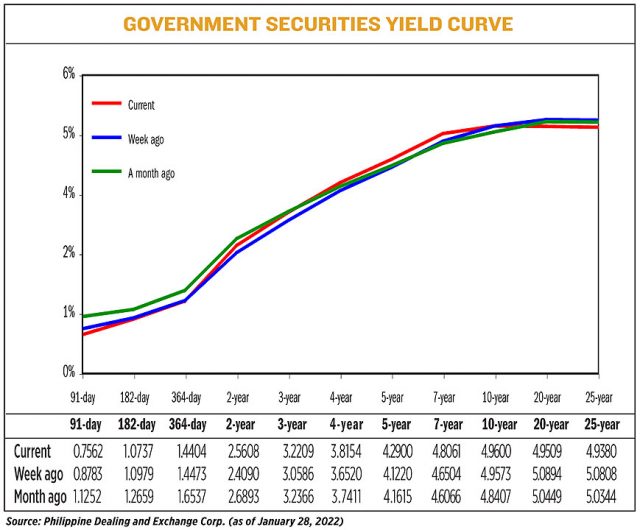
GS yields end mixed on hawkish Fed

YIELDS on government securities (GS) ended mixed last week after the US Federal Reserve signaled it would raise its benchmark rates starting March.

GS yields in the secondary market increased by 3.36 basis points (bps) on average week on week, based on the PHP Bloomberg Valuation (BVAL) Service Reference Rates as of Jan. 28 published on the Philippine Dealing System’s website.

Yields, which move opposite to bond prices, were mixed across the curve last week. At the short end of the curve, yields on the 91-, 182-, and 364-day papers dropped by 12.21 bps, 2.42 bps, and 0.69 bps, to 0.7562%, 1.0737%, and 1.4404%, respectively.

The belly of the curve rose as the two-, three-, four-, five-, and seven-year debt papers increased by 15.18 bps, 16.23 bps, 16.34 bps, 16.80 bps, and 15.57 bps, to yield 2.5608%, 3.2209%, 3.8154%, 4.2900%, and 4.8061%, respectively.

At the long end, the 10-year note inched up by 0.27 bp to 4.9600%, while the 20- and 25-year papers fell by 13.85 bps (to 4.9509%) and 14.28 bps (4.938%).

ATRAM Trust Corp. Head of Fixed Income Jose Miguel B. Liboro said GS rates shot up last week due to sudden increase in global bond yields.

“Local rates were put under pressure as global investors began to price in more aggressive than expected policy action from the US Federal Reserve,” Mr. Liboro said in an e-mail interview.

A bond trader said rates began rising ahead of the Federal Open Market Committee (FOMC) meeting and “finally broke resistance levels when the statement was deemed more hawkish than expected,” pushing rates at the belly of the curve upwards.

“Short-end was pinned lower because investors prefer to only short bonds (the shorter, lesser risk from fluctuations), tail-end was flat due to less supply and some specific demand for yield pickup,” the bond trader said in a Viber message.

At the end of the two-day FOMC meeting on Jan. 25-26, Fed Chairman Jerome H. Powell said the US central bank was likely to begin hiking interest rates in March to tame runaway inflation, Reuters reported.

He also reaffirmed its plan to end its bond buying that month.

However, Mr. Powell said the pace of succeeding rate hikes this year remain undecided as well as how quickly the Fed will let its massive balance sheet decline.

“While we believe that a 25-bp hike from the BSP later in the year is likely, softening inflation and a bias towards supporting local growth prospects are likely to take precedence over any spillover effect from a potential Fed hiking cycle,” Mr. Liboro said.

“We expect market to remain defensive early on due to pressure from global yields. However, the possibility of another inflation print below 4% for January is likely to spur some buying interest over the short term,” he added.

For the bond trader, yields this week would most likely “trend sideways with an upward bias” targeted at the four-year bonds and “longer tenors” due to expected weekly auctions by the Bureau of the Treasury (BTr).

The BTr will offer on Tuesday P35 billion in reissued five-year papers with a remaining life of four years and two months.

The Treasury plans to borrow P200 billion — P60 billion from Treasury bills and P140 billion from Treasury bonds — from domestic debt market in February. — Ana Olivia A. Tirona with Reuters

Six mobile ASF labs planned for P100 million

FREEPIK

THE Department of Agriculture (DA) said it plans to deploy six mobile laboratory units (MLUs) worth P100 million to contain African Swine Fever (ASF).

Along with the Bureau of Animal Industry (BAI), the DA will deploy the MLUs to ASF-affected regions by March.

Agriculture Secretary William D. Dar said in a statement that each mobile lab can be sent to any local government unit (LGU) where ASF is suspected. They will also serve as mobile veterinary schools to train LGU personnel in disease detection, prevention, and monitoring.

The BAI is also being tapped to manage Regional Animal Disease Diagnostic Laboratories that can confirm the presence of animal diseases through reverse transcription polymerase chain reaction (RT-PCR) tests.

“These laboratories just need to optimize processes to further strengthen the country’s animal diagnostic infrastructure,” BAI Director Reildrin G. Morales said.

The DA has also forged a partnership with science and veterinary group BioAssets Diagnostic Clinic to help contain ASF and other transboundary animal diseases.

BioAssets offers a project known as Brisk Response through In-location Diagnostics and Genome Sequencing (BRIDGES) which can isolate and characterize the ASF virus at a molecular level.

“BRIDGES may also be used to differentiate the field strain from vaccine strain, which may fast-track vaccine research development,” the DA said.

The project has an initial funding of P39.2 million from BioAssets and the Department of Science and Technology under the Science for Change Program.

The BAI and BioAssets have agreed to collaborate on biosecurity measures, provide onsite detection tools, and offer preventive diagnostics. — Luisa Maria Jacinta C. Jocson

New SRP list curtails retailers — supermarket group

By Revin Mikhael D. Ochave, Reporter

THE latest suggested retail price (SRP) list is hampering the freedom and growth of local retailers, according to the Philippine Amalgamated Supermarkets Association, Inc. (Pagasa).

Pagasa President Steven T. Cua said in a mobile phone message that any form of price control like the SRP list is not necessary unless there is an emergency or calamity.

“Applying a list of SRPs chokes the freedom of retailers to play with price strategies to compete and grow in the Philippine environment,” Mr. Cua said.

“Supermarkets in this country live with paper-thin margins. This is the major reason why foreign retailers have not survived or are not attracted to invest here despite the many times the Retail Trade Liberalization Act has decreased capital requirements for entering our soil,” he added.

Further, Mr. Cua said SRPs are set by manufacturers so the range of prices for a product will not drastically change.

However, he noted that it is just “suggested” since suppliers cannot force retailers to sell at prices wanted by the former.

“At this point, consumers do not seem to be aware or affected by this (SRP list) as they have more immediate concerns like health and livelihood,” Mr. Cua said.

On Jan. 27, the Department of Trade and Industry (DTI) announced the latest SRP list of basic necessities and prime commodities. The list showed that some of the products with price increases include bottled water, processed canned meat and canned beef, instant noodles, salt, and canned sardines.

Based on the new SRP list, 66% or 143 out of 216 stock keeping units (SKUs) kept their prices while 34% or 73 SKUs hiked their prices as a result of higher production costs.

The DTI previously said that the price hikes of around 86% of the 73 SKUs varied from 1% to 9%, which were lower compared to the rates of cost movement of some raw materials.

“All requests for adjustments were carefully reviewed to ensure that prices were reasonable. The DTI made sure that the price adjustments are justified. Not allowing reasonable price adjustments despite cost increases will affect investment climate, business viability and ability to keep the jobs in their companies,” Trade Undersecretary Ruth B. Castelo said.

Meanwhile, the DTI is seeking amendments to Republic Act No. 7581 or the Price Act in a bid to deter constant violators.

Trade Secretary Ramon M. Lopez said in a television interview over the weekend that one possible amendment to the Price Act is to allow the DTI to have a stronger enforcement power over violators.

Under the Price Act, the DTI has a mandate to ensure that the prices of basic goods and prime commodities are reasonable for consumers.

“Maybe we can allow DTI to have a stronger police power in the sense that perennial violators, if the law can allow (us) to revoke their licenses,” Mr. Lopez said.

“There is reasonable mandate in the sense that we can institute fines and penalties. That’s clear. But sometimes you need stricter measures. There are recidivists, or those who often violate to the point that there is a need to revoke the license,” he added.