One of the frothiest stocks in the Philippines has plunged in recent days, erasing more than $16 billion of its founder’s fortune and raising new questions about its remarkable ascent and sudden nosedive.
Property developer Golden MV Holdings Inc. began falling on Thursday after regulators lifted a six-month trading suspension on the stock, continuing through Tuesday morning. So far it’s down 76%, its worst streak as a public company.
It has also knocked Golden MV founder Manuel Villar off the perch as the richest man in the Philippines. He’s now worth $5.6 billion, according to the Bloomberg Billionaires Index, eclipsed by business tycoon Enrique Razon.
Golden MV told regulators both on Friday and Monday that it didn’t know why the stock dropped, filings show. A company representative didn’t respond to a request for comment.
“When a stock returns from trading halt — especially one linked to a high-profile tycoon like Manny Villar — investors typically reassess” its price relative to the company’s fundamentals, said Toby Allan Arce, an analyst at Globalinks Securities & Stocks Inc. “The market appears to have concluded that the company’s pre-suspension valuation was far too rich.”
Regulators suspended the stock in May after the company failed to file financial results because of a disagreement with its auditor. The sticking point was the valuation of land that Golden MV acquired from its founder for $93 million and subsequently revalued to $23.3 billion.
That transaction followed a run-up in Golden MV’s stock price that pushed the company’s price-to-earnings ratio above 1,000 and perplexed Manila’s financial community. Villar and parties related to him control 89% of the company’s shares.
In its 2024 annual report filed last week, Golden MV noted that it had agreed to value the land using a method suggested by its external auditors, which yielded a value closer to what the company paid for it.
Golden MV develops and manages cemeteries, memorial parks and low-cost housing. It’s developing a project called Villar City, which it says is a plan to transform a cluster of cities in southern Manila into the capital’s “new center of gravity.” The land acquired last year is meant to be part of that development. — Bloomberg
“Invictus was built on the spirit of cooperation and shared success. By uniting suppliers, developers, architects, and engineers, we aim to raise industry standards, pioneer innovation, and ensure that every member is not just a participant, but a leader in their field,” said Peter Mangasing, Invictus chairman.
The Federation of Construction Suppliers of the Philippines, largest construction supplier group in the country, pushes for stronger industry collaboration and sustainable growth
The Federation of Construction Suppliers of the Philippines, also known as Invictus, marked a milestone late October with the election and induction of its first set of officers. It’s an event that doubled as a festive reunion for the country’s leading players in construction and supply.
Held in grand fashion, the night was as much about community as it was about leadership. Nearly 500 guests—developers, engineers, architects, and suppliers—gathered to celebrate what organizers described as both a symbolic rebirth and a renewed call for collaboration in the construction industry.
The festivities opened with a traditional dragon dance that drew cheers from the crowd, followed by a dragon eye-dotting ceremony, signifying the “awakening of the dragon within Invictus.” Guests later joined the Mid-Autumn Festival-inspired dice game, with around P2 million worth of prizes that were given away.
A new chapter for Invictus
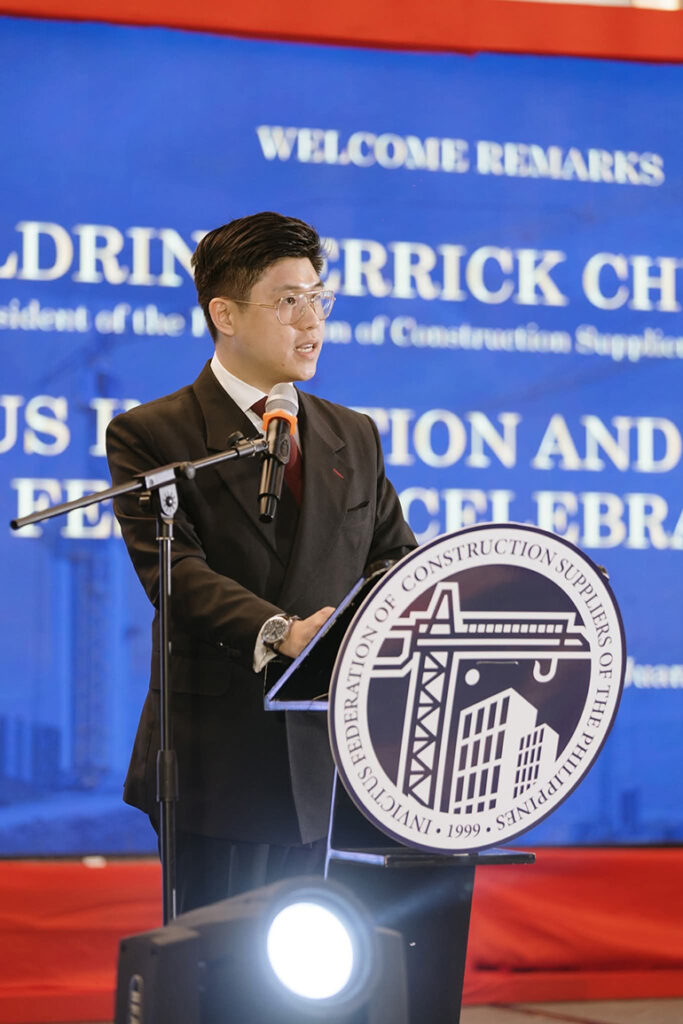
“On behalf of Invictus, it is my great pleasure to welcome you all to our annual induction and Mid-Autumn Festival,” said Invictus president Aldrin Derrick Chua in his welcome remarks.“Around 25 years, the founders of Invictus envisioned an organization of construction suppliers dedicated to helping one another grow. That same spirit of cooperation inspired us to revive that vision, leading to what we call Invictus today.”
Chua emphasized that the federation’s name embodies a philosophy—“always winning, yet always humble.”
“As Invictus, we are committed to winning together by working closely with industry partners and pioneering innovations in building materials,” he said. “Our goal is to ensure every member of this federation is not just a participant, but a leader in their respective field.”
Invictus, the largest construction supplier organization in the country, aims to guide the industry toward modernization through shared standards of excellence, innovation, and collaboration.
Invictus President Aldrin Derrick Chua emphasized that the federation’s name embodies a philosophy—“always winning, yet always humble.”
Honoring tradition and progress
The induction was led by Mayor Donya Tesoro of San Manuel, Tarlac, and witnessed by former Senator Cynthia Villar as the keynote speaker, and guest speaker Frederick Tan, Chief Operating Officer of Megawide Construction Corporation and second vice president of the Philippine Constructors Association.
Villar, who has long advocated for inclusive economic growth through housing and infrastructure, congratulated the officers and acknowledged the role of construction suppliers in nation-building.
Tan, in his keynote, shared insights from Megawide’s own journey as one of the country’s leading engineering and infrastructure firms, recounting its milestones—from its early beginnings in 1994 to major projects like the Mactan-Cebu International Airport and Parañaque Integrated Terminal Exchange. He underscored the importance of innovation, resilience, and collaboration as key to surviving and thriving amid changing market conditions.
“Construction is not just about building structures—it’s about creating the foundation for progress,” Tan said. “The industry has weathered many challenges, but we continue to move forward by investing in technology and sustainable solutions.”
Steady growth ahead
The night also featured a presentation from Shiela Lobien, the president of Lobien Realty Group, which gave an upbeat overview of the Philippine real estate and construction markets. Despite global headwinds, the country remains one of Southeast Asia’s fastest-growing economies, with GDP expected to grow by 5–6% this year.
The property market, said Lobien, remains resilient: “Developers are refocusing on residential and mixed-use projects, while the office market is stabilizing as more firms return to on-site work.” She added that government infrastructure programs, provincial development, and the continued demand for housing—particularly from OFWs—are fueling steady construction activity across the country.
“Land remains finite, and the Philippine demographic advantage continues to attract investment,” she said. “The construction and supply industries will play a vital role in sustaining that momentum.”
A celebration of unity and optimism
Beyond speeches and industry updates, the event was a celebration of community spirit—the very thing that binds Invictus’ members. Between rounds of games, dinner, and raffle draws, attendees shared stories and laughter, a reflection of the camaraderie that has long defined the construction sector.
For Invictus, the long-term goal is to “creating a future where every project is built with world-class expertise and a shared commitment to progress.”
“Invictus was built on the spirit of cooperation and shared success. By uniting suppliers, developers, architects, and engineers, we aim to raise industry standards, pioneer innovation, and ensure that every member is not just a participant, but a leader in their field,” said Peter Mangasing, Invictus chairman.
With its new leadership and renewed sense of purpose, Invictus is poised to strengthen its role as a driving force in Philippine construction—resilient, collaborative, and, true to its name, unconquered.
Spotlight is BusinessWorld’s sponsored section that allows advertisers to amplify their brand and connect with BusinessWorld’s audience by publishing their stories on the BusinessWorld Web site. For more information, send an email to online@bworldonline.com.
Join us on Viber at https://bit.ly/3hv6bLA to get more updates and subscribe to BusinessWorld’s titles and get exclusive content through www.bworld-x.com.
SYDNEY — Australia’s remote Indian Ocean outpost of Christmas Island has enough power to support a new Google data center without depriving locals, but its arrival could spur a push to renewable energy, the island’s biggest employer and the tech giant said.
Alphabet’s Google announced on Monday it will build a data hub on the tiny island located 350 km (220 miles) south of Indonesia, confirming a Reuters report.
It said it would also build a subsea cable system connecting Christmas Island to the Maldives and Oman, with two new data hubs to “deepen the resilience of internet infrastructure in the Indian Ocean Region”.
Google’s plans had raised concern there would not be enough power to meet the needs of locals, the island’s phosphate mine and the data center, but Phosphate Resources chief executive, Nicholas Gan, said supply was ample for now.
The phosphate company, which employs half the island’s population of 1,600, imports diesel to run a power generator that supplies the mine and meets Australian defense force needs.
“The power grid can supply both Google’s requirements and our requirements comfortably,” Mr. Gan said.
Capacity would be strained, however, if the island’s detention center for asylum seekers or a shuttered resort were to reopen, he said, adding that Google’s arrival bolsters the case for switching to renewable energy, which would be cheaper than importing diesel.
Australia’s infrastructure department is in discussions with Google to ensure its energy requirements are met without impacting supply to Christmas Island’s residents and businesses.
BOOM-BUST CYCLE ON REMOTE ISLAND
Another two planned Google subsea cables stretching east from Christmas Island will land near key Australian military bases, Reuters previously reported. Military experts say such a facility on the island would be valuable for using AI drones to monitor Chinese submarine activity.
Google said the island’s data hub would be smaller than some other Google data centers, and it would share its digital infrastructure with local users.
“The power required for a connectivity hub can still be a lot for some smaller locations, and where it is, Google is exploring using its power demand to accelerate local investment in sustainable energy generation,” its statement said.
A member of the island’s economic future working group, Mr. Gan said Google’s project will bring economic activity to an island 1,600 km from mainland Australia, with a history of boom and bust cycles, as it faced “the last era for mining”.
About 23 years ago, Australia and Russia planned to build a commercial spaceport on Christmas Island, but it prompted concern from Indonesia and was never opened, Australian parliament records show.
A casino that opened in 1993 attracted high rollers arriving by private jet from Jakarta but closed five years later amid an Asian economic downturn, the records show.
A detention center for asylum seekers trying to reach Australia by boat dominated the island for two decades, until a shift in Australia’s immigration policy saw it largely emptied in 2023.— Reuters
Visa, in collaboration with FinTech Alliance.ph and Google, on Tuesday officially launched Google Wallet and Google Pay in the Philippines.
In a statement, Visa said its cardholders now add their Visa debit or credit cards to Google Wallet and pay using Google Pay.
Visa card holders can now tap to pay using their Android devices at contactless-enabled terminals with no need for a physical card. It also works for online and in-app purchases.
The service is now available in the Philippines through seven partner issuers: China Banking Corp., EastWest Banking Corp., GoTyme Bank, Maya Bank, Rizal Commercial Banking Corp., Union Bank of the Philippines, Inc., and Wise.
“Google Pay amplifies the benefits of Visa for consumers, businesses, and our banking partners. As a trusted payment solution used worldwide, it is now available in the Philippines, bringing speed and security to every transaction,” Jeffrey Navarro, Visa country manager for the Philippines, said in a statement.
“Each payment is protected by Visa’s network token – a unique, one-time digital code that can help prevent fraud while ensuring a seamless experience,” he added.
Under the Bangko Sentral ng Pilipinas (BSP) guidance, Google Pay is classified as a technology service provider, as it does not hold consumer funds but links to Visa credit, debit, or prepaid cards. – Aaron Michael C. Sy
Kythe Foundation, Inc. hosts a media roundtable discussion to push for more child life services in the Philippines. — ALMIRA S. MARTINEZ
Kythe Foundation, Inc., said on Monday that many hospitals in the Philippines lack “child life services” essential to the overall well-being of sick children.
“The levels of anxiety in these children significantly decreased upon the provision of the child life services,” Kythe Foundation Consultant Angie Sievert-Fernandez told reporters in a roundtable discussion.
“It really needs to be pushed because it should already be rolled out, but why is it not being done up to this date?” she added.
Child life services are a psychosocial support to parents and pediatric patients in hospitals to help cope with the stress and anxiety of medical treatments and healthcare settings.
“It’s not just the child, sometimes, it also includes the siblings; it’s the entire family,” Maria Fatima “Girlie” Garcia-Lorenzo, president and co-founder of the group, said at the same event.
“We also have a behavioral program to support those parents who are losing their kids,” she added.
The said service also aims to minimize the psychological trauma of kids from medical procedures through counselling, therapeutic play, and age-appropriate explanations of treatments they need to undergo.
“Let them understand their illness. Let them understand the procedures. Why all the pricks and pokes? What do we do? Why do we have that?” Ms. Fernandez said. “You have to let them understand that because the children they think differently.”
“When a child knows what is being done and why, then it lowers anxiety and heightens compliance,” she added.
Under the National Integrated Cancer Control Act or Republic Act 11215, section seven, all appropriate hospitals and facilities must have provisions for child life services.
Data from Ms. Fernandez found that there are about 60 hospitals nationwide with pediatric cancer patients, but only 11 hospitals offer the said support to chronically ill children.
Among the hospitals with child life services, nine are affiliated with the foundation.
According to the Philippine Council for Health Research and Development (DOST-PCHRD), at least 5,000 Filipino children are diagnosed with cancer annually.
“Imagine all the other chronic illnesses out there…We are talking about millions of children in the country who are needing treatment but beyond that, they need healing,” Ms. Fernandez said.
“And healing doesn’t come only in medicine. Healing also comes in the support that you have from psychosocial support,” she added.
Ms. Lorenzo said that offering plantilla positions for child life coordinators and the lack of designated play areas in hospitals hinder the implementation of the service.
“What’s difficult is they just give us a person and they do it part-time so the program will not fly; it’s part-time,” she said.
“Another problem is the play area,” she added. “When you approach one hospital, the medical director asks us right away, what’s the ROI (return of investment) if we give you that space.”
Ms. Fernandez noted that hospitals often overlook the economic benefits of having a child life service in their institutions.
“For children who needed to [undergo] MRI, and they were prepared and educated instead of getting the full sedation, they receive partial sedation, or no sedation,” she said. “So, that’s savings for the hospital.”
As of 2025, Kythe Foundation has supported over 20,000 children nationwide since 1992.
“Imagine all of these children of ours in the Philippines who have mental health issues and trauma related to this and they are not supported,” Ms. Fernandez said.
“[They] will be the adults in the future. What is the impact of trauma? What is the impact of anxiety or fears? What kind of adults would we have,” she added. “So, it’s actually not just for now, it’s also for the future.” — Almira Louise S. Martinez
There is a gap between South Luzon’s resources and the technology needed to upgrade the system of farming in the region, according to Ferdinand Z. Garcia, regional director of the Philippine Chamber of Commerce and Industry Region IV-A.
“Some of our farmers – even those that use hybrid palay [rice that has not been husked] – have not fully adapted to modern farming yet. They also lack farming equipment,” he said in an interview at the sidelines of the Department of Science and Technology’s Regional Agri-Aqua Innovation System Enhancement (RAISE) Summit.
“We have not fully utilized these technologies,” he told BusinessWorld.
“I guess the chamber, since some are also landowners or businessmen, could bring these two together,” he added.
Interview by Patricia Mirasol Video editing by Richard Mendoza
(L-R) Dr. Fatma Tiu and Dr. Rey Rosales of Diabetes Philippines, Dr. Cyril Tolosa from AstraZeneca, and Mr. Reynaldo Abacan Jr. are united in the call to stop diabetes in a media conference held at EDSA Shangri-La Hotel.—ID8 EVENT PHOTO
An advocacy group on Friday said that the increasing cases of type 2 diabetes among young patients can be curbed through early screening and healthier habits in schools.
“Type 2 diabetes in the young is also increasing because of obesity and unhealthy lifestyle,” Diabetes Philippines Vice President Nines P. Bautista told BusinessWorld in an interview.
“What the school should do is incorporate lifestyle and exercise,” he added.
According to the Philippine College of Endocrinology Diabetes and Metabolism, type 2 diabetes mellitus (T2DM) is a “chronic, metabolic disorder that presents with hyperglycemia,” or a condition where sugar levels in the blood are elevated.
It added that patients with T2DM often only discover that they have the disease during a routine laboratory examination because of the lack of bothersome symptoms.
According to the International Diabetes Foundation (IDF), 589 million people globally had diabetes in 2024. Of which, 4,726,300 or 7.5% of Filipinos aged 20 to 79 years old are living with the disease, while 2.8 million remain undiagnosed.
“What makes this pandemic particularly alarming is that most of them do not know that they have diabetes,” Diabetes Philippines President Fatima I. Tiu said in a media event.
“Many individuals discover their condition only after a serious complication,” she added, underscoring other health issues like heart attack, stroke, and blurred vision.
The disease is caused by several factors, such as urbanization, sedentary lifestyle, unhealthy habits, limited access to preventive care, and widening health inequities, said Ms. Tiu.
As more Filipinos remain undiagnosed, she underscored that this is a “silent crisis” in the country.
“Early screening is one of our most powerful tools,” she said. “If we know the risk of the disease early, we will be able to intervene earlier, preventing complications, protecting quality of life, and reducing the burden on the families and our healthcare system.”
Apart from early screening, the group also encourages schools to push for a better learning environment through daily exercise and proper meals.
“Before when I was young, every morning we do exercise before we go to class, but it’s different now. There are so many classes,” Mr. Bautista said.
“What we do is we go to some schools to teach the students together with the teachers, and the canteen owners because we want to serve (the) right food to those kids,” he added.
Data from the IDF revealed that diabetes cases in the Western-Pacific region are estimated to reach 254 million by 2050. — Almira Louise S. Martinez
SHIRAKAWA, Japan — Shiroki Mitsunari does not remember seeing bears in the picturesque Japanese mountain village of Shirakawa when he was a child.
But since a cub attacked a Spanish visitor there last month, protecting residents and the throngs of tourists who flock to his home town to see its UNESCO-listed thatched-roof cottages has been his top priority.
“There are a lot more bears coming,” said Mr. Mitsunari, 40, a local official overseeing efforts to deter bears in the village, located in a remote valley in central Japan, roughly halfway between Tokyo and Osaka. He attributed the surge to a growing bear population and a shortage of their natural food sources.
While the tourist escaped with minor injuries, authorities have captured six bears near the historic Shirakawa-go site using honey-laced traps since then, he said. Bear sightings this year have topped 100, compared to around 35 last year, he added.
Across Japan, a record 220 people have been injured in bear attacks since April, according to public broadcaster NHK. Thirteen have died, including seven last month – a peak time when bears forage intensively before hibernating.
Many attacks were in far-flung towns rarely visited by overseas travelers. But the Shirakawa incident, and sightings near tourist hotspots like Kyoto’s Arashiyama bamboo grove, show it is not a risk visitors can ignore.
US, CHINA ISSUE TRAVEL ALERTS
The United States, China, and Britain last week issued travel advisories about the dangers of bear attacks in Japan.
The US alert warned about attacks near populated zones, noting that a park adjacent to its consulate in the city of Sapporo was closed for two weeks following a bear sighting.
In addition to honey-laced traps, authorities in Shirakawa have also chopped down fruit trees that might draw the hungry creatures, and issued warnings to visitors to walk in groups, wear bear bells and avoid certain areas.
“When we were preparing for this trip, we saw on social media that there were a lot of Japanese news reports of bear sightings,” said Cornelia Li, a 25-year-old e-commerce industry worker from Shanghai.
“We were a little (worried),” she said after affixing a bear bell to her 4-year-old daughter’s rucksack. Her family opted to book hotels in cities rather than rural areas due to the bear risk, she said.
BARKING DRONES TO REPEL BEARS
Asiatic black bears are listed as a vulnerable species globally, but their numbers are estimated to have tripled in Japan since 2012, helped by a decline in hunting.
Experts say climate change has reduced harvests of bears’ natural food like acorns and beechnuts, while the depopulation of rural areas and the proliferation of abandoned farmland have emboldened them to seek food near human settlements.
The situation has gotten so bad in the country’s rugged north that Japan this month dispatched the army to help authorities cull bears.
In Hida city, an hour’s drive from Shirakawa, authorities are testing drones to stop bears ransacking apple and peach orchards. The drones are equipped with loudspeakers emitting the sounds of barking hunting dogs and have firecrackers attached to them for an extra scare factor.
“We needed a rapid-response measure,” said Naofumi Yoshikawa, an official at Gifu prefecture’s environmental affairs department overseeing the trial.
There have been 78 sightings in Hida city this autumn, compared to 11 last year.
FEAR ALWAYS THERE
“Working out here, that fear of bears is always there,” said Masahiko Amaki, the head of the local orchard cooperative, as the sound of a dog-barking drone rang out across the valley.
“You don’t want to get hurt. And I’ve had a few close calls myself. They glare at you, and … yes, it’s really scary.”
A sign warning of bears at the head of a walking trail near the orchard urged hikers not to trek alone.
Back in Shirakawa, Mr. Mitsunari is also worried about the children at the local school he used to attend.
The students have all been given bear bells and told to walk home in groups to deter bears that tend to be most active in the early morning or around dusk.
Before the Spanish tourist, the village’s last bear attack had been 12 years ago, and Mr. Mitsunari says he’s determined to avoid any more incidents.
“That was pretty shameful for us. We are not going to let that happen again,” he said. — Reuters
A SOLDIER stands guard at the Great Hall of the People in Beijing, China, Oct. 18, 2023. — REUTERS
BEIJING — Film distributors have suspended the screening of at least two Japanese films in China amid a deepening dispute between Tokyo and Beijing, in what state broadcaster CCTV said was a “prudent decision” that took into account souring domestic audience sentiment.
The postponement comes barely two weeks after remarks about Taiwan by Japanese Prime Minister Sanae Takaichi sparked a heated response from China and kicked off the most serious diplomatic clash between the two East Asian powers in years.
Some Japanese films, including the animated “Crayon Shin-chan the Movie: Super Hot! Scorching Kasukabe Dancers” and manga-turned-movie “Cells at Work!”, originally slated for release in the coming weeks, will not begin screening in mainland China as scheduled, CCTV said, citing checks with film importers and distributors.
Animated film “Demon Slayer: Infinity Castle” was initially well received but has seen its box office performance decline after Ms. Takaichi’s remarks due to “strong dissatisfaction from Chinese audiences”, according to CCTV late Monday.
Film importers and distributors have chosen to heed the market’s response, respect audience sentiment, and postpone the releases of upcoming films, CCTV said.
Japan has sought to tamp down the escalating dispute with China that came after Ms. Takaichi told Japanese lawmakers this month that a Chinese attack on Taiwan threatening Japan’s survival could trigger a military response.
Beijing has since urged citizens to halt travel to Japan, and China’s Premier Li Qiang has no plans to meet Ms. Takaichi on the sidelines of this week’s G20 summit in South Africa.
The heads of Japan’s three business federations met with Ms. Takaichi late on Monday and urged dialogue to resolve the diplomatic tensions.
“Political stability is a prerequisite for economic exchange,” Yoshinobu Tsutsui, chairman of Japan’s biggest business lobby Keidanren, told reporters after the meeting, according to media reports. — Reuters
WASHINGTON — The UN Security Council on Monday voted to adopt a US-drafted resolution endorsing President Donald Trump’s plan to end the war in Gaza and authorizing an international stabilization force for the Palestinian enclave.
Israel and the Palestinian militant group Hamas agreed last month to the first phase of Mr. Trump’s 20-point plan for Gaza – a ceasefire in their two-year war and a hostage-release deal – but the UN resolution is seen as vital to legitimizing a transitional governance body and reassuring countries that are considering sending troops to Gaza.
The text of the resolution says member states can take part in the Trump-chaired Board of Peace envisioned as a transitional authority that would oversee reconstruction and economic recovery of Gaza. It also authorizes the international stabilization force, which would ensure a process of demilitarizing Gaza, including by decommissioning weapons and destroying military infrastructure.
Hamas, in a statement, reiterated that it will not disarm and argued that its fight against Israel is legitimate resistance, potentially pitting the militant group against the international force authorized by the resolution.
“The resolution imposes an international guardianship mechanism on the Gaza Strip, which our people and their factions reject,” Hamas said in its statement, issued after the adoption of the resolution.
Mike Waltz, the US ambassador to the UN, said the resolution, which includes Mr. Trump’s 20-point plan as an annex, “charts a possible pathway for Palestinian self-determination … where rockets will give way to olive branches and there is a chance to agree on a political horizon.”
“It dismantles Hamas’ grip, it ensures Gaza rises free from terror’s shadow, prosperous and secure,” Mr. Waltz told the council ahead of the vote.
Russia, which holds a veto on the Security Council, earlier signaled potential opposition to the resolution but abstained from the vote, allowing the resolution to pass.
The UN ambassadors of Russia and China, which also abstained, complained that the resolution does not give the UN a clear role in the future of Gaza.
“In essence, the council is giving its blessing to a US initiative on the basis of Washington’s promises, giving complete control over the Gaza Strip to the Board of Peace and the ISF (international stabilization force), the modalities of which we know nothing about so far,” Russian ambassador Vasily Nebenzya told the council following the vote.
The Palestinian Authority issued a statement welcoming the resolution, and said it is ready to take part in its implementation. Diplomats said the authority’s endorsement of the resolution last week was key to preventing a Russian veto.
Mr. Trump celebrated the vote as “a moment of true Historic proportion” in a social media post. “The members of the Board, and many more exciting announcements, will be made in the coming weeks,” Mr. Trump wrote.
‘PATHWAY’ TO STATEHOOD
The resolution has proven controversial in Israel because it references a future possibility of statehood for the Palestinians.
The resolution’s text says that “conditions may finally be in place for a credible pathway to Palestinian self-determination and statehood” once the Palestinian Authority has carried out a reform program and Gaza’s redevelopment has advanced.
“The United States will establish a dialogue between Israel and the Palestinians to agree on a political horizon for peaceful and prosperous coexistence,” it says.
Prime Minister Benjamin Netanyahu, under pressure from right-wing members of his government, said on Sunday that Israel remained opposed to a Palestinian state and pledged to demilitarize Gaza “the easy way or the hard way.”— Reuters
Wellness meets innovation as Luxe Slim, the proudly Filipino wellness brand, makes its Dubai debut — bringing its line of health-conscious beverages to a diverse and cosmopolitan community in the United Arab Emirates.
The launch event, held at Luxent Hotel in Quezon City, gathered wellness advocates, lifestyle influencers, and media representatives. It marks an important milestone for a brand widely recognized for making healthy living both enjoyable and accessible.
“Dubai has a large Filipino community — around 450,000 based on recent records. Many of them feel the burden of high costs because Dubai is far from the Philippines. Through our partnership with ZK Summit Holdings, Inc. and KPC Importation Services, our products will become more affordable, easier to ship, and more sustainable to access. Since there are many Filipinos in Dubai, we will also be able to help more of them,” said Anna Magkawas, president, Luxe Beauty and Wellness Corp.
“From Dec. 4 to 7, we will be in Dubai. On Dec. 5, 2025, we will meet interested distributors and those who want to market Luxe Slim in Dubai. We will discuss the business side, the potential income, and our available promos. With as low as 1,000 dirhams, they can already start a business with Luxe Slim, along with other affordable business packages.”
“For sure, our kababayans will be happy — we have business opportunity meetings, and we will post the registration link on our social media pages so they can secure their slots. The next day, we will hold a yacht party and contract signing with our distributors. We want to welcome them grandly and make our Dubai launch truly memorable,” Ms. Magkawas added.
A Partnership That Champions Filipino Excellence
The Dubai expansion is made possible through KPC Importation Services-Dubai under ZK Summit Holdings, Inc., founded by Dr. Mary Cruz, PhD, DBA, MAEd, LPT, and co-founded by Khelvin P. Cruz, CPA, MBA. Their leadership and international expertise ensure that Luxe Slim can reach global markets while maintaining the innovation, quality, and credibility that made the brand a household name in the Philippines.
Luxe Slim offers premium wellness drinks including healthy slimming coffee, nutrient-rich juices, and beauty smoothies — all designed to blend wellness with great taste while perfectly fitting the lifestyle of modern, on-the-go consumers.
Sharing a Global Wellness Philosophy
With its Dubai launch, Luxe Slim is not simply expanding geographically — it is bringing a philosophy of wellness, confidence, and balanced living to Filipinos and international consumers alike. The brand continues to prove that Filipino innovation can deliver products that inspire healthier lifestyles around the world.
“We have upcoming products under LuxeSlim and LuxeSkin, and we are planning to release an exclusive product especially for Dubai — LuxeSlim Pistachio. Since pistachio is strongly associated with Dubai, we are already undergoing research and development, and we will reveal the final product soon. We have also prepared a surprise ambassador who will be joining us at our grand launch in Dubai,” Ms. Magkawas said.
Spotlight is BusinessWorld’s sponsored section that allows advertisers to amplify their brand and connect with BusinessWorld’s audience by publishing their stories on the BusinessWorld Web site. For more information, send an email to online@bworldonline.com.
Join us on Viber at https://bit.ly/3hv6bLA to get more updates and subscribe to BusinessWorld’s titles and get exclusive content through www.bworld-x.com.
US dollar banknotes are seen in this illustration photo. — JAKUB PORZYCKI/NURPHOTO VIA REUTERS CONNECT
By Aaron Michael C. Sy, Reporter
MONEY SENT HOME by overseas Filipino workers (OFWs) jumped by an annual 3.7% in September, the fastest pace in five months, the Bangko Sentral ng Pilipinas (BSP) said on Monday.
Data from the central bank showed cash remittances rose to $3.12 billion in September from $3.01 billion in the same month in 2024.
This was the fastest growth since the 4% logged in April.
Month on month, cash remittances increased by 4.84% from $2.977 billion in August.
For the first nine months of the year, cash remittances sent through banks increased by 3.2% to $26.03 billion from $25.23 billion a year ago.
“The United States remained the top source of remittances to the Philippines during January-September 2025, followed by Singapore, and Saudi Arabia,” the BSP said in a statement.
Cash remittances from the US accounted for 40.4% of the total in the nine-month period.
This was followed by Singapore (7.1%), Saudi Arabia (6.4%), Japan (4.9%) the United Kingdom (4.8%), the United Arab Emirates (4.5%), Canada (3.5%), Qatar (2.9%), Taiwan (2.8%) and South Korea (2.5%).
Meanwhile, personal remittances went up by 3.8% to $3.46 billion in September from $3.34 billion a year earlier.
In the January-to-September period, personal remittances rose by 3.2% to $28.97 billion from $28.07 billion a year ago.
Personal remittances include both cash coursed through banks and informal channels as well as in-kind remittances.
Analysts said OFWs sent home more money starting September, as the holiday season approaches.
“The ‘ber’ months effect kicked in early, with OFWs sending more ahead of the long holiday season,” Reyes Tacandong & Co. Senior Adviser Jonathan L. Ravelas said in a Viber message.
He added that the strong labor market and a competitive peso also supported remittance growth in September.
The peso closed at P58.196 per dollar on Sept. 30, weakening by P1.066 or 1.87% from P57.13 on Aug. 29.
In September, the country’s unemployment rate improved to 3.8% from 3.9% in August. For the first nine months, the jobless rate stood at 4.1%, a tad higher than 4% in the same period last year.
“The onset of ‘ber’ months marks the start of the holiday season for Filipinos. Thus, we may expect OFWs to send their earnings to their families here for the celebrations and gatherings,” Oikonomia Advisory and Research, Inc. economist Reinielle Matt M. Erece said in a Viber message.
Mr. Erece said remittance growth could be faster from October to December, before stabilizing in January 2026.
“For the fourth quarter, expect remittances to stay resilient and peak in December. BSP’s 3% full-year growth target looks well within reach,” Mr. Ravelas likewise said.
The BSP expects cash remittances to grow by 3% to $35.5 billion this year.











 A Partnership That Champions Filipino Excellence
 Sharing a Global Wellness Philosophy