Home Blog Page 6812

Analysts: Comelec risks integrity after Marcos ruling
By John Victor D. Ordoñez

THE COMMISSION on Elections (Comelec) risks losing its credibility after a delayed ruling allowing the son and namesake of the late dictator Ferdinand E. Marcos to run for president this year, political analysts said.

Last week’s delayed decision by the election body’s First Division does not improve people’s confidence about its independence, Maria Ela L. Atienza, a political science professor from the University of the Philippines, said in a Viber message at the weekend.

“The task of Comelec now is to make sure that it can settle internal issues, work swiftly, diligently and fairly, because the campaign period is in full swing and the elections are approaching,” she added.

In the ruling written by Commissioner Aimee P. Ferolino, Comelec said former Senator Ferdinand “Bongbong” R. Marcos, Jr.’s failure to file tax returns in the 1980s, for which he was convicted a decade later for tax evasion, did not involve wicked, deviant behavior.

Commissioner Marlon S. Casquejo, who signed the ruling, also wrote a separate 12-page opinion in which he said Mr. Marcos’s crime did not involve “moral turpitude.”

“We cannot justify such omission necessarily results in injustice; this is an overkill,” he said in his opinion, referring to the presidential bet’s failure to file tax returns. “We cannot link such omission to contravention of morals; this is an exaggerated innuendo.”

“This incident is another massive hit on the independence and integrity of Comelec,” Hansley A. Juliano, a former political science professor studying at Nagoya University’s Graduate School of International Development in Japan, said in a Facebook Messenger chat.

“This becomes far more contentious especially since the composition of Comelec is already subject to scrutiny since most commissioners are Duterte appointees,” he added.

Former First Division Presiding Commissioner Maria Rowena V. Guanzon had accused Ms. Ferolino of delaying the decision to invalidate her vote as the decision was released after she retired.

She released a separate opinion on Jan. 31 in which she voted to disqualify Mr. Marcos, whom she called an ex-convict. She said his repeated failure to file his  tax returns showed a deliberate intent to violate the law.

Ms. Guanzon also alleged that a senator from Davao was meddling in the lawsuit filed by survivors of the dictator’s martial law regime.

Ms. Atienza said the delayed ruling and allegations of interference would make more concerned groups more watchful of the election body’s actions.

Three of Comelec’s members retired last week, leaving it with just four commissioners. It has since reorganized its two divisions.

“Comelec has to be reminded constantly of its accountability to the Filipino people and of its duties to make elections free and fair,” Ms. Atienza added.

Labor leader and presidential candidate Leodegario “Ka Leody” de Guzman on Sunday slammed the division ruling.

“A candidate who was convicted for not paying taxes was allowed to run, while voters are automatically made to pay taxes with the little they earn,” he said in a Viber message in Filipino.

Howard M. Calleja, a lawyer for one of the plaintiffs, earlier said they would seek reconsideration of the ruling this week.

“We will continue to exhaust all remedies available to bring out the truth, to attain justice, and to bring the issue to the proper legal conclusion it deserves,” he said. 

Marcos’s lawyer and spokesman Victor D. Rodriguez last week called the lawsuits a nuisance.

“Whether Comelec admits it or not, its attempt to present neutrality in a hyperpolarized election can and will be cast as partiality for the ruling party,” Mr. Juliano said. “The Marcos ruling only helps affirm that.”

Meanwhile, Mr. Marcos kept his lead in Pulse Asia Research’s presidential opinion poll last month, with six of 10 Filipinos likely to vote for him, the polling firm said in a statement on Sunday.

He was followed by Vice-President Maria Leonor “Leni” G. Robredo with 16%, boxing champion and Senator Emmanuel “Manny” D. Pacquiao and Francisco “Isko” M. Domagoso with 8% each and Senator Panfilo “Ping” M. Lacson with 4%.

Among those with a first choice for president, 24% said they would vote for Mr. Domagoso in case their candidate withdraws from the race, Pulse Asia said.

Davao City Mayor and presidential daughter Sara Duterte-Carpio topped the poll for vice-president with 50%, followed by Senator Vicente C. Sotto III (29%), Senator Francis “Kiko” N. Pangilinan (11%) and Willie Ong (5%).
DoH adds 3,050 COVID cases; 12% of samples positive

PHILIPPINE STAR/ MICHAEL VARCAS

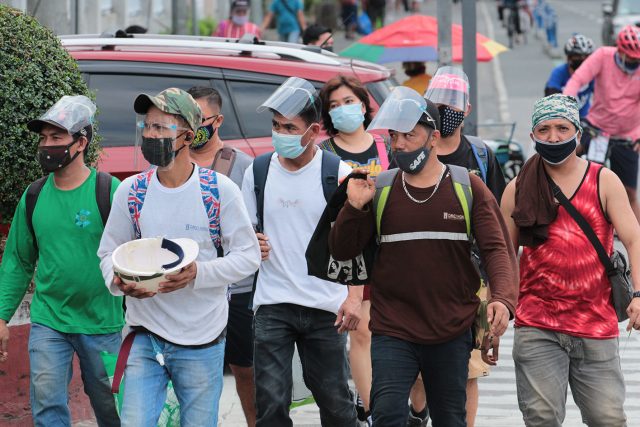
THE PHILIPPINES posted 3,050 coronavirus infections on Sunday, bringing the total to 3.64 million.

The Department of Health (DoH) failed to report deaths, citing technical issues. Recoveries rose by 5,811 to 3.5 million, it said in a bulletin.

DoH said 11.7% of 31,403 samples on Feb. 11 tested positive for coronavirus disease 2019 (COVID-19), still above the 5% threshold set by the World Health Organization (WHO).

Of 81,394 active cases, 4,546 did not show symptoms, 71,994  were mild, 3,068 were moderate, 1,460 were severe and 326 were critical.

It said 99% of infections occurred on Jan. 31 to Feb. 13. The top regions with cases in the past two weeks were Metro Manila with 556, Western Visayas with 367 and Calabarzon with 311.

The agency said 138 duplicates had been removed from the tally, 64 of which were recoveries, while 31 recoveries were relisted as deaths. Two laboratories failed to submit data on Feb. 11. — Kyle Aristophere T. Atienza

Manila chief mixes good looks, record to entice voters

PHILIPPINE STAR/EDD GUMBAN

By Jaspearl Emerald G. Tan

MANILA Mayor and presidential aspirant Francisco “Isko” M. Domagoso’s appeal to his supporters comes from being a former actor and his work in the city, political analysts said.

“It’s a combination of both,” Maria Ela L. Atienza, a political science professor from the University of the Philippines (UP), said in a Viber message. “In this country, where personality politics trumps party platforms and loyalty, celebrities can have an advantage.”

Mr. Domagoso, whose rags-to-riches story has captivated many Filipinos, beat ex-President Joseph E. Estrada in the 2019 local elections. Mr. Estrada was himself a famous action star before he entered politics.

Mr. Domagoso used to be a scavenger and pedicab driver in a Manila slum before he was discovered by a talent scout in the 1990s.

Ms. Atienza said not all celebrities who have the looks and fame win major electoral posts.

“In the case of Isko, we will see if he will succeed in combining his celebrity looks with his politician or local government background based on the actual election results.”

His work in Manila has made an impact and his supporters are not just drawn to his looks, said Herman S. Kraft, a political science professor from UP.

“Isko’s supporters see him as a serious candidate and not just as eye candy,” he said in a Viber message. “His work in Manila has made an impression.”

“There might be some enthusiasm because he looks good, but I don’t think those who see him that way will continue to stick with him as his campaign intensifies,” he added.

Robin Michael Garcia, chief executive at WR Numero Research, said Mr. Domagoso is a formidable presidential candidate. “He represents a serious electoral threat to other presidential candidates,” he said via Viber.

The mayor’s promise of scaling up his city projects sends a strong message to voters, said Michael Henry Ll. Yusingco, a senior research fellow at the Ateneo de Manila University School of Government. “He has what others have termed as a proof of concept,” he said in an e-mail.

It would be unfair to attribute his appeal solely to his past as a showbiz star, said Hansley A. Juliano, a former political science professor studying at Nagoya University’s Graduate School of International Development in Japan.

“People are judging him for his stint in Manila as vice-mayor, then credibly winning against Estrada as mayor in 2019 and establishing a sort of consensus appeal between the middle-class population of Manila, even as policies adversely affected the urban poor,” he said in Facebook Messenger chat.

Before becoming mayor, Mr. Domagoso served as the city’s vice mayor from 2007 to 2016. He grew up in Tondo and represented the district when he was elected to the Manila City Council in 1998.

Meanwhile, Mr. Domagoso on Sunday vowed to boost the Marikina shoe industry if he becomes president.

“The government will purchase Marikina’s shoes,” he said in a statement. “The shoes of the military and police all come from there. I wish it would be the same for schools and government offices.”

Campaign trail: Presidential candidates strive to focus on governance agenda

THE PROMINENT names in this year’s 10-way race for the presidency are aiming to veer away from personality politics, which largely characterizes Philippine elections, by focusing on how they plan to run the country in case of victory. 

Vice President Maria Leonor “Leni” G. Robredo on Sunday reiterated her plans to uphold a culture of transparency and inclusive governance if she wins to become the country’s leader in the May 9 polls.

“The country’s problems could be solved if the government is willing to work with ordinary people,” she said in a speech before a crowd of about 20,000 supporters at Quezon City Memorial Circle. 

“That is the kind of government that we would like to achieve.”

The opposition bet also vowed to end patronage politics, reiterating that it is the government’s responsibility to reach out to ordinary people. 

“The government should ensure that poverty would not be a hindrance for people to achieve healthcare services,” she said, noting that state services must not be used as rewards for political and electoral support. 

Her running mate, Sen. Francis “Kiko” N. Pangilinan, meanwhile, vowed to prioritize the plight of Filipino farmers and address food insecurity.

Ms. Robredo’s main rival, Ferdinand “Bongbong” R. Marcos, Jr., a former senator and son of the late Philippine dictator, toured Makati City on Saturday. 

‘UNITY’
Mr. Marcos, through his lawyer and spokesman Victor Rodriguez, said their camp will only focus on sending their message of “unity.” 

Mr. Rodriguez said in a Viber message that they plan to win “by simply focusing on our own campaign bringing with us the message of national unity and not to be distracted by the ruckus happening around brought about by the hateful, negative and vindictive platform and agenda espoused by a very noisy segment of our society.”

On Friday, London-based think tank Capital Economics said in a report that “poor governance, an undermining of institutions, a lack of policymaking experience, corruption and nepotism have all contributed to the political instability which has been a key factor behind the underperformance of the (Philippine) economy over recent decades.” 

It said the country’s situation is “unlikely to improve” and “could easily get worse” under Mr. Marcos’s administration. “What we do know about him is far from encouraging.”

The foreign think tank noted that Mr. Marcos has refused to participate in traditional pre-election debates. “We know nothing about his plans to help the economy recover from the pandemic, on fiscal policy or how to improve the business environment.” 

The group also said Mr. Marcos, who is leading pre-election surveys, has a poor legislative track record. “He has no legislative achievements to show for his six years in the Senate, where he was criticized for involvement in a massive corruption scandal.” 

‘CONCRETE’ 
Senator Panfilo M. Lacson, Sr., the first among the lot to confirm his presidential candidacy with a governance agenda last year, said his platform is his “arsenal” with its “concrete, realistic, practical, and sensible reforms.”

He said this plan was made in consultation with policy experts, economists, and government officials, among others. 

“I am confident that by placing a premium on issue- and platform-based campaigning, our electorate will vote beyond the metric of popularity and more on the measure of competence, qualification, and experience,” he said. 

His running mate, Senate President Vicente C. Sotto III, described their plan as “data-driven, science-based and future-proof platform of government.” 

‘REAL SURVEY’
Senator Emmanuel “Manny” D. Pacquiao, Sr., for his part, said his team’s true strength will be proven on election day, which he called the “real survey.” 

He expressed confidence on their platform of government, which he said is not based on empty promises.

The former world boxing champion has been campaigning on a 22-point agenda, with priorities on stopping corruption, improving employment, enhancing healthcare, improving telecommunication services, and developing renewable energy. 

Mr. Pacquiao said he is “confident that our people would choose someone who has done something for our people and for our nation.” 

WORKER
Labor leader Leodegario “Ka Leody” de Guzman, meanwhile, said he will continue to promote his platform based on the point-of-view of an ordinary worker. “It is a platform built for nature and labor, which is the source of all human needs.” 

“The proposals are radical because decisive measures are needed to solve problems not addressed by the elitist rags who actually also benefit from this kind of rotten arrangement,” he said in Filipino in a Viber message. 

Mr. De Guzman said while his campaign resources are limited, he is banking on the support of groups such as cooperatives and other organizations that have “experienced the power of unity and collective action in the face of powerful people in society.” 

The 90-day campaign for national positions kicked off on Feb. 8. — Kyle Aristophere T. Atienza and Alyssa Nicole O. Tan

No repatriation date yet but DFA assures it is ready to pull out Filipinos in Ukraine

DFA FB PAGE

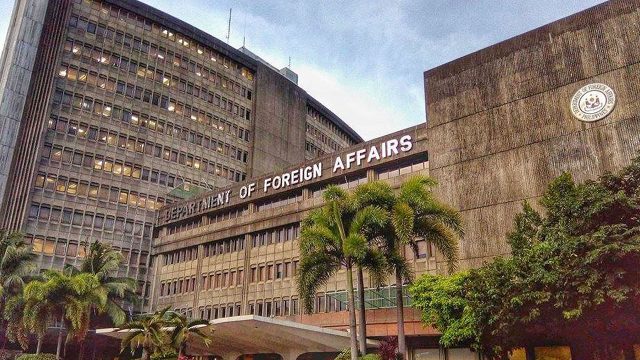
THE DEPARTMENT of Foreign Affairs (DFA) on Sunday said there is no set repatriation yet for about 380 Filipinos in Ukraine despite a serious threat of Russian invasion, but assured its overseas offices are ready to take action. 

“Each foreign service post has contingency plans for emergencies,” said Foreign Affairs Assistant Secretary Eduardo Martin R. Meñez in a WhatsApp message to BusinessWorld.

“Warsaw PE (Philippine Embassy) is in a state of readiness but there are levels of emergency, and mandatory repatriation level has not been called yet,” he said. 

The Philippines also has an honorary consulate general in Kyiv, which is supervised by the embassy in Moscow, according to the DFA website.

“And even if called (mandatory repatriation), we cannot force Filipinos to leave. If you recall recent events in Afghanistan, there were Filipinos who decided not to leave even at the height of emergency,” he added.

After the Taliban seized control of Afghanistan in Aug. 2021 soon after the withdrawal of United States forces, around 20 Filipinos chose to stay in the country for work while close to 200 were repatriated. 

On the Ukraine situation, the US State Department has ordered most of its embassy staff to leave while the Pentagon said it was withdrawing about 150 military trainers. US President Joseph R. Biden has also called on American citizens in Ukraine to immediately leave. 

Australia said on Sunday it was evacuating its embassy in Kyiv, with Prime Minister Scott Morrison calling on China to speak up for Ukraine and not remain “chillingly silent” as Russia massed military forces on its border. 

Several other states, including Belgium, Kuwait, Germany, Lithuania, Spain, and Italy, have also urged their citizens to leave Ukraine unless staying was absolutely necessary.

Mr. Meñez said they have yet to receive requests for repatriation among members of the Filipino community in Ukraine. 

“I don’t think the Filipinos have requested to return to (the) Philippines yet, and as far as I am aware, borders and transport are open if they wish to do so now,” he said. 

Foreign Affairs Deputy Assistant Secretary for Public and Cultural Diplomacy Gonar B. Musor, in a statement on Saturday, said most Filipinos in Ukraine are in Kyiv and surrounding areas, and are “therefore located far from the eastern border near Russia.”

Nonetheless, Philippine diplomats have called on Filipinos to “report any untoward incident they might observe in their respective areas, and continue monitoring their Filipino friends through social media.” 

Meanwhile, Senator Panfilo M. Lacson, Sr., who chairs the Senate Defense and Security committee, said the government should prepare safety nets to protect the country from a possible economic fallout due to Russia’s “imminent invasion of Ukraine.”

“An invasion of Ukraine may adversely affect the stock markets all over the world. Prices of basic commodities and fuel may increase. We need to be prepared for this, not to mention that we are still suffering from the pandemic and are far from economic recovery,” he said in a statement on Sunday. — Alyssa Nicole O. Tan with Reuters 

Group seeks gov’t help to protect consumers from impact of surging oil prices

PHILSTAR

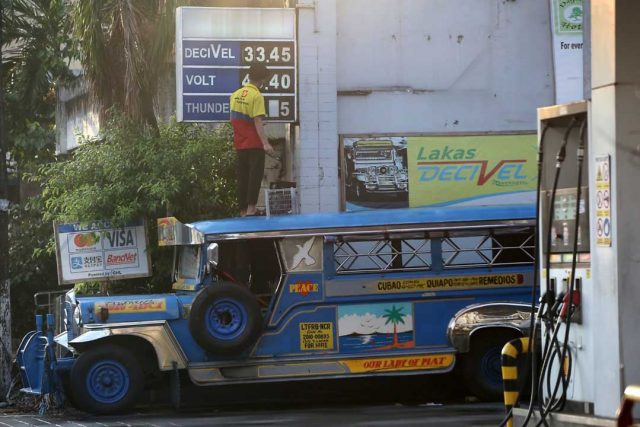
THE GOVERNMENT should recommend measures that would lessen the impact of surging oil prices on basic commodities, a consumer group said over the weekend.

Laban Konsyumer, Inc. President Victorio Mario A. Dimagiba said high fuel prices drive inflation, which affect consumers, especially those in vulnerable sectors such as daily wage earners. 

“We call on the government to remain vigilant despite the lower inflation in January and implement measures such as temporary reduction of taxes on fuel products and approve contracts to mitigate the impact of higher fuel and power prices on consumer prices in the coming months,” Mr. Dimagiba said in a statement over the weekend. 

Further, Mr. Dimagiba said there is a need to suspend the excise tax on fuel products, enforce a temporary price freeze on basic commodities, suspend the application of fare hikes, and give fuel discounts to public transport drivers and operators who have a weekly fuel consumption of 50 liters. 

“Diesel and gasoline prices should be included in the list of basic commodities, which are subject to price freeze or price control in times of calamity and disasters, and to review and repeal the weekly oil price formula that results in an identical amount of price adjustments among oil companies and retailers,” he said.

Based on data from the Department of Energy, year-to-date price adjustments on gasoline has reached P6.75 per liter, diesel at P9.15/L, and kerosene at P8.45/L. 

Some consumers have reached out to the group, according to Mr. Dimagiba, and gave suggestions on how the government can protect consumers. 

Some of the suggestions include the implementation of lower taxes and price controls, promotion of electric vehicles, and regulation of the oil industry.

“Some of these concrete and reasonable proposals from consumers are doable and can be done, if only the regulators have the political will to protect consumers from these unabated oil price hikes,” Mr. Dimagiba said. — Revin Mikhael D. Ochave

Swine fever, supply chain bottlenecks drive 2021 inflation in Davao

BW FILE PHOTO

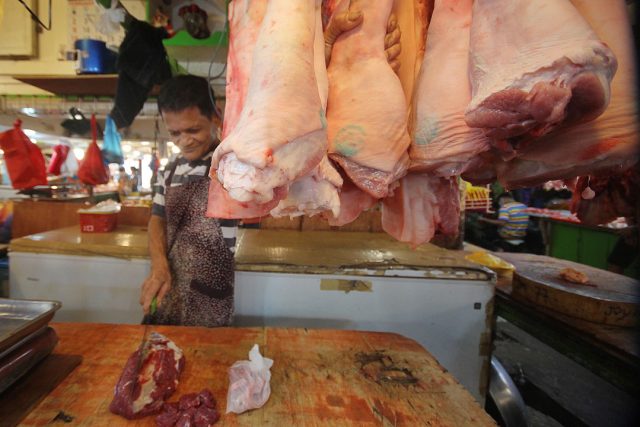
HIGH pork prices brought about by African Swine Fever (ASF) outbreaks and food supply chain bottlenecks were the main drivers of inflation in Davao Region last year, according to the National Economic and Development Authority (NEDA) regional head.

“Prices of food items were on the uptrend throughout the past year due to supply disruption and the prolonged impact of ASF on meat products. Thus, meat prices remained elevated in 2021 in this region,” said NEDA-Davao Regional Director Maria Lourdes D. Lim in a virtual briefing last week.

Inflation in the region averaged 4.6% in 2021 from 1.7% the previous year. 

“There was an acceleration of prices for all major commodities in 2021 driven mostly by higher prices in transport, food, alcoholic beverages, and tobacco. As well as in housing, water, electricity, gas, and other fuels,” she said. 

As of September last year, 43 towns across the region’s five provinces and Davao City have been affected by ASF. 

More than 10,000 hog raisers were affected, according to the Agriculture department’s regional office. 

The department as well as local governments have been extending financial aid and alternative livelihood assistance to the mostly backyard hog raisers.

On supply chain, mobility restrictions across the country due to the coronavirus pandemic affected cargo movement. 

For this year, Ms. Lim said they are confident of seeing economic recovery in the region, projecting a growth rate that could possibly be higher than the national level.

“With much optimism, we expect a positive outlook for Davao Region’s economy for 2022, we believe the region’s economic growth shall be at par or even surpass the economic performance of the country,” she said. 

The NEDA official noted a decrease in worker retrenchment in 2021 with 9,949 losing their employment from 18,470 in 2020. 

“These establishments continue to cope with the lingering effects of the pandemic as the main reason for the termination of workers and financial losses that these establishments continue to experience in 2021,” she said.

Overall employment in the region remained high at 94.6% from 95.8% year on year. — Maya M. Padillo

House resolution vs additional test for driver’s license renewal backed by DoJ

LTO.GOV.PH

A RESOLUTION filed at the House of Representatives that seeks to remove the additional test requirement for driver’s license renewal has received support from the Department of Justice (DoJ), a solon said over the weekend. 

Deputy Speaker and Cagayan de Oro Rep. Rufus B. Rodriguez, who filed House Resolution 2325 which calls on the Transportation department and the Land Transportation Office (LTO) to scrap the recently imposed additional test needed to renew a driver’s license, said the DoJ’s backing helps their bid. 

“We hope that the Department of Transportation and the Land Transportation Office will now finally listen and cease from imposing this requirement,” Mr. Rodriguez said in a statement. 

The DoJ expressed its support in a letter addressed to Samar Rep. Edgar Mary S. Sarmiento, who chairs the transport committee.

“(While) it is a function that is necessary, proper and incidental to the power of the LTO to issue driver’s licenses… it is a function that properly pertains to the LTO and it is not contemplated by EO No. 1101, s. 1985, that said function be performed by an LTO-accredited driving school or institution,” the DoJ said in the letter signed by Undersecretary Emmeline Aglipay-Villar.

“For this reason, we support the adoption of House Resolution No. 2325.”

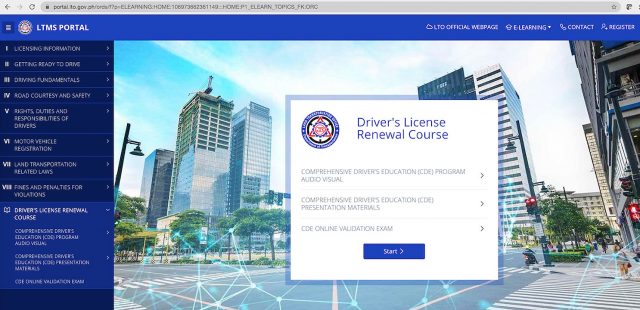
HR 2325 calls on the transport agencies to “immediately remove the additional requirement of acquiring a certification of completion of the comprehensive driver’s education for people renewing their driver’s licenses”. 

The certificate may be obtained for free through LTO offices or online, or from accredited driving schools, which charge fees ranging from P3,500 to P5,000. 

Mr. Rodriguez said that drivers crowding the LTO for the certification could worsen the spread of coronavirus disease 2019 (COVID-19) while paying a private institution is an added financial burden. 

The solon said that the LTO could be accused of corruption if it insists on the requirement. 

He also said LTO should strictly examine first-time applicants for a driver’s license, not those who are renewing. — Jaspearl Emerald G. Tan

Of passports, diasporites and our season in the sun

PCH.VECTOR-FREEPIK

Filipino families continue to relocate to the “land of promise,” so reported the Philippine Daily Inquirer (Feb. 6). The first choice for most seems to be the USA but Canada appears to be easier of entry. The motive is invariably a better tomorrow for the children. So, what’s new?

For one, this exodus is no longer about dirt-poor Ilocano farmers relocating their sacada-ship to Hawaii or California — the denizens of Carlos Bulusan’s cherished must-read biographical novel, America is in the Heart. No longer the struggling newly minted nurses and engineers of the 1960s, those the Philippine upper classes used to look down as “can’t make it here” types. I recall an acquaintance whose graduating electrical engineering class at the University of Santo Tomas was heavily recruited by local agents for the Boeing Aircraft Seattle plant in the 1960s, but he opted to stay. When queried why, he confidently remarked, “Why should I? I can make it here.”   

It was indeed still common for Filipinos to view the Philippines of the 1960s as a diamond in the rough needing only a little more work to become a jackpot.

Randy David’s “The Golden Age I Remember” (Philippine Daily Inquirer, Feb. 6) is a charming poignant paean to the 1960s era for its many now lost genteel adornments. People and government seemed still on the same page and purpose. We had many problems and we disagreed, but it was more to improve our collective lot than to spite our enemies. This contrasted sharply with the claimed “Golden Age” of the Marcos era which nurtured the “cargo cult” financed by an orgy of foreign borrowing. There were, of course, other things on our plate then besides benign politics: students from all over Asia populated our universities and ran experiments in our laboratories; our bright boys were setting up their capital markets and helping prepare their field studies. The seeds of the vaunted green revolution were sourced from Los Baños, Philippines. We were basking in the sun and the Philippine passport was flying high. 

We were then aspirational to our neighbors. Fifty years later, the tables have completely turned. Our Asian neighbors now encounter the Philippines through their house help rather than through their mentors. We have become a cautionary tale on what not to do; our democracy has become a horror story with which to bludgeon democratic aspirations elsewhere. The galloping foreign debt that the Marcos dictatorship behind a phalanx western-educated technocrats inveigled from foreign banks and frittered away made the dollar cheap and that ravaged our manufacturing sector. With manufacturing on the run, the engineers who stayed behind found fewer and fewer engineering jobs. They finally found solace as OFWs. 

Our ship could not leave port for lack of fuel, but much more for lack of courage to ditch the old fear of foreign domination. Investment in infrastructure had to wait for leftovers from debt service and terrible legacies such as the OPSF. “An hour late and a dollar short” went the popular epithet about the Philippines in the 1980s. And when foreign investment in manufacturing became a global tsunami in the wake of the 1987 Plaza Accord, our restive and coup-happy military, the restrictive backward-looking 1987 Constitution, and the heroic but foolish jawboning exercise using the JOBO bills by the central bank to cheapen the dollar, all conspired to ensure that none of the tsunami reached our shores. At the beginning of the 1990s, the diamond in the rough had been turned into muck. And the Philippine passport had crashed.

And now our children are paying the price. They now have to start a few paces back in the global race for jobs or for slots in universities thanks to the passport they hold. Which is why many parents are deciding to trade their low-power passport for high-power ones. You cannot change the color of your skin, but you can change the color of your passport to the vast improvement in your children’s prospects.

A low-power passport always triggers officiousness among immigration and customs officials in the countries you visit and that could mean unpleasant hustle. You can be singled out for a special interview — a courtesy never accorded a Scandinavian or a Japanese passport. Why? The Philippine passport ranks 77th out of 111 country passports in 2022 Henley Passport Power Index which grades passports by the number of countries where the passport holder can travel without a visa or with a visa readily granted at the airport. In the 2022 Arton Capital Index, the Philippine passport is ranked at par with those of sub-Saharan countries Rwanda, Uganda, and Sierra Leone. The top countries in the list, among them the USA and Canada, are of course the most favored destination for economic migrants from lower ranked countries. 

The latter day diasporites that have already made it here deserves a closer look. It is not easy for a diasporite to start over again at age fortyish. But as a first generation Filipino migrant, your benchmarks are the millions back in the Philippines who yearn to be in your place rather than your neighbor in Anaheim who may look down on you. Besides, “making it” in the Philippines now seems tainted by a virtual asterisk (*) besides the collapsed passport. Material success in a garbage dump can suggest, mostly falsely, that you are low life feeding on maggots! While not unique to the Philippines, the new diaspora contrasts sharply with the modern reverse diaspora in East Asian miracle economies.

Even among those of us who came back from abroad with the purest of motives — to create a land of milk and honey for our children — many have managed to hedge their bets. Among our educated friends and acquaintances, it is rare when there is not an offspring or two residing and earning money abroad, spared from the morass, but also serving as insurance against the fickleness of home. That makes exit from home easier. Nobel winner Elinor Ostrom of the “anti-tragedy of the commons” fame taught us that collective failure is less galling and more likely when people can easily walk away from the smash-up. 

This reversal of fortune gnawed at the gut of the generation who lived the 1960s — among them National Artist F. Sionil Jose and revered business guru David Sycip, both recently dead — who wore their discomfiture on their sleeves. For many of my generation, among them friends Rene Santiago and Bob Herrera-Lim who worked the Asian consultancy circuit, the memory of that season in the sun is tinged with sadness — sadness for the loss which my generation failed to stem.


Raul V. Fabella is a retired professor of the UP School of Economics, a member of the National Academy of Science and Technology, and an honorary professor of the Asian Institute of Management. He gets his dopamine fix from bicycling and tending flowers with wife Teena.

Fiscal recklessness

RAWPIXEL.COM-FREEPIK

Everyone can feel the election season in the air. With recent presidential interviews, platforms and plans are beginning to unveil with each presidential candidate aiming to get the most votes for the most powerful position in the land.

This article will focus on the fiscal policy implications of Marcos Jr.’s platform.

In the Boy Abunda interview, Marcos Jr. promised heavy spending like creating more jobs, increasing benefits and compensation for workers, providing ayuda (help) for people experiencing hunger, boosting agriculture and tourism, paying the debt, etc.

These answers are textbook responses to the usual problems. Also, note that Marcos Jr. said he wants to pay the country’s debt, which has expanded in the wake of pandemic financing. That’s quite a gargantuan task.

The country’s fiscal situation is certainly a cause for concern. Due to the pandemic-induced economic recession, the country could not count on consistent tax revenue at this time and had to primarily rely on borrowings to fund health and economic spending. 

COVID-19 has hit all economies hard, and deficit spending has become inevitable if the government would like to mitigate any long-term economic damage.

According to the latest data available, the government’s average quarterly deficit ratio rose from 6.6% of GDP at the end of 2019 to 9.2% by the third quarter of 2021. The resulting debt burden is remarkable: from an outstanding debt level of P7.7 trillion at the end of 2019 to P11.7 trillion by end-2021. In terms of GDP ratio, debt-to-GDP rose from 39.6% to 60.5% during that timeframe.

These figures, along with the fact that COVID-19 and its variants continue to be a global concern, should not preclude the government from pursuing strategic expansionary fiscal policy, however. The appropriate pandemic response still requires investment in our health sector, as well as necessary stimulus measures to revitalize consumer demand, bring back lost jobs, and regain investor confidence. Maneuvering these constraints will require shrewdly maximizing potential revenue sources, while spending funds as efficiently as possible.

But the unanswered big question Mr. Marcos needs to answer is: Where will he get the money for all his promises?

We do know that the only way spending can be maintained and even increased, as Marcos Jr. promises, is through increasing revenues or increasing borrowing. But borrowing is already stretched or extended. We do not want another debt crisis. Hence, the wise option is to rely principally on increasing the tax effort.

Red flags appear on how Marcos Jr. can create the fiscal space for his promises. His tax policy is not towards increasing revenues; in fact his stance will lead to even lower tax effort.

For example, he has called for the suspension of fuel excise taxes. He even wants to amend the oil deregulation law. In his press release (October 2021), Marcos Jr. said: “Amending the oil deregulation law with the intent of addressing the issue of runaway oil prices will take some time. This move to suspend the excise tax makes sense and will have an immediate positive impact on our people.”

Revenue from petroleum products totaled P42.7 billion in 2019 and because of low demand during the pandemic, dropped to just P27.6 billion in 2020. The importance of this revenue source should not be understated, however. For one, demand is returning to pre-pandemic levels as the economy and revenues are expected to pick up. Petroleum taxes are also in line with larger environmental goals of shifting incentives towards sustainable alternatives.

The populist rhetoric of suspending fuel taxes is an easy temptation for politicians to call. However, simply forgoing an important revenue source would further exacerbate our fiscal problems. Further, it is mostly higher income Filipinos who would benefit from a fuel tax suspension anyway, and the alternative of providing pandemic-related fuel subsidies to jeepney drivers, workers, and poor Filipinos would be much more targeted and efficient.

With billions worth of revenues to be lost because of this policy direction, we again ask: Where would he get the money to finance all his campaign promises related to the pandemic?

Another red flag is Marcos Jr.’s opposition to the sin taxes, which are mainly earmarked for health spending.

In the face of the onslaught of the Omicron variant, everyone knows a family member or friend, or has themselves already caught the virus. Amid the scores of thousands of patients admitted to our hospitals or who got sick, it is a relief that the Sin Tax Law provided funding for the pandemic response.

For the readers who are unfamiliar with this legislative measure, RA 10351 significantly raised the tax rates imposed on cigarette products. After this law was passed, cigarette prices increased by more than 300%, resulting in a significant reduction of smoking prevalence. Moreover, the bulk of government revenues from the sin taxes was earmarked for universal healthcare.

In 2020 alone, P93.57 billion out of the P171.91-billion budget of the Department of Health (or 54%) came from sin tax revenues. The amount of P58.73 billion from the sin taxes was used to finance PhilHealth, our National Health Insurance Program. PhilHealth spending and subsidies during this period were mainly used for the pandemic response.

The sin taxes are used to finance the insurance benefits of Filipinos who cannot pay their own monthly contributions (known as indigents). Several health programs such as epidemiology and surveillance, human resources for health, health promotion, and improvement of health facilities get their funding from the sin taxes. These are all critical components of the pandemic response.

It is most ironic that Marcos Jr. would claim that he’s the best candidate to address our health crisis when his position has been to deny the much-needed funding for health. Given the important role of sin taxes in improving our country’s health programs, Marcos Jr.’s opposition to increasing sin taxes, especially higher tobacco taxes, is irresponsible.

In 2012, he was one of the more vociferous senators to opposed the passage of Republic Act 10351, popularly known as the Sin Tax Law of 2012.

The arguments he used during the deliberations were misleading and patently incorrect. Marcos Jr.’s speech can be summarized, as follows:

1) Sin taxes will not lower smoking incidence because smokers will just transition to illicit markets and continue their habit.

2) The government will not generate revenues.

3) The measure will destroy the tobacco industry.

The data from the National Nutrition Survey (NNS) debunk Marcos Jr.’s first argument. After the tax was put in place in 2013, smoking incidence was reduced from 31% in 2008 to 23.3% in 2015. The most recent data show that smoking incidence for Filipinos aged 20 and above is down to 19.9% in 2019.

His second argument has likewise been proven wrong.

According to the Bureau of Internal Revenue, tobacco excise tax collection soared from P32.17 billion in 2012 to P99.5 billion in 2015. By the year 2020, our tobacco excise tax collection grew to P149.6 billion. Consequently, because of the earmarking of sin taxes for health spending, the health budget grew from P53.23 billion in 2013 to P171.91 billion in 2020.

It is thus troubling that the leading candidate in the 2022 presidential elections is also the leading voice against good tax reforms. The future of tax reforms and our national health system will be in jeopardy. Our fiscal health, which has gained tremendously from successive reforms since 2012, will be undermined. This does not bode well for the Philippine economy and our people’s well-being.


The authors are senior policy analysts of Action for Economic Reforms.

The sinister schemes of online lenders

VECTORJUICE-FREEPIK

Angelo is humble family man who represents everyday Filipinos. A loving husband and a father of two, the native Bulakeño works as a family driver to a household based in Pasig. He earns a fair wage, according to the going rates of family drivers these days. Angelo’s salary is just enough for his family’s basic needs like rent, food, and transportation. He has no savings. Extraordinary expenses like medical care, tuition fees, or emergencies are enough to throw Angelo into a monetary tailspin. 

Unfortunately, a family emergency occurred last November for which Angelo needed P68,000 to save his family. Desperate, the man tried to borrow from friends and relatives — but to no avail. With the pandemic, everyone was struggling. At his lowest, a friend advised him to explore online lenders who grant emergency loans within 24 hours. Angelo heeded his friend’s advice. This was when his nightmare started.

Working under the radar, numerous online lenders prey on desperate souls like Angelo. They lure innocent victims with text messages, ads on social media and through word of mouth, care of loan brokers. They promise access to cash in as quickly as one day. 

All one has to do is download the lender’s App and apply for a loan by agreeing to their terms and conditions. Approval is immediate and the loan proceeds are sent to the borrower through G-Cash, bank transfer, or other electronic means.

Angelo borrowed a total of P68,000 from 19 different online lenders in denominations of P1,000 to P4,500 each. This is what happened next….

He borrowed P3,000 from a certain online lender on Nov. 24. The loan had a duration of 30 days, maturing on Dec. 24. It carried an eye-watering interest rate of 51.79% per month or 629.41% per annum. The P3,000 Angelo received became a liability of P4,553 in just 30 days! Unfortunately, Angelo was unable to meet his payment on Dec. 24. The online lender immediately slapped a penalty amounting to 20% of the loan proceeds. In addition, interest was made to accrue on a daily basis at a rate of some 2.6% per day. 

Angelo finally paid his loan on Dec. 31. He paid a total of P4,890 for a loan of P3,000. The online lender earned 63% interest in just 37 days from poor Angelo.

His experience with another online lender was just as harrowing. Angelo borrowed P3,500 from lender No. 2. The loan was approved but the lender deducted P1,500 or 43% of the loan proceeds for supposed “Account Management Fees,” “Platform Service Fees,” “Risk Management Fees,” and “Credit Reporting Fees.” Angelo received only P2,000 but had to pay interest of close to 100% per month for a principal of P3,500.

The scandalous fees and interest rates are not even the worst of it. The harassment one receives for late payment is the vilest part. If a borrower is late by even one day, an army of trolls send text messages to berate, embarrass, and threaten the borrower. This is one example of such a message, received by Angelo: 

Ano, patigasan? Wala ka na bang kahihiyaan sa buhay? Utang ka tapos wala kang planong magbayad ng maaga….. pagkatpos kang pautangin ng kumpanya naming at ipakain sa pamilya mo tapos hindi ka na magbabayad? Etong mga information mo sa selfies mo kasama ang ID mo, asahan no na kakalat ito sa Credit Information Corporation at di ka na pamarisan!!!” (“What, want to see who is tougher? Have you no shame in life? You borrow and then you have no plans to pay early…… after our company lends you and you feed your family, and then you don’t pay? Be assured that the information on your selfies along with your ID will be shared with the Credit Information Corporation so as to prove a bad precedent !!!”)

The trolls would go a step further and call friends, relatives, and the employer of the borrower to expose the loan and the late payment. Again, this is meant to shame the borrower into submission. 

Evidently, when one agrees to the conditions of the loan, one gives permission to the online lending company to access all social media contacts. Poor Angelo — as an unsuspecting high school graduate, he had no idea that he was ceding his personal information by agreeing to the lender’s conditions.

Angelo was on the verge of a nervous breakdown by mid-December. Debased and shamed, he sought the help of his employer. Lucky for him, his employer agreed to bail him out.

All things told, Angelo borrowed P68,000 from 19 lenders for which he received only P58,024 due to the excessive processing fees of some. His employer paid off all his debts on Dec. 31. For loans with an average age of some 15 days, the employer paid P32,667 worth of interest. This represents an effective interest rate of 112% per month. 

With the help of his employer, Angelo filed a complaint before the Bangko Sentral ng Pilipinas (BSP) and the Department of Trade and Industry (DTI), consumer protection office, and the Securities and Exchange Commission (SEC).

Angelo requests the BSP, SEC and the DTI to investigate the sinister schemes of online lenders for their opportunistic practices and for their violations of the Usury Laws of the Philippines. 

We count on the BSP, DTI and the SEC for their immediate action towards online lenders who prey on our desperate countrymen.


Andrew J. Masigan is an economist

andrew_rs6@yahoo.com

Facebook@AndrewJ. Masigan

Twitter @aj_masigan

Love in the time of COVID

PCH.VECTOR-FREEPIK

This is our second Valentine’s Day in nearly two years of the COVID-19 pandemic. Perhaps two years have changed remembrances of Valentine’s Day in the recent past, of it being a giddy celebration of all kinds of love for a special “other” — legitimate and illegitimate, known and secret, present and past, and even future.

Everyone has to have a Valentine. One’s spouse is de-rigueur, and Mom and Dad are the favorites aside from other family members and close friends. Of course, Valentine’s Day is the big day for boyfriend-girlfriends, or open gay lovers. But the standing joke for Valentine’s Day before COVID was that it was celebrated on Feb. 13 for “forbidden” love. I wonder what happened to those drive-in motels with closed garages (the “biglang-liko” or sudden turn as they call these clandestine trysting places) where secret lovers exhausted and expended themselves in demonstrative declarations of love that cannot be? Many out-of-business motels are now COVID quarantine places for incoming tourists and returnees to the country and from other regions in the country. 

The alienation and isolation that occurs in a pandemic can change the face of love. Gabriel García Márquez set his most famous novel, Love in the Time of Cholera (published in 1985) in Colombia, in 1875 to about 1924, in the time frame of the fifth cholera pandemic that raged fiercest in 1883–1887. The epidemic cost 250,000 lives in Europe and at least 50,000 in the Americas. Cholera claimed 267,890 lives in Russia (1892); 120,000 in Spain; 90,000 in Japan; and over 60,000 in Persia. In Egypt, cholera claimed more than 58,000 lives. The 1892 outbreak in Hamburg killed 8,600 people (from Wikipedia). 

Some critic pointed out that aside from the name of the disease, the term “cholera” in Spanish, “cólera,” can also denote passion or human rage and ire (the English adjective “choleric” has the same meaning). Cholera as the disease; cholera as passion; passion as a disease: is love helped or hindered by extreme passion? Perhaps García-Márquez bares an allegory of maddened passionate love as it is isolated and quarantined until it is unmasked and released to again claim an unfulfilled love in youth. But time will have healed the hot passion of the loins to the comfortable warmth of the passion of the soul. 

The story opens with two deaths: a foreigner has committed suicide; the doctor-friend who proclaims him dead dies soon after from a freak accident, falling off a mango tree while trying to rescue his runaway pet parrot. At the wake for the doctor, two lovers-in-their-youth see each other after “51 years, nine months, and four days” and Florentino Ariza professes, for a second time since, his “eternal fidelity and everlasting love” to the doctor’s widow, Fermina Daza. 

A racy flashback to years of pining for Fermina — not without risqué love affairs deceiving, betraying, and using women, and including molesting a 14-year-old ward — paint Florentino as a flawed tragic hero, caught in the turmoil of hormones and dark thoughts broiling inside him. Angered and driven by the frustration of not getting her to be his wife (Fermina’s father had rejected his proposal to marry her when they were young), Florentino has built himself up to be a very rich man. Possession and property, power and influence are often placebos for the debilitating lack of emotional and spiritual achievement and the peace of the soul. 

But in old age (probably  70 years old) Florentino still obsesses over owning the reluctant Fermina. He relentlessly woos the widow until finally she succumbs to their first-ever lovemaking, cruising down the Magdalena River. (What more obvious simile that the main river in Colombia is named after the supposedly fallen biblical Magdalene?) As the ship nears its last port, Fermina fears having to face society with her perceived stigma of having fallen to base instincts. Florentino orders the ship captain to raise the yellow flag of cholera, which the captain does. There are no passengers onboard but Fermina, Florentino, the Captain, and his lover. No port will allow them to dock because of the supposed cholera outbreak aboard.

Love in the Time of Cholera — tragically ending in the painful ecstasy of García-Márquez’ penetrating strokes presages the seemingly near-hopeless human condition in this time of the long-playing COVID pandemic, like being onboard a ship that cannot yet dock. Today, the second Valentine’s Day in the grip of restrictions and isolations imposed by the pandemic, our values and definitions of love are challenged — is love an obsession with possession, a means to a self-serving love of self? Time enough to ponder and discern.

Possessive love has been romanticized much in literature and the arts, in folklore and common language, and social mores have institutionalized the dubious nobility of jealous protectiveness over the exclusivity of one for the other in a love relationship. A peer-vetted medical website says, “We almost all feel some degree of possessiveness in romantic relationships. After all, it’s at the heart of the phrase ‘be mine’ we hear every Valentine’s Day — that concept of ‘belonging’ to someone… If taken too far, possessiveness can become a serious issue that leads to other relationship problems.” 

“Possessiveness is fundamentally a fear of loss. Possessive people worry that their partners will leave them. They worry that their partners can’t be trusted… and they will lose their ‘possession’” (https://www.webmd.com/sex-relationships/signs-possessiveness, Dec. 3, 2020). 

What a sad commentary for the highest and noblest act that Man can do, “loving one another as God has loved you.” Trust and faith are the virtues that uphold this covenant between God and Man, between Man and each other. How poignantly Valentine’s Day in a pandemic reminds us that love is not possession of another, but a conscious act of the will and sustained feelings of heart and soul that persist even in the isolation and restrictions of time and distance, in quarantines and health protocols. 

The COVID pandemic has also riveted us from inordinately loving the material possessions and obsessions that had surrounded us in our “past life.” We have been caught in the accoutrements of wealth and power that shackled us in fierce competition with one another — economic status has been the measure of success. “In our day, for many people, life’s meaning is found in possessing, in having an excess of material objects. An insatiable greed marks all human history, even today, when, paradoxically, a few dine luxuriantly while all too many go without the daily bread needed to survive,” Pope Francis said in a Christmas Day homily at St. Peter’s Square in Rome (Reuters, Dec. 25, 2018). 

“Let us ask ourselves: Do I really need all these material objects and complicated recipes for living? Can I manage without all these unnecessary extras and live a life of greater simplicity?” Pope Francis said. 

Can I love without possessing? Must possessions be my measure of happiness? 

Pope Francis prays to God, “it is not the time of Your judgment, but of our judgment: a time to choose what matters and what passes away, a time to separate what is necessary from what is not. It is a time to get our lives back on track with regard to you, Lord, and to others.” (https://www.ncronline.org/, March 27, 2020). 

Amen.


Amelia H. C. Ylagan is a doctor of Business Administration from the University of the Philippines.

ahcylagan@yahoo.com

ADVERTISEMENT
ADVERTISEMENT