Home Blog Page 6765

Russia postpones Cuba debt payments amid warming relations

STOCK PHOTO | Image by IGORN from Pixabay

Russia has agreed to postpone some debt payments owed to it by communist-run Cuba until 2027, its lower house of parliament said on Tuesday, just days after the two countries announced they would deepen ties amid the spiraling Ukraine crisis.

The loans, worth $2.3 billion and provided to Cuba by Russia between 2006 and 2019, helped underwrite investments in power generation, metals and transportation infrastructure, according to a statement from the lower house, or Duma.

On Tuesday, Russian lawmakers ratified an agreement, originally signed with Cuban counterparts in Havana in 2021, that amended the loan terms, the statement said.

Cuba last week expressed support for Russia in its showdown with Western powers over Ukraine following a visit from Russian Deputy Prime Minister Yuri Borisov, and accused long-time rival the United States and its allies of targeting Moscow with what it called a “propaganda war” and sanctions. Read full story

Russia‘s decision to soften the loan terms comes as Cuba wrestles with a dire social and economic crisis that has led to severe shortages in food and medicine, and it follows protests last year believed to be the largest since Fidel Castro’s 1959 revolution.

Since the revolution, the two countries have had a long history of economic and military collaboration, though in recent decades those ties have faded.

Russia has, however, continued to deliver humanitarian aid and provide loans to the island.

Over the last decade, Cuba has also restructured debt with China, Germany and Mexico, as well as with Japanese commercial debt holders.

In October, Cuba reached a deal with the Paris Club of creditor nations to postpone an annual debt payment due in November until later this year. Read full story

Duma chairman Vyacheslav Volodin is expected to visit Cuba and Nicaragua on Feb. 23 and 24. – Reuters

West unveils sanctions with more ready if Russia carries out full-scale Ukraine invasion

A RUSSIAN FLAG flies with the Spasskaya Tower of the Kremlin in the background in Moscow, Russia, Feb. 27, 2019. — REUTERS

MOSCOW/DONETSK/WASHINGTON – Western nations on Tuesday punished Russia with new sanctions for ordering troops into separatist regions of eastern Ukraine and threatened to go further if Moscow launched an all-out invasion of its neighbor.

The United States, the European Union, Canada and Britain announced plans to target banks and elites while Germany halted a major gas pipeline project from Russia, which they say has amassed more than 150,000 troops near Ukraine’s borders. Moscow has denied planning an invasion.

One of the worst security crises in Europe in decades is unfolding as Russian President Vladimir Putin ordered soldiers into Donetsk and Luhansk to “keep the peace.” Washington has dismissed that as “nonsense”.

Satellite imagery over the past 24 hours shows several new troop and equipment deployments in western Russia and more than 100 vehicles at a small airfield in southern Belarus, which borders Ukraine, according to U.S. firm Maxar.

Weeks of intense diplomacy have so far failed and on Tuesday both U.S. Secretary of State Antony Blinken and French foreign minister Jean-Yves Le Drian cancelled separate meetings scheduled with Russian counterpart Sergei Lavrov.

“To put it simply Russia just announced that it is carving out a big chunk of Ukraine,” Biden said on Tuesday.

“This is the beginning of a Russian invasion.”

Plans announced by Biden to bolster Estonia, Latvia and Lithuania include sending 800 infantry soldiers and up to eight F-35 fighter jets to locations along NATO’s eastern flank, a U.S. official said, but are a redistribution, not additions.

Putin did not watch Biden’s speech and Russia will first look at what the United States has outlined before responding, according to Kremlin spokesperson Dmitry Peskov, cited by Russian news agencies.

Early on Wednesday, Putin said he was always open to finding diplomatic solutions but that “the interests of Russia and the security of our citizens are unconditional for us.”

Moscow is calling for security guarantees, including a promise that Ukraine will never join NATO, while the U.S. and its allies offer Putin confidence-building and arms control steps to defuse the stand-off.

A meeting between Biden and Putin, brokered by France, “certainly is not in the plans” at this point in time, the White House said on Tuesday.

MORE SANCTIONS TO COME?

U.S. sanctions are being applied to VEB bank and Russia’s military bank, Promsvyazbank, which does defense deals, Biden said. Starting on Tuesday, sanctions will begin against Russian elites and their family members.

Tass news agency cited Promsvyazbank as saying the sanctions would not have a significant effect since it had taken precautionary measures ahead of time. It did not give details.

Washington also said that it restricted dealings in the secondary market with Russia’s sovereign debt for bonds issued after March 1.

Canada also announced similar steps and will impose sanctions on members of the Russian parliament who voted for the decision to recognise the two separatist areas.

But many Western nations held off the strictest sanctions as they try to dissuade a larger Russian assault. Russia’s Sberbank and VTB would face sanctions if Moscow proceeds with an invasion, said a senior U.S. official, warning of a hit to the wider economy.

“We are fully prepared with a very large number of countries across the world to implement … export control measures.”

The European Union and Britain chiefly targeted Russian banks and their ability to operate internationally with the impact likely to be minimal. Read full story

Lavrov earlier brushed off the threat of sanctions.

“Our European, American, British colleagues will not stop and will not calm down until they have exhausted all their possibilities for the so-called punishment of Russia,” he said.

MARKETS WORRY, SEPARATISTS CELEBRATE

The prospect of a disruption to energy supplies and fears of war – stoked by reports of shelling in some areas and movements of unmarked tanks overnight in the city of Donetsk – rattled markets and sent oil prices to their highest level since 2014.

Germany put the brakes on the new Nord Stream 2 pipeline and Britain also hit Russian banks with sanctions. The Russian foreign ministry criticized the new measures as “illegitimate”.

Germany is Russia’s biggest customer for natural gas, and the decision by Chancellor Olaf Scholz on the pipeline – built but awaiting approval – was widely seen as one of the strongest measures Europe could take.

Ukrainian Foreign Minister Dmytro Kuleba hailed the move.

“This is a morally, politically and practically correct step in the current circumstances,” he said. “True leadership means tough decisions in difficult times. Germany’s move proves just that.”

The Kremlin said it hoped the delay was temporary. Putin said Russia “aims to continue uninterrupted supplies” of energy to the world.

Following Russia’s recognition of the independence of Donetsk and Luhansk, some residents in Donetsk city celebrated, with cars flying Russian flags and sounding their horns.

But several blasts could be heard at midnight in the centre of the separatist-held city, a Reuters witness said.

The Russian-backed regions broke away from Ukrainian government control in 2014 and proclaimed themselves independent “people’s republics” after a pro-Moscow Ukrainian president was ousted in Kyiv.

“I know that the blood I spilled with my comrades and our labors and efforts and the losses of civilians were not in vain all this time,” Dmitry, a former member of a pro-Russian militia, said in Donetsk on Tuesday. — Reuters

Collaborating to achieve sustainability with the American Chamber of Commerce of the Philippines

While the concept of sustainability has long been a topic of public discourse about society and its development, it has managed to gain traction with the growing awareness of the looming climate crisis and the global COVID-19 pandemic. Such crises have highlighted the potential social and economic damage liable to happen if humanity’s progress remains unchecked.

In a sense, sustainability is now being recognized by organizations, public and private globally, as the way forward, with the United Nations defining it as how society can meet “the needs of the present without compromising the ability of future generations to meet their own needs.”

The United Nations manifests its vision for a more sustainable world through the Sustainable Development Goals (SDGs), aimed at taking a holistic approach towards solving the world’s issues through strategies that build economic growth while addressing a range of social needs including education, health, social protection, and job opportunities, and tackling climate change and environmental protection. The topic of sustainability was the subject of discussion among the members of the American Chamber of Commerce – Sustainability Committee in a recent interview with BusinessWorld.

James Donovan, Co-founder and Global CEO at ADEC Innovations and director at the American Chamber of Commerce of the Philippines, emphasized the interconnectedness of the SDGs, saying that the 17 aspirational goals taken as a whole present a better picture of sustainability than any one metric or definition.

“It may be difficult to define sustainability without looking at the holistic interconnection of the SDGs. Always depending one upon the other, it underscores the interconnectedness for our society, institutions, and our environment. These are the challenges of our times, and I believe we are up for that challenge as we define a new relationship with our resources,” he said.

Erika Courteille, Director at Climate Change and Sustainability Services at SGV & Co., a member firm of Ernst and Young (EY) echoed the sentiment, adding that she sees sustainability as the “innovation opportunity of our lifetime”.

“Many enterprises and individuals are now very inspired to do the right thing, to collaborate with each other on critical sustainability issues. We see companies partnering together, industry associations coming up with different innovative solutions to help accelerate society towards a more sustainable future,” she said.

“Collectively, we can create financial, consumer, human and societal long-term value for all stakeholders. When businesses work sustainably, the world works better, whether it’s for business, people, and the planet.”

The country’s long road to a sustainable future

The Philippines has made great strides in its efforts towards achieving the SDGs it had identified as its areas of focus. Most recently, at the 2021 United Nations Climate Change Conference of the Parties (COP26), the government made sizeable efforts in its fight against climate change: from the establishment of a new panel of technical experts on climate change composed of scientists, and medical and disaster risk reduction practitioners from different regions; to the reveal of the government’s sustainable financial roadmap that sets the guiding principles creating the environment for greener policies; and the energy transition mechanism facility, which aims to fund the early retirement of coal-fired power plants and replace them with renewable energy alternatives.

Earlier, the Philippines has also committed to slashing its greenhouse gas emissions by 75% by 2030.

Ms. Courteille said that while all the commitments around carbon reduction sounds promising, the country still needs them to be aligned with its policy frameworks like the Philippine Development Plan, Ambisyon 2040, the Philippine Energy Plan 2018-2040, and the like.

“There’s so much more to be done in this space. Unless the government penalizes companies, who do not decarbonize, or offers incentives to companies that do, then it will be hard to achieve our nationally determined contributions on carbon emission reduction by 2030,” she said.

“The Philippine Development Plan should address and provide a blueprint for development across the four areas of sustainability: economic, environment, social, and governance, to ensure that no one is left behind as our country progresses.”

Mr. Donovan underscored the need for the Philippines to use the considerable skill and talent of its people to reframe how it approaches sustainability.

“Sustainability should be framed as a competitive advantage. I can’t say this enough, the Philippines delivers services all over the world, high-caliber back-office services, support services, and IT services. We need to take some of that capability and turn it inwards and understand that we have these various pillars that we need addressed and use some of that creative capability to create a value proposition for the Philippines,” he said.

“We need to get the private sector, the NGOs, and the government to understand a little bit about each other’s language to move these issues down and create value propositions people can put money in and get clear outputs. We need to move to that business model. We are all in this together,” he ends.

Ms. Courteille added, “We need to act now. Climate change is here. And we need all hands on deck. Private, public, academe, everyone needs to work together to try to figure out how we can adapt and fight climate change in the Philippines.”

Leading the way in the private sector

Corporations, businesses, and enterprises of all sizes have a social responsibility to respond to this call to action. In an interview, Anna Legarda, communications director of multinational consumer goods firm Procter & Gamble, agreed, and noted they are using their company’s sizable resources to deliver quality products to consumers in a sustainable way.

“At Procter & Gamble, sustainability is embedded into our business strategy, which means it is hardwired into the everyday methods of how we do business. It’s not seen as a separate piece of work that’s simply bolted on, and it’s certainly not seen as simply CSR or citizenship work only,” she said.

She also highlighted various initiatives that P&G has spearheaded to champion sustainability in four key areas: brand innovations, the company’s supply chain, employee work plans, and societal partnerships. These are part of P&G’s AMBITION 2030 commitments, which aims to protect and enable positive impact on the environment and society while creating value for both the company and their consumers.

The multi-pronged initiative creates measurable goals and targets by 2030 for areas where P&G can make the most impact, such as using 100% recyclable or reusable packaging, cutting greenhouse gas emissions by half, increasing water efficiency by 35% and sourcing at least five billion liters of water from circular sources, and collaborating with organizations to increase the global area of certified forests, and strengthening certification systems.

“We partner a lot externally because we know that sustainability and the challenges across its different facets cannot be solved alone. We make sure that we are partnered with experts in the field that we are working on, and that the partnerships are technically feasible and have short-term, mid-term, and long-term results we work on together,” Ms. Legarda said.

“P&G is committed to delivering the best and most trusted products that make our everyday lives better, and to doing this in a sustainable way. It’s not a choice anymore, we are here to be a force for good, and to be a force for growth for everybody. For the country, for the economy, for the citizens, for the industry.”

For their part, Atty. Joseph Fabul, country manager for Corporate and Government Affairs at multinational snacks company Mondelēz International, said that clear environment, social, and governance programs are drivers for growth for the company and as such, these goals are integrated into the company’s core.

“In Mondelēz International, we’re on a mission to lead the future of snacking by creating snacks the right way for both the people and the planet to love. We are focused on making our snacks more sustainably by using less energy, less water, and less waste, with ingredients that consumers know and trust,” he said.

“Our purpose is to empower people to snack right by providing the right snacks for the right moments and made in the right way. Our entire ESG strategy is hardwired into that purpose. And we aim to deliver lasting change at scale by prioritizing areas of greatest impact by focusing on innovative and measurable solutions and collaborating to drive sector-wide transformation.”

Mondelēz International, he pointed out, has its Snacking Made Right strategy, which outlines how the company aims to make a lasting and meaningful impact on the world by “taking care of its people, protecting resources, and providing moments of comfort and connection for our consumers.”

Snacking Made Right is the lens which the company views ESG, a framework for its sustainability and well-being agendas. The strategy involves the sustainable sourcing of the ingredients it uses in its products, sustainable resource use, end-to-end carbon emissions reductions, and recyclable packaging and waste management.

Most notably, Mondelēz International has announced that it is committing to a 2050 target of net-zero greenhouse gas emissions across its full value chain across the world. As part of the commitment, the company has signed the Science Based Targets Initiative’s Business Ambition for 1.5°C, aligning its long-term emissions mitigation targets with the ambitious aim of limiting temperature rise in accordance with the Paris Agreement.

Furthermore, Mondelēz International joined the United Nations Race to Zero Campaign to help build momentum towards a decarbonized economy.

“We are driving our public commitments to environmental and social progress enabled by strong, broad oversight, a culture of accountability and compliance, and positive two-way dialogue among stakeholders,” Atty. Fabul said.

“At Mondelez International, we are committed to doing business the right way. We have clear plans for our environmental, social, sustainability, and governance programs by creating a future with people and the planet in mind.”


Spotlight is BusinessWorld’s sponsored section that allows advertisers to amplify their brand and connect with BusinessWorld’s audience by enabling them to publish their stories directly on the BusinessWorld Web site. For more information, send an email to online@bworldonline.com.

Join us on Viber to get more updates from BusinessWorld: https://bit.ly/3hv6bLA.

DoF preparing tax transition plan

BW FILE PHOTO

LOCAL GOVERNMENTS should effectively collect revenues from the wealthy through improved real estate valuation, Finance Secretary Carlos G. Dominguez III said as he prepares a transition plan to help the next administration manage the country’s debt.

As it works on a fiscal consolidation plan for the next administration, the Department of Finance (DoF) is looking into taxes that could pay for the Philippines’ mounting debt after the government ramped up borrowings to finance the coronavirus disease 2019 (COVID-19) pandemic response.

“We are just putting the final touches on our fiscal consolidation plan. At this point, I don’t have a complete package, but certainly, looking realistically at our situation, we have to pay for COVID,” Mr. Dominguez told the Financial Executives Institute of the Philippines (FINEX) on Tuesday.

The Philippines ended 2021 with P11.73 trillion in outstanding debt, up by almost 20% year on year and pushing the country’s debt-to-GDP (gross domestic product) ratio to 60.5%.

The DoF raised $25.8 billion in financing for the government’s COVID-19 response from multilateral lenders, development partners, and foreign currency denominated global bonds.

Mr. Dominguez has not yet released details on his recommendations for new or higher taxes that would pay for the debts.

But he has spoken out against proposed plans to tax the super-rich, which he said could lead to aggressive tax avoidance schemes and drive out investment from the country.

House Bill No. 10253 or the proposed Super-Rich Tax Act of 2021 seeks to impose a tax of 1-3% for wealth starting at P1 billion and beyond. Under the bill filed by a minority bloc at the House of Representatives, the tax would be used to fund medical assistance, education, employment, social protection and housing for the poor.

Supporters of a wealth tax, such as the Asian Peoples’ Movement on Debt and Development, said it could fund urgently needed government services as the country faces multiple crises.

Mr. Dominguez instead supports plans to reform real property evaluation.

“The real wealth tax in the Philippines — that is real estate tax. That is not a national tax; that is a local tax,” he said.

“Local governments are in the best position to implement a real effective wealth tax, which is tax on real estate. And yet, it does not get done because local mayors and provincial governors do not want to get kicked out of office.”

He said property valuation should be assessed in line with international standards.

The third part of the Duterte administration’s comprehensive tax reform program, real property valuation reform is pending at the committee level in the Senate. The House of Representatives passed the measure in 2019.

The DoF’s transition plan will span four main categories: managing debt, inflation, inequalities made worse by the pandemic, and climate change.

The plan will combine improvements to tax administration so the government can plug leakages and update tax policy proposals, Mr. Dominguez said. — Jenina P. Ibañez

PHL investment grade rating to be supported by sustained policy reforms

PHILIPPINE STAR/ MICHAEL VARCAS

CONTINUED POLICY REFORMS by the next administration will likely help the Philippines keep its investment grade credit ratings despite the higher debt burden, a Monetary Board member said.

“If you look at the history of the Philippines, there has been tremendous continuity in both monetary and fiscal policy, with the incremental reforms happening one president after another,” Monetary Board member Felipe M. Medalla said at an online regional macroeconomic conference series held by the Bangko Sentral ng Pilipinas (BSP).

“So I guess this is one of the reasons our credit rating has not been brought down in spite of the fact that ratio of public debt to GDP (gross domestic product), in particular National Government debt to GDP has risen,” he added.

Last week, Fitch Ratings retained its “BBB” credit rating for the Philippines, but kept a negative outlook for the sovereign rating due to the country’s medium-term growth trajectory and hurdles to bringing down debt.

A negative outlook means the sovereign rating could be downgraded in the next 12 to 18 months. The ratings agency warned a credit downgrade could happen due to failure to bring down the debt ratio caused by “a reversal of tax reforms or a departure from a prudent macroeconomic policy framework that leads to sustained higher fiscal deficits.”

The country’s debt-to-GDP ratio climbed to a 16-year high of 60.5% last year as the government borrowed more to finance its pandemic response. This surpassed the 60% threshold considered manageable by multilateral lenders for developing economies.

BSP Department of Economic Research Managing Director Zeno Ronald R. Abenoja said a technical working group composed of representatives from economic agencies are already laying out plans to address fiscal sustainability.

“An anchor right now that is being mapped out for the next five years is to ensure that the debt-to-GDP ratio of 60% does not increase so much above 60%. In fact, it’s projected to reach the peak maybe this year [or] next year at a little above 60%. But it should go down afterward, and behind that will be a commitment to reducing the fiscal deficit,” Mr. Abenoja said.

In 2020, the budget deficit reached a record high of 7.5% as spending increased while revenues slumped during the pandemic. The deficit ceiling for 2021 was set at 8.2% of GDP, with official figures expected to be released on Feb. 28.

For this year, the fiscal deficit ceiling is lower at 7.7% of GDP.

Mr. Medalla noted some presidential candidates want nontax revenues to be the main funding source for government expenditures, which he said will not happen as nontax revenues are only 10-15% of the total.

Based on latest data from the Treasury, only P2 billion of the P2.7 trillion in revenues as of end-November came from nontax revenues, while 93% or P2.5 trillion are from tax collections.

“Now, I think the ideal situation is there are no new taxes, but at the same time, you are able to reduce what we call tax expenditures,” Mr. Medalla, a former socioeconomic planning secretary under the Estrada administration, said.

He noted there are still loopholes in the country’s tax system, citing a study by the University of the Philippines School of Economics which found most of the incentives given by the Board of Investments were given to “firms that would have invested anyway without the incentives.”

“Of course, if all the political promises happen, somebody’s saying we will cut taxes and increase expenditures, then we run the risk of our credit rating deteriorating,” Mr. Medalla said.

Filipinos head to the polls on May 9 to elect national and local leaders. A new president will assume office on June 30.

Faster economic growth will boost fiscal sustainability, he said.

“If the economy is growing at 6-7%, collections at the BIR (Bureau of Internal Revenue) will rise by at least, if you add inflation, that’s 3%, and you add some elasticity, revenue will start growing at 10-11% per year,” Mr. Medalla said.

The economy grew by 5.6% in 2021 after shrinking by a record 9.6% in 2020. Economic managers expect the economy to grow by 7-9% this year.

“So that’s the other side making sure the economy succeeds, so that the growth of the economy is the one that provides the revenue that will finance much needed public expenditures,” Mr. Medalla said.

The government is looking to further open up the economy as coronavirus disease 2019 (COVID-19) cases decline.

Mr. Abenoja said a shift to an endemic approach to COVID-19 will help drive economic activity and increase tax collections.

The government has kept Metro Manila under Alert Level 2 until the end of the month. Business leaders backed a move to put the National Capital Region under the most relaxed Alert Level 1 starting March. — Luz Wendy T. Noble

Russia-Ukraine crisis may derail PHL recovery

Army soldier figurines are displayed in front of the Ukrainian and Russian flag colors background in this illustration taken, Feb. 13, 2022. — REUTERS/DADO RUVIC/ILLUSTRATION
Army soldier figurines are displayed in front of the Ukrainian and Russian flag colors background in this illustration taken, Febr. 13, 2022. — REUTERS/DADO RUVIC/ILLUSTRATION

By Revin Mikhael D. Ochave, Kyle Aristophere T. Atienza
and Alyssa Nicole O. Tan, Reporters

THE COUNTRY’S economic recovery may be threatened as Russia’s invasion of Ukraine is likely to boost oil prices even higher and dampen investor sentiment.

Russian President Vladimir Putin on Tuesday ordered the deployment of troops to two breakaway regions in eastern Ukraine, a move that drew swift international condemnation. (Read related story “Global economic recovery faces more uncertainty if Russia invades Ukraine” on S1/8.)

University of Asia and the Pacific (UA&P) Senior Economist Cid L. Terosa said in an e-mail interview the Russia-Ukraine crisis may spook investors, prompting them to flee developing countries like the Philippines for safe havens.

“In times of crisis, capital moves away from developing countries to developed countries that are perceived to be safer havens for capital investments. This means that developing countries like the Philippines will most probably lose potential investments simply because foreign investors would like to be more cautious with their investments,” he said.

Mr. Terosa noted the capital outflow from the Philippines will likely affect the peso. “The peso-dollar rate can depreciate, which can make important intermediate goods or production inputs more expensive for Philippine industries and firms to buy. This can increase inflationary pressures and reduce the purchasing power of the peso,” he added.

The escalating tensions between Russia and Ukraine have caused a spike in global oil prices in recent weeks, with Brent oil now nearing $100 a barrel. This is expected to translate into even higher local pump prices, which will further quicken inflation.

Based on the weekly price reports of local oil companies, oil products have increased by P8.75 per liter for gasoline, P10.85 per liter for diesel, and P9.55 per liter for kerosene since Jan. 1.

“Higher inflation would slow down the economic recovery, amid the reduction in the purchasing power or disposable income amid more spending for oil and to pay for higher prices of affected goods services,” Rizal Commercial Banking Corp. Chief Economist Michael L. Ricafort said in an e-mail interview.

The Bangko Sentral ng Pilipinas (BSP) last week raised its average inflation forecast for this year to 3.7% from its previous 3.4% estimate. It is still within the 2-4% target band. Upside risks to inflation include the possible impact of higher oil prices on transport fares, the BSP said.

UnionBank of the Philippines, Inc. Chief Economist Ruben Carlo O. Asuncion said in an e-mail interview a prolonged conflict will “stall any upbeat growth momentum.”

“Consumer and business sentiment will turn cautious and worry over the broadening of the conflict in Europe,” he added.

Economic managers expect the Philippine economy to grow by 7-9% this year, after a 5.6% growth in 2021.

PREPARATIONS
Meanwhile, Malacañang is now “preparing for any and all eventualities” in Ukraine amid threats of a Russian invasion, Cabinet Secretary Karlo Alexei B. Nograles told a regular news conference on Tuesday.

He said the Philippine government hopes that parties in the Russia-Ukraine crisis will “explore all avenues for peace.”

Foreign policy experts said the Russia-Ukraine crisis might spark debates about the credibility of the United States’ commitment to its allies.

“There are concerns that the Ukraine issue showed how significant or not is the US capability to deter potential threats to sovereignty in the region,” said Herman Joseph S. Kraft, who heads the University of the Philippines Political Science Department.

“If any of its allies is threatened, could it provide support that has enough material basis to deter potential aggressors?” Mr. Kraft said in a Viber message.

Henelito A. Sevilla, Jr., professor and dean of the Asian Center of the University of the Philippines Diliman, said via e-mail that the “success and failure of the US as a global power in diffusing (the) tension in the border of Ukraine and in persuading Russia’s leadership from its possible military intervention will seriously call for the reevaluation of US global strategic preparedness.”

Renato C. de Castro, international studies professor at the De La Salle University, said in a Viber message he is confident the US will provide the necessary assistance to the Philippines in case of a similar situation.

“It will be forced to act to protect its credibility as an ally,” he said. “Big powers view wars as part of the game great powers play. The US will assist the Philippines based on its vital interests not because it values its partnership with (a) middle power like us.”

Former Ateneo de Manila University School of Government Dean and political science professor Antonio La Viña said that for the United States, national interest always takes precedence.

“It’s reliable only to us if it fits their interest,” he said in a Viber message to BusinessWorld. “Right now, it does, so they will likely back the Philippines,” he added.

Experts earlier told BusinessWorld that the US has to consider its own survival when trying to defend an ally such as the Philippines, whose sea dispute with China has gained the attention of the international community.

The Philippines can still rely on American security guarantees in case of an attack in the South China Sea because the disputed waterway is a key global trade route, according to foreign policy experts.

Washington last year warned China that an armed attack on Philippine defense forces in the waterway would trigger a 70-year-old mutual defense treaty.

“We should not be totally dependent on another state. It is a dog-eat-dog world out there. We cannot entrust the future of the existence of our state just to one other state,” Senator Aquilino Martin L. Pimentel III, who heads the Foreign Affairs Committee, told BusinessWorld in a Viber message.

“We should not entertain the idea of the US being the world’s policeman,” he added.

Deaths rise, births fall as pandemic continues

PHILIPPINE STAR/ MICHAEL VARCAS
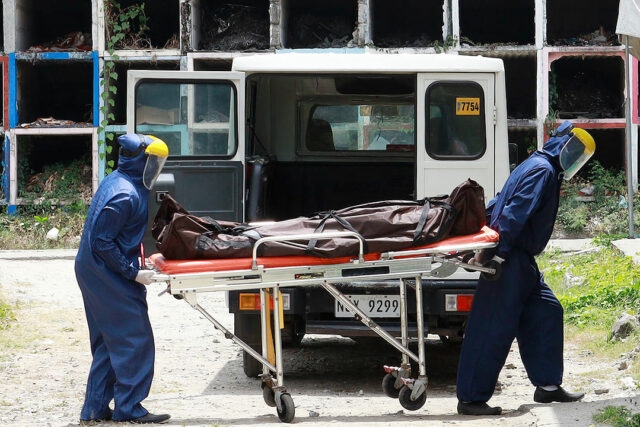
Funeral workers wear personal protective equipment as they enter the Baesa crematorium in Quezon City, April 15, 2021. — PHILIPPINE STAR/ MICHAEL VARCAS

THE NUMBER of registered deaths in the country rose by an annual 35.2% in 2021, while births fell by 19% as the coronavirus pandemic continued, the Philippine Statistics Authority (PSA) said on Tuesday.

Preliminary vital statistics data from the PSA showed deaths last year reached 829,955, rising by more than a third from 613,936 in 2020.

The Calabarzon (Cavite-Laguna-Batangas-Rizal-Quezon) Region accounted for 16.1% of the total deaths last year at 133,570. This was higher by 40.8% from 94,898 recorded in 2020.

It was followed by Central Luzon, with 13.1% share at 108,851, National Capital Region (11.9% at 98,834), Western Visayas (8.4% at 69,663), and Central Visayas (7.6% at 63,328).

Registered births, meanwhile, declined by almost a fifth to 1,237,748 in 2021 from 1,528,684 tallied in 2020.

Calabarzon likewise has the largest share of births at 15.3% (188,935), followed by Metro Manila’s 12.1% share (149,735), Central Luzon’s 11.8% (146,298), Central Visayas’ 8% (99,091), and Bicol Region’s 6.5% (80,480).

However, Calabarzon’s birth tally last year was lower by 18.8% annually compared with 232,606 in 2020. Registered births in the National Capital Region also contracted by 24.7%.

Meanwhile, registered marriages climbed by 35.2% year on year to 325,448 last year from 240,775 in 2020.

Calabarzon had the highest share of registered marriages at 14.8% with 48,038. Metro Manila had an 11.3% share or 36,872 marriages, followed by Central Luzon’s 11.2% (36,371), Central Visayas’ 9.3% (30,302), and Western Visayas’ 7.3% (23,899).

The information in the vital statistics report was compiled from tallies generated by city or municipal Civil Registrars during the period, consolidated by the PSA’s Provincial Statistical Offices and then submitted to the Office of the Civil Registrar General as of Jan. 31.

CAUSE OF DEATH
In a separate report, the PSA said that ischaemic heart diseases were the leading cause of deaths in the country with 125,913 cases as of end-November. This is equivalent to 17.9% of the 704,202 total deaths listed in the January to November period.

Cerebrovascular diseases were the second-highest cause of death with 68,180 (9.7% share). Meanwhile, COVID-19 as the cause of death totaled 97,212.

Deaths associated with COVID-19 are classified into those with the virus identified and not identified at the time of death.

COVID-19 with virus identified accounted for 67,494 or 9.6% of total deaths. Taken by itself, this category would be the second leading cause of death during the period.

Some 29,718 deaths due to COVID-19 fell into the “virus not identified” category — 4.2% of total deaths, or tenth overall.

According to the PSA, data on COVID-19 deaths were based on death certificates received and certified by health officers of local government units.

This is a departure from the data collected by the Department of Health (DoH), which maintains a separate COVID-19 tracking system and only counts confirmed cases.

DoH reported an additional 1,019 new infections on Feb. 22, bringing the total cases in the country to 3.65 million. Active cases stood at 56,668, while total deaths were recorded at 55,776. — Ana Olivia A. Tirona

CREIT climbs 11%, closes at P2.84 on market debut

By Keren Concepcion G. Valmonte, Reporter

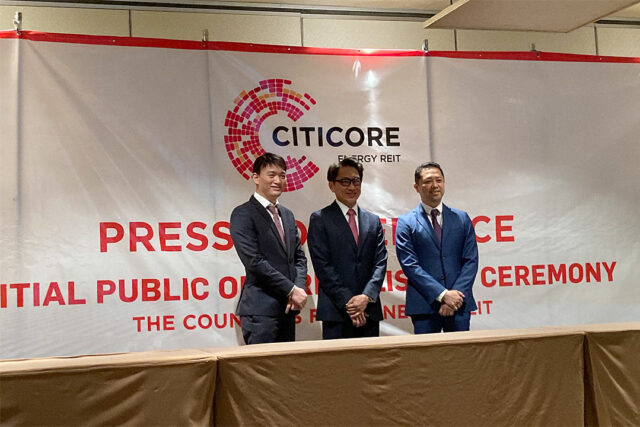
CITICORE Energy REIT Corp. (CREIT) finishes 11.37% higher on its first day at the Philippine Stock Exchange (PSE), closing at P2.84 apiece from its IPO price of P2.55.

The company’s shares opened 9.02% higher to P2.78 per share.

“The issue climbed to as high as P2.94 during the first few minutes of trading, but eventually retraced and moved sideways above the P2.78 area,” Timson Securities, Inc. Trader Darren Blaine T. Pangan said in a Viber message on Tuesday.

“Market participants may have decided to buy shares of CREIT amid the attractive dividend yields as well as the success of the previous REITs in the local scene,” he added.

In a text message, COL Financial Group, Inc. First Vice-President April Lynn C. Lee-Tan added that the stock performed well “most likely because of [the] good outlook of solar [firms] and high yield.”

The company is projected to have a dividend yield of 7% this year based on projected earnings and 7.4% by 2023.

“CREIT had a stellar debut today with many investors banking on its dependable income, stemming from guaranteed lease revenues from its properties plus a variable lease accruing to the firm based on 50% of the incremental revenue in excess of the agreed base revenue of each of the lessees,” Regina Capital Development Corp. Head of Sales Luis A. Limlingan said in a separate Viber message on Tuesday.

PSE President and Chief Executive Officer Ramon S. Monzon said over 19,400 investors participated in CREIT’s P6.4-billion initial public offering (IPO). The company deferred its listing to Feb. 22 from Feb. 17 due to “voluminous transactions arising from the huge number of retail and individual investors.”

CREIT sold 2.509 billion shares for P2.55 apiece. It sold 1.05 billion primary common shares, while sponsor Citicore Renewable Energy Corp. (CREC) sold 1.13 billion secondary shares and an overallotment of 327.27 million shares.

CREIT plans to use net proceeds from the IPO to purchase properties in Bulacan and South Cotabato.

These will be added to the company’s renewable energy property portfolio, which includes the Clark property, Armenia property, Toledo property, Dalayap property, and the Silay property. The five properties are being leased to solar power plant operators under the Citicore group.

Sponsor CREC has 1,500 megawatts (MW) of pipeline projects to be built within the next five years, which will be infused into CREIT “in batches.”

In a press briefing on Tuesday, CREIT President and Chief Executive Officer Oliver Y. Tan said CREC is “studying probably the first batch of around 120 MW to be infused as early as first quarter next year.”

“It really took us several challenges, several sleepless and tireless nights just to make this happen because the structure of the REIT (real estate investment trust) law in the Philippines is really geared to real estate so we only really needed to make so many workarounds just to make the structure to be able to work,” CREIT Chairman Edgar V. Saavedra said during the hybrid briefing.

CREIT is the first energy-themed REIT to list at the PSE. The company is the sixth REIT firm to brave the stock market, trailing five REITs with office and mixed-use assets in their portfolios.

“Everyone who wants to participate in the REIT finds our REIT law limiting [because] when the Congress enacted that REIT law, it was primarily for property REIT, for the typical office REIT,” Mr. Tan told BusinessWorld at Shangri-La The Fort in Bonifacio Global City.

“So outside of that typical [model], like us, where our revenue really is from the sale of electricity, so because of the limitation of the REIT [law], a REIT company cannot recognize revenue outside of rental income. That’s why we had to structure it such that the power company is selling electricity and paying lease to the REIT company to qualify, among others,” he added in a mix of English and Filipino.

The company engaged BDO Capital and Investment Corp., PNB Capital and Investment Corp., Investment & Capital Corporation of the Philippines, Unicapital, Inc., CLSA Ltd., and CIMB Investment Bank Bhd as its underwriting syndicate.

By the end of the trading day on Tuesday, a total of 521.43 million CREIT shares worth P1.48 billion were traded. It currently has a free float level of 38.33% and a market capitalization of P16.69 billion.

According to Finance Secretary Carlos G. Dominguez III, CREIT’s listing raises the total market capitalization of REITs at the stock exchange “to nearly P300 billion.”

“The Philippine REITs now constitute 1.4% of our GDP (gross domestic product). This is just the beginning. This powerful financial instrument holds much promise to help boost our economic recovery,” Mr. Dominguez said during the listing ceremony.

CREC’S CAPITAL SPENDING
Meanwhile, CREC has earmarked P3 billion this year for its existing projects’ capital expenditure (capex) and up to P70 billion in the next five years for projects in its pipeline.

“For this year, we are targeting around P3 billion [for capex],” Mr.  Tan, who also heads CREC, said in the press briefing.

He said this year’s budget is intended for: Citicore Power, Inc.’s 25-megawatt-peak solar farm expansion in Silay City; the construction of the second phase of its 72-MW Arayat-Mexico power plant with AC Energy Corp; the installation of 6.64 MW solar rooftop systems in Bataan; and the completion of three projects in Batangas.

In 2021, the company spent P4 billion for capex projects. Its biggest budget of P10 billion was allotted in 2015 when it was racing to qualify for perks under the feed-in tariff system.

CREC is eying a P70-billion capex spread in the next five years to add 1,500 MW of renewable energy to its portfolio. — with M.C. Lucenio

Remembering the Battle of Manila

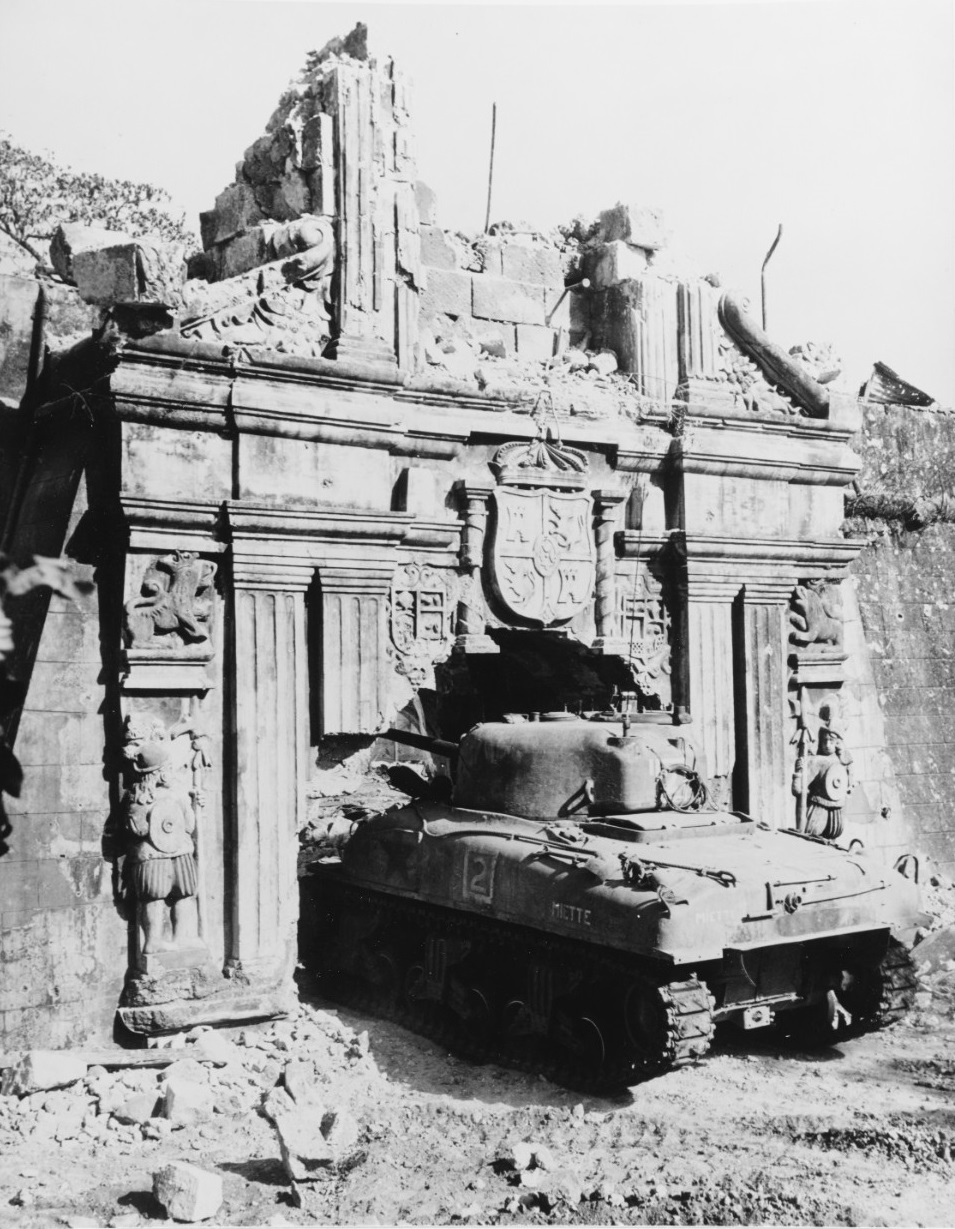
AS the end of World War II loomed, the month-long Battle of Manila destroyed the city. From Feb. 3 to March 3, 1945, Japanese and American armed forces clashed, the city’s districts burned and were reduced to rubble. By the end of the month, over 100,000 civilians had died.

“The fires intensified as the afternoon turned to dusk and then evening. Block by block the Japanese methodically destroyed much of the 160-acre Walled City, erasing four centuries of history in an afternoon. The Japanese had rigged explosives in the Manila Cathedral and surrounding buildings, detonating them early that evening,” American author James M. Scott wrote in Rampage: MacArthur, Yamashita, and the Battle of Manila (2018).

To commemorate the Battle of Manila and what was lost, four heritage and tourism groups — WanderManila, Don’t Skip Manila, The Heritage Collective, and Renacimiento Manila — have come together for 1945: In Memoriam, an online experiential tour on Feb. 26, 7 p.m. The virtual tour will detail how the Battle of Manila unfolded, how the city of Manila fell, and the lives that were lost during that period.

“We’re aiming to make 1945: A Memorial more than a simple online presentation. While the bulk of the presentation will be done live, we will incorporate a lot of pre-recorded segments to help people visualize how the battle was waged. We will also be soliciting pictures and videos from our followers so that they can be part of this presentation as well,” WanderManila Head Tour Guide Benjamin Canapi told BusinessWorld via Messenger.

The presentation, which is divided into four parts, will highlight the landmark sites of the Battle of Manila, such as the University of Santo Tomas which served as an internment camp for American prisoners, Intramuros which was almost completely destroyed, and the various sites of massacres around the city.

Joining Mr. Canapi in the virtual tour is Don’t Skip Manila co-founder Andrei Julian, cultural entrepreneur and owner of The Heritage Collective Stephen Pamorada, and Renacimiento Manila president Diego Torres.

“Each of us have different perspectives and different ways of telling our narratives, which will make this online presentation a memorable one,” Mr. Canapi said.

“All of us have one goal: to make the public more aware of the happenings of the Battle of Manila, and for us to help give the victims of the battle gain the closure they deserved,” Mr. Canapi said.

The virtual tour will stream live at the Facebook pages of Don’t Skip Manila, The Heritage Collective, Renacimiento Manila, and WanderManila. The presentation will be accessible at those pages after the livestream.

For more information, visit https://www.facebook.com/WanderManila. Michelle Anne P. Soliman

STI Holdings reports P171-M profit in second quarter

STI Education Systems Holdings, Inc. generated a P171.09-million net income attributable to the parent firm in its second quarter ending Dec. 31, 2021 after the company saw an 18% increase in revenues.

STI Holdings’ fiscal calendar starts July 1 and ends on June 30 the following year.

In a statement on Tuesday, the listed educational institution said it saw an 18% increase in overall enrollment to 82,629 students for the school year 2021 to 2022 from the 70,223 students enrolled the previous school year. STI Holdings said it saw a 40% increase in tertiary enrollment to 56,342 students from 40,176 previously.

“The increase in our enrollment and in the number of COVID-19 (coronavirus disease 2019) vaccinations throughout the country are signs that the ‘new normal’ may be just in our midst,” STI Holdings President and Chief Executive Officer Monico V. Jacob said.

According to a regulatory filing on Feb. 21, the P171.09-million profits generated during the quarter are nearly double the P90.32 million logged in the same period last year. Total revenues grew 18% to P749.1 million from P632.42 million.

For the first six months, STI Holdings swung to profitability. The listed educational institution recorded a P56.85-million net attributable income, a turnaround from the P112.32-million loss in the same period in 2020.

Meanwhile, its earnings before interest, tax, depreciation, amortization (EBITDA) for the period grew 37% to P419.1 million from P305.6 million last year. The company posted an 11% topline growth to P1.12 billion from P929.06 million.

STI Holdings said classes are still fully conducted online through the ONline and ONsite Education at STI (ONE STI) Learning model for the STI Education Services Group (STI ESG) and STI West Negros University, while iACADEMY uses the Guided Online Autonomous Learning (GOAL) program.

The company said its schools transitioned “seamlessly” as they had a blended learning model even before the pandemic hit.

STI ESG collaborated with the country’s major telecommunications providers for monthly data plans and loads of up to 34 gigabytes, allowing students to access their electronic Learning Management System, Microsoft Office 365 accounts, One STI Student Portal app, among others.

Meanwhile, Bacolod-based STI WNU subscribed to online school management software SchoolAutomate system by GTI Software Developer.

iACADEMY also upgraded its subscription to Adobe Creative Cloud-All Apps to accommodate more students.

“These technological enhancements are our ways of strengthening our commitment to help our students, faculty, and staff, not just survive, but thrive in days to come,” Mr. Jacob said.

STI shares at the stock market closed unchanged at 35 centavos apiece on Tuesday. — Keren Concepcion G. Valmonte

A look at our bloody past

By Jonathan Best

Book Review
Púgot: Head Taking, Ritual Cannibalism, and
Human Sacrifice in the Philippines
By Narciso C. Tan

Vibal Foundation –
Academica Filipina.
shop@vibalgroup.com.
Hardbound, P2,500

NARCISO C. Tan’s long-awaited study of the ritual practices of the Philippine’s many ancestral, ethnolinguistic groups has finally been launched by the Vidal Foundation as part of its Academica Filipina series of books on Philippine history, culture, and the arts. This latest publication is in the form of an elegant coffee table book, fully illustrated, annotated and designed with all the necessary addendum of a truly scholarly work. The title is Púgot: Head Taking, Ritual Cannibalism, and Human Sacrifice in the Philippines. The subject matter is both disturbing and controversial; however, Tan manages to handle it in such a professional manner that despite the gruesomeness at times, it never fails to be fascinating and informative. It rises above the sensational aspects of the violent subject matter and thoroughly explores the deep religious and spiritual beliefs which evidently sustained these ritualistic practices over centuries and possibly millennia before the modern Filipino nation fully evolved. Some of these lingering practices have been documented in remote mountainous areas as late as the mid-20th century during the Japanese occupation and the chaos of World War II.

The book is divided into three sections devoted to the three rituals noted in the title but in reverse order; human sacrifice, ritual cannibalism, and head taking. Barbara Watson Andaya of the University of Hawai’i provides a foreword which clearly establishes the importance of Mr. Tan’s book in the long line of studies and anecdotal references to “ritualistic violence” in early and even modern Philippine ethnographic history. Each section of the book provides numerous quotes relating to the given subject matter in both the original language of the source and accompanied by an English translation. As an added benefit to the reader, Mr. Tan includes brief biographical sketches in the footnotes for all the major scholars and informants he quotes, giving their names, dates, and when they were active in the Philippines if they were foreigners, which the majority of them were.

The research covers practices documented from Mindanao and Jolo in the south, to Apayao and the Batanes Islands in the north. From one end of the Philippine archipelago of 7,641 island to the other and with 77 different ethnolinguistic groups listed. The majority of information comes from groups in Mindanao or the Mountain Province region in northern Luzon. The author makes a point of only listing practices which can be defined as community sanctioned rituals, either of a religious nature or condoned by the local community as legitimate acts associated with ongoing regional conflicts. This criterion becomes somewhat ambiguous at times because the practice of slave taking and trading both had a commercial aspect and also was in many instances tied to human sacrifice. Racial attacks against the indigenous Negrito population were not necessarily motivated by any religious beliefs, and attacks against Spanish colonizers, lowland Christian communities, or Japanese occupiers during the war would be better characterized as political or military actions.

The rituals that Narciso Tan discusses can be broadly characterized as acts of supplication or acts to propitiate good or evil preternatural entities or to placate the spirits of the constantly watchful deceased ancestors or powerful members of the community who had recently died. Killing one or more male or female slaves or a loyal servant or even the wife of an important man so that the victim’s spirit could accompany the dead and serve him or her in the afterlife was a common belief. In some cases, the bravery or strength of the victim of a head-taking was believed to be transferred of the warrior who made the killing. Eating the victim’s heart, liver, or brain was also believed to magically transfer beneficial powers to warriors or to the male shaman or female priestesses who officiated at sacrificial rituals on behalf of the community.

In some instances, the entire community would be involved in these gruesome rituals, women and children included. Their aim was to placate spirits hungry for blood to insure good harvests, protection from illness and natural disasters such as typhoons or volcanic eruptions, or for protection from headhunting and slave trading raids from hostile neighbors or marauding pirate fleets. To win a wife and ensure a fertile marriage, young men were expected to bring home a head or at least be part of a successful head-taking raid.

When a community acquired a slave to sacrifice or a head or several heads or even a few body parts from a successful raid or an outright battle, it was cause for a cañao or festive celebration with many laudatory speeches, hours of dancing to the gansa (brass gongs), feasting and binge drinking. With the slow yet relentless pressure over the centuries of the more civilizing influences of Islam and Christianity, many of these violent rituals died out and animals such as carabaos, pigs, or chickens were substituted for hapless human victims. After 1900, American colonial administrators, more intent on building modern infrastructure, and mining for gold than on saving souls, were better able than the obsessively religious Spanish administration to pacify outlying and inaccessible regions. Eventually most of these cruel and barbaric practices died out as schools, clinics, and modern transportation systems were developed.

The author provides useful tables in each section listing the numerous groups involved and their specific practices.

Narciso Tan, a graduate of Xavier College in Manila, spent 10 years combing through libraries here and abroad, accompanied by his wife, Sharon, interviewing any scholars who could add to his almost encyclopedic archive of historical source material. His book includes quotations from rarely seen 11th century Chinese historical records, early Spanish colonizers such as Antonio Pigafetta, Juan de Salcedo, Sinabaldo de Mas, and numerous Catholic missionaries and chroniclers from the 17th through the 19th century such as Francisco Colin, Manuel Buzeta, Fr. Pablo Pastells, and many others. In the late 19th century, famous French and German anthropologists made extended visits to the Philippines such as Dr. Joseph Montano who researched in Mindanao, and Fedor Jagor and Alfred Marche who traveled in the Visayas, and Hans Meyer, Alexander Schadenberg, and Otto Scheerer who explored the Mountain Province region. The Americans arrived late on the scene but Fay Cooper Cole, R. F. Barton, Otley Beyer, Albert and Maud Jenks, Laura Benedict, Dean Worcester, and David Barrows all published important findings. More recently, William Henry Scott of Sagada published numerous books and articles which were valuable sources for Mr. Tan’s project. Although he never visited the Philippines, Jose Rizal’s good friend Dr. Ferdinand Blumentritt wrote extensively on the anthropological history of migrating Filipino ethnic groups.

The author repeatedly compares and contrasts similar violent ritualistic practices found in neighboring Southeast Asian countries, Polynesia, South Asia, and China so there can be no question of this study being a biased critic of Filipinos or their early history and evolutionary development. Some of his sources’ findings have been questioned as sensational exaggerations or racially and religiously prejudiced, but these issues Mr. Tan fully acknowledges and tries to offer as much explanatory context as possible so the reader can fully evaluate any questionable or biased misinformation. The breadth of his own research is overwhelming as evidenced in the 52-page glossary, bibliography, and index at the back of the book. This alone is a veritable gold mine of information and sources for anyone studying Philippine history.

The book is fully illustrated in color with reproductions of antique prints, maps, photographs, and drawings, from the Boxer Codex to National Geographic magazine, and many other sources interspersed with illustrative watercolors by talented local artists.

I first met Narciso Tan several year ago while he was doing research at the Ortigas Foundation Library and lent him four vintage photographs from my collection which he added to “An Early 20th Century Photo Folio of Headhunting Rituals” which he has placed at the end of the main text of his book. This folio of 28 sepia toned photos taken in the early 20th Century give the reader a somewhat lurid glimpse of the primitive rituals which existed centuries ago, common not only to the Philippines but to all evolving societies over the millennia.

Púgot is not an easy read but it is always fascinating and an invaluable source of arcane information regarding rarely explored aspects of the Philippine past.


Jonathan Best is a senior consultant at the Ortigas Foundation Library in Greenhills, Metro Manila.

PLDT says 11th data center to rise in Sta. Rosa, Laguna

THE PLDT group announced plans on Tuesday to build additional 100 megawatts (MW) of data center capacity, starting with a new hyperscale, telco-neutral, and purpose-built facility in Sta. Rosa, Laguna.

The project will be carried out by PLDT, Inc.’s information and communications technology arm ePLDT.

Prior to this project, PLDT has been serving the “unique requirements of hyperscalers” through the existing facilities, the group said in an e-mailed statement.

The group’s 11th data center will rise in a five-hectare PLDT property in Sta. Rosa.

“The city is geographically ideal being 100 meters above sea level and far from liquefaction, earthquake, and other natural disaster risks. Sta. Rosa is also a highly developed industrial area accessible through three major highways,” the group noted.

The project will be the “first of a series of hyperscale data centers totaling to a power requirement of 100 MW over the medium term,” it added.

PLDT and Smart President and Chief Executive Officer Alfredo S. Panlilio said the group’s data centers are being expanded “to accommodate the [growing] demand [and] to ensure that we are able to keep up and deliver future requirements.”

In 2021, the group announced that it would start building a hyperscaler data center in the country this year. It targets to complete the project in 2024.

Hastings Holdings, Inc., a unit of PLDT Beneficial Trust Fund subsidiary MediaQuest Holdings, Inc., has a majority stake in BusinessWorld through the Philippine Star Group, which it controls. — Arjay L. Balinbin

ADVERTISEMENT
ADVERTISEMENT