Home Blog Page 660

MPTC kicks off P8-B Lapu-Lapu Expressway phase 1 bidding

STOCK PHOTO | Image by RJ Trazona from Unsplash

METRO PACIFIC Tollways Corp. (MPTC) has started the bidding process to select contractors for the first phase of its P8-billion Lapu-Lapu Expressway (LLEx) expansion, which is expected to be completed by the fourth quarter of 2027.

“We are actually bidding it out now,” MPTC President and Chief Executive Officer Gilbert Gabriel F. Santa Maria said at a recent media briefing.

“We have an alignment already, but one of the things we need to do is that a lot of it goes over the same alignment with an existing road. The feasibility is done. We acquired the concession rights, and there was already an approval to do this… We are just bidding it out to see which EPC (engineering, procurement, and construction) contractors, or separate construction contractors, want to do this for us,” he added.

Mr. Santa Maria said the first phase of the LLEx is currently under detailed engineering design.

The estimated P8-billion cost covers construction, right-of-way acquisition, and concession rights, although final costs will be subject to further analysis and approval.

The project involves expanding MPTC’s Cebu-Cordova Link Expressway (CCLEx), a toll road the company plans to extend to enhance traffic capacity and efficiency. The P33-billion CCLEx is an 8.9-kilometer toll bridge connecting the town of Cordova on Mactan Island to Cebu City via the South Road Properties.

“We have completed the Cebu-Cordova link bridge but in order to make the bridge more effective, and contribute to the economy of Cebu, it has to be connected to MCIA (Mactan-Cebu International Airport),” he said.

The project will also link the bridge to Metropolitan Cebu City, with ramps to Guadalupe currently being designed, Mr. Santa Maria added.

Last year, MPTC said it planned to expand both ends of CCLEx, connecting it to Bacalso and Lapu-Lapu.

MPTC also said it sought a P15-billion investment from Spanish infrastructure firm Acciona S.A. in 2024 to support the CCLEx expansion.

The company has previously been in negotiations with a European firm to support the project, which is part of its strategy to increase the expressway’s traffic, currently reaching only 30% of projected volumes and falling short of the 50,000 motorists-per-day target.

MPTC is the tollways arm of Metro Pacific Investments Corp. (MPIC), one of the three key Philippine subsidiaries of Hong Kong-based First Pacific Co. Ltd., alongside Philex Mining Corp. and PLDT Inc. — Ashley Erika O. Jose

DigiPlus sees ‘gradual recovery’ after 51% earnings drop

DIGIPLUS.COM.PH

DIGIPLUS INTERACTIVE Corp., the listed digital entertainment company behind BingoPlus, ArenaPlus, and GameZone, is seeing signs of recovery in the fourth quarter after a steep drop in third-quarter net income triggered by tighter regulations that prompted e-wallet providers to remove in-app access to licensed online gaming platforms.

“Our customer service team has been actively contacting some of these high-value players and trying to bring them back to our platform,” DigiPlus President Tsui Kin Ming told reporters on Wednesday last week.

He said the company’s improving outlook is driven by measures to ease the impact of payment access restrictions since mid-August.

While declining to disclose the extent of the improvement, Mr. Tsui said recovery is underway.

“We’re seeing a gradual recovery from the last two months,” he said.

DigiPlus posted a 51.41% drop in third-quarter net income to P1.71 billion following the implementation of regulations that led e-wallet providers to block in-app access to licensed online gaming sites.

At the Philippine Stock Exchange’s Strengthening Access and Reach (STAR): Investor Day earlier this month, Mr. Tsui said DigiPlus had upgraded its payment system to maintain player access through various channels and tapped additional payment partners to widen its funding network.

In September, DigiPlus partnered with PhilFirst to introduce a surety bond program offering up to P1 million in financial protection for BingoPlus, ArenaPlus, and GameZone users, covering in-game wallets without requiring separate policies.

The company in October teamed up with CIS Bayad Center to expand nationwide over-the-counter payment options, boosting transaction security and convenience.

For the January-to-September period, DigiPlus’ net income rose 15.59% to P10.11 billion from P8.75 billion a year earlier, supported by steady growth in its retail games segment and contributions from new product launches and operational improvements. Revenues climbed 29.61% to P66.83 billion from P51.56 billion in 2024.

Gross revenues in the third quarter edged up 0.26% to P19.05 billion from P19 billion a year earlier on the back of continued product development, enhanced user experience, and stronger corporate governance initiatives.

At the local bourse on Friday, DigiPlus shares rose 1.31% or 35 centavos to close at P27.05 apiece. — Alexandria Grace C. Magno

A lifelong mission of resilience, inclusion, and impact

SM Group’s Hans T. Sy is MAP Management Person of the Year 2025

By Jomarc Angelo M. Corpuz, Special Features and Content Writer

Other than perhaps the Malacañang Palace, there is no building universally recognizable to any Filipino than a mall built by SM Prime Holdings, Inc. (SM Prime), with its iconic blue and white SM signage. Such is the influence, excellence, and reach of a company that has constructed over 90 malls in the Philippines and abroad.

At the head of the beloved brand is the Founding President and Chair of the Executive Committee of SM Prime, Hans T. Sy. Stepping into the shoes of his father, the late Henry T. Sy, Sr., Mr. Sy has more than excelled in leading one of the most valuable public companies in the country with SM Prime, one of the best-managed, fastest-growing, and most profitable banks in the Philippines with Chinabank, and one of the top universities in the country with the National University (NU).

Due to this pedigree, combined with novel advocacies in sustainability, diversity, and disaster risk reduction, Mr. Sy was recently named “MAP Management Person of the Year 2025” by the Management Association of the Philippines (MAP).

The award, previously known as the “MAP Management Man of the Year,” is given to individuals in business or government who have displayed unquestioned distinction in the practice of management and have made valuable contributions to the progress of the country and in re-shaping national values.

Adding to the glamour of the accolade, it has only been conferred 49 times in the six-decade history of the award. The criteria for the award include integrity, leadership, and management qualities; contribution to nation-building and values formation; and effective stewardship within the confines of the highest standard of business and management practice; among others.

In Mr. Sy’s case, he was bestowed the award for his lifelong commitment to environmental stewardship, social inclusion, good governance, and resilience (ESG+R), which established SM Prime as a benchmark for sustainable and resilient urban development.

During his time as the founding president of SM Prime, he integrated ESG+R principles into the company’s core by instituting elevated structures, flood defenses, solar power generation, and water reuse across all of the company’s malls long before the features became industry standards. Under Mr. Sy’s leadership, ESG+R drove both growth and efficiency, making SM Prime a pioneer and a benchmark for resilient urban development.

He was also chosen for championing people-centered leadership and diversity by fostering a corporate culture that promotes employee welfare, professional development, and work-life balance, while building an organization that exemplifies the UN Global Compact Women’s Empowerment Principles.

Another factor for his recognition is his spearheading of innovative and sustainable retail development, which continuously provides growth opportunities for micro, small, and medium enterprises (MSMEs), local government units, and the communities where SM malls operate.

These reasons were exemplified in Mr. Sy’s use of the SM platform to empower MSMEs and local government units (LGUs) along with his employees as he firmly believes that a company’s success is tied to the well-being of its community. He was also awarded as Outstanding Filipino Retailers President Award in 2024 for spearheading innovative and sustainable retail development, which provided countless growth opportunities for entrepreneurs.

Mr. Sy’s contribution in shaping global and local guidance on integrating disaster risk reduction into core business strategies by representing the Philippines in the United Nations International Strategy for Disaster Reduction and by founding ARISE Philippines also led to his selection for MAP Management Person of the Year.

“My firsthand experiences with disasters and rehabilitation pushed me to strongly advocate for disaster resiliency in everything we do across the SM group. I dream about having a resilient and sustainable society that the next generations can benefit from, where no one is left behind, and where everyone can experience a safer, better future,” Mr. Sy was quoted as saying.

Mr. Sy showcased his patriotism as well by raising the Philippine flag with pride in other countries like China, proving that Filipino companies can compete successfully with global big brands. This is showcased particularly in an expansion from four local branches to 60 across the Philippines and seven in China.

Mr. Sy is also credited for growing the company’s portfolio to include residences, hotels, convention centers, offices, and warehouses, establishing itself as the largest integrated property developer in the Philippines and one of the biggest in Southeast Asia.

This year’s MAP Management Person of the Year was also picked for broadening access to quality education and athletic excellence by nurturing NU and supporting other broad-based initiatives that shape future generations.

As the university’s chairman, Mr. Sy rebuilt NU from the ground up, restoring identity, credibility, and ambition through sports as he believed that producing sports champions would boost NU’s enrolment and academic standing. Since then, NU has produced board topnotchers with enrollment surging by 2,955% to 55,000 (2008 versus 2024) across 11 campuses.

Additionally, through Mr. Sy’s support, NU also deepened its commitment to inclusive education, offering nearly 800 scholarships as of 2025.

One more reason for his selection by MAP this year is his personal support for vulnerable children through Child Haus, which provides critical healthcare and hope to indigent children with cancer.

Mr. Sy’s advocacy led him to purchasing a house in Barangay Payahan out of his own funds for the organization, later financing and building a seven-storey Child Haus in Malate, Manila to improve medical access for the children. Monthly allocations of free diagnostic testing were secured, while the refurbishing of the original home continuing. These significant acts inspired a community of private individuals and businesses supporting dormitories, dining halls, play areas and therapy rooms within the two Child Haus facilities.

Finally, Mr. Sy was picked as MAP Management Person of the Year for his personal contributions to shaping national values and inspiring others through his unwavering integrity, exceptional managerial competence, and visionary leadership.

Widely known as a seasoned corporate leader with over 30 years of executive experience, he also earned distinction at the local, regional, and international levels for driving key initiatives, with impact spanning various sectors of Philippine society. Among his most distinguished awards prior to this recognition are the Tambuli Lifetime Achievement Award in 2024, the Outstanding Filipino Award in 2022, Asia’s Most Influential in 2021, and Asia’s Heroes of Philanthropy in 2019.

MAP is an exclusive organization that aims for management excellence and connects top management practitioners with each other. Previous winners of the prestigious award include titans in Philippine business, including Mr. Sy’s late father in 1999, Manuel V. Pangilinan in 2005, the late George S.K. Ty in 2006, Erramon I. Aboitiz in 2011, the late John Gokongwei, Jr. in 2017, Federico R. Lopez in 2020, Isidro A. Consunji in 2022, and Ernesto M. Tanmantiong in 2023.

T-bill yields may decline as BSP signals December policy rate cut

BW FILE PHOTO

TREASURY BILL RATES may ease this week as investors position for a possible rate cut by the Bangko Sentral ng Pilipinas (BSP) in December.

The Bureau of the Treasury (BTr) will offer P22 billion in T-bills on Monday — P7 billion in 91-day securities and P7.5 billion each in 182- and 364-day debt.

Yields may track the small declines in the secondary market last week after BSP Governor Eli M. Remolona, Jr. signaled that another 25-basis-point (bp) cut is possible next month, Michael L. Ricafort, chief economist at Rizal Commercial Banking Corp., said in a Viber message.

The BSP chief has said that easing might extend into 2026 as widening corruption issues tied to state flood control and infrastructure projects threaten to slow government spending and weigh on growth.

The BSP trimmed rates by 25 bps last month, its fourth straight move, bringing the policy rate to 4.75%. Since August last year, the Monetary Board has lowered borrowing costs by 175 bps. Its final policy meeting for 2025 is set for Dec. 11.

At the secondary market on Friday, yields on the 91-, 182- and 364-day T-bills slipped 2.38 bps, 3.93 bps and 2.3 bps to 4.8676%, 5.0032% and 5.0852%, respectively, based on PHP Bloomberg Valuation Service reference rates as of Nov. 21.

A trader said the absence of a bond auction this week could draw more bidders to the T-bill auction.

Last week, the Treasury raised P25 billion, above its P22-billion program, as demand surged. Total tenders reached P84.015 billion, more than four times the offer.

The 91-day tenor fetched an average of 4.842%, up 2.1 bps from a week earlier, with bids at P26.19 billion. Accepted yields ranged from 4.825% to 4.854%.

For the 182-day paper, the BTr increased the award to P10.5 billion from P7.5 billion after tenders climbed to P29.47 billion. The Treasury also doubled the noncompetitive bucket to P6 billion. The average rate dipped 1.1 bps to 4.97%, with awarded bids at 4.923% and 5%.

The 364-day T-bill raised P7.5 billion as planned, with demand at P28.355 billion. It averaged 5.017%, down 3.7 bps, with accepted yields at 5% to 5.028%.

The Treasury aims to raise P158 billion from the domestic market this month, including P88 billion in T-bills and P70 billion in bonds, to help finance a budget deficit capped at P1.56 trillion or 5.5% of economic output. — Aaron Michael C. Sy

SM Prime shares rise on targets, sector rebound

SM SUPERMALLS

SM PRIME HOLDINGS, Inc. (SMPH) shares climbed last week following the company’s target announcements and a broader rebound in the property sector.

Data from the Philippine Stock Exchange (PSE) showed SM Prime as the eighth most actively traded stock by Friday, with 67 million shares worth P1.44 billion changing hands over the week. The stock closed at P22.45 apiece, up 18.2% from the previous week’s P19, outperforming the property sector’s 10.4% gain and the PSE index’s (PSEi) 7.4% rise.

Despite last week’s gains, SM Prime remains 10.7% below its P25.15 close on the final trading day of 2024.

Christian Cabildo, equity analyst at The First Resources Management and Securities Corp., said the company’s recent announcements boosted investor sentiment.

On Wednesday, SM Prime disclosed its target to complete the redevelopment of SM City Iloilo by the first quarter of 2026. The P2.3-billion project will add 7,900 square meters (sq.m.) of gross leasable area (GLA) to the mall, enhancing dining, athleisure, and entertainment offerings. It will also feature upgraded infrastructure and expanded eco-friendly, sustainable facilities.

In addition, 23,670 sq.m. of GLA will be allocated to a new campus of the National University nearby, expected to further boost foot traffic.

“Positive developments like this definitely helped in lifting SM Prime from oversold territory,” Mr. Cabildo said.

The company also held a successful retail bond auction last week, with its P12-billion offering oversubscribed to P17 billion on Monday. Proceeds will fund various redevelopment projects and new lifestyle malls scheduled through 2030.

Mr. Cabildo noted that the news helped ease investor concerns following fears linked to flood control projects and weaker growth, demonstrating “the sector’s fundamental strength.”

The PSEi recently fell to pandemic-era lows amid a developing corruption scandal over alleged anomalous fund usage for flood control projects. The slump was compounded by political tensions and the country’s subdued economic performance, with third-quarter growth of 4% falling short of the 5.5% target for 2025.

In the nine months to September, SM Prime posted a 9.9% year-on-year rise in attributable net income to P37.24 billion from P33.88 billion in 2024. Revenues grew 3.6% to P103.4 billion from P99.76 billion in the same period.

For the full year of 2025, he forecasts SM Prime’s net income and revenues to reach P51-51.5 billion and P141.5-142 billion, respectively.

Regarding the stock, Mr. Cabildo said further upside may occur once it breaches resistance at P23.50, aligned with its 200-day moving average. Investors are also advised to monitor the Bangko Sentral ng Pilipinas’ monetary policy decision on Dec. 11.

For this week, he pegged support at P20.50-P21 and resistance at around P23. — Matthew Miguel L. Castillo

Understanding Philippine corruption and government finances

BW FILE PHOTO

By Jesus Felipe and Gerardo Largoza

The hundreds of billions of pesos that were stolen from flood control projects have robbed the Philippine economy of protection and productivity. But to say, as many Filipinos do, that they have been robbed of their taxes betrays a misunderstanding of how government finances actually work. Correcting such misconceptions is crucial because Philippine development has been held back by decades of public underinvestment and self-imposed austerity, possibly even more than it has by decades of corruption.

People are spilling onto major streets and gathering around public monuments to protest corruption scandals. This time it’s about flood control. President Ferdinand Marcos, Jr. first dropped hints as to the scale of malversation in his State of the Nation Address last July. Since then, events have taken on a life of their own. After three months of Senate hearings, the public has been able to confirm what it has long suspected: hundreds of billions of pesos salted away from thousands of overpriced, substandard, or nonexistent (“ghost”) projects. Nearly every level of government has been implicated, from district engineers to managers of government banks, to mayors, provincial governors, members of Congress, senators, including the Speaker of the House who has had to step down.

Estimates on the extent of graft in flood control vary; at present, official figures range from P42 billion ($715 million) to P118.5 billion ($2 billion) misappropriated since 2023, according to the Department of Finance. Greenpeace extrapolates a much larger figure of P1.089 trillion ($18.5 billion) over the same period, based on the total allocation for “climate-tagged” expenditures, with P560 billion ($9.5 billion) lost to corruption in 2025 alone.

If it’s true that over a trillion pesos have been plundered since 2023 (and more dating back to 2016), then why hasn’t the Philippine economy collapsed the way it did in 1983 when President Ferdinand Marcos, Sr. and his cronies set the Guinness World Record for “largest ever theft from a government”?

To explain why some episodes of corruption destabilize economies while others don’t, we make two claims about how monetary systems work.

First, is that governments spend fiat money (their own currency) by crediting bank accounts. This creates money into the system. Governments do this through their banker, namely the central bank (the Bangko Sentral ng Pilipinas or BSP in the Philippines). This means that a government that issues its own currency cannot run out of money, because it can always create more by crediting bank accounts. It implies that corruption denominated in the local currency (today’s) is not the same as corruption denominated in foreign exchange (like the 1980s episode).

Second, and a consequence of the previous point, taxes do not finance government spending. In standard economics and public discourse, taxes are viewed as the way governments collect money from citizens to fund spending. According to this view, citizens pay taxes, money goes into the Treasury, the government uses that money to pay for roads, schools, etc. If taxes are insufficient, the government must borrow, usually by issuing bonds. In short, taxes fund spending. This is what most people, including government officials and many economists (!), believe. This, however, is not how modern economies, including the Philippines, function.

Operationally speaking, government spending comes first — that is, the government must spend money in the economy before it can collect it back as taxes. It is government spending that creates the money (in the form of so-called “reserve balances”) that people then use to pay taxes. Governments do not need to “get” money from the private sector to be able to spend. They simply need the political authority and institutional coordination to do so. In the Philippines, government accesses its account at the BSP and this creates “reserve balances,” an accounting annotation on the government’s account at BSP. These are then transferred to the commercial bank where the recipient (household or firm) has the account (through Land Bank of the Philippines). Government spending is a transfer to the private sector. Taxes are not involved. This is shown in Figure 1. This is the process for every single payment the government makes.

Taxes do not fund spending the way a household’s earnings fund grocery purchases because households do not create money. Governments do. Instead, the state’s power to tax is what gives the local currency its value and demand, since people need the currency to pay taxes. When a sovereign government spends, it credits bank accounts electronically — essentially creating new money, as spending adds reserves to the banking system. When it taxes, on the other hand, it deletes or removes money from the system; that is, taxes subtract from reserves.

Put another way, when Filipinos pay taxes, they instruct their banks to transfer some of their deposits (claims on reserves) to the Treasury’s account at the BSP. The BSP then reduces the amount of reserves in the banking system by that amount. Tax payments are ultimately settled by a transfer from the bank to BSP, which then credited the government’s account at BSP. Important: your bank needs to settle your tax payment with the government through its account at BSP. The government’s tax receipts are merely an accounting record — the money does not go into some kind of jar, earmarked for building roads, schools and ports. Instead, the funds are, in essence, deleted from the system; that is, the reserves are extinguished. So, taxes, in fact, destroy money, i.e., they remove money from circulation. This is shown in Figure 2. There is no operational procedure through which the National Government uses tax receipts or borrowing for its spending. Taxing and spending are operationally independent procedures.

The fact that taxes do not fund government spending for public goods does not make them useless. Taxes help manage demand (they take away private sector purchasing power), and they penalize “bads” such as smoking.

Why does this matter at a time when the burning question is how to swiftly bring grafters to justice? Because ideas have consequences. We insist that widespread corruption is a disgrace to the Philippines. The nation does not have the public goods that it needs. Filipinos have a real opportunity today to understand that the government has always had much more scope to spend pesos to build infrastructure and to provide public education and health. Yes, the culprits got away with the purchase of million-peso luxuries and Parisian apartments, and must be caught. Yet, they did not steal taxes from the Filipino people because it is technically impossible to steal taxes, and because pesos, properly conceived, are not a scarce resource. What did they steal? Reserve balances created by BSP. This may sound strange to many but it is the reality.

Correcting such misconceptions is crucial because Philippine development has been held back by decades of public underinvestment and self-imposed austerity, possibly even more than it has by decades of corruption.

We end with an invitation: if anyone with knowledge of the actual government and BSP payment system disagrees with this account (obviously we have shortened the process), let us know.

A longer version of this article can be downloaded from here: https://tinyurl.com/2cxgr237


Jesus Felipe is a distinguished professor of Economics, De La Salle University (Manila, Philippines). Gerardo Largoza is an associate professor of Economics at the same university.

BPI sees consumer loan growth easing in 2026 as economy cools

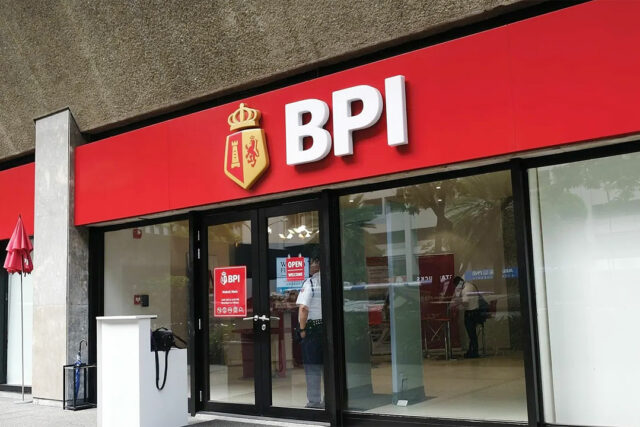
BPI FACEBOOK PAGE

BANK OF THE PHILIPPINE ISLANDS (BPI)expects its consumer lending expansion to slow next year as weaker economic conditions and geopolitical risks temper demand, a senior official said.

“We would have wanted to grow much more,” BPI Consumer Banking head Maria Cristina Go told reporters on Friday. “But we all were caught by surprise by the recent GDP (gross domestic product) growth, that’s why we have to be very cautious but remain optimistic.”

The economy grew 4% in the third quarter, the slowest in more than four years and well below the previous quarter’s 5.5%. Growth averaged 5% in the first nine months, putting the government’s 5.5% to 6.5% full-year target out of reach.

Given the weaker backdrop, BPI expects its consumer loan book to expand by 10% to 15% next year, easing from the 28% growth rate it has posted so far. This year’s rapid expansion was driven by home, auto, motorcycle and teachers’ loans, many of which came through the bank’s acquisition of Robinsons Bank Corp. in January.

Ms. Go said credit card, personal and business banking loans also experienced firm momentum this year. Lending to micro, small and medium enterprises surpassed the bank’s P35-billion target and reached P55 billion.

As of end-September, BPI’s total noninstitutional loan portfolio stood at about P750 billion, and the bank plans to keep its loan mix at about 30% in this segment next year.

Part of the caution for 2026 stems from geopolitical risks, she said, citing trade tensions and their potential impact on foreign exchange markets and interest rates. “Geopolitics is a risk that we all must be very sensitive to, and it impacts many aspects of the business,” she said.

Still, the Bangko Sentral ng Pilipinas’ rate cut cycle could bolster loan activity. “The BSP remains supportive… We’re looking at further rate cuts, which should spur consumer demand because it’s now more affordable to get a loan,” she said.

But confidence is critical — whether people proceed with plans to travel, buy a home, get a car, or take on credit card spending, she added.

BSP Governor Eli M. Remolona, Jr. has said another 25-basis-point (bp) cut is possible before the year ends, with more reductions likely in 2026 as the widening corruption scandal tied to state flood control projects weighs on public spending and growth.

The central bank has lowered its benchmark by a total of 175 bps since August 2024, bringing the policy rate to 4.75%. The Monetary Board will hold its final policy meeting of the year on Dec. 11.

Despite the slower outlook for 2026, BPI remains profitable. The bank posted a 5.2% increase in net income to P50.5 billion in the first nine months of the year as revenue growth continued to outpace rising expenses. — Aaron Michael C. Sy

Poultry, dairy output expand in Q3, hog production declines

PHILSTAR FILE PHOTO

POULTRY and dairy output expanded in the third quarter, while hog, cattle and goat production contracted, according to the Philippine Statistics Authority (PSA).

The PSA said hog production in the three months to September slipped 1.4% to 408,940 metric tons (MT) on a liveweight basis.

Hog output has now declined for seven consecutive quarters, following the industry’s slow recovery from African Swine Fever (ASF) and elevated feed costs.

Despite weaker production, the swine inventory as of Sept. 30 rose 0.1% to 9.11 million head, with smallhold farms accounting for 75.8% of the herd. Commercial farms accounted for 22.6%, while semi-commercial farms made up 1.6%.

The 9.11-million head population, however, is still significantly lower than the 15 million before the ASF outbreak.

Cattle production fell 2.7% in the third quarter to 50,870 MT (liveweight).

The PSA said the cattle inventory as of the end of September was 2.54 million head, down 1.6% from a year earlier.

Goat production fell 7.7% year on year to 15,700 MT (liveweight), marking a second straight annual decline in the third quarter. The PSA said 99.7% of the goat herd of 3.61 million head was held by smallhold farms.

Dairy posted the fastest expansion among major commodities, with output surging 34.7% year on year to 10,950 MT in the third quarter.

Meanwhile, the poultry subsector posted significant growth. Total chicken production jumped 12.4% to 553,650 MT (liveweight) in the third quarter.

Total chicken inventory, however, fell 0.3% as of the end of September to 221.19 million birds.

Chicken egg production expanded 7.7% to 212,680 MT. The total chicken laying flock as of the end of September increased 9.3% to 78.22 million birds, with layer chickens making up 61.6% of the total.

Duck meat production edged up 0.6% to 6,670 MT (liveweight). The duck inventory as of Sept. 30 rose 0.8% to 14.56 million birds, over 70% of which were raised in smallhold farms.

On the other hand, duck egg production contracted, slipping 4.3% to 12,090 MT as nine regions posted declines in output. — Vonn Andrei E. Villamiel

AIC says upgrades finished at Bohol, Laguindingan airports

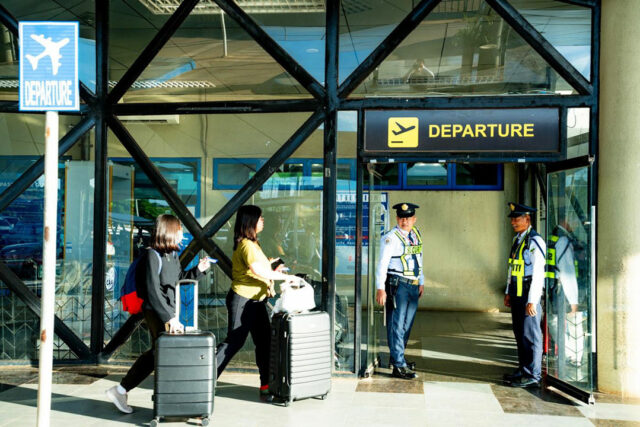
THE DEPARTURE ENTRANCE at Laguindingan International Airport (LIA) in Misamis Oriental. — ABOITIZ INFRACAPITAL, INC.

ABOITIZ INFRACAPITAL, INC. (AIC), the infrastructure arm of the Aboitiz group, said it has finished key upgrades at Bohol-Panglao (BPIA) and Laguindingan (LIA) International Airports, intended to improve operational reliability at the country’s sixth- and ninth-busiest airports.

“These improvements are important infrastructure upkeep that reflect our shared commitment with the government to make every AIC airport experience safer, more efficient, and more enjoyable for our travelers,” Aboitiz InfraCapital President and Chief Executive Officer Cosette V. Canilao said in a media release on Sunday.

The company assumed operations and maintenance of BPIA and LIA this year.

“We are ensuring that BPIA and LIA remain reliable gateways that connect communities, boost local economies, and strengthen our country’s aviation network,” Ms. Canilao added.

Aboitiz InfraCapital said the improvements included essential repairs to facilitate passenger access, assessments of uninterruptible power supply systems, and servicing of baggage carousels.

Additional preventive maintenance was carried out at BPIA for passenger boarding bridges and baggage weighing scales, reflecting the company’s efforts to modernize the airports.

“This initiative demonstrates how strong collaboration between the public and private sectors delivers better facilities and services faster, with direct benefits for travelers, airport staff, and host communities,” the company said.

AIC aims to increase BPIA’s annual capacity by 25%, from two million to 2.5 million passengers, within two years, under a P4.53-billion investment plan covering terminal expansion, modern aviation systems, and enhancements to airside and landside facilities. The company also targets boosting capacity to 3.9 million passengers annually by 2030.

The 30-year concession agreement for BPIA covers upgrades, expansion, and maintenance starting from the airport’s turnover in June.

For LIA, AIC announced last year that it would partner with Ireland-based daa International to implement upgrades and manage operations.

In addition to these regional airports, Aboitiz InfraCapital also manages Mactan-Cebu International Airport and has expressed interest in taking over operations and maintenance of other regional airports across the Philippines. — Ashley Erika O. Jose

From small to big

GILDED CAGE — JOSEPH L. GARCIA

RETIRED DESIGNER Wynn Wynn Ong has stepped back into the limelight for an exhibition, Distilled, for the 20th anniversary of the Yuchengco Museum. The exhibit was opened on Nov. 6, and will run until March 2026.

While best known for her jewelry, once mostly sold at Ricky Toledo and Chito Vijandre’s Firma boutique, we found out that evening that Ms. Ong had ventured even into furniture and clothing.

While her jewelry was all over the museum’s third floor, so were large carved tables and lamps, made with the same intricacy as her jewelry. Think of a piece called The Chase: a chest of kamagong wood which has metal handles shaped like lizards, all in different positions. It turns out they were all “chasing” a bejeweled insect found within one of the drawers. Then there is a piece called Gilded Cage which lies on a sculpted base of water serpents, surrounded by Asian motifs like peonies and Chinese lions — they all support a copper and wire cage with painted miniatures from the Boxer Codex, while tiny jade ornaments hang all over it.

The show is a retrospective, since Ms. Ong has been in retirement for almost eight years. Prior to that, she ran her studio for 18 years.

On being reunited with her past work, she told BusinessWorld: “They literally are like my children,” likening the year or so process in making each piece, never repeated, to the gestation period in the womb.

Of Burmese extraction but of a global upbringing, Ms. Ong was an educator first (as Vice-Chair of the International School Manila) before becoming a designer. “When you have a different worldview, your mind is much broader,” she said.

When her son went to college in Boston, she said, “I was so bored. I started playing.” She twisted wires and came out with a necklace in the shape of a question mark (also on display at the exhibit). “When I can’t find something that I’m looking for, or want, I decide to make it,” she explained.

“My approach is the same,” she said when asked about the differences between working on small things (jewelry) and big things (furniture). “I’ll study it, I’ll learn how to do it, and how to make the thing that’s in my mind.”

Ms. Ong retired eight years ago to concentrate on developing a property her family acquired in 1992 — her work in the beginning of the new millennium came first. “I love to build. I love to construct,” she said, and, “It’s good to have passions. But if you want to do something, you have to really focus.”

“Something had to give,” she said, adding this new project to a spinal injury she experienced three years prior to her retirement.

Asked if the retrospective has inspired her to come back, she said, “To do it as a full-time business, no.” She’s not averse to making something custom for a close friend, though, but even then, “There’s so many things I want to learn,” she said. “I’m the type of person (who) wants to keep learning.”

And the things she wants to learn range widely — “I want to paint. I want to do things. I want to go back to writing,” she said. — Joseph L. Garcia

Crooks incorporated: Distortions flood the budget cycle

PHILIPPINE STAR/RYAN BALDEMOR

(Part 3 of 3)

If the budget cycle is airtight with safeguards in place at each stage, why then are we seeing corruption at such a horrible scale and stretch today?

The answer is found in a Filipino idiom: bantay-salakay.

The very actors entrusted to protect the system are the ones raiding it. Once those who are supposed to guard the process turn against it, all defenses are compromised.

Based on admissions before the Senate Blue Ribbon Committee, independent reports by civil society and media organizations, and initial findings by the Independent Commission for Infrastructure (ICI) and the new Department of Public Works and Highways (DPWH) leadership, the emerging picture is one of a system gamed not by a single rogue contractor or a lone corrupt official, but a network and apparent syndicate of politicians, bureaucrats, contractors, and even some regulators working in concert.

THE EXPLOSION OF ‘INSERTIONS’
Congressional insertions are not new; they have been the subject of previous scams and mechanisms in the past that have reached the Supreme Court (the Priority Development Assistance Fund or PDAF, for instance).

What appears to be new in its present incarnation is the magnitude of insertions and the new work-around in appropriation: the use of unprogrammed funds and the scraping of so-called savings of Government-Owned and -Controlled Corporations or GOCCs for transfer to the Treasury.

In her Amicus Curiae brief submitted to the Supreme Court in the pending consolidated PhilHealth cases, Zy-za Suzara discussed “a new scheme” of massively funding pork barrel by defunding strategic development programs in the budget proposal and “parking them instead in the Unprogrammed Appropriations.” The freed up fiscal space in the proposed budget is allocated to legislators’ projects.

According to Suzara’s analysis of budget data, while the level of Unprogrammed Appropriations from the National Expenditure Program (NEP) to the General Appropriations Act (GAA) was historically largely unchanged, there has been a spike in Unprogrammed Appropriations over NEP levels beginning 2022. In 2024, from a proposed level of P282 billion, the GAA level reached P732 billion, or an increase of P450 billion over proposed.

Even as the defunded proposed programs were transferred to Unprogrammed Appropriations and the resulting fiscal space in Programmed Appropriations were replaced by Congressional insertions, the 2024 GAA also introduced a Special Provision authorizing the fund balance of GOCCs as a source of financing for the bloated Unprogrammed Appropriations. The Philippine Health Insurance Corp. (PhilHealth) was among the GOCCs from which fund balances were swept for this purpose.

“Insertions” have become an apt term for this apparent robbery-in-band of the national budget. Which insertions were introduced by which members of the House of Representatives and the Senate is the question in everybody’s mind.

At the Blue Ribbon Committee hearings, contractors and district engineers have said that the insertions become “sponsored” projects by legislators, earning for them “commitment” fees or kickbacks as high as 30% of the allotment — monies advanced by contractors even before formal procurement commences. In the vernacular, nagbababa ng pondo.

These changes to the appropriations bill did not happen transparently during the open budget deliberations as envisioned by House and Senate rules. Under the chambers’ rules, amendments should take place during the period of amendments in plenary. In practice, however, it appears that only committee amendments are openly introduced in plenary. Individual amendments have been introduced after the voting on second reading.

As Navotas Rep. Toby Tiangco claimed, these individual amendments are often handled by a so-called “small committee” in the House, operating behind closed doors. Another opaque stage where such insertions occur is at the bicameral conference committee, which meets behind closed doors to reconcile the House and Senate versions of the budget bill.

Addressing the matter, Senate President Vicente “Tito” Sotto III clarified that “amendments or insertions, whether individual or institutional, done during the deliberations in the Senate, are part of the regular budget process.”

Yet even granting that some amendments are legitimate adjustments, the lack of transparency leaves room for abuse. It is imperative for Congress to disclose and differentiate which changes were proper institutional amendments, which were questionable individual insertions, and who introduced the same, so the public may clearly see how public funds are being allocated.

In the previous PDAF case, the Supreme Court struck down express provisions of the General Appropriations Act that were tantamount to post-enactment appropriation. By contrast, in the current scheme of congressional insertions, no such express provision appears in the text of the GAA.

This absence of explicit language does not render the practice lawful, however. In Belgica v. Ochoa, the Court made clear that even informal practices that allow legislators to intrude into the proper phases of budget execution are equally unconstitutional.

The Court stated: “Corollary thereto, informal practices, through which legislators have effectively intruded into the proper phases of budget execution, must be deemed as acts of grave abuse of discretion amounting to lack or excess of jurisdiction and, hence, accorded the same unconstitutional treatment.”

Thus, while the present scheme of insertions may not be openly written into the GAA, its covert and informal nature makes it no less unconstitutional, as it similarly violates the separation of powers and undermines the integrity of the budget process. In fact, its opacity renders it even more repugnant.

MANIPULATION OF BIDDING
If congressional insertions set the stage for corruption by directing vast sums to specific projects and regions, bidding manipulation is where the scheme is executed on the ground. Procurement rules designed to ensure transparency, competition, and value for money, are subverted through collusion among politicians, insiders within DPWH, and contractors.

What appears on paper as a fair and open procurement process is a sham, with the real winners and losers decided before any bid is opened. Admissions before the Senate Blue Ribbon Committee from DPWH officials and contractors reveal three interrelated schemes: “in-house” contracting; lending of contractors’ credentials for royalty fees, and simulated or pre-arranged bidding.

Under procurement rules, DPWH projects are supposed to be awarded to independent qualified contractors. But admissions speak of instances when actual implementers are DPWH insiders themselves using outside contractors as fronts to get around the documentary requirements.

In this arrangement, a contractor “wins” the bid but merely lends its name, license, and eligibility, while DPWH insiders manage the project execution using government resources, equipment, or personnel. The contractor receives a royalty fee for allowing its accreditation to be used, while the actual work is carried out informally within the agency.

A related scheme is the lending of contractors’ licenses and credentials. Under RA 9184 and its Implementing Rules and Regulations, contractors bidding for public works must meet strict eligibility requirements, including a valid license from Philippine Contractors Accreditation Board (PCAB) and technical and financial capacity.

These rules are meant to ensure that only competent contractors handle infrastructure projects. Based on witness admissions in the Senate, however, there is a practice where contractors “rent out” their licenses and documents to bidders who lack the qualifications to bid. The licensed contractor does not perform the actual work but collects a royalty fee, typically a percentage of the project cost, in exchange for its paper credentials. This constitutes misrepresentation, making the bid fraudulent from the outset.

When combined with “in-house” contracting, license lending creates the appearance of compliance while concealing the truth that unqualified actors are behind the project.

Lastly, in simulated bidding or rigged bidding, the winning bidder is predetermined before the bidding process even begins. Other bidders are recruited to submit losing bids for a fee or other considerations, creating the illusion of competition. By pre-selecting the winner, bid prices are often inflated.

ACCOUNTABILITY? IT’S SYSTEMS FAILURE
The failure of accountability derives not just from a single weak link in the system. Over the decades under the watch of seven Philippine presidents after EDSA People Power, what has unfolded is systems failure, the collapse of multiple accountability safeguards, compromised by the very actors mandated to uphold them.

The Executive branch is not without fault. Rather than acting as a counterweight to questionable legislative practices, it has publicly defended actions that have weakened appropriations discipline.

When concerns were raised previously about the ballooning Unprogrammed Allocations, the Executive had insisted that these were not unconstitutional.

Likewise, when health advocates protested the transfer of “fund balances” from GOCCs, including PhilHealth, to the National Treasury to finance unprogrammed appropriations, Executive officials defended the transfers, citing fiscal management prerogatives.

DPWH officials have claimed at the Senate hearings that insertions do not begin only at the legislative stage but as early as the budget preparation phase. Former DPWH Undersecretary Roberto Bernardo revealed that even the release of Unprogrammed Funds is not shielded from congressional insertions.

These acts clearly blur the line between executive and legislative functions. Thus, while the Department of Budget and Management (DBM) is supposed to exercise supervision and oversight over the Executive throughout the budget cycle, it is being shown to be a complicit enabler of the flood of distortions.

Even the Commission on Audit (CoA), the institution at the very heart of external accountability, has not been spared from controversy. At the Senate hearings, it has been said that a percentage of project funds is regularly “set aside” for CoA officials, which can only be intended to secure an audit pass.

If true, this would mean that the very entity meant to scrutinize irregularities is financially entangled with those it audits. More explosive still is the allegation that a CoA Commissioner had directly solicited projects.

The mechanism of congressional oversight over the budget loses its meaning when legislators are themselves the originators of the system’s breakdown.

In a previous report, R2KRN had asked: Who comes with clean hands? The syndicated corruption among pushers, enablers, and players points to a damning answer: The dirt has stained most everyone, and visited most every entity, private and public.


Nepomuceno Malaluan, Malou Mangahas, and Jenina Joy Chavez are co-convenors of the Right to Know, Right Now! (R2KRN) Coalition.


FSCC to map PHL banks’ corporate links in 2026 to flag systemic risks

BW FILE PHOTO

THE FINANCIAL STABILITY Coordination Council (FSCC) plans to map out banks’ connections with major companies next year as it sharpens its monitoring of emerging risks in the Philippine financial system.

In a statement at the weekend, the council said it would develop a unified protocol for coordinated response among the Bangko Sentral ng Pilipinas, Department of Finance, Insurance Commission, Philippine Deposit Insurance Corp. and Securities and Exchange Commission. The framework will guide how regulators detect, assess and address vulnerabilities across institutions.

“The FSCC’s top priority is to stay ahead of emerging risks and respond as one cohesive front,” FSCC Chairman and BSP Governor Eli M. Remolona, Jr. said at a meeting held on Nov. 5. “By improving system-wide monitoring and coordination, the FSCC aims to safeguard the stability of the Philippine financial system.”

The council noted that banks’ links to nonfinancial corporations have deepened in recent years. It said risks tied to these interconnections are increasingly shaped by housing market trends and leverage in both corporate and household sectors.

Earlier this year, Moody’s Ratings flagged that Philippine banks’ ownership ties with large conglomerates boost credit profiles but also introduce concentration and contagion risks, especially during periods of stress.

Still, the FSCC said the domestic banking industry remains well-positioned, citing strong capital buffers, solid liquidity and adequate loan-loss provisioning. Capital ratios have stayed above regulatory thresholds despite financial shocks, it added.

The council also said it is advancing capital market reforms. Part of this effort includes setting a standardized pricing convention for peso bonds and refining open-market operations to improve market efficiency, the BSP said. — K.K. Chan

ADVERTISEMENT
ADVERTISEMENT