Home Blog Page 6551

Magdalo rep challenges anti-communist task force to prove Robredo-NPA link 
THE REPRESENTATIVE of a party-list of former military officers on Monday challenged the governments anti-communist task force to prove their accusation that Vice-President Maria Leonor LeniG. Robredo, whom the group is supporting for president in the May elections, is connected with the New Peoples Army (NPA).  

I am one of the former soldiers aligned with the Robredo camp. And I can say with certainty, we also do not want a coalition with the NPA,Magdalo Para sa Pilipino Rep. Manuel DG. Cabochan III said in a statement.   

The NPA comprise the armed fighters of the Communist Party of the Philippines.  

We are clearly against itBut there is no coalition with the NPA in the first place,he said.   

Mr. Cabochan said he is ready to give up his congressional seat if the National Task Force on Ending Local Communists Armed Conflict (NTF-ELCAC) can prove their allegation.   

Now, if the NTF-ELCAC can show proof today, aside from fake witnesses, that there is a coalition between the NPA and the Robredo Camp, I will resign as the incumbent representative and nominee of the Magdalo Party-List, he said.   

The Magdalo party-list, which represents retired soldiers, was founded by Samahang Magdalo in 2010. Samahang Magdalo is connected to the Magdalo Group, which led the Oakwoad mutiny and the Manila Peninsula siege that both sought to oust former President Gloria Macapagal-Arroyo.   

Former Colonel Ariel O. Querubin, who was a colleague of Mr. Cabochan in the Magdalo Group, said in a statement last week that he will not back Ms. Robredo after being told by senior police officers and representatives from the NTF-ELCAC that her group was associated with the NPA.  

Mr. Querubin, together with former police and military officials have said they will support the presidential bid of the late dictators son, Ferdinand BongbongR. Marcos, Jr.    

SENATORIAL CANDIDATES
In the Senate race, Senator Ana Theresia RisaN. Hontiveros-Baraquel, who is seeking reelection, promised support for workers and the end of contractualization if she wins another term. 

She plans to push for the Balik Trabahong Ligtas Bill, which aims to give public and private sector employees additional benefits such as life insurance.  

Ms. Hontiveros, who earlier filed the Security of Tenure Bill, also pointed out the need to remove the so-called “endo” or “5-5-5” system, wherein workerscontracts are terminated before they reach the minimum period that makes them eligible for certain benefits.   

“It’s time for endo or 5-5-5 to end,” she said in a statement. “Let us give job security and corresponding benefits to every Filipino.”  

Meanwhile, human rights lawyer Jose Manuel ChelI. Diokno, who is running for a senate seat, expressed his disappointment over the Philippine National Polices failure to investigate the alleged rampant smuggling of agricultural products into the country.   

This is the kind of organized crime that our law enforcers should be prioritizing,he said, noting that this has led to revenue loss and adverse effects on the livelihood of local farmers and fishermen. 

If elected, Mr. Diokno plans to provide free legal assistance in every barrio, or remote communities.  

He will also push for an independent commission to investigate abuses allegedly committed or instigated by persons in authority.   

In this way, he said, cover-ups will be avoided and all violators of the law will be equally penalized. Jaspearl Emerald G. Tan and Alyssa Nicole O. Tan 

Eastern Conference play-in set: Cavs at Nets, Hornets at Hawks

BROOKLYN Nets forward Kevin Durant (7) takes a three-point shot in the fourth quarter against the Indiana Pacers at Barclays Center. — REUTERS

THE BROOKLYN NETS won their regular-season finale on Sunday and secured the best seed in the National Basketball Association (NBA) Eastern Conference play-in tournament this week.

The Nets finished the season 44-38 after fending off the Indiana Pacers, 134-126. As the No. 7 seed in the East, they will host the No. 8 Cleveland Cavaliers on Tuesday evening to begin the play-in tournament.

The Atlanta Hawks and Charlotte Hornets both won their regular-season finales on Sunday to cement themselves as the Nos. 9 and 10, respectively, in the East. The Hawks (43-39) will host the Hornets (43-39) on Wednesday evening.

The winner of Brooklyn-Cleveland will advance to the playoffs and face the second seed (either Milwaukee or Boston) in the first round. The loser will host the winner of Atlanta-Charlotte on Friday to determine who draws the top-seeded Miami Heat in the opening round.

Brooklyn had an identical record to Cleveland after the Cavs beat Milwaukee on Sunday. But the Nets earned home-court advantage for Tuesday by virtue of winning the regular-season series, made possible by their 118-107 win over the Cavs on Friday.

The Western Conference play-in tournament schedule was finalized before Sunday’s action. The No. 7 seed Minnesota Timberwolves will host the No. 8 Los Angeles Clippers on Tuesday night. The No. 9 New Orleans Pelicans will host the No. 10 San Antonio Spurs on Wednesday night.

The play-in finals for both conferences are set for a Friday night doubleheader. — Reuters

Man City, Liverpool share spoils in pulsating title clash

MANCHESTER, England — Manchester City remained one point clear of Liverpool at the top of the Premier League standings after the highly-anticipated clash of the giants ended in a pulsating 2-2 draw at the Etihad Stadium on Sunday.

The match lived up to its billing right from the off as City flew out of the traps, racing into a fifth-minute lead after Kevin De Bruyne’s strike was deflected past Liverpool goalkeeper Alisson.

City, playing with the high pressing intensity which their opponents are famed for, could have taken the lead moments earlier but Raheem Sterling shot softly at Alisson from a glorious position.

With the raucous home crowd sensing Jürgen Klopp’s side were wobbling, however, Liverpool showed their mettle as they regrouped and leveled eight minutes later through Diogo Jota, assisted by a perfectly-cushioned Trent Alexander-Arnold pass.

The tempo was relentless, the action gripping and the momentum shifted again when Gabriel Jesus restored City’s lead in the 36th minute.

Liverpool cleared a corner only as far as Joao Cancelo and the Portuguese full back floated the ball back deep into the box where Jesus had stayed onside, nipping past Alexander-Arnold and steering the ball past Alisson.

It was the first time Liverpool had trailed at the break in the Premier League this season, but they did not need long to restore parity, scoring 46 seconds after the restart.

Mohamed Salah picked the ball up on the right flank and split the City defence with a superb pass to Sadio Mane who burst goalwards before converting with his customary precision.

REGAIN CONTROL
City was stunned but Pep Guardiola’s side recovered to regain control of the midfield for much of the second half and they came closest to winning the game.

Raheem Sterling thought he had again given the hosts the advantage in the 63rd minute, racing on to a brilliant De Bruyne through ball, only for the former Liverpool forward to be ruled offside following a VAR review.

In the 90th minute, City substitute Riyad Mahrez shaved the outside of the post with a free kick and in stoppage time the Algerian had a great chance to win the game but his attempted chip was off target.

It was a questionable decision from Mahrez when a more conventional approach might have paid off, but City was left to digest a point that changes little in the race.

“It’s a great chance. Riyad chose to chip and if it goes in it’s a wonder goal,” said De Bruyne.

“We played very well, I think we had the upper hand. This is the way we need to play the rest of the season. I know people said whoever wins gets the title. But it’s too hard, the schedule is too tough for both teams to win every game, but we will try,” added the Belgian.

The result was a repeat of October’s scoreline at Anfield and was the first time City had scored first and not gone on to win in the Premier League this season.

A fourth Premier League crown in five seasons is in City’s hands, though, as they moved on to 74 points, one ahead of their title rivals, but with seven games left for both teams there is still plenty of work to do.

“Of course, we knew we would come under pressure early on, they are a fantastic team,” said Liverpool captain Jordan Henderson.

“I felt we settled down a bit and caused them problems. It’s pleasing how we twice came from behind. We have to concentrate on ourselves and win as many games as possible. If they slip up we have to be there right behind them. We’ll keep going until the end,” he added. — Reuters

Major win cements Scheffler as world’s best player

AUGUSTA, Ga. — Scottie Scheffler held rock steady and cruised to a three-shot victory at the Masters on Sunday to earn the coveted ‘Green Jacket’ and cement his status as the world’s top ranked golfer.

From winning his first Professional Golfers’ Association (PGA) Tour event at the Phoenix Open just two months ago to claiming his first major title at Augusta National, Schleffer’s rise has been nothing short of meteoric.

Starting the final round with a three-shot advantage over Australian Cameron Smith, the 25-year-old American carded a one-under 71 for a 10-under 278 total, three clear of Rory McIlroy and five ahead of Smith.

McIlroy’s eight-under 64 matched the final-round record at the Masters as the Northern Irishman made a stirring late charge in a bid to claim the elusive title that would see him complete the career Grand Slam.

Scheffler said he could afford to focus on his own game thanks to his three-shot cushion.

“I may have looked calm on the outside, but it’s a long day. It’s a tough day,” said Scheffler.

“I was fortunate to put myself in a position where I was in control of the tournament today, so I didn’t have to worry about what anyone else was doing out there.

“If I took care of my stuff and played good solid golf, I felt like I would get the job done.”

The year’s first major was poised for a showdown between the planet’s two hottest golfers in Scheffler, the winner of three of his last five PGA Tour starts, and Smith, who claimed golf’s unofficial fifth major at the Players Championship in March.

And that is how the final round unfolded until the par three 12th in the heart of the notorious Amen Corner when Smith put his tee shot into Rae’s Creek on the way to a triple bogey six, sending him down the leaderboard.

“It’s just a really bad swing,” said Smith. “Probably one of the worst swings of the week and just at the worst time of the week. Just unfortunate, but I’ll grow from this and be stronger for it.”

A rattled Smith never recovered, slumping to a one-over 73 to finish five back in a tie for third with Irishman Shane Lowry, who closed with 69.

‘ENJOY THIS’
Smith got his day off to a scintillating start with back-to-back birdies.

But Scheffler hit back with a spectacular chip-in birdie at the third, which Smith would bogey, restoring the world number one’s three-shot cushion.

Smith slumped to a second bogey on the par three fourth and suddenly Scheffler had stretched his lead to four.

As the pair started the back nine, a mighty roar rolled across Augusta National after McIlroy carded an eagle at the 13th to get to six-under for the tournament.

That left McIlroy five back of Scheffler and one behind Smith, raising pressure on the pair as they entered Amen Corner — holes 11, 12 and 13, perhaps the most famous stretch of golf real estate where so many Masters have been won and lost.

“I’ve had the lead on the back nine here and haven’t been able to get it done,” said McIlroy. “I just wanted to try and put a little bit of pressure on and I feel like I did that.”

A long birdie putt at 11 by Smith triggered an explosion of cheers that would have been heard back home in Brisbane.

But then came the 12th, where so many Green Jacket dreams have turned into nightmares, Smith’s now among them after his tee shot found the water.

“It was definitely nice to build up a lead,” said Scheffler. “Nothing is safe out there on the back nine on this golf course.

“I’ve heard all the things that everybody says, it doesn’t start till the back nine on Sunday, anything can happen, don’t hit in the water on 12, all the stuff.

“I just blocked most of that out and tried to execute and hit good golf shots.”

The only moment Scheffler showed any hint of nerves came at the very end, standing on the 18th green and missing two short putts that would have given him a bigger margin of victory.

“I didn’t want any stress towards the end of the day,” said Scheffler. “I didn’t break my concentration until we got on to the green on 18.

“Once we got on to the green, I was like, all right, I’m going to enjoy this, and had some fun with it.” — Reuters

Djokovic vows to use tough experiences to fuel his season

NOVAK Djokovic plans to use the challenging experiences he has endured this year due to being unvaccinated against coronavirus disease 2019 (COVID-19) as fuel for the rest of the season, the world number one said on Sunday ahead of his return to action in Monte Carlo.

The 20-times Grand Slam champion was unable to defend his Australian Open title in January after being deported from the country, having initially been admitted to the tournament despite not taking the vaccine.

“I try to be optimistic in life and consider myself a very optimistic, positive person,” Serbian Djokovic told reporters. “I take lessons available in every experience, particularly in something as large as what happened in January.

“Once I start playing matches… I will obviously have to deal with everything that probably has been dormant inside and is maybe waiting to come out.

“I don’t feel it has left huge scars that I’m unable to train or participate in tournaments or live my life… far from that.

“But it has been a challenging few months and something I never experienced before. So I will try to use that as a fuel for what’s coming up.”

Djokovic, who has only played three matches this year — all in Dubai — said he missed competing.

“The last four, five months have been really challenging for me mentally and emotionally, but here I am. I try to leave all of that behind and move on,” Djokovic said.

“My Roland Garros win last year is still fresh in my memory, so I try to use that as inspiration to kickstart the claycourt season in the best possible way.

“I intend to play the full claycourt season according to my schedule of the previous years. I understand I probably won’t be at my best particularly at the beginning of this week, so I’m testing my engine, so to say, and building my game.”

Djokovic begins his claycourt campaign against Spaniard Alejandro Davidovich Fokina at the Monte Carlo Masters which starts on Monday. — Reuters

Seizing the momentum

PRESIDENTIAL ASPIRANT Leni Robredo in Dagupan, Pangasinan sortie on April 8. — PHILIPPINE STAR/MICHAEL VARCAS

I have written in this space many times before that survey rankings change over the campaign period. That is because the rankings reflect the sentiments of the voters at the time the survey was conducted. A lot of things can happen between the time a survey was conducted and Election Day that can change the sentiments of the voters, and consequently the rankings of the candidates in the surveys.

For one, campaign strategists of the different candidates will make things happen, either to boost their candidate’s political stock or to erode his opponents’ standing. There can also be developments outside the influence of the candidates that can have a significant impact on their campaign.

This was shown in the last Pulse Asia survey on preference for presidential candidates. Bongbong Marcos still leads in the March 17-21 survey, but his numbers went down by 4%, from 60% in the Feb. 18-23 survey to 56%. Leni Robredo’s numbers rose by 9%, from 15% in February to 24%.

Marcos remains the frontrunner in all geographical areas — 64% in Metro Manila, 54% in the rest of Luzon, 48% in the Visayas, and 62% in Mindanao. However, he lost points in all these areas — 2% in Metro Manila, 4% in the rest of Luzon, 5% in the Visayas, and 6% in Mindanao.

Robredo registered 17% in Metro Manila, 30% in the rest of Luzon, 28% in the Visayas, and 14% in Mindanao. However, except in Metro Manila where she lost 1%, she scored big in all the regional areas. She gained 14% in the rest of Luzon, and 9% each in the Visayas and in Mindanao.

Marcos still leads across social classes, but his numbers in these classifications also went down — 4% for people belonging to Class C, 5% for Class D, and 6% for Class E. Robredo gained 13% from Class C, 10% from Class D, and 9% from Class E.

Barry Gutierrez, Robredo’s spokesperson, said. “The survey numbers are starting to reflect what we have been seeing on the ground all along: the massive crowds, the fierce passion, the untiring commitment of Filipinos from all walks of life, coming together to rally behind Leni Robredo’s bid for the presidency.”

An event that could have influenced the ratings of Marcos and Robredo in the Pulse Asia survey was the pastoral letter the Catholic Bishops Conference of the Philippines sent to their flock on Feb. 25, just days after Pulse Asia completed its February survey. The letter belied the narrative that Ferdinand Marcos’s presidency was the Golden Age of a booming economy, golden infrastructure, discipline and order.

The letter warned the electorate of the radical distortions in the history of Martial Law and the EDSA People Power Revolution. It said, “An election or any process that is not based on truth is but a deception and cannot be trusted. Thus, and also in view of the coming elections, we call on you, Brothers and Sisters — especially the Youth, to examine carefully what is happening in our quest for a true and just society.”

Robredo’s gains in voter preference as indicated in the Pulse Asia survey may be significant but they are not enough to overcome the lead of Marcos. If the Kakampinks do not want an administration elected based on lies as the Catholic Bishops warn, then they should seize the momentum created by the pastoral letter to turn the tide in favor of Robredo.

Now that the Robredo campaign strategists have intensified the house-to-house campaign, the Kakampinks should tell the true story of the Martial Law years in every house they visit. They should tell the household that Bongbong cannot deliver on his promises as he has been a pampered and privileged individual all his life, and that he is lazy which is why he has no accomplishments to speak of.

They can use the slogan “Babangon muli” to project the specter of Ferdinand Marcos, the “Greatest Robber of Government” as the Guinness Book of Records describes him, coming back to life in the person of Bongbong. The message “Babangon muli” can be made to mean bringing back the horrible Conjugal Dictatorship, which stands for massive corruption, boundless extravagance, and unrestrained oppression.

To counter the narrative of a Golden Age propagated by an army of trolls over the last three years, the Kakampinks should narrate in every house they visit the sordid stories of warrantless arrests and of torture of political enemies and critics, the Jabidah Massacre and other mass murders, the soaring prices of basic commodities, the long queues for rice rations, and frequent widescale blackouts during Martial Law.

Those are the stories the Kakampinks should tell the folks in the countryside who have no access to social media, much less to mainstream media now that the far-flung network of ABS-CBN has been denied use of the air lanes. They should leave flyers that the voters in the house can read.

They need not produce a comic book like the one that foiled Bongbong’s first bid for the Senate in 1995. Simple flyers that tell the truth about Bongbong Marcos, like the posts that saturate social media now, will do.


Oscar P. Lagman, Jr. is a retired corporate executive, business consultant, and management professor. He has been a politicized citizen since his college days in the late 1950s.

The total package

PHILIPPINE STAR/EDD GUMBAN

Whenever I dream of what we could become, the term “total package” crosses my mind. It is mission-focused and considers the necessary capabilities, enablers, and tools necessary to make things happen. At ground level, these include:

a. Transforming our educational, political, cultural and economic systems and institutions necessary to drive nation-building initiatives.

b. Developing the country’s brain trust with the right mindset to influence the government and society to continually improve the state of the nation.

c. Cobbling a treasured collection of international and domestic collaborators to build all the necessary infrastructure to grow and develop our economy.

There’s a catch though. Those are long-range in nature, and unattractive to politicians with short-sighted self-serving time frames. This is more suited for statesmen and nation-builders with the vision, willingness, and patience to win the future. Admittedly, there are only a few willing to fold their sleeves for the long journey to a better Philippines.

Let’s take Vice-President Leni Robredo’s vision of transforming the country into a maritime power. It will take time but the foundations need to be laid. It’s clear to her that the Philippines is an archipelagic state with a large maritime domain requiring a strong merchant marine and Navy. A maritime power’s core elements are: geographic position; coastline; adequate and well-positioned ports; population size; sea-related activities; and good statecraft. Except for that last element that must be fulfilled, our country has all the other elements. Unfortunately, past and present administrations failed to exploit those.

We don’t build our own ships although we have foreign shipbuilders operating here. Our mariners account for around one-third of the world’s mariners, but they serve on ships belonging to other flags. UNCTAD’s Review of Maritime Transport 2021 cited the Philippines as Asia’s top global provider of both seafarers and officers that play a key role in global logistics. IDE-Jetro provides research on how the Philippines has changed its policies and laws concerning seafarer training, overseas employment support, and legal protection while responding to the changes in the global seafarer labor market, such as seafarer shortages in advanced shipping countries. In this regard, we are the gold standard. But we can do much more.

Should VP Robredo beat the odds and become the country’s next president, she’ll have her hands full. A shipbuilding industry has a very specific character. For example, fittings, fixtures, and man-hour requirements differ from ship to ship. It’s not a mass production item. Building the industry requires clear policy directions, appropriate legislation, economic growth, financial support, technical innovation, managerial and technical skills, and expanding trade routes. Ancillary industries, like steel, tools and parts manufacture, will be essential to its success.

We do have a scattering of small shipyards building, for example, multi-purpose attack craft, landing utility transports, offshore patrol vessels, fishing boats, barges, tugboats, leisure craft, and fast ferry boats. But they lack the wherewithal to service the vast commercial and security requirements of local and international markets, to include e.g., cruise liners, superyachts, oil and gas tankers, bulk cargo and container ships. The failure to support them has evidently stunted the industry’s growth. And because we’ve neglected it, we haven’t built the ships needed by our Navy and Coast Guard to defend and protect our national interests.

I envy the countries who were once behind the Philippines commercially and militarily in the 1950s and ’60s. For example, South Korea, Indonesia, and Singapore who, in the process, have enlarged their manufacturing and technological capacities. Had we done the same, we’d also be supplying the region and other parts of the world. If we only kept in step with our neighbors, we’d by now be churning out our own landing docks, submarines, frigates, corvettes, mines for warfare, offshore patrol vessels, fast missile attack crafts, replenishment and floating dry dock platforms.

Not only that. We’d be collaborating with foreign suppliers of weapons, combat systems, and non-combat equipment to equip those platforms that, in time, could also be manufactured domestically by public-private partnerships. These would include helicopters, communications systems, radar and sonar systems, missiles and rockets, guided munitions, air- sea- and land-based drones, crew-served weapons and ammunition. The direct benefits would be increases in GDP, technology transfers, purchasing power parity, value added, skills and knowledge.

VP Robredo has given the distinct impression that she understands the security-development nexus: that both are two faces of the same coin, that one cannot stand without the other. Becoming a maritime power will require transformed institutions, the brain trust and troves of partners and collaborators to make it happen. If she does it correctly, she’d be strengthening elements of our national power — academic and training institutions, human resources, economic diplomacy, industrial base, strategic infrastructure, and national security.

I’m picking up signals that foreign investors see VP Robredo as the best candidate that could restore trust and confidence in the country. By providing an enabling environment, foreign direct investments could surpass the peaks registered during the Ramos and Duterte administrations in 1998 and 2017, respectively, after 20 years of mostly mediocre and erratic performance. With a good economic team in place, good governance on the move, socio-political stability and professional security forces, the country may weather the natural and geopolitical turbulence affecting the global commons.

That will require a whole-of-government effort, national and local, to increase disincentives for malfeasance and misfeasance, while increasing incentives for good behavior and performance. A unifying and visionary leadership, no-nonsense governance and civic responsibility for the common good are indispensable to the effort. That’s essentially the total package.

This article reflects the personal opinion of the author and does not reflect the official stand of the Management Association of the Philippines or MAP.


Rafael “Raffy” M. Alunan III is a member and former governor of the MAP, chair of Philippine Council for Foreign Relations, vice-chair of Pepsi-Cola Products Philippines, Inc. and sits on the boards of other companies as independent director.

map@map.org.ph

rmalunan@gmail.com

Duterte’s Philippine Economic Debriefing

Last week, on April 5, I attended the Philippine Economic Briefing (PEB) at the PICC, a sort of valedictory address by the Duterte administration led by Secretary of Finance Carlos G. Dominguez. The Opening Remarks were given by Executive Secretary Salvador C. Medialdea, then the main report, “The Ship of State Has Been Masterfully Steered,” delivered by Mr. Dominguez, followed by “Monetary, External, and Financial Sector Updates” by Governor of the Bangko Sentral ng Pilipinas (BSP) Benjamin E. Diokno.

It was followed by a press conference with seven officials in the panel: Mr. Dominguez, Mr. Diokno, Trade and Industry Secretary Ramon M. Lopez, Agriculture Secretary William D. Dar, Tourism Secretary Bernadette T. Romulo-Puyat, NEDA (National Economic and Development Authority) Undersecretary Rose Edillon, and Transportation Undersecretary Giovanni Z. Lopez.

Mr. Dominguez emphasized in his report that the “Duterte presidency made the turn towards more inclusive growth and prosperity…. Our 2020 GDP would have plunged deeper by 13.3% instead of 9.6%… The Tax Reform for Acceleration and Inclusion (TRAIN) Law is a crowning achievement of this administration.”

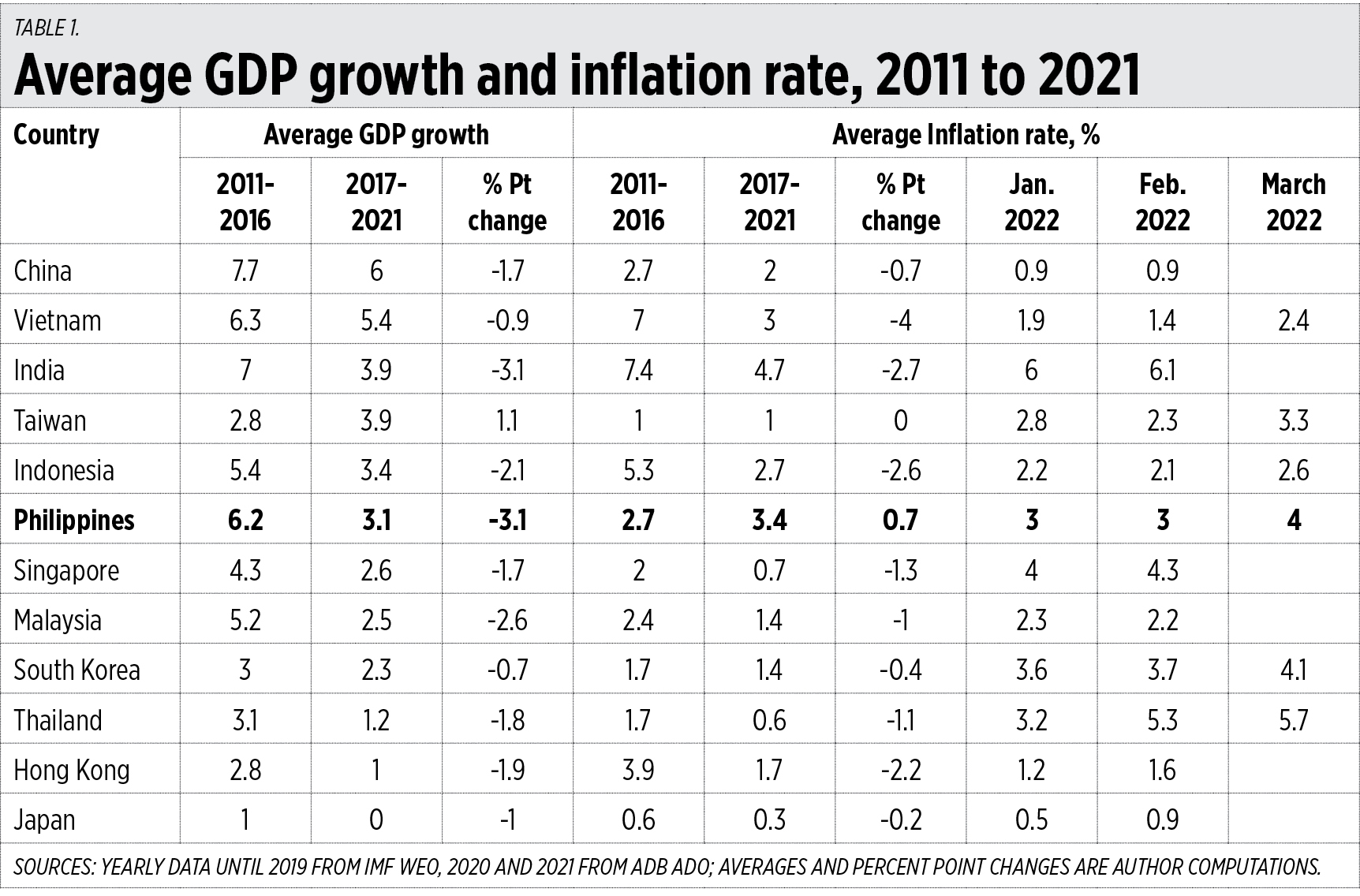
I titled this piece as economic “debriefing” because the comparative regional macroeconomic data do not seem to conform with these claims for the Philippines. And here are some numbers covering the 12 major economies of East and South Asia. Data sources are the IMF World Economic Outlook (WEO) database from October 2021 and the ADB Asian Development Outlook (ADO) from April 2022.

One, in average GDP growth from 2011-2016 to 2017-2021, the Philippines had the biggest decline of 3.1 percentage point along with India. The Philippines’ average growth of 3.1% in the last five years was high compared to those of Singapore, Malaysia, South Korea, Thailand, Hong Kong, and Japan, true. But the Philippines came from an average growth of 6.2% under the previous administration, so the percent point decline was starkly huge.

Two, the Philippines is the only economy that experienced a rising inflation rate over the same period, an increase of 0.7% percentage point, while the 11 other economies had zero or declining prices. Our average inflation rate from 2011-2017 of 3.4% was the second highest after India, while our five ASEAN neighbors had only 0.6% to 2.7%.

Three, the Philippines experienced the highest inflation rate of 5.2% among these economies in 2018 — the first year of implementation of the TRAIN law. The next highest inflation was Vietnam’s at 3.5% and lowest was Singapore’s at 0.4% that year. The oil tax hikes Part 1 — diesel from zero to P2.50/liter, gasoline from P4.35/liter to P6.50/liter, etc. — implemented that year triggered a series of commodity price increases, from food to wages and rentals. The diesel tax became P6/liter, gasoline P10/liter, etc. in 2020.

Four, inflation started to creep upwards in March this year to 4% due to the ongoing war in Ukraine and the US-led economic sanctions against Russia that has dragged perhaps the whole world economy into an inflationary spiral (see Table 1). Hence, the clamor by some sectors to suspend or reverse the oil tax hikes of the TRAIN law to help reduce prices in the Philippines.

Five, from 2019 to 2021 the Philippines had the second-highest increase of 5.2% in its budget deficit/GDP ratio after Thailand.  The Finance department, Congress, and many sectors of the country were swayed by Keynesian economic thinking — when household and private spending and investment declines, government spending should expand fast to “stimulate” overall demand — a questionable if not unrealistic philosophy in the current world.

Six, the expected “stimulated” rise in demand with high deficit spending did not happen as shown by -9.6% GDP contraction of the Philippines in 2020, the worst since post-WW2. In contrast, Vietnam and Taiwan did not significantly expand their deficit spending and they managed to have GDP growth of 2.9% and 3.4% respectively. This is a slap in the face of Keynesian economics in the last two years.

Seven, in external debt outstanding, the Philippines had the second largest increase of 27% from 2019 to 2021, next to South Korea’s 34% (see Table 2).

On the positive side, the Duterte administration should be recognized and credited for some good moves and fiscal reforms. Among these is the new Ease of Doing Business Act, principally initiated by the Department of Trade and Industry under Secretary Ramon Lopez. We need more businesses and job creators, not more bureaucracies.

The BSP under Mr. Diokno has consistently managed our external account. There was a buildup of our gross international reserves (GIR), from $79.2 billion in 2018 to $110.1 billion in 2020 and $108.8 billion in 2021. This was equivalent to about 10 months of imports cover and so we are shielded from any energy imports supply shock because of this huge GIR level. Also, there was the BSP’s Digital Payments Transformation Roadmap that strengthened the digital payment ecosystem.

I saw at the event the new President of Philippine Chamber of Commerce and Industry (PCCI), George Barcelon. Since they are the biggest business organization in the country, I asked him his assessment of the PEB. His response:

“Build, Build, Build initiatives were successful in roads, railways, airports and sea ports all over the country. On tax reforms, TRAIN, CREATE (Corporate Recovery and Tax Incentives for Enterprises Act), the Public Service Act, the Foreign Investment Act, and the Retail Trade liberalization Act, etc. will transform our nation’s ability to attract Foreign Investments and fiscal support for health and education. The private sector was disappointed in the handling of COVID-19 during the initial stages wherein strict quarantine was imposed without stakeholders’ involvement in the decision-making process. But credit goes to the cooperation and discipline of business owners and the general populace. The minor glitches are gaps that can be addressed. The new administration can leverage on the present administration’s ground work.”

If I have to grade the Duterte administration’s overall economic performance in the last six years from 1.0 to 5.0 with 1 as excellent and 5 as failure, just looking at internal figures I will give it a 2.5. But considering the comparative performance of our neighbors in the region, I will give it a 3-3.5: 2.0 in 2017-2019 and 4.5 in 2020-2021 because of its strict prolonged lockdown and mobility restrictions, and implicit mandatory vaccination policy.

Hoping that the next administration will not follow the pitfalls of this government. And to secure change in economic policies in the next six years, the Duterte-allied Bongbong Marcos — Sara Duterte tandem should not win.


Bienvenido S. Oplas, Jr. is the president of Minimal Government Thinkers.

minimalgovernment@gmail.com

Directions in middle power diplomacy for a Leni Robredo presidency

PHILIPPINE STAR/ MICHAEL VARCAS

The Philippines is a maritime nation. Additionally, an archipelagic state with a coastline of 18,000 km in length, it is a country in which 60% of its total population are coastal dwellers whose livelihoods and food security depend on the preservation of marine systems and protection from climate change — induced extreme weather patterns.

Understanding our maritime and archipelagic identities as a nation is more crucial than ever. It is tied with our foreign/security priorities as a small state in the context of hegemonic rivalries, rising powers’ reclamation of their spheres of influence, and a changing hierarchy of security concerns made evident during the pandemic. Acknowledging our role in terms of the impact of our positioning in Southeast Asia in the larger Indo-Pacific region will shape how the next administration will advance Philippine foreign policy and diplomatic interests.

The components of the National Security Policy (NSP) 2017-2022 reflect our construction of our archipelagic and maritime identities in which the threats of piracy in the porous southern maritime border, maritime domain awareness priorities, claims in the South China Sea, interest in the Benham rise, and maritime boundary delineation form part of the Philippines’ maritime security interests. The Duterte Administration underscores the “protection of trade and marine resources against piracy, poaching, illegal intrusion, terrorism and human trafficking at sea” in its 12 Point National Security Agenda. However, in practice these are compartmentalized by a hierarchy of security concerns that privileges internal/land-based security over external/maritime security. This privileging has resulted in the deprioritization of integrated coastal development, maritime law enforcement, maritime transport, shipbuilding and port services.

Furthermore, a security framing based on the primacy of the more than 50-year-old communist threat and of illegal drugs as the country’s major internal security challenge radically reduces a national security policy focus on emerging nonconventional and existential security challenges of climate change and illegal, unreported, and unregulated (IUU) fishing and marine degradation. Climate change, which has been relegated as a part of “other strategic concerns” in the NSP, affects coastal livelihoods and marine systems health. With P24 billion to P37.8 billion in losses due to illegal fishing, it poses a threat to the nation’s human security.

Our construction of identity as a maritime/archipelagic nation must be sealed by our “positioning” as a small state in international relations. Small states, as distinct from the major and great powers, have been cast into the spotlight with the Russian invasion of Ukraine and China’s assertion of power against Southeast Asia’s littoral states. Small states are not necessarily minor powers and given the balance between the resources and influence they are in possession of, small states may assert themselves through middle power diplomacy.

Middle powers are challenged to transform their material capabilities and resources to influence by capitalizing on international regimes building, coalition formation, norm diffusion, and niche diplomacy. In the context of a fluid and unpredictable security infrastructure, the Philippines with other middle powers in ASEAN can opt to advance middle power diplomacy based on a strategic autonomy from great powers and great power competition in the South China Sea and the larger Indo-Pacific region. As a low middle power (Lowy Institute 2021), it ought to leverage the elements of its power “to direct or influence the behavior of other states, non-state actors, and the course of international events.” Diplomatic influence based on its defense networks, and ASEAN’s dialogue partnerships in the ARF, EAS, and APEC and multilateralism are what the Philippines can capitalize on while it simultaneously builds the military’s credible deterrence capabilities. Domestically, it should pay attention to our climate change resilience gap, made more pronounced during the pandemic, by implementing a convergence in health, food, and environmental security and foreign policies. Major gaps in domestic institutions strengthening have to be addressed in order to fortify a credible image as a normative middle power in the ASEAN region, specifically in areas of multilateral leadership (such as women, peace, and security) where the Philippines has a strong track record to speak of.

Indeed, norm diffusion is a strategy that a Leni Robredo-led executive has the credibility to follow through. However, it will remain incumbent upon her administration to weigh in on the middle power strategies based on distancing and hedging against regional superpowers that the Duterte administration has instituted.

In the maritime domain, emphasis should be made in promoting a South China Sea Code of Conduct, practical cooperation involving the US and China and non-superpowers such as the Middle Power Quad (South Korea, Australia, Japan, and India) in maritime domain awareness, marine protection, and maritime safety, and in upholding the UN arbitral ruling (2016). A middle power positioning should revitalize the role of the military as it pivots from a prioritization based on internal security to humanitarian assistance and disaster response (HADR) and military diplomacy.

These are some of the concrete means to operationalize middle power diplomacy for the next administration.


Alma Maria O. Salvador is an associate professor of Political Science at the Ateneo de Manila University, Philippines.

Macron and Le Pen face French runoff with Europe-wide impact

FRENCH President Emmanuel Macron — BLOOMBERG

PRESIDENT Emmanuel Macron is set to face his nationalist rival Marine Le Pen in the final round of the French election in a re-run of their 2017 contest that will reverberate across Europe.

Mr. Macron got 27.6% of the vote compared with 23.4% for Ms. Le Pen, according to interior ministry figures based on 97% of registered voters counted. Snap polls taken after voting ended gave the 44-year-old president a narrow advantage heading into a runoff on April 24. Three surveys showed him leading by at least 54% to 46% while others showed a narrower lead. European stock futures dropped on polls showing a tight race.

“The game isn’t over yet,” Mr. Macron told his supporters in a short speech on Sunday night.

While the president’s perceived arrogance turns off many voters and helped Ms. Le Pen to frame him as “the president of the rich,” he’s made France a favored destination for foreign investors and pushed employment to the highest on record. He’s also been at the forefront of efforts to halt the war in Ukraine, to deepen economic ties between European Union members and, as leader of the bloc’s most powerful military, to forge a common defense policy.

All that may unravel if he’s defeated by Ms. Le Pen.

“The debate we‘ll have in the next two weeks will be decisive for our country and for Europe,” Mr. Macron said.

As the polls narrowed before the first round of voting, French equities, bonds and the euro all came under pressure on concern that a Le Pen presidency would make France less business friendly and more euroskeptic.

Mr. Macron had avoided explicit campaigning until close to the vote, instead, casting himself as a safe pair of hands during unstable times as he focused on the Ukraine crisis. His key asset heading into the election is a strong economic record.

Ms. Le Pen though campaigned hard across the country on the cost-of-living crisis, tapping into concern about inflation. Her supporters were buoyant on Sunday night, singing the French national anthem as the initial projections were released showing she’d eclipsed her first-round result from 2017.

“All of those who didn’t vote for Emmanuel Macron today, of course, should join this movement,” she told the cheering crowd. “I call on the French people from the left or the right, of whatever origin, to join this great national and popular movement.”

“I am persuaded Marine Le Pen can win,” said Jean-Paul Garraud, a lawmaker in the European Parliament who switched allegiance from France’s traditional center-right party, the Republicans, to back the nationalist. “Macron is now on the defensive.”

Republican candidate Valerie Pecresse, who got 4.8%, called on her supporters to back Mr. Macron in the second round, even as she criticized the president for driving voters toward Ms. Le Pen. Green leader Yannick Jadot, who got 4.6%, backed Mr. Macron as did a handful of other candidates.

Eric Zemmour, a former TV pundit convicted three times for hate speech who had also pitched for the far-right vote, urged his supporters to back Ms. Le Pen. Mr. Zemmour came fourth with 7.1%.

“The extreme right has a lot of support in our country,” Mr. Macron’s junior minister for Europe, Clement Beaune, said in an interview. “There is a battle to be won.”

The critical pool is likely to be the 22% of voters who backed Jean-Luc Melenchon, the far-left firebrand who came third. In a concession speech, Mr. Melenchon told his supporters they should give “not one vote” to Ms. Le Pen but he did not endorse Mr. Macron. Ms. Le Pen’s protectionist stance on economic issues has allowed her to reach some voters who have traditionally backed left-wing candidates and have been angered by Mr. Macron’s support for business and investment.

“Melenchon’s voters won’t want Macron to be re-elected,” Garraud said. “What will they do?”

A presidential debate scheduled for April 20, will be key. Ms. Le Pen’s 2017 campaign was effectively sunk by a disastrous performance in that year’s televised head-to-head and she has been working with advisers to ensure she’s better prepared this time around.

Mr. Macron starts campaigning again on Monday, when he will visit northern France and sit for an interview on BFM TV in the evening. — Bloomberg

War to cut Ukraine’s GDP output by over 45% — WB

WASHINGTON — Ukraine’s economic output will likely contract by a staggering 45.1% this year as Russia’s invasion has shuttered businesses, slashed exports and rendered economic activity impossible in large swaths of the country, the World Bank (WB) said on Sunday.

The World Bank also forecast Russia’s 2022 gross domestic product (GDP) output to fall 11.2% due to punishing financial sanctions imposed by the United States and its Western allies on Russia’s banks, state-owned enterprises and other institutions.

The World Bank’s “War in the Region” economic update said the Eastern Europe region, comprising Ukraine, Belarus and Moldova, is forecast to show a GDP contraction of 30.7% this year, due to shocks from the war and disruption of trade.

Growth in 2022 in the Central Europe region, comprising Bulgaria, Croatia, Hungary, Poland and Romania, will be cut to 3.5% from 4.7% previously due to the influx of refugees, higher commodity prices and deteriorating confidence hurting demand.

For Ukraine, the World Bank report estimates that over half of the country’s businesses are closed, while others are operating at well under normal capacity. The closure of Black Sea shipping from Ukraine has cut off some 90% of the country’s grain exports and half of its total exports.

The World Bank said the war has rendered economic activity impossible in many areas, and is disrupting agricultural planting and harvest operations.

Estimates of infrastructure damage exceeding $100 billion by early March — about two-thirds of Ukraine’s 2019 GDP — are well out of date “as the war has raged on and caused further damage.”

The bank said the 45.1% contraction estimate excludes the impact of physical infrastructure destruction, but said this would scar future economic output, along with the outflow of Ukrainian refugees to other countries.

The World Bank said the magnitude of Ukraine’s contraction is “subject to a high degree of uncertainty” over the war’s duration and intensity.

A downside scenario in the report, reflecting further commodity price shocks and a loss of financial market confidence triggered by an escalation of the war, could result in a 75% contraction in Ukraine’s GDP and a 20% contraction in Russia’s output.

This scenario would lead to a 9% contraction in the World Bank’s Europe and Central Asia region of emerging market and developing economies — more than double the drop in the baseline forecast.

“The Russian invasion is delivering a massive blow to Ukraine’s economy and it has inflicted enormous damage to infrastructure,” Anna Bjerde, the World Bank’s vice president for Europe and Central Asia, said in a statement.

“Ukraine needs massive financial support immediately as it struggles to keep its economy going and the government running to support Ukrainian citizens who are suffering and coping with an extreme situation.”

The World Bank has already marshaled about $923 million in loans and grants for Ukraine, and is preparing a further support package of more than $2 billion.

“Rapid IMF and World Bank assistance has allowed Ukraine fiscal space to pay salaries for civilians, soldiers, doctors, and nurses, while also meeting its external debt obligations,” US Treasury Secretary Janet Yellen, who oversees the US controlling share in the World Bank, told US lawmakers during a hearing last week. — Reuters

Shanghai to lift lockdown in some areas despite rise in COVID cases

REUTERS

SHANGHAI — Authorities in China’s financial center of Shanghai said they would start lifting lockdown in some areas from Monday, despite reporting more than 25,000 new COVID-19 infections, as they strive to get the city moving again after more than two weeks.

Shanghai has classed residential units into three risk categories, to allow those in areas without positive cases for a stretch of two weeks to engage in “appropriate activity” in their neighborhoods, city official Gu Honghui said.

“Each district will announce the specific names of the first batch (of communities) divided into the three types, and three subsequent lists will be announced in a timely manner,” he told a news briefing.

That promises relief for some of the city’s 25 million residents, many of whom struggled to find food and medicine after more than three weeks locked down in the battle on China’s biggest outbreak since coronavirus was first discovered in central Wuhan in late 2019.

Mr. Gu said Shanghai had divided the city into 7,624 areas that are still sealed off, a group of 2,460 now subject to “controls” after a week of no new infections, and 7,565 “prevention areas” that will be opened up after two weeks without a positive case.

Those living in “prevention areas,” though able to move around their neighborhoods, must observe social distancing and could find themselves sealed off again if there are new infections, he said.

Shanghai would make “dynamic” adjustments to the new system, Mr. Gu added, vowing greater efforts to minimize the impact of curbs on ordinary people in China’s most populous city.

“We also hope all citizens and friends will continue to support and cooperate,” he said.

Some criticized the move as a big risk at a time when Shanghai’s caseload exceeds 25,000, however.

“I think the Shanghai government has a secret plan to infect the whole of the Chinese people,” said one poster on the Weibo platform, using the name “The Star Broke the Ice.”

Others said authorities had no choice.

“I think this is the Shanghai government admitting it cannot continue locking down while ensuring that its citizens don’t starve to death,” said another Weibo user, posting under the name Ruan Yi.

China’s strategy remains unchanged, however, with national health official Liang Wannian saying the “dynamic clearance” policy was still Shanghai’s “best option.”

It was misleading to view Omicron as “big flu,” and lowering China’s guard would expose its huge elderly population to risk, especially as the virus mutates, said Mr. Liang, the head of the National Health Commission’s working group on COVID-19.

“If we lie flat, the epidemic would just be a disaster for these kinds of vulnerable people,” the People’s Daily newspaper of the ruling Communist Party quoted Mr. Liang as saying on a visit to the eastern city.

Shanghai added 25,173 new asymptomatic infections on Sunday, up from 23,937 the previous day, although symptomatic cases edged down to 914 from 1,006. — Reuters