Home Blog Page 6418

Duterte orders gov’t agencies to use digital payment systems

Bureau of Internal Revenue (BIR) staff check the income tax returns submitted by individuals and business owners at the BIR Office in Intramuros, Manila, April 18, 2022. — PHILIPPINE STAR/ RUSSELL A. PALMA

PRESIDENT Rodrigo R. Duterte ordered all government agencies to use digital methods in disbursing and collecting payments, a step that could put the Philippines closer to becoming a cash-lite society.

In Executive Order (EO) No. 170, Mr. Duterte said the digitalization of payments is in line with the government’s effort to develop an inclusive digital financial ecosystem, which would make formal financial services accessible to more Filipinos.

“All departments, agencies, and instrumentalities of the government, including state universities and colleges, government-owned or -controlled corporations, are hereby directed, and local government units are hereby enjoined, to adopt digital payments for their respective disbursements and collections,” the order stated.

The EO also directed all covered agencies to use “safe and efficient” digital disbursement, including distribution of financial assistance and payment of salaries, wages and allowances to employees.

“Covered agencies shall be allowed to disburse funds directly into the transaction accounts of recipients or beneficiaries, whether held in government or private financial institutions, without need of a special arrangement from the financial institutions concerned,” the order read.

A government servicing bank will carry out the payment instructions, and is allowed to collect fees from covered agencies for electronic fund transfers.

The EO also requires all covered agencies to offer a digital mode of collecting payments for taxes, fees, tolls and other charges. These agencies should still accept cash and other traditional forms of payment.

“Digital collection of payments will expedite transactions, generate savings for the government, and reduce the risk for graft and corruption,” Bangko Sentral ng Pilipinas (BSP) Governor Benjamin E. Diokno said via Twitter.

Covered agencies are expected to adopt a business continuity plan that will be implemented in times of calamity to ensure digital payments will not be affected, and to ensure traditional payout channels can be offered.

These institutions can also tap payment service providers that are compliant with the National Retail Payment System Framework.

A technical working group (TWG) on the adoption of digital payments will be formed, composed of representatives from the departments of Finance and Budget, Bureau of the Treasury, Bureau of Internal Revenue (BIR), and the Government Procurement Policy Board Technical Support Office. 

Implementing rules and regulations (IRR) should be released within 90 days from the effectivity of the EO.

Covered agencies will be given six months after the issuance of the IRR to fully implement digital disbursements and collections. However, a tiered transition period may be allowed for other government agencies, depending on their operational readiness and capability.

Funding for the initial implementation of the EO will be under the respective budgets of the covered agencies. For the succeeding years, the funding will be incorporated in their respective regular appropriations or corporate operating budgets.

“Concerned agencies are encouraged to establish programs to capacitate their personnel on innovative technologies, payment systems, and cybersecurity and data privacy protection tools, and shall build public understanding on digital financial services,” the order stated.

The TWG will determine which agencies are capable of adopting digital payments within a shorter or longer period.

Fintech Alliance.ph Chairman Angelito M. Villanueva said that government-to-person as well as person-to-government transactions are among the largest financial transaction use cases that could help boost digital adoption in the country.

“This must be complemented with fast, reliable, and affordable data and telecoms infrastructure even in remote areas in the country to allow more users to embrace it,” Mr. Villanueva said in a Viber message.

Based on data from the Bangko Sentral ng Pilipinas, 93.2% of government payments were done digitally in 2020. Payment of salaries for government employees was fully digitalized in the same year.

Digital payments made up 20.1% of all transaction volumes in 2020. By 2023, the BSP is looking to bring digital payments to 50% of all transaction volume. — Luz Wendy T. Noble

Retail inflation growth slows in Metro Manila

PHILIPPINE STAR/RUSSELL A. PALMA

RETAIL PRICES of goods in Metro Manila grew in January at their slowest pace in six months, preliminary data from the Philippine Statistics Authority (PSA) showed.

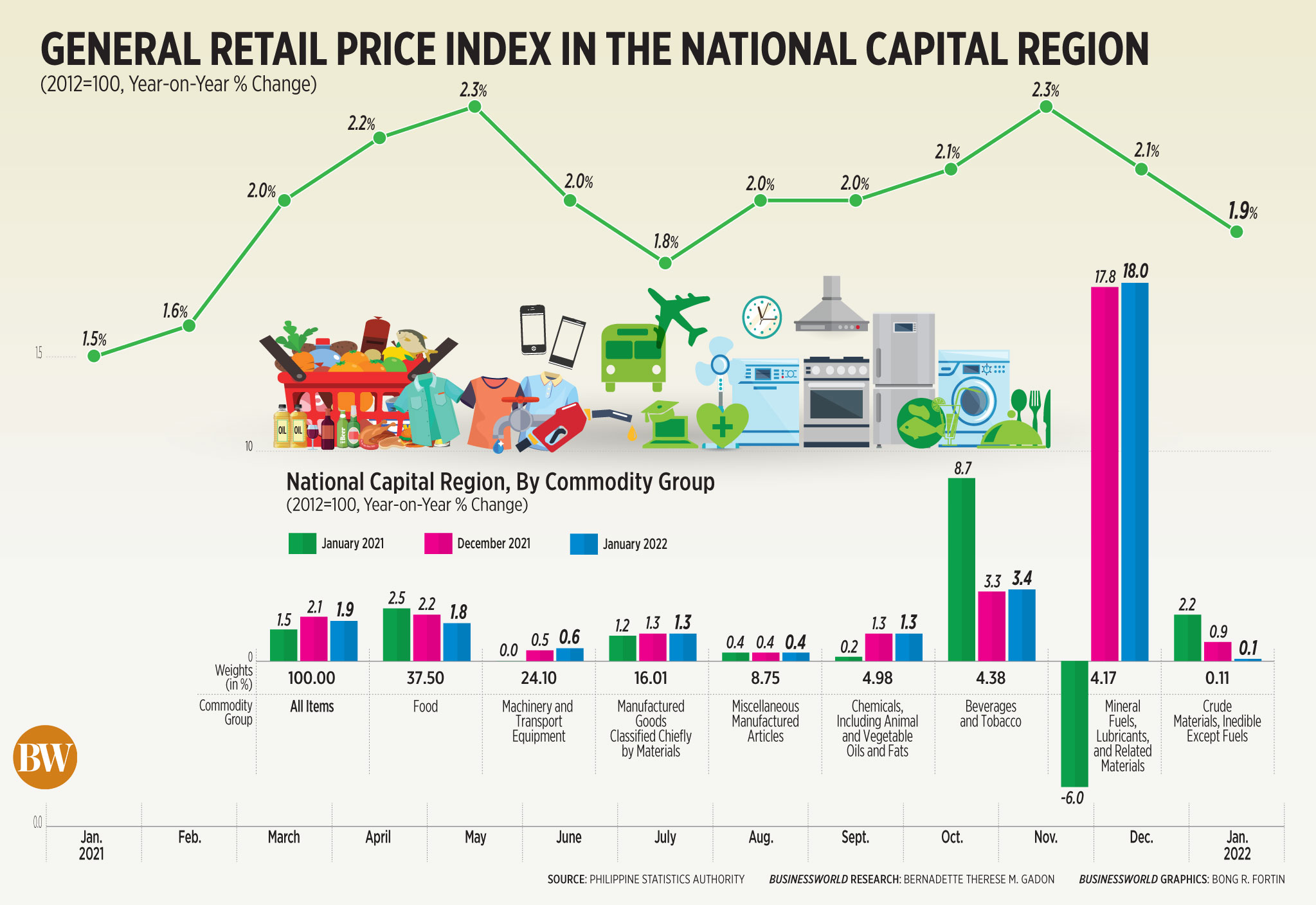
The National Capital Region’s (NCR) general retail price index (GRPI) grew by 1.9% year on year in January, slower than the 2.1% posted in December but quicker than the 1.5% in January 2021.

The January growth rate was the slowest in six months since the 1.8% expansion in July last year.

General retail price index in the National Capital Region

Rizal Commercial Banking Corp. Chief Economist Michael L. Ricafort attributed the slower growth in January to “seasonal slowdown” after the holidays.

January also saw lockdown restrictions tightened to curb an Omicron-driven surge in coronavirus cases.

The PSA reported declines in the prices of food and crude materials, inedible except fuels which dropped to 1.8% year on year (from 2.2% in December) and 0.1% (from 0.9%), respectively.

Other commodities where prices accelerated included beverages and tobacco (3.4% from 3.3%), mineral fuels, lubricants and related materials (18% from 17.8%), and machinery and transport equipment (0.6% from 0.5%).

Mr. Ricafort warned the GRPI could pick up in February and March as oil and commodity prices spiked after Russia invaded Ukraine on Feb. 24.

“Russia’s invasion/war with Ukraine that led to higher prices of oil/energy, grains/flour/other food items, metals, and other global commodities imported by the country, thereby could lead to pass-on/higher prices of other goods and services,” he said.

The weaker peso could also add to import costs and overall inflation, Mr. Ricafort said. — Ana Olivia A. Tirona

Co-led companies post first-quarter income growth

COMPANIES led by businessman Lucio L. Co reported strong profit growth in the first quarter, with his retail holding firm Cosco Capital, Inc. posting a 10.9% increase in consolidated net income to P2.7 billion.

In a disclosure on Monday, Cosco Capital said its consolidated revenues were up by 2.8% to P40.68 billion from P39.57 billion in the same period of 2021.

“The company continued to benefit by way of a better bottom line results from a combination of the gross margin enhancements thru stronger suppliers supports, sustained strategic cost and expense management as well as the income tax savings from the implementation of the CREATE Law,” it said, referring to Republic Act No. 11534, or Corporate Recovery and Tax Incentives for Enterprises Act.

The group’s grocery retailing businesses, Puregold Price Club, Inc. and S&R Membership Shopping Club, contributed 68% to the total core net income.

During the first quarter, the grocery retail segment’s net income grew 6.5% to P2.15 billion from improvements in gross profit margins and cost reduction measures.

Consolidated revenues also rose by 2.1% to P38.5 billion, driven by an increase in customer traffic.

“This was fueled by the company’s continuous organic expansion of grocery retail outlets, diligent cost management and sustained strong consumer demand,” Puregold said in a disclosure.

Consolidated net sales increased 2.1% to P38.51 billion. The group opened five new Puregold stores in the first quarter of 2022.

As of end-March, the group had a total of 504 grocery retail stores nationwide. These include 435 Puregold stores, 22 S&R membership shopping warehouses, and 47 S&R New York Style quick service restaurants.

Meanwhile, Cosco Capital’s liquor distribution business contributed 17% to the total profit of the group.

The Keepers Holdings, Inc. reported that its consolidated net income jumped 34.3% to P333.5 million, resulting from strong sales performance and cost control of its distribution, marketing and promotion expenses.

The company said consolidated revenues grew 23.3% to P2.17 billion on the back of a 17% growth in the volume of cases sold totaling more than 831,000 for the first quarter.

“This was driven principally by the continued robust performance of Alfonso, the leading imported brandy in the market, which has already surpassed its pre-pandemic levels despite some challenges brought by the continuing impact of the Covid-19 lockdowns experienced during the year,” The Keepers Holdings said in a disclosure.

Cosco Capital’s commercial real estate segment, which contributed 14% to total earnings, posted net income growth of 13.3% to P227 million for the period from P200 million in the same period in 2021.

The company said the increase was due to a combination of strategic cost efficiencies in the management of its cost of services as well as operating expenses.

“The real estate group continued to expand its real estate assets portfolio through acquisitions of additional land banking assets for future development and initiated the development of two commercial assets to be completed during the year,” Cosco added.

Lastly, the group’s specialty retailing segment, Office Warehouse, Inc., accounted for 1% of its total net income.

The Office Warehouse’s net income slightly dropped to P16 million from P18 million and revenues also decreased by 8% to P390 million amid lockdown restrictions.

At the stock exchange, Cosco Capital shares gained by 11 centavos or 2.37% to P4.75 on Monday. Puregold shares rose by P0.85 or 2.69% to finish at 32.50 apiece.

Shares in The Keepers Holdings slipped a centavo or 0.86% to P1.15 each. — Luisa Maria Jacinta C. Jocson

Megaworld records profit rise, sees sustained growth

PROPERTY developer Megaworld Corp. reported a 30% increase in net income attributable to parent company equity holders to P3.1 billion, calling it a “strong start” of an expected sustained performance.

In a disclosure on Monday, the listed company also reported an after-tax income of P3.5 billion, up 41% from a year ago. Consolidated revenues climbed 29% to P13.1 billion.

“This is definitely a strong start for us, and affirms that our improved performance can be sustained. While there was some concern last January due to the omicron variant, consumer confidence remained on the uptrend and our quick recovery showed that we are now in a better position to manage the pandemic and move forward,” Megaworld Chief Strategy Officer Kevin L. Tan said in a statement.

Of the company’s business segments, real estate sales recorded a 36% year-on-year growth to P8.1 billion as construction activities normalized. Reservation sales also increased by 12% to P23.2 billion.

Meanwhile, Megaworld Premier Offices registered P3 billion in rental income for the first three months of the year, up by around 16% from P2.6 billion.

Megaworld Lifestyle Malls’s rental income jumped 40% to P717.1 million on the back of improved foot traffic and the increase in retail locators that have restarted their operations.

The company’s hotel business, Megaworld Hotels & Resorts, posted a 50% growth in revenues to P502.9 million, driven by the uptick in leisure-related activities and expansion in domestic travel. Meetings, incentives, conferences, exhibitions, and similar activities have also started to pick up in the middle of the quarter, it noted.

“We are now focused on returning to our pre-pandemic performance and to grow beyond that. In fact, we are now looking at opportunities to further expand our geographical footprint in the country this year with the launch of several new townships,” Mr. Tan said.

To date, the company has 28 integrated urban townships, lifestyle communities, and lifestyle estates across the country.

Megaworld shares went up by 0.74% or two centavos to close at P2.72 at the stock exchange on Monday. — Luisa Maria Jacinta C. Jocson

Emperador hikes capex to P3B

EMPERADOR, Inc. said it is increasing its capital expenditure (capex) budget this year to P3 billion from P1.74 billion in 2021 as it further expands to international markets.

“Most of the capex budget will be spent outside the Philippines, bulk of which will be on the whisky business. We operate in an ever-changing, dynamic and highly competitive industry,” Emperador President Winston S. Co said on Monday.

“Strategic investments are key to ensuring that as a global company, we can adapt to evolving consumer preferences and demands. Not only this, but we are also able to deepen and strengthen our premiumization and internationalization efforts,” he added.

In 2021, the company reported that normalized net income was up 35% to P10.8 billion and normalized earnings to owners increased 34% to P10.6 billion.

“Emperador stayed the course as we continued to pursue the vision to grow the company achieving another banner year this 2021. I attribute this to the resilience of our company whose financial position allowed us to weather logistical challenges brought by Covid-19,” Emperador Director Kevin Andrew L. Tan said.

“We witnessed record breaking growth as our whisky and brandy sectors expanded their reach and introduced innovations,” he added.

Revenues were up 6% to P55.9 billion, of which 67% came from the brandy segment and 33% from the whisky business.

“Resilience appropriately describes Emperador’s financial performance against a backdrop of a pandemic,” Kenneth V. Nerecina, investor relations director, said.

Mr. Nerecina said that strong whisky sales, tamer growth in the brandy sector, and improved product mix and less promotional expenses contributed to the company’s financial performance.

Emperador said it is pursuing a “global strategy of premiumization and internationalization,” which includes adapting to consumer preferences and working on stronger distribution and availability across the globe.

At the stock exchange, Emperador shares rose by 0.10% or two centavos to finish at P19.64 apiece on Monday. — Luisa Maria Jacinta C. Jocson

Converge income rises 27% to nearly P2 billion on increased subscriber base

LISTED fiber internet provider Converge ICT Solutions, Inc. saw its first-quarter attributable net income increase by 27% to P1.97 billion from P1.55 billion in the same period a year earlier as a result of higher revenues from residential and enterprise subscribers.

The company’s revenues rose by 40% to P7.75 billion from P5.55 billion in the same period in 2021, its first-quarter report showed.

Revenues from the company’s residential business increased by 42% to P6.81 billion during the period from P4.80 billion previously, driven by a 52.5% year-on-year growth in its subscriber base. It ended the quarter with 1,802,202 residential subscribers.

Enterprise revenues increased by 25% to P935 million in the first three months of the year from P750 million in the same period in 2021.

According to the company, the increase was fueled by robust growth in the small and medium enterprise (SME) segment. Its SME customers rose by 200%, reaching 25,810 as of March 31.

Cost of services went up by 30% to P3.02 billion from P2.33 billion in the first quarter of 2021, resulting in a gross profit of P4.72 billion, which is 47% higher than the P3.22 billion gross profit reported in the same period the previous year.

“Converge has been able to maintain its strong balance sheet and cash flows with ample liquidity and gearing comfortably within bank covenants, as we drew down from available facilities to finance the significant network expansion done during the first quarter of the year,” the company said.

Its net debt position rose from P11.76 billion as of Dec. 2021 to P16.30 billion as of March 2022.

“The company availed of a total of P4.96 billion in new debt in 1Q2022 offset by repayments and amortizations amounting to P486 million,” it noted.

“The company’s debt service coverage ratio was 6.1x and the gross debt position as a percentage of total equity was 0.7x, well above the required financial covenants from its debt facilities.”

Its total undrawn debt facilities amounted to P26.5 billion as of March 31, 2022.

Last week, the company announced that it was added in the MSCI Global Standard Indexes, an international equity index which tracks stocks across 33 markets.

Converge said the latest additions will take effect on May 31 this year.

“Our inclusion in the global benchmark, the MSCI, is yet another testament to our strong market position. We’re pleased to have joined another index that will further broaden our exposure to international passive investors,” said Maria Grace Y. Uy, president, chief resource officer, and chief risk officer of the company.

Converge ICT shares closed 0.18% higher at P27.80 apiece on Monday. — Arjay L. Balinbin

First Gen income declines by 24% 

LOPEZ-LED First Gen Corp. posted a recurring net income of $59 million in the first quarter, down by 24.4% from $78 million in the previous year, as its natural gas and geothermal energy platforms recorded lower operating profit.

In a media release on Monday, First Gen President and Chief Operating Officer Francis Giles B. Puno said the company generated more power in the first quarter compared with the same period last year, but its Avion gas-fired power plant and a geothermal unit Energy Development Corp. (EDC) were hit by unscheduled shutdowns.

“In EDC’s case, it led to high replacement power costs as Typhoon Odette debilitated transmission capacity despite the plants’ ability to produce power. EDC was able to wheel out its power by mid-January. As for the rest of the natural gas fleet, it was plagued by gas interruptions at the Malampaya field. This resulted in the importation of expensive liquid fuel,” Mr. Puno said.

In peso terms, the power generation company’s net income was down to P3 billion from P3.8 billion previously, using a weighted average rate of $1 to P50.938 for the period ended in March this year and $1:P48.12 in end-March 2021, the company said.

During the quarter, consolidated revenues from the sale of electricity rose by 18% to 570 million from $483 million.

First Gen said the revenue growth came from higher electricity sales that was supplemented by elevated fuel prices and wholesale electricity spot market prices. The natural gas portfolio accounted for 62% of total consolidated revenues, while EDC’s geothermal, wind, and solar revenues contributed 33%. The hydro plants made up 4% of the total. 

Recurring earnings for the natural gas platform declined by 27% to $38 million. The 97-megawatt (MW) Avion power plant’s unit 1 was found to have incurred damage in December 2021, but was brought back to operations by February 2022 with a new turbine.

The 420-MW San Gabriel power plant recognized lower capacity fees due to its de-ration from gas supply restrictions.

“While all four natural gas fired plants benefited from greater electricity sales, higher fuel prices and operating expenses contributed to its lower earnings,” First Gen said.

Including non-recurring items, the gas platform’s attributable net income to parent decreased to $43 million from $57 million previously.

Mr. Puno said that to address the recurring gas issue, the importation of liquefied natural gas can happen by the fourth quarter of this year when First Gen’s LNG terminal operates.

Meanwhile, the EDC geothermal, wind, and solar platform suffered from outages, which was largely of Typhoon Odette. This led to transmission constraints and lower wind generation from Burgos wind farm.

EDC contributed both recurring and attributable earnings of $17 million, 38% lower than the previous year’s.

The hydro platform’s contribution doubled to $10 million from $5 million last year as the 132.8-MW Pantabangan-Masiway power plants generated higher operating income from its contract with Manila Electric Co. and merchant sales.

First Gen has 3,495 MW of installed capacity in its portfolio, which it said accounts for 19% of the country’s gross generation.

On Monday, shares in the company slipped by P0.55 or 2.66% to close at P20.10 each at the stock exchange. — Victor V. Saulon

2GO cuts net loss to P35 million as economy reopens 

LISTED transportation and logistics company 2GO Group, Inc. announced on Monday that it trimmed its net loss for the first quarter of the year to P35 million from a loss of P292 million previously.

The company attributed its improved financial performance to the reopening of the country’s economy.

Its revenues, both from shipping and non-shipping businesses, remained nearly P4 billion in the first three months of the year, the company’s first-quarter report showed.

However, the cost of services and goods sold went down by 9% to P3.66 billion from around P4 billion in the same period in 2021, resulting in a gross profit of P335.15 million from a loss of P4.89 million previously.

The company reported an operating income of P92.15 million versus an operating loss of P230.67 million reported in the first quarter of 2021.

“With the country’s economic reopening underway, shipping revenues rose 53%, as both sea freight and travel gained traction,” the company said in an e-mailed statement.

“Logistics and other services revenue grew 14%, boosted by the growth in cold chain reefers, e-commerce fulfillment and international courier services. In aggregate, 2GO Group delivered PHP3.9 billion in revenues for the first three months of 2022,” it added.

2GO Group President and Chief Executive Officer Frederic C. DyBuncio said the company mainly focused on profitable services and customers, while “driving efficiencies in its operations and stringently controlling costs.”

“We are encouraged by the country’s reopening as it opens opportunities for us to facilitate economic activity,” he added.

The company is modernizing its operations to improve customer experience and strengthen services.

“As the economy continues on its path towards recovery, 2GO looks forward to the return of travel and tourism. Our ships and port operations have been upgraded in preparation for this to provide passengers with an enhanced onboard and terminal experience. We are optimistic that our continued modernization efforts will further improve service standards and drive profitability,” Mr. DyBuncio said.

2GO Group shares closed 0.14% lower at P6.89 apiece on Monday. — Arjay L. Balinbin

Bubble Gang revamps, takes on new cast members

New director promises political satire will remain

THE LONGEST-running sketch comedy show in the country, Bubble Gang, has been revamped with new segments and new actors on May 27.


Bubble Gang premiered on GMA Network on Oct. 20, 1995 in a Friday night timeslot. The relaunched Bubble Gang has made cast changes, but actor, comedian, and recording artist Michael V. (a.k.a. Beethoven Del Valle Bunagan), who has been with the show since the very beginning, remains.

“The main goal is to entertain. And [of course], it’s a business. It has to make money, that means we have to sell to advertisers and the viewers. Given those parameters, we have to consider that the objective of the program is met by the talents,” Bang Arespacochaga, Assistant Vice-President at GMA, said in an online press conference on May 13.

Bubble Gang’s current director Frasco Mortiz — who came over to GMA after a stint in ABS-CBN where he worked on sketch comedy Goin’ Bulilit, among other shows — said that the show will “allow them [existing and new cast members] to shine” and give them “opportunities to do something new.”

Among the show’s cast members who were retained, aside from Michael V, are Paolo Contis, Chariz Solomon, Betong Sumaya, Sef Cadayona, Valeen Montenegro, Archie Alemania, Analyn Barro, Faye Lorenzo, and Kokoy de Santos.

Joining the show for its 27th year are actor and commercial model Kokoy de Santos (Gameboys), dramatic actress Faith da Silva, StarStruck Season 7 Ultimate Male Survivor Kim de Leon, dancer and YouTube personality Dasuri Choi, and comedienne Tuesday Vargas.

“We always want to discover new talents and give change to others,” Ms. Arespacochaga said.

“We [will] introduce new online personalities to do their material on the show, para hindi lang usual sketches or spoofs ’yung mapapanood nila (…so that viewers will not be limited to sketches or spoofs). May content na ang pinangagalingan ay from the personality (There will be content from the personality),” Mr. Mortiz said.

The show will also include more regular segments such as “Marites United,” where neighbors exchange gossip, and “Bes Friends” where Mr. De Santos and Mr. Cadayona play best friends who critique embarrassing posts on social media.

POLITICAL SATIRE REMAINS
Mr. Bunagan, the show’s creative director, also said that political satire will remain part of the show.

Hanga’t hindi binubusalan ang karapatan ng mga shows para mag-express, I’m pretty sure makakapanod kayo ng sketches, gags, and satire regarding the government (As long as the right to express is not muzzled, I’m pretty sure viewers can expect sketches, gags, and satire regarding the government),” Mr. Bunagan said.

With the changing behavior of viewers, the show’s old and new episodes are accessible to stream online. Bubble Gang’s full episodes are also on view on http://bit.ly/GMAFullEpisodes and GMA Network’s comedy content YouTube Channel YouLOL (You Laugh Online).

Nag-iiba lang yung pinangagalingan ng humor pero hindi nawawala ’yung need ng tao na maging masaya. ’Yung need din namin na magpatawa ay hindi mawawala (The source of humor may be different but the need for people to be happy is not lost. Also, our need to make people laugh will not go away),” Mr. Mortiz said of the show’s longevity.

“The objective of the show is to be funny, relevant, to be revolutionary, and evolutionary. As long as it meets those requirements, I believe the show will be here for a long time,” Mr. Bunagan said.

Bubble Gang airs on GMA on Fridays at 9:40 p.m. — Michelle Anne P. Soliman

Gilas Women open their golden quest with win over Indonesia

GILAS Pilipinas’ Afril Bernardino — SBP

HANOI — Banking on defense and a big third quarter surge, the Philippine women’s basketball team started its quest for a second Southeast Asian Games gold medal Monday with a 93-77 victory over Indonesia at the Thanh Tri Gymnasium here.

After a close first half, the Gilas women went on a 32-19 tear in the third and pulled away, going into the fourth with a 72-57 lead en route to the rousing win.

Using their quickness to the hilt, the Gilas Women collected 18 steals, drawing praise from coach Patrick Aquino.

“They played so hard. What can I ask for,” said Mr. Aquino. “That’s what we’ve been working on for the last couple of months. Hopefully, we can sustain that.

“I’m just happy that they were doing their best,” Mr. Aquino added.

Afril Bernardino led the squad with 16 points on top of nine rebounds and four steals.

She got a lot of support, with Janine Pontejos adding 15 points on seven-of-18 shooting from the field and Camille Clarin scoring 11.

Gabi Bade, one of the team’s two new recruits from the United States, had 11 points in her SEA Games debut. A daughter of former PBA player Cris, she is a mainstay of Sacramento State.

The other new player on the squad, Stefanie Berberade, a former Player of the Year in the National Association of Intercollegiate Athletics school Westmont, scored four points.

After a one-day break, the Philippines faces Thailand, the team it beat for the breakthrough gold medal in the 2019 Games, on Wednesday in the resumption of the women’s tournament that drew six teams.

The top squad after the round-robin play wins the gold.

The scores:

Philippines 93 – Bernardino 16, Pontejos 15, Clarin 11, Bade 11, Cabinbin 8, Guytingco 6, Surada 6, Castillo 5, Castro 5, Berberabe 4, Tongco 4, Fajardo 2.

Indonesia 77 – Claresta 19, Antonio 12, Pierre-Louis 11, Pratita 9, Callista 8, Elya Gradita 7, Sutijono 6, Lestari 3, Sophia 2, Anggraeni 0, Nanda Perdana 0.

Quarterscores: 17-17, 40-38, 72-57, 93-77.

Filinvest Land’s income slips to P678M

FILINVEST Land, Inc. reported a net income of P677.77 million attributable to equity holders in the first quarter, down 8% from a year ago, as gross revenues dipped while expenses increased.

In its quarterly financial report, the property developer said gross revenues during the quarter slipped by 0.5% to P4.14 billion while its gross expense rose by 0.7% to P2.76 billion.

Separately, Filinvest Land said in a media release that its residential revenues surged by 9% to P2.69 billion in the first quarter, driven by high reservation sales and continued construction progress.

“We are pleased with the continued growth of our residential revenues, and we expect to sustain this momentum as the economy, both here and abroad, continues to open,” said Filinvest Land President Tristaneil D. Las Marias on Monday.

Mr. Las Marias said overseas Filipino workers (OFW) “are starting to gain traction once again.”

“We plan to boost our international sales network further and improve our digital and online platforms to reach out to more OFW markets abroad,” he added.

He said Filinvest Land would continue speeding up construction completions while rolling out projects in emerging markets with large unserved housing demand.

“We anticipate an improvement in rental revenues going forward now that the traffic has improved in malls and rental concessions will be reduced,” he added.

Reservation sales in the first quarter increased by 28% to P4.39 billion, due to high sales to OFWs and strong demand for housing products in the Laguna, Cavite, Rizal, Bulacan, and Pampanga market areas.

The company has a planned bond issuance worth P8 billion with an oversubscription option of up to P3.9 billion. The funds generated from the proposed offering will be used to support its capital expenditures and service debt repayments.

Filinvest Land said it is aiming to expand its leasing business to reach 2.1 million square meters of gross leasable area by 2026 and is ready to launch P30 billion worth of residential projects.

“We are grateful for this development as we reach our growth targets for our leasing and residential businesses,” Filinvest Land Chief Executive Lourdes Josephine Gotianun-Yap said.

At the stock exchange, Filinvest Land shares remained unchanged at P1.00 on Monday. — Luisa Maria Jacinta C. Jocson

Swiss voters approve ‘Lex Netflix’ TV streaming funding law

ZURICH — Swiss voters on Sunday backed proposals to make global TV streaming services such as Netflix Inc., Amazon, and Disney invest some of their revenues generated in Switzerland into domestic film-making.

Just over 58% of voters backed the proposal, according to the final result, in one of three national votes held under the Swiss system of direct democracy.

Switzerland will become the latest European country to introduce such measures to support local TV and film production and boost locally produced content.

“This result underlines the cultural importance of film-making in Switzerland,” Swiss Interior Minister Alain Berset told a press conference on Sunday.

In the binding referendum on what is being called “Lex Netflix,” international streaming services must invest 4% of the revenue they make in Switzerland in local film production.

The investments can take the form of buying locally made shows, making programs themselves, or go into an investment fund.

Netflix said it respected the result and would work with the government implementing the regulation.

“We believe that good stories can come from anywhere, and we have already invested in content from Switzerland in the past,” a Netflix spokesperson said.

Amazon declined to comment and Disney did not respond to a request for comment.

A similar law has been passed in Portugal where streaming service providers have to pay 1% on their income to the Institute of Cinema and Audiovisuals.

Denmark is considering a levy and Spain is due to introduce one. France and Italy make streaming services invest a proportion of their revenues in European content in local languages. — Reuters

ADVERTISEMENT
ADVERTISEMENT