Home Blog Page 627

Yields on gov’t debt rise on profit taking
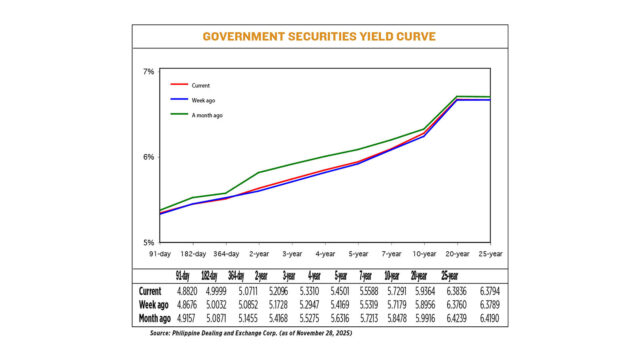
YIELDS on government securities (GS) ended mostly higher last week as market players repositioned before the month’s end amid domestic political concerns and with expectations of another rate cut from the Bangko Sentral ng Pilipinas (BSP) this month already priced in.

GS yields, which move opposite to prices, rose by an average of 1.73 basis points (bps) week on week, according to PHP Bloomberg Valuation Service Reference Rates data as of Nov. 28 published on the Philippine Dealing System’s website.

The short end of the curve was mixed, with the 91-day Treasury bill (T-bill) going up by 1.44 bps to 4.8820%, and the 182- and 364-day T-bills slipping by 0.33 bp (to 4.9999%) and 1.41 bps (5.0711%), respectively.

At the belly, yields climbed across the board. Rates of the two-, three-, four-, five, and seven-year Treasury bonds (T-bonds) climbed by 3.68 bps (to 5.2096%), 3.63 bps (5.3310%), 3.32 bps (5.4501%), 2.69 bps (5.5588%), and 1.12 bps (5.7291%), respectively.

Tenors at the long end likewise ended higher. Yields on the 10-, 20-, and 25-year T-bonds rose by 4.08 bps, 0.76 bp, and 0.05 bp to 5.9364%, 6.3836%, and 6.3794%, respectively.

Total GS volume traded went up to P91.27 billion last week from P62.52 billion recorded previously.

“Profit-taking was the theme this week as investors de-risk ahead of the Nov. 30 rally, which comes after confirmation by some parties that there as sides who are plotting a transition government,” a trader said in a text message.

The trader said expectations of further rate cuts from both the BSP and the US Federal Reserve are already mostly priced in.

Noel S. Reyes, Security Bank Corp. Trust Asset Management Group chief investment officer,  likewise said in a phone interview that market activity was mostly muted throughout the week, with players mostly reducing their risk positions amid domestic political concerns as the flood-control mess continues to unravel.

“There’s been a gradual steepening of the curve. The 10-year bond’s yield went up slightly, but overall, it’s still pretty much within the range that we’ve been seeing,” he added.

He said US Treasury yield movements also partly affected the GS market. “But since it was also in a range for the past week, it’s not as relevant as an influence in terms of peso government securities yield movements.”

The market is already looking ahead to the Monetary Board’s Dec. 11 meeting, Mr. Reyes added.

“Inflation is manageable for us and the GDP (gross domestic product) was very soft for the third quarter, which now means the BSP will likely need to act more than what is necessary,” he said.

“I think originally, they were still contemplating on whether 25 bps was certain for December. I think because of recent events, that has become a larger possibility.”

BSP Governor Eli M. Remolona, Jr. earlier said they could deliver a fifth straight 25-bp cut at this month’s policy review to help provide economic support following the weak growth seen last quarter as a corruption scandal involving government infrastructure projects has dampened consumer and investor confidence.

The central bank has lowered borrowing costs by a total of 175 bps since it began its easing cycle in August 2024, with the policy rate now at an over three-year low of 4.75%.

Philippine GDP grew by 4% in the third quarter, the slowest in over four years. This brought the nine-month average to 5%, below the government’s 5.5-6.5% GDP growth target for the year.

Thousands of protesters in the Philippines, including Roman Catholic clergy and civil society groups, on Sunday gathered in the capital for another rally triggered by a government corruption scandal, Bloomberg reported.

Manila police estimated about 3,000 demonstrators assembled at a major public park in Manila. Some shouted chants calling for the jailing of corrupt officials, while ranking Church officials in the predominantly Roman Catholic nation separately held Mass at a site where a public uprising erupted nearly four decades ago.

“Let us unite in repentance for corruption in our society,” said Cardinal Pablo Virgilio David, president of the Catholic Bishops’ Conference of the Philippines. “We need a moral and spiritual reset if we want a brighter future for the Philippines.”

For this week, Mr. Reyes said GS yields could be range-bound before the Monetary Board’s policy meeting next week.

“Unless there is a significant risk that occurs on Sunday… if it becomes violent, then there could be some sell-off on that day. It’s really more the event on Sunday and anticipation of BSP action,” he added.

“Fundamentally, we think that yields will eventually move lower to reflect the rate cut,” the bond trader said. — Matthew Miguel L. Castillo

Airlines finish Airbus software update

PHILIPPINE STAR/EDD GUMBAN

LOCAL AIRLINES have finished updating the software on their Airbus aircraft after an urgent advisory from the manufacturer prompted carriers to ground several planes.

“Cebu Pacific is pleased to inform its passengers that it has successfully completed the mandatory software update across the affected Airbus A320/A321 aircraft, and normal operations have been restored,” the airline said in a statement on Sunday.

On Saturday, the Transportation department said 75 aircraft operated by Philippine Airlines (PAL), Cebu Pacific and AirAsia Philippines were affected by the required update.

Airbus issued the directive after a technical advisory flagged a potential safety risk across its A320 family — the A318, A319, A320 and A321 models — following a reported malfunction in October.

“Analysis of a recent event involving an A320 Family aircraft has revealed that intense solar radiation may corrupt data critical to the functioning of flight controls,” Airbus said on its website. A “significant number” of A320 Family aircraft in service might be affected, it added.

PAL said all aircraft scheduled for commercial flights that were covered by the mandatory update have completed the upgrade.

“Our technical and engineering teams worked swiftly and meticulously to ensure full compliance within the prescribed timeframe, prioritizing the highest standards of safety and reliability,” it said in a separate statement.

AirAsia Philippines Chief Executive Officer Suresh Bangah said the airline moved quickly to meet Airbus’ requirements. “We want to assure our guests that safety is, and will always be, our top priority,” he said in a statement on Saturday.

The Transportation department said 93 flights were affected by the issue — 82 were canceled and 11 delayed — affecting at least 14,000 passengers. Airlines are offering flexible options, including free rebooking and conversion to travel credits.

“Regardless of how small the glitch might be, when it comes to aviation, it will always have a considerable impact on passenger perception and confidence,” Nigel Paul C. Villarete, senior adviser on public-private partnerships at Libra Konsult, said via Viber.

Air travel continues to recover. Passenger volume reached 46.84 million in the nine months through September, up 6.25% from a year earlier, driven by domestic traffic, the Civil Aeronautics Board reported.

Mr. Villarete said the software update should help strengthen public confidence by ensuring a safer, more reliable avionics system. “We just need to go through the reaction and learning curve as we grapple with passengers’ trust and confidence in our systems,” he said. — Ashley Erika O. Jose

Uniqlo gives for the holidays

UNIQLO has given thousands of clothes to disaster relief efforts for the recent calamities that have struck the Philippines, as well as to farming communities.

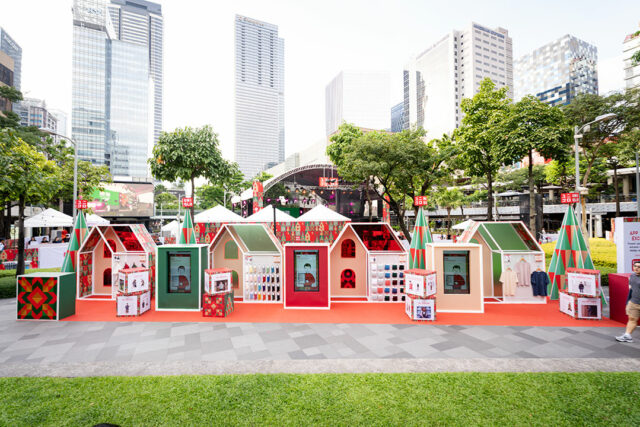
“Considering that the Philippines has a warm, tropical climate, we have started distributing AIRism,” said Geraldine Sia, chief operating officer of Uniqlo Philippines, in an interview with BusinessWorld during Uniqlo’s Holiday Celebration on Nov. 13 at the BGC Amphitheater. The celebration featured a Christmas tree lighting, and acts like Jose Mari Chan and KZ Tandingan.

The clothing drive is part of a global initiative called The Heart of LifeWear, which sees thousands of clothes donated to refugees. “We have distributed around 31,000 all over the Philippines,” she added.

“We usually reach out to the communities which we think are in need,” she said. “We also partner with some of our benefactors — they know which communities really need it the most.” These benefactors include The SM Foundation and SOS Children’s Villages.

Part of these giving efforts also centers around sustainability: this season, they’re bringing out the ReUniqlo boxes, where clothes of any brand, dropped into these boxes by customers, will be donated. “They’ll be the ones able to contribute and donate to these villages nationwide,” she said. “Our mission is really to change lives by the power of clothing.”

“We will continue to do this as much as possible,” she added. — JLG

Northern exposure

PHOTO BY PABLO SALAPANTAN

Kia’s diverse lineup shines in drive to Pagudpud

By Pablo Salapantan

WHEN YOU think about how Kia has survived the onslaught of challenges in the Philippine automotive scene, you have to give them credit.

In this day and age, consumers are spoiled for choice at every price point, feature package, and even powertrain type. It is an “adapt or die” industry, and Kia has just reminded us how its range of model choices is keeping it alive and kicking.

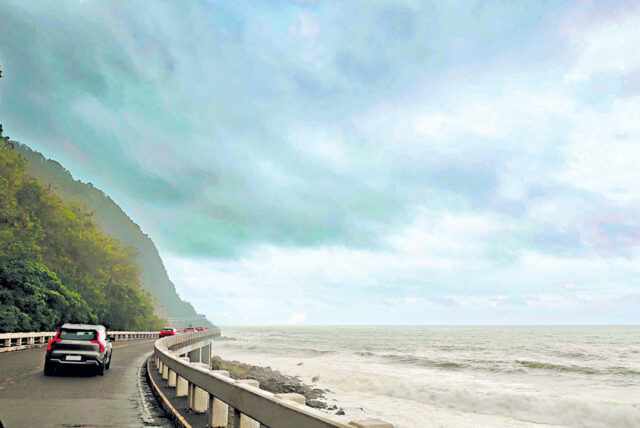
We go on a lot of media drives. I’d say we’ve covered most of Luzon at this point, but very few (almost none) have ever taken us to the “tippy top” of the island, which is why I was quite surprised when Kia Philippines said we’d be going from Manila all the way to Pagudpud — the so-called “Boracay of the North.”

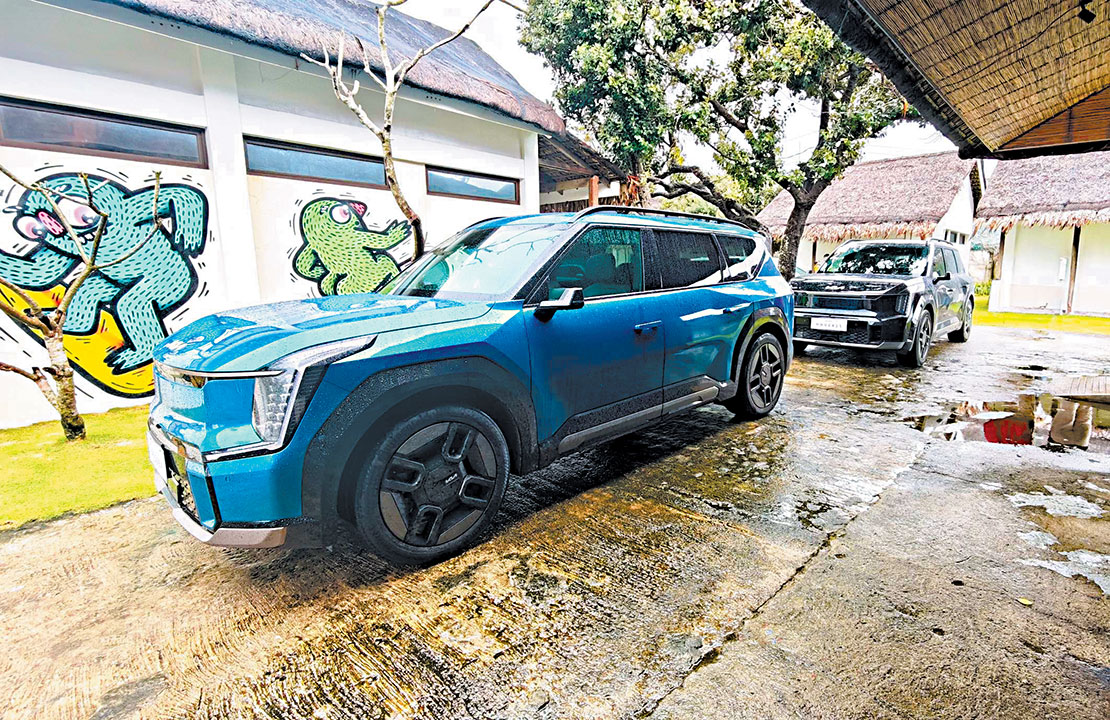
Another differentiator for this drive is that, instead of just focusing on a single model, we got behind the wheel of four models representing various price points, sizes, and even propulsion types. We were given the Sonet, Sorento, Carnival, and EV9 to play with over hundreds of kilometers through most stunning scenery.

EDGE OF LUZON
Our trip started early. After the customary meetup and drive briefing, we departed Metro Manila for an overnight stop in La Union. The first car I was assigned to is one of my favorite cars at the moment, the Sonet.

Since its launch, the Sonet has become the darling of Kia. It is, in my opinion, one of the best value vehicles out there. Kia has packaged the Sonet so well in terms of pricing, capability, and features. Driving the Sonet feels solid, despite the budget price and the small proportions. It is surefooted through almost all driving conditions. On the highway, it remains planted, smooth-driving, and even comfortable. On provincial roads, it has enough presence to earn respect, and proved it also has the “oomph” to easily keep up with the faster vehicles in the convoy.

After a hearty lunch at the end of the Tarlac-Pangasinan-La Union Expressway (TPLEX), we moved up to the bigger Sorento Hybrid for the final stretch to Awesome Hotel in La Union. I had already driven the Sorento to Baguio where we even did some moderate off-roading, so I was already familiar with what it can do. It’s just refreshing to be reminded of just how good the Sorento is overall: The smoothness, the frugality of the hybrid powertrain, and just the model as a whole ticks all the right boxes for the segment. My favorite thing about the Sorento has to be its design. It’s probably one of the best-looking crossovers in its segment.

Day Two of the drive was a “slog” between two drivers over a six-hour drive from La Union to our final stop in Pagudpud. On this leg of the journey, I drove the Carnival Hybrid and the new flagship model of the brand, the EV9.

I consider the Kia Carnival as one of the underrated models in the segment. Its past few generations have provided a complete minivan or luxury van experience without breaking the bank. The current model takes things further by providing not just an excellent passenger experience, but an engaging drive as well. Kia likes to point out that the Carnival is no longer a “minivan” per se, but may be considered an SUV. It honestly does feel good to drive. There’s no sense of heft and size that most van bodies have.

I honestly would be hard-pressed to choose between the Carnival and the Sorento if I were on the lookout for space and practicality. That’s how good the Carnival is; it blurs the SUV/minivan divide.

NOT JUST ANOTHER EV
Toward the latter part of the journey, we finally got our hands on the EV9. Now, to be honest, I wasn’t expecting to be wowed. At this point, I’ve driven all kinds of EVs already, and was expecting to chalk up the EV9 as another one in a long line.

Boy, was I wrong. The EV9 is impressive in all aspects. It’s probably one of the most advanced and technologically sound EVs sold locally. It has all the creature comforts anyone can think of, but the highlight would be the lounge-type seats, which boast optimal support with extreme comfort. It was also surprising when it came to driving. Despite the size and weight, it easily carved up the beautiful coastal roads and technical mountain passes. The EV9 was stable and capable all throughout.

It’s so easy for car brands to fall into the trap of trying to keep up with all industry trends. We’ve seen how it can ruin and harm. Kia has chosen to cherry-pick what it thinks the market needs and wants, and has applied it to a very diverse but well-thought-out lineup. There are no weird outliers in the lineup. Look through the offerings; each model fits a specific need and purpose.

There have been a lot of ups and downs throughout Kia’s (long) history, but today it boasts a great product lineup — which is not something that can be said for most of the competition.

YGG Play Summit 2025 elevates Web3 creators, emphasizes digital upskilling

By Jomarc Angelo M. Corpuz, Special Features and Content Writer

The Yield Guild Games (YGG) Play Summit 2025 drew more than 5,600 local and international in-person attendees from Nov. 19-22 to the SMX Convention Center at SM Aura in Bonifacio Global City, Taguig.

This year’s “City of Play” theme was a celebration of the trailblazing content creators whose impact and influence are moving Web3 gaming from niche to mainstream. To achieve this, the YGG Play Summit provided a platform for rising Web3 content creators to network with potential new partners and improve their business acumen through interactive sessions, while refining their craft in front of a global audience.

“We’ve seen very talented people come [into our community], who started as volunteers and scholars, and now they’re project founders leading companies, now they’re e-sports players and top creators,” said Gabby Dizon, co-founder of YGG.

“This kind of opportunity is the reason why YGG exists, and this is why we do what we do. We’d like people to remember the experiences and the opportunities here, so we’d have something to look forward to again next year,” he added.

To kick off the YGG Play Summit, a live recording of LOL Lounge, YGG Play’s podcast on the business of Web3 game publishing, delved into strategies for building successful, sustainable careers in content creation.

The special episode featured GamingGrid Co-Founder YellowPanther and Gaming Daily Founder Iceyyy, two leading content creators and ambassadors for YGG Play who built their brands throughout the pandemic, in conversation with YGG Co-Founder Gabby Dizon and host Leah Callon-Butler of Emfarsis.

They explored what makes brand-creator partnerships work in Web3, underscoring that long-term success comes from authentic alignment over short-term profit, real enthusiasm for the games they review, and a commitment to a more professional approach.

The summit placed equal emphasis on upskilling through their initiative, Metaversity Interactive, recognizing that creators, students, and builders all need access to practical education to thrive in an industry defined by rapid technological change.

The program brought together industry, government, and academic leaders to work with students to identify in-demand Web3 and AI skills, and assess candidate readiness. Insights gathered from the forum will inform future Metaversity programs to meet real-world market needs.

“We took gaming beyond just games to learning skills as we were playing together. We started to learn together and saw how gaming can be a point of entry for Filipino talent. Today, it has become a pathway, really, into digital careers, creative industries, and global economic participation,” YGG Pilipinas Country Head Mench Dizon said during the third day of the summit.

The session was attended by more than 50 participants, including representatives from YGG, YGG Pilipinas, Mysten Labs, Earnscape, The9Bit, CCP Games, Gunzilla Games, OP Games, Coins.ph, and the DICT, as well as graduates of the Sui Builder Program.

The GAM3 Awards by GAM3S.GG brought its in-person ceremony back to Manila for a second year in a row as well. The awards body honors the best in Web3 gaming with one of the most prestigious titles awarded being Creator of the Year, previously won by YellowPanther (2024), Sam Steffanina (2023), and Brycent (2022).

This year, it went to Cagyjan, co-founder of the Silly Kitties IP and one of the earliest content creators in Web3, starting with Axie Infinity in 2020.


SparkUp is BusinessWorld’s multimedia brand created to inform, inspire, and empower the Philippine startups; micro, small and medium enterprises (MSMEs); and future business leaders. This section will be published every other Monday. For pitches and releases about startups, e-mail to bmbeltran@bworldonline.com (cc: abconoza@bworldonline.com). Materials sent become BW property.

DMW says Benilde campus to boost Aseana City growth

FACEBOOK.COM/DLSCSB.OFFICIAL

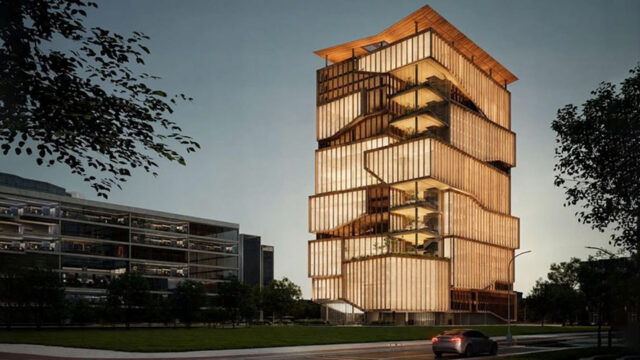
D.M. WENCESLAO and Associates, Inc. (DMW) expects the planned De La Salle-College of Saint Benilde campus in Aseana City to bolster the growth of its 107.5-hectare mixed-use estate in Parañaque.

“At the end of the day, we want to build a holistic development,” DMW Chief Executive Officer Delfin Angelo “Buds” C. Wenceslao told reporters last week. “That’s why having an educational institution in Aseana City was a no-brainer for us.”

He said the Light Rail Transit Line 1 extension — particularly the Redemptorist-Aseana station — would further improve access to the estate. DMW also expects to work with the campus on improving the district’s built environment.

Aseana City, located along Diokno and Macapagal boulevards, follows a “15-minute city model” with residential, retail and office developments including Pixel Residences, Parqal mall and the upcoming Aseana Plaza.

The La Salle Benilde campus will rise on a 3,845-square-meter lot and is targeted for completion by 2027. The school has yet to announce the contractor for the project.

Benilde Vice-President for Administration Michael Luis Fernando D. Tecson III said the school needs additional space due to rising enrollment. Some popular programs — such as architecture and multimedia arts — have already capped admissions because of classroom shortages.

“So we turn away students even if we don’t want to,” he said.

The forthcoming campus is expected to serve about 5,000 students across architecture, interior and industrial design, fashion design, cybersecurity, game design, information systems, and business administration.

It will include multi-tiered lecture halls, classrooms, labs, workshops, sewing and weaving rooms, and a theater. — Beatriz Marie D. Cruz

Outrage in the city

DEMONSTRATORS in Cairo’s Tahrir Square on Feb. 8, 2011. — EN.WIKIPEDIA.ORG

The symbolic American “street” — the National Mall in Washington, DC, flanked by the Smithsonian Institution museums on the longitudinal sides and on opposite ends, by the Washington Monument and the US Congress building — has literally embodied mass protest in 20th century America.

From even before the 1963 Civil Rights Movement protests (the occasion for Martin Luther King’s “I have a dream” address) to the war protests against the 1970’s American military action in Vietnam and Cambodia, to the demands for women’s and gay rights, the National Mall’s kilometer long stretch emerged as hallowed ground.

“America’s Civic Stage” for contesting the status quo — for proposing alternative, libertarian narratives and action — was the end point of the “The Longest Walk” from Alcatraz in San Francisco, to bring attention to the rights of Native Americans.

Paris’ Place de la République is its “street” for both mass protest and collective mourning. Actually a 3.4-hectare square (the intersection of several arrondissements), the space saw 1.6 million people congregate around its Monument à la République in 2016, in collective outrage over the terrorist attacks on their city.

This biggest demonstration in French history is only one of the habitual uses of this special place, towered over by the 1883 Monument à la République — reverentially called the Marianne, a symbol of France. Marianne holds a representation of the Déclaration des droits de l’Homme et du citoyen de 1789 (the Declaration of Rights of Man and of the Citizen).

The 23-meter-high monument of Marianne was installed to celebrate the 90th anniversary of the French Revolution. It calls to mind the rootedness of modern democracy — including the United States liberal version, called Jeffersonian democracy after its paradoxically slave-owning writer — in the universality of the principle of human rights. Hence in the 18th century French Revolution.

OLD SQUARES, RENEWED MEANINGS
Of more recent vintage as a site of protest is the rather old Tahrir Square of Cairo. This space was already symbolic before the 2011 eruption of the Arab Spring in North Africa. “Tahrir” is liberation in Egyptian. It was the name given this round-rather-than-square intersection point in the Cairo downtown area, which was originally called Ismailia Square after Khediv Ismailia, the Egyptian founding father.

Marking pivotal moments — the Egyptian Revolution of 1919 and that of 1953, which changed Egypt from a constitutional monarchy to a republic — the Tahrir name stuck. Major protests gravitated towards it: the 1977 Bread Riots, for example, and the 2003 protests against the war in Iraq.

And in 2011–2013, it was to be the focal point of enormous protests against the inability of President Hosni Mubarak to deliver the promise of democracy; and subsequently, a counter-revolution against President Mohamad Morsi (who was killed, following passions against the super-conservative Muslim Brotherhood), leading to the ascendance of the present leader, Abdul Fatah al-Sisi.

Tahrir Square, an old space imbued with new political purging/renewal meanings, is curiously analogous to a rather small space in a nearby country — Spain. It is the space of performance for the flamenco.

Written for the site 1Win-ES.pro this year: “Flamenco was born in the courtyards, caves and streets of southern Spain, forged in the oppression of the Gitanos (Roma), the anguish of Sephardic Jews and the sorrow of displaced Moors. It was — and remains — the soundtrack of exile.” Born in pain, its performance is always an act of resistance.

There are myriad flamenco performance spaces in Spain’s cities, particularly in Andaluz. For centuries, the extraordinary dance/song form voiced resistance to the Spanish status quo, even during the dictatorship of Generalissimo Franco, who sought to co-opt this form of the marginalized by gentrifying it and remaking it as a tourism come-on.

But this recent BBC News report intrigues “…the flashmob group Flo6x8 has rebranded flamenco as a powerful political weapon. This anti-capitalist group has been well publicized for its political performances that have taken place in banks and even the Andalusian Parliament. Using the body and voice as political tools, the group carries out carefully choreographed acciones (actions) in front of bemused bank staff and customers. These performances are recorded and then posted online, attracting a huge number of views.”

HECTARAGE FOR MILLIONS
The Philippines’ National Capital Region has two spaces for venting collective outrage, also driven by the aspiration for sociopolitical reform. One of these spaces is the 58-hectare Luneta Park, which is just outside Fort Santiago, the Spanish soldiers’ barracks, at the mouth of the Pasig River facing Manila Bay. The space is at least half a millennium old.

The park called Bagumbayan (New Town) until the late 19th century is invested with powerful cultural energy from having been the place of execution of Jose Rizal. Reconstrued as a lunette-shaped space in the early 20th century urban plan of the American Daniel Burnham, it became Manila’s official ceremonial space: presidential inaugurations, Independence Day parades and the like are regularly staged here.

So, too, are rallies planned to bring in millions of people. The scale of Luneta accommodates this many Filipinos wanting public venting of collective fury. But so can a narrower space, the EDSA People Power site at the corner of Ortigas Avenue. The place where millions demanded the ouster of the authoritarian Ferdinand E. Marcos has been made narrow by an overpass.

On Nov. 30, both sites will have received millions of Filipinos, ideologically divided according to site, but commonly enraged by the nearly unthinkable scale of corruption in government. Manila’s protest spaces are much bigger now than the pre-WW2 Plaza Miranda fronting the Church of Quiapo, which was the reference for the confronting question asked of would-be political advocates: can you defend it in Plaza Miranda?

It’s a reminder that cities that allow alternative flows of history can manage to give democracy a chance. Chances, really. Democracy’s promise is nearly always clipped, sometimes in the bud. But so long as there is that hallowed ground, hallowed ideals might survive.

Alternatively, see what happened after the events of June 4, 1989, at Tiananmen Square — a complete erasure.


Marian Pastor Roces is an independent curator and critic of institutions. Her body of work addresses the intersection of culture and politics.

PHL fresh fruit imports seen rising 25% this year – USDA

PIXABAY

FRESH FRUIT shipments to the Philippines are expected to climb by 25% this year even as the United States’ exports to the country are likely to decline, according to the US Department of Agriculture (USDA).

The USDA said in a Nov. 25 report that global exports of fresh fruit to the Philippines are projected to increase by 25% after growing by 3% year on year to $321 million in 2024.

“Fresh fruit shipments to the Philippines have shown strong growth in 2025, increasing by 20% through August,” it said.

“The overall demand for imported agricultural and related products is driven by a young and growing population, rising incomes, and the Philippines’ reliance on imports to meet domestic food needs.”

It said the country’s population could reach 164 million by year-end and is expected to grow by more than 1 million annually, which would help drive demand for food products.

Despite this, fresh fruit exports from the US to the Philippines declined 10% to less than $14 million in 2024 and are expected to decrease by at least 7% this year. Over the past decade, US exports to the Philippines declined by 73%.

Fruits from the US made up only 3% of the Philippines’ total fresh fruit imports in 2024, the report showed, with products including apples, cherries, grapes, oranges, strawberries, cranberries, blueberries and peaches.

“Exports of apples, grapes, oranges, and plums experienced significant decreases, while sweet cherries, strawberries, nectarines and peaches, and blueberries and cranberries showed remarkable growth,” the USDA said.

Even as overall fruit exports are expected to drop this year, US traders see increased apple shipments, it said. “This increase is expected to be driven by the popularity of the Ambrosia, Cosmic Crisp and SugarBee varieties, which were introduced in 2024 and have gained traction among Philippine consumers.”

“The United States is widely recognized for consistently supplying premium-quality fruit, and US exporters are encouraged to leverage this reputation through strong US branding and the introduction of innovative fresh fruit varieties to the Philippine market,” it added.

“The Philippines grows a wide variety of fruits. Only bananas and papayas are harvested year-round, while the rest are seasonal. This presents an opportunity for US exporters to fill gaps in the market throughout the year.”

Meanwhile, data showed that China was the main source of the Philippines’ fresh fruit imports in 2024, accounting for 72% of shipments. Fruits imported included apples, grapes, mandarins, pears, lemons and limes, oranges and other citrus hybrids.

South Africa and Australia accounted for 9% and 8% of the market, respectively, exporting fruits like mandarins, grapes and oranges. — Vonn Andrei E. Villamiel

Peso may remain at P58:$1 level on improving sentiment

BW FILE PHOTO

THE PESO is seen holding within the P58-per-dollar level this week on improved market sentiment after S&P Global Ratings last week affirmed the Philippines’ credit rating.

The local unit closed at P58.645 per dollar on Friday, 11.5 centavos stronger than its P58.76 finish on Thursday, Bankers Association of the Philippines data posted on its website showed. Week on week, the peso climbed by 21 centavos from its P58.855 close on Nov. 21.

“The US dollar-peso exchange rate again slightly improved… as market sentiment largely boosted by the S&P’s latest affirmation on the Philippine credit ratings and positive outlook shows that the country’s economic and credit fundamentals remain intact despite geopolitical risks, Trump factor, local political noises recently,” Rizal Commercial Banking Corp. Chief Economist Michael L. Ricafort said in a Viber message.

S&P Global Ratings last week affirmed the country’s long-term “BBB+” and short-term “A-2” investment grade credit ratings with a “positive” outlook as it sees long-term growth recovery despite the impact of the corruption scandal on the Philippine economy.

Meanwhile, Jonathan L. Ravelas, a senior adviser at Reyes Tacandong & Co., said in a Viber message that prospects of a US Federal Reserve rate cut weighed on the dollar last week, which propped up the peso.

For this week, analysts see the local unit moving sideways before the release of key economic data, including the November inflation report and data on manufacturing activity.

Mr. Ricafort said the peso might trade between P58.40 and P58.90 against the dollar this week, while Mr. Ravelas expects it to move between P58.60 and P58.90 versus the greenback. — K.K. Chan

Armani names new board to steer company through succession plan

ITALIAN luxury group Armani said on Friday it had appointed a new eight-member board, keeping three seats for representatives of the family and bringing in veteran industry executives Marco Bizzarri and John Hooks, and Milanese businessman Angelo Moratti. The enlarged board will steer the fashion house as its owners prepare to sell a 15% stake following the death of founder Giorgio Armani in September, at a time when the broader luxury industry faces strong headwinds.

The previous, seven-strong board included more family members: Mr. Armani’s sister Rosanna, nieces Silvana and Roberta, and nephew Andrea Camerana along with Mr. Armani’s long-time partner Pantaleo Dell’Orco.

The current board is chaired, as the previous one, by Mr. Dell’Orco. The other two seats for family members are occupied by Silvana Armani and Mr. Camerana.

Armani confirmed Federico Marchetti, founder of e-retailer Yoox, in the role of director. Another seat is occupied by Armani’s former deputy managing director Giuseppe Marsocci who joined the board last month when he was named chief executive of the group. Mr. Armani’s will instructed heirs to gradually sell the fashion house he created 50 years ago or seek a market listing, starting with a 15% stake within 18 months. It gives priority to luxury conglomerate LVMH, beauty group L’Oréal, eyewear maker EssilorLuxottica, or another group of “equal standing.”

The group reiterated that the Giorgio Armani Foundation will retain a stake of no less than 30% in the company’s capital, regardless of potential future developments such as the arrival of new shareholders or a public listing. — Reuters

Honda Foundation extends aid to Typhoon Tino survivors

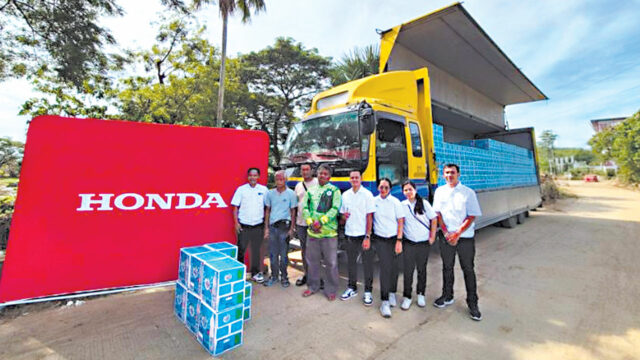
Honda Foundation donates much-needed water to typhoon-affected families in Liloan, Cebu. — PHOTO FROM HONDA FOUNDATION, INC.

LATE LAST month, associates from the Cebu office of Honda Philippines, Inc. (HPI) representing Honda Foundation, Inc. (HFI) visited affected families in Barangay Cotcot, Liloan, Cebu. This is where 35 individuals unfortunately passed away and entire communities were submerged in floods. HFI donated a total of 20,160 1.5-liter bottles of drinking water to 1,680 families. Local residents and officials, headed by the Barangay Captain Martin Yungco, directly received the packages from HFI.

HFI and Honda Cars Philippines, Inc. (HCPI) President Rie Miyake said, “We at Honda are so saddened to hear that our fellow Filipinos in Cebu have been hit with another tragic calamity. We would like to reach out and offer our sympathies to all affected and sincerely hope that they are finally able to recover soon.”

Members of HFI include HPI, HCPI, Honda Parts Manufacturing, Corp. (HPMC), and Honda Trading Philippines Ecozone Corp. (HTPE). To learn more about HFI, contact (02) 8581-6700 to 6799 and 0917-578-8723.

MGEN, ACWA to develop 125-MW solar farm in Iloilo

MERALCO POWERGEN CORP.

MERALCO POWERGEN Corp. (MGEN) and Saudi Arabia-based ACWA Power are moving forward with a planned 125-megawatt (MW) solar project in Concepcion, Iloilo in central Philippines, marking the first venture under their partnership.

“We are looking at a land (parcel) in Concepcion, Iloilo,” MGEN President and Chief Executive Officer Emmanuel V. Rubio told reporters last week. “That’s our first project with them.”

He said the project would rise on a 120-hectare site and would serve as the companies’ initial joint renewable energy development after a strategic agreement signed in mid-2025.

The deal covers collaboration on solar projects in the Philippines and the wider Southeast Asian region.

To secure offtake for the plant’s output once operational, MGEN is considering joining the government’s green energy auction, which awards long-term supply contracts through competitive bidding.

ACWA Power, a major global developer and operator of renewable energy and green hydrogen projects, is expected to contribute its experience and long-standing ties with leading engineering and construction companies.

The company has a portfolio of 78.8 gigawatts of capacity worldwide, including projects known for record-low solar tariffs.

“The value that ACWA will bring is their experience and their relationship with established EPCs (engineering, procurement, construction),” Mr. Rubio said. “Hopefully, they can make this project very competitive.”

MGEN, the power generation arm of Manila Electric Co. (Meralco), has more than 5,068 MW of net sellable capacity across conventional and renewable energy assets.

Meralco’s parent company, Beacon Electric Asset Holdings, Inc., is partly owned by PLDT Inc. Hastings Holdings, Inc., under the PLDT Beneficial Trust Fund’s MediaQuest Holdings, Inc., has an interest in BusinessWorld through the Philippine Star Group. — Sheldeen Joy Talavera

ADVERTISEMENT
ADVERTISEMENT