Home Blog Page 6256

Netflix plans Squid Game reality show with big cash prize, no fatal consequences

Lee Jung-jae in a scene from the film Squid Game (2021)

NETFLIX, Inc.’s most-watched series is no longer just a fictitious television show after the streaming service greenlit “its biggest reality competition ever” called Squid Game: The Challenge.

Unlike the series where the stakes are life or death, the worst possible fate in this 456-player competition will be leaving without the $4.56-million winnings, which Netflix claims is the largest lump sum prize in reality TV history.

Squid Game became Netflix’s most-watched series when it was released in September 2021 as it told the story of cash-strapped contestants who play childhood games for a chance to win life-changing sums of money.

The first season holds the record as Netflix’s most popular series of all time, with over 1.65 billion hours viewed in its first 28 days, the company said.

The 10-episode reality competition will include games inspired by the original show, as well as new additions, Netflix said.

One of YouTube’s top US creators, MrBeast, did an unofficial iteration of this idea by recreating aspects of the South Korean drama’s set and hosting games featured in the show, like “Red Light, Green Light.” The YouTuber also opted out of the killing aspect but strapped a device to all 456 players that mimicked a bullet shot when a player was ruled out.

Netflix’s reality show will be filmed in the UK and is currently only casting English speakers. The announcement comes just days after the scripted series was renewed for a second season. — Reuters

COVID-19-related insurance payouts reach P2.93 billion in the first quarter

INSURANCE CLAIMS related to coronavirus disease 2019 (COVID-19) paid out by the industry reached P2.93 billion in the first quarter, based on a study conducted by the Insurance Commission (IC) to assess the impact of the pandemic on the sector.

Between January and March, the life insurance industry paid out P1.79 billion in claims that made up 61% of all COVID-19-related payments.

Health maintenance organizations (HMOs) paid P948 million, or 32% of the total, while nonlife insurers and mutual benefit associations (MBAs) paid 5% and 2% respectively, or P145 million and P49.4 million.

The IC said 30 out of 33 licensed life insurers were included in the survey, as well as 49 out of 55 licensed nonlife insurers, 29 out of 33 licensed MBAs, and 24 out of 28 licensed HMOs, for a total of participation rate of 88.59%, or 132 out of 149 registered firms.

“Despite the large payouts for COVID-19 related claims, the life and nonlife insurance, HMO and MBA industries remain resilient,” Insurance Commissioner Dennis B. Funa said

“While it may be arguable that COVID-19-related claims only account for a small portion of benefits paid by our regulated entities, the impact of these benefit payments was undoubtedly felt by our fellow Filipinos especially when they needed these benefits,” he added.

Of the P2.93 billion in COVID-related payouts made in the first quarter, P1.65 billion or about 56% of the total were for death benefits, while payments made for outpatient benefits were at P594.8 million or 20.31% of the total.

Meanwhile, inpatient claim payments totaled P410.7 million, just 14% of the total.

However, in the terms of number of claims made, out of a total of 206,806 claims, outpatient benefits outpaced other categories at 171,823 claims, followed by 13,020 claims for other benefits, such as emergency care and financial assistance benefits, and 6,518 claims for medical reimbursement benefits.

COVID-19-related claims during this period also exceeded those made in the previous year by 119.95%. A majority of the claims paid by life insurers and MBAs were for death benefits, while most of the payouts by HMOs were for out-patient benefits.

The study also found that as COVID-19 cases increased, related claims also increased. In January, where cases spiked to 700,000, claims paid out for the month was recorded at about P1.2 billion, while in February, where new cases were at 100,000, about P1 billion in claims were paid out.

Meanwhile, in March, when COVID-19 cases went below 100,000, paid claims were only around P700 million.

CUMULATIVE CLAIMS
Since the pandemic started until the end of March this year, total COVID-19-related claims paid by insurance entities reached P19.64 billion.

Broken down, P3.89 billion or 20% was paid in 2020, P12.82 billion or 65% was paid in 2021, and the remaining P2.93 billion was disbursed in the first quarter of 2022.

The life insurance industry paid P10.84 billion in COVID-19-related claims or 55% of the total. This was followed by HMOs that paid out P7.39 billion or 37% of the total. Lastly, MBAs and the nonlife industry paid P882 million and P527 million respectively.

In 2020, HMOs paid the largest amount of COVID claims, totaling P1.91 billion, followed by the life insurance industry with P1.47 billion. MBAs paid P355 million, while the nonlife sector disbursed P160 million.

However, this situation was reversed in 2021, with the life insurance industry paying out P7.59 billion, followed by HMOs at P4.53 billion. MBAs and the nonlife sector paid P478 million and P222 million, respectively.

Mr. Funa noted that the P2.93 billion in claims paid in the first quarter of 2022 was only 2% of the total payments made in 2021. — T.J. Tomas

Philippines places 20th in global illegal fishing index

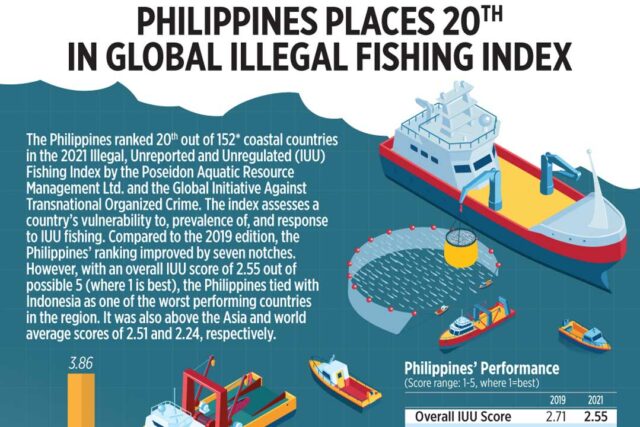
The Philippines ranked 20th out of 152* coastal countries in the 2021 Illegal, Unreported and Unregulated (IUU) Fishing Index by the Poseidon Aquatic Resource Management Ltd. and the Global Initiative Against Transnational Organized Crime. The index assesses a country’s vulnerability to, prevalence of, and response to IUU fishing. Compared to the 2019 edition, the Philippines’ ranking improved by seven notches. However, with an overall IUU score of 2.55 out of possible 5 (where 1 is best), the Philippines tied with Indonesia as one of the worst performing countries in the region. It was also above the Asia and world average scores of 2.51 and 2.24, respectively.

The Philippines ranked 20th out of 152* coastal countries in the 2021 Illegal, Unreported and Unregulated (IUU) Fishing Index by the Poseidon Aquatic Resource Management Ltd. and the Global Initiative Against Transnational Organized Crime.

Globe says new technology boosts energy efficiency by up to 15%

REUTERS

GLOBE Telecom, Inc. announced on Wednesday a new technology it is using to facilitate fourth-generation (4G) technology acceleration and fifth-generation (5G) technology evolution while improving energy efficiency by up to 15%.

“Globe has completed the deployment of a new series of antennas that efficiently enables the acceleration of 4G and the evolution of 5G technology — a step that seeks to boost the company’s 4G and 5G network and ensure energy efficiency,” the telco said in an e-mailed statement.

“The technology also minimizes feed loss and improves energy efficiency by 10%~15%. This means that Globe can maximize energy efficiencies and lower electricity utilization through antenna development and power consumption innovation,” it added.

Joel R. Agustin, senior vice-president and head of network planning and engineering at Globe’s network technical group, said that deployment of 4G and 5G is accelerating and usage is continuously growing.

“The antenna is important for a network to have greater capacity, accelerate site deployment, have broader and deeper coverage, and achieve a low carbon footprint,” he added.

The country placed 53rd out of 100 countries in this year’s Inclusive Internet Index commissioned by Meta and developed by Economist Impact. The index evaluated national-level internet inclusion in 100 countries based on availability, affordability, relevance, and readiness.

With a score of 72.3 out of a possible 100, the country was Asia’s eighth least inclusive internet environment.

“Globe is innovating with its vendor partners on the latest technologies available to improve customer experience through efficient 4G/5G network deployment,” Mr. Agustin said.

At the same time, the company said that this latest technology is part of its commitment to the United Nations Sustainable Development Goals.

“Globe allocated P89 billion in capital expenditures this year to roll out more 5G sites and in-building solutions, upgrade cell towers to 4G LTE, add more 4G cell sites, and lay down fiber to the homes,” it noted. — Arjay L. Balinbin

Gilas youth battles Kazakhstan for qualification in KO playoffs

AFTER falling short to Japan, Gilas Pilipinas youth is determined to still make the quarterfinals through the next possible route against Kazakhstan in the qualification phase of the 2022 International Basketball Federation (FIBA) U16 Asian Championship in Doha, Qatar.

Gilas faces Kazakhstan at 8:45 p.m. (Manila time) with the winner advancing to the knockout (KO) playoffs against reigning champion Australia, which topped Pool A with an unbeaten 3-0 card.

The Filipino teens got dragged into the qualifications after settling for the second spot in Pool C following a foiled comeback attempt against eventual group leader and automatic quarterfinalist Japan, 73-67.

Caelum Harris finally broke through in that match the other night, shrugging off his two-point debut in Gilas’ 82-45 win over Kuwait with an 18-point eruption plus six rebounds and two steals.

Jared Bahay (12) and Zain Mahmood (10) also had their shares, but the Nationals could not complete their rally from a 13-point deficit as time expired.

Against Kazakhstan, the wards of coach Josh Reyes eye a resounding rebound to keep their hopes of returning to the World Cup alive.

Gilas has to make the semifinals of the Asian tilt to advance in the 2022 FIBA U17 World Cup in Spain next month.

The previous batch of Gilas led by Kai Sotto achieved multiple Final Four finishes in FIBA Asia to make it to two World Cups. — John Bryan Ulanday

Firms must upskill workers, invest in technology to grow

TRUSTPAIR.COM

COMPANIES must upskill workers, invest in technologies and cultivate empathy in the workplace to grow amid a hybrid work setup, HP Philippines Managing Director Christian Reyes said.

“I think leading with empathy was very important, and second was also building a culture of trust. Employees are no longer physically near you in the office, and you’ve got to be able to trust that they’re able also to work and balance things,” Mr. Reyes said in an interview with BusinessWorld. “If you look at it globally… it’s a trend. If you read a lot of narratives and articles, hybrid work is here to stay.”

“It’s important to ensure that you develop and create a culture of trust and respect, and at the same time, invest in technologies that help your employees be productive. Now, as more and more employees and workers are doing work remotely at home or in a coffee shop, it is very important to have the right equipment to collaborate,” he added.

Mr. Reyes said in a hybrid setup, cybersecurity is a bigger issue, urging companies to upgrade their own hardware and software and brief employees on cyber threats and how to respond to them.

“We believe we’re on the right path. Last March, we got the #5 rank out of the top 25 places to work in the Philippines,” Mr. Reyes said, referring to the its ranking under the medium-sized company category (100-999 employees) of Great Places to Work in the Philippines 2022.

“The more we proactively support and engage our employees, especially with the background of the pandemic, the more they are likely to make bigger contributions,” he added.

Mr. Reyes shared that HP has employee support initiatives like upskilling their workers through online certifications; wellness programs through offerings of free counseling, lifestyle tips, and wellness challenges; diversity, equity and inclusion, composed of an all-female employee run network and a youth support system; a social impact program under which its employees volunteer with Child Hope Philippines; and connectedness, a connect session where employers and employees talk about non-work related topics.

THE ‘GREAT DISRUPTION’
Mr. Reyes said the pandemic changed how companies function and how consumers behave.

“The great disruption at one point impacted the way we work, and overnight, it was difficult for a lot of leaders, especially in the Philippines, to suddenly transition to hybrid and remote work, when a lot of companies were used to face-to-face,” he added.

These difficulties included staying connected with employees through this new hybrid setting. Mr. Reyes underscored the importance of building connections with employees, even outside work.

“What often gets overlooked is celebrating wins… When you celebrate wins, no matter how small or how big, it makes the employees feel very triumphant. It encourages them even more, especially when it is recognized by leaders,” he said.

As for consumers, Mr. Reyes said they have become “more demanding” about how they use technology in their lives.

“They have higher expectations of what they purchase, and they expect technology to help them be more productive. They expect tech to help them seamlessly to switch between productivity and meetings and entertainment and gaming,” Mr. Reyes said.

“It’s very important for business to also transition and adopt a changed mindset,” he added. “Having a personal and more human-centric approach to services and subscriptions is the way moving forward,” and highlighting the need more personalized services and subscriptions to consumers.

He highlighted HP’s EasyInk app, which alerts an HP printer user when their ink level is low and lets them order cartridges for delivery to their homes.

LEADERSHIP PRINCIPLES
Mr. Reyes also emphasized some principles leaders and decision makers should keep in mind, especially in this age of hybrid work.

First, he said business leaders need to play the long game. During the pandemic, companies were forced to react quickly to respond to changes, so a return to a more slow and steady approach is crucial.

“Make sure you don’t burn out and conserve energy. With all this disruption and uncertainty, and if the focus is too much on what has to be done now, I guess all the stress that comes with it, there’s a risk of burning out,” Mr. Reyes said.

Second, leaders should have a global mindset and look outward for more opportunities, he said.

“Because I get to work with a lot of companies in the region and globally in HP, and I get to share a lot of ideas, I get to learn best practices from other countries, not just in Southeast Asia, but also in Asia, or even worldwide,” Mr. Reyes said. “But they also learn from us.”

Lastly, leaders have to be okay with the idea of failing and learn from failure.

“Fail fast and grow… We encourage our employees to innovate and try something new,” Mr. Reyes said. “It’s easier said than done, because it’s very important to build a culture and a safety net where failure is okay. It underpins the fact that, try something new and disruptive, but at the same time, if you fail, quickly learn and get insights from it.” — Tobias Jared Tomas


Korean pop band BTS taking a break to work on solo projects

Just days after releasing its anthology album Proof, K-pop band BTS announced it was going on a break.

BTS, the South Korean band that spearheaded a global K-pop craze, is taking a break as a group to work on solo projects, the singers announced on Tuesday.

Band member RM, speaking at the annual FESTA dinner that celebrates the group’s founding, said he had been feeling a need to explore his own work without the constant recording and performing required of BTS.

“The problem with K-pop and the whole idol system is that they don’t give you time to mature. You have to keep producing music and keep doing something,” said RM, seated at a table with his six fellow band members and speaking in Korean.

A video of the dinner was posted on the band’s official Twitter handle.

An English translation of the remarks showed one of the members calling the break a “hiatus,” a description a representative for the band disputed in a statement.

“To be clear, they are not on hiatus but will take time to explore some solo projects at this time and remain active in various different formats,” the statement said.

BTS made its debut in June 2013 and became a worldwide sensation with its upbeat hits and social campaigns aimed at empowering young people. The group released its new album, Proof, on Friday.

Last year, BTS became the first Asian band to win artist of the year at the American Music Awards. The group met US President Joseph R. Biden at the White House in May to discuss hate crimes targeting Asians. — Reuters

BPI to offer auto, housing loans at in-branch event

BW FILE PHOTO

BANK of the Philippine Islands (BPI) will offer exclusive financing products for vehicles and housing during an in-branch loan festival next week.

BPI’s Best Deals Fest will run from June 20 to 24 in all its branches nationwide. The bank is targeting to deliver 20% more bookings of auto and housing loans through the event.

“Consumer confidence is back. Car and home purchases are back in demand as Filipinos move forward and continue to pursue their aspirations,” BPI Retail Lending Group Head Dennis T. Fronda said in a statement on Wednesday. “The Best Deals Fest is a perfect opportunity for aspiring car and homeowners to get their dream home and car, as BPI and our partners have exclusive offers for them.”

“This activity will show the relevance of a brick-and-mortar branch as a one-stop shop for their financial needs. In this case, their home and auto loans,” Mr. Fronda said. “While there is convenience in using digital platforms for usual financial transactions, big purchases like a house or a car will be made more convenient for the clients if assisted in a branch.”

In 2021, BPI’s auto loan portfolio saw bookings rise by 37% year on year, while its housing loan portfolio also grew by 10%.

Through the bank’s Exclusive Partner Offers promo only available during the event, clients can get large cash discounts, low interest rates, and waived fees on vehicles and properties from participating car brands and real estate developers.

Customers can also avail of the bank’s Flex-Rewards promo, where they can get up to P50,000 worth of rewards for every P500,000 in auto loans and for every P1 million in housing loans.

BPI partner merchants Ford Motor Co., Ayala-led AC Motors, and Ayala Land, Inc. will be part of the event.

BPI’s net income climbed by 59.6% year on year to P8 billion in the first quarter, buoyed by higher interest earnings and lower loan loss provisions as asset quality improved. — TJT

Overseas Filipinos’ cash remittances (April 2022)

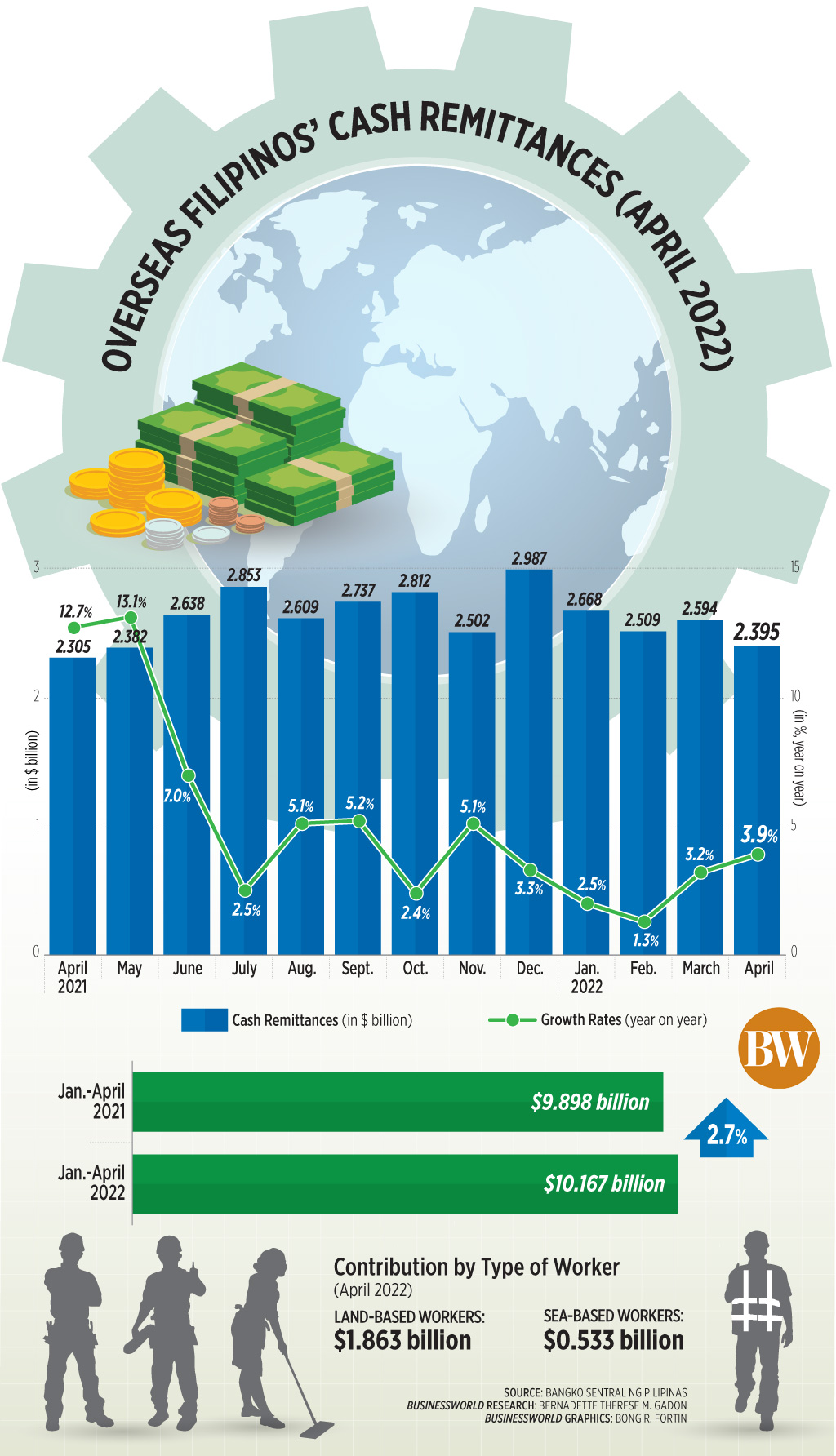
CASH REMITTANCES sent home by overseas Filipino workers (OFWs) jumped by 3.9% in April as many countries further reopened their economies and eased travel restrictions amid the ongoing pandemic. Read the full story.

Overseas Filipinos’ cash remittances (April 2022)

Robinsons Land’s P15-B bonds get highest credit rating

ROBINSONS Land Corp. announced on Wednesday that its planned P15-billion bond issuance attained the highest issue credit rating.

The real estate developer’s proposed bond issuance offers up to P10 billion with an oversubscription option of up to P5 billion. It is the first tranche of the company’s shelf-registered debt securities program in the aggregate principal amount of P30 billion.

According to the firm, the bond issuance received the highest issue credit rating of PRS Aaa, with a stable outlook from Philippine Rating Services Corp. (PhilRatings).

“PhilRatings’ assignment of the highest issuer rating is a recognition of Robinsons Land’s strong fundamentals and financial stability. It is a vote of confidence in the company’s ability to create long-term shareholder value,” said Frederick D. Go, the company’s president and chief executive, in a statement.

According to PhilRatings, obligations rated PRS Aaa are of the highest quality with minimal credit risk while the obligator’s capacity to meet its financial commitment on the obligation is extremely strong.

A stable outlook is an indication that the rating “is likely to remain unchanged” in the next 12 months.

In the first quarter, the firm’s operating income increased by 12% to P2.29 billion, driven by growth in its mall and office businesses.

Robinsons Land has a portfolio of 53 lifestyle centers; 28 prime office developments; 24 multi-branded hotel properties consisting of upscale deluxe hotels, midmarket boutique city and resort hotels, essential service value hotels, and luxury resorts; and seven industrial facilities, among others.

At the stock exchange on Wednesday, its shares declined by 1.69% or 30 centavos to close at P17.50. — Luisa Maria Jacinta C. Jocson

Lady Blazers celebrate return of coach Yee with LPU win

COLLEGE of Saint Benilde (CSB) celebrated the return of its head coach Jerry Yee with a 25-21, 25-8, 25-13 dismantling of Lyceum of the Philippines University (LPU) on Wednesday to remain unscathed in the 97th National Collegiate Athletic Association (NCAA) volleyball tournament at the Paco Arena.

The Lady Blazers played a little more inspired with Mr. Yee back in the fold after coaching the national Under 17 team in Thailand in dominating the Lady Pirates and nailing their second win in a row.

And so was Mr. Yee.

“Feels good to get a head start,” said Mr. Yee, who missed his team’s 25-10, 25-13, 25-15 triumph over San Beda in the sport’s season inaugurals on Saturday. “In NCAA, it will be a single-round robin so you get to play teams just once.”

“We just want to win as many games as we can and possibly gain some incentives later or keep team morale high,” he added.

With the exception of the opening set where LPU put up a decent fight, CSB was in total command most game where it relied heavily on the troika of Jade Gentapa, Jhasmin Gayle Pascual and skipper Francis Mycah Go.

Ms. Gentapa paced the team will 11 points while Mses. Pascual and Go contributed 10 hits apiece.

LPU, which downed University of Perpetual Help System DALTA (UPHSD), 25-23, 25-19, 25-16, on Sunday, fell to 1-1.

The Lady Blazers were in a familiar place just like last season two years ago when they went on a blistering 7-0 start only to see their title hopes vanish in thin air after the league decided to pull the plug due to the pandemic.

CSB hopes to finish what it started on this one though. — Joey Villar

Powering sustainable digital transformation in the country through use of edge computing

TRUSTPAIR.COM

AS IT MOVES towards a new economic frontier, the Philippines is accelerating its digital transformation and promoting digital readiness guided by its national initiatives. Driven by efforts — especially those helmed by the Department of Information and Communications Technology (DICT) — the country is ramping up digital adoption and connectivity to tap into a P5-trillion opportunity and transition the country to the next industrial age.

The Philippines was one of the earliest Southeast Asian nations to take a lead in 5G deployment. Alongside bringing the country to the next era of connectivity, it also quickly responded to the increasing digital demands exacerbated by the COVID-19 pandemic with a government policy urging the use of cloud technology.

Through these efforts, the Philippines is taking the right steps to boost more inclusive digital transformation. However, inclusivity is just one part of ensuring better digital transformation opportunities and benefits in the long term. Greater demand for digital services will result in increased demand for data, and the data centers to manage them, and the resultant energy demand from this will pressure the surrounding environment.

As it accelerates its digital plans in the 5G era, the Philippines must ensure that its digital transformation infrastructure is managed sustainably. The key to this is harnessing edge computing, which can optimize data management to be more efficient even as data demands multiply.   

ENABLING SUSTAINABLE DIGITAL ADVANCEMENTS WITH EDGE INTELLIGENCE
With more modern networks utilizing 5G, there is a greater need in managing rapid increases in data transfer network capacity requirements. This is especially for providing low latency services and capacity increases more sustainably.

There has also been unusually high growth in data creation and replication globally. This trend will continue over the next few years, requiring more energy consumption to manage and transport data at a rate similar to the annual production of 50 nuclear power plants.

This is why edge computing and edge intelligence will be essential components in the Philippines’ 5G networks and related applications. They will enable the development of more sustainable digital infrastructure, as they can improve workload optimization, which would then significantly reduce energy consumption related to data transport.

Essentially, edge computing refers to the practice of shifting portions of computation away from centralized servers and bringing them closer to where data is being created. The processing and analysis of raw data are done at the edge, while findings such as real-time insights, predictions or other types of actionable intelligence are sent to the data center.

Therefore, modern edge capabilities help make data management more sustainable, underpinned by minimizing latency and reducing backhaul traffic volumes and costs. For example, edge intelligence can contribute to data usage optimization and reduce the amount of data needed to traverse the network, thereby lowering energy consumption and resultant carbon emissions. To illustrate, optimization of workloads will significantly reduce energy consumption related to data transport and decrease the need for physical transport, hence reducing CO2 output.

Applications powered by new edge capabilities can also meet user needs more capably through more sustainable use of environmental resources. This further reduces energy consumption and carbon emissions. Predictions performed by edge intelligence algorithms show that data and computation can be brought closer to the sites where green energy is available, which will help optimize green energy usage.

HOW MODERN PHILIPPINE CSPS SHOULD HARNESS EDGE SYSTEMS
To respond to the growing sustainability challenge posed by digital transformation, communications service providers (CSPs) in the Philippines should leverage edge systems that adopt the following best practices:

• Sustainability and competitiveness

Edge computing can dramatically improve energy efficiency, data security, and privacy in digital infrastructures. With cloud technology already transforming the Philippines’ socioeconomic landscape, CSPs can access greater flexibility, lower overall costs and high service availability to meet growing demands on networks, sustainability, new applications and data by people and enterprises. It will also multiply economic activities by opening significant business opportunities for new edge application developers.

• Network scalability and operability

Edge computing enables massively distributed, automated, cloud-native and secured basis across diverse locations. This is especially game changing for countries with challenging archipelagic geographies such as the Philippines, where some of the country’s leading CSPs are currently working on the improvement. This improved connectivity then provides a platform to make latency-sensitive applications and digital services sustainable and energy-efficient as their use is scaled-up nationwide, whether they are for banks, enterprises, manufacturers, security/surveillance companies, ports, or more. This is evidenced by CSP operators currently working out partnerships to provide customers with network resiliency and manage end-to-end demands.

• Solution focus

With increasing co-innovation and co-development between CSPs and network technology companies in the Philippines, it is essential to create edge-based solutions that enable sustainable and automated data transfer across future digital infrastructure for consumers and enterprises across industries.

SUSTAINING THE PHILIPPINES’ 5G FUTURE WITH EDGE SYSTEMS
As it is already in the 5G era, the Philippines will play a significant role in Southeast Asia’s digital advancement. With greater anticipated regional market influence, the nation must ensure that its digital transformation infrastructure and networks are managed sustainably. This will also be instrumental to the country’s transition toward an innovation-based, high-income nation.

There is already strong growth in the Philippines’ hyperscale data center market. Currently, domestic consumers (both general and enterprise) are tapping into enhanced connectivity for applications such as entertainment (including video streaming and mobile gaming), retail and security (i.e., sophisticated cameras for enhanced surveillance).

CSPs are starting to realize this potential through agreements to bring low latency experiences with faster download speed. This makes them, and the country they are based in, poised to drive a new generation of intuitive applications that will run on a distributed architecture along with several components — but all finding their place at the network edge. Adopting edge systems can hence catalyze the unlocking of new digital opportunities and revenue streams, while also scaling digital transformation more sustainably.