Home Blog Page 6212

The ups and downs of the global energy transition journey

The energy transition that has been long underway continues to make strides. In 2020, even as COVID-19 lockdowns put pressure on industries across the world, the adoption of renewable energy such as wind and solar PV have continued to gain traction globally, while electric vehicles set new sales records.

“The new energy economy will be more electrified, efficient, interconnected and clean. Its emergence is the product of a virtuous circle of policy action and technology innovation, and its momentum is now sustained by lower costs,” the International Energy Agency (IEA) said in its World Energy Outlook 2021.

“In most markets, solar PV or wind now represents the cheapest available source of new electricity generation. Clean energy technology is becoming a major new area for investment and employment — and a dynamic arena for international collaboration and competition.”

According to IEA data, sales of electric cars (including fully electric and plug-in hybrids) doubled in 2021 to a new record of 6.6 million. Overcoming the strains in the global supply chains caused by the pandemic, EVs are winning over more and more consumers, as the number of electric cars on the world’s roads by the end of 2021 was about 16.5 million, triple the amount in 2018.

Yet hurdles remain in the renewable energy transition, and they have not become less daunting. The Russian invasion of Ukraine has only engendered more uncertainty in an industry that is already mired in it.

Washington-based nonprofit research firm Resources for the Future (RFF) said that even before Russia’s invasion of Ukraine, Brent crude spot prices rose from an average of $42/bbl in 2020 to $71/bbl in 2021. This spiked to more than $120/bbl by early March 2022 when the Russian tanks rolled across the border.

The spikes in energy prices have been worse in Europe, where the RFF saw natural gas markets in the Netherlands, which already broke record levels in 2021, further surged to more than €165 per megawatt-hour (roughly $54 per MMBtu) in early March, more than 10 times higher than the 2020 average.

The RFF noted that as clean energy technologies such as electric vehicles, wind turbines, and solar modules also rely on the same global supply chains which in some cases are geographically concentrated and inelastic, geopolitics will continue to play a role in energy markets for the foreseeable future.

“Energy outlooks released in 2021 could not have anticipated these events, and only one scenario (the US Energy Information Administration’s High Oil Price) assumed oil prices reaching today’s levels at any point before 2050,” RFF said in their Global Energy Outlook 2022.

“These price increases burden energy consumers around the world. In the near term, options for easing high prices are limited, but in the medium to longer terms, energy security can be enhanced through reducing oil and natural gas consumption and further diversification of suppliers.”

Energy security is made even more critical in a world where energy demand is further expected to rise as more developing countries rise up from the throes of the pandemic and continue their growth. Meanwhile, the looming climate crisis grows no less urgent, and the energy sector remains as the world’s top producer of greenhouse gases. Change cannot come sooner for the sector, in other words.

“We cannot afford to ignore either today’s global energy crisis or the climate crisis, but the good news is that we do not need to choose between them – we can tackle both at the same time,” IEA Executive Director Fatih Birol said in the agency’s World Energy Investment 2022 report.

“A massive surge in investment to accelerate clean energy transitions is the only lasting solution. This kind of investment is rising, but we need a much faster increase to ease the pressure on consumers from high fossil fuel prices, make our energy systems more secure, and get the world on track to reach our climate goals.” — Bjorn Biel M. Beltran

Ease Healthcare transforms women’s health access in the Philippines

Ease Healthcare, one of the fastest-growing women’s health ecosystem in Asia, has officially launched its digital health services and mobile app in the Philippines. By combining community, education, health tracking, and telehealth onto a single app, Ease empowers Filipinas with the tools and support they need to make informed decisions about their sexual, reproductive, and menstrual health and wellness.

As part of their launch activities, Ease has partnered with “It’s OK to Delay,” an SBC (social and behavior change) campaign by the United States Agency for International Development (USAID) ReachHealth project, to educate young adults in the Philippines about family planning and contraception. As part of the partnership, a  virtual live event, “Girls Helping Girls’ was held, focused on family planning.

“In a conservative society like the Philippines, women’s health is not often openly discussed. This has led many young women to come unprepared in making informed decisions about family planning and their own sexual and reproductive health matters,” said Philippine Commission on Population and Development (POPCOM) Executive Director Juan Antonio A. Perez III. “We’re excited to democratize conversations on women’s health with Ease, and we look forward to more partnerships with them in the future.”

Together with local organizations such as POPCOM, Ease aims to address four key access gaps for women’s health in the Philippines through its services: inconvenience, high costs, stigma, and lack of education.

“When conducting in-depth research for our Philippine launch, we were faced with numerous misconceptions online around women’s health in the country. We quickly realized a dire need to bust these myths and provide reliable and insightful educational content specifically catered to our Philippine consumers,” said Ease Healthcare Co-Founder Guadalupe Lazaro. “Besides providing greater education, we also wanted to build a safe community for women to exchange information and ideas without feeling judged, so that more could make informed decisions about their own health. Through these efforts, we hope to change the landscape of women’s health in the Philippines.”

Through the Ease app, users can gain access to convenient, affordable, personalized, and credible women’s health information and services from the comfort of their own homes. Users can access teleconsultations with leading local medical professionals for their various women’s health needs, as well as opt for discreet medication delivery right to their doorsteps within one to two business days in Metro Manila and Antipolo, and three to 10 days for the rest of the Philippines. Ease will also be building more in-app community features localised to the specific needs of Filipino women.

“Today, we have over 12,000 women in the Philippines alone using our app and teleconsultation services, and we look forward to growing this community with this official launch,” said Rio Ho, co-founder of Ease Healthcare. “We hope to establish ourselves as a trusted and reliable source for women’s health services and education in the country.”

For more information on Ease Healthcare and its services in the Philippines, visit https://ease-healthcare.com/ph/. Download Ease app in App Store and Google Play Store.

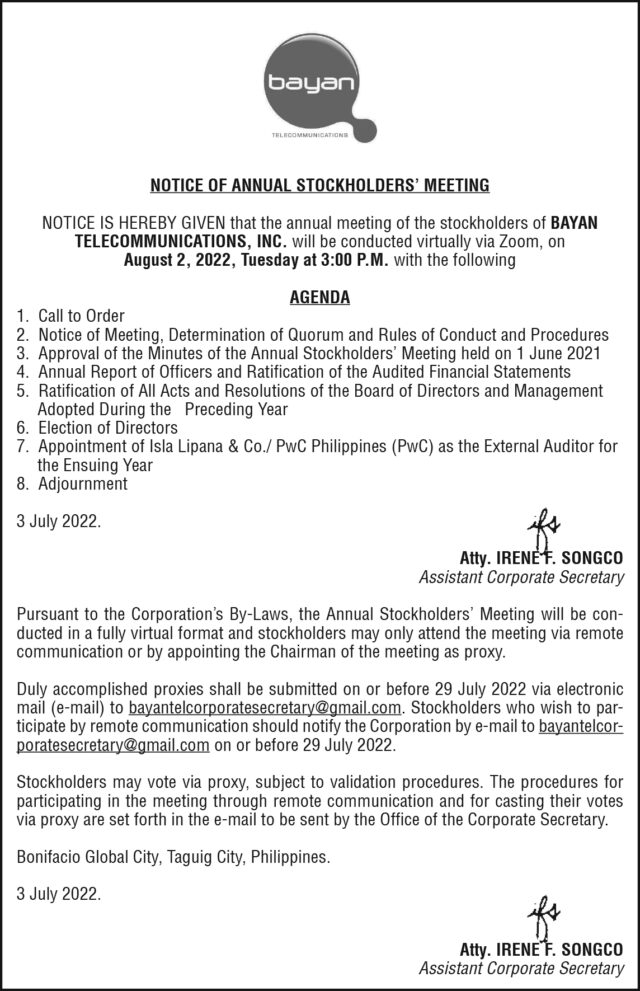
Bayan Telecommunications, Inc. to conduct annual stockholders’ meeting virtually on August 2


Spotlight is BusinessWorld’s sponsored section that allows advertisers to amplify their brand and connect with BusinessWorld’s audience by enabling them to publish their stories directly on the BusinessWorld Web site. For more information, send an email to online@bworldonline.com.

Join us on Viber to get more updates from BusinessWorld: https://bit.ly/3hv6bLA.

Radio Communications of the Philippines, Inc. to hold annual meeting of stockholders virtually on August 2


Spotlight is BusinessWorld’s sponsored section that allows advertisers to amplify their brand and connect with BusinessWorld’s audience by enabling them to publish their stories directly on the BusinessWorld Web site. For more information, send an email to online@bworldonline.com.

Join us on Viber to get more updates from BusinessWorld: https://bit.ly/3hv6bLA.

June inflation likely hit 6% — poll

A wide variety of fish at the Marikina Public Market. — PHILIPPINE STAR/ WALTER BOLLOZOS

By Keisha B. Ta-asan

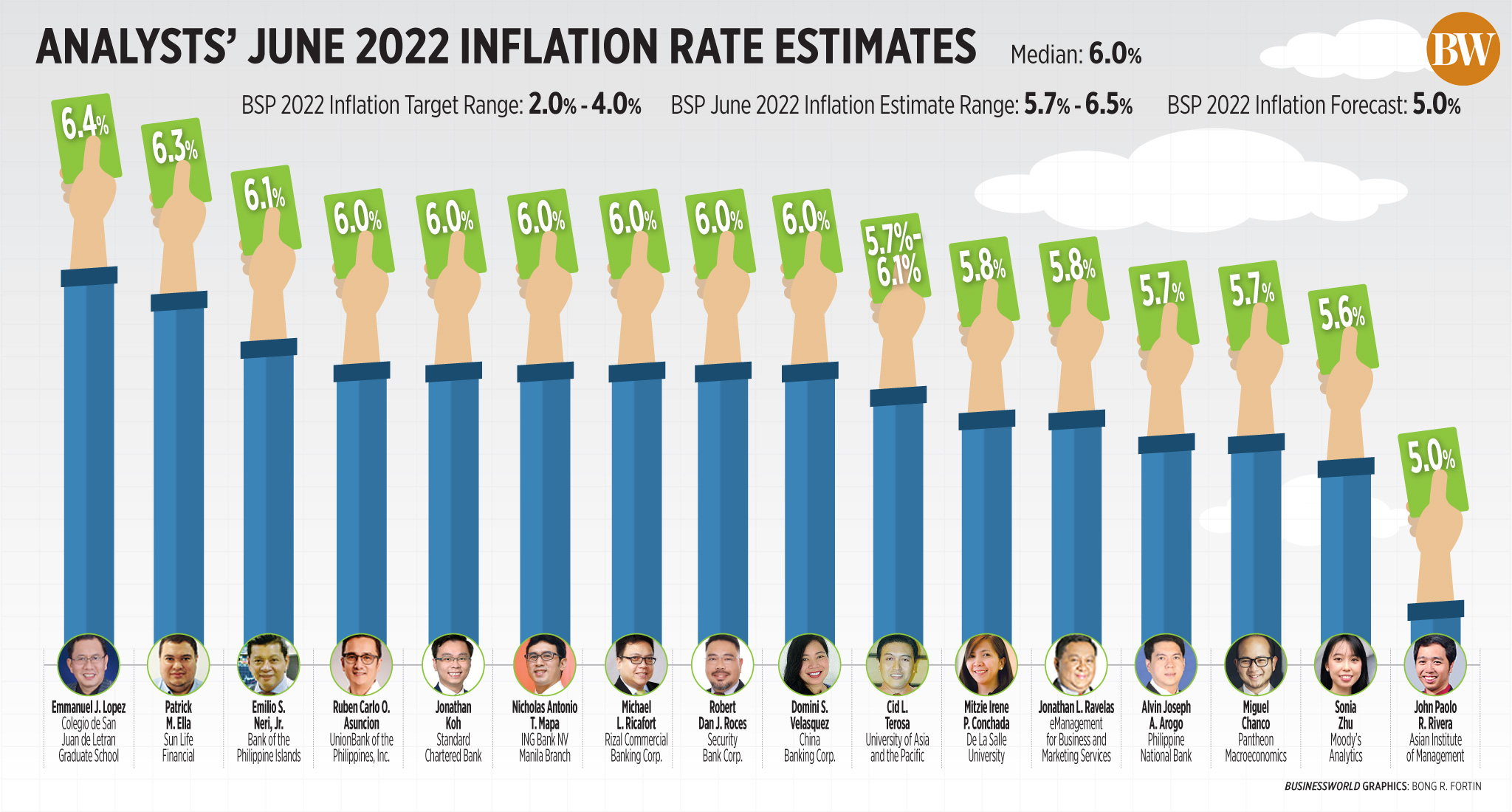
PHILIPPINE INFLATION probably hit 6% in June amid spiraling oil and food prices and higher electricity rates, according to a median estimate of 16 analysts in a BusinessWorld poll last week, boosting the case for bigger increases in key interest rates.

This would be the quickest since 6.1% in November 2018, and faster than 5.4% in May and 3.7% in June last year, according to data from the Bangko Sentral ng Pilipinas (BSP). It would also breach the central bank’s 2-4% target and the Development Budget Coordination Committee’s 3.7-4.7% estimate this year.

“Higher inflation for the month remains to be driven by persistently elevated oil prices now impacting more and more commodities,” Domini S. Velasquez, chief economist at China Banking Corp., said in an e-mail. “Domestic pump prices increased in all four weeks for the month of June.”

Analysts’ June 2022 inflation rate estimates

Record gasoline prices paired with unrelenting food and commodity costs are adding strain to Filipinos’ cost of living, suggesting that the BSP might have to increase rates further to slow economic growth.

The Philippine Statistics Authority (PSA) will release June consumer price index (CPI) data on Tuesday.

Crude oil prices have spiraled out of control amid concerns over supply since Russia invaded Ukraine on Feb. 24.

Gasoline, diesel and kerosene prices had jumped by P30, P45.90 and P39.75 a liter as of June 28, according to data from the Energy department.

The central bank also expects the price of Dubai crude to average about $106.30 a barrel this year from the $104.04 estimate in May.

“It is inevitable that essential needs will be severely affected by escalating prices,” Colegio de San Juan de Letran Graduate School Associate Professor Emmanuel J. Lopez said in an e-mail.

The minimum fare in traditional jeepneys rose to P11 nationwide starting Friday and to P13 for their modern counterparts.

“We see higher inflation in the second half than in the first half as the second-round effects will likely be more pronounced in the succeeding months due to the increase in the country’s minimum wage,” Philippine National Bank economist Alvin Joseph A. Arogo said. 

The higher minimum wage across all regions took effect last month, which the Labor department said would cushion the impact of high commodity prices.

“Meralco-serviced areas experienced higher electricity prices in June as generation charges climbed,” Ms. Velasquez said, referring to the capital region’s power distributor Manila Electric Co. “Food-inflation also accelerated as transport costs increased, compounded by shortages in key food items such as fish.”

50 BPS
Meralco raised its overall rate by P0.3982 to P10.4612 a kilowatt-hour (kWh) in June from P10.0630 a month earlier.

“Price pressures are largely supply side-driven, Nicholas Antonio T. Mapa, senior economist at ING Bank N.V. Manila, said in an e-mail, referring to the war in Ukraine and supply side chain disruptions. “But it is almost impossible to discount the emergence of demand side pressures.”

“Malls are packed, restaurants are full and traffic is back to pre-COVID levels, showing that consumers are still adamant about spending even in the face of multi-year inflation,” he added.

Russia’s invasion of Ukraine and coronavirus lockdowns in China have worsened supply chain disruptions.

“If the war in Ukraine and the weakening of the peso continue in the next months, inflation will breach 6%,” Mitzie Irene P. Conchada, an economics professor at De La Salle University, said in an e-mail.

The peso closed at P55.09 a dollar on Friday, losing 11.5 centavos from Thursday’s finish, according to data posted on the Bankers Association of the Philippines website. It also weakened by 10.5 centavos week on week.

This was the peso’s weakest finish in almost 17 years, or since it closed at P55.26 a dollar on Oct. 25, 2005.

“The Monetary Board might consider a one-time preemptive 50-basis-point (bp) policy rate hike when it meets on Aug. 18 if inflation’s upside risks remain persistent,” Robert Dan J. Roces, chief economist at Security Bank Corp., said in an e-mail.

Expectations of higher inflation in June could prompt the BSP to be more aggressive in their monetary tightening, economists said.

“A likely rise in inflation coupled with the hawkish tone at the June monetary policy meeting opens the door for a 50-bp rate hike in August,” Standard Chartered Bank and Philippine economist Jonathan Koh said in an e-mail.

The Monetary Board at its June 23 meeting raised the benchmark interest rate by 25 bps to 2.5%. The BSP is prepared to “take all necessary policy action to bring inflation toward a target consistent path over the medium term and deliver on its primary mandate of price stability,” former central bank governor and now Finance Secretary Benjamin E. Diokno said then.

The central bank also raised its average inflation forecast for this year to 5% from 4.6% and to 4.2% from 3.9% for next year. The average inflation is expected to slow to 3.3% by 2024.

The BSP will hold its next policy review on Aug. 18.

Analysts praise Marcos veto of Bulacan economic zone bill

SANMIGUEL.COM.PH

By Kyle Aristophere T. Atienza, Reporter

ANALYSTS mostly welcomed newly installed President Ferdinand R. Marcos, Jr.’s veto of a bill that would have created a special economic zone north of the Philippine capital, saying it sent a message that public interest should trump business gains.

Mr. Marcos made the right decision in rejecting that bill that would have given tax perks to companies in the planned ecozone including San Miguel Corp.’s P740-billion international airport project, said Terry L. Ridon, a public investment analyst and convenor of think tank InfraWatch PH.

“These are unprecedented tax perks granted to the Bulacan airport, particularly the indefinite exemption from income and property taxes, as the franchise provides no hard deadline on when the government can finally levy income and property taxes on the airport,” he said in a Facebook Messenger chat at the weekend.

The project had already been given “massive tax perks” through a legislative franchise, Mr. Ridon said.

San Miguel President Ramon S. Ang did not immediately reply to a Viber message seeking comment.

Mr. Marcos fully supports the Bulacan Airport City Special Economic Zone and Freeport, and his decision to veto the bill was meant to cure its defects, Press Secretary Rose Beatrix Cruz-Angeles said in a statement on Sunday.

“Presidential Veto is the fastest way to cure the defects of House Bill 7575, especially the provision which exempts the Commission on Audit to look into the financial transactions on the special economic zone and freeport,” she said.

“The construction of the Bulacan International Airport and Aero City is not affected by the veto,” Ms. Angeles said, noting that the San Miguel group has a separate franchise for it.

In his veto message to Congress on July 1, Mr. Marcos cited the need for fiscal prudence especially in times “when resources are scarce and the needs are abundant.”

Creating a new special economic zone, which offers lengthy tax breaks to investors, would pose a “substantial financial risk to the country,” he added.

His sister Senator Maria Imelda Josefa Remedios R. Marcos, who sponsored the bill, said she did not take the veto personally.

Mr. Ridon said the government could lose as much as P150 billion in income taxes for a 40-year income tax exemption. “With no hard cap or specific sunset provision on when the tax incentives end, the government will certainly lose even more.”

In his veto message, Mr. Marcos said the bill would “significantly narrow” the country’s tax base. It is not “aligned with the government’s objective to develop a tax system with a broad base and low rates.”

“The veto sets the stage towards leveling the playing field for private investments in the public sector, as it indicates that there should be no sacred cows in the treatment of large businesses dealing with government,” Mr. Ridon said.

The veto showed that public interest should always be at the core of any government investments, he added.

Mr. Marcos’ decision also “affords government other alternatives in pursuing similar flagship projects that will not disadvantage the public.”

Mr. Marcos said the proposed economic zone is near the special economic zone in Clark, Pampanga, which goes against the state policy of creating this in strategic locations.

Eligible enterprises outside economic zones can apply for tax incentives provided by a Singapore-inspired tax law that significantly cut corporate income tax, he added.

In one of his first few decisions as president, Mr. Marcos sent a signal that “benefits should outweigh the cost and the benefits should outweigh the risk,” said John Paolo R. Rivera, an economist at the Asian Institute of Management.

“He’s being strategic. We can devote resources to value-adding economic activities,” he said in a Viber message. “He’s making economic sense. He gives an emphasis on overall economic welfare.”

The bill disagrees with existing laws since it lacks audit provisions, land expropriation procedures and a master plan, said Mr. Marcos.

He added that the measure gives the economic zone authority blanket powers to handle technical airport operations in violation of existing aeronautical laws.

Some analysts were skeptical about the veto, saying people should watch Mr. Marcos’ future dealings with the business community.

While the veto might have been “carefully considered,” it might “send a negative signal to investors,” said Antonio A. Ligon, a law and business professor at De La Salle University.

“This has been studied by those who proposed it,” he said by telephone. “He has to clarify why, especially to those who are optimistic about this freeport zone.”

Mr. Ligon said the ball is now in Congress, and that would give a preview of how it will deal with Mr. Marcos during his six-year term. “If lawmakers want to override the veto, they will address the objectionable features of the bill.”

He said it might also prompt lawmakers to revisit the law on special economic zones and consider changing provisions that give wide-ranging tax perks.

‘CURIOUS CASE’
Ateneo de Manila University Political Science Professor Arjan P. Aguirre said the public should be critical of the points raised by Mr. Marcos.

“We expect a new set of powerful stakeholders who will have a privileged place in the determination of the new administration’s agenda,” he said in a Messenger chat.

The veto is a “curious case” because it would affect the interest of one of the country’s most influential and richest citizens, said Robin Michael U. Garcia, a political economy professor at the University of Asia and the Pacific.

“He issued the veto just a day after his inauguration,” he said, adding that it was “a show of strength.”

“It is really telling of how he will deal with the business sector,” Mr. Garcia said, noting that his father, the late dictator Ferdinand E. Marcos, had a “love-and-hate relationship” with the business sector during his two-decade rule.

Mr. Garcia recalled how the elder Mr. Marcos favored his own set of businesses and cronies “at the expense of the whole business community.”

The academic said the public should be wary of the political implications of the decision more than the economic costs.

San Miguel, one of the country’s biggest and most diversified companies, is investing P740 billion to turn a 2,500-hectare property in Bulacan province into an aerotropolis featuring a world-class gateway that can handle 100 million passengers yearly.

Business sentiment for next 12 months worsens

PHILIPPINE STAR/KRIZ JOHN ROSALES

BUSINESS SENTIMENT worsened for the next 12 months, with consumers less likely to spend amid rising oil and food prices, according to the Philippine central bank.

The Bangko Sentral ng Pilipinas (BSP) confidence index fell to 59.9% from 69.8%, according to the results of its Business Expectations Survey.

“The less upbeat business outlook of most of the regions was due to perceived uncertainties brought about by the government transition to a new administration, seasonal decline in production during the rainy season and expectation of higher inflation due to rising fuel prices,” according to the report.

Business expectations surveyFerdinand R. Marcos, Jr. took his oath as Philippine president on Thursday, vowing to fulfill his promises to Filipinos including better improving their quality of life.

The Marcos administration inherited some global issues affecting the Philippines, including spiraling oil and food prices caused by Russia’s invasion of Ukraine.

“Further, business confidence for the next 12 months was weighed down by concerns over the inoculation targets not being met, China lockdowns and possible stagflation due to the Ukraine-Russia conflict,” the BSP said.

Meanwhile, households expect the prices of consumer goods and services to rise faster in the third quarter, the central bank said, citing Consumer Expectations Survey.

The spending outlook of households on goods and services for the third quarter was less upbeat as the consumer index declined to 38.3% from 40.4%.

“This suggests that while more respondents continue to expect higher spending on basic goods and services, a moderation in spending among consumers is expected for Q3 2022,” according to the report.

This may also reflect adjustments in consumers’ spending patterns related to their expectations of higher inflation.

“Businesses are expecting that inflation will settle at 4% for Q2 2022, and at 4.1% for Q3 2022 and the next 12 months (from 4.2% across said periods in the Q1 2022 survey results),” the central bank said.

The inflation expectation of companies in the near term is above the upper end of the government’s 2–4% target.

Companies also expect a weaker peso and higher borrowing and inflation rates in the near term.

“Businesses expect that the peso may depreciate against the US dollar in Q2 and Q3 2022, and in the next 12 months,” it said.

The peso closed at P55.09 a dollar on Friday, losing 11.5 centavos from its Thursday finish. It was its weakest close in more than 16 years, or since it close at P55.26 on Oct. 25, 2005.

The BSP surveyed 1,509 companies for its Business Expectations Survey on April 18 to June 1. It also surveyed 5,437 households for its Consumer Expectations Survey on April 25 to May 5. — Keisha B. Ta-asan

Pushkart.ph plans expansion to Cavite, Pampanga by third quarter

ONLINE grocery shopping and delivery platform Pushkart.ph is aiming to expand in cities across Cavite and Pampanga within the third quarter of this year.


Pushkart.ph said that the expansion to Cavite and Pampanga would be under a partnership with Metro Retail Stores Group, Inc., via its Metro Supermarket.

“Well-positioned for expansion, Pushkart.ph is ready to bring its operations and services to more cities outside Metro Manila particularly in Cavite and Pampanga, through a partnership with Metro Supermarket within the third quarter,” Pushkart.ph said in a statement on Sunday.

Aside from Cavite and Pampanga, Pushkart.ph President and Chief Executive Officer Michael Lim said that the platform is also eyeing further expansion to other parts of the country and across Southeast Asia.

“We aim to offer a more personalized online shopping experience and boost the retail value chain in the country by maximizing Society Pass, Inc.’s (SoPa’s) technology. With its support, we plan to expand to more key cities in Visayas and Mindanao, and eventually in other parts of Southeast Asia,” Mr. Lim said.

Currently, Pushkart.ph operates in all cities of Metro Manila and some parts of Rizal such as Cainta, lower Antipolo, and Taytay where it has partnerships with supermarket chains, namely: Fisher Retail, Inc. (Fisher Supermarket) and Metro Supermarket. It also has a tie-up with RSVP Shoppers Mart (Reysal Supermarket) in Laguna.

Amid rising local prices of goods, Pushkart.ph also announced that it is conducting a month-long “super sale” that started on June 27 up to July 31 while also letting customers have the convenience of food and grocery shopping using their laptops or mobile phones.

Customers can avail of up to 10% off on groceries in Metro Supermarket and Fisher Supermarket.

Another 20% price reduction will also be offered on the original prices of products from Pushkart.ph’s specialty stores and food merchants, while patrons from Laguna will also get special and free food and grocery items for online orders on July 15.

According to Pushkart.ph, the orders have free delivery during the promo period, on top of the discounts.

“The super sale is very timely because we want to offer our customers reprieve to the increasing prices of goods by providing them great deals. All they have to do is simply download our mobile application or go to our website and they can easily score great deals,” Mr. Lim said.

“Aside from giving away discounts, we want to ride on our growth momentum through this super sale by raising awareness and driving more users to our website and mobile app so they can realize the convenience we offer. This is also our way of giving back to their support, especially during the height of the pandemic,” he added.

First introduced in 2017, Pushkart.ph’s services are available on iOS, Android, and through its website. In February this year, the online grocery shopping and delivery platform was acquired by Nasdaq-listed Southeast Asian loyalty and analytics platform SoPa as part of the latter’s expansion efforts. — Revin Mikhael D. Ochave

Filinvest starts making precast concrete products

CALAMBA, LAGUNA – Gotianun-led, Filinvest Land, Inc. (FLI) expects to boost product delivery as it launched along with Dreambuilders Pro, Inc. its first precast and batching plant in its township development Ciudad de Calamba on Saturday.

“The addition of concrete batching into the portfolio of our construction arm Dreambuilders Pro will allow us to strengthen our product delivery ability and enhance our expertise in serving the growing housing demand in the Philippines,” FLI President Tristaneil D. Las Marias said.

The concrete batching plant has a total capacity of up to 60 cubic meters (cu.m.) per hour or a total of 90,000 cu.m. of concrete per year. The precast plant has a total capacity of 288 square meters per day equivalent to 2.5 housing units per day.

FLI aims to minimize the cost of construction by manufacturing its own concrete. The company also believes that the plant will answer delay issues caused by the lack of construction materials, freeing it from being at the mercy of its suppliers.

The concrete batching plant and precast plant are collocated here in Calamba, Laguna. The facility will set the requirements of FLI throughout its business units.

The launch marks the start of the group’s production of ready-mixed concrete and precast concrete products that will be used internally for all FLI projects, particularly, residential development.

Dreambuilders Pro President and General Manager Arnulfo N. Delos Reyes said the products “will set the highest quality standard, efficiency in terms of cost and speed for housing projects.”

The plant generated over 300 new jobs and was designed to be eco-friendly by recycling waste and virtually producing no noise, air, debris, and water pollution.

“Our commitment is to be a green facility, to be environment friendly and compliant. We will contain our carbon footprint [and] aim to be a model [for] other industries,” Dreambuilders Pro’s Equipment Management Head Cornelio D. Padua said.

The plant will provide a stable supply of concrete mix to FLI’s developments not just within Laguna but also in Cavite, Bulacan, Batangas, and Metro Manila.

“We look forward to growing our concrete batching portfolio and eventually expanding to other areas across the country,” added Mr. Las Marias.

The city government of Calamba also supported the FLI-Dreambuilders Pro project.

“With the recent addition of this innovative precast and concrete batching plant, we look forward to seeing more developments. We hope in continuing and furthering the good relationship with Filinvest for the betterment of Calamba City,” Calamba City Mayor Roseller H. Rizal said.

FLI, one of the country’s leading full-range property developers, has built for more than 50 years a diverse project portfolio spanning the archipelago. The projects include large-scale townships, namely: Havila, Timberland Heights, and Manna East in Rizal; Ciudad de Calamba; City di Mare in Cebu; and Palm Estates in Talisay City.

Through the years, FLI has built more than 200 residential developments across the country.

FLI owns 20% of Filinvest Alabang, developer of Filinvest City, a central business district in southern Metro Manila. It is also developing two townships in the Clark Special Economic Zone: its industrial and logistics park and mixed-use development at New Clark City and Filinvest Mimosa+ Leisure City in partnership with Filinvest Development Corp.

On Thursday last week, FLI successfully raised P11.9 billion from its oversubscribed bond offering, which will be used to partially finance its capital expenditure program and refinance maturing debt.

On Friday, shares in the company closed 2.27% or two centavos lower at P0.86 apiece. — Justine Irish DP. Tabile

SteelAsia to start operating Batangas melt shop in 2024 

STEEL firm SteelAsia Manufacturing Corp. is planning to start the operation of its industrial scale melt shop in Lemery, Batangas by 2024.

SteelAsia said the melt shop, which is the first of its kind in the country, will use the latest green technology from Italy-based steel and mining firm Tenova to reduce the project’s carbon footprint.

“Its Consteel Evolution technology saves energy, decarbonizes steel production, and reduces environmental impacts through efficient energy recovery and pollution control innovations,” SteelAsia said in a statement over the weekend.

According to the company, the 600,000-ton plant will use local scrap metal to produce high-grade billets, which are used as raw material for the construction of buildings, ports, and ships.

Benjamin O. Yao, SteelAsia president, said the melt shop will formalize and organize the collection, consolidation, and recycling of scrap metal across the country, and will provide opportunities for individuals and small businesses such as junk shops.

He added that the melt shop would also help reduce the country’s importation of billets.

“This is part of the vision of SteelAsia to put in place an integrated steel industry, the backbone of a country’s industrial base. SteelAsia, the largest steel producer in the country, already has six operating plants and has lined up several more in a multibillion-dollar plan to keep the country abreast of its neighbors,” Mr. Yao said. — Revin Mikhael D. Ochave

Cebu Pacific resumes flights to Sydney

BUDGET carrier Cebu Pacific announced that it resumed its direct flights between Manila and Sydney as of July 1 amid the easing of travel restrictions in the Philippines and Australia.

“With this route resumption, we are pleased to fly once again to and from this destination after more than two years,” Cebu Pacific Chief Commercial Officer Alexander G. Lao said in an advisory. “This also allows Filipinos to reunite with friends and family. We will continue working on boosting seamless connections across our network to address demand.”

The airline will offer flights between Manila and Sydney three times per week on Monday, Wednesday and Friday.

According to the advisory, Flight 5J 39 departs Manila at 11:20 p.m. and arrives at Sydney Kingsford Smith Airport at 9:50 a.m. (local time) the following day. Its return flight, 5J 40 flies out of Sydney at 11:20 a.m. (local time), and arrives in Manila at 5:50 p.m. every Tuesday, Thursday and Saturday.

Sydney-bound tourists must present printed copies of their coronavirus disease 2019 (COVID-19) vaccination certificate upon check-in. Travelers must also complete and submit their digital passenger declaration form at least 72 hours before departure.

“Coming home, boosted Filipinos no longer need to take a COVID test pre-departure. For more information, passengers may refer to the Cebu Pacific Travel reminders page for the latest updates and complete travel guidelines to their destination,” the firm added.

Cebu Pacific said it will continue to offer its guaranteed low fares to stimulate travel across its flight network, which covers the widest Philippine destinations.

It added that it will implement “a multi-layered approach to safety, while it operates with a 100% fully vaccinated crew, 95% of whom have been boosted.” — Luisa Maria Jacinta C. Jocson

Filipinas open ASEAN women’s tournament against Matildas

FILIPINAS training under the watchful eyes of Alen Stajcic. — PFF

HOST Philippines gets tested in the AFF Women’s Championship right away as it opens its campaign against Australia’s Under 23 (U23) team on Monday night at the Rizal Memorial Stadium.

The Filipinas take on the Australians, the 2008 winners, at 7 p.m., intent on making the most of their home field advantage and crowd support to get off to a winning start in Group A.

Also featured in Day 1 at Rizal is the Group A kickoff match between Singapore and Malaysia at 4 p.m.

The history-making Filipino booters are playing at home for the first time since clinching a ticket to the 2023 FIFA Women’s World Cup early this year and bagging the bronze in the Southeast Asian Games last May.

For Alen Stajcic’s charges, there’s no shortage of motivation to perform in the July 4-17 Association of Southeast Asian Nations (ASEAN) showpiece.

“We’ve been in the European subcontinent, Australia, and North America just in my seven months in the team. There’s a lot of leading and growth that has happened. We’re really looking forward to the next chapter and playing on home soil is something special,” said Mr. Stajcic.

“Since we’ve been playing all over, we really haven’t got that home field advantage. Everybody is excited for that. All the support will help us in the long tournament. Everybody is excited and honored to play in the Philippines,” said skipper Tahnai Annis.

The Filipinas, whose best finish was fourth in the 2019 edition in Thailand, are coming off a productive buildup in Slovenia, where they beat Bosnia and Herzegovina in a pair of friendlies, 3-0 and 2-1.

After the Matildas U23, the host squad battles Singapore (July 6), Malaysia (July 8), Indonesia (July 10), and four-time champion Thailand (July 12). The objective is to finish in the Top 2 of the group to advance to the knockout rounds.

The other group consists of defending champion Vietnam, 2019 bronze medalist Myanmar, Timor-Leste, Cambodia and Laos. — Olmin Leyba

ADVERTISEMENT
ADVERTISEMENT