Home Blog Page 6189

TDF yields rise on faster June inflation, hawkish BSP signals

BW FILE PHOTO

YIELDS on the Bangko Sentral ng Pilipinas’ (BSP) term deposits climbed further on Wednesday following hawkish signals from the central bank chief and after June inflation hit a near four-year high in June.

Demand for the term deposit facility (TDF) of the central bank totaled P479.514 billion on Wednesday, above the P300-billion offering as well as the P330.635 billion in tenders recorded last week.

Broken down, bids for the seven-day term deposits amounted to P232.213 billion, higher than the P150 billion auctioned off by the BSP. It also surpassed the P167.585 billion in tenders seen a week earlier.

Accepted rates ranged from 2.58% to 2.725%, slightly narrower than the 2.5% to 2.75% margin seen in the prior auction. With this, the average rate of the one-week paper rose by 2.9 basis points (bps) to 2.6937% from 2.6647% previously.

Meanwhile, the 14-day papers attracted P247.301 billion in bids against the P150-billion offering. Demand was also up from the P163.05 billion in tenders seen on June 29.

Banks asked for yields from 2.6253% to 2.7588%, also slimmer than the 2.5% to 2.7999% band recorded a week earlier. This caused the average rate of the two-week term deposit to increase by 1.97 bps to 2.7299% from 2.7102%.

The BSP has not auctioned off 28-day term deposits for more than a year to give way to its weekly offerings of securities with the same tenor.

The TDF and the 28-day bills are used by the BSP to gather excess liquidity in the financial system and to better guide market rates.

Faster June headline inflation and hawkish signals from BSP Governor Felipe M. Medalla caused TDF yields to go up, Rizal Commercial Banking Corp. Chief Economist Michael L. Ricafort said in a Viber message.

Yields also rose as the peso continued to weaken versus the dollar, which could add to inflationary pressures, Mr. Ricafort said.

Inflation picked up to its fastest level in nearly four years in June, the Philippine Statistics Authority (PSA) said on Tuesday.

Preliminary data from the PSA showed the consumer price index accelerated to 6.1% year on year in June, exceeding the BSP’s 2-4% target for a third straight month. This was faster than the 5.4% in May and 3.7% a year ago.

The June print matched the pace recorded in November 2018 and was the fastest growth in 44 months or since the 6.9% print in October 2018.

It brought the year-to-date average to 4.4%, higher than the 4% a year ago. This is still below the BSP’s 5% average inflation forecast for this year.

On Tuesday, Mr. Medalla said the central bank may raise policy rates by at least 100 bps more in the rest of its meetings for the year to bring cumulative hikes for 2022 to 150 bps, as the policy rate needs to be higher than the 3% midpoint of their 2-4% inflation target.

He also said an increase of at least 25 bps is guaranteed at the Monetary Board’s next meeting on Aug. 18, but he is also open to a bigger increase of up to 50 bps to temper rising inflation.

The Monetary Board has raised benchmark interest rates by a total of 50 bps so far this year, via 25-bp hikes at its May 19 and June 23 meetings, bringing the policy rate to 2.5%.

It has four more meetings scheduled for the year to be held on Aug. 18, Sept. 22, Nov. 17 and Dec. 15.

Mr. Medalla on Tuesday said they are “a lot more concerned” about the impact of the peso’s decline against the dollar on inflation, adding that every 1% depreciation in the local unit adds about 0.05-0.1% to the inflation rate.

The peso closed at P55.67 per dollar on Wednesday, down by 44 centavos from its P55.23 finish on Tuesday, Bankers Association of the Philippines data showed.  For the year so far, the peso has weakened by P4.23 or 8.29% from its Dec. 31, 2021 close of P51 per dollar. — K.B. Ta-asan

Michelin names nine new value-for-money eateries in Singapore

FOOL, a wine bar from chef-owner Rishi Naleendra and group beverage manager Vinodhan Veloo, is a new entry in the Michelin Guide’s Bib Gourmand category in Singapore. — PHOTO FROM FOOLWINE.COM.SG

THE Michelin Guide has named nine new eateries on the Bib Gourmands, its value-for-money list, in Singapore.

There are 67 names on the list in total, with five of the new entries comprising restaurants, while three are hawker center stalls and one is a street food establishment, Michelin said in a statement Tuesday.

The Bib Gourmand category, which was created in 1997, is granted by Michelin’s inspectors to places that offer diners very good value for money on a gourmet experience, according to the statement.

New names include Fool, a wine bar from chef-owner Rishi Naleendra and group beverage manager Vinodhan Veloo — also in the team behind Michelin-starred Cloudstreet — as well as Kelantan Kway Chap – Pig Organ Soup in the Berseh Food Centre and street food stall Sing Lung HK Cheong Fun in Beach Road.

Singapore just in the past few months has emerged from many of its pandemic-related restrictions, and the Michelin statement pointed to a “healthy recovery” in the economic activities and daily life of the city-state.

“With this selection of newly awarded Bib Gourmand locations, we celebrate the dynamism of the local food industry, which has neither lost at all its passion, nor its quality of offerings,” said Gwendal Poullennec, international director of the Michelin Guide, in the statement.

Here’s a list of the new entrants:

• Restaurants

• Cumi Bali

• Fool

• One Prawn & Co

• Unagi Tei

• Un-Yang-Kor-Dai

• Hawker Stalls

• Kelantan Kway Chap – Pig Organ Soup in the Berseh Food Centre

• Hai Nan Xing Zhou Beef Noodle at the Kim Keat Palm Market & Food Centre in Toa Payoh

• Lixin Teochew Fishball Noodles at the Kim Keat Palm Market & Food Centre in Toa Payoh

• Street Food Stall

• Sing Lung HK Cheong Fun in Beach Road

Bloomberg

IPOPHL to boost expansion of MSMEs in global markets 

THE Intellectual Property Office of the Philippines (IPOPHL) plans to strengthen its assistance for micro, small, and medium enterprises (MSMEs) to reach global markets.

“IPOPHL will intensify efforts to help MSMEs recover and more homegrown names to scale up in global markets. In aligning with Trade Secretary Alfredo E. Pascual’s vision, we will equip more MSMEs with the sufficient knowledge and capacity to develop their IP (intellectual property) protection strategies,” IPOPHL Director General Rowel S. Barba said in a statement on Wednesday.

Further, Mr. Barba said that local businesses, entrepreneurs, startups, innovators, and artists should utilize IP in building competitiveness and resilience in a knowledge economy.

“The borderless digital world is also a bright spot for recovery, with opportunities for local high-value brands, innovative IP products and creative outputs to become a profound part of global supply chains,” Mr. Barba said.

Mr. Barba also said that the IPOPHL is optimistic that the country will sustain its momentum in maximizing IP for economic recovery and growth, amid the change in leadership at its parent agency, the Department of Trade and Industry (DTI).

Mr. Pascual recently assumed the role as the DTI’s top official, replacing Ramon M. Lopez.

“IPOPHL extends its full support in advancing the new secretary’s goal of enabling innovation. There is already growing recognition of our country as a champion of IP protection and enforcement, both in the region and the world. We will continue to build on this positive reputation,” Mr. Barba said.

Meanwhile, Mr. Barba said that the IPOPHL will renew its push for the amendment of Republic Act No. 8293 or the IP Code of the Philippines during the 19th Congress.

“The move will help the Philippines keep in step with legal and technological developments happening across the world while boosting its attractiveness for tech businesses. Modern IP laws and efforts could be a point of attraction for foreign startups and big tech companies to set up shop in a country,” Mr. Barba said.

“The enhancements we push for will allow for flexible protection mechanisms that will encourage greater commercialization of inventions. Protective forms of trademarks will be expanded to create more tools for competitiveness while we establish clearer provisions on copyright and aim to provide ease in doing business among artists,” he added.  — Revin Mikhael D. Ochave

Fil-Am guard Paul Garcia to boost Ateneo Blue Eagles backcourt

PAUL Garcia, a 5-foot-11 floor general from Maryland — PAUL GARCIA TWITTER

ATENEO secured the services of Filipino-American stalwart Paul Garcia to bolster its buildup for a revenge bid in the University Athletic Association of the Philippines (UAAP) after getting dethroned as the three-time champion.

The Blue Eagles on Wednesday announced the commitment of Mr. Garcia, a 5-foot-11 floor general from Maryland, who will be eligible right away starting in Season 84 later this year.

A product of Salisbury University Seagulls, Mr. Garcia’s arrival is seen to boost Ateneo’s backcourt following the graduation of Tyler Tio and Gian Mamuyac as well as the departure of SJ Belangel to Korea.

Born to both Filipino parents but grew up in the United States, the 23-year-old Mr. Garcia played three seasons for the Seagulls and had his best season last year with averages of 8.6 points, 48% three-point accuracy and 2.0 rebounds.

He already played in the Philippines in the past, teaming up with now NBA cager Jalen Green of Houston for the Fil-Am Sports USA in the 2018 NBTC.

Mr. Garcia, who has two playing years left, joined Albert Albert Opeña, Jr. from Canada and Filipino-Australian Mason Amos in Ateneo’s growing list of reinforcements to reclaim lost glory in the UAAP.

The Blue Eagles in May bowed to University of the Philippines in a thrilling three-game finals series highlighted by JD Cagulangan’s game-winner to relinquish the title it held since 2017.

As part of its redemption bid for the UAAP Season 85 in September, Ateneo will participate in the World University Basketball Series in Japan next month with hopes of having Mr. Garcia on deck.

Holdovers Dave Ildefonso, Josh Lazaro, Geo Chiu and Chris Koon are expected to carry the torch for Ateneo with Ange Kouame’s availability still up in the air due to his meniscal sprain and partial ACL tear injuries. — John Bryan Ulanday

EU lawmakers pass landmark tech rules, but enforcement a worry

TRUSTPAIR.COM

BRUSSELS — EU lawmakers gave the thumbs up on Tuesday to landmark rules to rein in tech giants such as Alphabet unit Google, Amazon, Apple, Facebook and Microsoft, but enforcement could be hampered by regulators’ limited resources.

In addition to the rules known as the Digital Markets Act (DMA), lawmakers also approved the Digital Services Act (DSA), which requires online platforms to do more to police the internet for illegal content.

Companies face fines of up to 10% of annual global turnover for DMA violations and 6% for DSA breaches. Lawmakers and EU states had reached a political deal on both rule books earlier this year, leaving some details to be ironed out.

The European Commission has set up a task force, with about 80 officials expected to join up, which critics say is inadequate. Last month it put out a 12 million euro ($12.3 million) tender for experts to help in investigations and compliance enforcement over a four-year period.

EU industry chief Thierry Breton sought to address enforcement concerns, saying various teams would focus on different issues such as risk assessments, interoperability of messenger services and data access during implementation of the rules.

Regulators will also set up a European Centre for Algorithmic Transparency to attract data science and algorithm scientists to help with enforcement.

“We have started to gear the internal organization to this new role, including by shifting existing resources, and we also expect to ramp up recruitment next year and in 2024 to staff the dedicated DG CONNECT team with over 100 full-time staff,” Breton said in a blogpost.

DEEP POCKETS
Lawmaker Andreas Schwab, who steered the issue through the European Parliament, has called for a bigger task force to counter Big Tech’s deep pockets and array of lawyers.

European Consumer Organisation (BEUC) echoed the same worries.

“We raised the alarm last week with other civil society groups that if the Commission does not hire the experts it needs to monitor Big Tech’s practices in the market, the legislation could be hamstrung by ineffective enforcement,” BEUC Deputy Director General Ursula Pachl said in a statement.

The DMA is set to force changes in companies’ businesses, requiring them to make their messaging services interoperable and provide business users access to their data.

Business users would be able to promote competing products and services on a platform and reach deals with customers off the platforms.

Companies will not be allow to favor their own services over rivals’ or prevent users from removing pre-installed software or apps, two rules that will hit Google and Apple hard.

The DSA bans targeted advertising aimed at children or based on sensitive data such as religion, gender, race and political opinions. Dark patterns, which are tactics that mislead people into giving personal data to companies online, will also be prohibited. — Reuters

Digital payments rose, made up 30.3% of retail transaction volume in 2021

BW FILE PHOTO

DIGITAL PAYMENTS rose in terms of volume and value in 2021 as consumers and businesses used online channels amid mobility restrictions brought by the pandemic, the Bangko Sentral ng Pilipinas (BSP) said on Wednesday.

The share of digital payments in the total volume of retail transactions in the country rose to 30.3% in 2021 from 20.1% a year earlier, according to latest data from the BSP.

Meanwhile, the value of payments done online represented 44.1% of total retail transactions last year, higher than the 26.8% share in 2020.

“The latest results show we are closer to meeting our objective of converting at least 50% of retail payment transactions to digital form by the end of 2023, under the BSP Digital Payments Transformation Roadmap,” BSP Governor Felipe M. Medalla said in a statement.

Merchant payments, peer-to-peer (P2P) remittances and business transactions of salaries and wages to employees were the key contributors to the progress of digital payments, all of which are high-frequency, low-value retail transactions.

The volume of merchant payments grew by 43.8%, while P2P remittances rose by 268.6%.

Meanwhile, payments of salaries and wages to employees increased by 170.2% last year. This reflects the transition of businesses using digital channels such as electronic fund transfers to bank or e-money accounts.

The increase in electronic fund transfers could be seen as a result of expanding access to transaction accounts and the shifting preference of clients toward digital modes for payments, the BSP said.   

The central bank also said that during the pandemic, clients who had financial accounts were able to safely and conveniently conduct digital transactions using their mobile devices in their homes.

“This capability for digital transactions should be within reach of every Filipino in our increasingly digital economy,” Mr. Medalla said.

“Hence, the BSP, with the support of the payments industry led by the Philippine Payments Management, Inc., continues to promote a vibrant and inclusive digital payments ecosystem where every Filipino can actively participate and enjoy its benefits,” the central bank chief added. 

The BSP wants digital payments to make up 50% of all transactions both in volume and value by 2023.

The central bank also wants the country to become a cashless society by 2025.

In 2019, the central bank launched the national Quick Response (QR) Code Standard or QR Ph which has contributed towards the BSP’s financial inclusion goals. The facility is used for digital P2P transfers and person-to-merchant (P2M) payments through the InstaPay rail.

Under the BSP Circular No. 1055, the central bank required all participating payment service providers to adopt QR Ph for interoperability. As of April, there were 28 and 17 financial institutions participating in the P2P and P2M facilities, respectively. — Keisha B. Ta-asan

Philippines ranks 30th in Global Business Complexity Index

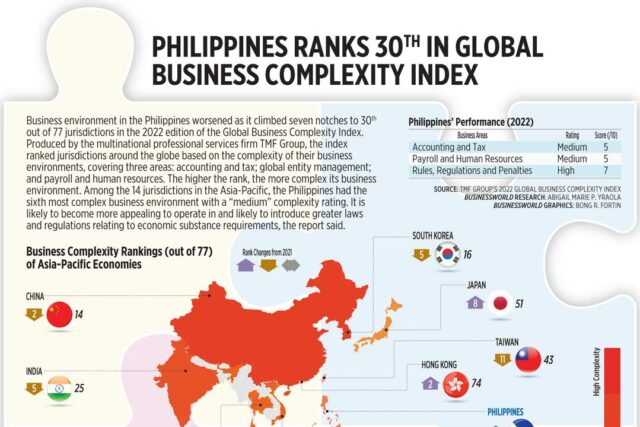
Business environment in the Philippines worsened as it climbed seven notches to 30th out of 77 jurisdictions in the 2022 edition of the Global Business Complexity Index. Produced by the multinational professional services firm TMF Group, the index ranked jurisdictions around the globe based on the complexity of their business environments, covering three areas: accounting and tax; global entity management; and payroll and human resources. The higher the rank, the more complex its business environment. Among the 14 jurisdictions in the Asia-Pacific, the Philippines had the sixth most complex business environment with a “medium” complexity rating. It is likely to become more appealing to operate in and likely to introduce greater laws and regulations relating to economic substance requirements, the report said.

Philippines ranks 30<sup>th</sup> in global business complexity index

New restaurants open in City of Dreams Manila

ROSSI Pizza’s Vegana

CITY of Dreams Manila has opened new restaurants at The Shops at the Boulevard. Here is a rundown of the establishments offering Italian, Thai, and Korean cuisine.

ROSSI PIZZA

Adjacent to Jing Ting and Hidemasa, Rossi Pizza is a casual trattoria that serves Roman-style pizza, known for its scrocchiarella (light, crispy texture), which consists of a mix of five different flours made with Italian grains, water, olive oil, and salt that has been matured in 18 hours of low temperature.

Among the chef’s recommendations are: Capricciosa pizza (with, prosciutto cotto, champignon, artichokes, and olives); the classic Margherita with basil; Quattro Formaggi (with parmesan, gorgonzola and taleggio cheeses). Vegetarians will delight in the Funghi (creamed mushrooms, roasted mushrooms, vegan TVP and arugula); and Vegana (eggplant, zucchini, mushrooms, and onion).

Rossi seats 72 guests and is open daily from noon to 9 p.m.

MANGO TREE

Explore Thai cuisine served in a contemporary 148-seater restaurant with private dining rooms that seat 10 to 70 diners.

Founded in 1994, the restaurant chain’s bestsellers are: Pla Neung Ma-naow or Steamed Sea Bass with Lime Sauce (sea bass, chili, lime, lemongrass, basil, tom yum, served with seafood sauce) Phad Phong Ka Ree or Stir-fried Crab in Curry Sauce (signature crab meat with egg and yellow curry sauce); Massaman Kha Gae or Mussaman Australian Lamb Shank (slow cooked lamb shank with mussaman curry, potatoes, peanuts, onion); and Phad Thai Goong (stir-fried rice noodles with shrimp, roasted peanuts, tofu, chili flakes, bean sprouts, lime, and egg net).

Mango Tree is open from 11 a.m. to 11 p.m., Sunday to Thursday; and until midnight on Friday and Saturday.

J. PARK GARDEN KOREAN RESTAURANT

Korean barbecue restaurant J. Park Garden serves samgyeopsal on a traditional grill-in-table albeit in a modern setting. Premium samgyeopsal, Korean beef, Wagyu, and US beef ribs are available, along with ala carte fare that includes Korean stews and soups such as Bulgogi Jeongol (beef hotpot) and Kimchi Jjigae (kimchi stew); noodle dishes such as Mul Naengmyeon (cold wheat noodles), and Japchae (stir-fried glass noodles and vegetables); and other well-loved snack items like teokbokki (spicy stir-fried rice cake), gimbap (seaweed rice roll), and mandu (dumpling).

J.Park Garden seats 76 guests and is open daily from 9 a.m. to 3 a.m.

CAFÉ MARY GRACE

Café Mary Grace is the home of ensaymadas, cheese rolls, and fresh-from-the-oven pastries and cakes. It also offers all-day breakfast items, soups, salads, pastas, and sandwiches complemented by signature drinks — including their famous hot chocolate.

Café Mary Grace is open from 11 a.m. to 11 p.m., Sunday to Thursday; and from 10 a.m. to midnight on Friday and Saturday.

For more information, visit www.cityofdreamsmanila.com.

Using cloud intelligence for retail growth opportunities

TRUSTPAIR.COM

By Allen Guo

FOR MANY bricks-and-mortar retail brands, the global pandemic was the catalyst that accelerated their plans to establish an online presence. In order to survive during — and after — the pandemic, many brands have realized that they need to swiftly adapt their business strategy in a significant way, while revamping their entire IT infrastructure. Such measures are necessary if they want to respond effectively to the changes in consumer behavior, and to seize retail opportunities as they evolve in the post-pandemic digital economy.

It is my belief that the retail sector will be receptive to new digitalized businesses models, and willing to explore emerging technologies as well as cloud-based solutions. From an operational perspective, there are many benefits for them to enjoy; cloud-based solutions reduce retailers’ overheads with respect to managing a complicated IT infrastructure. They also provide useful resources to stimulate innovation, which is just what is needed as today’s consumers are eager to explore unique and ultimate shopping experience.

Retailers in the Philippines are also being supported and encouraged by the government to look to the opportunities posed by digitalization and e-commerce. This year, the Philippine Department of Trade and Industry (DTI) launched the e-Commerce Philippines 2022 Roadmap. In it, the department outlines the strategies, agenda, and road map for a thriving Filipino e-commerce industry. The document also speaks of the huge potential for growth in the sector, which can be stimulated through the digital transformation of Philippine businesses and investment in technological tools.

Therefore, to remain competitive, it is essential that bricks-and-mortar retailers look to adopt cloud-based intelligent solutions to underpin their digital transformation process.  Retailers can leverage intelligent solutions to build a cloud-first and secure infrastructure, to expand their omni-channel operational footprint, enhance the customer engagement experience and utilize smart supply chains to optimize brands’ digital business models. In short, all of the measures needed to streamline their business while presenting retailers with innovative offering for their customers.

CLOUD-FIRST INFRASTRUCTURE AND OMNI-CHANNEL SALES
During the pandemic, many retailers discovered to their advantage how analytics-driven, cloud-based technologies, were able to support the huge increase in the number of online shoppers. Underpinning their ability to deliver their online offering reliably and consistently during that time of crisis, was a cloud-first and secure infrastructure. This enabled retailers to adopt cloud-native technologies that can easily scale up or down the infrastructure based on their real-time business needs. Features like a globally accelerated network, cloud-native container management, and unified backup and recovery services, gave retailers peace of mind that their platform is robust, irrespective of the extreme demand it was subject to.

Adding further reassurance, are the host of essential security solutions that the cloud offers which provides comprehensive compliance and protection against a range of ever-present and increasingly sophisticated security threats. For example, retailers can build anti-fraud risk engines based on Apache Flink — an open-source stream processing framework — to defend against the ever-evolving tactics of fraudsters.

In a bricks-and-mortar business model, there are other operational essentials a retailer has to deal with daily. These range from processing orders, to dealing with payments, product assortments, inventory information, supply chain processes and so on. All of those can be digitalized and reviewed visually to help management make informed business decisions. Perhaps most importantly, when they are optimized, it is easier for digital channels to reach end customers directly while facilitating a seamless online and offline shopping experience for shoppers.

THE CLOUD ROUTE TO AN OPTIMIZED CUSTOMER EXPERIENCE
Innovative technology plays a key role in recreating a fabulous in-store experience when consumers order online. Livestreaming is one useful tool for further enhancing the customer engagement experience to help drive sales. For example, ApsaraVideo Live, Alibaba Cloud’s end-to-end livestreaming solution, supports retailers’ engagement with shoppers. It does this via a live shopping platform that reaches across social media, apps and websites with high definition and low latency livestreaming capabilities, as well as personalized services such as real-time audio and subtitle translation, human interaction, and in-picture product promotion.

Using cloud computing, AI and AR/VR technologies for creating 3D virtual spaces and digital ambassadors, retail brands can attract consumers and create a shopping ‘buzz’. In particular, using cloud-based XR solutions to build a “metaverse” presence, is considered essential for retailers looking to engage with Gen-Z customers. They have different expectations when it comes to the online experience, so gearing up to successfully meet their needs can only be accomplished by adopting the latest in retail technology.

A SEARCH THAT GOES BEYOND WORDS
Meanwhile, ‘back at the store’, some products – like Image Search and Chatbots – have added a new dimension to how customers interact with sites and how they search for products. The technologies provide the necessary insights and real-time information to optimize the shopping experience for the customer, encouraging them to return time after time.

For example, image search utilizes machine learning to analyze images. It enables shoppers to upload a photo or a screenshot of the product they’re interested in, rather than trying to locate it by typing in a vague keyword into the search box. Retailers can implement image search as added functionality to improve the effectiveness of the search, yielding better results for the customer and increasing customer satisfaction.

Retailers can also tap into services like Alibaba Cloud’s OpenSearch, a one-stop platform for developing intelligent search services. It was built on the large-scale distributed search engine developed by Alibaba, with the aim of helping retailers to develop high quality, maintenance-free, and high-performance intelligent search services with high search efficiency and accuracy.

Another innovative tool is the chatbot. Leveraging cloud-based, AI-powered chatbots, retailers can deliver engaging and memorable services when answering customer questions relating to product information, delivery status, shipment schedules and product recommendations. An added benefit for retailers is that the technology can help retailers save on customer service-related expenses and gain a more detailed understanding of customers’ overall inquiry trends.

KEEPING STOCK OF IT ALL, ALL YEAR AROUND AND BEYOND
In scenarios where stocks of essential supplies are low, technology can be used to steer customers to retailers that do have the essential supplies they need. This is made possible by retailers developing smart supply chain and inventory management solutions for asset and inventory tracking, which gives them visibility into the supply chain. From a retailer’s perspective, such solutions can also save them from the time spent cataloging items and conducting stock-taking activities. With automation, retailers can also match inventory and order status in real time, and – at the end of the customer journey – offer suitable delivery options to customers.  Furthermore, retailers can forecast sales demand so they can better plan the product assortment and optimize the management of inventory.

While the pandemic has given every single sector a considerable jolt, it has also been an opportune time for retailers to use cloud-based intelligent technology to finesse their online and offline offerings to meet the expectations of the post-pandemic consumers, as well as develop innovative models to capture new business growth in the digital economy era.


Allen Guo is the Alibaba Cloud Intelligence country manager for the Philippines.

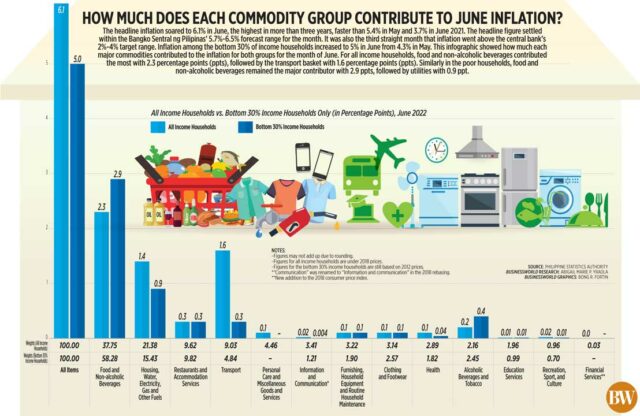
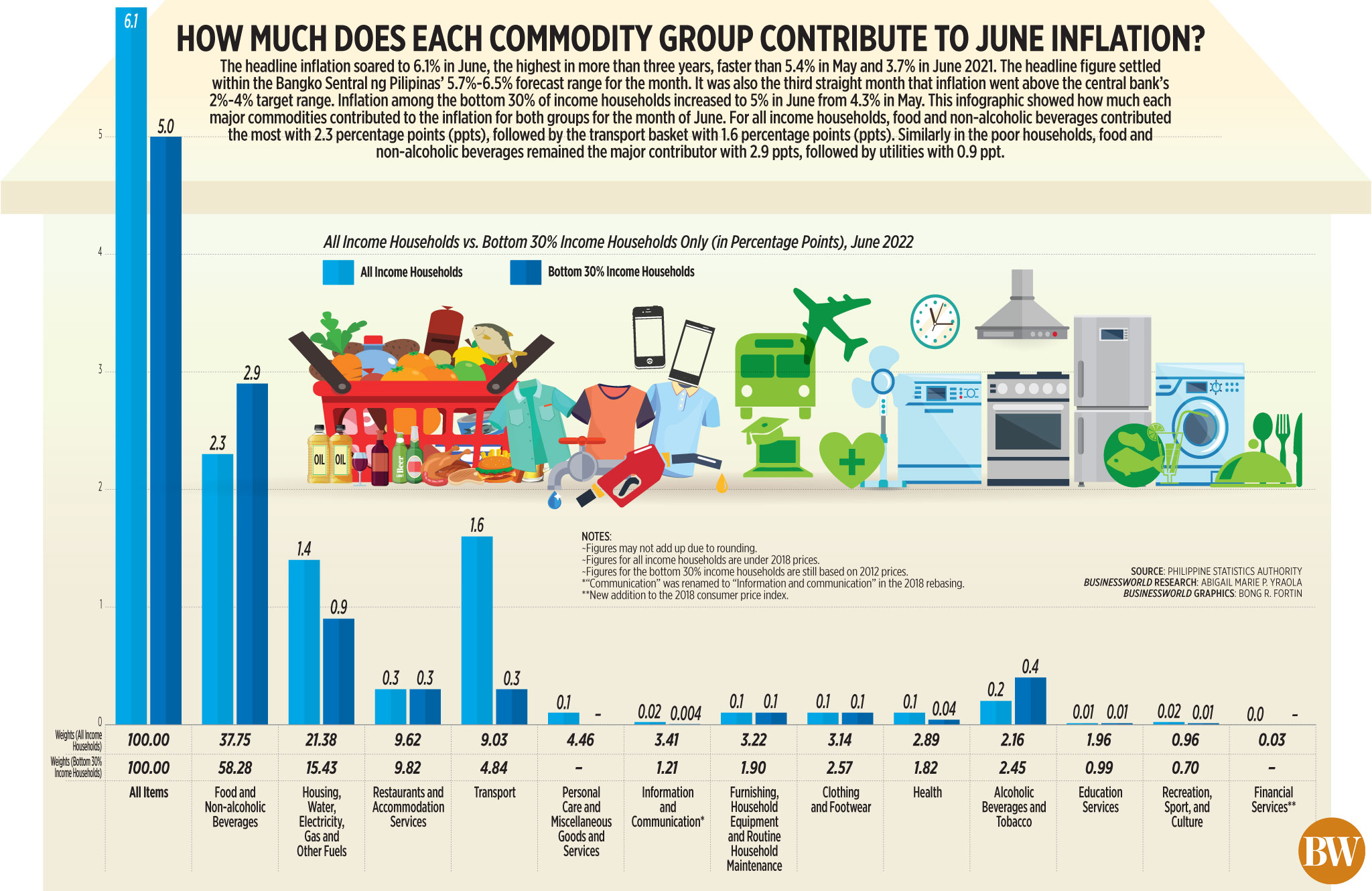
How much does each commodity group contribute to June inflation?

The headline inflation soared to 6.1% in June, the highest in more than three years, faster than 5.4% in May and 3.7% in June 2021. The headline figure settled within the Bangko Sentral ng Pilipinas’ 5.7%-6.5% forecast range for the month. It was also the third straight month that inflation went above the central bank’s 2%-4% target range. Inflation among the bottom 30% of income households increased to 5% in June from 4.3% in May. This infographic showed how much each major commodities contributed to the inflation for both groups for the month of June. For all income households, food and non-alcoholic beverages contributed the most with 2.3 percentage points (ppts), followed by the transport basket with 1.6 percentage points (ppts). Similarly in the poor households, food and non-alcoholic beverages remained the major contributor with 2.9 ppts, followed by utilities with 0.9 ppt.

See related story: Inflation nears 4-year high in June

How much does each commodity group contribute to June inflation?

Ayala Land lists P33-billion fixed-rate bonds

AYALA Land, Inc. (ALI) successfully listed its new P33 billion fixed-rate bonds due 2024, 2027, and 2029 on July 4 at the Philippine Dealing & Exchange Corp. (PDEx).

The two, five, and seven-year bonds are ALI’s largest issuance to date and its second for the year in the local capital debt market.

“With this latest bond offer, we raised P45 billion in debt capital, representing a 90% utilization rate of our P50-billion shelf registration in less than a year,” ALI Deputy Treasurer Jose Emilio B. Jamir said.

ALI reported that the proceeds of the offering will be used for refinancing, funding general corporate requirements, and capital expenditures for upcoming real estate projects.

Its total outstanding listed bonds are now at P120.3 billion, representing 8.9% of the total outstanding listed corporate bonds on PDEx.

“This could only be a positive signal of the corporate sector’s continued thrust for economic revival even in the face of stresses brought on by global events,” PDEx President and Chief Executive Antonino A. Nakpil said.

In May this year, ALI also issued P12-billion six-year fixed-rate bonds with an interest rate of 5.81% per annum.

ALI’s total outstanding listed bonds are now at P120.3 billion, representing 8.9% of the total outstanding listed corporate bonds on PDEx.

ALI is the largest property developer in the country, with more than 12,000 hectares of land bank and a track record in developing large-scale, integrated, mixed-use, and sustainable estates.

It has 47 estates and hosts a diversified portfolio of complementary businesses.

ALI’s shares showed an increase of P0.50 or 1.89% closing at 26.90 apiece on Wednesday. — Justine Irish DP. Tabile

PBA D-League kicks off with battle of collegiate champions

TOP contenders Wangs Basketball @26-Letran and Adalem Construction-St. Clare collide in a battle of collegiate champions to usher in the much-awaited comeback of the Philippine Basketball Association (PBA) D-League Aspirants Cup at the Smart Araneta Coliseum.

Game time is at 10:30 a.m. with the Knights as the back-to-back National Collegiate Athletic Association (NCAA) champions and the Saints as the reigning five-time National Athletic Association of Schools, Colleges and Universities (NAASCU) king going for the first blood in D-League’s return after more than two years of break due to the pandemic.

Established collegiate programs in AMA Online and Centro Escolar University (CEU) then follow suit at 12:30 p.m. to complete the twin-bill opener of the eight-team tourney hat also includes EcoOil-La Salle, Marinerong Pilipino, Builders Warehouse–UST and Apex Fuel–San Sebastian.

Parading an intact core from its perfect title run in NCAA Season 97, Letran looms the team to beat but coach Bonnie Tan remains wary of the competition.

“Medyo kulang pa ang preparations namin. We just resumed practicing this week, so mate-test talaga ‘yung tibay ng mga bata,” said Mr. Tan, tasking seasoned guard Fran Yu to lead the way with the possible unavailability of NCAA Rookie of the Year and Most Valuable Player (MVP) Rhenz Abando due to his national team duty.

A champion of its own, St. Clare vows an all-out fight even against the NCAA title holder.

“Lalaban lahat yan, kaya importante sa amin na makasabay. Hindi naman kami sumali dito para tumakbo-takbo lang,” coach Jinino Manansala said with NAASCU MVP behind the efforts of MVP Johnsherick Estrada and Senegalese big man Babacar Ndong at helm. — John Bryan Ulanday