Home Blog Page 612

Tariffs, AI boom could test global growth’s resilience, OECD says

Philippine businesses are ramping up adoption of artificial intelligence. — REUTERS/DADO RUVIC/ILLUSTRATION

PARIS – Global growth is holding up better than expected as an artificial intelligence investment boom helps offset some of the shock from US tariff hikes, the OECD said on Tuesday, nudging up its outlook for some major economies.

The Paris-based organisation warned, however, that global growth was vulnerable to any new outbreak of trade tensions while investor optimism about AI could trigger a stock market correction if expectations are not met.

In its Economic Outlook, the Organisation for Economic Cooperation and Development forecast global growth would slow modestly from 3.2% in 2025 to 2.9% in 2026, leaving its forecasts untouched from its last estimates in September. It predicted a rebound to 3.1% in 2027.

OECD head Mathias Cormann said the trade shocks triggered by US President Donald Trump’s tariff hikes had so far proved relatively mild, but added their costs were likely to rise.

“The full effects of those higher tariffs since the start of the year will become clearer as firms run down the inventories that they built up,” he told a press conference.

UPGRADED GROWTH FORECASTS FOR 2025, BUT RISKS REMAIN
The US economy is forecast to grow 2% in 2025, revised up from 1.8% in September, before slowing to 1.7% in 2026 – up from 1.5% predicted in September.

AI investment, fiscal support and expected Federal Reserve rate cuts are helping offset the drag from tariffs on imported goods, reduced immigration and federal job cuts, the OECD said.

However, it warned that the Trump administration had put US fiscal policy on an unsustainable trajectory with large budget deficits and rising debt that would require a “significant adjustment” in the coming years.

China’s growth is expected to hold steady at 5% in 2025, up from 4.9% in September, before slowing to 4.4% in 2026 – unchanged from September – as fiscal support fades and new US tariffs on goods imported from China bite.

The euro zone’s 2025 growth forecast was revised up to 1.3% from 1.2%, supported by resilient labour markets and increased public spending in Germany. Growth is expected to moderate to 1.2% in 2026 – it was seen at 1% previously – as budget tightening in France and Italy weighs on the outlook.

Japan’s economy is projected to grow 1.3% in 2025, up from 1.1%, and buoyed by strong corporate earnings and investment, before slowing to 0.9% in 2026.

TRADE AND INFLATION OUTLOOK
Global trade growth is expected to moderate from 4.2% in 2025 to 2.3% in 2026 as the full effects of tariffs weigh on investment and consumption. Elevated trade policy uncertainty limits prospects for a recovery.

Inflation is projected to gradually return to central bank targets by mid-2027 in most major economies. In the US, inflation is expected to peak in mid-2026 due to tariff pass-through before easing. In China and some emerging markets, inflation is projected to rise modestly as excess production capacity declines.

Most major central banks are expected to maintain or lower borrowing costs over the coming year as inflation pressures ease. The Federal Reserve is projected to cut rates slightly by the end of 2026, barring inflation surprises from tariffs. — Reuters

SM Prime backs women leaders advancing disaster risk reduction across Asia-Pacific

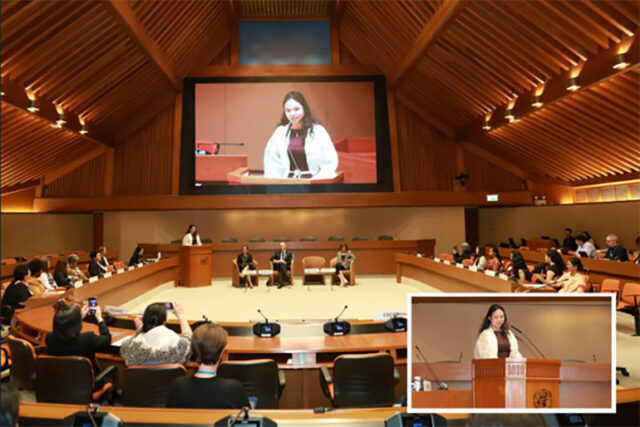
SM Prime Vice-President and Head of Design, Innovation and Strategy Jessica Sy speaks at the 5th United Nations Office for Disaster Risk Reduction (UNDRR) Women International Network for Disaster Risk Reduction (WIN DRR) Excellence Awards in Bangkok, Thailand. — Photos courtesy of UNDRR

SM Prime Holdings, Inc. (SM Prime) reinforced its push for climate resilience as Vice-President for Design, Innovation and Strategy Jessica Sy joined regional policy makers and development leaders at the United Nations Office for Disaster Risk Reduction’s Women International Network for Disaster Risk Reduction (WIN DRR) Excellence Awards in Bangkok on Nov. 25.

SM Prime, known for its ESG+R sustainability framework, has supported the WIN DRR program since 2021 through a partnership with the Australian government. The initiative highlights women across the Asia-Pacific region working to lower disaster risk and strengthen community preparedness amid more frequent climate-related events.

This year’s awards drew more than 200 nominations, with the panel naming seven Rising Stars and seven Excellence Award finalists.

Indonesia’s Nashin Mahtani, who heads the Disaster Map Foundation (Yayasan Peta Bencana), received the Rising Star Award for expanding real-time risk-mapping systems used by millions across Southeast Asia.

Kiribati’s Takena Redfern, acting director of the country’s Climate Change and Disaster Risk Management Division, won the Excellence Award for leading work on the nation’s “Early Warnings for All” roadmap.

Ms. Sy said the honorees demonstrate how timely data, early warning systems and community-focused solutions can reduce disaster impacts and build long-term resilience. “It’s an initiative we deeply believe in,” she said.

A panel discussion on women’s leadership in disaster risk reduction followed the ceremony, featuring Asia Pacific College President Maria Teresita Pastor Medado.

The event concluded with a consultation on WIN DRR’s future direction, with SM Prime represented by Atty. Pearly Joan Jayagan Turley, senior assistant vice-president for Corporate Compliance and program director of SM CARES for Women.


Spotlight is BusinessWorld’s sponsored section that allows advertisers to amplify their brand and connect with BusinessWorld’s audience by publishing their stories on the BusinessWorld Web site. For more information, send an email to online@bworldonline.com.

Join us on Viber at https://bit.ly/3hv6bLA to get more updates and subscribe to BusinessWorld’s titles and get exclusive content through www.bworld-x.com.

Building for tomorrow

The Observatory is a 4.5-hectare mixed use development, rising in the center of Metro Manila. (Artist’s Perspective)

FNG creates spaces that evolve with the needs of Filipinos

Cautious optimism defines the outlook for 2026, as the Philippines enters a period shaped by shifting global currents and emerging local opportunities. In spite of lowered forecasts from multilateral lenders due to uncertainty about the country’s governance and its ongoing struggle to attract foreign investment, the government is pushing for significant reforms that aim to strengthen long-term growth, rebuilding trust in the country’s institutions, while at the same time adapting to global and domestic risks.

In such a market, opportunity favors the bold. As investors search for stability, Federal Land NRE Global, Inc. (FNG) aims to deliver just that by creating communities grounded in a long-term vision and the strong design principles that have come to define their portfolio.

FNG, the Filipino-Japanese joint venture between Federal Land, Inc. and Nomura Real Estate Development Co., Ltd., enters 2026 with an outlook aligned with the country’s current trajectory. With a development philosophy rooted in Japanese precision and Filipino expertise, FNG builds with the long view in mind: Japan-inspired communities shaped by livability, connectivity, and enduring value.

Discover Japan-inspired living experiences right in the center of Metro Manila.

Nowhere is this more evident than in Yume at Riverpark in General Trias and the rising mixed-use development, The Observatory, in Mandaluyong City.

Regional growth hubs will play an increasingly important role in the country’s economic expansion as infrastructure continues to move outward from Metro Manila. General Trias is one of the clearest examples of this shift. Supported by an expanding network of schools, hospitals, industrial parks, retail centers, and government-backed mobility projects, the community has transformed into a high-potential destination for families and investors seeking a balanced environment.

An Ateneo de Manila University campus is set to rise in Riverpark, bringing the prestigious university to Cavite.

Amidst this transformation, the fast-rising district Riverpark stands as testament to the potential this community holds. Developed by Federal Land, the master-planned estate is designed around open spaces, green networks, people-first mobility, and the long-term evolution of the district. With spaces dedicated to future commercial, institutional, and residential growth, Riverpark’s direction is fully set on growth.

In fact, businesses agree as proven by the early 2025 sellout of the first phase of the Riverpark North Commercial Lots. This momentum reflects not only healthy market demand, but trust in the district’s future.

Yume at Riverpark, FNG’s award-winning neighborhood in Cavite, will feature a serene, well-designed Japanese garden. (Artist’s Perspective)

Within Riverpark, FNG’s Yume at Riverpark brings a distinctly Japanese approach to suburban living in Cavite. The residential enclave blends modern architecture, functional spaces, and amenities built for comfort and efficiency.

Yume at Riverpark’s planning follows this logic closely: efficient home layouts, generous open spaces, and a lifestyle designed around wellness and long-term value. Soon, the community will welcome a new house & lot enclave, adding contemporary sophistication to the district’s growing portfolio.

EMPOWERING THROUGH CONNECTIVITY

If Riverpark represents the rise of new growth corridors, then Mandaluyong embodies the strength of Metro Manila’s urban core and the shifting demands of the modern workforce. Connectivity is becoming one of the most important differentiators for workers navigating hybrid schedules, multigenerational households, and increasingly competitive labor markets. Mandaluyong’s unmatched access to Makati, Bonifacio Global City, and Ortigas makes it the geographic center of this movement.

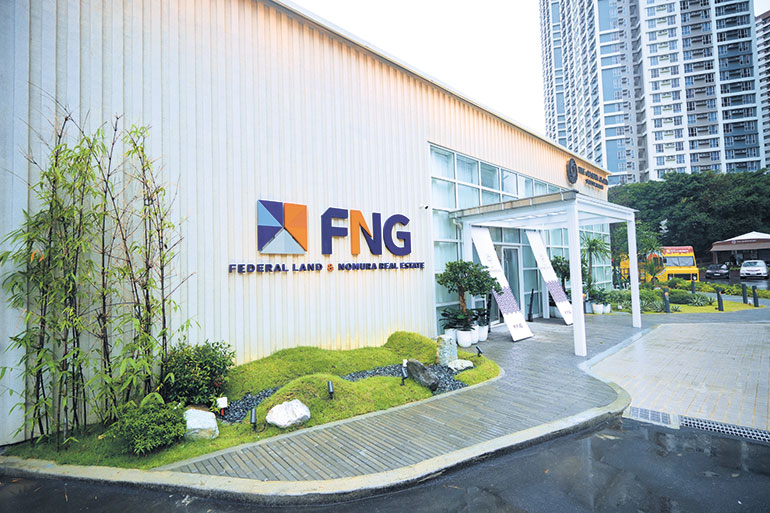
The Observatory Sales Pavilion, FNG’s first standalone showroom along Pioneer Street in Mandaluyong, launched in 2025.

Here, FNG introduces The Observatory, a premium residential development created with the Japanese principles of smart space utilization, functional amenities, and seamless everyday living.

With Mandaluyong continuously attracting new locators and developments, property values have shown consistent upward movement over the years, a trend expected to strengthen as the country achieves upper-middle income status on the world stage.

Across both emerging and established districts, FNG’s developments reflect many of the priorities that define growth in the near future: credibility, people-centered planning, and strategic positioning. The company’s Filipino-Japanese heritage reinforces a long-term approach to real estate, one that is grounded on disciplined execution, community-building, and the belief that growth is strongest where environments are thoughtfully shaped for the people who live and work in them.

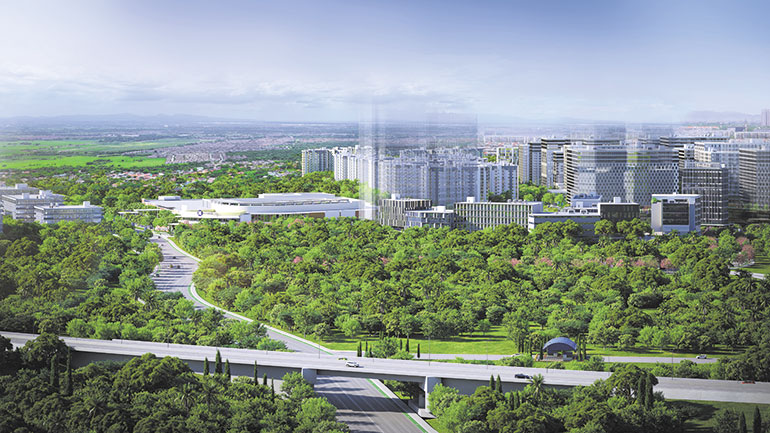
The CALAX Open Canal Interchange, located near the entrance of Riverpark North, reduces travel time between Cavite and Makati CBD. (Artist’s Perspective)

As the Philippines navigates the uncertainties and opportunities of 2026, FNG remains focused on building adaptive communities that meet the moment. In rising cities like General Trias and Mandaluyong, FNG continues to set the pace for what the future of Philippine real estate can look like.

For more information about FNG, visit https://fng.ph/.


Spotlight is BusinessWorld’s sponsored section that allows advertisers to amplify their brand and connect with BusinessWorld’s audience by publishing their stories on the BusinessWorld Web site. For more information, send an email to online@bworldonline.com.

Join us on Viber at https://bit.ly/3hv6bLA to get more updates and subscribe to BusinessWorld’s titles and get exclusive content through www.bworld-x.com.

US vaccine committee’s hepatitis B changes would be most consequential yet

WHO FILE PHOTO

NEW YORK — Robert F. Kennedy Jr.’s vaccine advisers will vote this week on whether to delay hepatitis B shots for most American children, the new chair of the committee said, a move that would be the most consequential change since the health secretary began remaking vaccine policy.

Delaying the decades-old practice of administering the hepatitis B vaccine to newborns is an idea that has been pushed by long-time anti-vaccine activist Mr. Kennedy.

The committee has not settled on exactly how long to recommend pushing them back, the new committee head said in an interview. Some 3.5 million American children a year are recommended to get the shot on the day of their birth.

“We try to avoid giving things to the most vulnerable,” Dr. Kirk Milhoan, a pediatric cardiologist named to run the CDC’s Advisory Committee on Immunization Practices, said on Monday. “We want to test these things incredibly thoroughly before we give it to them, especially in a neonatal period or in a pregnant mother. So these are things that we have a very high suspicion of.”

A review of more than 400 studies and reports by independent vaccine experts released on Tuesday found that the US policy of giving the hepatitis B vaccine to newborns cut infections in children by more than 95%.

NO CONVERSATIONS WITH VACCINE MAKERS
The vaccine advisory committee to the US Centers for Disease Control and Prevention has not spoken directly to vaccine makers about potential supply concerns they have raised that could result from delaying the shots, Mr. Milhoan said.

“We’re not really dealing with that issue right now,” he said. “We haven’t had those discussions, and that might not be really appropriate for the (committee) to have those discussions outside of the meeting.”

Even small changes to the vaccination schedule could disrupt the supply of hepatitis B vaccine or others given in combination with that inoculation, such as the polio vaccine, for a year or longer, several vaccine makers and experts told Reuters.

The committee is scheduled to meet on Thursday and Friday.

Sources at vaccine makers, who spoke on the condition of anonymity, told Reuters the committee has not asked for specific data or details on how any changes to the hepatitis B vaccination schedule could impact vaccine supply in the US.

That is a departure from how it proceeded previously when the CDC would communicate directly with industry ahead of ACIP meetings, said John Grabenstein, a consultant and former Merck vaccine executive. Merck is one of the manufacturers that makes a hepatitis B shot used in the US.

He described the new committee as being far less predictable, saying that “uncertainty is not good in industry.”

A spokesperson for the US Department of Health and Human Services did not respond to a request for comment.

Mr. Kennedy cleared the way for CDC policy changes by ousting Director Susan Monarez over vaccine policy disagreements, as well as firing all 17 independent expert members of the Advisory Committee on Immunization Practices and replacing them with his own nominees.

Under his watch, the agency rewrote its website to say that evidence does not back the claim that vaccines do not cause autism, contrary to established science. The CDC has also dropped recommendations for COVID shots for pregnant women and children, drawing criticism from major US medical groups, and split up the combined measles-mumps-rubella-varicella vaccine for children younger than age 4.

SIGNIFICANT SUPPLY DISRUPTION POTENTIAL
Hepatitis B is a viral infection that causes liver inflammation. It primarily spreads through blood, semen or certain other body fluids, but can also be spread through more casual contact.

In addition to Merck, GSK makes a hepatitis B vaccine and Sanofi makes a combination shot with Merck that includes six different vaccines.

The hepatitis B vaccine is currently recommended for all American children in a series of three shots. The first shot is given in hospitals soon after a child is born with the final two generally administered as part of combination shots. The multi-dose shot includes vaccines against other illnesses like diphtheria, tetanus, pertussis, polio, and Haemophilus influenzae type b.

The combination shots could become useless if the recommendations on timing for the vaccines no longer align, Mr. Grabenstein said.

“This is what I call the tyranny of just-in-time inventory,” Mr. Grabenstein said. “To maximize efficiency, they will have minimized their stockpile, and if there’s an abrupt change, it could lead to shortages.”

Sanofi at the last ACIP meeting said any delay could “cause significant supply disruptions for a year or longer as production of vaccines is adjusted given the long lead time required.”

Merck has said that changes to the established schedule could lead to a resurgence of preventable disease.— Reuters

The Galleon: Legacy in Motion

Aerial perspective of exterior

Ortigas Land continues to reinforce its long-standing commitment to shaping master-planned communities as it advances the development of The Galleon, a two-tower mixed-use landmark rising along ADB Avenue in Ortigas Center. Now in its 94th year, the company remains one of the country’s most enduring real estate developers — building estates and commercial centers that have defined Metro Manila’s urban landscape for generations.

At the heart of this milestone development is Residences at The Galleon, a premium residential tower designed to elevate modern city living within one of the metro’s busiest and most connected business districts. The project offers thoughtfully planned homes that cater to professionals, families, and long-term investors who want the convenience of an integrated lifestyle within Ortigas Center.

A RARE MIXED-USE ESTATE IN ORTIGAS CENTER

The Galleon is one of the few fully integrated developments in the Ortigas CBD, combining office, residential, and retail components in a single address. This integration enhances convenience and accessibility for homeowners and strengthens long-term value for the entire estate.

The project’s office offering, Offices at The Galleon, continues to progress according to its construction timeline and is pursuing LEED certification, underscoring Ortigas Land’s commitment to sustainability in its modern commercial properties. The advancement of the office tower further supports the positioning of the estate as a thoughtfully planned destination for work, life, and leisure.

Perspective of residential lobby drop-off

A HOME DESIGNED FOR MODERN LIFESTYLES

Residences at The Galleon offers homes characterized by clean lines, modern finishes, and efficient layouts that create a calm and comfortable living environment. Generous windows bring natural light into each unit, while contemporary design choices ensure that spaces feel inviting, intuitive, and suited to today’s evolving urban lifestyles.

To enhance everyday convenience, units come with smart home capability, allowing residents to control selected features remotely. Each homeowner also receives two years of complimentary Globe fiber connectivity, ensuring seamless work-from-home setups, uninterrupted entertainment, and smooth day-to-day digital usage in their homes.

AMENITIES THAT SUPPORT REST, WELLNESS, AND CONNECTION

Perspective of pool deck

Residents at The Galleon enjoy a curated suite of amenities designed to complement both active and leisurely lifestyles. A swimming pool and landscaped outdoor areas offer quiet moments of relaxation within the city, while a fully equipped fitness center provides space for daily wellness routines.

Versatile function rooms accommodate gatherings, celebrations, and meetings, and dedicated leisure spaces — such as entertainment rooms and a golf simulator within the game room — provide a variety of recreational options for residents of all ages. Integrated retail options situated within The Galleon offer residents added comfort and convenience.

A PRIME LOCATION FOR CONNECTIVITY AND EVERYDAY CONVENIENCE

Situated in Ortigas Center, Residences at The Galleon stands at the intersection of major commercial, medical, retail, and educational institutions. Its location provides access to key business hubs and benefits from ongoing infrastructure improvements that continue to enhance mobility across the metro.

Residents are within walking distance of corporate headquarters, shopping centers, and public transport links, allowing them to move effortlessly between work, home, and lifestyle destinations.

Perspective of residential garden

A PRIME ADDRESS WITHIN AN ESTABLISHED CBD

With limited new residential supply in the Ortigas CBD and continued demand for centrally located homes, Residences at The Galleon offers an appealing proposition for both end-users and investors. Its placement within a mixed-use development, combined with Ortigas Center’s stability as a commercial district, supports long-term desirability and value retention.

As Offices at The Galleon advances and the development  continues to take shape, homeowners can look forward to a vibrant and connected community designed to meet the needs of the modern urban resident.

ORTIGAS LAND’S CONTINUING LEGACY

Approaching a century of building transformative communities, Ortigas Land remains dedicated to creating developments that balance accessibility, convenience, and long-term value. Residences at The Galleon reflects this ongoing commitment — offering a premium home within a thoughtfully planned development designed for the future.

For over nine decades, Ortigas Land has built masterplanned communities that stand the test of time. Its landmark developments — Capitol Commons, Greenhills Center, Circulo Verde, and Ortigas East — reflect the company’s commitment building great places for life. Learn more at www.ortigas.land.


Spotlight is BusinessWorld’s sponsored section that allows advertisers to amplify their brand and connect with BusinessWorld’s audience by publishing their stories on the BusinessWorld Web site. For more information, send an email to online@bworldonline.com.

Join us on Viber at https://bit.ly/3hv6bLA to get more updates and subscribe to BusinessWorld’s titles and get exclusive content through www.bworld-x.com.

FarEye and PASIA partner to harness AI, powering 100 million deliveries and driving logistics efficiency in the Philippines

With logistics costs at 27% of GDP, AI offers the Philippines a multibillion-dollar opportunity to boost efficiency, strengthen competitiveness, and accelerate GDP growth

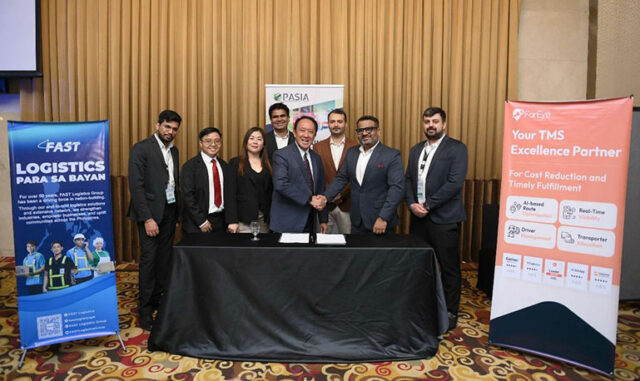
FarEye, the global leader in Last-Mile TMS, has announced a partnership with the Procurement and Supply Institute of Asia (PASIA) to help organizations in the Philippines enhance logistics efficiency through AI and data intelligence.

The partnership comes at a critical time for the Philippines, where logistics costs account for nearly 27% of GDP — over three times the global average and far higher than the ASEAN benchmark of 16%. Addressing this gap represents a major opportunity to unlock billions in economic value and strengthen national competitiveness.

PASIA is looking to leverage FarEye’s global experience, best practices, and AI-powered product capabilities to help enterprises across industries plan smarter, execute faster, and operate more sustainably across the country’s complex, island-based logistics landscape.

Across the Philippines, FarEye’s technology is already enabling leading retailers, manufacturers, and logistics providers — orchestrate nearly 100 million deliveries annually to reduce route miles, improve on-time delivery rates, and gain end-to-end visibility. By applying AI-driven planning, predictive analytics, and orchestration, enterprises are turning logistics from a cost center into a strategic growth lever.

“The Philippines stands at the crossroads of complexity and opportunity,” said Gautam Kumar, COO and co-founder, FarEye. By working with PASIA, we want to redefine what intelligent logistics can achieve, helping enterprises move from operational efficiency to national impact, and positioning the Philippines as a benchmark for AI-led logistics in the region.



“Our collaboration with FarEye reflects PASIA’s commitment to advancing the Philippines’ logistics sector through innovation and capability building, said Charlie Villaseñor, CISCP, chairman and CEO, PASIA. By combining our industry network and expertise with FarEye’s AI-driven platform, we aim to empower organizations to achieve global standards in efficiency, sustainability, and competitiveness.”

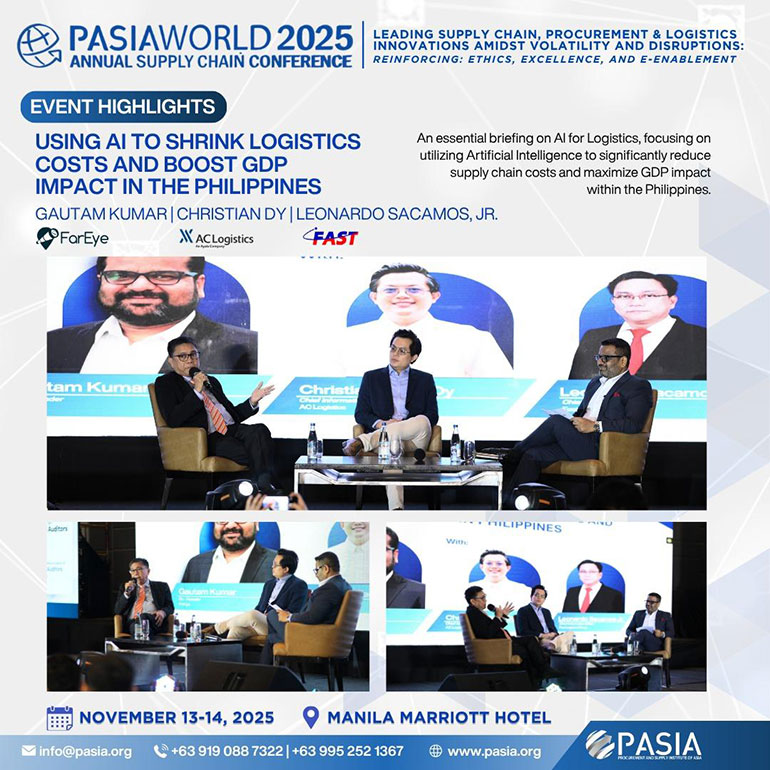
FarEye’s participation at PASIA 2025 which brought together over 300+ companies industry professionals, reinforces its commitment to supporting the Philippines’ vision of becoming a regional logistics hub and a model for digitally enabled economic progress. As India and the Philippines deepen their partnership in trade and technology, FarEye continues to serve as a bridge between AI innovation and economic impact,  helping enterprises build smarter, more efficient delivery ecosystems.

About PASIA:

PASIA (Procurement & Supply Institute of Asia) is the premiere professional institute for supply chain, procurement and logistics headquartered in the Philippines and operating globally. PASIA focuses on providing world-class trainings & certifications, memberships, and conferences. And its commercial entity, Pasia Shared Services Corporation, The global solutions and shared services company that delivers end-to-end supply chain capability augmentation through consulting, services, and technology.

For the past 23 years, PASIA has established its strong reputation in the ASEAN region as a supply chain organization by over supporting 300 companies worldwide in enhancing and improving their supply chain capabilities in terms of people, process, and technology enablers.

Visit www.pasia.org.

About FarEye

FarEye is an AI-Powered  last mile technology platform. FarEye is a partner for companies obsessed with delivery experience for their customers. Our vision is to ensure every delivery in the world reaches its destination every time, on-time, accurately, efficiently, and as sustainably as possible.

FarEye’s AI-Powered platform turns deliveries into a competitive advantage. Carriers & Shippers use FarEye’s unique combination of orchestration, real-time visibility, and branded customer experiences to simplify complex last-mile logistics. The FarEye platform allows businesses to increase consumer loyalty and satisfaction, reduce costs and improve operational efficiencies, sustainably. FarEye has 150+ customers across 30 countries and five offices globally.

FarEye, First Choice for Last Mile.

Learn more: https://fareye.com/


Spotlight is BusinessWorld’s sponsored section that allows advertisers to amplify their brand and connect with BusinessWorld’s audience by publishing their stories on the BusinessWorld Web site. For more information, send an email to online@bworldonline.com.

Join us on Viber at https://bit.ly/3hv6bLA to get more updates and subscribe to BusinessWorld’s titles and get exclusive content through www.bworld-x.com.

Putin and Witkoff discuss peace options for Ukraine past Moscow’s midnight

Russian President Vladimir Putin — KREMLIN.RU

MOSCOW — Russian President Vladimir Putin spent around five hours negotiating with Donald Trump’s most trusted envoys until well after midnight in Moscow about the possible outlines of a peace settlement to end the war in Ukraine.

Mr. Trump has repeatedly complained that ending Europe’s deadliest conflict since World War Two has been one of the elusive foreign policy aims of his presidency and has at times scolded both Mr. Putin and Ukrainian President Volodymyr Zelenskiy.

“Our people are over in Russia right now to see if we can get it settled. Not an easy situation, let me tell you. What a mess,” Mr. Trump said on Tuesday in Washington, adding that there were casualties of 25,000 to 30,000 per month in the war.

Special envoy Steve Witkoff, a billionaire US real estate developer who has known Mr. Trump since the 1980s, and Jared Kushner, the husband of Mr. Trump’s daughter Ivanka, began talks in the Kremlin at around 1630 GMT on Tuesday.

They talked with Mr. Putin, his foreign policy aide Yuri Ushakov and Putin envoy Kirill Dmitriev, via interpreters, until well past midnight Moscow time, with the Kremlin announcing talks concluded only at about 2130 GMT.

There was no immediate word on the results – if any – of the meeting, though Mr. Dmitriev posted on X that the meeting was “productive” beside an emoji of a dove.

Mr. Witkoff was shown on Russian media arriving at the US embassy in Moscow.

So far peace talks have snagged over Russia’s territorial demands to the whole of Donbas, which its forces do not fully control. Other sticking points are Russia’s demands for a formal pledge that the US-led NATO alliance will not admit Ukraine and for limits on the Ukrainian army.

A leaked set of 28 US draft peace proposals emerged last week, alarming Ukrainian and European officials who said it bowed to Moscow’s main demands.

European powers then came up with a counter-proposal, and at talks in Geneva, the United States and Ukraine said they had created an “updated and refined peace framework” to end the war.

Mr. Zelenskiy, speaking in Dublin, said everything would depend on the talks in Moscow but that he was afraid the United States could lose interest in the peace process.

“There will be no easy solutions … It is important that everything is fair and open, so that there are no games behind Ukraine’s back,” he said. — Reuters

Global financial system must adapt to better serve economy, UN trade agency says

PHILIPPINE STAR/KRIZ JOHN ROSALES

LONDON — The financial system risks undermining global trade if it fails to adapt to the economy’s needs, with developing countries likely to suffer the most, the UN Trade and Development Agency said on Tuesday.

Shifts in financial markets now drive global trade almost as much as real economic activity, with financial conditions increasingly determining global trade flows and shaping development prospects worldwide, the UNCTAD report, which was presented in London, said.

“Trade is not just a chain of suppliers. It is also a chain of credit lines, payment systems, currency markets and capital flows,” UNCTAD’s secretary-general, Rebeca Grynspan, said in a statement.

Ms. Grynspan told Reuters in an interview that the financial and trade systems are so closely synchronized that any rise in market volatility or uncertainty will have a significant impact on global trade.

UNCTAD said global growth was expected to slow from 2.9% in 2024 to 2.6% in 2025 due to rising financial volatility and geopolitical tensions.

More than 90% of global trade relies on bank financing, with dollar liquidity and cross-border payment systems remaining essential to international commerce.

“This deep reliance on financial channels makes trade closely linked to global financial and monetary conditions,” the report said. “A shift in interest rates or investor sentiment in a major financial center can affect trade volumes worldwide.”

The report said although developing economies are expected to grow faster than advanced ones, they face higher financing costs, volatile capital flows, and rising climate-related risks, factors that constrain the fiscal and investment space needed to sustain growth.

The dollar remains central to global finance. That offers stability in uncertain times, but it also ties developing economies to financial cycles they have little power to influence, the agency said.

“We need to find ways in which the instruments of the payment system, of the insurance, of the capacity of these countries to lend or do things in their own currency will be part of the resilience of the system for the future,” Ms. Grynspan said.

UNCTAD called for reforms to align trade and finance and ensure long-term stability, including modernizing trade rules, reforming the international monetary system to limit damaging currency and capital-flow volatility, and strengthening capital markets to expand affordable long-term finance.

“What does genuine resilience require? Integrated policy frameworks that recognize links between trade, finance and sustainability,” Ms. Grynspan said. “Fundamentally, we cannot understand trade isolated from finance.” — Reuters

Judy Ann Santos on the DTI P500 Noche Buena budget issue: more research should’ve been done

Judy Ann Santos-Agoncillo is welcomed by UFC as its newest endorser. — EDG ADRIAN A. EVA

Filipina actress and chef Judy Ann Santos-Agoncillo urged the Trade Department to be more sensitive and to conduct more thorough research following its claim that P500 is enough for a Noche Buena meal, noting that the remark is offensive to Filipinos who are already struggling daily.

“Prices of goods have really become expensive. Probably more research should have been done before releasing such a statement,” Ms. Santos-Agoncillo said in Filipino during a Tuesday press conference of UFC, a Filipino food product brand. The event formally introduced her as the brand’s new endorser for a new campaign.

“In times like these, when everyone is hanging by a thin thread, people will inevitably notice whatever is said.”

“Especially when it comes to money, since a lot has already gone missing… why are we going back to the lower value? Where did the rest go?” she added, raising concerns about the proper spending of public funds.

The actress was asked about the issue after sharing her plans and possible dishes for the upcoming Noche Buena. She was also asked what could reasonably be prepared with P500.

“Probably just simple food—simple pancit, maybe some fried chicken on the side, or roast chicken. You don’t need five different dishes,” said Ms. Agoncillo, who became also known for giving cooking tips on her previous shows.

The P500 Noche Buena budget issue stemmed from a radio interview with Trade Secretary Maria Cristina A. Roque, who said that with such an amount, a cheap ham, macaroni salad, and spaghetti can already be purchased.

She later clarified that the suggested budget only covers a basic Christmas meal for a small family of four.

The proposed budget drew criticism on social media, as well as from civil society groups such as the IBON Foundation, which accused the DTI of gaslighting Filipino families and asking them to “celebrate poverty.”

“This is how elitist the DTI secretary and the Marcos Jr. administration really are,” IBON Executive Director Jose Enrique “Sonny” A. Africa said in a Facebook statement over the weekend.

“Overflowing food and drinks for them while millions of ordinary Filipinos are asked to be happy with a subsistence Noche Buena,” he added.

According to BusinessWorld’s Dec. 2 infographics report, the estimated cost of a basic Noche Buena basket for 2025 stands at P2,493.90, up 1.8% compared to last year’s 0.2% decline.

The report also shows that the Noche Buena Index—which tracks annual price movements of items such as spaghetti sauce, pasta, cheese, and other holiday staples—has risen 27.3% since 2011, reflecting an average yearly increase of 2.3% from 2012 to the present.

Price data were based on the DTI’s suggested retail price list, with available figures dating back to 2011. — Edg Adrian A. Eva

NG debt rises to P17.56T at end-Oct.

BW FILE PHOTO

THE NATIONAL GOVERNMENT’S (NG) outstanding debt inched up to P17.562 trillion at the end of October due to a weaker peso.

Data from the Bureau of the Treasury (BTr) showed outstanding debt rose by 0.61% to P17.562 trillion in October from P17.46 trillion at end-September. 

This was 1.2% higher than the P17.36-trillion projected debt level by end-2025.

Year on year, NG debt jumped by 9.62% from P16.02 trillion as of October 2024, the BTr said.

The end-October level was also a tad lower than the record-high P17.563 trillion in outstanding debt seen as of July. 

“The expansion was driven by net issuances of domestic and external liabilities, as well as due to the upward revaluation effects of the weaker peso against the US dollar,” the BTr said.

The peso depreciated to P58.771 per dollar at the end of October from P58.149 at end- September, it said.

NG debt is the total amount owed by the Philippine government to creditors such as international financial institutions, development partner-countries, banks, global bondholders and other investors.

In October, the bulk or 68.6% of the debt stock came from domestic sources, while external obligations made up the rest, consistent with the government’s strategy to prioritize local currency financing to reduce foreign exchange risks and help develop the bond market.

Domestic debt went up by 0.6% month on month to P12.05 trillion at end-October from P11.97 trillion at end-September. This was slightly above the P12.04-trillion year-end domestic debt projection.

The net issuance of government securities added P70.65 billion to the outstanding debt, and the peso’s depreciation also increased the valuation of its retail dollar bonds by P1.78 billion.

Year on year, this was 10.61% higher than the P10.89 trillion recorded as of October 2024.

Meanwhile, external liabilities rose by 0.63% to P5.52 trillion at end-October from P5.48 trillion at end-September. This exceeded the P5.32-trillion end-2025 external debt projection by 3.8%.

The month-on-month increase came “behind the net availment of loans of P8.25 billion and upward net adjustments in the peso equivalent of foreign currency debt of P26.1 billion,” the BTr said.

“Peso depreciation against the US dollar added P58.64 billion to the debt total, while peso appreciation against third currencies provided an offset of P32.54 billion.”

The outstanding foreign debt was composed of P2.82 trillion in global bond issuances and P2.7 trillion in loans. External debt securities were made up of P2.39 trillion in US dollar bonds, P257.61 billion in euro bonds, P58.77 billion in Islamic certificates, P57.83 billion in Japanese yen bonds, and P54.77 billion in peso global bonds.

Year on year, foreign debt climbed by 7.53% from P5.13 trillion.

NG-guaranteed liabilities dipped by 0.64% month on month to P344.41 billion at end-October due to net repayments of P1.25 billion and lower valuation of foreign currency guarantees of P0.97 billion.

“The Bureau reaffirmed its commitment to prudent debt and risk management, ensuring that borrowings remain aligned with the government’s long-term fiscal sustainability goals and supportive of a thriving and stable macroeconomic environment toward a prosperous and more inclusive future for Filipinos,” the Treasury said.

NG debt as a share of gross domestic product (GDP) went up to 63.1% at end-September from 60.1% in the same period last year. This is above the 60% threshold deemed sustainable for developing countries.

The Department of Finance expects the NG debt-to-GDP ratio to ease to 61.3% by end-2025 and eventually fall to 58% by 2030. — with inputs from A.R.A.Inosante

Industry groups oppose tax on single-use plastics

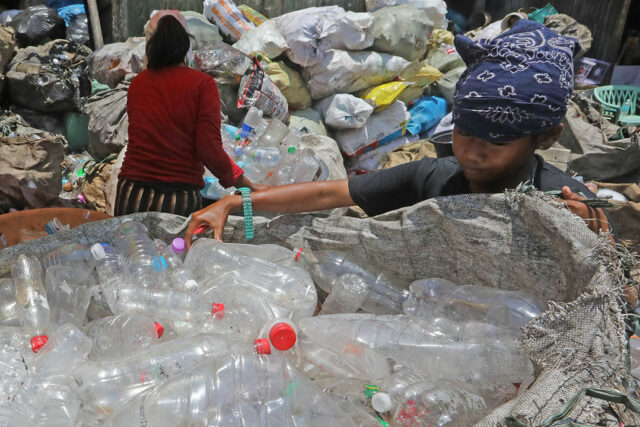
Plastic bottles are segregated at a junk shop in Manila, April 22, 2024. — PHILIPPINE STAR/EDD GUMBAN

By Kenneth Christiane L. Basilio, Reporter

INDUSTRY GROUPS on Tuesday pushed back against a proposal to impose an excise tax on single-use plastics, saying the suggested levy is unfair, could make goods expensive and lead to job losses.

“The proposed tax is discriminatory,” Benjamin So Chua, president of the Philippine Plastics Industry Association, told lawmakers at a House of Representatives hearing. “And it is regressive, increasing consumer costs disproportionately on low-income households.”

There are nine pending House bills proposing an excise tax on single‑use plastics, with the tax rate ranging from P100 to P150 per kilogram of plastic bags. The excise tax would then be increased by 4% every year to discourage the use of single-use plastics.

“The market price of our plastic products is P90 per kilo… if you add another P100 per kilo, that will more than double the price. When we add P150, it will become around three times the cost,” Mr. Chua said.

“This will definitely result in demand destruction and loss of employment to our industry,” he added.

The Philippines has one of the cheapest tax rates for single-use plastics compared to other countries at P0.40 per bag, the Department of Finance (DoF) said last year.

However, the Philippines is considered one of the biggest sources of plastic waste in the world. World Bank data showed the Southeast Asian nation as the third-largest contributor of mismanaged plastic in the ocean annually.

The proposed plastic tax is part of the Marcos administration’s legislative wishlist for the 20th Congress. A similar measure was approved on final reading by the House in 2022, but a counterpart bill at the Senate failed to be approved.

Finance Undersecretary Karlo Fermin S. Adriano said the proposal is primarily not a tax bill but an environmental measure, aimed at curbing the widespread use of plastic bags in one of the world’s most plastic‑reliant and heavily polluted countries.

Plastic pollution costs the government about P70 billion per year, he added. “What we’re going to collect, if we follow a P100-per-kilogram excise tax, is only around P8 billion.”

“The revenue we’re going to collect from the excise tax is significantly smaller than the current economic cost of plastic pollution,” Mr. Adriano told lawmakers at the same briefing.

But there is no alternative to plastics as a major packaging material that is both cheaper and more reliable,” Joseph R. Fabul, director of the Philippine Chamber of Food Manufacturers, said.

“There is no commercially viable large-scale alternative that matches the safety barrier and logistics functions at comparable costs,” Mr. Fabul told the same hearing.

Mr. Adriano said the plastic tax measure’s intent is for producers to pass the levy onto consumers to curb the use of plastics.

“It will be burdensome, particularly for the poor,” said Mr. Adriano. “But we would also like to note that this income decile is the most vulnerable to climate change and its impact. When there are floods, they are the ones who cannot recover.”

The Philippines is among the world’s most disaster-prone countries, with storms and monsoon rains routinely inundating towns and cities. The Southeast Asian nation was hit by 22 storms this year, with a series of strong typhoons in late October leaving hundreds dead and causing billions of pesos in damage.

“That’s why we are imposing this excise tax, so that consumers in general will internalize the cost of all these environmental effects and impacts,” Mr. Adriano said.

The DoF is looking to expand the type of plastics covered under the proposed measure, he added. “Previously, the proposal only covered plastics, specifically sando bags and labo bags.”

“We’re just finalizing the details, like the design, which includes, among others, the tax rate and the coverage,” he said.

The House Ways and Means Committee has formed a technical group to refine the bill’s provisions, particularly the tax rate and plastic type coverage, panel chairman and Marikina Rep. Romero S. Quimbo said.

Analysts said the proposal could stoke inflation in the short term, as many basic commodities rely on plastic for packaging.

However, John Paolo R. Rivera, a senior research fellow at the Philippine Institute for Development Studies, said prices of items that use plastic packaging will likely go up due to the excise tax.

“The tax would raise the cost of plastic-packaged goods, and firms may pass on part of that cost to consumers especially for items like bottled drinks, sachet products and convenience foods,” he said in a Viber message. “However, the overall impact on inflation may be small, since the tax targets only a narrow segment of goods and consumers can shift to cheaper, reusable, or non-plastic alternatives.”

“In the long term we may expect a shift towards sustainable packaging, especially if competition calls for it,” Reinielle Matt M. Erece, an economist at Oikonomia Advisory & Research, Inc., said in a Viber message. “This shift is good both for the environment as well as economically.”

Palace to lawmakers: Speed up 2026 national budget deliberations

PHILIPPINE STAR/KRIZ JOHN ROSALES

By Chloe Mari A. Hufana, Reporter

MALACAÑANG on Tuesday urged lawmakers to hasten the passage of the proposed 2026 national budget to avoid a reenacted spending plan.

President Ferdinand R. Marcos, Jr. wants Congress to move swiftly on the budget bill, Palace Press Officer Clarissa A. Castro said.

“The President does not want a reenacted budget. So, we should move as quickly as possible. Even though time is short, hopefully we can speed things up,” she told a Palace briefing in Filipino.

The proposed 2026 General Appropriations Act (GAA) has been subject to more scrutiny after allegations that billions of pesos of unprogrammed appropriations were inserted in this year’s national budget.

The Budget department defines a reenacted budget as “a situation where the previous year’s GAA is extended and remains in effect for a preceding year until such time Congress passes a budget bill into law.”

Senator Sherwin T. Gatchalian, chair of the Senate Finance Committee, said on Monday that the chamber is on track to pass the budget bill.

The House of Representatives approved the P6.793-trillion national budget on final reading last October. The Senate is set to approve the budget bill on second reading on Wednesday, and on third and final reading on Dec. 9.

The bicameral conference committee is scheduled to hold deliberations from Dec. 11-13 to reconcile the conflicting versions of the House and Senate versions. The bicam report is set to be out by Dec. 16.

As part of efforts to boost transparency, Mr. Marcos had earlier ordered the bicameral conference committee proceedings to be livestreamed.

Congress is expected to ratify the budget bill by Dec. 17. Mr. Marcos is expected to sign the 2026 GAA on Dec. 29.

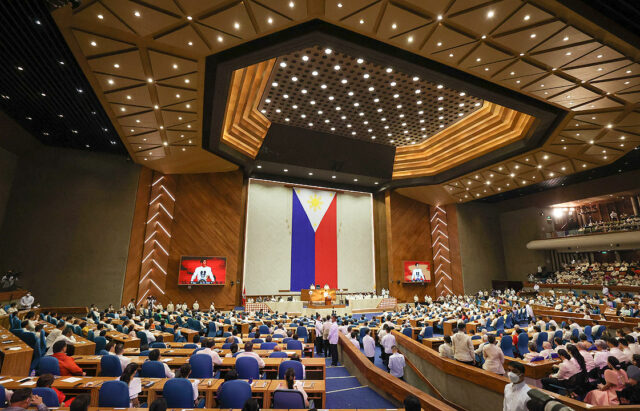
Mr. Marcos, during his fourth State of the Nation Address on July 28, said he would not sign the budget unless it aligns with his administration’s goals.

Ederson DT. Tapia, a political science professor at the University of Makati, said a reenacted budget would be a setback for governance because it forces agencies to operate on outdated assumptions.

“When the budget is reenacted, no new initiatives can move, agencies are locked into outdated priorities, and critical programs in education, health, infrastructure, and disaster response are either delayed or frozen altogether,” he said via Facebook Messenger.

Mr. Tapia said it also undermines Congress’ role in setting national priorities and risks normalizing governance by default rather than by deliberate planning.

Gary G. Ador Dionisio, dean of the De La Salle-College of St. Benilde School of Diplomacy and Governance, said a reenacted 2025 budget threatens the Philippine economy, public services and Mr. Marcos’ political capital.

He said this would undermine reforms introduced by Congress to address past budget controversies, raise doubts among stakeholders about the administration’s economic leadership, and increase risks of inefficiency and corruption, particularly in discretionary fund allocations.

“A reenacted budget increases vulnerabilities to inefficiency and corruption, especially in the allocation of discretionary funds,” he said via Facebook Messenger.

“If this will happen, certainly various sectors both national and international stakeholders will cast a shadow of doubt to the leadership and capacity of (President Marcos) to stir our problematic economy and downgraded international credit rating.”

ADVERTISEMENT
ADVERTISEMENT