Home Blog Page 6009

Driven by a passion, realizing a vision

Federal Land developments through the years

Federal Land, Inc. celebrates five decades of solid commitment to property development

By Adrian Paul B. Conoza

Philippine business visionary Dr. George S.K. Ty’s passion for architecture inspired him to create communities that generations of Filipinos can enjoy. That passion initially showed when he was hands-on in designing some branches of Metrobank, but later on, this passion became the driving force to build Federal Land, Inc., a subsidiary of GT Capital Holdings, Inc. that for five decades has evolved into one of the leading real estate developers in the Philippines.

Marking 50 years this 2022, Federal Land, Inc. has built a solid track record and set standards for the Philippine real estate sector through several residential, office, commercial, and township developments that have defined and keep redefining the ever-evolving skylines inside and outside Metro Manila.

Federal Land’s beginnings trace back to 1972, when the company was founded as Federal Homes, Inc. The company’s first completed project was Soler Tower, a residential condominium in Binondo, then Manila’s business and financial district.

This was followed by the Tytana Plaza and the Mandarin Mansion, considered to be Manila’s first high-rise office and residential building that catered to the specific needs of the Filipino-Chinese community in Binondo. Townhouses were also built along Roxas Boulevard and United Nations Avenue.

The company’s first years also saw Federal Homes’ steady presence in the residential development sector with developments such as Bayview International Towers, Escolta Towers, Skyland Plaza, Ylaya Mansion, and Federal Towers.

In addition to these buildings, Federal Homes started making a mark in the Makati Central Business District (CBD) with the Metrobank Plaza Building, one of the first few tall buildings to be put up in the country’s premier financial district in the 1970’s.
Federal Land, Inc. President and COO Thomas Mirasol; Federal Land, Inc. Chairman Alfred Ty; Nomura Real Estate Development Co., Ltd. Chair Eiji Kutsukake; and Nomura Real Estate Development Co., Ltd. Executive Officer Yusuke Hirano at the launch of Federal Land NRE Global, Inc.

Since Federal Homes took a new name, Federal Land, Inc., in 2002, the premiere property developer saw steady growth in its constant commitment to building dynamic communities.

Federal Land’s portfolio grew with multiple prime real estate projects sprawled across the metro. These projects include Bay Garden Club Residences in Manila Bay Area, Pasay; Oriental Garden Makati and The Grand Midori Makati in Makati; the feng shui-guided Four Season Riviera and the Riverview Mansion in Binondo, Manila; eight-tower Peninsula Garden Midtown Homes in Paco, Manila; the three-tower The Capital Towers in the heart of Quezon City; and Marquinton Residences in Marikina, which mixes rural charm and modern progress.

Federal Land also built distinct office spaces and skyscrapers in the metro’s bustling business districts. At the corner of Ayala Ave. and H.V. Dela Costa Street in Makati, the 47-storey GT Tower International, crowned with a 10-storey vertical fin, has been a notable part of the financial district skyline since the 2000’s. At the edge of Makati CBD, meanwhile, the 28-storey Philippine AXA Life Center was designed and built to accommodate the growing number of companies in the district.

In another emerging financial district, Bonifacio Global City (BGC), Taguig, the 66-storey Metrobank Financial Center, meanwhile, stands as the tallest building in the Philippines since 2017.

Federal Land also ventured into the hospitality segment. The company partnered with leading international hospitality brands to bring the five-star experience to the Philippines.

Federal Land tapped Marco Polo Hotels to revitalize the former Cebu Plaza Hotel, a landmark hotel atop the hills of Cebu. Today, Marco Polo Plaza Cebu offers a luxury getaway with premium amenities, award-winning restaurants, as well as panoramic views of sea, sky, and city.

In Manila, Federal Land partnered with Hyatt Hotels to develop and operate Grand Hyatt Manila in BGC. The hotel is one of the tallest structures in the country and serves as a beacon of hospitality with its elegantly appointed suites, world-class cuisine, and top-notch service.

Dynamic communities

Alongside residential and office structures, Federal Land has built communities that aim to provide a holistic living experience for residents through easy access to life’s essentials and joys.

The 36-hectare master-planned community Metro Park in Manila Bay Area, Pasay, for instance, brings together residences, office towers, shopping malls, events centers, an open park, and a school in a single comprehensive space. Metro Park houses several resort-inspired homes complementing its bayside location including Bay Garden Club and Residences, Six Senses Residences, Palm Beach West, and the upcoming development Mi Casa that will feature Hawaiian-inspired amenities. Metro Park also includes iMet, a three-tower office development with the ground level allocated for retail outlets; Blue Bay Walk, an open-air mall; Met L!ve, one of the developer’s well-known lifestyle spaces; Le Parc and Le Pavillon, which are both events halls.

In Marikina, Federal Land has Marquinton Residences and Tropicana Garden City, which is composed of residential condos and the developer’s very own Blue Wave Mall, a mixed-use mall with office spaces. Its newest development, Siena Towers offers fresh new inventory to the Marikina Community.

The Seasons Residences in Grand Central Park, BGC

In BGC, Federal Land is creating a notable master-planned community patterned after New York City in the United States. Grand Central Park, a 10-hectare development is set to house some of Federal Land’s most prestigious structures such as Grand Hyatt Manila, the two towers of Grand Hyatt Manila Residences, The Seasons Residences, the first MITSUKOSH in the Philippines; alongside The Shops at Grand Central Park, exclusive condos, and office tower.

In the south of Metro Manila, Florida Sun Estates brings the Horizon Land brand to General Trias, Cavite. With condos, house and lot properties, plus a retail area.

Outside Metro Manila, Federal Land is also building dynamic communities.

In partnership with internationally-renowned Marco Polo Hotels, Federal Land has built a luxurious presence at Nivel Hills in Cebu City, through the Marco Polo Plaza Cebu hotel and the five-tower Marco Polo Residences.

Strong partnerships

Building these numerous spaces and communities has been possible not only because of Federal Land’s high standards in creating and constructing distinct, innovative, and long-lasting structures but also through partnerships with reputable local and global institutions.

Federal Land has a long history of partnering with trusted brands from the local and international scene to bolster its property development expertise and help the company operate on a higher plane. This was born out of the late founder George SK Ty’s philosophy of partnering with global giants to improve the local conglomerate’s standards and abilities.

The Grand Midori Ortigas

To build the five-star Grand Hyatt Manila and the Grand Hyatt Manila Residences, which is the first residential condominium in Southeast Asia to carry the esteemed and timeless Grand Hyatt distinction, Federal Land partnered with Orix Corp. of Japan, as well as the prestigious Hyatt Hotels of USA. Orix Corp. also joined the developer in building The Grand Midori Makati and Ortigas condominiums.

Federal Land also formed a joint venture with two of Japan’s leading firms, Nomura Real Estate Development Co., Ltd. and Isetan Mitsukoshi Holdings Ltd., to develop two developments that will largely bring an oriental flair to the Grand Central Park at BGC. The first mixed-used development with a distinct Japanese concept, The Seasons Residences is designed to blend Japanese innovations and the Filipino sense of community together in a single space. The country’s first MITSUKOSHI will anchor the podium of The Seasons Residences.

Moreover, Federal Land strengthens its strategic alliance with Nomura Real Estate Development this year, forming a new joint-venture company, Federal Land NRE Global, Inc., which envisions the development of new urban lifestyles that connect communities with endless possibilities through value creation and sustainable growth.

Ways Forward

What started as a passion for structures, designs, and spaces has fruitfully grown into a drive for developing world-class properties that contribute to nation-building. With an ever-expanding portfolio, Federal Land continues to create well-built and innovative properties, and nurturing communities at par with the rest of the world, as well as seeks to expand and nurture communities that not only make a distinction in the country’s skylines but also seek to improve and enhance the lives of Filipinos today and in more years to come.


Spotlight is BusinessWorld’s sponsored section that allows advertisers to amplify their brand and connect with BusinessWorld’s audience by enabling them to publish their stories directly on the BusinessWorld Web site. For more information, send an email to online@bworldonline.com.

Join us on Viber to get more updates from BusinessWorld: https://bit.ly/3hv6bLA.
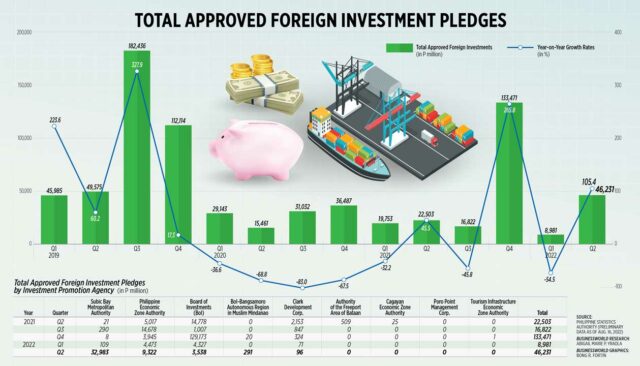
Total approved foreign investment pledges

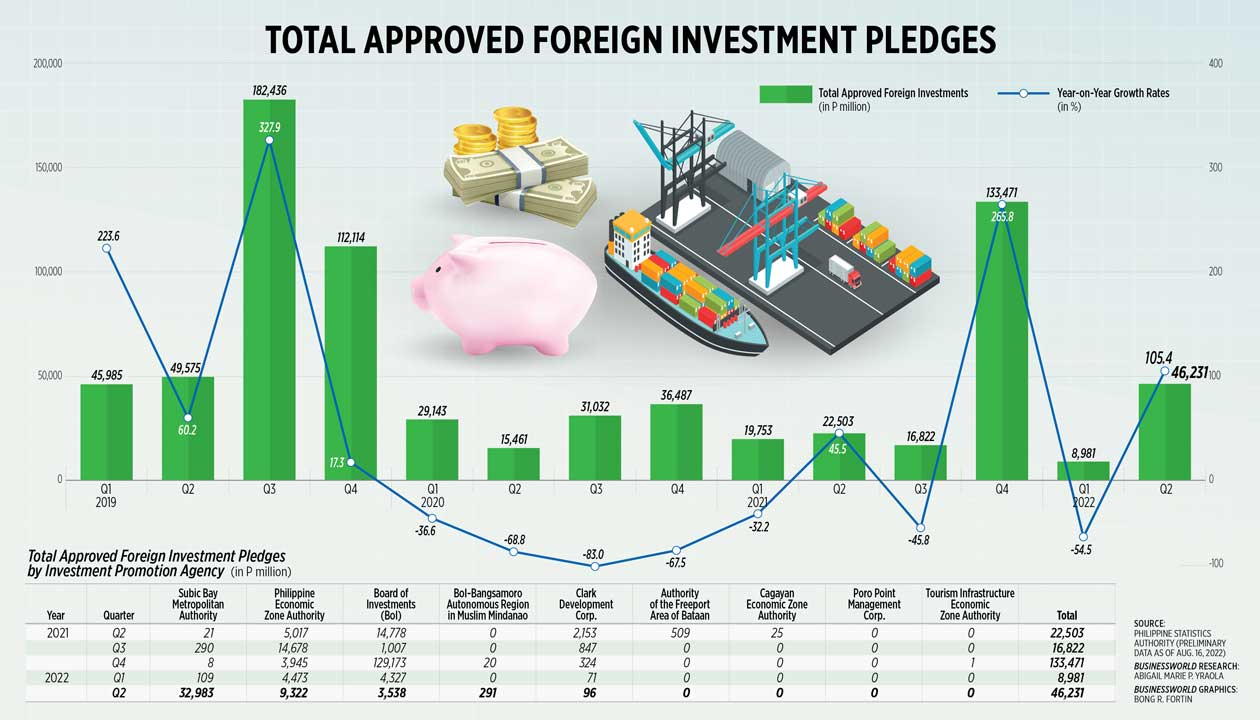
APPROVED foreign investment pledges more than doubled in the second quarter from a year ago, as the Philippine economy continued to reopen amid looser mobility curbs. Read the full story.

TOTAL APPROVED FOREIGN INVESTMENT PLEDGES

Foreign investment pledges double in Q2

THE ORTIGAS business district pictured on Nov. 9, 2021. — PHILIPPINE STAR/ MICHAEL VARCAS

By Abigail Marie P. Yraola, Researcher

APPROVED foreign investment pledges more than doubled in the second quarter from a year ago, as the Philippine economy continued to reopen amid looser mobility curbs.

The value of foreign commitments stood at P46.231 billion in the April to June, up by 105% from P22.503 billion a year earlier, preliminary data from the Philippine Statistics Authority (PSA) showed on Tuesday.

This was the highest since the P133.471 billion recorded in the final three months of 2021.

The second quarter’s triple digit increase was the fastest since the 265.8% growth in the fourth quarter of 2021.

The Netherlands was the biggest source of approved investment pledges in the second quarter at P19.037 billion, followed by Singapore and Japan with commitments worth P15.887 billion and P6.508 billion, respec-tively.

Security Bank Corp. Chief Economist Robert Dan J. Roces said the approved investment pledges bode well for economic recovery.

“Recall that one of the drivers for the 7.4% second-quarter gross domestic product growth was expanded capital formation, with a sizeable contribution from (foreign direct investment),” he said in an e-mail interview.

Preliminary data from the PSA showed the economy expanded by 7.4% in the second quarter, slower than the 12.1% in the same period a year earlier and 8.2% in the first quarter.

“Factors include improved mobility, which allowed for more investments, and better confidence in the Philippine economy,” Mr. Roces said.

Most parts of the country have been under the most lenient Alert Level 1 since March. Economic activity got a lift from easing travel restrictions and election spending.

Asian Institute of Management economist John Paolo R. Rivera also attributed the higher investment pledges to the “renewed optimism for the economy given a new administration and the improvement of the investment climate due to lagged effects of fiscal monetary policy implemented before.”

Ferdinand R. Marcos. Jr. won by a landslide in the May 9 presidential elections, and assumed office on June 30.

REAL ESTATE

The PSA said 41.7% or P19.295 billion of the approved foreign investments would go to real estate activities. Investments in the transportation and storage sector amount to P14.524 billion, followed by manufacturing at P6.154 billion.

In the second quarter, investment commitments were approved by five investment promotion agencies — Board of Investments (BoI), BoI-Bangsamoro Autonomous Region in Muslim Mindanao, Clark Development Corp., Philippine Economic Zone Authority (PEZA), and Subic Bay Metropolitan Authority.

The SBMA approved the bulk or 71.3% of the total, which reached P32.983 billion. PEZA approved commitments worth P9.322 billion, while BoI greenlit P3.538 billion in pledges.

The Poro Point Management Corp. and Tourism Infrastructure Economic Zone Authority did not approve investments for the second quarter of 2022 and 2021.

Nearly three-fourths or P33.935 billion of foreign investment pledges will finance projects in Central Luzon. Central Visayas cornered P3.938 billion or 8.5% of the total, while Calabarzon — the region that comprise Cavite, Laguna, Batangas, Rizal and Quezon — got P3.701 billion or an 8% share.

Should these foreign commitments materialize, these projects will generate 12,626 jobs, 25.8% lower than the projected additional employment of 17,013 in the same quarter in 2021.

Meanwhile, investment pledges by Filipinos hit P53.38 billion in the second quarter.

This brought the total commitments to P99.611 billion, with Filipinos accounting for 53.6% of the total.

If investor sentiment further improves, Mr. Roces said foreign commitments would go up.

“Downside risks remain in regard to global inflation, but lower global commodity prices should provide some relief in the final quarter, and investments should pour in,” he added.

PSA data on foreign investment commitments differ from actual FDIs tracked by the Bangko Sentral ng Pilipinas (BSP) for the balance of payments. The central bank’s monitoring goes beyond the projects and includes other items such as reinvested earnings and lending to Philippine units via their debt instruments.

PEZA INVESTMENTS

Meanwhile, PEZA is targeting to attract more investments from Australia and New Zealand.

“Among the target sectors we’re looking at, the best bets would come from manufacturing and information technology, data centers, telecommunications and agriculture,” PEZA Officer-in-Charge and Tereso O. Panga told reporters on the sidelines of the Pacific Business Mission to the Philippines investment briefing on Tuesday. “Also on mineral processing because of the status of the Philippines being the fifth most mineralized country in the world,”

Delegates from Australia and New Zealand will attend briefings and meet potential developers for the location of their businesses in the Philippines, he said.

“We expect investments to be realized out of this investment mission. They have been working on this since the pandemic and their coming here is surely a sign of their strong interest in investing in the Philippines,” Mr. Panga said.

He said there were 138 Australian enterprises registered with PEZA as of June. The enterprises are involved in shipbuilding, business process outsourcing, call centers, software development, engineering, architectural and other design services.

Some of the top Australian enterprises registered with PEZA include Austal Philippines, ANZ Global Services and Operations (Manila), Inc., RD Environmental Solutions, Inc., Telstra International Philippines, Inc., and QBE Group Shared Ser-vices Ltd. – Philippines Branch.

“These companies contribute P14.632 billion of investments, generate $351.944 million of exports, and created 43,033 direct jobs,” Mr. Panga said.

There were three New Zealand companies registered with PEZA as of June this year, he added. The companies are engaged in rubber and plastic products, business process outsourcing, engineering, architectural, and other design services.

Mr. Panga said PEZA is looking at other countries for potential investment opportunities.

“Other than Australia and Japan, we are reaching out to nontraditional sources of investments and trade. The Regional Comprehensive Economic Partnership (RCEP) members would be a good start like China, Australia and New Zealand. The Middle East also has a good potential as well. Also the European Union because they are looking at the Philippines as their potential base in the region for their logistics hub,” he said.

“The RCEP and other free trade agreements “will diversify the country’s exports in terms of products and services and country destinations and enhance the country’s attractiveness to foreign investments,” he added. — with Revin Mikhael D. Ochave

Marcos may allow food manufacturers to directly import sugar

A vendor repacks sugar at Quinta Market in Quiapo, Manila, Aug. 11, 2022. — PHILIPPINE STAR/EDD GUMBAN

PRESIDENT Ferdinand R. Marcos, Jr. is looking into the possibility of allowing food manufacturers to directly import sugar amid tight domestic supply and high prices.

At the same time, the country’s biggest beverage manufacturers on Tuesday admitted they were having difficulty securing enough supply of premium refined sugar for their products.

“Another area that has to be looked into, the president said, is direct importation by food manufacturers with the approval of the Sugar Regulatory Administration (SRA) as part of emergency measures to address current industry concerns,” Malacañang said in a press release on Tuesday.

Mr. Marcos, who is also Agriculture secretary, raised the idea during a meeting with members of the Philippine Chamber Food Manufacturers, Inc. (PCFMI) on Monday evening.

At the meeting, he underscored the need to boost sugar supply to protect local jobs.

“It has become a worrisome problem. We are doing all of these things to protect the jobs of workers in those industries. So, we are studying several measures that we can take to immediately increase the supply of sugar in the country,” he said.

Mr. Marcos said his government was in talks with traders to bring down sugar prices.

“Hopefully, we can get some concessions with the traders so that at least the pricing will be reasonable,” he said. “The concern is the supply right now. I’ll make sure that there is sufficient supply in the country so that you can operate at full capacity.”

In a statement, Coca Cola Beverage Philippines, Inc., ARC Refreshments Corp. and Pepsi-Cola Products Philippines, Inc. said they were having problems getting enough supply of bottler’s grade sugar.

“We confirm our industry is facing a shortage of premium refined sugar, a key ingredient in many of our products,” they said in a joint statement. “We are working closely with other stakeholders of the industry and the govern-ment to address the situation.”

Mr. Marcos said at the weekend there might be a need to import sugar in October, due to tight supply.

He said the Philippines might only need 150,000 metric tons (MT), half of the 300,000 MT earlier proposed by the SRA.

The SRA has estimated that raw sugar production in the crop year ending Aug. 31 would reach 1.8 million MT, 16% lower than the previous season.

ANOTHER RESIGNATION

Meanwhile, Sugar Regulatory Administration (SRA) chief Hermenegildo R. Serafica has resigned from his post.

In an Aug. 15 letter, Executive Secretary Victor D. Rodriguez said he accepted Mr. Serafica’s resignation on behalf of the president.

Mr. Serafica in a separate statement said he was leaving the post “with a light heart and clear conscience knowing that I performed the functions of my office consistent with, or within the bounds of the law.”

His resignation comes days after Malacañang ordered an investigation into the “unauthorized” signing of Sugar Order No. 4, which would have allowed 300,000 MT of sugar imports.

Mr. Serafica was one of the signatories, along with SRA board member and millers representative Roland B. Beltran and Agriculture Undersecretary Leocadio S. Sebastian, who signed on behalf of Mr. Marcos. Messrs. Beltran and Sebastian also submitted their resignation.

“I signed the document based on the data presented by the SRA. There is a clear indication of the rapidly diminishing supply of sugar,” Mr. Sebastian said at a House of Representatives hearing on Monday.

“I cannot stand watching Filipinos suffer from high local prices of sugar. The food and beverage manufacturing subsector comprises 50% of supply utilization. However, I immediately resigned when I knew the President disapproved of my actions,” he added. — Kyle Aristophere T. Atienza and Luisa Maria Jacinta C. Jocso

Senator proposes legalization of ‘ukay-ukay’

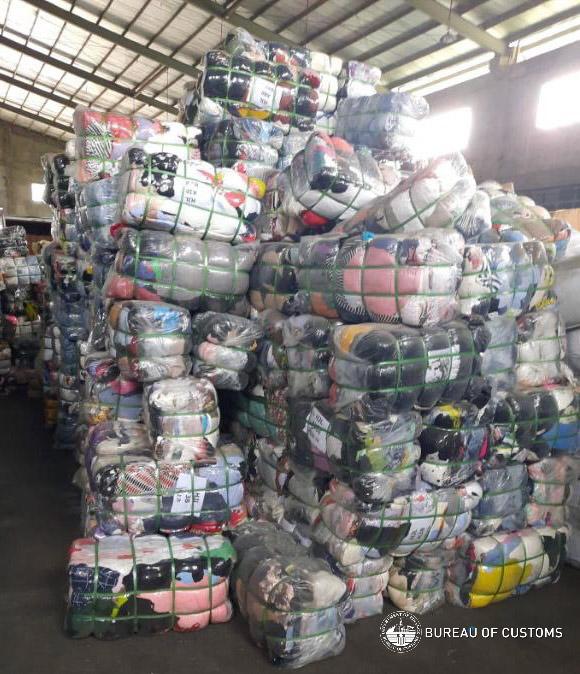
The Bureau of Customs said it seized various counterfeit and used clothing from a warehouse located in Mayzan, Valenzuela City in July.

By Alyssa Nicole O. Tan, Reporter

A SENATOR raised the possibility of legalizing the commercial importation of secondhand garments amid the proliferation of stores illegally selling “ukay-ukay” around the country.

“I think it’s about time, if the Bureau of Customs (BoC) can’t control the importation of ukay-ukay, we make them pay taxes so that the government can earn from this in some way,” Senator Rafael T. Tulfo said in mixed English and Filipino during a Ways and Means Committee hearing on Tuesday.

He questioned the Customs bureau over widespread smuggling of secondhand garments, commonly referred to as ukay-ukay. Republic Act (RA) No. 4654 prohibits commercial importation of used clothing.

“We have been implementing measures against smuggling. In fact, as we heighten and intensify our efforts against smuggling, the smugglers also become more innovative,” Customs Deputy Commissioner Edward James D. Buco told during the hearing.

Mr. Buco noted that several shipments of secondhand clothing have been seized this year, and cases were filed against importers.

However, Mr. Tulfo said that even if BoC fails to detect shipments of secondhand clothes, they should conduct follow-up operations when they see thrift shops.

Senate Ways and Means Committee Chairman Sherwin T. Gatchalian said Customs should coordinate with local government units to address smuggling of secondhand clothing.

“Local governments might not even be informed that these types of operations are not within the bounds of the law,” he said.

Mr. Gatchalian said it may be time to revisit RA 4654, which prohibits imports of used clothing and rags to safeguard public health and the nation’s dignity.

“We cannot fault the retailers for selling ukay-ukay because I don’t think they know it’s illegal. In fact, many of the retailers pay business permits but they sell ukay-ukay,” he added.

Senator Pia S. Cayetano, who heads the Senate Sustainable Development Goals (SDG), Innovation and Futures Thinking Committee, said secondhand clothing promotes “responsible consumption.”

However, she noted some garments might be unusable and are merely thrown away.

Rizal Commercial Banking Corp. Chief Economist Michael L. Ricafort said the taxation of secondhand clothing would help the government generate much-needed revenues.

However, he said many retailers and manufacturers would be hurt by the influx of cheap, used clothing.

“There may be businesses or industries that may be adversely affected by increased competition from these imports such as clothing or apparel manufacturers that may have reservations or opposition in terms of possible job or other business losses,” he told BusinessWorld in a Viber message

“There have also been allegations that some of these have been repurposed or rechanneled from donations or charity, thereby presenting some possible loopholes or complications such as risks of misdeclaration among other issues, as being part of the underground economy,” he added. This will pose a challenge for proper documentation and declaration of imported items.

Domini S. Velasquez, chief economist at China Banking Corp., is not in favor of legalizing imports of secondhand clothing.

“If there are lapses specific to ukay-ukay, these will have to be reviewed and addressed by the proper authorities,” she said told BusinessWorld in a Viber message. “In terms of conducting business within the country, the Bureau of Internal Revenue and LGUs are the proper units that should ensure that businesses pay appropriate taxes.”

John Paolo R. Rivera, an economist at the Asian Institute of Management, said stringent Customs regulations are needed.

“Before you can implement the tax policy, supporting regulations have to be imposed first,” he told BusinessWorld in a Viber message. “Taxing them might require additional layers of policy implementation like business registration and permits. If this cannot be considered, it might be another tax policy that will have issues with collection,” he added.

Marcos is likely to pursue a liberal economic agenda despite protectionist bent — analysts

PHILIPPINE STAR/ KRIZ JOHN ROSALES

DESPITE the president’s protectionist pronouncements, the Marcos administration will likely continue to pursue economic liberalization, analysts said.

This, despite concerns over local firms’ competitiveness in the global market.

“The mainstream thinking within the government, and most definitely within the economic team, is that increased trade and more foreign investments will be the main drivers of our economic recovery and will pave the way for the high growth that is envisioned,” Joseph Purugganan, program coordinator at the think tank Focus on the Global South, said in an e-mail.

“The push to liberalize the economy will continue.”

President Ferdinand R. Marcos, Jr. has vowed to boost local food production and limit imports “as much as possible.” He also promised to work closely with the private sector and make the Philippines an investment destination.

“We consider [his statements] that sound protectionist as populist rhetoric intended to maintain a level of popular support but will not go deep enough,” Mr. Purugganan said.

Despite Mr. Marcos’ plan to boost local production, he has not supported moves to repeal the Rice Tariffication Law, a policy that has been criticized by agricultural stakeholders.

“I think the economic agenda of Marcos Jr. will be shaped by two factors: Restoring his father’s policies as solutions to current problems and continuing the economic agenda of the Duterte administration,” Mr. Purugganan said.

He said he expects Mr. Marcos to “project a firm belief in opening up the economy and letting the corporate sector drive development, while also trying to project a willingness to act and utilize state power, when necessary, particularly in times of emergency or crisis.”

Meanwhile, Mr. Marcos’ agriculture push is now challenged by rising fuel and fertilizer prices.

Duke Ronald R. Cocoto, who teaches economics at the Ateneo de Manila University, said Mr. Marcos might soon view importation as a solution to “quickly ease financial pressure on local consumers amidst elevated inflation” and enhance competition that could force local players to boost the quality of their output.

“In this post-pandemic stage where inflation has been one of the country’s biggest challenges, it could be expected that talks on bills to further liberalize the economy would resume, especially if this would cater to the socioec-onomic agenda of the Marcos administration such as protecting the purchasing power of Filipinos,” he said in a Messenger chat.

Mr. Marcos, who is also Agriculture secretary, has rejected a plan by the Sugar Regulatory Administration (SRA) to allow importation of up to 300,000 metric tons (MT) of raw and refined sugar, which was aimed at easing tight supply and bringing down prices.

In a vlog posted on Sunday, Mr. Marcos said he is open to additional sugar imports of only around 150,000 MT.

RCEP

Mr. Marcos is expected to follow in his predecessor Rodrigo R. Duterte’s footsteps and continue his liberal economic programs.

Trade Secretary Alfredo E. Pascual said last month that the ratification of the Regional Comprehensive Economic Partnership (RCEP) is a priority, even as Mr. Marcos earlier said he wants it reviewed to ensure the agriculture in-dustry is protected.

RCEP is a free trade agreement involving Australia, China, Japan, South Korea, New Zealand, and the 10 members of the Association of Southeast Asian Nations (ASEAN).

“With the ratification of RCEP deemed as a priority, the Marcos administration is expected to strike a balance between protecting certain sectors and opening up the economy especially if it wishes to become an investment destination in Asia while creating quality employment for Filipinos,” Ateneo’s Mr. Cotoco said. — Kyle Aristophere T. Atienza

China ODA best option for 3 railway projects, DoTr says

STOCK PHOTO

THE Department of Transportation (DoTr) considers China’s official development assistance (ODA) to be the “best option” for funding three major railway projects, an official said on Tuesday.

“We are not closing our doors (to) other funders; but right now, the DoTr is thinking that the China ODA is the best option,” Transportation Undersecretary Cesar B. Chavez said in an appearance on One News PH’s Agenda program on Tuesday.

He said that some of the contracts have already been awarded to Chinese contractors.

“China ang magsu-supervise ng Calamba to Daraga, usually hindi sila nagsasama (China will supervise the Calamba to Daraga segment [of the PNR South Long Haul Project], and they typically do not work with contractors from other funders),” he said.

He noted that Japan and the Asian Development Bank (ADB) are currently committed to their own railway projects in the Philippines.

The ADB supports the North–South Commuter Railway project while Japan oversees the Metro Manila Subway project, he said.

The Philippines and China have agreed to resume negotiations on the PNR South Long Haul (PNR Bicol), Subic-Clark Railway, and Mindanao Railway (Tagum-Davao-Digos) projects.

The government recently canceled its loan applications for the three projects because the Chinese government was “unresponsive,” Mr. Chavez said in July.

President Ferdinand R. Marcos, Jr. has directed the DoTr to go back to the negotiating table to secure loan agreements for the three railway projects.

“China is very interested. In our meeting last Thursday (Aug. 11) with the Chinese Ambassador (Huang Xilian), China expressed excitement and interest with regard to pursuing the projects, especially those mentioned by the President,” Mr. Chavez said.

He said the Mindanao Railway project remains a priority.

“The feasibility study has been done. The government has already allotted around P6.5 billion for the acquisition of the right of way,” Mr. Chavez said.

“What we need now is the funding for the construction… There were some concerns before the end of the last administration, and therefore we leave it to the Department of Finance to guide us because they are the ones in charge of applying for the loan, negotiating for the loan, and signing the loan for this project,” he said.

Separately, a senior legislator from the Bicol Region said China remains willing to fund the P142-billion rail link connecting Manila to Bicol.

The government of President Ferdinand R. Marcos, Jr. has also committed to completing the Philippine National Railway South Long Haul Project before 2028, Albay Rep. Jose Ma. Clemente S. Salceda said in a statement.

“Given how much progress has already been made on the Bicol rail, it appears that the best way forward is to just keep the arrangement with China, subject to some changes in interest rates,” he said.

Mr. Salceda said P14 billion in project management consultancy fees have been paid out and could go to waste if the project is scrapped, adding that the government still needs funding for civil works, trains and electromechanical equipment.

“If the Department of Finance decides to (reopen loan negotiations), construction can start very soon after,” he added.

Mr. Salceda, who chairs the House ways and means committee, said Transportation Secretary Jaime J. Bautista had affirmed the Marcos government’s commitment to complete the railway. — Arjay L. Balinbin and Matthew Carl L. Montecillo

DBM procurement service focusing on common-use items after laptop episode

Philstar

THE Procurement Service of the Department of Budget and Management (DBM) said it has suspended the procurement of non-common use supplies and equipment (NCSE) until further notice, and is currently focusing on common-use supplies and equipment (CSE).

The service had come under scrutiny after P2.4 billion worth of laptops acquired for the Department of Education (DepEd) were allegedly overpriced. The laptops were procured to enable teachers to conduct distance learning at the height of the pandemic.

The DepEd laptops, classified as NCSEs, were procured in 2021 and were intended for distribution to 68,500 teachers. The Procurement Service has sought the assistance of the National Bureau of Investigation to investigate the purchase.

“I issued a directive suspending the procurement of non-common use supplies and equipment, effective immediately,” Procurement Service Executive Director Dennis S. Santiago said in a statement issued on Tuesday by the DBM.

“During the suspension, the Procurement Service shall not accept new requests for NCSE procurement until further notice. This will allow us to focus on the fulfillment of our primary mandate, which is to procure CSEs.”

According to the Commission on Audit, NCSEs are goods, materials, and equipment that are required by a procuring entity for a specific project. These are neither common-use supplies nor inventory items.

On the other hand, “CSEs include the procurement of items essential to the day-to-day operations of government agencies such as, but not limited to, ballpens, papers, stapler, paper clips, folders, and the like,” the DBM said.

Mr. Santiago said the Procurement Service will fulfill its outstanding obligations in obtaining NCSEs processed before the suspension.

Tatapusin na lamang po ’yung procurement ng mga non-CSE na ongoing o nasa pipeline na hanggang sa sila’y makumpleto. Pero hanggang doon na lang po iyon. Pagkatapos noon, wala na. Lahat ng procurement, CSE na lang (We will complete the non-CSE transactions in the pipeline, but that will be all. After that, all transactions will be CSE only),” Mr. Santiago said.

The Procurement Service is the central procurement office for CSE items on behalf of the entire government. — Diego Gabriel C. Robles

Post-Mandanas devolution under review for compliance with Local Government Code

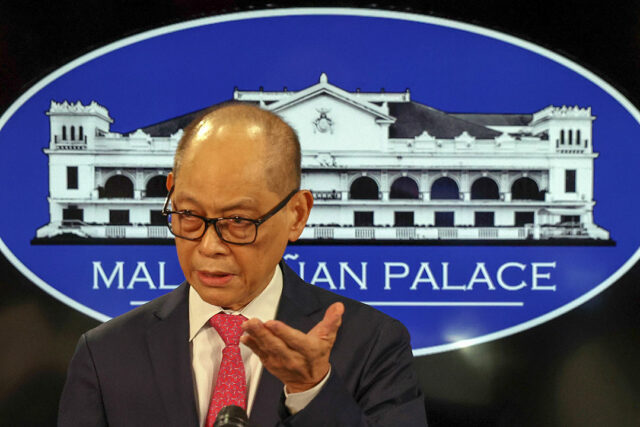
Finance Secretary Benjamin E. Diokno — PHILIPPINE STAR/KRIZ JOHN ROSALES

By Diego Gabriel C. Robles

THE National Government is reviewing plans to devolve some of its functions to local government units (LGUs) amid questions about the exact mandate of LGUs under the Local Government Code, Finance Secretary Benjamin E. Diokno said, while warning that local governments can expect a smaller share of national taxes next year because of the pandemic.

“(The review will prevent the assignment) to LGUs responsibilities that were not originally assigned as a result of the Local Government Code of 1991. For example, research and development (R&D); that should not be assigned to LGUs, right? Maybe some cities can afford it, but a great majority of LGUs cannot afford R&D. Also, education. Education is not assigned to LGUs under the Local Government Code. So why assign them some responsibilities on that?” Mr. Diokno told the Senate committee on local government on Tuesday.

The devolution plan was outlined in Executive Order (EO) 138, issued in June 2021 in response to the Supreme Court’s Mandanas ruling. The Court had ruled that LGUs are entitled to a 40% share of all “national taxes,” over-turning the National Government’s previous interpretation of the Code, which was that LGUs were entitled to a 40% cut of “internal revenue” — effectively, the Bureau of Internal Revenue’s collections only.

The previous administration, facing the prospect of losing access to a significant amount of funds as a result of the ruling, decided to offload P234.4 billion worth of functions to local governments, with EO 138 setting a 2024 terminal date for the devolution exercise.

The 40% share of national taxes, a subsidy to local governments now known as the National Tax Allotment (NTA), is based on the collections of the National Government from three years prior, according to the Local Govern-ment Code. That means the 2023 NTA will be 40% of collections in 2020, the first year of the pandemic, when government revenue took a hit from the lockdowns.

“LGUs… got a bonus or a windfall as a result of the (Mandanas) ruling; they will get a lot of money this year. I think if my recollections (are) correct, an additional hundred billion for this year. However, they will face some prob-lems next year because the formula is based on the collection three years prior, which means, because of the pandemic, collections were down,” Mr. Diokno said at the hearing.

Also at the hearing, Local Government Undersecretary Marlo L. Iringan estimated the impact of the ruling in 2022 as a 37.89% increase in LGU allocations to P959 billion.

“However, given the decrease in revenue collections of the National Government in fiscal year 2020, in view of the impact of the COVID-19 pandemic, the projected total share of LGUs from the national taxes for 2023 will significantly decrease (by) an estimated P138 billion, or equivalent to (a) 14.47% (decline),” Mr. Iringan said in projecting a P820-billion NTA for LGUs next year.

In 2020, the government collected P2.86 trillion in revenue, down 8.97%, as the economy contracted by a record 9.6% due to the lockdowns associated with the pandemic.

Mr. Diokno added that the Madanas ruling “poses a lot of challenges both to the National Government and the local governments. On the part of the National Government, we must recognize that, as a result of the pandemic, public debt has actually increased,” Mr. Diokno said.

The ratio of debt-to-gross domestic product was 62.1% as of the second quarter, above the 60% threshold considered manageable by developing economies. The ratio eased from 63.5% at the end of the first quarter.

“Realistically, because you are giving LGUs more money, the problem pointed out by the World Bank, and I agree, is that many LGUs won’t be able to spend the money. It’s because of the lack of capacity. In fact, even before the crisis, local governments already had a surplus position. They usually have large surplus because they are not able to spend their money,” Mr. Diokno said.

Aside from advocating for LGU digitalization and capacity building, Mr. Diokno said some of the administration’s priority legislation items will “help local government units attain fiscal sustainability.”

These include measures calling for real property valuation and assessment reform, LGU property insurance, and amendments to the Local Government Code of 1991 on local finance.

The amendments for the latter “include simplifying the rate structure of local business tax, revisiting the situs provision, and assigning more revenue productive taxes to LGUs, and providing a mechanism for administrative re-course in case of dispute related to LGU taxing power, among others,” Mr. Diokno said.

Airline fuel surcharge to decline in Sept.

PHILIPPINE AIRLINES (PAL), Cebu Pacific, and AirAsia Philippines said on Tuesday that they will lower their fuel surcharges next month.

The three airlines issued statements following a Civil Aeronautics Board’s (CAB) announcement that it is altering the applicable passenger and cargo fuel surcharge for domestic and international flights to Level 9 from Level 12 in September.

The CAB cited the lower average price of jet fuel (P46.73 per liter) between July 10 and Aug. 9, against the P54.73 average between June 10 and July 9.

“Airlines wishing to impose or collect fuel surcharge (next month) must file their application with this office on or before the effectivity period, with fuel surcharge rates not exceeding (Level 9),” CAB Executive Director Carmelo C. Arcilla said in an advisory issued on Aug. 15.

Level 9 on the CAB matrix permits a fuel surcharge per passenger of between P287 and P839 for domestic flights and between P947.39 and P7,044.27 for international flights.

Currently, the fuel surcharge per passenger runs between P389 and P1,137 for domestic flights and P1,284.40 and P9,550.13 for international flights.

“We welcome this positive development, and we will carry out the corresponding adjustments in our fuel surcharges,” PAL Spokesperson Cielo C. Villaluna said in a phone message.

“The new fuel surcharge rate will be applicable to tickets that will be purchased in September,” she added.

Cebu Pacific Chief Commercial Officer Xander Lao said separately that the budget carrier also welcomes the adjustment in the fuel surcharge policy.

“We look forward to the lower fuel surcharge which should help make fares more affordable and stimulate air travel,” he said in a statement.

Low-cost carrier AirAsia Philippines said: “This will benefit many of our guests who are now planning their travels in time for the ‘Ber’ months.”

“(We) will reflect the adjustments in our ticket prices accordingly,” it added. — Arjay L. Balinbin

Kegel exercises can tame bladder problems

UNSPLASH

MAKING CHANGES in everyday behavior is the first line of therapy for an overactive bladder (OAB), said Dr. Victor Federico B. Acepcion, a urologist and chair of the department of surgery of Capiz Emmanuel Hospital.

You may need to modify what you drink and eat, lose extra weight, or stop smoking, he said at an Aug. 11 session organized by UP Med Webinars.

OAB is the frequent and urgent need to empty one’s bladder. The symptoms of OAB are urinary urgency (a sudden and overwhelming urge to urinate immediately); urinary frequency (urinating more than eight times a day); urge incontinence (urine leakage or wetting accidents that follow a sudden urge to urinate); and nocturia (waking up two or more times at night to urinate).

People with OAB practice bathroom mapping so they know where to go when they feel the symptoms of voiding. They also tend to feel reluctant to travel by car or use public transport — even for short distances.

Many individuals with OAB limit their fluid intake in the hope of alleviating their symptoms, Dr. Acepcion said. Not drinking enough fluids, however, can make one’s urine concentrated, thereby irritating the bladder and causing urinary urgency, urinary frequency, urinary tract infections, dehydration, and constipation.

Dr. Acepcion advised avoiding drinking large amounts at one time — such as with meals — and drinking the majority of one’s fluid intake during the first half of the day, while cutting back as evening approaches.

“During the evening, I advise patients to drink just one glass, maybe for their maintenance medications,” he said.

Also to be avoided are food and beverages that contain bladder irritants, the most common of which is caffeine.

Dr. Acepcion recommended consuming fiber-rich fare, like whole grain bread and fresh fruits, instead of OAB contributors like carbonated drinks, tomato-based products, and alcohol.

BLADDER RETRAINING

Bladder retraining, or the gradual conditioning of the bladder to hold urine for longer periods, is another prescribed therapy, according to Dr. Acepcion.

Because the bladder is controlled by muscles, it can be trained, the National Association for Continence (NAFC) said.

The NAFC advised using a bladder diary to keep a log of details such as one’s fluid intake, the number of times one urinates, the number of wetting accidents and what happens when they occur (e.g., while laughing or sneezing), and diet information.

Specific bladder retraining techniques include visiting the bathroom later than your scheduled time (e.g., going to the bathroom every hour and fifteen minutes instead of every hour) and performing Kegel exercises (which strengthen the pelvic muscles that support the bladder).

A technique for patients to locate their pelvic muscles is by pretending to avoid passing gas, per Harvard Health Publishing. Patients can start doing Kegel exercises by contracting their pelvic muscles for three to five seconds, and then relaxing them for three to five seconds, before repeating the cycle for a total of 10 times.

Harvard Health recommends gradually increasing the length of contractions and relaxations to 10 seconds.

Do not tighten your abdominal muscles at the same time, Dr. Acepcion added, noting that abdominal muscles push urine out rather than hold it in. “When done correctly, all other muscles should relax,” he said. — Patricia B. Mirasol

BTr fully awards T-bonds amid strong demand

BW FILE PHOTO

THE GOVERNMENT fully awarded the reissued 10-year Treasury bonds (T-bonds) it auctioned off on Tuesday at a lower average rate despite expectations of another hike by the central bank.

The Bureau of the Treasury (BTr) on Tuesday raised P35 billion as planned from its offer of reissued 10-year bonds that have a remaining life of nine years and 10 months. Total bids reached P128.83 billion or more than thrice the amount on the auction block.

Rates awarded on Tuesday ranged from 5.785% to 5.87%, bringing the average yield on the bond to 5.813%, lower by 143.70 basis points (bps) than the 7.25% coupon fetched for the series when it was first offered on June 21.

The average rate was also 15.08 bps below the 5.9638% quoted for the 10-year bonds at the secondary market before Tuesday’s auction, based on PHP Bloomberg Valuation Reference Rates data provided by the BTr.

To accommodate the strong demand seen for Tuesday’s offering, the Treasury opened its tap facility to raise P15 billion more via the bonds for a yield-to-maturity of 5.813%.

National Treasurer Rosalia V. de Leon told reporters in a Viber message that it was another “impressive” auction as the market’s preference for long tenors caused the offer to fetch rates lower than second-ary market levels, even with the Bangko Sentral ng Pilipinas (BSP) expected to raise borrowing costs anew at their Thursday meeting.

“Expectations continue to be defied auction after auction. This one was a strong one and that is ahead of a projected 50-bp BSP hike this Thursday,” the first trader said.

“Sentiment has indeed improved for local bonds given the decline in global oil prices, which in turn alleviates inflation fears,” the trader added.

The second trader said the bond’s average yield dropped amid strong demand for the offer despite the looming rate increase from the central bank, with investors likely looking to put their cash in higher-yielding instru-ments amid lingering global uncertainties.

“Investors in this space might be looking beyond this year already as the global growth outlook weakens,” the trader added.

The BSP is widely expected to raise its benchmark rates anew on Thursday, with most analysts forecasting a 50-bp increase as inflation remains elevated.

A BusinessWorld poll held last week showed 16 out of 18 analysts expect the Monetary Board to hike rates at its Aug. 18 meeting.

For 13 analysts, the central bank may deliver a hike of 50 bps, while three analysts see a 25-bp increase. Only two analysts expect the BSP to keep borrowing costs unchanged.

BSP Governor Felipe M. Medalla earlier said that the central bank’s policy-setting Monetary Board may hike rates by 50 bps at their meeting this week as inflation quickened to 6.4% in July, a near four-year high. This was also faster than the 6.1% in June and 3.7% a year ago.

For the first seven months, headline inflation averaged 4.7%, higher than the 4% seen in the same period in 2021 and the central bank’s 2-4% target for the year but lower than its 5% forecast.

The Monetary Board has raised rates by a total of 125 bps since May, including a 75-bp off-cycle hike last month.

Faster inflation continues to cloud the global economic outlook, as Russia’s war in Ukraine, along with supply chain issues, has caused commodity and energy prices to rise and a tightening in financial conditions.

Amid rising prices, most central banks have moved to reverse the ultra-loose monetary policy they adopted during the coronavirus pandemic to support growth, raising fears of a global slowdown.

In particular, the US Federal Reserve has been extra aggressive in raising its benchmark rate from near zero, stoking recession concerns in the world’s largest economy and causing policy spillovers to emerging markets like the Philippines.

The BTr wants to raise P215 billion from the domestic market this month, or P75 billion through Treasury bills and P140 billion via T-bonds.

The government borrows from local and external sources to help fund a budget deficit capped at 7.6% of gross domestic product this year. — D.G.C. Robles

ADVERTISEMENT
ADVERTISEMENT