Home Blog Page 5829

IRR on single-parent benefits issued; law to take effect in Oct.

ADITYA ROMANSA-UNSPLASH

THE Department of Social Welfare and Development said on Thursday that it has issued the implementing rules and regulations (IRR) of the Expanded Solo Parent Act, outlining job benefits that solo parents are entitled to.

Republic Act 11861, which lapsed into law on June 4, provides solo parents additional work leave, scholarship and cash subsidies and priority status in government housing projects.

The law also offers a 20% discount on hospital bills for the parent and child and a 15% discount on school supplies.

It will also grant a 10% discount and an exemption from value-added tax on various goods for children up to six years old.

“We recognize that solo parents are among the vulnerable members of our society,” Gabriela Party-list Rep. Arlene D. Brosas said during the signing of the IRR.

“With the additional benefits provided under this measure, solo parents will at least (be shielded from) the impact of rising prices, huge income losses, and a lack of state support,” Ms. Brosas said, adding that single mothers make up two-thirds of solo parents in the Philippines.

Social Welfare Secretary Erwin T. Tulfo said in a Facebook post that the law’s implementation will start by the end of October. — Matthew Carl L. Montecillo

Singer R. Kelly, already behind bars, ordered to pay victims

SINGER R. Kelly attends Brooklyn’s Federal District Court during the start of his trial in New York, US, August 18, 2021 in a courtroom sketch. — REUTERS

NEW YORK — R. Kelly, the multiplatinum R&B singer convicted twice this year of sex crimes, will be required to pay at least $300,000 in restitution to some of his victims, a federal judge said on Wednesday.

The money will compensate two women, known as Jane and Stephanie, for the costs of therapy and herpes treatment, US District Judge Ann Donnelly said at a hearing in Brooklyn.

That figure is likely to rise after prosecutors recalculate the cost of medication for Stephanie.

Ms. Donnelly denied prosecutors’ requests to compensate Jane for lost income, and provide any compensation to a third victim known as Sonja.

Mr. Kelly attended the hearing via Zoom from a federal prison in Chicago.

Ms. Donnelly sentenced Mr. Kelly in June to 30 years in prison, after a jury convicted him of racketeering and other charges.

Prosecutors said the 55-year-old Mr. Kelly exploited his stardom and wealth over more than two decades to lure women and underage girls into his orbit for sex.

The monthlong trial amplified accusations that had dogged the singer of the Grammy-winning hit “I Believe I Can Fly.”

Mr. Kelly was also convicted last month in Chicago on separate charges of child pornography and luring underage girls for sex.

He is awaiting sentencing in that case, and also faces various state charges in Illinois and Minnesota.

Mr. Kelly, whose full name is Robert Sylvester Kelly, is among the most prominent people convicted of sexual misbehavior during the #MeToo movement against such conduct by prominent men. — Reuters

August ‘hot money’ outflows lowest in 3 months

BW FILE PHOTO

SHORT-TERM foreign investment outflows slowed in August, as the Bangko Sentral ng Pilipinas (BSP) and central banks globally further increased borrowing costs.

Data released by the Philippine central bank showed transactions on foreign investments registered with the BSP through authorized agent banks (AABs) saw a net outflow of $86 million in August, the smallest outflow in three months.

The August figure was 16% lower than the $103-million net outflows recorded in July. It was also a reversal from the $11.5 million net inflows in the same month in 2021.

Foreign investments registered with the BSP through AABs are also known as “hot money” due to the ease with which they enter and exit financial markets. Investors typically want to secure the best short-term rates possible.

“Outflows were lower than the previous month as investors took into account the pivot of the BSP to be more aggressive, with its off-cycle hike in July and another 50-bp (basis point) hike in August,” China Banking Corp. Chief Economist Domini S. Velasquez said in a Viber message.

The Monetary Board has so far raised the benchmark policy rate to 225 basis points (bps) this year, including its surprise 75-bp hike in July and back-to-back 50-bp increases in August and September.

“However, this did not prevent net portfolio outflows from continuing for the fourth month as markets were generally risk-off on emerging economies,” Ms. Domini said.

Gross outflows of hot money increased by 10.4% to $878 million in August from $795 million a year ago.

“Aggressiveness in the monetary tightening cycle in advanced economies and investors’ perception that these economies are safer to invest in, prompted greater outflows from the Philippines,” she added.

The US Federal Reserve has raised rates by 300 bps since March, taking into account its three consecutive 75-bp increases in June, July, and September.

Meanwhile, gross inflows decreased by 1.85% to $792 million in August from $807 million a year earlier.

The top five investor economies during the month are the United Kingdom, United States, Hong Kong, Malaysia, and Luxembourg, which accounted for 82.6% of foreign portfolio investment inflow.

The bulk of investments went to securities of banks; holding companies; property; food, beverage and tobacco; and electricity, energy, power, and water. The rest were invested in peso government securities.

For the eight months to August, foreign investments yielded a net inflow of $539 million, a turnaround from the $434-million net outflows in the same period last year.

“Moving forward, we expect this risk-off sentiment to continue affecting hot money as central banks globally remain hawkish,” Ms. Domini said.

She added that record-high yields in developed countries and financial turmoil might drive investors away from emerging economies such as the Philippines.

The BSP said registration of inward foreign investments delegated to AABs by the BSP is “optional under the rules on foreign exchange transactions.”

The central bank expects hot money to yield a net inflow of $4.5 billion in 2022. — Keisha B. Ta-asan

GM delays return-to-work plans to 2023

REUTERS

GENERAL MOTORS Co. (GM) on Tuesday said it will not mandate workers return to offices before 2023 after it had told them last week that they would be expected to work three days on-campus each week later this year.

The automaker told employees who have been working remotely that it does “not plan to mandate which days of the week will be collaboration days. In no scenario will our Work Appropriately evolution begin before Q1 2023.”

GM on Friday had cited the dramatic improvement in the COVID landscape for the change “to drive the best collaboration, enterprise mindset and impact.”

Many companies are still grappling with how much to require white-collar employees to return to offices. Marriott CEO Anthony Capuano told Reuters last week that the company has no requirements but is “encouraging folks to be here several days a week.”

GM said on Tuesday’s clarification was “based on the dialogue that took place since Friday. We intend to spend the next few weeks continuing to listen to your feedback so that we incorporate it into our implementation plans.”

GM said it would “communicate more information at the end of next month. Between now and then, we continue to ask for constructive dialogue about our culture, collaboration, speed and innovation.”

Thousands of GM workers including hourly workers assembling cars have continued in-person work during COVID-19. — Reuters

AEV, UBP executives trade roles

EXECUTIVES of Aboitiz Equity Ventures, Inc. (AEV) and Union Bank of the Philippines (UBP) will be trading roles as part of the Aboitiz group’s transformation into becoming the country’s first “techglomerate.”

In a press release on Thursday, the firm said that AEV Senior Vice-President and Chief Financial Officer Manuel R. Lozano and UBP Senior Executive Vice President, Treasurer and Head of Global Markets Jose Emmanuel U. Hilado will be trading roles effective next year.

Recently, UBP hired a new treasurer and global markets head to replace incumbent Mr. Hilado beginning Oct. 1, 2022.

Mr. Hilado will then assume the role of UBP’s chief financial officer until Dec. 31, 2022, after which he will transfer to AEV, the firm said.

As he assumes Mr. Lozano’s position, Mr. Hilado will oversee AEV’s treasury, tax advisory and compliance services, finance, accounting and business support, investor relations, and legal and compliance.

Meanwhile, Mr. Lozano will oversee UBP units such as controllership, corporate accounting, tax and insurance, management information system, finance, corporate planning and investor relations, remedial management and asset recovery, business services, and wholesale credit review.

AEV said that as UBP’s chief financial officer, Mr. Lozano will supervise the bank’s finance unit and serve as the chief financial spokesperson for the organization.

“He will be a key player in crafting and implementing the bank’s business strategies as well as working hand in hand with the business units to ensure consistent and superior operating performance,” the firm said.

AEV said that Mr. Lozano will directly report to UBP President and Chief Executive Officer Edwin R. Bautista “with regard to all strategic and tactical matters as they relate to corporate portfolio strategy and capital allocation, budget management, balance sheet management, and tax optimization.”

AEV is the public holding company of the Aboitiz group with major investments in power, banking and financial services, food, infrastructure, and land.

On Thursday, shares in AEV climbed by P1.70 or 3.08% to P56.90 each, while shares in UBP lost P1 or 1.22% to P80.95 apiece. — Justine Irish D. Tabile

Alec Baldwin, others may be charged in October over Rust shooting

ALEC BALDWIN/IMDB.COM

ACTOR Alec Baldwin is among up to four people who may face charges in October for the fatal shooting of cinematographer Halyna Hutchins during filming of the Western Rust in 2021, a New Mexico prosecutor said.

The final police report on the shooting near Santa Fe, New Mexico is expected next month, at which time prosecutors will file criminal charges if warranted, district attorney Mary Carmack-Altwies told the state’s finance board.

Investigators are focusing on the “many individuals” who handled the pistol Mr. Baldwin fired during a rehearsal, killing Ms. Hutchins and injuring director Joel Souza, Ms. Carmack-Altwies said in a letter to the board.

“One of the possible defendants is well-known movie actor Alec Baldwin,” she said in an Aug. 30 letter requesting additional funding to prosecute the high-profile case.

Four jury trials with each defendant charged under some variation of state homicide statutes are possible, Ms. Carmack-Altwies told the board during a Sept. 20 meeting.

The former public defender said her team faced “well-paid and experienced defense lawyers” from Los Angeles and New York and would need to retain a near full-time prosecutor, special investigator, media spokesperson and expert witnesses.

The finance board granted the district attorney’s office $317,750 in funding during the Sept. 20 meeting after it requested $635,500.

Mr. Baldwin has denied responsibility for Ms. Hutchins’ death and said live rounds should never have been allowed onto the set.

His attorney Luke Nikas warned against assumptions Mr. Baldwin would be charged.

“The DA has made clear that she has not received the sheriff’s report or made any decisions about who, if anyone, might be charged in this case,” he said in a statement on Monday. — Reuters

When intuitive decision-making matters

A CLASSIC Harvard Business Review article by Eric Bonabeau entitled “Don’t Trust Your Gut” discusses how intuition plays an important role in decision-making but warns that it can be dangerously unreliable. He noted how research revealed that 45% of corporate executives rely more on instincts than on facts and figures in running their businesses. Detached from rigorous analysis, intuition is a fickle and undependable guide.

Intuition is the ability to have a grasp on a situation or information without the need for conscious reasoning. As Bonabeau describes it, “people have always sought to put their faith in mystical force when confronted with earthly confusion.” Intuition or gut instinct is also known as sixth sense and involves being able to gather information that other individuals may miss.

The allure of intuition lies in its transformative power and the stories of business legends guided by vision and their subconscious mind. It is romantic, even magical. It simplifies complex situations and raises to high stations those who claim to have the capacity for good hunches that pay off. Bruce Henderson, founder of the Boston Consulting Group, calls intuition “the subconscious integration of all the experiences, conditioning, and knowledge of the lifetime, including the culture and emotional biases of the lifetime.”

Finance today has a new school of thought dubbed behavioral finance where understanding the implications of psychological factors reveals some of the potential problems of intuitive decision-making. Errors in information processing can lead to misestimating the true probabilities of possible events and associated returns. The individual’s limited analytical processing capacity can lead to overreaction.

In the analysis of Bonabeau, the problems in information processing make reliance on intuition dangerous. We give disproportionate weight to (a) information confirming not challenging our assumptions; (b) conclusions justifying, not upending, the status quo; and (c) information we receive first, which distorts our interpretation of subsequent data.

Research has revealed our unconscious desire to identify patterns to understand and anticipate the future. The problem here is when a new phenomenon exists, brains try to categorize it based on our previous experience, to fit even when it doesn’t. You’ll likely miss what makes it different and lead to wrong action.

Pattern seeking can cut off or narrow an individual’s thinking too quickly. An intelligent decision-making process requires the explanation of options and alternatives. Intuition seeks immediate closure. Additionally, it masks me-too thinking. In today’s interconnected world, we live in a vast echo chamber where the voice of intuition could simply be the voice that communicates to everyone else. The tendency is to follow the crowd. Intuition could be misleading.

Given all the negatives, should we set aside intuition? Empirically, insights provide important illumination that cannot be ignored. Combine this with the context and circumstances of the situation and it can lead to better outcomes.

Bartleby of The Economist recently wrote that some decisions are more connected to emotional responses and inherently less tractable to analysis.

There are situations in the workplace where instinctive decision-making is the only way to get through the day.

There is danger in over-analysis and planning. Fast thinking, which relies on intuition, can help when overthinking things could lead to what Bartleby calls analytical overshadowing, mulling a simple problem until it turns into a complex one. Intuition becomes more unerring with experience.

Dr. Melanie Greenberg in Psychology Today suggests that the mind should integrate logical thinking with emotional awareness. The wise mind integrates our intuitive reactions with the wisdom of experience and knowledge about the world. Insight brings the courage to see what others don’t. It is key to the eureka moment.

There is no one best approach. Henry Mintzberg and Frances Westley acknowledge that the rationale or think-first model of decision-making needs supplementation. Think-best models assume rationality with one’s capacity to define, gather data, analyze, diagnose, design, and decide. To be effective, we should also embrace intuitive or action-oriented forms of decision-making. There are times when insights from deep knowledge where the subconscious mind prevails can lead to correct action. As Louis Pasteur puts it, “choice favors the prepared mind.”

When to use intuition and how to combine it with deliberative thinking is a skill worth exploring and developing. By being aware of its pitfalls, the different ways of knowing and deciding can be adopted, when needed.

The views expressed herein are his own and does not necessarily reflect the opinion of his office as well as FINEX.


Benel Dela Paz Lagua was previously EVP and chief development officer at the Development Bank of the Philippines. He is an active FINEX member and an advocate of risk-based lending for SMEs.  Today, he is independent director in progressive banks and in some NGOs.

An unpopular manager gets hate mail

I’m the human resource (HR) manager of a factory. Yesterday, a janitor gave me an unsigned open letter he found in a toilet cubicle. It was a poison-pen letter aimed at a department manager notorious for his dictatorial management style. The letter complained about his unreasonable manner of dealing with subordinates. What should I do with it? — Rainbow Connection.

What’s your company policy on these matters? Obviously, you don’t have any because you took the time to seek my advice. Double check the wording of your code of conduct or similar regulations if it can be classed as “disrespecting management authority” or some similar violation.

The problem is, who may be charged in the case of anonymous letters? How far are you willing to go to uncover the author? Have there been similar incidents in the past? What did management do then? This situation calls for serious thought.

First, thank the janitor for his discovery and instruct him to keep it secret. You don’t want the manager to be the subject of rumors spread by a few disgruntled workers even if they have good reason. If there are valid issues between these workers and their manager, then bringing the case out into the open is not advisable.

It may be too late to keep a lid on things, but just the same, do everything you can to prevent any greater damage, not only to the manager but to the whole organization as well.

COURSE OF ACTION
You can’t stop a disgruntled worker or workers from issuing complaints covertly. But a poison-pen letter is always out of line. It’s a level worse than talking about a colleague behind his back.

The letter could be a symptom of bad management, though it is difficult to speculate. Therefore, as an HR manager, you must probe deeper for any underlying issues raised by the letter. The complaint could be exaggerated or baseless. Manage the situation by doing the following:

One, inform the chief executive officer (CEO) or any senior official. Preferably someone who is both in charge of your work and of the manager involved. This is cause for concern and should not be handled at your level, even if you think it’s a minor matter. Tell the CEO or your boss about your initial findings and recommendations.

Clearance from a higher-up will give you the confidence to do your job and ignore some people’s attempts to dismiss an unsigned letter as a non-issue.

Two, review the manager’s work circumstances. If the CEO agrees to proceed with your proposal, round out your information with verifiable records on employee absenteeism, tardiness and turnover rate, including requests for transfers to other departments or branches, among other things.

It’s better to dig down to the past three years to detect any trends and understand context. You might also find revealing information in exit interviews. If the department’s metrics are out of line compared to other departments, consider it a strike against the manager.

Last, confer with the manager. The idea is not to indict, but to share information and allow the manager to give his side. Nothing more than that. However, do note that depending on the manager’s personality, such information-sharing may be misinterpreted, and could even backfire on you if you are perceived as giving importance to a trivial issue.

How might this happen? If your company has a formal whistleblower program where complaints may be filed with no danger of retaliation, you might be seen as giving too much importance to anonymous letters.

PROACTIVE PROGRAMS
Prevention is better than cure. These situations often crop up in the absence or incomplete application of communication programs that are supposed to be managed by the HR department. These programs include the following:

One, corporate-wide employee morale survey. The result may take some time and may not be ready by the time you have to act on the manager’s case. Just the same, consider the survey a regular annual opportunity to be alerted to the need to proactively deal with any issues that may arise.

Two, engagement dialogue between manager and workers. Why wait for exit interviews when managers can talk to people casually. The questions can be as simple as how are you doing? What are the challenges in your job that we can mutually resolve? How can I help you achieve your career goals in this organization?

Three, a quality circle (QC) or any team problem-solving activity. A group activity like this is often branded as ineffective by managers with dictatorial tendencies. But a QC often serves as an alternate grapevine. It is where workers can vent against certain policies or management personalities. If you don’t know this yet, then you could be losing out.


Chat to air out your workplace questions with Rey Elbo on Facebook, LinkedIn or Twitter, e-mail elbonomics@gmail.com or go to https://reyelbo.com


Ayala Land relaunches Parklinks South Tower 

A UNIT of Ayala Land, Inc. recently relaunched its second tower in Parklinks, achieving 17% reservation sales in its first weekend.

Parklinks South Tower, which was originally launched in 2019, is a residential, high-rise tower in Ayala Land’s Parklinks development.

“We just launched Parklinks South Tower just last weekend. And we are already 17% taken up for that second tower. So, we had a very successful launch weekend,” AyalaLand Premiere, Inc. Project Development Manager Cherryl Nera-Uy said during the Parklinks media tour on Wednesday.

The first tower — Parklinks North Tower — was reported to be 80% taken up.

“We have very good sales here in this estate, which really speaks about the confidence our market has in this estate,” Ms. Uy said.

The 4,145-square meter (sq.m.) Parklinks North Tower has 280 units in total, with 55 floors, while the 4,002 sq.m. Parklinks South Tower has 313 units.

Units in the towers can be a one-bedroom unit, which has 70 sq.m., to a four-bedroom unit, which has 306 sq.m. with only four to nine units per floor.

Parklinks North Tower will be turned over in 2025 while Parklinks South Tower is set to be turned over in 2029.

Total potential sales for the first tower are P13 billion, while Ayala Land expects P15 billion in sales for the South Tower.

AyalaLand Premiere said that it has seen an appreciation by 23.2% in capital values for its Parklinks North Tower from P280,000 per sq.m. in late 2018 to P345,000 per sq.m. at present.

The 35-hectare Parklinks is a 50-50 venture between Ayala Land and LT Group, Inc. It is being developed by ALI Eton Property Development Corp. in Brgy. Ugong Norte, Quezon City.

AyalaLand Premiere is a real estate subsidiary of Ayala Land that engages in first-class residential developments offering luxury living. It is also the developer of Parklinks North and South Towers. — Justine Irish D. Tabile

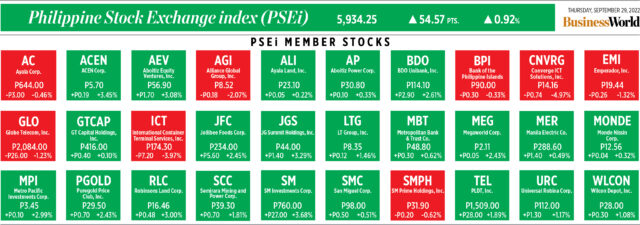
How PSEi member stocks performed — September 29, 2022

Here’s a quick glance at how PSEi stocks fared on Thursday, September 29, 2022.


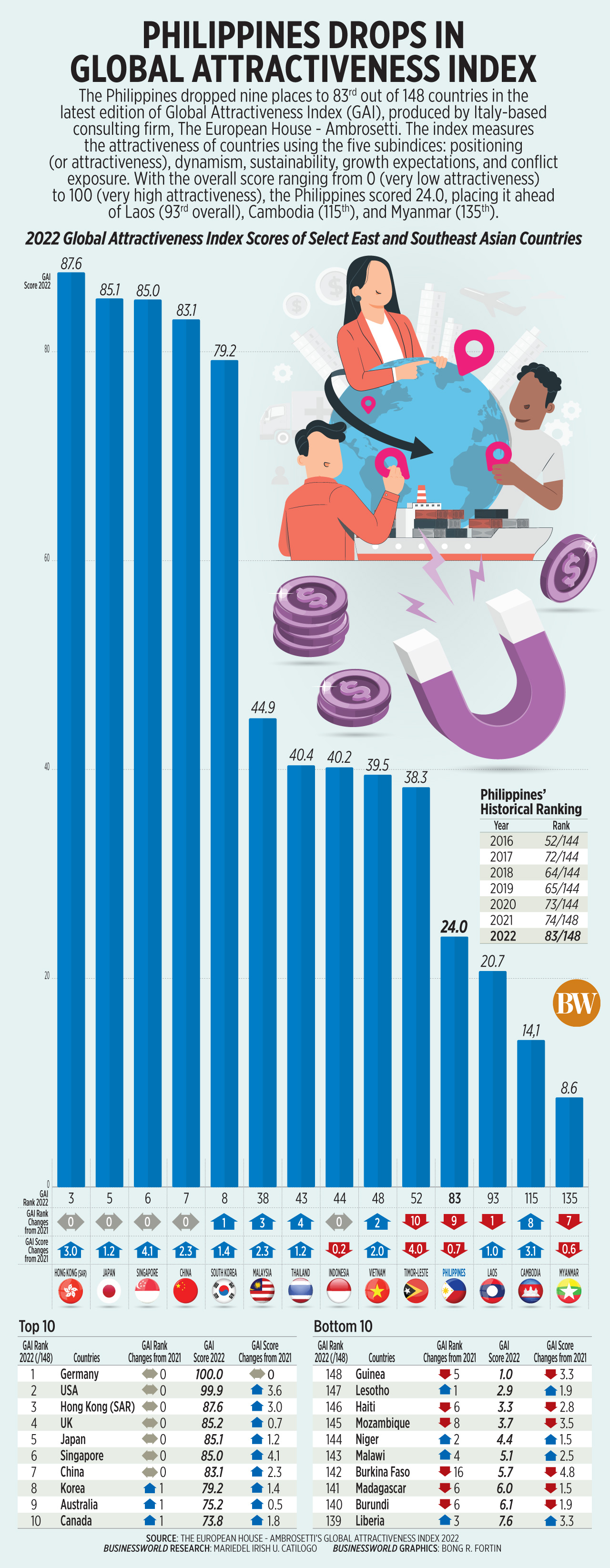
Philippines drops in global attractiveness index

The Philippines dropped nine places to 83rd out of 148 countries in the latest edition of Global Attractiveness Index (GAI), produced by Italy-based consulting firm, The European House – Ambrosetti. The index measures the attractiveness of countries using the five subindices: positioning(or attractiveness), dynamism, sustainability, growth expectations, and conflict exposure. With the overall score ranging from 0 (very low attractiveness) to 100 (very high attractiveness), the Philippines scored 24.0, placing it ahead of Laos (93rd overall), Cambodia (115th), and Myanmar (135th).

Philippines drops in global attractiveness index

Peso closes stronger as dollar demand eases

BW FILE PHOTO

THE PESO appreciated on Thursday as demand for dollars declined due to the Bank of England’s (BoE) emergency action to launch a bond program to avoid a meltdown in the gilts market.

The local unit closed at P58.97 against the greenback on Thursday, gaining one centavo from its P58.98 finish on Wednesday, Bankers Association of the Philippines data showed.

The peso started trading at P58.87 per dollar on Thursday. Its weakest showing was at P59, while its intraday best was at P58.75 versus the greenback.

Dollars exchanged fell to $902 million on Thursday from $1.19 billion on Wednesday.

The peso slightly strengthened due to the effect of the BoE’s intervention through purchases of long-dated bonds, Rizal Commercial Banking Corp. Chief Economist Michael L. Ricafort said in a Viber message.

The BoE said on Wednesday it would start a temporary program of bond purchases to stabilize the market and postpone the planned start of its gilt sale program.

“As the Governor said in his statement on Monday, the Bank is monitoring developments in financial markets very closely in light of the significant repricing of UK and global financial assets,” the BoE said in a statement.

“In line with its financial stability objective, the Bank of England stands ready to restore market functioning and reduce any risks from contagion to credit conditions for UK households and businesses,” it added.

“To achieve this, the Bank will carry out temporary purchases of long-dated UK government bonds from 28 September. The purpose of these purchases will be to restore orderly market conditions.”

MUFG Bank Currency Analyst Sophia Ng in a report said even though this move tamed the volatility in the market, it is seen to be inflationary in nature and may have an impact on the pace and magnitude of subsequent rate hikes.

Ms. Ng said the improvements in risk appetite overnight following the launch of the BoE’s emergency bond-buying program “should bring a reprieve for Asian currencies today.”

The peso also strengthened as the local stock market gained on Thursday, Mr. Ricafort said.

The bellwether Philippine Stock Exchange index climbed by 54.57 points or 0.92% to close at 5,934.25 on Thursday, while the broader all shares index inched up by 25.24 points or 0.79% to 3,190.88.

“The peso [was] slightly stronger after crude oil prices [were] still among 8-month lows,” Mr. Ricafort added.

Brent crude futures fell $1.18 or 1.3% to $88.14 a barrel by 0823 GMT and US crude futures dropped by $1.11 or 1.4% to $81.04.

Both benchmarks rebounded in the previous two sessions from nine-month lows earlier in the week, buoyed by a temporary dive in the dollar index and a larger than expected US fuel inventory drawdown.

For Friday, Mr. Ricafort gave a forecast range of P58.80 to P59 per dollar. — Keisha B. Ta-asan

ADVERTISEMENT
ADVERTISEMENT