Home Blog Page 5749

AboitizLand eyes P1.8B sales from Lipa project

ABOITIZLAND is looking to generate P1.82 billion in sales revenues from a new residential development in Lipa, Batangas.

The real estate unit of the Aboitiz group is developing Meadow Village, the third and most premium enclave of The Villages at Lipa.

David Rafael, AboitizLand president and chief executive officer, said in a statement that the 12-hectare premium residential lot development will generate P1.82 billion in sales revenues from 171 units.
“The launch of Meadow Village could not come at a better time for discerning investors. The Calabarzon region continues to advance in investment prominence with the presence of LIMA Estate in Lipa. And the first central business district in Batangas will soon rise in the Aboitiz-owned smart and future-ready mixed-use economic center,” Mr. Rafael said.

The Meadow Village offers lots sized between 250 up to 1,500 square meters (sq.m.). Future residents can choose “Sunrise” lots that face the east, corner lots with an average size of 417 sq.m., and “Greenbelt” lots that offer landscape views. Also offered are regular lots sized around 302 sq.m. and “Central Park” lots.

AboitizLand said the Villages at Lipa has already seen significant value appreciation for earlier projects, Sierra and Brook Villages, since these were launched in 2019.

Security Bank starts offer of 1.5-year bonds

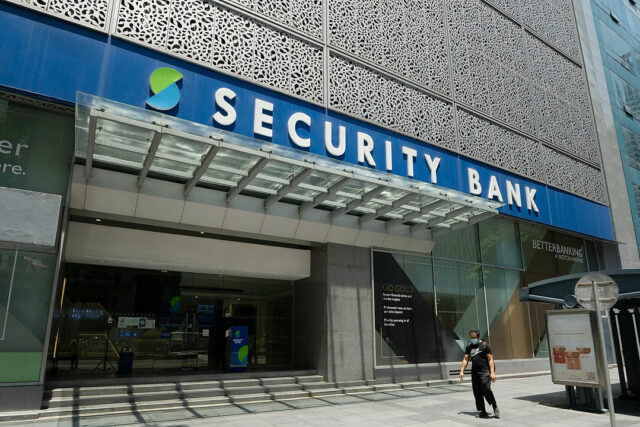
SECURITY BANK/BW FILE PHOTO

SECURITY BANK Corp. (Security Bank) on Monday started an offer of 1.5-year peso-denominated bonds from which it is looking to raise at least P3 billion in fresh funds.

The bonds are being marketed with a fixed rate of 5.3% per annum, Security Bank said in a disclosure to the stock exchange on Monday.

“Proceeds will be used to support the bank’s lending activities and expand its funding base,” the lender said in an e-mail.

The issue size is set at P3 billion with an oversubscription option depending on demand. The bonds will be issued out of Security Bank’s P100-billion peso bond and commercial paper program.

The papers are available to the market for investments starting at P1 million and increments of P100,000 thereafter.

The offer period will run until Oct. 28, unless adjusted by the bank.

Security Bank will list the bonds on the Philippine Dealing and Exchange Corp. on Nov. 10 “to provide secondary market liquidity to investors who would like to trade the instruments,” it said.

The lender tapped Philippine Commercial Capital, Inc. (PCCI) to be the sole bookrunner for the issuance. The joint lead arrangers and selling agents for the transaction are PCCI and SB Capital Investment Corp.

The offering is the Security Bank’s second for the year. The listed bank last tapped the domestic debt market in July, where it raised P16 billion via 1.5-year peso bonds, more than the original plan of P1 billion as the offer was oversubscribed.

The papers were also issued also out of the lender’s P100-billion peso bond and commercial paper program.

Security Bank Executive Vice-President and Financial Markets Segment Head Raul Martin A. Pedro had said that successful issuance and the oversubscription are testaments to investor confidence in the lender.

The lender doubled its bond and commercial paper program to P100 billion in June 2020 from the initial P50 billion when it was established in December 2018 as it wanted to raise more funds for its lending business and to lengthen the maturity of its liabilities.

Security Bank recorded a higher net income in the second quarter of 2022 on the improved performance of its core businesses and lower credit provisions.

The bank booked an attributable net income of P3.52 billion in April-June, up by 139.4% from the P1.47 billion in the same period in 2021.

This brought its attributable net profit for the first half to P6.25 billion, more than double the P3.12 billion seen in the comparable year-ago period.

Security Bank is the country’s ninth largest lender in terms of assets with P796.78 billion and seventh in terms of capital with P123.41 billion as of end-June, based on Bangko Sentral ng Pilipinas data.

Its shares closed at P81.70 apiece on Monday, down by 1.57% or P1.30 from the previous finish. — Keisha B. Ta-asan

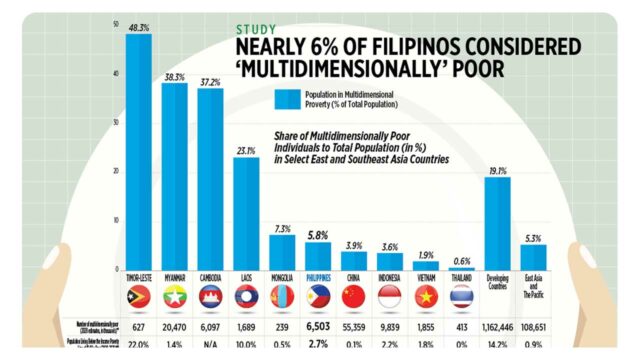
Nearly 6% of Filipinos considered’ multidimensionally’ poor

The share of “multidimensional” poor in the Philippines reached 5.8% in 2020, equivalent to 6.503 million Filipinos, according to the latest estimates from the Global Multidimensional Poverty Index by United Nations and Development Program (UNDP) and Oxford Poverty and Human Development Initiative (OPHI). This was unchanged from 2019. People are considered “multidimensionally” poor if they “suffer from multiple disadvantages” aside from lack of income using 10 indicators* of health, education, and standard of living. The country’s multidimensional poverty incidence was higher than the 2.7% incidence of monetary poverty (or the percentage of those living below the $1.90-per-day poverty threshold under 2011 purchasing power parity terms). This implies that people living above the poverty line could still suffer deprivations in health, education, and standard of living.

Nearly 6% of Filipinos considered’ multidimensionally’ poor

Upson to use eco-friendly packaging in its stores

TECH retailer Upson International Corp. will eliminate single-use plastic and paper bag packaging across its stores as it fully transitions to reusable bags.

“We recognize the need for businesses to help address the challenges facing our world today including global issues such as single-use packaging,” Upson President and Chief Executive Officer Arlene Louisa T. Sy said in a press release.

“We’re taking action, as appropriate, to reduce environmental damage and find new ways to continually make a positive impact for people and the planet,” Ms. Sy added.

The reusable bags are made from non-woven polypropylene which Upson said is more durable than single-use plastics and paper bags and can withstand handling and transport after being used multiple times.

As the production of cotton bags takes less energy, this results in lesser carbon emissions.

“There is also no clear answer on which bag is the best and most sustainable. But we keep working with customers to help reduce packaging waste. To this end, we provide an eco-friendly packaging that is suitable for our products,” Ms. Sy said.

Upson said that according to the Sustainability Accounting Standards Board standards, one of the material sustainability issues for retailers and distributors is the packaging.

This is why companies in the multiline and specialty retail industry are recommended to engage with suppliers in coming up with a strategy that will reduce the environmental impact of the products’ packaging.

According to Upson, among the strategies the retailers and suppliers can employ are optimizing packaging weight and volume and using environment-friendly materials for packaging.

Although the company recognizes the idea that environmental, social, and governance considerations will only become important in the long term, it said that it will continue evaluating the standards as a guide in its governance and reporting.

Upson offers its retail products through its stores: Octagon Computer Superstore, Micro Valley, and Gadget King. — Justine Irish D. Tabile

BTS holds free concert to support South Korea’s bid to host World Expo

REUTERS

SEOUL — K-pop boy band BTS reunited on Saturday for a concert in Busan in support of South Korea’s bid to host the World Expo 2030 in the southern port city.

The free concert — titled BTS <Yet To Come> in BUSAN — drew an audience of about 52,000 people to a stadium, according to the Yonhap News Agency.

A total of 100,000 were expected to visit the stadium and other areas, according to Busan Metropolitan City authorities, with some fans watching the event live on large screens set up at several places around Busan.

The concert followed the seven-member band’s announcement of a break in June from group musical activities to pursue solo projects, raising questions about the band’s future.

With BTS’ oldest member, Jin, who is turning 30 next year, facing South Korea’s mandatory military service, the country’s defense minister said in August that BTS might still be able to perform overseas while serving in the military.

Under a 2019 revision of the law, globally recognized K-pop stars were allowed to put off their service until 30. Military service is hugely controversial in South Korea where all able-bodied men aged between 18 and 28 must fulfill their duties as part of efforts to defend against nuclear-armed North Korea.

“If the seven BTS members feel the same way and if you guys have faith in us, we will overcome whatever happens to us in the future and we will perform with you guys and make music. Please have faith in us,” BTS leader RM told fans during the concert, without elaborating further.

Four countries, including South Korea, Italy, Ukraine, and Saudi Arabia, have submitted competing candidatures to organize World Expo 2030, according to the expo organizing body Bureau International des Expositions (BIE). The host country of the World Expo 2030 is expected to be elected next year.

In July, K-pop sensation BTS was named as the official ambassadors for the World Expo 2030 in Busan, over 300 km southeast of capital Seoul.

BTS made its debut in June 2013 and became a worldwide sensation with its upbeat hits and social campaigns aimed at empowering young people.

Last year, BTS became the first Asian band to win artist of the year at the American Music Awards. The group met US President Joseph R. Biden at the White House in May to discuss hate crimes against Asians. — Reuters

UK housing market shows strains from ‘mini-budget’

REUTERS

LONDON — Britain’s housing market lost momentum this month after Prime Minister Liz Truss’ economic plans upset financial markets and triggered a repricing of the mortgage market, data from property website Rightmove showed on Monday.

Asking prices for homes coming to the market rose by 7.8% year on year in October, the smallest increase since January.

Britain’s housing market had already been showing signs of cooling after a more than 20% surge in prices since the start of the pandemic as the cost of living rose and the Bank of England steadily increased interest rates.

But last month Ms. Truss’ government announced a plan to boost economic growth through unfunded tax cuts that alarmed financial markets.

The turmoil meant some institutions temporarily stopped selling mortgages to new customers, while others ramped up repayment rates for new loans.

Rightmove said the first-time buyer category had been hit hardest by the uncertainty.

“Buyer demand was already starting to soften and higher interest rates were anticipated, but they’ve been brought forward sharply due to market uncertainties,” Tim Bannister, Rightmove director of property science, said.

Rightmove reported a rush of buyers trying to complete sales before mortgage offers fixed at prior lower repayment rates expired.

Mr. Bannister said would-be buyers faced tricky decisions now.

“It’s understandable that some new movers who have the option to wait may want a clearer view than they’re getting right now before they proceed with a major purchase such as a home,” he said.

Rightmove’s index of asking prices, which is not seasonally adjusted, typically falls in November and December. — Reuters

Banks’ credit card receivables post double-digit growth as of July

CREDIT CARD receivables of banks operating in the Philippines posted double-digit growth as of July amid the economy’s continued recovery and growing consumer demand for digital products, the Bangko Sentral ng Pilipinas (BSP) said on Monday.   

BSP Governor Felipe M. Medalla said in his speech during the anniversary event of the Credit Card Association of the Philippines (CCAP) that the growth reflects the collaborative efforts of the credit card industry to ensure a resilient and stable financial system.

“Despite a challenging operating environment, the credit card industry managed to grow its portfolio in a prudent manner. Credit card receivables have started to post double digit growth in 2022, reaching 20.4% year on year in July 2022,” Mr. Medalla said.

He added that the nonperforming loan (NPL) ratio of the industry peaked at 10.1% in November 2020. Latest data from the central bank showed the share of nonperforming credit card receivables in total NPLs stood at 6.76% as of end-June.

BSP Deputy Governor Chuchi G. Fonacier said in a separate speech that the resilience of the industry can also be seen in the double-digit growth of credit card billings.

“Credit card financing has been slowly gaining momentum in line with resumption of economic activities,” Ms. Fonacier said.

She said credit card billings rose by 41.4% annually in June, higher than the 29.5% growth in the same period in 2021.

“The credit card industry has also been at the forefront of extending the BSP’s temporary relief measures to individuals or businesses affected by the COVID-19 (coronavirus disease 2019) crisis,” Ms. Fonacier said.

“Apart from keeping finance charges within the BSP’s ceilings on credit card transactions, the industry led the way in restructuring credit card receivables,” she said.

Majority of restructured consumer loans were credit card receivables worth P6 billion as of end-July, comprising a 56.3% share, Ms. Fonacier said.

“We likewise appreciate the active engagement of CCAP in the BSP’s initiatives, particularly in the regular review of the credit card ceilings. The inputs and feedback of the credit card industry form part of the BSP’s holistic assessment of the appropriateness of the credit card ceilings,” she added.

The central bank earlier imposed an interest rate cap on all credit card transactions to ease the burden of consumers and enterprises affected by the COVID-19 pandemic.

The interest rates or finance charges on the unpaid outstanding credit card balance of a cardholder were capped at 2% per month or 24% per year.

“With demand for digital financial products increasing, there is still a lot of scope for growth in the credit card industry,” Ms. Fonacier said.

“Rest assured that we will continue to work closely together towards the achievement of our shared objective of promoting access to consumer credit through a safe, secure and reliable credit card industry,” she added.

SIM REGISTRATION LAW
Meanwhile, the mandatory registration of all subscriber identity module (SIM) cards in the Philippines will help lessen credit card fraud and eliminate barriers to digital transformation, the BSP and the CCAP said.

“Similar to the call of CCAP, we likewise support the SIM Card Registration Act, which intends to deter the proliferation of SIM card aided crimes such as bank fraud and text scams,” Mr. Medalla said.

“The rampant activities of fraudsters and scammers are compelling reasons for the passage of safeguard registration,” he said, adding that the central bank will continue to work with the CCAP in raising awareness and in protecting consumers.

The SIM Card Registration Act requires buyers of SIM cards to register prior to activation, while those already in circulation will be deactivated unless registered within a set period. The law penalizes the use of false or fictitious information and identities and the use of fraudulent documents in SIM card registration.

There are more than 120 million mobile subscribers in the Philippines, where scams using links in text messages have been rising.

“CCAP has been privileged to have been given the chance to share with the BSP that the clickable links are not the problem, but the people who maliciously use them,” CCAP Chairman Rolando P. Ebreo said.

“With the SIM registration law, we are set, as a nation, to combat that malice and to once again add a layer of protection for our Filipino consumers. It will help mitigate, if not prevent, scam messages that contain links used to lure the victims into giving out their information,” Mr. Ebreo said.

CCAP Executive Director Alex Ilagan said they continue to work with different government authorities to ensure the well-being of their customers.

“Initiatives that ranged from events that focused on the responsible use of credit cards, lobbying for the protection of consumers from smishing attacks, and pursing our strong position on SIM card registration are some of the highlights of the past three years,” Mr. Ilagan said.

He also encouraged more credit card businesses to share best industry practices and engage with the BSP regularly on emerging issues.

The industry should also develop consumer education programs to create awareness on the benefits and risks of using credit cards, he said.

“As the effects of the pandemic linger, CCAP and its members will continue to work together in offering more liberal debt restructuring or forbearance programs to allow cardholders in financial distress repay their obligations and regain good credit standing,” Mr. Ilagan said.

“We look back now and see that the challenges we faced also provided us the opportunity to learn more on how we can be a stronger organization to help our fellow Filipinos,” he added. — K.B. Ta-asan


Overseas Filipinos’ cash remittances (August 2022)

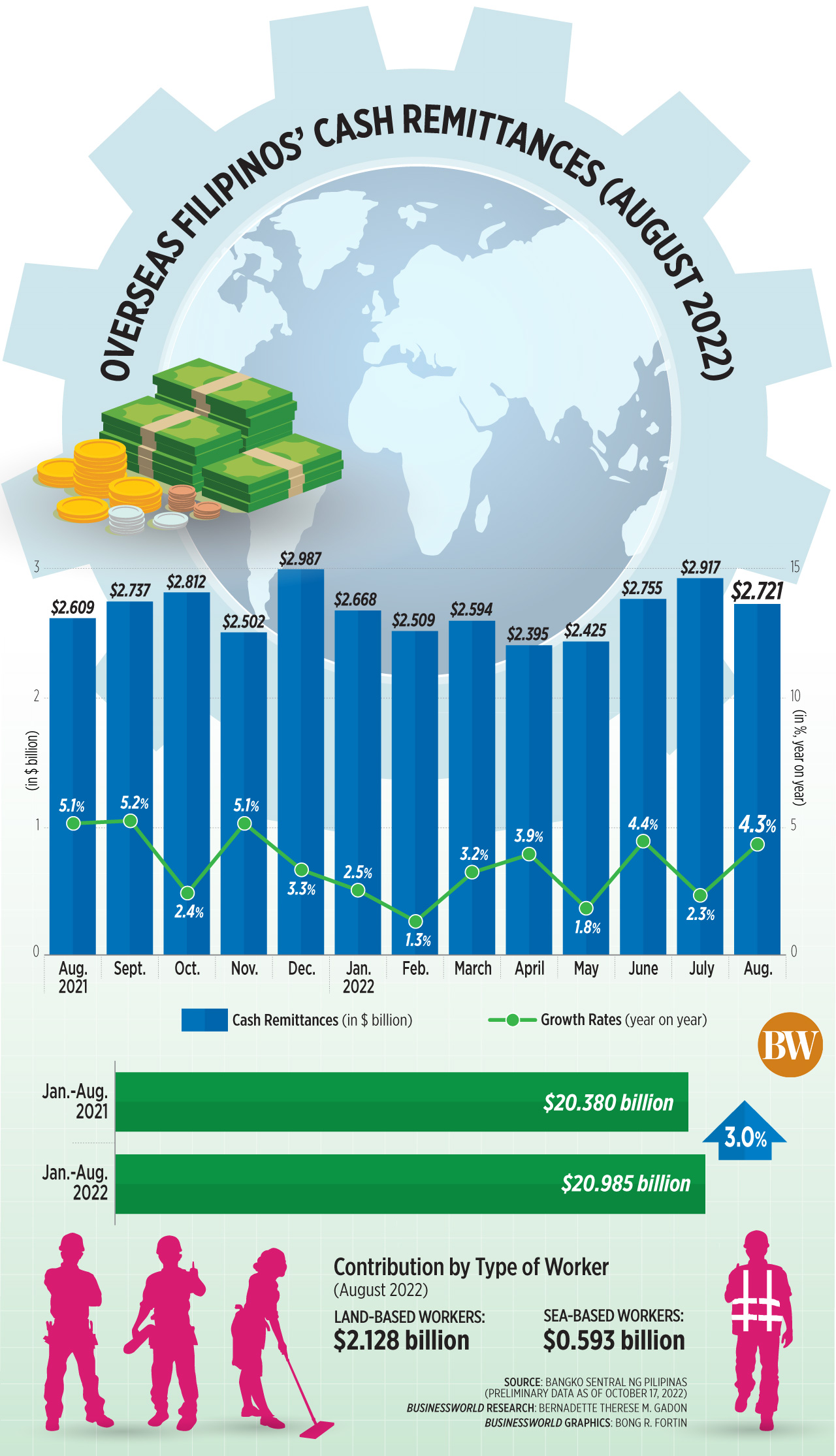
MONEY SENT HOME by overseas Filipino workers (OFWs) jumped 4.3% year on year in August, as migrants took advantage of the peso’s weakness against the US dollar. Read the full story.

Overseas Filipinos’ cash remittances (August 2022)

Century Pacific Food’s brands certified as plastic-neutral

BRANDS under Century Pacific Food, Inc. (CNPF) received “Net Zero Plastic Waste” certification for the second straight year, the firm said on Monday.

To be certified “means that an entity’s plastic footprint is effectively offset by recovering an equivalent amount of plastic waste, preventing it from leaking into nature, and ensuring it is processed safely.”

According to a media release, the brands that were certified are Argentina, Birch Tree, Coco Mama, unMEAT, Hunt’s, Swift, Century Quality Bangus, Angel Coffee Creamer, Wow, Home Pride, and Choco Hero.

“These are CNPF brands that make use of flexible plastic packaging,” the company said.

Meanwhile, the household brands of CNPF like Century and 555, make use of tin and paper for packaging.

The company started managing its plastic footprint in 2019 through the Plastic Credit Exchange (PCX), the world’s first fully integrated plastic offset program.

PCX engages a third-party assurance group, PriceWaterhouseCoopers, to audit the plastic footprint of participating companies and certify their respective offsets.

CNPF brands first received certifications in 2021 and from July 2020 to December 2021, it was able to effectively recover and offset a total of 4,300 metric tons of plastic waste through PCX.

“For manufacturers like us, participating in an offsetting program can be the first step in becoming more responsible for our footprint,” CNPF Executive Vice-President and Chief Operating Officer Gregory H. Banzon said.

Aside from managing its plastic footprint, CNPF’s other initiatives include the launch of the Zero Hunger Alliance and its coconut division’s pursuit of carbon neutrality by 2028.

Its Zero Hunger Alliance in partnership with Gawad Kalinga aims to combat hunger and malnutrition among vulnerable communities nationwide.

Meanwhile, under its carbon neutrality program in partnership with e-payment giant GCash and non-profit impact organization HOPE, CNPF will plant a million coconut trees, which will help with carbon sequestration.

The planted trees “are donated to smallholder coconut farmers in Mindanao, helping their farms become more productive and boosting their incomes.”

On Monday, shares in CNPF climbed by 50 centavos or 2.13% to P24 apiece. — Justine Irish D. Tabile

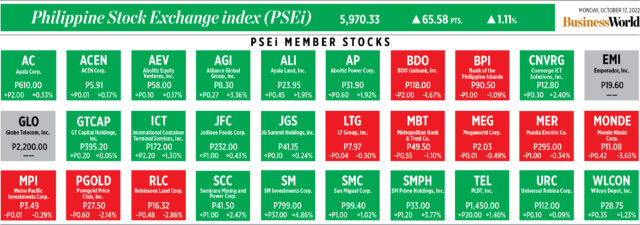
How PSEi member stocks performed — October 17, 2022

Here’s a quick glance at how PSEi stocks fared on Monday, October 17, 2022.


Peso ends at record low vs dollar on hawkish Fed comments

BW FILE PHOTO
THE PESO on Monday ended at its record low against the dollar for the fourth time this month amid hawkish comments from US monetary policy makers. — BW FILE PHOTO

THE PESO on Monday closed at its record low versus the dollar for the fourth time this month after US Federal Reserve officials said the US central bank may hike rates by 75 basis points (bps) at its remaining meetings to curb rising inflation.

The local unit closed at its record low of P59 versus the greenback on Monday, declining by 6.5 centavos from its P58.935 finish on Friday, Bankers Association of the Philippines data showed. This all-time low close was first logged on Oct. 3 and then on Oct. 10 and Oct. 13.

The peso opened Monday’s session at P58.97 against the dollar. Its weakest showing was at its finish of P59, while its intraday best was at P58.92 versus the greenback.

Dollars exchanged decreased to $524.9 million on Monday from $542.8 million on Friday.

“The peso weakened anew after Fed official Bullard hinted at a 75-bp US rate hike in December, stronger than the market consensus of a 50-bp move,” a trader said in an e-mail.

St. Louis Fed President James B. Bullard said on Friday in a Reuters interview that a faster-than-expected US inflation may warrant continued “front-loading” through 75-bp rate hikes at its Nov. 1-2 and Dec. 13-14 meetings.

If the Fed follows through with two more 75-bp hikes this year, its policy rate would end 2022 at a range of 4.50%-4.75%. The Fed has raised borrowing costs by 300 bps since March.

Hawkish statements from other Fed officials last week also caused the peso to decline, Rizal Commercial Banking Corp. Chief Economist Michael L. Ricafort said in a Viber message.

San Francisco Federal Reserve President Mary C. Daly on Wednesday reiterated the US central bank’s commitment to curbing inflation with more rate increases.

Meanwhile, Federal Reserve Bank of Cleveland President Loretta J. Mester said the Fed will need to continue raising rates and keep them high from some time to rein in inflation.

On the other hand, Kansas City Fed President Esther George said on Friday that the US central bank should tighten slowly and steadily allow time for its policy actions to make their way through the economy and minimize market volatility.

During the Fed’s Sept. 20-21 monetary policy meeting, a number of officials “emphasized the cost of taking too little action to bring down inflation likely outweighed the cost of taking too much action.”

Fed officials said it is important to stay the course in fighting inflation “even as the labor market slowed.”

For Tuesday, the trader said the peso might strengthen on potentially upbeat China gross domestic product growth.

The trader expects the local unit to move between P58.80 and P59 versus the dollar, while Mr. Ricafort gave a forecast range of P58.85 to P59. — Keisha B. Ta-asan

Stocks rise on remittance data, bargain hunting

BW FILE PHOTO

LOCAL STOCKS closed higher on Monday following the release of data showing remittances rose in August and on continued bargain hunting.

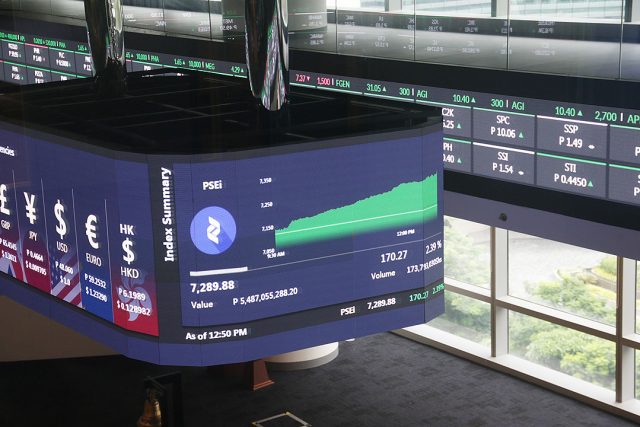
The benchmark Philippine Stock Exchange index (PSEi) went up by 65.58 points or 1.11% to close at 5,970.33 on Monday, while the broader all shares gained 20.89 points or 0.65% to end at 3,198.63.

China Bank Securities Corp. Research Director Rastine Mackie D. Mercado said that the PSEi rallied following strong remittances data.

“The index surges, but volume remains tepid. The PSEi posted a strong rally today ahead of the release of August remittance data. Today’s move may have reflected investors’ optimism on the remittance print,” Mr. Mercado said in an e-mail on Monday.

Data from the Bangko Sentral ng Pilipinas showed cash remittances sent through banks went up by 4.3% to $2.72 billion in August, higher than the $2.60 billion a year earlier. The growth in remittances was the fastest since the 4.4% logged in June.

However, the amount sent home by migrant Filipinos was the lowest in three months or since the $2.43 billion in May.

For the first eight months, cash remittances amounted to $20.985 billion, up 3% from $20.38 billion in the same period last year.

The BSP expects remittances to grow by 4% this year.

Meanwhile, Philstocks Financial, Inc. Research Analyst Claire T. Alviar said the market continued to post gains on bargain hunting. 

“The local bourse bucked the trend of the US markets last Friday. Investors extended bargain hunting, but market participation remains weak,” Ms. Alviar said in a Viber message.

Ms. Alviar said that the index heavyweights also pulled the market higher.

“Philippine shares closed higher with investors bracing for another week of data ahead. There are a handful of speaking engagements from Federal Reserve officials throughout the week,” Regina Capital Development Corp. Head of Sales Luis A. Limlingan said in a Viber message, adding that investors are also awaiting the release of companies’ financial reports.

Most sectoral indices ended higher on Monday. Holding firms went up by 128.11 points or 2.27% to 5,763.54; property rose by 57.45 points or 2.26% to 2,597.20; mining and oil gained 139.47 points or 1.32% to end at 10,651.20; and services climbed by 9.92 points or 0.65% to 1,529.48.

Meanwhile, financials declined by 18.16 points or 1.19% to 1,502.31 and industrials dropped by 7.81 points or 0.09% to 8,693.45.

Value turnover went up to P6.64 billion on Monday with 541.89 million shares changing hands from the P4.65 billion with 443.29 million issues traded on Friday.

Advancers outnumbered decliners, 87 versus 76, while 49 names closed unchanged.

Net foreign selling stood at P36.51 million on Monday versus the P513.21 million in net buying seen on Friday.

China Bank Securities’ Mr. Mercado placed the PSEi’s support 5,830 and resistance at 6,000-6,050. — A.E.O. Jose

ADVERTISEMENT
ADVERTISEMENT