Home Blog Page 5688

Ayala Land to roll out EV hubs in residential estates by next year

AYALA LAND, Inc. will put more focus on its residential estates for the second phase of the rollout of its electric vehicle (EV) charging stations next year.

“We are looking at new sites like the residential because right now we focused on the commercial areas [such as] the community estates, malls, offices, hotels and industrial parks,” Ayala Property Management Corp. (AMCP) Technical Manager Marc V. Magbitang said in a chance interview.

“So, we are looking into our residential properties. That’s our next project,” he added.

According to Mr. Magbitang, Ayala Land is currently studying how the EV hubs’ rollout in the residential estates will work.

“[This is because] a lot of the residents of the Ayala properties are very interested in electric vehicles,” he said.

Meanwhile, Mr. Magbitang said that Ayala Land will wait for the issuance of the Comprehensive Roadmap for the Electric Vehicle Industry (CREVI) next year before it starts the rollout.

“Basically, we will have to wait for the government’s directive, for the CREVI,” he said.

The Department of Energy (DoE) with partner agencies — Department of Transportation, Department of Trade and Industry, and Department of Science and Technology — will be issuing the CREVI by the first quarter of next year.

CREVI, with its aim of promoting EV use in the country, will outline the annual targets in line with the DoE’s vision of the country becoming a full EV society by 2040.

Ayala Land recently rolled out the first phase of its EV charging hub rollout with more than 20 charging hubs activated across its estates in seven cities in Luzon.

To finish the first phase, Ayala Land is looking to complete the ones in Vermosa Cavite, Circuit Makati, and Laguna Technopark before the year ends.

Ayala Land has committed to becoming net zero by 2050 or to reduce its greenhouse gas emissions possibly close to zero. — Justine Irish D. Tabile

Entertainment News (11/01/22)

INDIE-folk band The Ransom Collective (TRC)

The Ransom Collective releases comeback single

INDIE-folk band The Ransom Collective (TRC) has released its comeback single titled “3 AM” — its first song release in over three years. Composed of Kian Ransom (main vocals, guitar), Redd Claudio (drums), Jermaine Choa Peck (percussions, vocals), Leah Halili (bass, vocals), Lily Gonzales (keyboards, vocals), and Muriel Gonzales (violin, vocals), TRC remained solid in spite of being apart for the past few years since some of them decided to leave the country. According to the group, the song outlines a journey from resistance to acceptance, touching on the struggles of letting go, and the triumph and growth that eventually come out of the process. The band plans to reunite and play live shows again next year. “3 AM” is available on all digital platforms under Mustard Music, a Universal Records Philippines sub-label.


Maria Clara at Ibarra now livestreamed

THE PORTAL fantasy series Maria Clara at Ibarra will now be livestreamed exclusively on GMA Network’s official website. Fans of the show, which is set within the story of Jose Rizal’s novels Noli Me Tangere and El Filibusterismo, may catch the show at any time via the Kapuso Stream on GMANetwork.com (www.gmanetwork.com/entertainment/tv/kapuso_stream/videos/). Barbie Forteza plays Klay, a 21st century woman who is transported to the 19th century and now works as a house helper of Ibarra (played by Dennis Trillo) and she finds herself slowly falling in love with him. His fiancé Maria Clara (Julie Anne San Jose) is becoming more curious and jealous of Klay, the mystery woman and so-called cousin of Ibarra. Maria Clara at Ibarra airs weeknights on GMA at 8 p.m. and on GTV at 9:40 p.m.


Malaysian singer tackles depression in new single

MALAYSIA-based singer-songwriter liesl-mae reflects on her struggles with mental health in her new single, “Raincloud.” Addressing the cyclical nature of depression and its effects, the young artist hopes to engage in a discussion to dismantle the social stigmas surrounding mental health. On writing about mental health, a topic she handles with care and consideration, liesl-mae approaches “Raincloud” as if it were an “open letter to depression,” steering clear of accusatory language or being overly critical of herself. “For the first time, I channeled anger into my music… [It’s] an emotion I’m not used to outwardly expressing,” the artist said in a statement. “Raincloud” is now available on all digital music platforms via OFFMUTE.


Araneta City kicks off Christmas season

KICKING off its celebration of the holiday season, Araneta City lights up its iconic giant Christmas tree — all 100 feet of it — in a star-studded celebration on Oct. 28. This year, the giant Christmas tree sparkles in mostly red and gold, is adorned with 3,000 LED bulbs, 2,000 Christmas balls, 100 hot air balloon ornaments, 1,000 pine garlands, and other Christmas ornaments. Apart from the giant Christmas tree, two classic Christmas attractions in Araneta City — the Christmas on Display and Fiesta Carnival — will make a comeback this year. The traditional outdoor Christmas on Display features life-size animated mannequins portraying the classic story of the Nativity. Meanwhile Fiesta Carnival, once a popular amusement theme park, now has modern carnival rides and attractions. “Araneta City is a place of memorable Christmas nostalgia. As we revive COD and Fiesta Carnival that the batang ‘70s to ‘90s used to enjoy, we want the City of First to bring the most joy and excitement to people even to the younger generations,” Marjorie Go, AVP for Marketing of Araneta City, said. Araneta City’s Christmas on Display and Fiesta Carnival will open in November.


Post-Halloween special: Midnight Series @QCinema

AS A SPECIAL treat for lovers of genre and fantasy movies, QCinema is relaunching its Midnight Series section with three spine-tingling titles. First introduced in 2017, the section offers chills and thrills for its late-night festival screenings. To be screened is Lorcan Finnegan’s psychological thriller Nocebo, the first co-production of Ireland and the Philippines, with Epic Media and Film Development Council of the Philippines as co-producers. The film focuses on a fashion designer (Eva Green), who’s suffering from a mysterious illness. A Filipino caregiver, played by Chai Fonacier, arrives and soon offers traditional folk healing. The immediate recovery of Ms. Green’s character soon leads to a revelation of a horrifying truth. The second film is the Spanish-language supernatural thriller, Huesera, starring Mexican actress Natalia Solian as a woman who finds herself pregnant and is soon threatened by occult forces. British-Iranian director Ana Lily Amirpour returns to local screens with her latest cult hit, Mona Lisa and the Blood Moon, starring Kate Hudson and Jun Jong-seo. Korean star, Jong-seo, plays a girl with unusual powers who escapes from a mental asylum. A chance encounter with Ms. Hudson’s prostitute character soon gives way to a strange alliance, as they go on a crime spree, roaming neon-streaked New Orleans streets. QCinema film festival will run from Nov. 17-26.


Season 2 of Gossip Girl arrives Dec. 1

THE SECOND season of the Max Original Gossip Girl debuts on Dec. 1, available to stream on HBO GO. Developed by showrunner Joshua Safran, a writer and executive producer on the original series, the new series is based on the bestselling novels by Cecily von Ziegesar and the original show, developed by Josh Schwartz and Stephanie Savage. It’s the second semester of Junior year, and Gossip Girl is leaving no stone unturned in her effort to control the scandalous lives/spin the scandalous lies of Manhattan’s elite. She’s learned what her audience wants, they shall get, and will turn the heat up on what’s been simmering as well as look at her own impact, and how she can make it more catastrophic than it was before. The cast of Season 2 includes Jordan Alexander, Eli Brown, Thomas Doherty, Tavi Gevinson, Emily Alyn Lind, Evan Mock, Zion Moreno, Whitney Peak, Savannah Lee Smith, and Grace Duah. Michelle Trachtenberg guest stars. Stream or download Gossip Girl Season 1, which debuted in July 2021, on HBO GO (https://www.hbogoasia.ph/).

RHB aims to launch digital bank in 2023

RHB Bank Bhd. plans to introduce its digital banking platform as early as the second half of next year, its top executive said, as Malaysia’s fifth-biggest lender looks to hold back a tide of fintech startups.

The bank and its partner Boost, an arm of communications giant Axiata Group Bhd., could invest as much as one billion ringgit ($212 million) in the venture, RHB’s Chief Executive Officer Mohd Rashid Mohamad said in an interview at his office in Kuala Lumpur. Boost and RHB were among five groups that won digital bank licenses from Bank Negara Malaysia, the country’s central bank, in April. The others chosen include ventures led by Singaporean tech firms Grab Holdings Ltd. and Sea Ltd.

“We plan to launch the digital bank in the second half of next year or latest by the first quarter of 2024,” said Mr. Rashid, who assumed his current role in April. The other four license holders haven’t given a timeline on their rollout.

Established firms like RHB are facing pressure from fintech upstarts that move quickly to embrace new technology and are often more willing to burn through piles of cash to peel away their clients.

Asked why the digital bank will have such a long gestation period, Mr. Rashid said, “We are building the digital bank from scratch. We need to put up a new core banking system and infrastructure product proposition that are in line with Bank Negara’s requirements.” 

SERVING THE UNBANKED
For Malaysia’s central bank, the licenses are an opportunity to encourage lenders to help people outside the traditional banking system to have access to credit and more chances to build wealth.

Through the digital bank, RHB hopes to expand its business to include the “unserved and underserved community” by providing financing as well as a host of banking services. “We will be using more of AI and technologies to assess their credit based on the data points and models that we have put in place.”

RHB is also looking to spread its digitization push beyond Malaysia to the rest of Southeast Asia, home to more than 650 million people. The lender aims to launch a mobile app offering full banking services in Cambodia later this year, pending regulatory approval, as it seeks to position itself among the top 10 banks in the country, Mr. Rashid said.

The international business contributed 9% to pretax profit in the first half of this year versus 3% in 2021, Mr. Rashid said, adding that RHB aims to have the segment accounting for 15% of pretax earnings by 2024. For Cambodia, Singapore and Indonesia — its three key markets — the group expects to have 1,379 employees by the end of this year, up from 1,230 as of the end of 2021, he said.

In Singapore, RHB plans to expand its corporate and wealth management business while in Indonesia, it will focus on capital market activities and to be in the top 10 stockbroking firms there by 2024, Mr. Rashid said.

The lender also has a presence in Thailand, Brunei, Vietnam and Laos. — Bloomberg

As rents continue to soar in Singapore, expatriates in Hong Kong bag bargains

THE FINANCIAL DISTRICT is seen shrouded by haze in Singapore, Sept. 18, 2019. — REUTERS/FELINE LIM

THE rental markets of rival Asian financial hubs Hong Kong and Singapore have run into a pronounced reversal of fortunes.

Rents of prime accommodation in Singapore, typically favored by expatriates, have surged to the highest in over a decade, closing the gap with notoriously costly Hong Kong. The city-state is set for further gains as the country reopens and foreigners flood the market, including Hong Kong residents who have left due to the city’s crackdown on coronavirus disease 2019 (COVID-19) and civil liberties.

Hong Kong’s prime rents fell for the first time in two years as the mass exodus left landlords struggling to find tenants. Rentals dipped 2.1% in the second quarter compared with a year ago, underscoring the effect of prolonged border closures on expats, who have been the major source of rental demand in Hong Kong, according to a Knight Frank report.

Hong Kong’s rents are an outlier among global cities. From New York to London, rents have jumped on a tight supply, while higher mortgage rates have strained affordability, making it more difficult for renters to move into home ownership.

These factors, coupled with the influx of expats and wealthy immigrants, sent rents in Singapore soaring almost 31% in September compared to a year ago, according to data from real estate portals 99.co and SRX.

Still, while rents are falling in Hong Kong, it remains the world’s most expensive city for expats.

A fully furnished two-bedroom 1000-square-foot (93 square meters) apartment in Orchard, Singapore is leased at about $5,600 a month, PropertyGuru data show. In Mid Levels, Hong Kong, a similar property goes for $7,500 a month, according to real estate platform Spacious.

FLOCKING TO SINGAPORE
Singapore’s rising rents have not dampened demand. When tech consultant Mark Haynes moved his family from Hong Kong for a job opportunity, he did not hesitate to sign a S$7,000 ($4,900) a month, one-year lease for a two-bedroom privately owned apartment close to the central business district.

“We were outbid four times,” said the 56-year-old. “We didn’t negotiate anymore and took the next available one; couldn’t take the chance.”

Foreigners are not the only group exiting Hong Kong.

Hong Kong local Kelly Ho, 33, moved with her logistics worker husband and daughter in December last year into a one-bedroom privately owned suburban flat for S$2,300 a month.

Anecdotally, there has been an increase in demand for Singapore rental units from those born in Hong Kong and expats who used to live there, said Nicholas Mak, head of research and consultancy at APAC Realty Ltd. unit ERA.

Some relocated with their companies, while others chose Singapore for its reputable international schools and cultural similarities, he added.

Expats from Hong Kong are expected to be Singapore’s key source of rental demand, Knight Frank said in a separate report. They rent homes while they wait for permanent residency or citizenship, it added.

That includes Ms. Ho, who wants to stay in the country for good. There is “no more freedom,” she said, citing Beijing’s tightening political grip on Hong Kong.

Arrivals from other countries are just one side of the picture to Singapore’s surging rents. Property curbs introduced by authorities in September to cool the buoyant housing market may also cause more people to rent.

The rental market may remain strong for at least six to nine months, until an increase in home supply brings some relief next year, said Mr. Mak.

EMPTY HOMES
It’s a different story in Hong Kong, where the exodus of residents intensified this year.

The outlook is negative toward the yearend, said James Fisher, chief operating officer at Spacious. “We did see a bit of demand increase, but I think this is a seasonal or short term benefit from reduction in quarantine restrictions and not enough to cover all the inventory out there.”

In Hong Kong, areas popular with expats are among the locations with the biggest fall in rents since their peak in mid-2019, Spacious data show. The Poho area above Sheung Wan and south of Lantau Island saw rental values drop by more than 20% since then.

Hong Kong Chief Executive John Lee earlier this month announced plans to woo back foreign talent. This includes cutting property duties for non-permanent residents and relaxing visa rules to reverse a brain drain prompted by isolationist COVID-19 policies and a crackdown on political dissent. The city faces mounting competition from Singapore as a regional hub for global business and talent.

The new initiatives will help, but without a timeline to lift the remaining  COVID-19 curbs and return to pre-pandemic norms, “regaining ground lost during the pandemic to Singapore and other rivals will take time,” said Bloomberg economist Eric Zhu in a note.

In the meantime, some expats, mainly finance executives, who have been in Hong Kong since before the pandemic are taking advantage of the current low rents in areas such as Mid Levels and the Peak, said Centaline Property Agency Ltd. broker Matthew Kwong.

For instance, an expat signed a lease for a four-bedroom penthouse in Mid Levels for HK$80,000 ($10,200) in September, he said. Before the pandemic, the lease would have been HK$100,000. — Bloomberg

PT&T losses shrink to P26.7M after cutting expenses 

LISTED telecommunications services provider Philippine Telegraph and Telephone Corp. (PT&T) said it managed to reduce its losses for the nine months to September by reducing expenses.

PT&T’s net loss for the nine-month period was P26.7 million, lower than the previous year’s net loss of P40.53 million, the company’s latest financial report shows.

This is “due to savings in non-core expenses,” it noted. “Additional expenses such as recognition of the legal interest rate of 6% per annum on unsettled obligations, as directed by the Rehabilitation Court, and rehab-related expenses affected the net loss for the period,” it added.

Revenue for the period reached P411.22 million, up 18.5% from P347.1 million in the same period last year.

For the nine-month period, the company’s operating revenue from broadband reached P409.3 million, a 19.9% increase over its performance last year.

“Activities for the broadband group included street-level saturations on major nodes, optimization of existing infrastructure in commercial buildings and establishments, and account management of existing subscribers,” the company said.

PT&T noted that its personnel-related expenses for the period amounted to P179.1 million, 8.3% higher than the previous year’s P165.3 million, “as the company prepares its workforce in sustaining growth in connectivity and IT services despite the ongoing pandemic.”

“Due to the implementation of work-from-home arrangement and skeletal workforce last year, premises-related expenses increased to P30.4 million from P27.9 million in the comparative period,” it added.

Meanwhile, selling, general, and administrative expenses went beyond last year’s level from P46.7 million to P52.1 million, together with cost of sales from P50.4 million to P84 million.

“This increase indicates the company’s ability to adapt to the pandemic by investing in operations to support its growing business. The increase in operating costs and expenses is aligned with the company’s strategy and is necessary to sustain its businesses,” PT&T said

For the third quarter, the company reduced its net loss to P10.22 million from a loss of P13.96 million in the same period last year.

Revenue for the period reached P136.11 million, up 13.4% from P120.02 million previously.

Third-quarter expenses increased 6.06% to P141.31 million from P133.24 million in the same period last year.

“The company holds an optimistic view on the Philippines’ broadband industry through our efforts to improve coverage and spur subscriber growth,” PT&T said.

“PT&T aims to expand coverage and upgrade its network infrastructure which will help to cope with the growing demand and ensure that network congestion would be minimized,” it added. — Arjay L. Balinbin

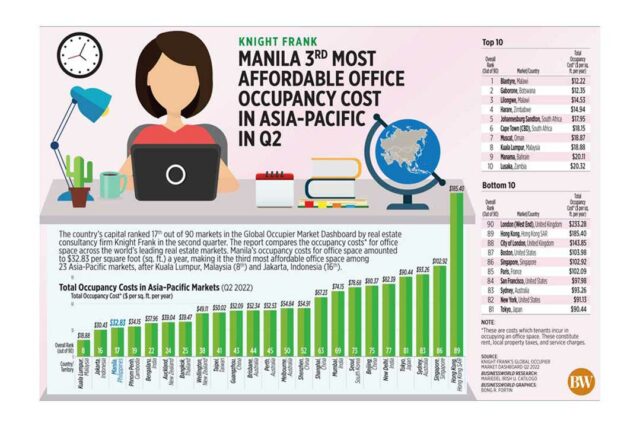
Manila 3rd most affordable office occupancy cost in Asia-Pacific in Q2

The country’s capital ranked 17th out of 90 markets in the Global Occupier Market Dashboard by real estate consultancy firm Knight Frank in the second quarter. The report compares the occupancy costs* for office space across the world’s leading real estate markets. Manila’s occupancy costs for office space amounted to $32.83 per square foot (sq. ft.) a year, making it the third most affordable office space among 23 Asia-Pacific markets, after Kuala Lumpur, Malaysia (8th) and Jakarta, Indonesia (16th).

Manila 3<sup>rd</sup> most affordable office occupancy cost in Asia-Pacific in Q2

PSEi rises in Oct. as month-end rally lifts market

BW FILE PHOTO

PHILIPPINE SHARES rose month on month in October despite being in the 5,000 level in its first two weeks amid worries over the US central bank’s tightening path, rebounding from a decline in September.

The Philippine Stock Exchange index (PSEi) closed at 6,153.43 on Oct. 28, the last trading day of October, up by 7.18% from its Sept. 30 finish of 5,741.07.

“For October, the PSEi already gained by 7.2% for the month, after declining by 12.6% in September 2022,” Rizal Commercial Banking Corp. Chief Economist Michael L. Ricafort said in a Viber message on Friday.

The PSEi’s month-on-month gain came even as it traded below the 6,000 mark from Oct. 3 to Oct. 17, as well as on Oct. 21, amid recession fears due to the US Federal Reserve’s aggressive rate hike cycle and inflation concerns here and abroad.

Towards the end of the month, the index rebounded on bargain hunting and as investors took positions ahead of the release of firms’ third-quarter financial results.

Still, for the year so far, the benchmark index has declined by 13.61% from its Dec. 31, 2021 close of 7,122.63.

For this month, COL Investment Management, Inc. President Marvin V. Fausto said investors will remain cautious due to the policy meetings of the Fed on Nov. 1-2 and of the Bangko Sentral ng Pilipinas (BSP) on Nov. 17.

“For the rest of November, investors and traders will be watching for signs that inflation is decelerating and will gauge the resolve of central bankers in terms of their commitment to stick with tightening monetary policy,” Mr. Fausto said in an e-mail on Friday.

“We look forward to a better fourth quarter since from a seasonality perspective, fourth quarter the best performing quarter for Philippine equities,” he added.

China Bank Securities Corp. Research Director Rastine Mackie D. Mercado said earnings will continue to drive trading for the first two weeks of this month, with firms expected to release their results until Nov. 15.

“On the 10th, 3rd quarter GDP (gross domestic product) will be reported, and while expectations have been tempered the print will give funds a bigger sense of the impact of policy tightening and will be a guide to better project,” online brokerage 2TradeAsia.com said in a market note.

“Mid-November, another round of Fed rate hikes is anticipated. the BSP is expected to mirror the Fed on the 17th to protect the peso,” 2TradeAsia.com said. “Expect November to pull investor focus in multiple directions, given macro events unfolding for the month. The US midterm elections on the 8th, while not groundbreaking, might cause some volatility especially if the US chambers.”

Meanwhile, Mr. Ricafort said the PSEi may be lifted by window-dressing activities ahead of the year’s close. — AEOJ

Analysts: Brazil polls may inspire Pinoy opposition

PHILIPPINE STAR/ WALTER BOLLOZOS

By Kyle Aristophere T. Atienza, Reporter

PHILIPPINE opposition forces that include leftists and moderates should expand their constituency-building efforts now to give themselves a fighting chance against the resurgence of right-wing populism, political analysts said, as Brazil saw the defeat of Jair Bolsonaro’s far-right rule in a tight presidential race.

The opposition camp should also capitalize on the alliance strategy it used in the May 9 elections to secure seats in the 2025 senatorial election, they added.

Luiz Inacio “Lula” da Silva was elected president of Brazil in a stunning comeback after a tight run-off race on Sunday. His victory heralds a political about-face for Latin America’s largest country after four years of Mr. Bolsonaro’s rule.

Mr. Da Silva’s Workers’ Party, which allied itself with both hardline and moderate socialists as well as sectors in the economic and judicial elite, pursued a policy-driven platform as Brazil experienced a major economic crisis under Mr. Bolsonaro, said Hansley A. Juliano, a political economy researcher. 

“The party invested not only in policy platforms but also in actual constituency building, at a time when the internet and globalization had not atomized contemporary societies and generations,” he said in a Facebook Messenger chat. “The party was comparatively uncompromising with its focus on social welfare and economic equitability.”

Mr. Juliano doubts the Liberal Party, whose previous members had been implicated in corruption scandals, and its ally Akbayan Party could lead the opposition in the coming years. “Taking responsibility for the flaws of the Aquino administration and stopping invoking that nostalgia has to be a start for the yellow influencers still online.”

Former Vice-President and Liberal Party head Maria Leonor “Leni” G. Robredo, who vowed to pursue economic and political reforms, lost to President Ferdinand R. Marcos, Jr. by a landslide May.

Ms. Robredo started as an underdog in the 2022 campaign, and while she eventually became more popular after supporters launched house-to-house and grassroots campaigns, it was not enough to win the presidency.

She ran as an independent candidate and didn’t attend the party’s national assembly last month. 

Mr. Da Silva, who won 60.35 million votes against Mr. Bolsonaro’s 58.21 million, left the presidency from 2003 to 2010 with a high approval rating due in large part to his socioeconomic programs that made Brazil one of the world’s largest economies.

But his party mate and successor Dilma Rousseff got involved in corruption issues that tarnished the reputation of their political party, enabling the rise to power of Mr. Bolsonaro, a former military official who identified himself as a rightist politician.   

“The Workers’ Party and Lula made the effort to say sorry and rebuild trust after it fell from power, which was helped by the level of incompetence of Bolsonaro’s administration,” Mr. Juliano said.

‘RESTRUCTURING’
Brazil enforces a two-round system for its presidential elections, where multiple candidates take part in the first round. A second round — where the top two candidates compete — could happen if no single candidate achieves more than 50% of the vote in the first round. 

The second round allows politicians to assess their strength and recalibrate their strategies.

“This system promotes stronger party discipline, a working party organization, comprehensive party platform and tactical voting,” said Arjan P. Aguirre, who teaches political science at the Ateneo de Manila University. “Opposition parties were able to mobilize because they were incentivized to do so.”

In the Philippines, the electoral system, which heavily favors the incumbent, forces opposition forces “to disengage, be dissolved or worse, join the administration coalition just to survive,” Mr. Aguirre said.

“What the Philippine opposition can do especially for the next presidential election in 2028 is to use the midterm elections in 2025 for serious party restructuring, sincere constituent engagements, grassroots force development, movement partnerships and coalition building,” he said.

Their efforts should be focused on offering a counter-narrative to the brand of politics left by ex-President Rodrigo R. Duterte, whose strongman rule supported by many Filipinos enabled the rise of Mr. Marcos, Mr. Aguirre said.

“The political forces within the opposition should learn how to work together in mainstreaming and deepening this political narrative to win more seats at the House of Representatives and Senate, gain more local positions in local government units and increase their visibility in communities.”

Lula’s victory was “founded” on the earlier success of the Left, which “delivered concrete policies and programs before,” said Anthony Lawrence A. Borja, a member of De La Salle University’s Department of Political Science and Development Studies.

This means any lessons that Philippine opposition forces should learn from the Brazilian election “must reach back to the earlier pink tide of leftist populism,” he said in a Messenger chat, referring to a turn toward left-wing governments in Latin America in the 1990s to 2000s as a protest against the neoliberal economic order.

The pink movement that boosted the Robredo campaign was very different from that of Brazil because it fell short of pushing an anti-capitalist stance. The Robredo bandwagon was a movement against corruption, impunity and rising authoritarianism, experts said.

But the strategy was successful in creating a broad coalition, attracting leftists, liberals, celebrities, business owner, former state officials, and traditional elites.

Gov’t told to stop drug war to help  decongest prisons

PHILIPPINE STAR/ MIGUEL DE GUZMAN

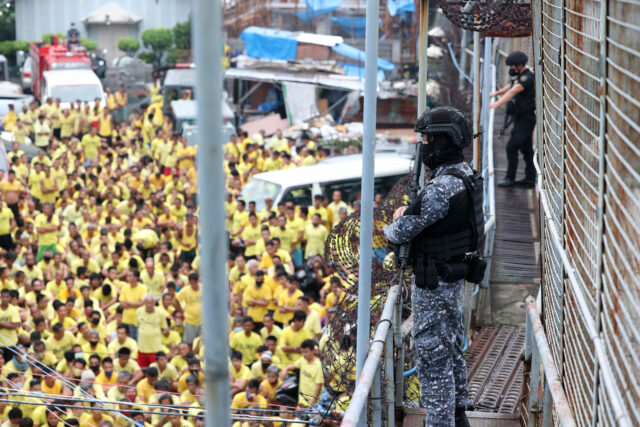
THE PHILIPPINE government should stop its deadly war on drugs if it aims to decongest one of the world’s most crowded jails, according to a human rights advocate.

“It’s impossible for the Department of Justice (DoJ) to decongest prison facilities as long as the drug war continues, which is responsible for over 60% congestion rate,” Fides M. Lim, convenor of Kapatid, a support group for political prisoners, said in a Facebook Messenger chat.

Suspects arrested in the state’s anti-illegal drug campaign add to the congested jails that are a “revolving door” of inmates, she added.

Justice Secretary Jesus Crispin C. Remulla earlier told the United Nations Human Rights Council the government aims to release about 5,000 inmates by June next year.

Last week, the Bureau of Corrections released more than 350 inmates who had served their sentences, Mr. Remulla told an online press briefing on Oct. 26.

The government released about the same number of inmates last month, which included the sick and elderly.

The Justice chief earlier said the national penitentiary, which was designed to house 6,000 prisoners, had 17,000 inmates.

Ms. Lim said DoJ should also review the cases of political prisoners who are detained due to “trumped-up cases.”

“Political prisoners may be but a fraction of the prison population but their incarceration embodies the greatest injustice in our midst,” she said.

With 215,000 prisoners nationwide, Philippine jails and prisons are overfilled more than five times their official capacity, making them the most overcrowded prison system in the world, according to the World Prison Brief.

Many of the country’s jails fail to meet the minimum United Nations standards given inadequate food, poor nutrition and unsanitary conditions, according to Human Rights Watch.

DoJ plans to build a P2.5-billion “world-class” maximum security facility in the town of Sablayan in Occidental Mindoro, Mr. Remulla said in August.

It also plans to relocate the national penitentiary’s minimum security facility to Nueva Ecija in northern Philippines.

Ms. Lim said the country’s jails should be run by trained civilians instead of military personnel.

“Why is it that every problem in this country should have a military solution that is essentially punitive in nature when the central argument for prison reform is human rights?” she asked.

The Commission on Human Rights (CHR) has repeatedly flagged the worsening congestion in the country’s jails, more recently spurred by the arrests of suspects in ex-President Rodrigo R. Duterte’s war on drugs that has killed thousands.

The CHR also said the Duterte government had encouraged a culture of impunity by hindering independent inquiries and failing to prosecute erring cops.

The United Nations Office of the Commissioner for Human Rights earlier said the government’s probe of human rights violations in connection with its deadly drug war lacks transparency.

Mr. Remulla told the UN council on Oct. 6 the government aims to “change the culture” of the local justice system, which he said is prone to delays.

Political analysts have said the government should keep its promise to the UN to overhaul its justice system or risk losing its credibility. — John Victor D. Ordoñez

Marcos thumbs down nationwide calamity declaration

A VILLAGE in the southern province of Maguindanao del Norte in the Bangsamoro region was buried in mud and rocks due to a landslide set off by the weeks of rains and aggravated by tropical storm Nalgae (local name: Paeng) on Oct. 28. — BANGSAMORO GOVT

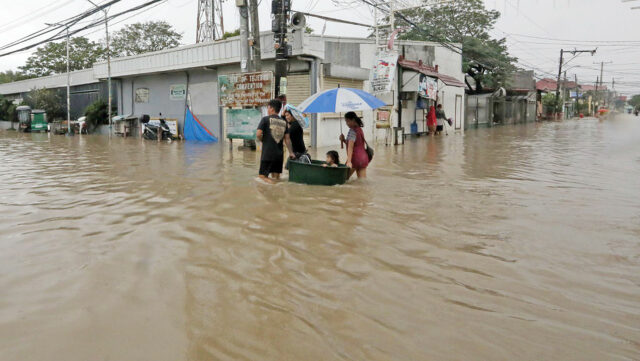
PHILIPPINE President Ferdinand R. Marcos, Jr. on Monday thumbed down proposals to place the country under a state of calamity for a year after Tropical Storm Nalgae, locally named Paeng, affected many areas and killed almost a hundred people, noting that damage from the storm were highly localized. 

Speaking to reporters after a situation briefing, Mr. Marcos said he found that a nationwide state of calamity was unnecessary after consulting with the Department of Environment and Natural Resources (DENR) on the matter.

I dont think its necessary. I came to that conclusion in consultation with DENR,he said. They said its not extensive the damage is highly localized. 

Mr. Marcos said theres no need for a national calamityfor the regions of Ilocos and Cagayan Valley in the north as well as parts of the Visayas in the central part of the archipelago. 

Local governments are authorized under the law to declare a state of calamity within their jurisdictions. Such declarations serve as basis for the release of special disaster response funds.  

I dont think its necessary,the President said. I think we will focus better if we stay with the calamity status that we have now. 

The Bangsamoro region, three provinces, and 158 cities and municipalities have declared a state of calamity, based on the National Disaster Risk Reduction and Management Council’s (NDRRMC) monitoring report as of Monday. 

PRICE FREEZE
The Department of Trade and Industry (DTI) issued a reminder that an automatic price freeze takes effect for 60 days in areas under a state of calamity. 

For areas under a state of calamity, a price freeze on basic necessities is in effect. We will continue to monitor and provide feedback on possible concerns,Trade Undersecretary Ana Carolina P. Sanchez said in a Viber message to reporters on Monday. 

Basic necessities under the DTIs jurisdiction include canned fish, locally made instant noodles, bottled water, bread, processed milk, coffee, candles, laundry soap, detergent, and salt.    

Other government agencies such as the Agriculture department is in charge of monitoring prices on farm and marine products, while the Health department monitors the prices of drugs deemed as essential. 

DEATHS, DAMAGE
The death toll from the typhoon has hit 98, of which 58 have been confirmed, according to the NDRRMC report.  

Of the validated deaths, 53 were from the Bangsamoro Autonomous Region in Muslim Mindanao (BARMM) and two from the Soccsksargen region in the countrys south, areas which were not directly in the typhoons path but had been inundated by rain in recent weeks.

Three other verified deaths were from Western Visayas in central Philippines. 

The NDRRMC said 69 people were reported to have been injured, while 63 were missing.  

The typhoon, which was set to leave the Philippine area on Monday afternoon or evening, affected 590,990 families or 1.95 million people in 17 regions, the disaster council said.

Western Visayas topped the list with 217,000 affected families, followed by BARMM with more than 177,000, and Soccsksargen with over 42,000. 

More than 105,000 people had been evacuated, it added. 

The storm has affected 4,188 houses, 3,499 of which were partially damaged while 689 were totally destroyed. 

Many businesses incurred additional losses after the typhoon led to power disruptions, which forced some establishments to use fossil fuel generators to continue their operations amid the storm. 

NDRRMC said brownouts had been experienced in 263 cities and municipalities, while water supply was disrupted in eight areas. 

Damage in the agriculture sector increased to P1.33 billion from an initial report of P49.54 million, according to the Department of Agriculture (DA). 

A total of 53,849 farmers and fishers, and 64,607 hectares of agricultural areas were affected, based on the DAs report as of Monday afternoon. 

Agricultural losses and damage have been reported in the regions of Mimaropa, Bicol, Western Visayas, Zamboanga Peninsula, and Soccsksargen. 

Affected commodities include rice, corn, high value crops and fisheries.  Damage has also been incurred in agricultural facilities. These values are subject to validation,the bulletin said. 

The DA said affected farmers can avail of assistance such as rice, corn, and assorted vegetable seeds, and drugs and biologics for livestock and poultry. The Bureau of Fisheries and Aquatic Resources is also extending aid to fisherfolk. 

ANOTHER STORM
Meanwhile, a new tropical storm named Queenie was spotted 815 kilometers east of northeastern Mindanao, packing maximum winds of 65 kilometers per hour (kph) and gustiness of up to 80 kph, PAGASA said in an 11:00 a.m. bulletin on Monday. 

Queenie is unlikely to directly affect the country until Tuesday,PAGASA said. However, light to moderate with at times heavy rains [are] possible over Caraga, Eastern Visayas, and Bicol Region beginning Wednesday. 

Wind signals might be raised over the eastern portion of Caraga region in the countrys south and in some areas in Eastern Visayas on Tuesday evening. 

Queenie was expected to further intensify. It could weaken by Tuesday evening or Wednesday.

It might lose the characteristics of a tropical cyclone by Friday while approaching Caraga or Eastern Visayas, PAGASA said. Kyle Aristophere T. Atienza and Revin Mikhael D. Ochave

PHL lawmaker calls on vulnerable nations to unite in pushing for accountability from big polluters

PHILIPPINE STAR/EDD GUMBAN

A PHILIPPINE lawmaker said nations that are most vulnerable to climate change should band together in pushing for more direct compensation systems from the world’s biggest polluters.  

Albay Rep. Jose Ma. Clemente S. Salceda said he hopes that vulnerable countries will form a united front in the 2022 United Nations Climate Change Conference in Egypt this month to demand accountability from major polluters like the United States and the European Union.  

International aid and green financing are not enough,Mr. Salceda, a former co-chair of the UN Green Climate Fund, said in a statement on Sunday. There has to be some form of compensation to the most vulnerable and affected countries.  

He recommended the creation of a global quick response fund, similar to the Philippines calamity fund, with the money to be providedby countries according to their pollution contributions, and accessed by countries as soon as climate-related disasters affect them.  

He said nations like the Philippines that are the most at-risk due to its impacts have a moral responsibility and the moral ascendancy to fight for the principle of loss and damage.  

The 2022 Global Risk Report ranked the Philippines as number one among 193 countries in terms of risk because of climate change. 

If we are soft on this position, we throw other climate-vulnerable countries under the bus,he said. So, we have to be strong on loss and damage.  

Mr. Salceda said international climate law defines loss and damageas the permanent loss or reparable damage caused by climate change including extreme weather events like typhoons, as well as slow-onset events such as sea-level rise. Kyanna Angela Bulan

Cotabato provincial gov’t pitches airport project to locators, carriers

MLANG.GOV.PH

THE LOCAL government of Cotabato made a pitch last week to potential locators and airline companies for an airport in the southern province that is planned for revival.  

Cotabato Governor Emmylou LalaTaliño-Mendoza, in her 1st First 100 Days Report, said the airport project remains a priority as it is considered a vital infrastructure for economic development, particularly for moving agricultural output and tourism.   

The project, previously known as the Mlang Airport and now referred to as the Central Mindanao Airport, is not included in the list of priority airports under the 2023 national budget.  

A team of stakeholdersare set to leave for Manila before the end of this week to do a pitch for possible locators and airline companies,said Ms. Mendoza, who will be heading the delegation.  

Cotabato Rep. Ma. Alana Samantha Taliño-Santos has also been in talks with officials of the national tourism and transport agencies to secure funding for the planned reopening of the Central Mindanao Airport.  

At the same time, the governor said the legal office is working on the processing of documents for private properties acquired by the provincial government for the airport site.  

Tourism is an important sector that will provide additional livelihood for each Cotabateño,Ms. Mendoza said in her report.  

Cotabato has several eco-tourism destinations, including an entry point to Mt. Apo, the highest peak in the Philippines.  

The Central Mindanao Airport is included in the Mindanao Development Authoritys (MinDA) priority infrastructure projects portfolio.   

It is seen to catalyze inclusive and balanced rural development in Mindanaocomplement General Santos and Awang Airports and will boost the economic activities of the area where many agricultural products, including highly-perishable fruits come from,according to MinDA.  

Ms. Mendoza also reported that roads and other vital infrastructure such as water systems in the rural areas are being implemented.   

It (road network) is the key to rural development as it provides access to safe, affordable, accessible, and sustainable transport systems for those who need it most linking our farmers to markets, students to schools, workers to job sites, and patients to hospitals,she said. Maya M. Padillo

ADVERTISEMENT
ADVERTISEMENT