Home Blog Page 5498

DTI says Manila supermarkets complying with Christmas feast price guide

DTI

THE DEPARTMENT of Trade and Industry (DTI) on Wednesday said selected supermarkets in Manila are compliant to the recently issued price guide for food items commonly used for the traditional Filipino Christmas feast.   

In a statement on Wednesday, the DTI said that it monitored supermarkets in Sta. Cruz, Manila on Dec. 2 to check their compliance with the recommended prices for what is referred to as noche buena goods.   

The department said shops that were visited complied with the price guide while all shelf keeping units (SKUs), including noche buena items, had the appropriate price tags.   

Consumers should buy in bundles, as this buying scheme provides more affordable alternatives. Further, through product bundling, the buying experience of consumers is simplified,Trade Undersecretary Ruth B. Castelo said.    

According to the DTI, it also checked the prices and supply of processed and agricultural basic necessities and prime commodities, the accuracy of weights and measures, and the appropriate price tags.    

As we get busy in preparation for the upcoming holidays, we remind our Filipino consumers to exercise their right to choose,Trade Secretary Alfredo E. Pascual said as he assured continued monitoring by the agency.   

The DTIs noche buena price guide was issued on Nov. 23, which includes ham, fruit cocktail, spaghetti noodles, spaghetti sauce, and queso de bola.   

A total of 195 SKUs out of 223 noche buena products recorded price increases. Revin Mikhael D. Ochave

Magnitude 5.3 earthquake rocks parts of Luzon, including Metro Manila

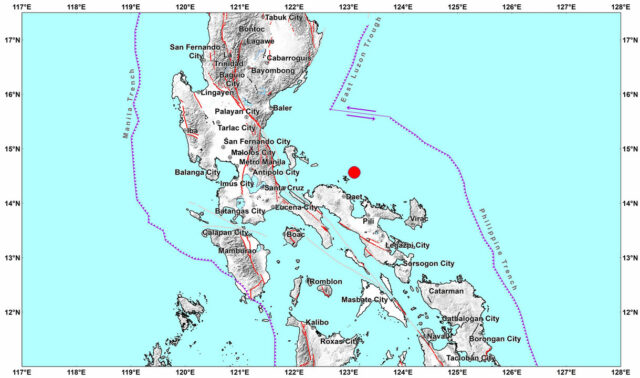
A MAGNITUDE 5.3 earthquake struck off the eastern part of Luzon mainland on Wednesday, with tremors felt all the way up to some northwestern provinces, according to state seismologists.   

The earthquake was recorded at 1:05 p.m. with the epicenter located northeast of Tinaga Island in Camariñes Norte, according to the Philippine Institute of Volcanology and Seismologys (Phivolcs) bulletin.  

Intensity V, categorized as strongunder Phivolcsscale, was felt in the towns of Mercedes and Jose Panganiban in Camariñes Norte. 

Phivolcs said no major damage was expected but aftershocks were likely.   

The Camariñes Norte provincial disaster management office did not report any immediate damage or injuries.   

Intensity IV or moderately strong shaking was reported in Daet, Camariñes Norte, and Guinayangan and Polillo in Quezon.  

Iriga City and the towns of Ragay and Pili in Camariñes Sur along with Mauban, Lopez, Mulanay, Alabat, and Gumaca in Quezon experience Intensity III.   

Parts of the provinces of Albay, Aurora, Batangas, Bulacan, Camariñes Sur, Cavite, Nueva Ecija, Pampanga, Pangasinan, Rizal, and the cities of Marikina and Pasig felt Intensity II.   

Intensity I was recorded in surrounding areas, including some island provinces.   

The Philippines is located within the so-called Pacific Ringof Fire, a network of volcanoes around the Pacific Ocean where most of the worlds earthquakes strike. MSJ

Manila Water ramps up water sampling

MANILA Water Co. is ramping up its water sampling to ensure potability, the Metro Manila’s east zone water concessionaire announced on Wednesday.   

“The strict and regular testing of water samples from the source to the distribution system will guarantee that our 7.4 million customers get clean and potable water 24/7,” Nestor Jeric T. Sevilla, Jr., Manila Waters corporate strategic affairs group head, said in a media release.  

The company said the water treatment process includes microbiological, physical and chemical examinations of water samples. The sampling conducted covered about 99.85% of Manila Water’s total water distribution.    

According to Manila Water, its water supply passed the parameters of the Philippine National Standards for Drinking Water (PNSDW).   

The east zone concessionaire said its Manila Water Laboratory has also achieved 109.3% compliance set by the PNSDW.    

Mr. Sevilla also said that the company continues to conduct internal plumbing system checks to determine leaks and avoid unnecessary spikes in consumption of customers, which leads to excessive billing.    

The water concessionaire serves Manilas east zone network, which comprises Marikina, Pasig, Makati, Taguig, Pateros, Mandaluyong, San Juan, portions of Quezon City and Manila, and several towns of nearby Rizal province. Ashley Erika O. Jose

Morocco advances to quarterfinal as Spain flops in shootout, 3-0

YASSINE Bounou (MAR) during the World Cup match between Morocco vs Spain in Doha, Qatar on Dec. 6. — REUTERS/FOTO OLIMPIK/NURPHOTO

Hat-trick hero Ramos helps Portugal thrash Swiss

AL RAYYAN, Qatar — Achraf Hakimi calmly converted a penalty to send Morocco through to the World Cup quarterfinals for the first time with a 3-0 shootout win over former champions Spain after a cagey last-16 clash ended goalless on Tuesday.

The Spanish-born Hakimi chipped in the decisive penalty, prompting a deafening roar of joy and celebration from the Morocco supporters, after their side became the first Arab nation ever to qualify for the tournament’s quarterfinals.

Morocco goalkeeper Yassine Bounou, who plays for Spain’s Sevilla, saved spot-kicks from Carlos Soler and Sergio Busquets after Pablo Sarabia had hit the post and Hakimi, a product of the Real Madrid youth system, held his nerve to earn his team a quarter-final against Portugal.

Morocco became only the fourth African nation to reach the last eight of the tournament, 12 years after Ghana did so in South Africa.

After a scrappy match finished 0-0 after extra time with few shots on target for either side, Morocco fed off the raucous support of their red-clad fans in the shootout as Spain crumbled.

Spain enjoyed more than 75% of possession and completed almost 1000 passes but Morocco caused problems for them on the counter-attack and goalkeeper Unai Simon made some good saves.

“We fought and made the Moroccan people happy, we made history and Morocco deserve it, Moroccan people made us united on the pitch,” coach Walid Regragui said.

Morocco defender Jawad Yamiq was proud of his team’s performance.

“We honored the Arab and African football, coach Regragui gave us the confidence that we needed in this game, a big boost in morale,” he said.

“We knew that Spain depend on their ball possession and we played with that in mind. They didn’t impose any danger.”

It was the fourth time Spain have been knocked out of the World Cup on penalties and the second in a row

It was a huge blow for Luis Enrique’s team, who arrived in Qatar as one of the favorites after reaching the Euro 2020 semifinals and the Nations League final last year.

“We completely dominated the match, it’s a shame it went that way,” the Spain coach told TVE.

“It’s the most difficult thing, playing against a team like Morocco who are hard workers.

“The penalties cost us, but I am very proud of the team and all the players. I’m very sorry about the result but I congratulate Morocco.”

FEW SHOTS
Spain spent big chunks of the match orbiting around the Morocco penalty area without attempting any shots, through balls or moves to break down their well organized opponents.

They tried to play the possession-style game that was the trademark of the great Spanish sides who won two European Championships and the World Cup between 2008 and 2012.

But they lacked a cutting edge and Morocco allowed them possession while trying to exploit the pace of Hakim Ziyech and Soufiane Boufal.

A foul on the latter gave the African side the first scoring opportunity as Hakimi blazed over a free kick.

In a tight first half, the only other chances came when defender Nayef Aguerd headed over and Marco Asensio hit the side-netting for Spain.

Dani Olmo had Spain’s first shot on-target in the 54th minute with an angled shot which Bounou palmed away.

Luis Enrique sent on Alvaro Morata and Nico Williams to inject a bit of life into his team and Morocco had to dig deep to get through extra time without conceding.

They managed to do so and Spain’s collapse in the shootout prompted wild celebrations among the ecstatic Morocco supporters who will get at least one more chance to make their presence felt in Qatar.

RAMOS HELPS PORTUGAL THRASH SWISS
Portugal’s Goncalo Ramos rose to the occasion on his first World Cup start to net a hat-trick in a 6-1 demolition of Switzerland on Tuesday, sending his side through to the quarterfinals for the first time in 16 years and setting up a clash with Morocco.

Portugal coach Fernando Santos had benched the country’s all-time top scorer Cristiano Ronaldo, tasking Benfica forward Ramos with leading the line despite the 21-year-old making his debut just three days before the World Cup in a friendly.

Ramos had played only 10 minutes as a substitute in Qatar but the youngster looked like he belonged on the big stage with a memorable performance for Portugal, who did not miss Ronaldo — a late substitute who had a goal ruled out for offside.

After a tepid start, the game came to life when Ramos opened the scoring in the 17th minute by picking up Joao Felix’s incisive pass before blasting the ball into the top corner from a tight angle to put the Portuguese ahead.

They doubled their lead through skipper Pepe when the 39-year-old timed his leap to perfection to rise above the two Swiss centre backs and head home from a Bruno Fernandes corner in the 33rd minute, with Yann Sommer well beaten yet again.

Switzerland striker Breel Embolo was frustrated by the Portugal defense despite the odd surging run into the final third, while their best chance of the half came when Xherdan Shaqiri’s free kick was pushed out for a corner. — Reuters

San Diego dominates PHL National Women’s Chess Championship

MARIE Antoinette San Diego (center) wins women’s chess championship crown. — NATIONAL CHESS FEDERATION OF THE PHILIPPINES

MARIE Antoinette San Diego came through with an effort to remember as she crowned herself winner of the Philippine National Women’s Chess Championship present presented by Nova Wellness Store for the first time at the PACE yesterday.

It was a dream come true for the 23-year-old Woman International Master (WIM) from Dasmariñas City bet as she finally laid claim to the one title that she long sought for since childhood and joined the ranks of former titlists Woman Grandmaster Janelle Mae Frayna and WIM Jan Jodilyn Fronda.

And Ms. San Diego made it for everybody to remember as she topped it with style by scoring 10.5 points out of a possible 11 on 10 wins including ones over Mmess. Frayna and Fronda and a draw.

There were some moments though when she teetered in defeat but relied on good fortunes, perseverance and tactical creativity to crawl her way back.

But overall, she was like a fearsome tigress on the prowl, always hunting for her helpless preys.

And this final-round game was no exception as she went for the kill early against the young, talented but inexperienced April Joy Claros, who was forced to scamper for safety and defend with all her might only to end up losing a pawn and eventually a piece or face the inevitability of a checkmate.

She was so dominating that the runner-up, Ms. Frayna, wound up a clear 2.5 points behind with eight points.

Knowing it was over but the shouting, the country’s first WGM opted to not push herself anymore and settled for a quiet truce with Olympiad teammate WIM Bernadette Galas.

Ms. Frayna consoled herself with P30,000 that she hoped would soothe the pain of losing the crown she wore on her head for years now.

Vice Glysen Derotas, another potential future champion, took third when nobody was looking and P20,000 while Ms. Fronda ended up fourth with a P10,000 to go home with. — Joey Villar

Mickey Yatar represents PHL at the World Finals of Red Bull Dance Your Style 2022

THE FOUNDATION has been laid out for Mickey Yatar and all roads lead to Johannesburg, South Africa, for the World Finals of Red Bull Dance Your Style 2022.

Following months of training and preparation, Mr. Yatar is primed and ready to bring pride to the Philippines and claim his title of the best dancer in the world.

Mr. Yatar was able to secure his spot as the country’s representative by capturing the hearts of the Filipino people during the National Finals held at the Bonifacio High Street Amphitheatre last July 23. Following his victory, Mr. Yatar expressed his gratitude to all his peers who supported him throughout the journey and made it adamant that he would bring the same drive and charisma to South Africa’s dance floor.

Carrying on Mr. Yatar’s preparation and his impressive showing from the National Finals, the 31-year-old Waacking Superstar from Baguio City is determined more than ever to carry on his momentum heading into the World Finals and bring home the title of the best dancer in the world.

It’s been four years since France hosted the first-ever Red Bull Dance Your Style World Finals. In this season, interested viewers can watch the World Finals live at Red Bull’s official Tiktok account on Dec. 10, 2022, at 8:30 pm (CET).

Petro Gazz Angels eye Open or All-Filipino Conference

PETRO GAZZ ANGELS — PVL

MOMENTS after its magnificent Premier Volleyball League Reinforced Conference title conquest, Petro Gazz has set its sight on a title that has eluded the franchise — the Open or All-Filipino Conference.

“It’s really a tough fight in the All-Filipino because the other teams have star-studded rosters,” said triumphant Angels coach Rald Ricafort after steering his charges to the club’s second Reinforced Conference crown since their breakthrough win three years back.

Mr. Ricafort was referring to three-time Open titlist Creamline, sister team Choco Mucho and F2 Logistics as the early favorites in the season-launching conference early next year.

“Like Creamline, the Rebisco teams, F2 Logistics, those are strong and deep teams,” said Mr. Ricafort. “But we will still fight for it and we still need to work harder and hopefully we could snare another title.”

The closest the Angels came close to claiming a championship outside the Reinforced came in 2019 when it made the Open finals only to get swept in two games by the Cool Smashers.

Creamline, a loaded team bannered by former MVP winners Alyssa Valdez, Tots Carlos, Jema Galanza and Jia de Guzman, should be the biggest thorn to Petro Gazz’s ambitious bid as it has always given the latter nightmares.

In fact, the Angels lost their two meetings with the Cool Smashers in the Reinforced including an embarrassing straight-set defeat in the semis that sent the former on the brink of elimination.

But as fate would have it, Petro Gazz has turned things around in its favor and eventually won it all while Creamline crashed out of the finals and settled for a bronze.

But with the acquisition of MJ Philips and seasoned Aiza Pontillas and Myla Pablo, early this year, the sky is the limit for Petro Gazz.

“We need to work out the system for the locals but slowly, we’re getting there,” said Mr. Ricafort. Joey Villar

Donovan Mitchell’s 43 points help Cleveland sink LA Lakers

DONOVAN Mitchell scored a season-high 43 points to fuel the host Cleveland Cavaliers to a 116-102 victory over the Los Angeles Lakers on Tuesday.

Mitchell made 17 of 27 shots from the floor and 4 of 8 from 3-point range to eclipse his previous season-high point total of 41, set during the Cavaliers’ 132-123 overtime win at Boston on Oct. 28.

Cleveland’s Jarrett Allen scored 22 of his 24 points in the first half and finished with 11 rebounds in his return from a five-game absence due to a back injury.

Darius Garland added 21 points and 11 assists to propel Cleveland to its eighth win in last 11 games overall and improve to an NBA-best 11-1 at home this season.

Former Cavaliers star LeBron James collected 21 points and 17 rebounds for the Lakers, who saw their three-game winning streak come to a halt. Thomas Bryant scored 19 points and Russell Westbrook and Dennis Schroder each added 16 in a losing effort.

Western Conference Player of the Week Anthony Davis of the Lakers scored just one point in eight minutes before exiting the game with flu-like symptoms.

Los Angeles didn’t do itself any favors with its performance from 3-point range. It made just 6 of 36 attempts from beyond the arc.

Schroder sank a mid-range jumper to forge a tie at 92-92 before Mitchell ignited a 9-0 surge. He had a driving layup and a 3-pointer before setting up Allen and Cedi Osman for short jumpers.

The Lakers closed the deficit to five before Mitchell effectively put the game out of reach. He converted a three-point play, sank a pair of free throws, set up Caris LeVert’s layup and drained a 3-pointer to push the Cavaliers’ lead to 113-98 with 3:22 remaining in the fourth quarter. — Reuters

Trump Organization found guilty of tax fraud scheme

US President Donald Trump speaks at an event in the State Dining Room of the White House, in Washington, U.S., Feb. 24, 2019. — REUTERS

NEW YORK — Donald Trump’s real estate company was convicted on Tuesday of carrying out a 15-year-long criminal scheme to defraud tax authorities, adding to the legal woes facing the former US president as he campaigns for the office again in 2024.

The Trump Organization — which operates hotels, golf courses, and other real estate around the world — was found guilty of paying personal expenses for top executives including former chief financial officer Allen Weisselberg, and issuing bonus checks to them as if they were independent contractors.

The company faces up to $1.6 million in fines after being convicted on all charges, including scheming to defraud tax authorities, conspiracy and falsifying business records. Mr. Trump was not charged in the case.

Justice Juan Merchan, who presided over the trial in state court in New York, set a sentencing date for Jan. 13.

While the fine is not expected to be material for a company of the Trump Organization’s size, the conviction could complicate its ability to do business.

Mr. Weisselberg, 75, testified as the government’s star witness as part of a plea deal that calls for a sentence of five months in jail.

Manhattan District Attorney Alvin Bragg, whose office prosecuted the case, called the verdict “very just.”

“The former president’s companies now stand convicted of crimes,” Mr. Bragg said in the New York courthouse after the verdict, speaking of the Trump Corporation and Trump Payroll Corporation, the two units of the Trump Organization which were convicted.

Asked if he regretted not charging Mr. Trump in the case, Mr. Bragg did not respond. He has said that the office’s investigation into Mr. Trump is continuing.

APPEAL
Alan Futerfas, a lawyer for the Trump Organization, said the company would appeal and that the criminal law governing corporate liability was vague.

“It was central to the case,” he told reporters after the verdict.

The jury deliberated for about 12 hours over two days.

The case centered on charges that the company paid personal expenses like free rent and car leases for executives including Mr. Weisselberg without reporting the income, and gave them bonuses as non-employee compensation from other Trump entities like the Mar-a-lago Club, without deducting taxes.

According to testimony during the four-week trial, Mr. Trump himself signed the bonus checks annually, paid private school tuition for Mr. Weisselberg’s grandchildren, authorized the lease for his luxury Manhattan apartment and approved a salary deduction for another executive.

“The whole narrative that Donald Trump was blissfully ignorant is just not real, prosecutor Joshua Steinglass told jurors during his closing argument on Friday.

He said the “smorgasbord of benefits” was designed to keep top executives “happy and loyal.”

Republican Mr. Trump, who on Nov. 15 announced his third campaign for the presidency, said in a statement he was “disappointed” by the verdict but called the case a “Manhattan witch hunt.” Both Mr. Bragg and his predecessor who brought the charges, Cyrus Vance, are Democrats.

SEPARATE LAWSUIT
The Trump Organization separately faces a fraud lawsuit brought by New York state Attorney General Letitia James.

Mr. Trump himself is being investigated by the US Department of Justice over his handling of sensitive government documents after he left office in January 2021 and attempts to overturn the November 2020 election, which he lost to Democrat Joseph R. Biden.

Lawyers for the Trump Organization argued that Mr. Weisselberg carried out the scheme to benefit himself, not the company. They tried to paint him as a rogue employee. Mr. Weisselberg is currently on paid leave and testified that he hopes to get another $500,000 bonus in January

Mr. Trump wrote on his Truth Social platform on Nov. 19 that his family got “no economic gain from the acts done by the executive.”

Mr. Weisselberg, who pleaded guilty in August to concealing $1.76 million in income from tax authorities, testified that although Mr. Trump signed checks involved, he did not conspire with him.

He said that the company saved money by paying for his rent, utilities, Mercedes-Benz car leases for him and his wife and other personal expenses rather than raising his salary, because a wage hike would have had to account for taxes.

He said Mr. Trump’s two sons — who took over the company’s operations in 2017 — gave him a raise after they knew about his tax dodge scheme.

By then, Mr. Trump was president, and the company was preparing for greater scrutiny.

“We were going through an entire cleanup process of the company to make sure that since Mr. Trump is now president everything was being done properly,” Mr. Weisselberg testified. — Reuters

China’s hopes of looser COVID rules set off rush for fever drugs

REUTERS

BEIJING/SHANGHAI — Tired of being cooped up to comply with China’s strict anti-COVID rules, people awaited clarity on an easing of restrictions that could be announced as soon as Wednesday, while the more cautious rushed to buy cold medicines and home test kits.

After President Xi Jinping chaired a meeting of the Communist Party’s politburo, state media fed the growing sense of anticipation by reporting that China should seek “to better coordinate epidemic policies with economic and social development”.

Widespread protests against some of the world’s toughest COVID curbs last month were quickly followed by various restrictions being lifted by authorities in some cities, while top officials began toning down their warnings about the dangers posed by COVID-19.

China may announce 10 new national easing measures as early as Wednesday, two sources with knowledge of the matter told Reuters.

That has raised prospects that Beijing may slowly look to align with the rest of the world and start re-opening its economy three years into a pandemic which erupted in the central Chinese city of Wuhan in late 2019.

But the looser curbs — which have included cuts in testing and less onerous quarantine rules — have set off a rush for preventative drugs as some residents, particularly the unvaccinated elderly, feel more vulnerable to the virus.

Authorities across the country have warned of tight supplies and price gouging from retailers in recent days.

“Please buy rationally, buy on demand, and do not blindly stock up,” the Beijing Municipal Food and Drug Administration was quoted as saying in the state-owned Beijing Evening News.

In Beijing’s upmarket Chaoyang district, home to most foreign embassies as well entertainment venues and corporate headquarters, shops were fast running out of some those drugs, according to a resident.

“Last night the medicines were already in stock, and now many of them are out of stock,” said Zhang, a 33-year-old educationist, who only gave one name.

“Epidemic preventions have been lifted…COVID-19 testing sites are mostly being dismantled… So, because right now in Chaoyang district cases are quite high, it is better to stock up on some medicines,” he said.

The surge in demand has driven up share prices in medicine manufacturers including cough syrup producer Guizhou Bailing, and Xinhua Pharmaceutical, which makes 40% of all Ibuprofen sold in China. 

‘POLICY DISPARITY’
The shifting stance from authorities comes after a string of demonstrations last month that marked the biggest show of public discontent in mainland China since President Xi Jinping took power in 2012.

While those protests petered out amid a heavy police presence, there have been pockets of unrest.

In the latest incident, videos posted on Twitter showed university students chanting protest slogans against COVID policies on their campus in Nanjing city. Reuters confirmed that the footage was taken at Nanjing Tech University.

The uneven nature of the easing measures and varying interpretation of the rules from city to city has been an ongoing source of frustration for many people and businesses.

The European Chamber of Commerce in China said in a statement on Tuesday that it was concerned about “the general lack of coordination and policy disparity seen across China, as well as by the overall lack of general information on what changes are to be expected and when.”

“This continues to be a cause of uncertainty for businesses and the public at large,” it said.

What has been more consistent in recent days are messages from officials downplaying the health risks of the virus — bringing China closer to what other countries have been saying for more than a year as they dropped restrictions, and shifted towards living with the virus.

Gu Xiaohong, a top traditional Chinese medicine official, was quoted in the state-run Beijing Daily on Wednesday as saying China should change its official name for COVID-19 to reflect the virus’ mutation and that patients with light symptoms could recuperate at home. — Reuters

Maryland governor bans use of TikTok on state devices

WASHINGTON — Maryland Governor Larry Hogan issued an emergency directive on Tuesday prohibiting the use of Chinese-owned short-video sharing app TikTok on state government devices and networks, the latest US Republican to crack down on TikTok.

South Dakota Governor Kristi Noem last week signed an executive order barring state employees and contractors from installing or using TikTok on state-owned devices and South Carolina Governor Henry McMaster on Monday asked a state agency to ban TikTok from state government phones and computers.

Mr. Hogan’s ban covers numerous Chinese and Russian-influenced products and platforms because he said they present an “unacceptable level of cybersecurity risk to the state.”

Maryland executive branch agencies must remove the products from state networks and prevent access.

TikTok said the concerns prompting state bans were largely fueled by misinformation.

“We are disappointed that the many state agencies, offices, and universities that have been using TikTok to build communities and connect with constituents will no longer have access to our platform,” the company said on Tuesday.

Mr. Hogan’s directive also applies to Huawei Technologies, ZTE Corp., Tencent Holdings’ WeChat, QQ and QQ Wallet, Alibaba products and Russia’s Kaspersky Lab.

Brendan Carr, a Republican member of the Federal Communications Commission, praised Mr. Hogan’s action he said would “protect Maryland from the threats posed by malign foreign actors.”

Last month, FBI Director Chris Wray said TikTok’s US operations raised national security concerns, flagging the risk the Chinese government could harness the video-sharing app to influence users or control their devices.

Beijing could also use the popular app, owned by ByteDance, to “control software on millions of devices,” giving it the opportunity to “technically compromise” those devices, Mr. Wray added.

The government’s Committee on Foreign Investment in the United States (CFIUS), which reviews foreign acquisitions of US assets for potential national security risks, in 2020 ordered ByteDance to divest TikTok because of fears that US user data could be passed on to Beijing.

CFIUS and TikTok have for months sought to reach a national security agreement to protect the data of TikTok’s more than 100 million US users but sources said it appears unlikely a deal would be reached before January.

TikTok executive Vanessa Pappas told lawmakers in September that TikTok was making progress toward a final agreement with the US government.

Former President Donald Trump in 2020 attempted to block new US users from downloading WeChat and TikTok, which would have effectively blocked the apps’ use in the United States, but lost a series of court battles.

President Joseph R. Biden in June 2021 withdrew Mr. Trump’s executive orders that sought to ban the downloads and directed the Commerce Department to conduct a review of security concerns posed by the apps. — Reuters

Hope for coconut farmers: recommendations for the President

TIJANA DRNDARSKI-UNSPLASH

(Part 3)

In his doctoral dissertation that was presented to the University of Navarre a few years back, Dr. Ramon de Vera, an accomplished agribusiness entrepreneur and banker, also suggested that Congress should legislate the establishment of a Board of Agribusiness Investments (BOAI) that would cater to the needs of large-scale investments in corporate farming, granting incentives to large-scale farming in the same way that Board of Investments (BoI) grants incentives to manufacturing and other industrial ventures.

Among the major tasks of this BOAI will be the facilitation of the leasing of public lands to investors in agribusiness. Part of government bonds that are being floated, despite a high-interest regime expected in the medium term, should be utilized to support key investments in agribusiness projects in the rural areas, especially in the coconut regions.

In order to facilitate land consolidation, the transfer or lease of a Certificate of Land Ownership (CLOA) should be liberalized. Farmers with CLOAs who are no longer able or interested in farming should be assisted in consolidating their holdings to sell or lease their properties to those investing in corporate farming. The ceiling on corporate farms should be removed or at least the maximum should be raised to 20,000 hectares. There are prospective investors in palm oil production that requires as much as 20,000 hectares.

In islands and provinces where abundant agricultural lands are still available — as in Mindanao, Palawan, Samar, Leyte, Nueva Ecija, Nueva Vizcaya, and Cagayan — corporate investors should be assisted by the Department of Agrarian Reform (DAR) and the Department of the Environment and Natural Resources (DENR) to develop contiguous and larger farms.

Without going to the extreme of One Town One Product (OTOP), specific crops should be identified as most suitable in the different regions. For example, coconuts are best planted in Palawan, especially in the southern portion. There should be a revisit of the practice of some regions most frequently visited by strong typhoons of planting coconut trees. For example, there have been serious proposals to replace coconut trees in Bicol with corporate farms of pili trees. Foreign investors should be encouraged to invest in corporate farming of this product, which can be even more popular than macadamia nuts in global markets if cultivated, processed, and marketed. The failed attempt of the Kennemer group to invest in large-scale planting of cacao in Palawan should be examined for lessons to be learned.

More government assistance and incentives should be given to multinational enterprises like Nestlé that has already been seriously assisting coffee farmers to improve their productivity. With the right government approach, there is no reason why the Philippines cannot follow the example of Vietnam which accomplished the feat of becoming the second largest exporter of coffee, next only to Brazil, and dethroning Colombia for second place in record time.

In the livestock sector, much can be learned from the very successful joint venture between the US-based Cargill and Joy Poultry Products (producers of Jollibee chicken products) in establishing the largest poultry operations in the ASEAN region in the City of Sto. Tomas, Batangas.

Although some progress has already been made on the following recommendations since they were made by Dr. De Vera several years ago, it is worthwhile to present them again in this article as a check list for President Ferdinand Marcos, Jr., to help him in his objective of attaining greater food security during his term.

There is a constant need in the agricultural sector, affected by numerous public agencies, to be freed from the burden of multiple and overlapping requirements for approval before any investment can be made, especially for a foreign investor.

Among the measures recommended by Dr. De Vera in his doctoral thesis are:

1. Establish a one-stop multi-agency center for corporate investments in agribusiness by both local and foreign investors.

2. Stop land acquisition and distribution to small farmers. Instead focus on infrastructures and services to help farmers work together in different forms of land consolidation. In this regard, I must compliment the Duterte Administration, not only for increasing public expenditures on infrastructures from the historical low of 2-3% to a high of 5-6% during his watch. His government also accomplished much in helping farmers by spending the largest portion of the infrastructure budget in the countryside, especially on farm-to-market roads in non-urbanized areas. As a member of a private board of advisors to the Department of Public Works and Highways (DPWH) during the tenure of former DPWH Secretary Mark Villar, I can attest to the department’s policy of deliberately avoiding projects in urban areas, especially in the National Capital Region and Metro Cebu. They made sure that most of the projects in urban centers would be undertaken by private companies like Megawide, San Miguel Corp., First Pacific, DMCI, ICTSI, etc., in tandem with foreign companies like GMR from India and Acciona from Spain.

3. Allow CLOAs to be used as security for bank loans (removing the monopoly of the Land Bank of the Philippines).

4. Encourage tree planting on idle and unproductive lands, inviting long-term investors to choose their own sites. A study of Finland’s tree planting practices can provide leads to long-term investments in this sector.

5. Set up farming support centers that will provide equipment, processing of raw materials, storage, technical support, and farmer education to the surrounding communities.

6. Set up farm products exchange centers (called “bagsakan” in the local language) in both rural and urban areas in order to reduce intermediation and inequitable distribution of revenues between the farmers and the middle men. Promote widely the digital solutions of agripreneurs like May-ani that sends to small farmers’ smart phones timely information on the prices of their products in the final markets, so that middlemen do not take undue advantage of their lack of information. There are already actual investments in these food terminals being made by such large conglomerates as the Ayalas, the Villars, and the Aboitizes. As much as possible, the Government should leave this very important role of farms product exchange centers to the private sector.

7. Establish seed banks to provide quality seeds for various varieties of crops, especially fast-growing fruits and vegetables, in order to improve the productivity of small farmers. There are joint ventures like East-West Seeds and Harbest Corp. that can help the Government with this very important service to the farmers.

8. Provide transport facilities to farming community centers to reduce intermediation in products transfer. It is obvious that farm-to-market roads benefit mostly those farmers with transport vehicles. Incentives should be given to those private companies investing in the logistics and supply chain sectors that directly benefit small farmers.

These suggestions, borne of concrete business experiences of an agribusiness entrepreneur and banker, are in some way or another, being implemented by different groups in both the public and private sector. It is my hope that they will be especially applied to alleviate the plight of coconut farmers. If we are able to attract sufficient investors and managers to follow the advice that Dr. Ramon de Vera made in his doctoral dissertation, I have no doubts that the target of reducing the poverty incidence in our country to a single-digit 9% by 2028 is attainable.


Bernardo M. Villegas has a Ph.D. in Economics from Harvard, is professor emeritus at the University of Asia and the Pacific, and a visiting professor at the IESE Business School in Barcelona, Spain. He was a member of the 1986 Constitutional Commission.

bernardo.villegas@uap.asia