Home Blog Page 5456

Peso slumps as oil prices rise on demand hopes

ANGIE REYES-PEXELS

THE PESO weakened against the dollar on Tuesday due to rising oil prices following China’s easing of its coronavirus disease 2019 (COVID-19) restrictions.

The local currency closed at P55.90 versus the greenback, slumping by 75 centavos from Friday’s P55.15 close, data from the Bankers Association of the Philippines showed.

The peso opened the session at P55.15 per dollar, which was also its best showing intraday. Meanwhile, it dropped to as low as P55.93 against the greenback.

Dollars traded dropped to $813.27 million from $1.02 billion on Friday.

The market was closed on Monday due to a special non-working holiday.

A trader said in a Viber message that the local currency weakened significantly due the rise in global crude oil prices as China, one of the world’s largest importers of fuel, eased COVID-19 restrictions.

Oil prices rose to three-week highs on Tuesday as China’s latest easing of COVID-19 restrictions spurred fuel demand hopes, while concerns that winter storms across the United States are affecting energy production continued to support prices, Reuters reported.

Brent crude was up 52 cents or 0.6% at $84.44 a barrel by 0712 GMT, while US West Texas Intermediate (WTI) crude was at $80.04 a barrel, up 48 cents or 0.6%. They hit their highest since Dec. 5 earlier in the session.

On Friday, Brent rose 3.6%, while WTI gained 2.7%, as they recorded their biggest weekly gains since October.

China will end its quarantine requirements for inbound travelers starting on Jan. 8, the National Health Commission said on Monday, dropping a rule in place since the start of the pandemic three years ago. That raised optimism of higher demand from the top crude oil importer.

The greenback softened after China said it would drop its quarantine rule. A weaker dollar makes oil cheaper for holders of other currencies.

Meanwhile, another trader said that the peso weakened amid demand for dollars.

“Usually every [middle] or end [of the] month, corporates are net buyers of US dollars,” the second trader said.

For Wednesday, first trader sees the peso moving between P55.75 and P55.60 against the greenback, while the second trader gave a wider forecast range of P55.60 to P55.60 per dollar. — A.M.C. Sy with Reuters

Shares inch up on window dressing, lack of leads

REUTERS

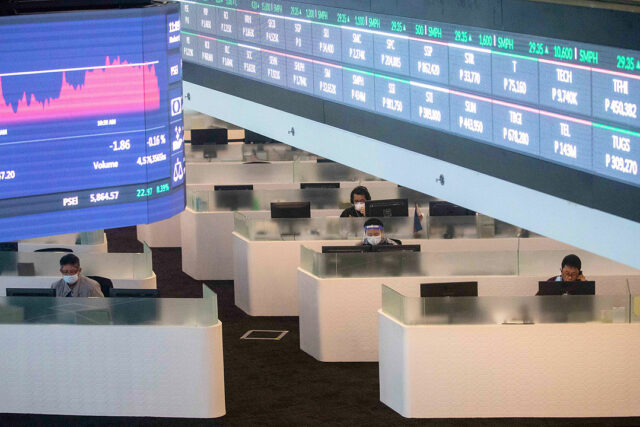
LOCAL SHARES inched up on Tuesday on window dressing ahead of the year’s close and amid lack of fresh leads.

The benchmark Philippine Stock Exchange index (PSEi) climbed by 23.87 points or 0.36% to close at 6,564.90 on Monday, while the broader all shares index rose by 8.95 points or 0.26% to 3,441.42.

“Local shares moved sideways on thin volume today. Share prices’ average true range narrowed to month lows due to the lack of fresh leads and with most money managers,” AB Capital Securities, Inc. Vice President Jovis L. Vistan said in a Viber message on Tuesday.

“Positive bias was aided by year-end window dressing. Upside was capped by concerns on the inflation report next week,” Mr. Vistan added.

Headline inflation rose to 8% last month from 7.7% in October and 3.7% in November 2021. The November inflation print was the fastest in 14 years or since the 9.1% seen in November 2008.

For the first 11 months, inflation averaged 5.6%, faster than the 4% in the same period a year ago. This was well above the Bangko Sentral ng Pilipinas’ (BSP) 2-4% target for the year but was still below its full-year forecast of 5.8%.

The BSP earlier said they expect inflation to rise slightly in December due to higher food prices caused by recent typhoon and increased liquefied petroleum gas prices and electricity rates.

“Philippine shares kicked off the final week of the year on a positive note, as funds begin the window dressing period,” Regina Capital Development Corp. Head of Sales Luis A. Limlingan said in a Viber message.

“US stock futures also rose on Monday night as investors head into the final trading days of 2022,” Mr. Limlingan added.

US stock futures and the S&P 500 e-minis inched up by 0.6%, indicating the market is set to rise as traders return to their terminals on Tuesday after the Christmas holiday, Reuters reported.

Back home, most sectoral indices closed higher, except financials, which declined by 8.94 points or 0.54% to close at 1,631.77, and mining and oil, which inched down by 0.20 points to 10,559.46.

Meanwhile, property climbed by 26.29 points or 0.91% to at 2,902.63; holding firms added 57.55 points or 0.89% to close at 6,501.19; services increased by 1 point or 0.06% to 1,607.33; and industrials inched up by 4.38 points or 0.04% to end at 9,365.09.

Value turnover declined to P2.89 billion on Tuesday with 1.06 billion shares changing hands from P3.14 billion with 1.91 billion issues traded on Friday.

Advancers outnumbered decliners, 97 versus 88, while 42 names closed unchanged.

Net foreign selling declined to P47.22 million on Tuesday from P248.14 million on Friday.

Philippine financial markets were closed on Monday due to a special non-working holiday.

AB Capital Securities’ Mr. Vistan placed the PSEi’s support at 6,440 and resistance at 6,600. — J.I.D. Tabile

Energy dep’t touts savings from power conservation program

PHILIPPINE STAR/ MICHAEL VARCAS

THE DEPARTMENT of Energy (DoE) said Tuesday that 24 industrial, commercial and government establishments participating in its energy efficiency and conservation (EEC) program saved about 36.94 million kilowatt-hours (kWh) of electricity this year.

“With energy efficiency and conservation as a whole-of-nation approach to reduce consumption and ultimately earn savings, I encourage others also to approach this advocacy creatively and with fervor, especially as we further improve our EEC program,” Energy Secretary Raphael P.M. Lotilla said in a statement Tuesday.

The DoE said the 24 entities were also able to save 60,912.55 liters of diesel, and 44,059 liters of gasoline.

The DoE said that Circuit Corporate Center One, Robinsons Place Gensan, and North Triangle Depot Commercial Corp. (which trades under the Trinoma brand) saved a combined 16.69 million kWh.

Serendra Retail, CBP Tech Tower, and Glorietta Corporate Center Two realized combined energy savings of 2.40 million kWh.

Ayala Center Cebu District Cooling System Plant, Canon Business Machines, Inc., and Ayala Center Makati District Cooling System Plant had combined energy savings of 5.95 million kWh.

Ayala Malls Central Bloc and Ayala Malls Manila Bay had total combined energy savings of 5.84 million kWh.

Baguio Ayala Land Technohub and Ayala Malls Solenad posted combined energy savings of 4.35 million kWh.

Republic Act No. 11285 or the Energy Efficiency and Conservation (EEC) Act of 2019, authorizes EEC programs and encourages the use of energy efficient and renewable-energy technologies.

Mr. Lotilla said that about 36% of all energy is consumed by buildings.

“With increasing urbanization, the number of new buildings (is growing by) more than 20% a year and will continue to do so. So, the efficient use of energy, water, and other resources becomes even more (critical),” Mr. Lotilla said.

He said the government’s own EEC savings as of Dec. 13 amount to P284.93 million.

Mr. Lotilla added that the DoE has also proposed to President Ferdinand R. Marcos, Jr. a plan to promote energy-efficient and inverter-type technologies in all government agencies, local government units and foreign service posts, which will result in projected savings of 347.42 megawatts (MW) equivalent to P7 bilion.

Mr. Lotilla estimated that 4,241 designated establishments from the commercial, industrial, and transportation sectors are implementing various projects to reduce their energy consumption.

“These projects had a total investment worth P4.5 billion or the equivalent of 491.75 gigawatt-hours of energy savings. We are working to increase these numbers,” he added.

The DoE is counting on the EEC program to cushion the impact of volatile petroleum prices. — Ashley Erika O. Jose

Government jobs critical to improving employment, labor-affiliated party says

PHILIPPINE STAR/BOY SANTOS

By John Victor D. Ordoñez

PUBLIC-SECTOR jobs will be critical for improving employment ahead of an expected global economic slowdown, according to a political party aligned with the labor movement.

“The government should play a vital role in providing employment opportunities and not rely on the private sector by funding a robust public employment program that will contribute, among others, to the development of the agriculture, health, and transportation (industries),” Partido Manggagawa Chairman Rene B. Magtubo said in a Viber message.

“To date, most if not all of the returning overseas Filipino workers (OFWs) who are still capable of working train their sights on employment opportunities abroad rather than state job programs,” he added.

Mr. Magtubo said the government should also focus on boosting jobs in manufacturing to improve the overall quality of jobs next year.

President Ferdinand R. Marcos, Jr. has said he intends to promote manufacturing to create more jobs and expand economic output.

The jobless rate fell to 4.5% in October, the lowest since October 2019, before the pandemic hit.

Job quality that month improved as the underemployment rate, or the percentage of employed seeking more work, eased to 14.2% from 15.4% in September.

Partido Manggagawa also said Tuesday that workers continue to struggle with low wages despite the recovery from the pandemic.

“Despite runaway inflation, the government played deaf to the demands and stuck to the myth that there was no supervening condition that existed to warrant a new round of wage hikes,” it said in a statement, referring to the normal practice of waiting for a year between wage hikes, with exceptions being made for supervening conditions.

Inflation rose to a 14-year high of 8% in November, against the 7.7% posted in October.

Labor Secretary Bienvenido E. Laguesma has said the National Wages Productivity Commission and tripartite wage boards are studying the need for additional wage increases amid soaring prices of basic goods.

The Kapatiran ng mga Unyon at Samahang Manggagawa on Dec. 5 filed a petition seeking a P100-increase in the daily minimum wage in Metro Manila to help workers deal with inflation.

In June, the Metro Manila Wage Board imposed a P33-minimum wage increase. Wage boards can only act on wage petitions a year after a region’s last wage order.

Partido Manggagawa noted that the decline in unemployment numbers does not reflect the thousands of low-paid workers losing jobs and many working in jobs that lack benefits.

“In other words, these employed but vulnerable workers in the post-pandemic context are still harmed by decent-work deficits,” it said. “More Filipinos are back to work but in bad jobs.

Customs raises P268M from auctions of seized goods

PHILSTAR FILE PHOTO

THE BUREAU of Customs (BoC) said it generated P268.483 million from auctions of seized goods as of end-November.

The bureau said it auctioned a total of 137 containers of various goods including luxury vehicles, general merchandise, and other products between July 25 and Nov. 1. This amounted to P55.533 million or 20% of the total proceeds in the first 11 months.

The BoC said it also collected P24.942 million following audits P391.289 million from prior disclosure program (PDP) applications during the first 100 days of office of the new government.

“The efforts of the Post Clearance Audit Group (PCAG) to promote compliance with customs laws and regulations have proven effective and efficient as reflected in the yearly increase in Prior Disclosure Program (PDP) applications,” the BoC said.

As of the end of November, P1.725 billion was collected from post clearance audits.

The BoC said that its risk-based post clearance audit process and customs compliance programs helped minimize revenue leakage.

This year, it also said that it implemented three information and communications technology systems, including the ASEAN Customs Declaration Document (ACDD) System, which enhances Customs risk-targeting and profiling activities. 

These also include the National Customs Intelligence System (NCIS), a web portal that stores data and generates reports according to the selected filters; and the Payment Application Secure 6 (PAS6), a payment system that ensures the accurate and immediate exchange of transaction information on the assessment details of payable duties and taxes. 

The agency also reported that the Port of Batangas, Manila International Container Port, and Port of Limay had the highest collections, combining for P432.113 billion, accounting for 60.49% of the total revenue collected as of the end of October.

The BoC has said it exceeded its full-year revenue collection target by 9.5% at the end of November.

In the 11-month period, the agency collected P790.301 billion, beating its 2022 revenue target of P721.52 billion.

For 2023, the Customs bureau is expected to generate P765.59 billion in revenue, up 6.11% against its target this year.

This includes P485.67 billion in value-added taxes (VAT) on imports, P196.6 billion in excise taxes, P63.67 billion in import duties and taxes and P19.64 billion in other fees. — Luisa Maria Jacinta C. Jocson

Power infrastructure deemed top priority for climate-proofing efforts

PHILSTAR FILE PHOTO

POWER infrastructure was put forward as a priority for the government’s climate-proofing efforts, the Philippine Institute for Development Studies (PIDS) said, citing the network’s vulnerability to calamities.

In a study published Tuesday, PIDS said most of the environment-related triggers for power interruptions are “major storm disasters.” 

“Concurrently, this begs the need to improve and climate-proof our power and electricity-related infrastructure to protect them from damage and shorten the duration of downtime after weather-related events,” the study found.

PIDS said that in 2021, 94.7 million consumer hours were lost to major storm disasters. The metric is computed by multiplying the number of hours of power interruptions and the number of customers affected.

Between 2015 and 2021, consumer hours lost to major storm disasters averaged 107.34 million, with the high in 2019 at 399.2 million. 

The study analyzed data from monthly interruption reports (MIRs) between January 2015 and December 2021 filed by electric cooperatives (ECs) which are monitored by the National Electrification Administration (NEA). 

In 2021, consumers experienced an average of 5.7 power interruptions a year, equivalent to 8.8 hours of no electricity overall, the study found.

The average time to restore power was 1.5 hours after a power outage, the study found, with restoration taking the longest in the wake of a major storm disaster.

Consumers in Luzon experienced more frequent power interruptions, while consumers in the Visayas endured longer hours with no electricity.

The study found that the main cause of power interruptions was the insufficient supply of power to ECs. In 2021, 169.1 million consumer hours were lost due to “insufficient supply.” Over 2015 to 2021 period, lost consumer hours averaged 171.9 million. — Aaron Michael C. Sy

IP involvement seen as key to success of ecosystem scheme

PHILIPPINE STAR/ ROMAR MIRANDA

THE ACTIVE engagement of indigenous peoples (IPs) and local communities is  deemed critical to the success of a payment for ecosystem services (PES) scheme, the Philippine Institute for Development Studies (PIDS) said, citing the results of a study.

PES schemes compensate individuals or communities for their role in protecting the environment or ecosystem. The value generated by their services is quantified via the impact of keeping water clean, mitigating floods, and sequestering carbon.

“This entails multiple consultations for awareness building and scoping out possible entry points as well as challenges to the agreement. External support from private entities, civil society organizations, non-government organizations, and international development organizations help facilitate protected areas without consistent government funding towards the path of sustainability,” PIDS said.

Global indicators on ecosystem extent and condition decreased 47% from their natural baselines and will continue to decline by at least 4% per decade, PIDS said, citing a United Nations report.

“This presents dire forecasts for the Philippines which topped the World Risk Report in 2022. Missing environment markets hinder the full capture of immediate and slow-onset damage from disasters and climate change and the extent of repercussions to national accounts,” the study concluded.

“This weakness facilitates the emergence of valuation approaches for economic contributions, one of which is PES. As evaluation and empirical data contribute to the greater inclusion of the environment in economic development, it becomes integral to look at how financing tools inform management and conservation mechanisms,” it added.

The study said that the country lacks a definitive national policy and framework on PES.

“The PES concept remains intangible to local government units (LGUs) and policymakers. Communication of process and benefits should be well-packaged with concrete and actionable ways forward, but the success of this rests on the assumption of trust among parties,” it said.

“At the moment, LGUs have no mechanisms to receive funds from non-government entities, but public finances are limited and unsustainable …User fees remain a grey area in the fiscal landscape which calls for imminent standardization of methodology. While its institutionalization is also encouraged, setting the process in stone might have several setbacks,” it added.

PIDS also recommended capitalizing on the increased interest from the government, frame sustainable PES templates, and augment accounting and auditing rules to reflect PES and natural capital accounts. — Luisa Maria Jacinta C. Jocson

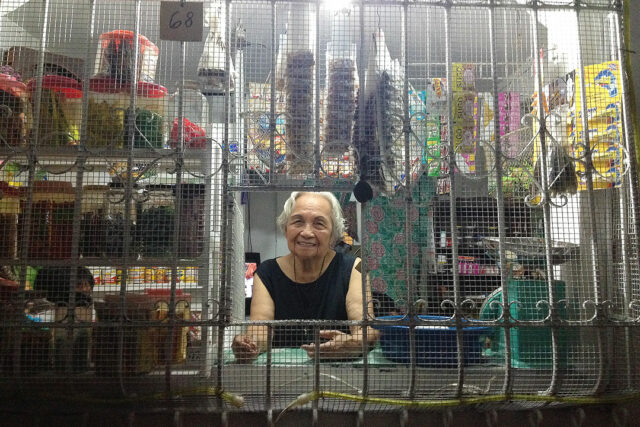
Holiday sari-sari store purchases topped by items associated with frying food

BW FILE PHOTO

PRODUCTS associated with frying food were the top items purchased during the holidays from neighborhood retailers, known as sari-sari stores, according to a study released by technology startup Packworks and sociocultural research firm Fourth Wall.

The study, of data collected between Dec. 1 and 14, indicated that packaged sauce was the fastest-growing, up 8% from a year earlier. Breading and coating mixes grew 7%, the study found.

Posting 5% growth was cooking oil.

”Our statistical analysis shows that only the products related to fried food are the ones that experienced significant growth between 2021 and 2022,” the report found.

John Brylle L. Bae, research director for Fourth Wall, said Filipinos are a “sawsawan culture,” referring to the dipping sauces accompanying many meals.

“Filipinos prefer fried foods because of its association with sawsawan… The sawsawan culture epitomizes the communal nature of eating — (it’s) more than just consuming good food, but forging long-lasting connections,” he said.

Reporting mixed growth were items associated with preparing fruit salad, a staple of many holiday celebrations, with evaporated milk purchases up 2% year on year, while purchases of condensed milk fell 1%; all-purpose cream purchases declined 11% while canned fruit purchases plunged 16%.

Demand for sugar and seasoning also declined. Sugar purchases fell 9% while those of seasoning declined 33%. The report said the declines in these categories were due to a growing health consciousness in the public as well as high prices.

“Our analysis further suggests that during holiday season, Filipinos are willing to forgo salads and sweets, but they struggle to let go of fried foods. The aversion to sugars and salads comes from high inflation, growing concerns about diabetes, and increasing health consciousness. Meanwhile, the propensity for fried foods comes from practical considerations (convenient and economical) but also from a much deeper sociocultural consideration,” Mr. Bae added.

Packworks develops a B2B app targeted at micro-retailers, which helps them keep track of their inventory and sales. It claims to have connected 110,000 sari-sari stores. — Ashley Erika O. Jose

Search and rescue operations continue after Christmas rains

CDRRMO DIPOLOG

By Kyle Aristophere T. Atienza, Reporter

EMERGENCY responders carried on with search and rescue operations on Tuesday amid continued rains that started days before Christmas in central and southern parts of the Philippines, according to reports from national agencies and local governments.

In a situation report as of Dec. 27, the government’s disaster council said 13 deaths have been reported, 23 were missing, and six were injured.

Of the reported deaths, seven were from Northern Mindanao, three from Bicol region, two from Eastern Visayas, and one from Zamboanga Peninsula, it said.

Twelve of those missing are in Eastern Visayas, eight in Bicol, and three in Northern Mindanao.

The rains, caused by a shear line and triggered landslides and flooding, have affected 44,282 families or 166,357 people, with 45,382 people displaced.

It forced 10,536 people or 45,337 families to take refuge in 87 evacuation centers.

The unusual heavy downpour, as described by local authorities, has also damaged 534 houses, 165 of which were totally destroyed.

Misamis Occidental, a province in Northern Mindanao, was among those badly hit by the Christmas rains as it recorded eight deaths.

Its governor, Henry S. Oaminal, Sr., said the collapse of flood control structures in the province forced 16,200 people from nine municipalities and two cities to evacuate.

“The cause for all this pain is that river flood controls collapsed — destroyed,” Mr. Oaminal told ONENews Channel, noting that the province has recorded seven deaths, six of which were caused by drowning.

The provincial government was already studying the declaration of a state of calamity, the governor said separately in an interview with ABS-CBN’s DZMM.

So far, only Gingoog City in Misamis Occidental has declared a state of calamity.

Mr. Oaminal said they did not expect the heavy flooding since the province is not prone to typhoons.

“This is the first time in Misamis Occidental. Our province is not a typhoon-prone area. There were rains before, but not this amount of rainfall which is very unusual,” he said, admitting that the province was not prepared for the disaster.

The governor said the local government was struggling to restore power and communication lines in the province.

The typhoon has caused damage to infrastructure initially estimated at P14.58 million, the disaster council said.

Damage to agriculture, meanwhile, has hit  P61.88 million, affecting 1,966 farmers.

The disaster council said state assistance to those affected by the typhoon was estimated at P5.25 million so far.

SAR OPERATIONS
Diego Agustin Mariano, head of the joint information center of the Office of Civil Defense, said search and rescue operations (SAR) for the missing persons were being conducted by the Philippine Coast Guard, Philippine National Police, Bureau of Fire Protection (BFP), among other government offices that are part of emergency response teams.

“SAR operations are continuing, especially as the weather improves, SAR for those missing will be able to move faster, most of them are fishermen so our operations are at sea,” he said in Filipino at a public news briefing.

Rhea Torres of the state weather bureau PAGASA said the weather condition in some parts of the Visayas and Mindanao may improve as early as Thursday.

“In the coming days, starting tomorrow, the shear line would affect large parts of the Visayas and Mindanao. But on Thursday, the weather may improve in some parts of Visayas and Mindanao until New Year (Jan. 1),” she told ONE News Channel.

Meanwhile, the Office of the Press Secretary said the Department of Public Workers and Highways has already deployed more than 7,000 personnel for disaster operations this year.

“Aside from personnel deployment, the DPWH also dispatched 1,711 pieces of equipment and cleared 168 road sections in multiple provinces from Luzon to Mindanao,” it said in a statement, as it touted the agency’s accomplishments for this year.

Pasig City bans operators of offshore gaming, other online gambling firms

JUDGEFLORO

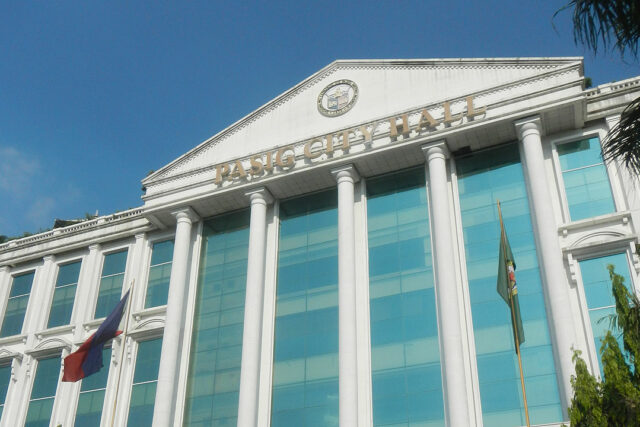
THE PASIG City government is banning offshore gaming operators and other online gambling businesses through a local ordinance approved on December 15, with existing establishments given until end-2023 to close shop.

Pasig City Mayor Victor Ma. Regis “Vico” N. Sotto, in a tweet on Tuesday, announced that he has signed City Ordinance No. 55, which revokes the local government-issued permits of companies operating online casinos, e-games, e-sabong, e-bingo outlets, online poker, computer gaming stations, as well as Philippine Offshore Gaming Operators (POGO).

Affected establishments are given a period of one year to close down their operations.

Listed businesses under Resolution No. 92, series of 2020 that have previously been granted licenses to operate can renew their business permits during the January 2023 renewal period and will be valid until December 31, 2023.

No new permits will be issued, based on the ordinance.

Violators of the ordinance will pay a fine of P5,000 or be jailed for one year, or both, upon discretion of the court.

The city ordinance, authored by Councilor Simon Gerard R. Tantoco, chair of the  Committee on Games and Amusement, states that online gambling establishments “undermine the social, moral, and economic growth and development of our society,” and has threatened the city’s safety and security.

It also indicated that there have been verified reports on the proliferation of online gaming in Pasig City, namely offshore gaming, online casinos, e-games, and e-bingo outlets, including computer gaming stations and software for gaming for a fee.

“While we have seen the social ills of these forms of gambling (have you heard of the mother who pawned her child?), that’s not all,” Mr. Sotto said on his Twitter account, citing the case of a mother who pawned her own child four times to pay for gambling debts.

During the city’s flag ceremony at the Pasig City hall on Monday, Mr. Sotto said corruption from POGO-related operations was also one of the reasons for approving the city ordinance. “We found out that they have an annual budget for our officials,” Mr. Sotto said, citing how operators allot a budget to pay the city government to ensure permit renewal in the city.

“I take it as a personal insult when there are ‘alleged’ offers of bribes every permit renewal season. If their operations are legitimate, why should there be placements like these?” Mr. Sotto said on Twitter.

Pasig City, located in the capital region Metro Manila, was declared the “Most Business-Friendly Local Government Unit” in the Highly Urbanized Cities category by the Philippine Chamber of Commerce and Industry in October. — Beatriz Marie D. Cruz

Palace touts over 1,000 kms of roads built, repaired since July

DPWH

THE GOVERNMENT has constructed and rehabilitated more than 1,000 kilometers of roads from July to November this year, according to Malacañang, as the Marcos administration vowed to provide infrastructure for unhampered transport of goods in the countryside.

In a statement, the Office of the Press Secretary (OPS) said the Department of Public Works and Highways (DPWH) “has so far constructed, maintained and rehabilitated 1,105 kilometers of roads from July to November this year.”

The department has also upgraded a total of 112 bridges and 650 flood control structures, OPS said.

Through a budget provided by the Department of Agriculture, DPWH has also built some 75 kilometers of farm-to-markets roads.

“(This is) part of President Marcos’ pledge to help farmers transport their harvest to public markets,” the OPS said, citing the DPWH’s accomplishment report.

The agriculture sector contributes about a 10th to the Philippine gross domestic product. The country’s agriculture output contracted in the first two quarters in 2022 but expanded 1.8% in the third quarter.

The administration of President Ferdinand R. Marcos, Jr., who assumed office in July, has committed to boost local production, promising to improve the delivery of agriculture products to markets by building more farm-to-market roads.

The government must “consider agriculture infrastructure as integral to the overall infrastructure push,” Terry L. Ridon, a public investment analyst and convenor of think tank InfraWatch, earlier told BusinessWorld.

“It should have the same priority and national impact as the need to build more roads, bridges and rail,” he said in a Messenger chat, noting that the agriculture budget for 2023 is “insufficient” to make farming infrastructure resilient to strong typhoons and other impacts of climate change.

The Philippines is struck by at least 20 typhoons every year, five of which are considered destructive. In October alone, the country was visited by three storms, causing billions in agricultural losses.

The DPWH’s major infrastructure projects include the Cavite-Laguna Expressway, NLEX-SLEX Connector Road, Central Luzon Link Expressway, Cagayan de Oro River Flood Management project, Samar-Pacific Coastal Road and the Mindanao Growth Corridor Road Sector Project, the Palace said.

“To support the Agri-infrastructure Support Program, farm-to-market and farm-to-mill roads will be built, based on the DPWH program,” the OPS said.

“The DPWH also has programs on flood management, water management and basic social infrastructure support that will create more livable, sustainable and resilient communities,” it added. — Kyle Aristophere T. Atienza

Senator reiterates push for disease control center on International Day of Epidemic Preparedness  

PHILIPPINE STAR/ MICHAEL VARCAS

A SENATOR on Tuesday reiterated the urgency of creating a disease prevention and control center to ensure a stronger response against public health emergencies in the future.  

To avoid heavily burdening our public health system that may signify serious repercussions, including countless morbidities and mortalities, trade disruptions and negative effect on the economy, our proposed measure emphasizes on the importance of having a strong public health capacity in communities across the country before any public health emergency occurs,  

Senator Sherwin T. Gatchalian said in a statement in time for the observance of International Day of Epidemic Preparedness on Dec. 27.  

Mr. Gatchalian filed in July Senate Bill 825 or the Disease Prevention and Control Act.   

The current COVID-19 situation emphasizes the risks and highlights the need to improve preparedness, surveillance and response at local, national and international levels against future pandemics,Mr. Gatchalian said in the bills explanatory note.    

The measure is currently pending at the Senate Committee on Health Demography.  

A counterpart bill in the House of Representatives, numbered 6522 and titled Philippine Centers for Disease Prevention and Control (CDC) Act, was approved on final reading on Dec. 12. 

The countrys reactive and bureaucratic approach in detecting and fighting against communicable diseases has proven to be fatal as the slow response in handling COVID-19 outbreak by the health department has affected and taken the lives of our frontline health workers, and endangered millions of lives of ordinary Filipinos, Mr. Gatchalian said in the bill.  

In the Senate version of the proposed law, the center will have the following functions: active surveillance, research, and recommendation of preventive measures against infectious diseases, among others.  

It is also mandated to assess and support local government units in preventing communicable diseases, and determine whether to declare a public health emergency an epidemic. 

The center will be an attached agency of the Health department, and will be composed of the Research Institute for Tropical Medicine, Disease Prevention and Control Bureau, Epidemiology Bureau, Health Emergency Management Bureau, Bureau of Quarantine, and Health Promotion and Communication Service. Beatriz Marie D. Cruz 

ADVERTISEMENT
ADVERTISEMENT