Home Blog Page 541

PAL launches nonstop Cebu-Guam flights

PHILIPPINE STAR/EDD GUMBAN

FLAG CARRIER Philippine Airlines (PAL) has started nonstop flights between Cebu and Guam, offering direct service from Central Visayas to the western Pacific Islands.

The Cebu-Guam route, which began operations on Dec. 16, complements PAL’s daily Manila-Guam flights. The airline uses Airbus A321ceo aircraft for the new service.

Flights from Cebu to Guam operate three times weekly — on Tuesdays, Thursdays, and Saturdays — while return flights from Guam are on Wednesdays, Fridays, and Sundays.

Earlier this month, PAL announced it would revive its Manila-Saipan service by March to further expand connectivity across the Pacific. The airline will operate the route twice weekly, with departures from Manila every Wednesday and Sunday and return flights on Mondays and Thursdays.

Saipan, a US territory, will become PAL’s seventh US destination, joining Los Angeles, San Francisco, New York, Seattle, Guam, and Honolulu. The Manila-Saipan route will complement PAL’s existing Pacific network, which includes flights to Guam, Honolulu, and Palau via Cebu. PAL first launched seasonal Manila-Saipan flights in 2016.

On the financial side, PAL Holdings, Inc., the operator of PAL, reported a 33.58% jump in attributable net income to P9.03 billion from P6.76 billion a year ago, driven by higher passenger revenues of P116.56 billion, up from P115.66 billion.

Cargo and ancillary revenues contributed P6.71 billion and P12.67 billion, respectively.

Total revenues for the nine-month period rose 2.68% to P136.01 billion from P132.45 billion, while gross expenses increased 3.96% to P124.85 billion from P120.09 billion. — Ashley Erika O. Jose

Government caps contractual-worker hiring

THE government has capped the hiring of contractual employees and tasked-based workers following the issuance of Joint Circular No. 1, series of 2025, the Civil Service Commission (CSC) said on Thursday.

The circular, jointly issued with the Commission on Audit and the Department of Budget and Management, sets limits on contractual hiring by government agencies, allowing them to engage contract of service (CoS) and job order (JO) workers only up to the number recorded at the end of 2025, according to CSC.

The circular allows departments and agencies to engage new CoS and JO workers through individual contracts and to renew the contracts of existing CoS and JO workers until Dec. 31.

The guidelines cover national government agencies, government-owned or -controlled corporations with original charters, state universities and colleges, and constitutional bodies.

Local government units and CoS and JO workers paid from engineering and administrative overhead expenses are excluded.

“The issuance also directs agencies to review their staffing requirements, prepare Optimization Plans under the Government Optimization Act, and consider existing CoS and JO workers for possible absorption into plantilla positions,” the CSC said in a statement.

“Additional provisions include ancillary benefits, reportorial requirements, and responsibilities of agency heads to support worker welfare,” it added. — Erika Mae P. Sinaking

IC lifts stop order again MEDOcare Health Systems

INSURANCE.GOV.PH

THE Insurance Commission (IC) has lifted the cease-and-desist order it issued against health maintenance organization (HMO) MEDOcare Health Systems, Inc. (MHSI), allowing it to exit conservatorship after more than five months.

The stop order was lifted on Dec. 16, effectively releasing the company from conservatorship, according to a notice posted on the IC’s website.

The HMO was told to stop writing new business and was placed under conservatorship on June 18 due to its continued noncompliance with the IC’s product approval requirements.

Data from the IC showed that MHSI posted a net income of P12.6 million in the first three months of 2025.

Its assets stood at P374.8 million and liabilities of P193.5 million as of March. — ARAI

Wishes for the children

STOCK PHOTO | Image by Yarenci Hdz from Unsplash

On Christmas week, we pray for love, grace, forgiveness, hope, protection and world peace. As we count our blessings and challenges, we release negative and confusing thoughts.

We are at the crossroads, between the distant past, the memories of a golden age, the roller coaster present and the dim, hazy future.

There is too much uncertainty, skepticism, anxiety, angst and rage at the recent upheavals — in our country and the world.

The children are our future citizens, and they deserve a better quality of life. These are my wishes for them.

1. A home with loving, responsible parents who teach, guide and care for them. That all parents and will lead by example and teach the children the important spiritual and family values, heritage and tradition, good manners, considerateness, compassion and kindness.

2. That children will appreciate, respect and be grateful to their parents and grandparents, that they learn about the value of family and traditions, and do not become contaminated by the materialism of others — schoolmates, friends and social media.

3. That all children be safe from domestic violence, abuse, bullying, corruption, predators and the dangerous effects of the internet.

4. That children will appreciate, respect and be grateful to their parents and grandparents who have sacrificed much to give them the basic needs and the essential education to grow, thrive and survive in the world.

5. That all children especially in the rural areas will have proper nourishment, medical and dental care to be healthy, and that they receive the vaccines to combat diseases.

6. A pollution-free environment, clean air, pure drinking water, open fields, parks with trees and flowers. That children will learn how to protect and enjoy nature — the rivers, sea, lakes and forests.

7. That the public school system will be upgraded with enough good teachers, more classrooms, books, mobile libraries, reading programs and tablets with free internet access, and affordable education in private schools.

8. A gender discrimination-free society wherein boys and girls are inspired to be the leaders in their chosen professions, and the resources and opportunities to achieve their goals.

9. A comprehensive national sports program for national and international competitions, so that they will learn the value of friendly competition, the art of winning and losing gracefully.

10. A progressive national arts and culture program with the budget for outreach projects to elevate the consciousness and develop the talents of the children and young scholars, including in the National Music Competitions for Young Artists Foundation.

11. Quality and balanced programming on television, with more educational shows such as The Knowledge Channel, and that producers, managers and stars do not exploit aspiring performers.

12. An accelerated science, math and technology education program to equip all future graduates with skills to compete in the international market.

13. More educational grants for deserving students, and funds from both the government and private institutions.

14. A stable economy with jobs and livelihood programs so that children can go to school and not be pressured to work.

15. A country with visionary national and local servant-leaders, hard-working and honest officials with intelligence, wisdom, integrity, good qualifications and heart.

16. A crime-free, abuse-free and corruption-free environment. That all kids will be protected from the menace of incest, physical and emotional abuse and the scourge of drugs.

17. That children will not be used and exposed as soldiers in areas of armed conflict.

18. Freedom of expression, the right of children to be themselves, be respected and be heard, open communication with parents, teachers and guidance counselors, and access to mental health experts when needed.

19. Innocence. A happy childhood and the chance to enjoy being a child, time to study, read, create, play, pray and rest.

20. Above all, time to grow up and develop at all levels — spiritual, mental, emotional and physical — at their own pace in a peaceful, inspiring world.

A blessed Christmas to all!


Maria Victoria Rufino is an artist, writer and businesswoman. She is president and executive producer of Maverick Productions.

mavrufino@gmail.com

Shell art tilt highlights regional winners

THE FIRST-PLACE winner in Sculpture is Pinagtagping Piraso by Ivan Joysen Del Rosario of Rizal Technological University.

THE CONTEST that launched the careers of National Artists Federico Aguilar Alcuaz, Ang Kiukok, and Benedicto “Bencab” Cabrera, among others, may just have launched a new crop of artists. It’s also interesting that a lot of the winners come from schools outside Manila, highlighting a truly inclusive contest (and insight and stories literally from all over the country).

Fifteen artists from across the country were honored at the 58th Shell National Students Art Competition (NSAC) Awarding Ceremony, held at the Ayala Museum in Makati on Dec. 5. This year, the competition received 2,200 entries from across the Philippines, all responding to the theme “Alab” (Filipino for flame).

According to a release, “With the theme ‘Alab’ the 58th Shell NSAC symbolizes the passion, hope, and purpose that drive today’s young artists. It reflects the fire that fuels their creativity and the stories behind their inspiration. Through their works, these individual flames come together to celebrate Filipino ingenuity and illuminate a shared vision for a brighter, more progressive Philippines.”

The 58th Shell NSAC’s categories include Watercolor, Digital Fine Arts, Photography, Sculpture, and Oil/Acrylic. Each category was judged by well-known artists and practitioners in the field: Watercolor was evaluated by Renato Habulan, Nemi Miranda, and Thomas Daquioag; Digital Fine Arts by Jose Tence Ruiz, Ross Capili, and Pablo Biglang-Awa, Jr.; Photography by Edwin Tuyay, Luis Martinez, and Wig Tysmans; and Sculpture by Paul Albert Quiaño, Salvador Alonday, and Ram Mallari, Jr. Meanwhile, Raul Isidro, Raul Lebajo, and Nestor Olarte Vinluan assessed the Oil/Acrylic entries.

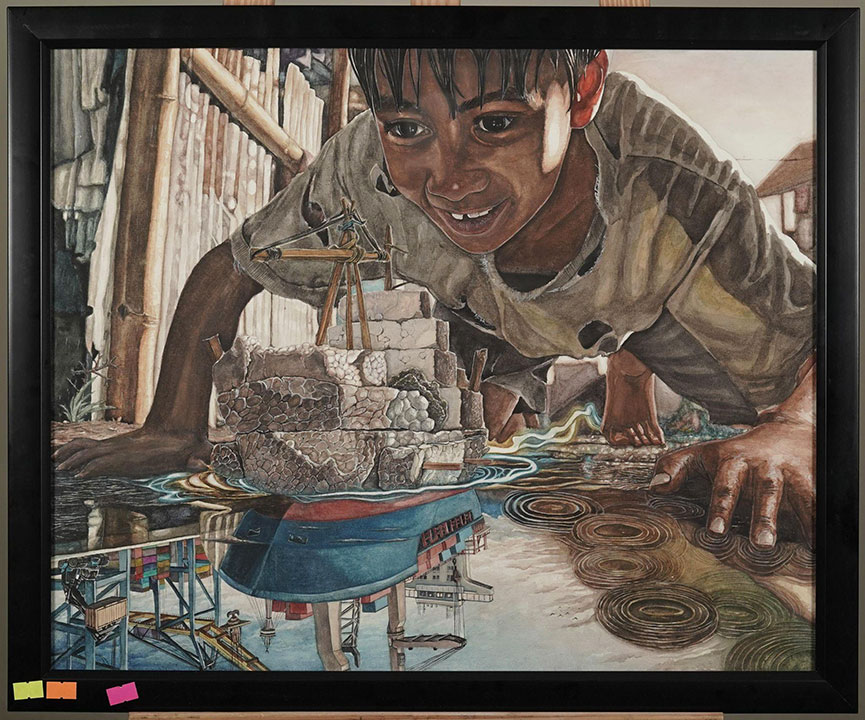
The winner in the Watercolor category is Odyssey of the Scrap Mariner by Jonnas Almazar of Bataan Peninsula State University, depicting a child with his simple scrap-made toy boat. The 2nd and 3rd place awards went to Irish Fernandez of Ilocos Sur Polytechnic State College – Main Campus for Two-Big and Keth Byonnsey Estilo of Eulogio “Amang” Rodriguez Institute of Science and Technology for Kinsesas, respectively.

The winner in Digital Fine Arts is Sagwan Math-tatag! by Adam Martin De Leon of the University of the East – Caloocan. Inspired by his workplace, the piece reflects the country’s struggle with math proficiency and the hope to uplift future learners, according to a statement. Second and 3rd place went to Sofia Frances De Guzman of Mapúa Malayan Colleges Laguna for This Flame Remembers Me, and Amos Ulang of the University of the Philippines – Diliman for Moving Stories.

Jerry Balanay of Northwestern Mindanao State College of Science and Technology won first place in Photography for Alab: A Burning Vision of Hope. The photo captures an artist illuminated by candlelight, shaping hope and creativity in the darkness.

Second and 3rd place went to Jason Mendoza for Hangga’t May Liwanag and Shainne Maica Ayap of Lyceum of the Philippines University – Batangas for The Flame Within.

Ivan Joysen Del Rosario of Rizal Technological University won first place for Sculpture for Pinagtagping Piraso, inspired by his grandmother’s battle with Alzheimer’s. Jusun Joshua Estoce of the University of Santo Tomas won 2nd place for 0.02g, while Gian Paolo Marchadesch of the University of the Philippines – Diliman won 3rd place for Paglayag Tilupad.

The winner in the Oil/Acrylic category is Usok na Nagiging Buhay by Ruth Cenas of the University of the Philippines – Mindanao. The painting shows a young dreamer sketching by candlelight, where rising smoke forms the image of a painter, symbolizing the future she hopes to build, according to a statement. Second and 3rd place went to Don Ace Rabbon of the University of Northern Philippines for Raniag ni Maskbayan (The Light of Futurity), and Vilia Crestene Gelaga of Cebu Technological University – Argao Campus for The Flame Within.

OUTSIDE THE CITY
As we’ve mentioned, a large number of the winners come from schools beyond the capital. “I’m looking for every artwork na mayroong malakas na impact (that has a strong impact) to the viewer,” said artist and judge for the Watercolor category Nemi Miranda. Asked if the winners’ roots were a factor in judging, he said, “’Pag dating sa mga judges, hindi namin inaalam ang personality ng mga contestants (we do not have prior knowledge of the personality of the contestants), to be fair to all participants,” he said.

Asked about the relevance of letting more regional contestants participate, he said, “It will draw inspiration doon sa mga regional artists sa malayong lugar (from faraway places), na they have the chance of being winners also, in the future.”

Abdulmari “Toym” D. Imao, Jr., Filipino visual artist and newly elected Dean of the UP Diliman College of Fine Arts, served as a speaker for the ceremony. He pointed out to the students from Visayas and Mindanao, “Malayo ang inyong pinanggalingan (you have come from so far away).” He then talked about a boy who once sold peanuts next to a cinema in Jolo, Sulu. A World War II landing craft with a new life as a floating museum docked there, and every day, the boy went to look at the artwork. The curator gave him his card, if in case he ever wanted to study in Manila. In Manila, he worked as a houseboy while lining up for scholarships in Malacañang. On one such occasion, he collapsed due to hunger, to be found by Jose Maria Ansaldo, then a secretary of Philippine President Ramon Magsaysay. This chance meeting put him on the track for a scholarship in UP, which then allowed him to take scholarships and grants, one after another, in the US and in Europe. “And he was my father,” said Mr. Imao, telling the story of Abdulmari Imao, who became the country’s first National Artist for Visual Arts of Moro identity.

“Why am I telling you this? Sometimes, it’s not about just the final work that you put out there. The work is the bonus (to) your own personal journey as an artist,” he said.

Meanwhile, one of the winners, Mr. Almazar of Bataan, said when he won, “’Di talaga ako makapaniwala (I can’t believe it).” His voice shaking, his peers shouted and laughed and teased him affectionately about crying. He said that his winning work in watercolor, Odyssey of the Scrap Mariner was inspired by a picture he saw of poor children building boats out of scrap — something he used to do. Inspired by and dedicating his work to children of underprivileged families, he said, “Everything is possible, as long as naniniwala tayo sa kakayahan natin (if we believe in our abilities).”

“Keep the flame burning.” — JLG

Should employees petition to remove a toxic boss?

Our department head is a dictator. He controls rather than coaches, blames instead of guides, and uses fear, favoritism, or humiliation to get results. Most of the time, he uses four-letter words to get us going. Ninety percent of people under his department are fed up. We’re thinking of writing a petition so that he’s replaced, if not dismissed by the chief executive officer (CEO). Please advise before we do anything. — Sea Lion.

There are many things that could unite employees who think they must do something against a toxic boss. This is often done through a silent network forum, including meal breaks turning into therapy sessions. Outside of work, group chats light up with animated discussions, solidifying into a resolution that “something must be done.”

Eventually, someone suggests petitioning the CEO to remove him. It sounds bold. It feels cathartic. It also sounds like justice. But is it the best option? The short answer is no, if you’re resorting to it as the first option.

Don’t be trigger-happy. Writing a petition to the CEO is premature, risky, and surprisingly ineffective as many of them tend to protect their management team.

When employees are unhappy, emotions run high. In that emotional state, a petition feels like strength in numbers. There’s unity in numbers. Unfortunately, many CEOs don’t always see it that way. Rather, they would look at a petition like a rebellion to be suppressed.

Your CEO may think: How could I protect this manager who has consistently delivered extraordinary results? If that’s the case, your petition may quietly die at the risk of the signatories becoming visible and silently hunted by the manager.

EMOTION VERSUS DATA
CEOs act on risk, performance, and data, not people’s emotions. The argument that the boss is toxic is emotionally true but operationally weak. They would want to hear objective data provided by an independent human resources (HR) department. They will ask:

Would that result in a higher attrition for this department than others? Are employee engagement scores declining? Are targets being missed? Are customers complaining? Are safety, compliance, or ethical lines being crossed? In other words, CEOs want to see how behavior translates into business or governance impact.

A boss who is unpleasant to workers but still delivers results will often be tolerated. One common mistake that employees make is attacking the manager instead of his behavior. “That boss is arrogant, abusive, and impossible to work with.” Those statements may be true, but they are subjective and easy to dismiss unless supported by data.

What carries weight are patterns of behavior with actual complainants’ testimonies: Publicly shaming employees during meetings. Setting unrealistic deadlines that lead to burnout. Ignoring HR or safety protocols. Threatening “rebels” who raise valid concerns.

Patterns suggest a systemic issue, not a personality clash.

EXHAUSTING OTHER REMEDIES
Before employees consider a petition, they should ask a hard question: Have they fully availed of the existing grievance channels, if the employees are unionized? These usually include how HR has handled individual or multiple complaints.

Also, what’s the result of the annual morale survey? What was done by the immediate boss of the manager, assuming the toxic boss is not reporting directly to the CEO?

How about other options like the internal ombudsman office, ethics committee, or a whistleblower program, if any? Because the CEO can always ask: Why are you bothering me with this when there are other appeals mechanism available? If there are no clear answers, then your petition will be routinely ignored.

After all, collective action doesn’t require a public petition. When multiple employee complaints are reported through proper channels, it sends a strong signal — it’s not an isolated grievance. It’s a leadership issue. Quiet consistency is more powerful than drastic, loud confrontation.

WHEN PETITIONING MAKES SENSE
Of course, there are situations when a petition can be handled directly by the CEO. This includes the repeated failure of HR to resolve such cases, or if the available mechanism is not working to expectations. Even then, the goal should not be instant removal of the toxic boss. 

Rather, a more effective message is: “We are requesting CEO intervention to address behaviors that are harming people, their morale, and performance that could result in organizational risk.” That subtle shift allows top management to choose the corrective action like a reassignment or removal without anyone feeling publicly cornered.

In conclusion, petitioning the CEO to take corrective action against a toxic boss is not wrong, if you’re not doing it as a knee-jerk reaction. Start with evidence. Individually, the complainant could silently raise the issue with the toxic boss. If warranted, use the available open-door system.

Focus on logical and systematic impact. Escalate without emotion. And when removal becomes necessary, it should look less like a revolt — and more like a responsible leadership correction that redounds to the benefit of the organization.


Consult your workplace issues with Rey Elbo for free. E-mail elbonomics@gmail.com or DM Facebook, LinkedIn, X or via https://reyelbo.com. Anonymity is guaranteed, if necessary.

Yuchengco firm’s Isabela solar farm starts exporting power to Luzon grid

YUCHENGCO-LED Rizal Green Energy Corp. said the initial capacity from its solar farm in San Pablo, Isabela has started injecting electricity to the Luzon grid after securing approval from the National Grid Corp. of the Philippines (NGCP).

In a statement on Thursday, the company said that NGCP issued the provisional certificate of approval to connect the solar project’s Phase 2 with a capacity of 33.831 megawatt-direct current (MWdc).

The plant completed its energization as a load facility in November.

The company is expecting to energize remaining 6.006 MWdc “in the coming weeks,” along with its 25-MWdc Bugallon solar facility in Pangasinan.

Rizal Green is a joint venture between Japan’s Taisei Corp. and PetroGreen Energy Corp., which is part of the Yuchengco Group of Companies.

“Once energized, [PetroGreen] would have 263 MW of utility-scale operational renewable energy facilities,” said PetroGreen Vice-President Maria Victoria Olivar said.

The Limbauan solar plant is the this facility of PetroGreen to add power supply to the grid after the 27MWdc Dagohoy solar farm in Bohol and the 19.6MWdc San Jose solar farm in Nueva Ecija.

PetroGreen is the renewable energy arm of PetroEnergy, which is aiming to increase its generation capacity to 500 MW by 2029 from its current 145 MW. — Sheldeen Joy Talavera

Justice Reform Initiative: celebrating a decade of resolve

This year marks the 10th anniversary of the Justice Reform Initiative (JRI), a milestone that allows us to reflect on a decade of dedicated effort to strengthen one of the most vital pillars of our democracy: the rule of law. When JRI was established, the justice system faced significant challenges. Case delays were common, public trust was low, and confidence was fragile. FINEX joined as a founding member because we recognized that a healthy economy and credible institutions are interconnected. If we want a Philippines where businesses can grow and people can thrive, we need a justice system that is predictable, impartial, and trustworthy.

Over the past ten years, JRI has consistently provided a productive platform for dialogue and reform. It has united groups who believe that a fair and effective justice system benefits every Filipino. Through these partnerships, JRI has advanced practical reforms centered on transparency, accountability, and modernization. Initiatives such as case decongestion programs, improved judicial appointment processes, and the increasing digitalization of court systems demonstrate the progress achieved.

For FINEX, this work strongly aligns with our mission. Economic activity depends on trust and confidence that contracts will be enforced, disputes will be fairly resolved, and corruption won’t influence outcomes. A weak justice system directly impacts the cost of doing business, investor confidence, and ultimately, the country’s competitiveness. In the words of PHINMA’s Chairman Ramon del Rosario, Jr., “Good governance is not only the right thing to do; it is also good for business. It creates trust, and trust drives investment.” By supporting JRI, we promote a broader vision of national development built on good governance. Judicial reform is not just a legal matter; it is an economic and social necessity.

Judicial reform is complex and requires time; no single institution can accomplish it alone. However, when stakeholders work together, when business leaders voice their opinions, when the judiciary welcomes innovation, and when civil society remains focused on accountability, the path to reform becomes clearer.

Of course, much work remains. Case backlogs continue to strain the system. Delays still burden ordinary Filipinos seeking justice. Corruption and political interference threaten institutional independence. Technology investments must accelerate so courts can keep pace with modern demands. These challenges are real, and they will require patience, persistence, and partnership to overcome. But the last ten years have shown that progress is possible when institutions commit to reform with honesty and resolve.

As JRI enters its second decade, FINEX reaffirms its support for this essential mission. Strengthening the rule of law will increase investor confidence, empower businesses, and create a more stable environment for long-term growth. But beyond economic advantages, a reliable justice system restores something even more vital: faith in institutions meant to protect all Filipinos.

Congratulations to the Justice Reform Initiative on this meaningful milestone. Ten years of advocacy is an achievement worth celebrating, but it is also a reminder of what more can be done. Look forward to further reforms that strengthen the rule of law because a just society is the foundation of a strong and hopeful nation. After all, as former Chief Justice Artemio Panganiban said, “Economic progress and the rule of law are twins. One cannot thrive without the other.”

The views expressed herein are his own and do not necessarily reflect the opinion of his office as well as FINEX.


EJ Qua Hiansen is the chief financial officer of PHINMA Corp. and the president of the Financial Executives Institute of the Philippines.

Europe’s naivety about the China export shock is tragic

STOCK PHOTO | Image by TravelScape from Freepik

By Lionel Laurent

EUROPEAN UNION (EU) carmakers like Volkswagen AG got their wish this week when a combustion-engine ban for 2035 onward was effectively abandoned. It was seen as too ambitious, too costly and a dream for Chinese rivals, whose electric vehicle (EV) head start (powered by subsidies) has given them a 7% share of the continent’s autos market. Faced with a choice between climate leadership and protecting jobs, the EU chose the latter.

While it’s true that the ban failed to spark a true European EV boom, dumping it is nowhere near enough to secure the industry’s future. It won’t solve Chinese competition. Worse, ditching it sends a signal that carmakers can comfortably take their foot off the investment accelerator. That’s the wrong message.

The tragedy here is Europe’s industrial and geopolitical naivety in the face of China’s export engine and high-tech ambitions, rather than clumsy bureaucratic overreach. Beijing’s trade surplus with the EU has widened to close to $300 billion this year. While once it was Germany flooding China with cars and machines, the direction reversed after COVID-19, with German car exports to China slumping 70% between 2022 and 2024. Automaker profits are sinking and they’re cutting jobs. Volkswagen has shut a plant in its home market for the first time.

Addressing this means being clear-eyed about what’s driving the imbalance. There’s genuine innovation at the core of China’s BYD Co., which took Tesla, Inc.’s crown as the world’s biggest electric car company and which sells EVs like the Dolphin Surf for less than €23,000 in Europe. But the country’s European success is also wrapped in subsidies, overcapacity and a weakening yuan. The fact that China exports more gasoline cars than EVs is also proof that this is about more than fiddly EU rules. “China makes more than the world can take,” as the Asia Society Policy Institute’s Lizzi C. Lee put it recently.

The flipside of Chinese oversupply is weak European demand. As the tariff drawbridge gets raised in the US and China squeezes out EU imports, the lack of a strong European market is becoming obvious. Sluggish economies, high sticker prices and alternative transport options have weighed on the EV transition, as have uneven charging infrastructure and expensive energy. In the first half of this year, European car production fell by 2.6%; China’s soared by 12.3%. Howls of protest at the 2035 ban have ultimately been a distraction.

European policymakers need more than regulatory U-turns, or public laments, to address the industry’s deep-rooted problems. They must weigh other means to limit Chinese supply. EV tariffs have so far been too little too late, failing to cover other cars like hybrids. They may have to be expanded. The EU should also seek out allies to put pressure on China about its weak currency, described by hedge fund boss Stephen Jen as an unsustainable disadvantage. Economist Nicolas Goetzmann estimates that overall euro-area imports from China have increased by almost 5% between October 2022 and 2025 in volume terms.

At the same time, the EU should also put a rocket under demand at home. A recent paper by the Centre for European Reform proposes expanding subsidies to steer demand toward Europe-made EVs and filtering out Chinese production by favoring low-emission supply chains. And given the gloomy state of private-sector activity in the bloc, with Germany’s industrial sector unexpectedly deteriorating this month, the European Central Bank should signal openness to cutting interest rates further rather than mooting more hikes.

EVs are not going anywhere. BloombergNEF still forecasts global sales of electric cars will increase by 16% in 2026 to 25.4 million units. If there’s been a misdiagnosis, it’s about Europe’s capacity to transform its industry while playing by rules that neither the Chinese nor the Americans follow. Until that mindset changes, tweaking 2035 bans won’t mean much.

BLOOMBERG OPINION

Stuff to Do (12/19/25)


Get some laughs with Rex Navarrete and Red Ollero

RENOWNED Filipino stand-up comedians Rex Navarrete and Red Ollero will have a one-night only show on Dec. 20, 3 p.m., at Power Mac Center Spotlight in Circuit, Makati. Titled “An Almost Christmas Show,” it puts together the two comedians for the holiday season. Tickets are available via ticket2me.net/ComedyManila.


Watch The Man Alive Choice in Manila

THE K-SHOW “The Man Alive Choice” is coming to City of Dreams Manila this Dec. 27 and 28. The Las Vegas-style body performance show, which was a hit in Seoul and Jeju in South Korea, will have immersive storytelling, high-energy choreography, and steamy production. The limited Manila run also marks the oppas’ first all-gender show.


Catch orchestral concerts at Ayala Triangle

MAKATI IN COLOR: Paskong Likha is kicking off at Ayala Triangle this week. Presented by Ayala Land, Inc., and Make It Makati, this weekend’s lineup includes a Simbang Gabi mass every 6 p.m. until Dec. 23 at the canopy fountain area of Tower One and Exchange Plaza. On Dec. 19 and 21, 6 p.m., “Pasko na Manam: Music in the Park” will be led by the Manila Philharmonic Orchestra String Quartet, who will serenade parkgoers at the lawn area in front of Manam at the Triangle. On Dec. 20, 6 p.m., the show will instead be led by Leggiero Strings and Chamber Orchestra String Quartet at the same venue. Meanwhile, “Makati Street Meet,” in collaboration with the French Embassy, will fill the stretch of Paseo de Roxas with street booths from 10 a.m. to 10 p.m. on Dec. 20 and 21.


Marvel at the fireworks at Greenhills

AT GREENHILLS MALL in San Juan City, fireworks will light up the sky for three nights in a row to celebrate the Christmas season. The shows will take place on Dec. 20, 25, and 30 at 6 p.m., set to be multicolored spectacles to embody the holiday spirit.

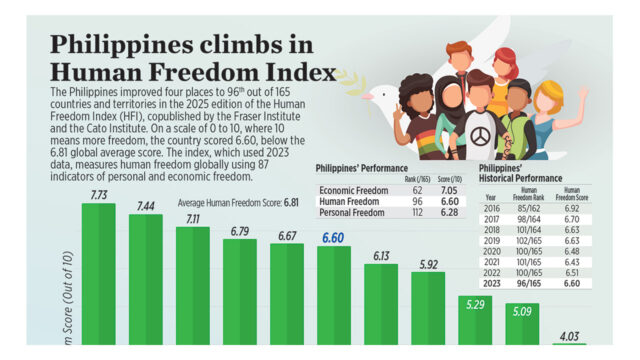
Philippines climbs in Human Freedom Index

The Philippines improved four places to 96th out of 165 countries and territories in the 2025 edition of the Human Freedom Index (HFI), copublished by the Fraser Institute and the Cato Institute. On a scale of 0 to 10, where 10 means more freedom, the country scored 6.60, below the 6.81 global average score. The index, which used 2023 data, measures human freedom globally using 87 indicators of personal and economic freedom.

How PSEi member stocks performed — December 18, 2025

Here’s a quick glance at how PSEi stocks fared on Thursday, December 18, 2025.


ADVERTISEMENT
ADVERTISEMENT