Home Blog Page 5285

Arts&Culture (02/08/23)


Kawayang Tulay by Wilfredo “Yeye” Calderon

Majayjay the subject of watercolor exhibit

MAJAYJAY in Laguna is a quaint small town located at the foot of Mount Banahaw, a close-knit community with lots of natural resources. The wholesome beauty of the town was captured in watercolor and coffee paintings by Wilfredo “Yeye” Calderon. Also from Laguna, Mr. Calderon was tasked by Monsignor Mel Barcenas to restore the original Stations of the Cross paintings inside the Church of St. Gregory the Great Parish. During his regular visits to the Church, Mr. Calderon discovered the hidden gems of Majayjay. An exhibit of 30 of his Majayjay works will go on view on Feb. 25 at Latriccia’s Resort Hotel in Majayjay. Part of the proceeds will fund the numerous projects of the parish. For more details about the fund raising art exhibition, visit the Facebook page https://facebook.com/yamanngmajayjay or contact the St. Gregory the Great Parish’s Finance Committee at 0917-621-1672.


First exhibition of 2023 at ArtistSpace

IN CELEBRATION of the Philippine Arts Month, Pugad ni Art Studio (PnAS) takes center stage with a group exhibition entitled “Querencia”. It is on view until Feb. 14 at ArtistSpace located at Ground Level, Ayala Museum Annex, Makati Ave. corner De La Rosa St., Greenbelt Park, Makati City. “Querencia” means “a place where one draws inspiration or strength from” or “the place where one feels most comfortable and true.” The group exhibition features the works of 22 visual artists, both budding and seasoned, coming from different parts of Luzon, mainly from the Cordillera region, showing 45 works of art. The participating artists are Francis Alingcayon, Angelie Banaag, Manny Cabrera, Salvador Cabrera Jr., Norman Casilin, RM Cerezo, Alfonso Dato, Alfred Dato, Yoner Dato, Erni “ErGo” Gomez, Art Lozano, Summer Lozano, Franco Matucad, Elmo Modelo, Iwag Palattao, Mia Panimdim, Lourice Raphael, Jose Santiago, Dexter Simsim, Joey Simsim, Hazel Sobremonte, and Kyle Vizcara.


Filipinas Heritage Library holds webinar on Pinoy folklore

THE AYALA Foundation, Inc. – Filipinas Heritage Library presents “Mystic Toolkit: Pinoy Folklore and the Tarot” with Louie Jon A. Sánchez, Ph.D. In this webinar and workshop with the UP professor, participants will learn to use Philippine folklore and the tarot to get creative juices flowing and reflect on their life choices. The free webinar will be held on Feb. 11, 10-11a.m., while a two-day Zoom workshop will be on Feb. 11 and 18, 11 a.m. to 5 p.m. for P1,000 (discounted to P800 for AM Members and AGC employees, and P715 for Seniors and PWDs). Slots are limited. The speaker/facilitator, Mr. Sánchez, is a poet, critic, and translator. An associate professor at the College of Mass Communication, University of the Philippines Diliman, he teaches courses on the teleserye, communication, and television studies. He is also a level-two certified Reiki healer and combines energy healing with Tarot and oracle readings. For inquiries, send an e-mail to asklibrarian@filipinaslibrary.org.ph.


Photo exhibit at Bencab Museum

FOTOMOTOPH is a photography collective that organizes the largest festival of Philippine photography. Through exhibitions and a programming of educational activities, FotomotoPH aims to foster conversations about photography’s role in Philippine culture and demonstrate ways in which the photographic medium as an art form can express complex identities. Now on its second year, FotomotoPH launched “Fotomoto22: Home” with an open call throughout the Philippines and the diaspora. From the festival’s main body of work, 100 images were selected to be presented at the BenCab Museum. “FotoMoto 22: Home” is on view until March 26 at the BenCab Museum in Baguio. The exhibit is the festival’s first time to travel to the northern region, in solidarity with National Artist Benedicto “BenCab” Cabrera’s participation in the first Fotomoto festival and also as a way to connect with photographers in the region. Participants approached the theme of “Home” in response to the collective experience of having emerged from the past two years with new perspectives on our homes, due to prolonged isolation forced by the COVID-19 pandemic. Meanwhile, “Skywatcher II,” an exhibit of photos by BenCab, is on view at the museum’s Sepia Gallery until March 26.


Four exhibits at West Gallery

THERE are four exhibits on view at the West Gallery in Quezon City, running until Feb. 11. They are Paolo Icasas’ “The Jealous Mistress,” Lindslee’s “Long Life,” Art Tavera’s “Shape, Form and Aesthetic Chloroform,” and Teo Esguerra’s “Marikit Na: Portrait of A River”.


ARTablado presents ‘Art Flare’ at Robinsons Antipolo

ARTABLADO helps celebrate Arts Month by presenting the exhibit “Art Flare” at the Robinsons Antipolo, which features five prolific visual artists: Neptalie “Rico” Aunzo, Pol Mesina, Jr., Nelson Basa, Daniel Dumaguit, and Ramil Tumampos. “Art Flare” will feature 40 works, all of which embody each artist’s love for country. Themes also include maternal love and an appreciation for nature, culture, and religion. “Art Flare” is on view until Feb. 15 at the Upper Ground Floor, North Wing of Robinsons Antipolo.


ArtPh debuts in-person exhibit ‘SIBOL’ at the Shang

Shangri-La Plaza mall partners with ArtPh for its first-ever in-person group art exhibit “SIBOL,” at the East Atrium. It is ongoing until Feb. 15. Curated by ArtPh co-founders art collector Lori Jurvida and TV personality Christine Bersola-Babao,SIBOL” presents the works of emerging and established artists, including the hyperrealist works of Cagayan-based artist Neill Christian Simon Onza, who went viral for his contemporary take on Juan Luna’s Spoliarium. Also on view are works by Nestor Abayon, Jr., an artist from Occidental Mindoro, and Jarren Dahan, a North Cotabato artist and a Fine Arts student at University of Mindanao, both of whom garnered attention for their paintings of their parents who are farmers. Also joining SIBOL” are Eloy Muñoz, Sonny III Tolentino, and Ted Peñaflor IV.


MCAD holds environmental online exhibit

THE MUSEUM of Contemporary Arts and Design (MCAD) presents “Gubat,” the fourth biome in Derek Tumala’s online exhibition “Tropical Climate Forensics”. The “Gubat” biome shows the effects of deforestation, mineral extraction, and the failure of the government to enforce sustainable environmental laws on the country’s forests, its inhabitants, and the entire population. MCAD’s “Tropical Climate Forensics” exhibit is part of the World Weather Network — a global coalition of 28 arts agencies around the world in response to the climate crisis. It is supported by the British Council’s Creative Commissions for Climate Action, a global program exploring climate change through art, science, and digital technology. For more information on the project visit, https://www.mcadmanila.org.ph/tropical-climate-forensics/ To visit the app directly, log on to https://porensiko.ph/.


UP Arts and Culture Festival honors National Artists

IN CELEBRATION of the National Arts Month, the UP Diliman Arts and Culture Festival 2023 takes place from February to March with the theme, KALOOB: Mula at Tungo sa Bayan, and will pay tribute to the achievements of artists-scholars-creators who created works that shed light on the Filipino condition. The concept of “kaloob,” which can mean “present, contribution, gift, offering, donation, inheritance, memory,” gives importance to the interconnectedness of Filipinos through the spirit of giving and fellowship. The festival has three main dimensions: first is honoring the newly appointed National Artists (Proclamation Number 1390 signed on June 10, 2022), of whom five are artist-scholars belonging to the UP community; second is introducing the new artist-scholars who create and conduct research under the Artist Support Program of the UP Diliman Office for Initiatives in Culture and the Arts; and lastly, officially recognizing the National Living Treasures or Culture Bearers. For more information about the festival and its components, visit bit.ly/2023UPDACF.

Closing the care gap

Noncommunicable diseases like cancer often require prolonged management and sometimes, hospitalization and recovery, entailing huge expenses that can push patients and their family to financial hardship, even poverty.

People who seek cancer care hit barriers at every turn. Income, education, geographical location and discrimination based on ethnicity, race, gender, sexual orientation, age, disability and lifestyle are just some of the factors that can negatively affect care.

The most disadvantaged groups are also more likely to have increased exposure to a host of other risk factors such as tobacco, unhealthy diet or environmental hazards. In fact, the World Health Organization (WHO) said about a third of deaths from cancer are due to tobacco use, high body mass index, alcohol consumption, low fruit and vegetable intake and lack of physical activity.

Every year on Feb. 4, we observe World Cancer Day. The cancer community comes together, through capacity building and advocacy initiatives, to intensify the call to reduce the global cancer burden, promote greater equity and integrate cancer control in the world health and development agenda.

The theme of this year’s celebration is “Close the Care Gap.” The more we know about cancer, the more lives we can save. However, the reality today is that the world’s population lacks access to the full range of essential health services. This is the equity gap, and it is costing lives.

If we do not take action, cancer will continue to be a leading cause of death worldwide. There were almost 10 million cancers death in 2020, or about one of six deaths, according to the WHO. Globally, the most common cancers are breast, lung, colon and rectum and prostate cancers.

Meanwhile, human papillomavirus and hepatitis are responsible for about 30% of cancer cases in low and lower middle-income countries.

The Department of Health (DoH) said cancer is among the top three leading causes of death in the Philippines, and its burden is increasing. For breast and lung cancer alone, cases increased annually by 5.9% and 7.2%, respectively, between 2012 and 2018, according to a Philippine Institute for Development Studies (PIDS) report.

The most common types of cancer in the Philippines are breast, lung, colorectal, liver, prostate and cervix uteri, with the highest share of deaths from lung, liver, and breast cancers, according to PIDS.

Patient organizations have noted that many don’t consult their doctors regularly, making it more difficult to prevent, detect and treat cancer. Some may think of a cancer diagnosis as a death sentence. But the WHO said between 30% and 50% of cancers can be prevented by avoiding risk factors and implementing evidence-based prevention strategies.

One can lower the risk of getting many common cancers by making healthy choices, the US Centers for Disease Control and Prevention (CDC) said. Advancements in science, including those related to innovations in diagnostics, vaccines and medicines, allow for many cancers to be cured if detected early and treated effectively.

The CDC said screening tests can find some cancers early, when treatment works best. Meanwhile, vaccines can help prevent several kinds of cancer. For example, the human papillomavirus vaccine helps prevent most cervical cancers and several other types of cancer. The hepatitis B vaccine can help lower the risk of liver cancer.

A new era of innovation is also pushing the frontiers of science and having a significant impact on the lives of patients with a wide range of cancers, noted the Pharmaceutical Research and Manufacturers of America. It said new cancer medicines have led to treatment advances in recent years, preventing deaths across many tumor types, particularly for breast and lung cancers and melanoma.

Some patients also do not seek or continue their treatment due to the anxiety of putting a heavy financial burden on the family. While the passage of the Universal Health Care (UHC) Act and National Integrated Cancer Control Act (NICCA) can ensure equitable and rational delivery and financing of the cancer care continuum, the full implementation of these laws has been delayed due to challenges posed by the COVID-19 pandemic. Patients who pay for their own treatment are often unable to continue with treatment and care.

Leveraging on the NICCA and UHC Act implementation to put cancer prevention and care on the national agenda will be crucial to achieve health equity. The Health department, PhilHealth and private sector can use these landmark laws as motivation to increase overall cancer care financing. Continuous engagement of the Executive branch and private sector with legislators can ensure that the NICCA is progressing as envisioned, according to the PIDS paper.


Teodoro B. Padilla is the executive director of the Pharmaceutical and Healthcare Association of the Philippines (PHAP), which represents the biopharmaceutical medicine and vaccine industry in the country. Its members are in the forefront of research and development efforts for COVID-19 and other diseases that affect Filipinos.

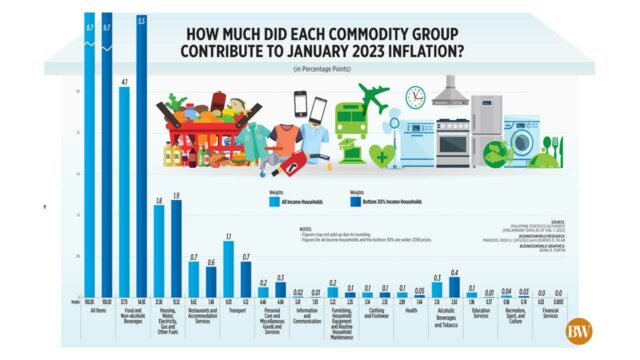
How much did each commodity group contribute to January 2023 inflation?

HEADLINE INFLATION accelerated to a fresh 14-year high in January as food prices continued to surge, fueling bets of further interest rate hikes to anchor expectations. Read the full story.

How much did each commodity group contribute to January 2023 inflation?

Rediscount facility untapped in Jan.

BW FILE PHOTO

BANKS did not tap the central bank’s rediscount facility last month as liquidity in the financial system remained ample.

“There were no availments on the rediscounting lines of banks with the BSP under the Peso Rediscount Facility and Exporters’ Dollar and Yen Rediscount Facility (EDYRF) for the period covering 01 to 31 January 2023,” the Bangko Sentral ng Pilipinas said in a statement on Tuesday.

Lenders likewise left the facility untouched in the same month in 2022. The rediscount window only saw availments in April, June and October last year, with cumulative loans hitting P15.3 billion.

The last time the EDYRF was tapped was for a dollar rediscounting loan in 2016.

The central bank’s rediscount window gives banks access to additional money supply by posting their collectibles from clients as collateral.

The BSP’s rediscount facility gives banks access to additional liquidity by letting them post collectibles from clients as collateral.

In turn, lenders can use the cash, which could be in peso, dollar, or yen, to lend more to their corporate or retail clients and service unexpected withdrawals.

Banks did not borrow from the rediscounting facilities in January due to excess liquidity in the financial system after the holidays and amid better asset and loan quality, Rizal Commercial Banking Corp. Chief Economist Michael L. Ricafort said in a Viber message.

“Banks also have other funding options other than the BSP rediscounting facilities such as interbank borrowings, deposits, fund-raising via the capital markets such as the issuance of bonds and stocks, among others,” he said.

Outstanding loans issued by universal and commercial banks increased by 13.4% year on year to P10.9 trillion in December, slower than the revised 13.9% growth in November, preliminary data from the BSP showed.

Credit for production activities jumped by 12.1% to P9.56 trillion, slowing from the revised 12.6% growth in November.

Banks extended more loans for real estate activities (13.1%); manufacturing (14.9%); electricity, gas, steam and air-conditioning supply (14.4%); motor vehicles (12.7%); and information and communication (21.6%).

In the same month, domestic liquidity rose by 6.4% year on year to P16.3 trillion in December.

Meanwhile, the banking industry’s bad loans fell for the 10th straight month in December 2022, bringing the nonperforming loan (NPL) ratio to its lowest in 28 months.

Banks’ gross NPL ratio dropped to 3.17% in December, from 3.97% a year ago and 3.35% in November, BSP data showed. This was the lowest ratio in more than two years or since 2.84% in August 2020.

Soured loans declined 11.6% to P399.53 billion in December, from P452.45 billion a year earlier. This was also 2.1% lower than P408.1 billion in November.

FEBRUARY RATES
For February, the applicable rate for peso rediscount loans will be at 7.1148% for 90 loan maturity days, and at 7.7296% for 91-180 days.

Meanwhile, dollar borrowings will be priced at 7.183% (1-90 days), 7.328% (91-180 days), 7.34450% (181-360 days).

Yen-dominated borrowings will be priced at 2.08875% (1-90 days), 2.12% (91-180 days), 2.1775% (181-360 days). — K.B. Ta-asan

Nespresso taps Mober in decarbonizing on-ground delivery via EVs

PHILIPPINE tech-logistics startup Mober has partnered with Nespresso in the Swiss coffee brand’s sustainability efforts such as switching to a delivery fleet that uses electric vehicles (EVs).

In a statement on Tuesday, Mober said the partnership with Nespresso aims to decarbonize on-ground delivery by shifting to EVs. Mober started delivering Nespresso products from the latter’s warehouse to stores across Metro Manila in December last year.

“We aim to catalyze a transition to zero-emissions mid and last-mile delivery in the Philippines. By switching to EVs, Nespresso is set to eliminate hundreds of tons of carbon dioxide (CO2) emissions yearly, and this is just the beginning for us,” Mober Founder and Chief Executive Officer Dennis Ng said.

Mr. Ng said that shifting to EVs allows the company to operate more efficiently while also contributing to carbon footprint reduction efforts.

“Monitoring the CO2 offset for our EV fleet can serve as a conscious reminder for businesses looking to go green to reflect on using EVs soonest. This will also help us save the data for future use and reach our net-zero goal target,” Mr. Ng said.

According to Mober, it currently has a fleet of 20 EVs and e-trucks, serving clients such as IKEA for last-mile delivery, Nespresso for warehouse-to-store delivery, and SM Appliance Center for same-day delivery.

“Mober’s electric vans can travel up to 230 kilometers, while the range of its electric trucks is 280 kilometers, offering flexibility to meet their clients’ wide logistical needs. EVs run on fast-charging lithium-ion batteries and emit zero carbon dioxide compared to internal combustion engine (ICE) vehicles,” Mober said.

“Moreover, EVs require less maintenance and have lower operating costs, which can help save money in the long run. Companies can book and partner with Mober instead of buying their own EVs to decarbonize their fleet,” the startup added.

Mober said that Executive Order No. 12 issued by Malacañang on Jan. 13, which temporarily imposed a zero tariff on certain imported EVs for five years, will also help support the transition of more retailers and businesses to “green fleets.”

Meanwhile, Mober seeks to deploy 100 EV units within the year and become the largest green logistics provider in five years.

“If Mober could deploy 300 EV deliveries, 1,542 tons of annual carbon reductions could be achieved, which is equivalent to the CO2 savings from a 1-megawatt peak solar photovoltaic project,” Mr. Ng said.

“A delivery driver typically commutes 200 kilometers per day and consumes 16.4 liters of petrol per day, thus emitting 40.2 kilograms (kg) in CO2 emissions for an ICE delivery vehicle. Assuming the same range applied to a single Mober EV delivery vehicle, daily CO2 emissions can be reduced by 14 kg or 35%,” he added. — Revin Mikhael D. Ochave

P&A Grant Thornton to celebrate 35 vibrant years of excellence, quality Service

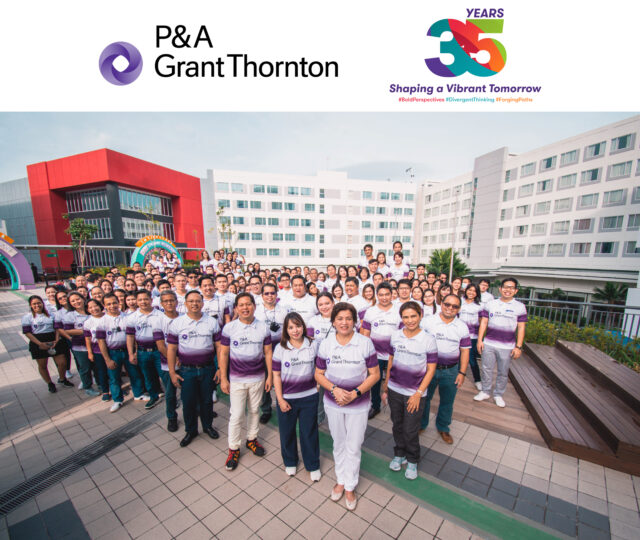
P&A Grant Thornton, one of the leading audit and business advisory firms in the country today, is set to celebrate its 35th anniversary to mark its rich history, celebrate its current success, and unveil future plans and goals.

Throughout its 35 years of existence, P&A Grant Thornton has since stood out in the field of advisory and audit, first as the “little firm that could”, surprising its growing clientele and competitors. It made its mark as an exuberant young firm in its early years of providing unlimited top-notch service to dynamic organizations, and as an audit and advisory firm brimming with potential for growth and driven by its “go-beyond” mindset.

This year’s anniversary theme is “Shaping a Vibrant Tomorrow”, a phrase descriptive of P&A Grant Thornton’s long-term commitment to spark inspiration among stakeholders, innovate and transform, answer global calls to promote sustainability, and foster stronger collaboration among stakeholders as a catalyst of change.

“Our upcoming 35th Anniversary Celebration marks another poignant milestone in the history of P&A. For us, it is more than just a reminder of our journey throughout the years. It is a striking portrait of who we really are as a company. If one were to look at our history, three qualities stand out – bold perspectives, divergent thinking, and our persistence to always forge new paths,” explained Marivic Españo, Chairperson and CEO of P&A Grant Thornton.

By forging new paths, the Firm envisions a future replete with new partnerships and increased collaboration with government, investors, and other local stakeholders, including those within the Grant Thornton business network.

“At P&A Grant Thornton, we believe that we can meet the future with our strategic capabilities in mind. We will use the influence we have worked hard to achieve in becoming an even more effective role model in the industry and within our community,” added Marivic.

The auspicious event will be held on February 15, 2023 at the Fairmont Hotel in Makati.

Aside from the highly anticipated performance of the Philippine Madrigal Singers, one of the highlights of the event is the special segment dedicated to two prominent figures in the Grant Thornton community: Rodger Flynn, Grant Thornton’s Regional Leader – Network Capabilities for APAC and Peter Bodin, the CEO of Grant Thornton International. They will each give short but inspiring messages in line with P&A Grant Thornton’s anniversary.

P&A Grant Thornton founders – Ben Punongbayan and Jose Araullo – will grace the event. Esteemed Partners will lead the presentation of the current undertakings of P&A Grant Thornton, as well as a vivid blueprint of the Firm’s long-term plans.

Clients of the Firm, new and long-time clientele alike, will be attending the event. A separate program will be held for staff, while the Firm’s offices in Cebu and Davao will also be celebrating the anniversary on separate dates. These events will shine a spotlight on the Firm’s vision for the coming years and its renewal of commitment to provide distinctive service which carries P&A Grant Thornton’s stamp of quality and excellence.

For inquiries and for clients who wish to RSVP for the event, you may reach P&A Grant Thornton at pnagt35thanniv@ph.gt.com.


Spotlight is BusinessWorld’s sponsored section that allows advertisers to amplify their brand and connect with BusinessWorld’s audience by enabling them to publish their stories directly on the BusinessWorld Web site. For more information, send an email to online@bworldonline.com.

Join us on Viber at https://bit.ly/3hv6bLA to get more updates and subscribe to BusinessWorld’s titles and get exclusive content through www.bworld-x.com.

Donell Gumiran bags PHL National Award in the Sony World Photography Awards

PHOTOGRAPHY by Donell Gumiran for 2023 Sony World Photography Awards

DUBAI-BASED Filipino photographer Donell Gumiran is the National Award winner for the Philippines in the World Photography Organization’s Sony World Photography Awards 2023.

The National Awards program is an initiative set up by the World Photography Organization and Sony to support local photographic communities around the world, with 55 countries taking part this year. Over 415,000 images from over 200 countries and territories were submitted to the Sony World Photography Awards 2023 and over 200,000 were entered to the Open competition (from which the National Awards winner was selected).

PHOTOGRAPHY by Donell Gumiran for 2023 Sony World Photography Awards

According to Photo.com, Mr. Gumiran is a Design & Senior Art Director based in Dubai. “Every time I press the shutter, it seems like it’s an extension of my personality,” the site quotes Mr. Gumiran as saying. He has received numerous awards, most recently the Tokyo Foto Award, Japan – Gold 2019. In the Philippines, he was a recipient of the National Commission for Culture and the Arts’ Ani ng Dangal Award in 2018 and 2019.

All National Award winners receive Sony digital imaging equipment and will be included in the Sony World Photography Awards exhibition and book.

New to this year’s Awards are four Regional Awards set up by the World Photography Organization and Sony Europe.

The overall winners in the Student, Youth, Open and Professional competitions of the Sony World Photography Awards 2023 will be announced on April 13 and will go on display as part of the exhibition at Somerset House, London from April 14 to May 1.

This year’s National Awards winners are:
Austria — Fabian Jung
Bangladesh — Protap Shekhor Mohanto
Cambodia — Chan Sithy Heng
Egypt — Abdelrahman Gabr
France — Samia Berbiche
Germany — Andreas Mikonauschke
India — Pradeep Kodimana Ramakrishnan
Indonesia — Mawaruddin Mawaruddin
Japan — Hajime Hirano
Republic of Korea — Gyu Seob Shim
Kuwait — Adil Javed
Malaysia — Eng Tong Tan
Myanmar — Si Thu Ye Myint
Nepal – Rabik Upadhayay
Nigeria — Nukabari Opuama
Pakistan — Yawar Abbas
Philippines — Donell Gumiran
Poland — Mateusz Żurowski
Qatar — Abdulla AL-Mushaifri
Saudi Arabia — Mansoor Mohsen
Singapore — Huazheng Hong
South Africa – Tshabalala Bongani
Sri Lanka — Rajeev Abeysekara
Switzerland — Sandra Handschin
Taiwan — Leo Huang
Thailand — Saravut Vanset
Turkey — Erhan Coral
United Arab Emirates — Oday Shanshal
United States — Angela Perez
Vietnam — Thin Nguyn Ngc

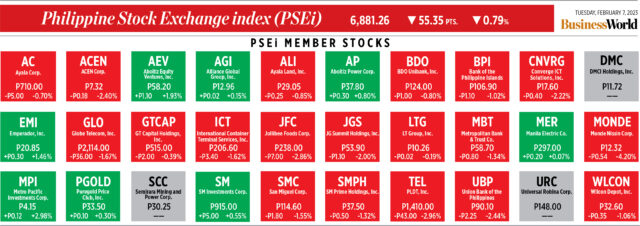
How PSEi member stocks performed — February 7, 2023

Here’s a quick glance at how PSEi stocks fared on Tuesday, February 7, 2023.


Shares fall on faster-than-expected Jan. inflation

BW FILE PHOTO

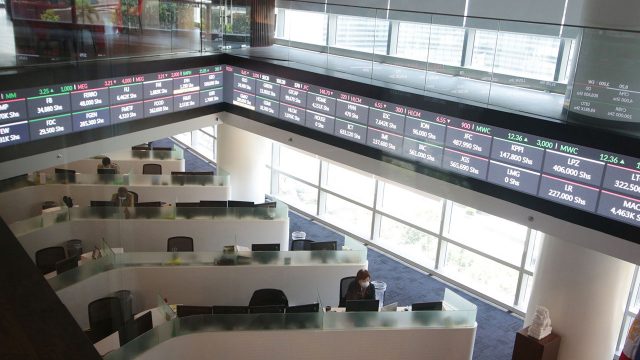
STOCKS continued to decline on Tuesday on faster-than-expected January inflation that fueled expectations of another big rate hike by the Bangko Sentral ng Pilipinas (BSP).

The benchmark Philippine Stock Exchange index (PSEi) went down by 55.35 points or 0.79% to close at 6,881.26 on Tuesday, while the broader all shares index dropped by 18.93 points or 0.51% to end at 3,655.75.

“The local bourse dropped by 55.35 points (-0.8%) to 6,881.26 as the Philippine inflation rate came in higher than the expectation, which could raise the possibility that the Bangko Sentral ng Pilipinas will remain aggressive in its monetary tightening, especially in its upcoming meeting,” Philstocks Financial, Inc. Research Analyst Claire T. Alviar said in a Viber message.

“The PSEi dropped as it became clear inflation is far from peaking, which has created scope for debt markets to bid up interest rates reflected in the retail Treasury bonds’ (RTB) 5.5-year coupon rate of 6.125% and dashed BSP pivot hopes,” First Metro Investment Corp. Head of Research Cristina S. Ulang said in the Viber message.

Headline inflation accelerated to a new 14-year high of 8.7% in January as food prices continued to surge, the Philippine Statistics Authority reported on Tuesday, faster than the 8.1% print in December 2022 and 3% in the same month last year.

This was the quickest since the 9.1% logged in November 2008. This was also higher than the 7.5% to 8.3% forecast range given by the central bank for the month, and marked the 10th consecutive month that inflation was above the BSP’s 2-4% target for the year.

BSP Governor Felipe M. Medalla earlier said the central bank could hike borrowing costs by 25 or 50 basis points (bps) at their policy meeting on Feb. 16 to anchor inflation expectations.

The Monetary Board raised benchmark interest rates by 350 bps in 2022, bringing its key rate to 5.5%.

Meanwhile, the government raised P162.18 billion from the rate-setting auction for the RTBs on Tuesday, more than its P30-billion program.

Most sectoral indices closed lower on Tuesday except for mining and oil, which rose by 57.64 points or 0.52% to 11,050.18, and holding firms, which climbed by 6.73 points or 0.1% to 6,710.54.

Meanwhile, services dropped by 26.70 points or 1.52% to 1,720.81; property lost 28.83 points or 0.95% to end at 2,991.76; financials declined by 17.13 points or 0.93% to 1,810.78; and industrials went down by 83.71 points or 0.84% to end at 9,849.24.

Value turnover went down to P6.14 billion on Tuesday with 1.03 billion shares changing hands from the P9.95 billion with 1.24 billion issues traded on Monday.

Decliners outnumbered advancers, 97 versus 88, while 51 names closed unchanged.

Net foreign buying reached P590.74 million on Tuesday versus the P1.45 billion in net selling seen the previous trading day. — J.I.D. Tabile

Peso tumbles to P55-per-dollar level as headline inflation surges in Jan.

PHILIPPINE STAR/ WALTER BOLLOZOS

THE PESO sank to the P55-per-dollar level on Tuesday as January headline inflation was faster than expected and amid hawkish signals from the US Federal Reserve.

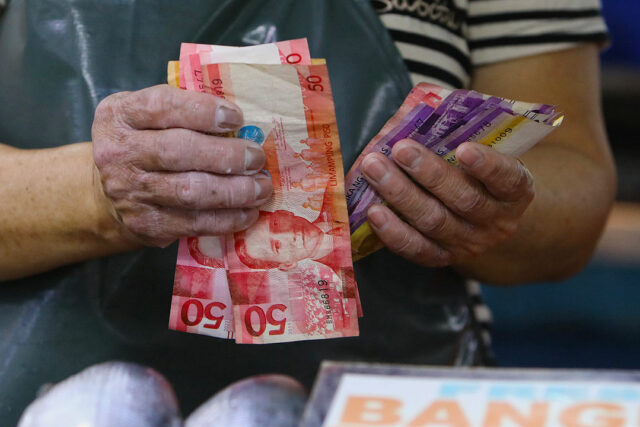
The local currency closed at P55.085 versus the greenback on Tuesday, declining by 69.5 centavos from Monday’s P54.39 finish, data from the Bankers Association of the Philippines showed.

The peso opened Tuesday’s trading session at P54.65 per dollar. Its weakest showing was at P55.10, while its intraday best was at P54.60 against the greenback.

Dollars traded rose to $1.274 billion from $1.053 billion on Monday.

The peso declined following the release of January inflation data and hawkish signals from a Fed official, Rizal Commercial Banking Corp. Chief Economist Michael L. Ricafort said in a Viber message.

“The peso weakened significantly after the Philippine headline inflation for January 2023 was reported at 8.7%, surpassing market and central bank’s expectations,” a trader said in an e-mail.

Headline inflation was at a 14-year high of 8.7% in January, faster than the 8.1% in December and 3% a year ago.

This also surpassed the 7.6% median estimate in a BusinessWorld poll conducted last week and the 7.5% to 8.3% forecast range given by the Bangko Sentral ng Pilipinas (BSP) for the month.

Meanwhile, Atlanta Federal Reserve Bank President Raphael Bostic told Bloomberg that the Fed may need to lift borrowing costs higher than previously anticipated 25 basis points (bps) given the unexpectedly strong jobs data in January.

The US central bank hiked borrowing costs by 25 bps at its Jan. 31 to Feb. 1 meeting, bringing the fed funds rate to a 4.5% to 4.75% range, the highest since 2007.

The Fed has now hiked rates by 450 bps since March 2022.

For Wednesday, the trader said the peso could weaken further against the dollar on expectations of hawkish remarks from Fed Chair Jerome H. Powell overnight.

The trader expects the peso to move between P55 and P55.25 per dollar on Wednesday, while Mr. Ricafort gave a wider forecast range of P54.90 to P55.20. — AMCS

Gov’t investment target from Japan trip P150B

President Ferdinand Marcos Jr. answers questions from the media after his first Cabinet meeting in Malacañan Palace, July 5, 2022. — PHILIPPINE STAR/KRIZ JOHN ROSALES

THE PHILIPPINES is expected to obtain P150 billion in investment pledges during President Ferdinand R. Marcos, Jr.’s official visit to Japan.

“We are expecting that substantial returns in terms of new projects, the value of which we currently estimate at P150 billion, and we estimate too these will generate employment for 8,000 Filipinos,” Philippine Ambassador to Japan Mylene J. Garcia-Albano told ABS-CBN News Channel on Tuesday.

Ms. Albano said Mr. Marcos is set to meet executives from electronics, semiconductor, printer and wiring harness manufacturing companies.

Companies from these industries “comprise the bulk of our industrial relations with Japan,” she said, adding, “They will discuss how the private sector, the Japanese investor companies, the government and other stakeholders can work more closely together to ensure the success of these businesses in the Philippines.”

Foreign Affairs Assistant Secretary for Asia and Pacific Affairs Nathaniel Imperial in an earlier briefing said Mr. Marcos will be attending roundtable and business meetings, as well as a business conference to be held on Feb. 9 and 10.

Ms. Albano also noted the expected “signing of several letters of intent and agreements which are expected to significantly expand Japanese investments.”

Mr. Marcos is expected to sign seven key bilateral deals.

“During the visit, we anticipate the signing of seven key bilateral documents or agreements covering cooperation in infra development, defense, agriculture and information and communications technology — areas that are in the President’s priority agenda,” Mr. Imperial said.

The government is set to sign the exchange of notes on loan agreements for the North-South Commuter Railway project from Malolos, Bulacan to Clark International Airport, and from Manila’s Tutuban station to Calamba, Laguna.

“This will involve around $3 billion worth of loans that will be later signed also by the Department of Finance (DoF),” Mr. Imperial said.

Also on the list are agreements on humanitarian assistance and disaster relief cooperation between the Department of National Defense and its Japanese counterpart.

Japan is the only country with which the Philippines has a bilateral free trade agreement — the Japan Economic Partnership Agreement. Japan is the Philippines’ second-largest trading partner, third-largest export market and third-largest source of exports. — Alyssa Nicole O. Tan

Farmers call for gov’t-backed push to make industry competitive under RCEP

REUTERS

AGRICULTURE industry representatives said the government has not adequately supported farmers in achieving competitiveness against imports, which they called a necessary step before opening up the market under the terms of the Regional Comprehensive Economic Partnership (RCEP).

During a Senate hearing on the world’s largest free trade agreement on Tuesday, United Broiler Raisers Association President Elias Jose M. Inciong said: “What will provide true protection is competitiveness… the reason why we did not become competitive, the reason why we are so prone to imports, the reason why the agriculture sector cannot provide adequate supply is because of the dereliction of duty of the NEDA (National Economic and Development Authority and the DA (Department of Agriculture) in the implementation of the overall design of the WTO (World Trade Organization),” he said.

He was referring to the trade regime the Philippines signed on to in 1995, which guarantees market access for foreign commodities up to a minimum volume.

“There is no path for development for the sector; however, the path is very wide for import development,” he added.

Mr. Inciong compared the current pitch to join the RCEP with the campaign to join the WTO, noting that only features benefiting importers were implemented while provisions specifying domestic support were neglected.

The last major commodity to be opened up to imports was rice. The Rice Tariffication Law opened up rice imports to private parties, who had to pay tariffs of 35% on Southeast Asian grain.

Of these tariffs, P10 billion a year is allocated to the Rice Competitiveness Enhancement Fund (RCEF), which supports the industry’s modernization by funding mechanization, upgraded seed, and rice cultivation know-how, among other things.

Mr. Inciong said the rest of the farm industry as well as fisheries have yet to undergo modernization, and added that database support for the industry remains inadequate.

“Whenever we have hearings here and at the House, on tariffs and the like, 30% of the time, there is a debate on the correctness of the data,” Mr. Inciong said.

“We could produce all of these products but because we did not do our homework, we become more and more reliant on imports, and that will be the scenario in RCEP,” Raul Q. Montemayor, national manager of the Federation of Free Farmers, said.

He noted that the agricultural trade deficit continues to grow despite claims of adequate protection provided by trade deals.

“They told us that there was nothing to worry about because tariffs will not go down, but we have seen over the past few years that the agricultural trade deficit has ballooned to $90 billion,” he said.

Under RCEP, he added, 84% of agricultural tariff lines will have zero tariff protection.

Trade Assistant Secretary Allan B. Gepty said the trade deal only calls for the additional liberalization of 33 tariff lines to four trade partners, with most other commodities already subject to other free trade agreements.

“Mr. Montemayor is correct to say that we have trade deficits, that’s the reality. In fact,… as early as the ’60s, deficit in trade and goods has been creeping in,” he said.

However, “before we characterize deficits, we have to consider that importing is not outrightly wrong,” he added. “As long as what you’re importing is being used for consumption, like food security, then it’s good since you’re giving food to the people.”

Mr. Gepty said that between 2018 and 2020, the Philippines mostly imported, at a deficit, cereals including rice, prepared animal fodder, miscellaneous edible preparations, meat and edible meat offal, and dairy products.

“We are at a deficit because we need them and we don’t have them here, so we import them,” he said. “Importing is good if you will use these inputs to farms or for further production.”

Trade Secretary Alfredo E. Pascual, speaking at the hearing, said that while he recognizes the concerns raised, “it is important to understand the bigger picture and view RCEP in terms of the opportunities it can bring to us.”

“We are situated in a dynamic region of the world and we cannot afford to remain out of its further economic integration,” he said.

“In any case, the government will continue to provide the needed support and level the playing field to help equip and sharpen the capacity of our businesses,” he added.

 Mr. Pascual noted that RCEP provides a framework of rules that ensure regulatory consistency.

It creates a “conducive business environment that is key to ensuring the confidence of the business sector, and spurring further economic growth,” he said.

Mr. Pascual believes that the Philippines’ current linkages to the global supply chain may deteriorate if investors and businesses begin to look elsewhere for a better economic environment and opportunities.

“Considering that a number of key trading partners and competitors are also participating in this agreement, delays in Philippine participation will result in the diversion of trade and investments toward countries already within the regional bloc, at the expense of our industry and people,” he said.

“Even our exports could become less competitive, including electronic and agricultural products, as intermediate goods used as inputs for further production and manufacturing become more expensive in comparison to our competitors,” he added.

On the other hand, Mr. Pascual said the trade deal is expected to strengthen links in manufacturing, technology, agriculture, and natural resources with member states, as well as reinforce the participation of micro, small and medium enterprise participation in the global supply chain.

The Department of Trade and Industry (DTI) noted the Philippines’ readiness to accelerate the economic recovery and overall standing in the global trading environment through its accession to RCEP.

Senate President Pro Tempore Lorna Regina B. Legarda, who chaired the sub-committee hearing, said there must be “guidelines, policies, programs, funding, resources, commitments and oversight that will ensure that the agencies who negotiated for this and who are mandated to bring about a robust agricultural sector… will do… their best” upon the country’s accession to the RCEP.

She said the industries affected must be allowed to help draft the guidelines to be followed by the agencies pushing for the trade deal.

“This ratification will not change what’s been there for 40 years but if there is a window of opportunity given to Laos, Myanmar, and we’re the only one not included, I would not want that,” Ms. Legarda said.

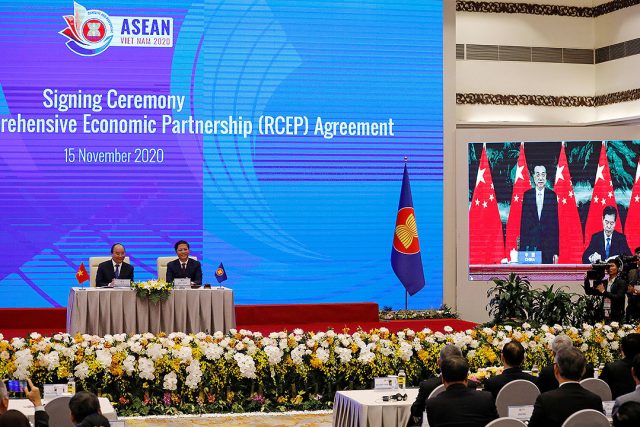
RCEP, which started taking effect on Jan. 1, 2022, involves Australia, China, Japan, South Korea, New Zealand and the 10 members of the ASEAN.

The Philippines has yet to join RCEP as the Senate was unable to ratify the agreement before adjourning on Feb. 3. President Rodrigo R. Duterte signed the trade agreement on Sept. 2. — Alyssa Nicole O. Tan

ADVERTISEMENT
ADVERTISEMENT