Home Blog Page 5226

ChatGPT launches boom in AI-written e-books on Amazon

A CHILDREN’s book made with ChatGPT.

SAN FRANCISCO — Until recently, Brett Schickler never imagined he could be a published author, though he had dreamed about it. But after learning about the ChatGPT artificial intelligence (AI) program, Mr. Schickler figured an opportunity had landed in his lap.

“The idea of writing a book finally seemed possible,” said Mr. Schickler, a salesman in Rochester, New York. “I thought ‘I can do this.’”

Using the AI software, which can generate blocks of text from simple prompts, Mr. Schickler created a 30-page illustrated children’s e-book in a matter of hours, offering it for sale in January through Amazon.com, Inc.’s self-publishing unit.

In the edition, Sammy the Squirrel, crudely rendered also using AI, learns from his forest friends about saving money after happening upon a gold coin. He crafts an acorn-shaped piggy bank, invests in an acorn trading business and hopes to one day buy an acorn grinding stone.

Sammy becomes the wealthiest squirrel in the forest, the envy of his friends and “the forest started prospering,” according to the book.

The Wise Little Squirrel: A Tale of Saving and Investing, available in the Amazon Kindle store for $2.99 — or $9.99 for a printed version — has netted Mr. Schickler less than $100, he said. While that may not sound like much, it is enough to inspire him to compose other books using the software.

“I could see people making a whole career out of this,” said Mr. Schickler, who used prompts on ChatGPT like “write a story about a dad teaching his son about financial literacy.” Mr. Schickler is on the leading edge of a movement testing the promise and limitations of ChatGPT, which debuted in November and has sent shock waves through Silicon Valley and beyond for its uncanny ability to create cogent blocks of text instantly.

There were over 200 e-books in Amazon’s Kindle store as of mid-February listing ChatGPT as an author or co-author, including How to Write and Create Content Using ChatGPT, The Power of Homework, and poetry collection Echoes of the Universe. And the number is rising daily. There is even a new sub-genre on Amazon: Books about using ChatGPT, written entirely by ChatGPT.

But due to the nature of ChatGPT and many authors’ failure to disclose they have used it, it is nearly impossible to get a full accounting of how many e-books may be written by AI.

The software’s emergence has already ruffled some of the biggest technology firms, prompting Alphabet, Inc. and Microsoft Corp. to hastily debut new functions in Google and Bing, respectively, that incorporate AI.

The rapid consumer adoption of ChatGPT has spurred frenzied activity in tech circles as investors pour money into AI-focused startups and given technology firms new purpose amid the gloom of massive layoffs. Microsoft, for one, received fawning coverage this month over its otherwise moribund Bing search engine after demonstrating an integration with ChatGPT.

But already there are concerns over authenticity, because ChatGPT learns how to write by scanning millions of pages of existing text. An experiment with AI by CNET resulted in multiple corrections and apparent plagiarism before the tech news site suspended its use.

THREAT TO ‘REAL’ AUTHORS?
Now ChatGPT appears ready to upend the staid book industry as would-be novelists and self-help gurus looking to make a quick buck are turning to the software to help create bot-made e-books and publish them through Amazon’s Kindle Direct Publishing arm. Illustrated children’s books are a favorite for such first-time authors. On YouTube, TikTok, and Reddit hundreds of tutorials have spring up, demonstrating how to make a book in just a few hours. Subjects include get-rich-quick schemes, dieting advice, software coding tips, and recipes.

“This is something we really need to be worried about, these books will flood the market and a lot of authors are going to be out of work,” said Mary Rasenberger, executive director of writers’ group the Authors Guild. Ghostwriting — by humans — has a long tradition, she said, but the ability to automate through AI could turn book writing from a craft into a commodity.

“There needs to be transparency from the authors and the platforms about how these books are created or you’re going to end up with a lot of low-quality books,” she said.

One author, who goes by Frank White, showed in a YouTube video how in less than a day he created a 119-page novella called Galactic Pimp: Vol. 1 about alien factions in a far-off galaxy warring over a human-staffed brothel. The book can be had for just $1 on Amazon’s Kindle e-book store. In the video, Mr. White says anyone with the wherewithal and time could create 300 such books a year, all using AI.

Many authors, like Mr. White, feel no duty to disclose in the Kindle store that their great American novel was written wholesale by a computer, in part because Amazon’s policies do not require it.

When asked for comment by Reuters, Amazon did not address whether it had plans to change or review its Kindle store policies around authors’ use of AI or other automated writing tools. “All books in the store must adhere to our content guidelines, including by complying with intellectual property rights and all other applicable laws,” Amazon spokeswoman Lindsay Hamilton said via e-mail.

A spokeswoman for ChatGPT developer OpenAI declined to comment.

FROM CONCEPTION TO PUBLICATION IN JUST HOURS
Amazon is by far the largest seller of both physical and e-books, commanding well over half of sales in the United States and, by some estimates, over 80% of the e-book market. Its Kindle Direct Publishing service has spawned a cottage industry of self-published novelists, carving out particular niches for enthusiasts of erotic content and self-help books.

Amazon created Kindle Direct Publishing in 2007 to allow anyone to sell and market a book from their couch without the hassle or expense of seeking out literary agents or publishing houses. Generally, Amazon allows authors to publish instantly through the unit without any oversight, splitting whatever proceeds they generate.

That has attracted new AI-assisted authors like Kamil Banc, whose primary job is selling fragrances online, who bet his wife he could make a book from conception to publication in less than one day. Using ChatGPT, an AI image creator and prompts like “write a bedtime story about a pink dolphin that teaches children how to be honest,” Mr. Banc published an illustrated 27-page book in December. Available on Amazon, Bedtime Stories: Short and Sweet, For a Good Night’s Sleep took Mr. Banc about four hours to create, he said.

Consumer interest so far has been admittedly sleepy: Mr. Banc said sales have totaled about a dozen copies. But readers rated it worthy of five stars, including one who praised its “wonderful and memorable characters.”

Mr. Banc has since published two more AI-generated books, including an adult coloring book, with more in the works. “It actually is really simple,” he said. “I was surprised at how fast it went from concept to publishing.”

Not everyone is blown away by the software. Mark Dawson, who has reportedly sold millions of copies of books he wrote himself through Kindle Direct Publishing, was quick to call ChatGPT-assisted novels “dull” in an e-mail to Reuters.

“Merit plays a part in how books are recommended to other readers. If a book gets bad reviews because the writing is dull then it’s quickly going to sink to the bottom.” — Reuters


First Gen calls for national adaptation, decarbonization plan

LOPEZ-LED First Gen Corp. has called on the government to create a national decarbonization and adaptation plan to scale up the greening of the Philippine electricity grid.

“We need a comprehensive, integrated and well-studied national decarbonization and adaptation plan of our own, backed by constant feedback from what science is telling you,” Federico R. Lopez, chief executive officer of First Gen, said during the Philippine Environment Summit in Tagaytay City on Wednesday.

He said the global energy transition has immense implications for the role of the electricity grid.

“The most important point is that by 2050 we will need five times the electricity we use today, and we will need 10 to 12 times the clean energy in use today. Even as we do this, we must continue to improve access to 24/7 electricity for billions of people,” Mr. Lopez said.

He noted that decarbonizing the grid means reducing its carbon emissions, thus reducing the emissions per unit of electricity generated.

“Of course, over time as more clean energy and storage is added into our grids, we must look toward decommissioning our fossil fuel-powered plants — the coal plants and ultimately, the oil and natural gas plants. For the latter they can either be re-powered with green fuels like hydrogen as they become feasible in the coming decade,” he said.

The Department of Energy has recently announced its plan to develop clean energy sources such as hydrogen and ammonia fuel in line with its plan for a cleaner energy future. 

Latest available data from the department show that coal-fired power plants still dominated the energy mix with a 57.5% share in gross power generation, with renewable energy, natural gas and oil-based sources contributing 23.4%, 17.7% and 1.4%, respectively.

Mr. Lopez said that aside from decarbonization, the government should also focus on other factors that could affect the country’s growth.

“Decarbonization has many aspects not only energy,” he said, citing agriculture, waste, and food.

He also pointed to adaptation that involves the Climate Change Commission, the Department of Environment and Natural Resources, and the Department of Public Works and Highways

“[For adaptation,] you have to know what’s coming, the kind of climate impacts,” he said.

At the local bourse on Wednesday, shares in First Gen closed 22 centavos or 1.22% lower to end at P17.78 apiece. — Ashley Erika O. Jose

POCO launches X5 series phones

TRUSTPAIR.COM

SMARTPHONE brand POCO earlier this month launched in the Philippines two new devices, the X5 Pro 5G and X5 5G.

“Designed for content creators to take things to the next level, we believe the POCO X5 Pro 5G is nothing short of the best smartphone in the $300 segment,” said Angus Ng, head of product marketing at POCO Global.

“With a superb screen and performance, the POCO X5 5G also delivers amazing value and the best possible user experience for a smartphone under $200.”

The two phones mark the fifth anniversary of POCO as a brand, the company said in a statement.

It said the POCO X5 Pro 5G features upgrades to its camera functions, processing speeds, and display, while the POCO X5 5G has a long battery life.

The X5 Pro 5G has a 6.67-inch Flow AMOLED screen with a 120Hz refresh rate and is the slimmest X series device so far.

“Photos and videos come to life with 100% DCI-P3 and 10-bit color depth, and Dolby Vision makes the viewing experience even better. Imagined to go with you anywhere, the POCO X5 Pro 5G has 1920Hz PWM dimming to protect eyesight when reading and creating in low light if inspiration strikes late at night,” POCO said.

The phone has a Snapdragon 778G 5G chipset with advanced TSMC 6nm, offering both power efficiency and high performance, making its camera processing system faster than the previous model.

It has a 108-megapixel main camera for professional-level, ultra-high-resolution photography. It also supports 4K video shooting.

The X5 Pro 5G also has a 5,000mAh battery that supports 67-watt turbo charging.

It comes in three colors, namely black, blue, and yellow, and is available in two variants: a 6GB memory + 128GB storage model (with a recommended retail price of P16,999) and an 8GB+256GB variant (P18,999).

Meanwhile, the POCO X5 5G has a slim 6.67-inch AMOLED DotDisplay with a 120Hz refresh rate.

It is powered by a Snapdragon 695 chipset and also has a 5,000mAh battery that supports 33W fast charging.

The POCO X5 5G comes in three color options of green, blue, and black, with the 6GB+128GB model priced at P14,999 and the 8GB+256GB variant costing P15,999. — BVR

Robinsons Bank launches automated savings feature for online banking app

ROBINSONS BANK Corp. on Wednesday announced that they are launching an automated savings feature for their online banking app RBank Digital.

The savings feature called Rkansya is available to anyone with a Robinsons Bank savings or checking account, the lender said.

“Rkansya, the newest digital piggy bank in town, is revolutionizing the way customers save and achieve their financial goals — whether it’s for a new travel destination, a gadget or gaming console upgrade, or maybe even to build a rainy-day fund,” Robinsons Bank said in a statement.

The Gokongwei-led bank said the auto-debit feature will automatically fund the Rkansya using a linked savings or checking account, depending on the duration of time selected by the user.

“Unlike your traditional piggy bank, it’s easier to track your progress with Rkansya as you’ll always see how far you’ve come,” the lender said.

Robinsons Bank’s website showed the minimum balance to earn rewards for Rkansya is at P2,000, while the maximum is at P500,000. There is no required maintaining balance.

The bank said clients can earn 3 Go Rewards points per month for every P2,000 maintained in their Rkansya.

If no withdrawals are made within three months, an extra 2 Go Rewards points will be awarded quarterly, it added.

Users can save for a minimum of three and a maximum of 12 months, with the promo period lasting a year after launch. Rkansya also provides real-time updates on the amount saved, the timeline, and remaining balance.

Users can also make multiple Rkansya accounts to save for different goals, it added.

Robinsons Bank will soon merge with listed Bank of the Philippine Islands under a deal announced last year.  A.M.C. Sy

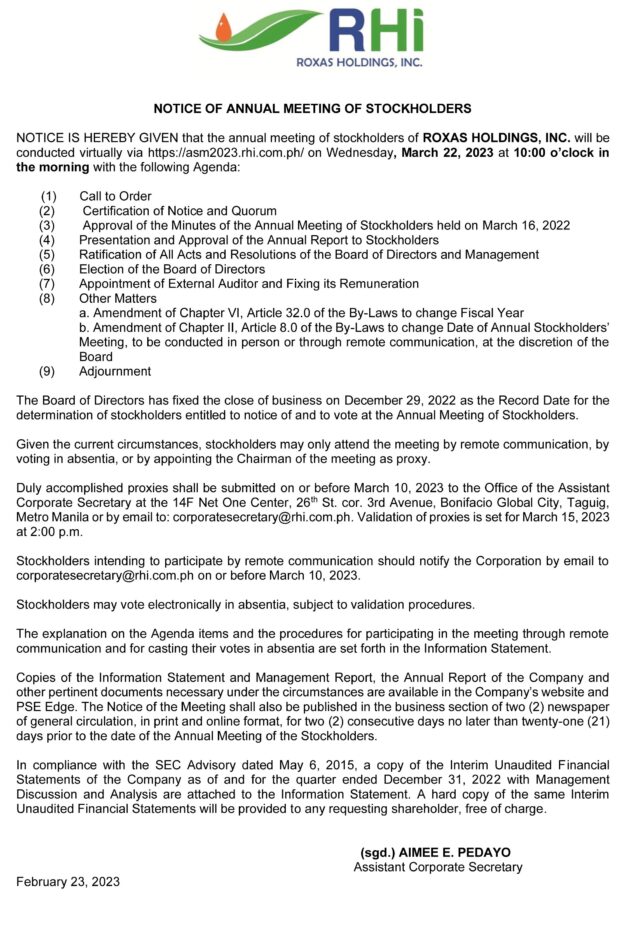
Roxas Holdings, Inc. to hold annual meeting of stockholders on March 22


Spotlight is BusinessWorld’s sponsored section that allows advertisers to amplify their brand and connect with BusinessWorld’s audience by enabling them to publish their stories directly on the BusinessWorld Web site. For more information, send an email to online@bworldonline.com.

Join us on Viber at https://bit.ly/3hv6bLA to get more updates and subscribe to BusinessWorld’s titles and get exclusive content through www.bworld-x.com.

Still filming, Spielberg, 76, wins Berlin lifetime award

DIRECTOR Steven Spielberg holds the Honorary Golden Bear Award for Lifetime Achievement he received at the 73rd Berlinale International Film Festival in Berlin, Germany, Feb. 21. — REUTERS/FABRIZIO BENSCH

BERLIN — Director Steven Spielberg, picking up a lifetime achievement award at the Berlin Film Festival, said the prospect of making new films continued to excite him at 76, and unveiled new details of his planned HBO series.

The director, whose credits include some of the biggest-grossing and best-loved works in cinema history, including E.T. the Extra-Terrestrial and Jaws, has just finished two films back-to-back: the semi-autobiographical The Fabelmans and West Side Story, a film of the classic Broadway musical.

“Whatever seized me as a little kid is the same feeling I retained all those decades later,” he told reporters on Tuesday. “When I find a book or a script or come up with an original idea that I think would make a good movie: that excitement … supersedes everything.”

Mr. Spielberg, professing he “loves to work and needs to work,” is finalizing a script left unfinished by his friend Stanley Kubrick at the time of his death in 1999.

“We’re mounting a large production for HBO based on Stanley’s original script Napoleon,” he said. “A seven-part limited series.”

Reflecting on the past two years of frenetic film-making, Mr. Spielberg said the pandemic prompted him to revisit his childhood in The Fabelmans.

“My mom used to say: ‘I’ve given you so much good material. When are you going to use that material?’” he said. “The fear I felt about the pandemic gave me the courage to tell my personal story.”

Mr. Spielberg, known for his accessible, compelling movies, advised would-be filmmakers to start with the story.

“If you want to be a movie director, first of all write,” he said. “Because it’s the stories that are going to get an audience to pay attention to you, not the shots.” — Reuters

How hybrid work can lead to sustainable practices

TRUSTPAIR.COM

FILIPINOS now prefer to work in a hybrid setup and studies have shown that it not only opens many benefits for the employees, but new possibilities for the employers. This includes revisiting operations and embedding more sustainable business practices in ways that can dramatically change their consumption patterns such as reducing their environmental footprint by equipping employees with tools that are better for productivity and the planet, and appealing to worker preferences in an increasingly competitive labor market.

HP, for example, has outlined bold sustainable impact goals and commitments over the next decade. It aims to be the most sustainable and just technology company in the world by 2030, ushering a new era of progress where climate change is reversed, human rights are universally protected, and digital equity democratizes opportunity for all. Sustainable impact has been a part of the company’s DNA from the very beginning. It is proven to be one of the strategic drivers that accelerate and scale growth for the business.

A WIN-WIN-WIN OPPORTUNITY
Improving sustainability through the transition to hybrid work provides benefits for employers, employees, and the environment, all at the same time. That’s because many of the systems, measures, and technologies that create a better hybrid work experience also enable more-efficient management of physical office resources, from smarter use of space to the conservation of energy and water.

Realizing the potential benefits of adapting to not only hybrid work but also an overall sustainable business — where work is conducted in the space that best suits the task at hand — brings with it an opportunity to adopt an “only-what-we-need-when-we-need-it” approach to resources, ranging from power to square footage.

“We’re now basing facilities decisions on utilization, not headcount,” says Rena Marin, country HR head of HP, Inc. in the Philippines. “We’re creating more choice for employees, including multifunctional areas that can be adapted to meet their needs.”

In some cases, that could mean moving walls to turn individual cubicle space into open collaboration areas, or incorporating movable, adjustable office furniture that employees can reconfigure as necessary. Organizations may also choose to eliminate personal workspaces altogether and replace them with hot desks, or shared workstations that employees can reserve for use when they’re in the office.

SMART FACILITIES THAT CONSERVE RESOURCES
A range of technologies can help companies pinpoint what resources they need, when and where they need them, increasing efficiency and conservation.

This includes a number of solutions that use Wi-Fi connectivity combined with sensors to determine how rooms and offices are being used, and how frequently. With that data, organizations can turn off power, heating, and cooling in empty spaces or implement a smart heating and lighting system.

Additionally, by tracking occupancy across the building, some software can also allow employees to check which rooms are available for an impromptu meeting; book a workstation in advance of their arrival; or see which colleagues are working from the office each day.

DOING MORE WITH LESS (WASTE)
Equipping hybrid employees with new tools and tech to do their jobs in a hybrid world not only helps them maintain productivity wherever they are, but also gives businesses a chance to choose more sustainable devices.

The most important piece of equipment for any hybrid employee is a powerful and portable laptop, such as the HP Elite Dragonfly, the HP Elite c1030 Chromebook, or the HP ZBook Studio mobile workstation, all of which include components made from recycled ocean-bound plastic and long-lasting batteries for seamless transition between home and office.

While many companies adapted quickly to remote work with more mobile devices and cloud solutions, one area that often posed a challenge for remote workers was printing — especially for those who didn’t have printers at home, or needed to print frequently.

“The pandemic has reinforced the idea that work is not a separate place, and for many people that involves printing where they are,” says Christian Edmond Reyes, Philippines managing director of HP, Inc. “Just like we’ve seen with computing, printing needs to adapt to hybrid work in terms of mobility.”

HP Roam for Business addresses that challenge, allowing mobile workers to safely and securely submit print jobs on the go, from any device and any location, and then print only when they are at an HP Roam-enabled printer. This gives hybrid employees flexibility and security, and also helps reduce wasted energy, paper, and supplies from unintentional prints. This added layer of efficiency can even reduce printing needs by 15% to 30%, according to HP studies.

CUTTING THE COMMUTE
According to the Climate Change Commission (CCC), transportation is the third-largest contributor to the country’s greenhouse gas emissions. Netherlands-based technology specialist TomTom’s 2020 Traffic Index reported that commuters lost an average of 188 hours in traffic that year, or the equivalent of seven days and 20 hours.

With Filipinos staying home due to the ongoing pandemic and work hybrid setups, many did not have to experience the difficulties of traffic and commuting.

“With the workplace changing so rapidly, there is a collective responsibility to maintain a strong focus on sustainability as we not only adapt, but innovate in the face of change,” shares Mr. Reyes. “The opportunity to evolve work in a more ethical and sustainable way is there for the taking. It’s up to all of us, as citizens of the planet, to do it in such a way that helps not only the company and the employees, but the world around us.”


HP, Inc. is a technology company that believes one thoughtful idea has the power to change the world. Its product and service portfolio of personal systems, printers, and 3D printing solutions help bring these ideas to life. For more information about HP, visit http://www.hp.com.

‘Tremendous’ demand seen for solar energy

PIXABAY

SOUTHEAST Asia is poised to register a huge demand for solar energy, a China-listed solutions provider with projects in the Philippines said, as it forged a partnership in anticipation of more orders for solar modules.

In a statement, Trina Solar Energy Development Pte. Ltd. said on Wednesday that it had signed a memorandum of understanding with an entity that provides products required for solar installations.

The partnership with JJ-LAPP covers “strategic cooperation, and foresee tremendous demand in Southeast Asia for solar energy,” it said. The partner is a joint venture between Jebsen & Jessen Group and LAPP Holding Asia.

“Trina Solar will maintain its leadership and meet the increasing market demand for high-performance PV (photovoltaic) modules. Working together can deliver a lower BOS (balance of system) cost because JJ-LAPP and Trina Solar account for the bulk of the hardware that goes into a solar installation,” said Todd Li, president of Trina Solar for Asia Pacific.

Trina Solar provides solar modules, trackers, supervisory control and data acquisition (SCADA) systems and other products required for commercial, industrial and utility-scale installations. JJ-LAPP offers products required for solar energy systems such as AC and DC cabling and connectors.

“We can also help to reduce manpower costs for the customer’s project by coordinating our efforts and delivering greater efficiency in work processes,” Mr. Li added.

Trina Solar said the two entities have previously worked together on solar projects in Indonesia, the Philippines, and Thailand.

In the Philippines, they have been working on rooftop installations for a furniture retailer that has several large stores, it said, adding that each rooftop commercial installation is 120-300 kilowatts.

JJ-LAPP said it anticipates the number of solar modules ordered from Trina Solar this year to more than double from last year’s 21 megawatts.

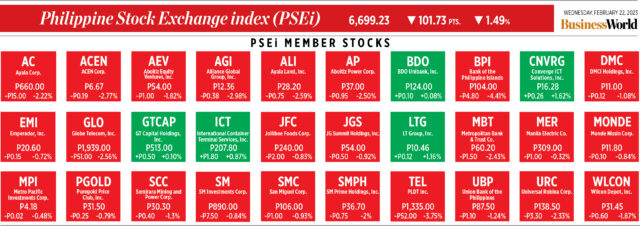
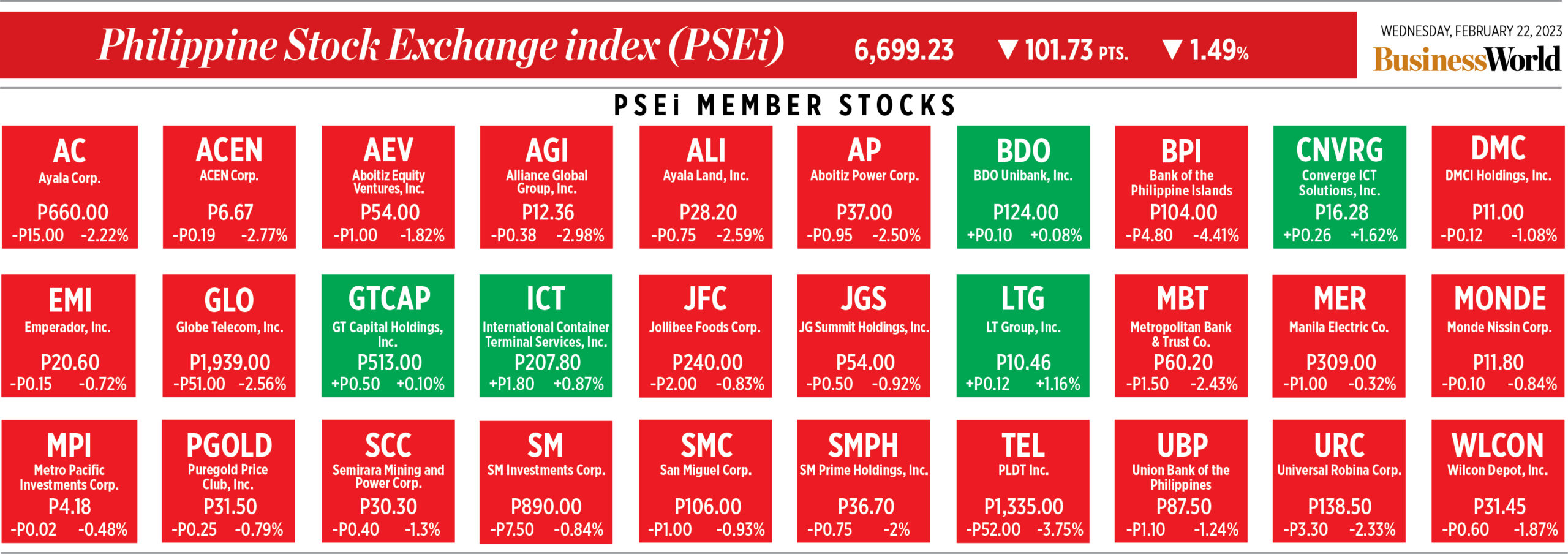
How PSEi member stocks performed — February 22, 2023

Here’s a quick glance at how PSEi stocks fared on Wednesday, February 22, 2023.


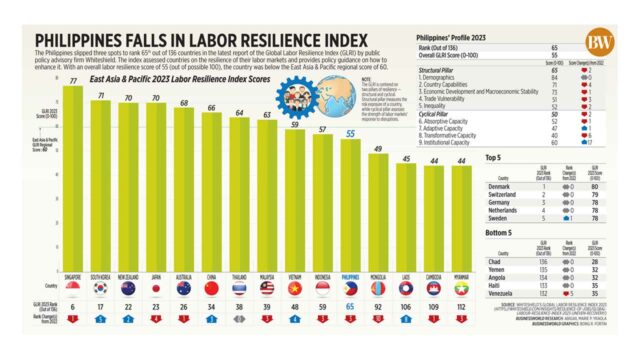
Philippines falls in labor resilience index

The Philippines slipped three spots to rank 65th out of 136 countries in the latest report of the Global Labor Resilience Index (GLRI) by public policy advisory firm Whiteshield. The index assessed countries on the resilience of their labor markets and provides policy guidance on how to enhance it. With an overall labor resilience score of 55 (out of possible 100), the country was below the East Asia & Pacific regional score of 60.

Philippines falls in labor resilience index

Peso drops further vs dollar before Fed minutes release

BW FILE PHOTO

THE PESO weakened against the dollar on Wednesday amid bets on the US Federal Reserve’s next policy move ahead of the release of the minutes of their meeting earlier this month.

The local currency closed at P55.18 versus the greenback on Wednesday, declining by 9.5 centavos from Tuesday’s P55.085 finish, Bankers Association of the Philippines data showed.

The peso opened Wednesday’s session at P55.07 per dollar. Its intraday best was at P55.05, while its weakest showing was at P55.24 against the greenback.

Dollars traded fell to $1.006 billion on Wednesday from $1.035 billion on Tuesday.

“The peso weakened amid hawkish expectations ahead of the release of Fed policy minutes overnight,” a trader said in a Viber message.

Markets are awaiting hints about how high Fed policy makers expect interest rates to go from minutes of the US central bank’s Jan. 31 to Feb. 1 meeting, especially amid recent data showing stronger-than-expected US employment and consumer prices.

At that review, the US central bank hiked its target interest rate by 25 basis points (bps) to a range between 4.5% and 4.75%. This brought cumulative increases since March 2022 to 450 bps.

The Fed’s next policy meeting is on March 21-22.

Meanwhile, Rizal Commercial Banking Corp. Chief Economist Michael L. Ricafort said in a Viber message that the peso weakened after Russian President Vladimir Putin announced on Tuesday that Russia was suspending participation in the New START nuclear arms reduction treaty with the United States.

Signed by then-US President Barack Obama and his Russian counterpart Dmitry Medvedev in 2010, the New START treaty caps the number of strategic nuclear warheads that the United States and Russia can deploy.

The peso weakened against the dollar due to softer US existing home sales data, Mr. Ricafort added. The report from the National Association of Realtors on Tuesday showed a fall in home sales by 0.7% in January to a seasonally adjusted annual rate of 4 million units.

For Thursday, the trader said the peso may rebound against the dollar on the back of profit taking.

The trader expects the peso to move between P55.05 and P55.30 versus the greenback on Thursday, while Mr. Ricafort gave a forecast range of P55.10 to P55.30. — A.M.C. Sy

PSEi tracks Wall Street’s decline on rate concerns

REUTERS

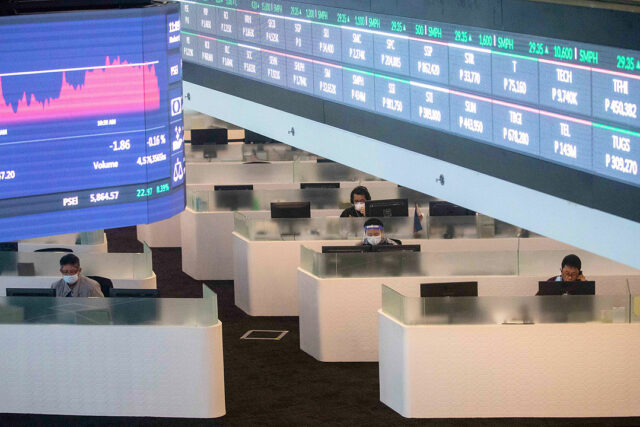
PHILIPPINE STOCKS dropped on Wednesday after Wall Street declined due to fears of bigger rate hikes in the United States to control inflation.

The benchmark Philippine Stock Exchange index (PSEi) went down by 101.73 points or 1.49% to end at 6,699.23 on Wednesday, while the broader all shares index lost 42.25 points or 1.16% to close at 3,579.36.

“The PSEi tumbled for the day… as it tracked offshore markets’ weakness given prospects of higher interest rates,” China Bank Securities Corp. Research Director Rastine Mackie D. Mercado said in an e-mail.

“The local bourse plummeted, tracking US markets, as global sentiment turned south on a combination of increasing rate hike worries, renewed recession uncertainties abroad and fears of a potential escalation in Ukraine-Russia war following Putin’s state of the union speech,” AP Securities, Inc. Equity Research Analyst Carlos Angelo O. Temporal said in a Viber message.

Wall Street posted its worst performance of the year on Tuesday, with the main benchmarks ending down as investors interpreted a rebound in US business activity in February to mean interest rates will need to stay higher for longer to control inflation, Reuters reported.

The Dow Jones Industrial Average fell 697.1 points or 2.06% to 33,129.59; the S&P 500 lost 81.75 points or 2% to 3,997.34; and the Nasdaq Composite dropped 294.97 points or 2.5% to 11,492.30.

The falls came after the S&P Global Purchasing Manufacturer’s index, which reflects business activity in the United States, returned to expansion for the first time in eight months in February. The 50.2 reading, up from 46.8 in January, was buoyed by a robust services sector, according to a survey.

Meanwhile, on Tuesday, Russian President Vladimir V. Putin delivered a warning to the West over Ukraine by suspending its last major nuclear arms control treaty with the United States.

Back home, all sectoral indices closed lower on Wednesday. Property fell by 54.57 points or 1.84% to 2,907.62; financials lost 32.30 points or 1.75% to end at 1,807.94; industrials dropped by 124.51 points or 1.27% to 9,613.78; mining and oil shed 134.80 points or 1.2% to close at 11,093.83; holding firms went down by 75.61 points or 1.15% to 6,464.93; and services declined by 18.52 points or 1.10% to 1,665.47.

Value turnover went up to P4.93 billion on Wednesday with 1.34 billion shares changing hands from the P3.52 billion with 611.20 million issues traded on Tuesday.

Decliners outnumbered advancers, 134 versus 45, while 43 names closed unchanged.

Net foreign selling surged to P752.34 million on Wednesday from P150.30 million on Tuesday.

“We think [Wednesday]’s market weakness could remain through [Thursday], leading the index to test the 6,600-6,640 support levels,” China Bank Securities’ Mr. Mercado said.

Mercantile Securities Corp. Head Trader Jeff Radley C. See put the PSEi’s support at 6,388-6,656 and resistance at 6,815-6,932, while AP Securities’ Mr. Temporal placed support at 6,650 and resistance at 6,840. — A.E.O. Jose with Reuters

ADVERTISEMENT
ADVERTISEMENT