Home Blog Page 5214

Pivot to America

RAWPIXEL.COM-FREEPIK

It is too early to conclude that President Ferdinand Marcos, Jr. is replicating his late father’s foreign policy. That policy consisted of developing as much as possible the country’s relations with any country regardless of ideology or political and economic system. In contrast and despite appearances, Marcos Jr.’s emergent foreign policy seems more conventional, and if it replicates anything at all, echoes that of the post-1986 administrations that replaced his father’s.

A succession of US Presidents — Richard Nixon, Gerald Ford, James Carter, and Ronald Reagan — supported Marcos Sr.’s authoritarian, anti-communist regime. But aware as he was of how quickly the US could turn against him, he departed from the dependence of past administrations on it for political, economic, and military aid. Since 1946, almost every one of those administrations had assumed a commonality of interests with that country, and as a consequence had aligned with the US during the Cold War.

But four years after declaring martial law, on the argument that the country should be more Asia-oriented, Marcos initiated a review of Philippines-US relations, particularly the trade agreements between the two countries, and the Military Bases Agreement. It was during his dictatorship that the Philippines became a member of the Association of Southeast Asian Nations (ASEAN), which was organized to unite those countries into an organization that would ensure “peace and prosperity in the region.” To reduce the amount and scope of aid Saudi Arabia and Libya were providing the Muslim secessionist movements, he also tried to strengthen regime ties with those and other Middle-Eastern countries.

But even more significant was his opening diplomatic relations with the People’s Republic of China (PRC) in 1975 and, a year later, with the now defunct Union of Soviet Socialist Republics (USSR). These were followed by the normalization of relations between the Philippines and the rest of the Soviet bloc in Eastern Europe, together with the establishment of diplomatic relations with Cuba and the newly established socialist Republic of Vietnam.

Those countries had either been the US’ and Western countries’ leading foes in the Cold War (China, the USSR and its allies), the subject of decades-long economic sanctions that are still in place today (Cuba), and even the target of the US attempt to prevent through a two-decade war of aggression its “loss” to socialism (Vietnam). Their recognition by the Philippines was among the indicators that the country could be heeding the late Senator Claro M. Recto’s counsel that the government pursue an independent foreign policy and that it be neutral rather than side with any bloc of nations among the protagonists of the Cold War.

The US presumably did not take kindly to those Philippine initiatives. Together with its perception that the dictatorship’s abuses at home were fueling the “insurgency,” it led to its urging Marcos to “break clean” and to give up power in the face of the 1986 “People Power” uprising.

The US nevertheless welcomed the Marcos family to Honolulu, Hawaii where it lived in exile for six years (1986-1992), among other possible reasons because Marcos allegedly contributed generously to the campaign of Ronald Reagan — with whom and whose wife Nancy he and Imelda Marcos were reportedly on a first-name basis — for the US Presidency.

There were no significant departures from Marcos’ foreign policy in the administrations that succeeded his. The Philippine Senate went on to reject the renewal of the Military Bases Agreement in 1991 despite then President Corazon Aquino’s objections. But whatever damage to US-Philippine relations those initiatives and the latter cost were very quickly repaired —and more.

In 2002, the Gloria Macapagal-Arroyo regime pledged to support US policies on Iraq in the aftermath of the Sept. 11, 2001 attacks on the World Trade Center in New York and the Department of Defense’s (DoD) Pentagon headquarters in Virginia. The Philippines had earlier signed during the Joseph Estrada Presidency the 1999 Visiting Forces Agreement (VFA) with the US under the terms of which Philippine troops periodically held joint military exercises with their US counterparts. Mrs. Arroyo’s successor, Benigno Aquino III, committed the country in 2014 to the further support of US strategic interests by signing and ratifying the Enhanced Defense Cooperation Agreement (EDCA). Under the terms of that pact, US forces with their equipment can access selected Philippine military bases.

Piqued by former US President Barack Obama’s criticism of his regime’s egregious human rights violations, President Rodrigo Duterte, who succeeded Aquino III, declared the “separation” of the Philippines from the US. He threatened to end the VFA while he cozied up to China by practically ignoring its intrusions into the West Philippine Sea (WPS) and welcoming into the country tens of thousands of its workers and gamers in Philippine Offshore Gaming Operations (POGO).

Duterte’s “separation” threat never went beyond words. Both the VFA and the EDCA are still very much in force. But his frequent rants against the US and his accommodation of China did have some effect on the Philippines’ relations with the US. While not exactly ice-cold during his six years in office, those relations had not been as warm as they were during his last two predecessors’ watch.

Duterte ally Ferdinand Marcos, Jr. was thought to be no more than a Duterte clone in both domestic as well as foreign affairs, and, because of his silence during his campaign for the Presidency on what policies he would pursue in international relations, was perceived as likely to merely affirm by default the country’s “pivot to China.”

He has indeed declared that the country would remain “close” to China, and has supposedly convinced Chinese President Xi Jinping to support the finalization of the Code of Conduct agreement among the countries with claims to the South China Sea, while on his part, the latter has predicted the beginning of “a new chapter” in Philippines-China relations.

But what makes these words sound like efforts to assure each other of their benevolent intentions is the visit to the Philippines of US Vice-President Kamala Harris, during which, among others, a US pledge of military aid and an agreement to make more Philippine military bases accessible to US forces have been reached. The visit and its results must be seen in the context of the US policy of preventing the rise of China to superpower status through its “Pivot to Asia,” and President Joseph Biden’s oft-repeated pledge to defend Taiwan in the event of any PRC attempt to forcibly unite that island with the Chinese mainland.

And there is, of course, also the Philippines’ Mutual Defense Treaty with the US, which its officials have repeatedly declared they would honor by defending the Philippines from external threats. Vice-President Harris herself reiterated that pledge on Nov. 21 in reference to Philippine problems in the WPS.

Ferdinand Marcos, Jr. has made it clear that he wants to strengthen Philippine relations with other ASEAN countries and is soliciting the goodwill of the Chinese Dragon. But he must contend with the fact that despite the billions spent on its “modernization,” the Armed Forces of the Philippines (AFP) is still most expert only at the suppression of dissent and social unrest, hence the country’s reliance for its external defense on the US despite its interests’ not necessarily coinciding with our own. Whether it is against China or any other threat, it is the US the Philippines will have to turn to for its defense — and it will be in the former’s interest to comply.


Luis V. Teodoro is on Facebook and Twitter (@luisteodoro).

www.luisteodoro.com

Gambling’s global coming-out party in Qatar

FREEPIK

THE Qatar World Cup got off to an inauspicious start this week: a loss for the host nation, a ban on drinking beer, and the threat of a yellow card for players wearing anti-discrimination armbands.

And, for a gambling industry trying to capitalize on the potential $160-billion-plus tentpole football event, the own goal of a share-price slump at sports-bet firm DraftKings, Inc. after customers reported their accounts were compromised and cash withdrawn.

DraftKings says it identified less than $300,000 of customers’ funds that were affected and intends to make customers whole. But it’s the tip of an iceberg of potentially grim unintended consequences that the post-pandemic betting boom will bring to society, including addiction, corruption, and money-laundering risks, as cash-strapped governments and sports leagues push to liberalize previously illegal or frowned-upon business to boost their bottom line.

There are global forces at work here: Technology has cranked up the appeal and accessibility of sports broadcasting via the smartphone in our pocket — and also unleashed the ability of gambling firms to reel in punters 24/7. COVID-19 has accelerated legalization efforts from the US to Brazil to Thailand as governments search for new tax revenues and the industry splashes cash on new growth drivers after lockdown.

Hence, DraftKings has described the World Cup as “the big one”: the confluence of a major sporting event and a newly legalized US market, which UBS reckons could be worth $19 billion by 2025. Americans are hardly soccer-mad; Bloomberg Intelligence’s Brian Egger estimates $1.7 billion in US wagers on the World Cup, a fraction of the Super Bowl’s. But it’s a test case for a marketing blitz that saw DraftKings alone spend nearly $1 billion last year to attract new customers.

The betting boom’s defenders argue this is a virtuous pattern of dodgy offshore business being dragged onshore. Yet we don’t know whether the bombardment of celebrity-packed gambling ads will create its own crisis of problem gambling — with helplines already flooded with calls — or corruption in sport as suspected match-fixing soars. Or whether regulators are up to the task of keeping up with the churn of digital dollars and the hacking, data breaches and criminal activity it can bring.

What’s concerning is that policymakers seem more focused on the money they hope to collect from an industry whose margins have historically been high, in keeping with other “vice” businesses as old as time. The state of New York expects to generate $615 million in tax revenue from online sports betting next year. “Whatever New York gets is gravy, because we’ve never had it before,” one state senator said.

This is a dangerous game to play, and comes close to assuming what’s good for gambling is good for the state — creating conflicts of interest. The New York Times’ reporting suggests current regulation is haphazard and lax, with some gambling firms flouting state-specific restrictions against using credit cards. The experience of the UK is that the social costs of gambling run to about £1.3 billion ($1.5 billion) annually. The failures of cannabis legalization, which has neither stamped out the black market nor delivered all its tax-revenue promises, might be repeated.

Countries with more experience with gambling addiction are trying to stuff parts of the proverbial genie back into the bottle, and the UK — for all its past errors — deserves credit for cracking down on promotion and sponsorships that get their hooks into youngsters early, even if social media is a whole other swamp that needs draining. Amazon.com, Inc. streaming platform Twitch recently slapped a ban on unlicensed gambling livestreams, with one streamer claiming he was paid $360 million by casino Stake, which sponsors soccer team Everton.

Ironically, DraftKings’ share-price slump offers a small-scale silver lining here. The capital market’s rebuke of the company’s aggressive spending campaigns and apparent customer-account compromise will likely force more marketing restraint.

But the post-COVID world has yet to fully understand or respond to the risks stored up by gambling and “gamblification.” This World Cup is already a symbol of corruption in sport, with ongoing probes into how Qatar was awarded the tournament. The head-scratching hypocrisy of a beer-free stadium plastered with signs promoting cryptocurrency trading is one of many warning signs that the business of sport is heading down a very fraught path. Without more regulation and enforcement of rules, and less promotion and normalization of gambling, more own goals will come.

BLOOMBERG OPINION

An epidemic of effeminate men

A direct offshoot of the country having 57% of its newborn children as illegitimate (as of 2020, see this column’s “A nation of illegitimate children,” Nov. 17, 2022), is that a disturbing number of our young are growing up absent a father. Which leads us inevitably then to the question of effeminacy: too many of our men have become effeminate.

“Effeminate” here is not to be equated here with “feminine,” which are attributes inherent in women and leads to their perfection. Thomas Aquinas defines “effeminacy” as the unwillingness or inability to put aside pleasure rather than do what is necessary or difficult. The different forms of effeminacy are that oriented towards:

• Sensual pleasures: this is the most common form — chasing food, simping for women, just lying around, doing nothing difficult.

• Appetitive pleasures: essentially giving in or being held captive by one’s emotions, rather than fighting them and let their reason reign.

• Intellectual pleasure: indulging in esoterism for esoterism’s sake rather than real world action benefitting others.

• Volitional or the pleasure of self-love: usually takes the form of someone constantly wanting to do his own thing — i.e., “I’ll do it on my own time and pace regardless of the demands of duty” (“The Crisis of Our Times – Too Many Men are Effeminate,” Fr. Chad Ripperger, Oct. 29, 2018, https://bit.ly/Catholicman_Effeminate).

Effeminacy therefore is not akin to mere surface mannerisms. Gentle and quiet men are not necessarily effeminate. On the other hand, that brusque, loud, heavily tattooed man always seen surrounded by women is likely to be “effeminate”: unable to maintain a commitment, care for his children, persevere in work or other difficulties. Effeminacy therefore is not to be limited to the idea of sexual orientation. As an aside: a 2005 “consensus” pegged the number of male homosexuals at 1% of the Philippine population. Effeminacy in men is a broader (and more problematic) issue for the country.

Their effect on society is to cause it to lose its moorings. One that has let emotion run wild and trample all over reason. A society of “don’t judge” but which cancels anyone with a contrary opinion. One that shrilly demands “freedom” but would happily imprison their neighbor for simply using his brain to decide about his own health. It has become a country where masculinity is disparaged by women while those same women loudly complain that there are no “real men” around.

So, it’s no surprise then that with all these contradictions, mental health issues are on the rise. The Department of Health (DoH) estimated around 3.6 million Filipinos suffering from mental health problems in 2021. Perhaps the inutile pandemic measures had something to do with it but note that even in 2016 one study already pointed out that 20% of (or nearly 21 million) Filipinos suffered from mental health problems. Of that, around 5 million Filipinos suffered from clinical depression.

Another study painted a more troubling picture: “The Philippine World Health Organization (WHO) Special Initiative for Mental Health conducted in 2020 showed that 3.6 million Filipinos suffer from at least one kind of mental, neurological, or substance use disorder. Suicide rates are reported to be at 3.2 per 100,000 population with higher rates among males (4.3/100,000) than females (2.0/100,000). However, these numbers may be underreported because suicide cases may sometimes be misclassified as ‘undetermined deaths.’ The WHO estimated that 154 million Filipinos suffer from depression, 1 million from schizophrenia, and 15.3 million from substance use disorders, while 877,000 die due to suicide every year.” (“Philippine Mental Health Act: Just an Act? A Call to Look Into the Bi-directionality of Mental Health and Economy,” Maravilla and Tan, July 21, 2021, https://bit.ly/MentalHealthEconomy).

This is significant, not only because of the human tragedy involved, but also on a policy level “mental disorders could greatly affect employment and levels of education, most especially in ages 25 to 52 years.”

Which is ironic because at a time when the Philippines has been pushed by progressives to its most “inclusive” and “equitable” levels yet, lauded for being “a best performer when it comes to gender equality in the East Asia and Pacific (EAP) region and even globally” (according to the World Bank), that our society seem so lost.

Which leads us to what Columbia law professor Tim Wu calls “The tyranny of convenience” (https://nyti.ms/3AGNRrP, February 2018): “We err in presuming convenience is always good, for it has a complex relationship with other ideals that we hold dear. Though understood and promoted as an instrument of liberation, convenience has a dark side. With its promise of smooth, effortless efficiency, it threatens to erase the sort of struggles and challenges that help give meaning to life. Created to free us, it can become a constraint on what we are willing to do, and thus in a subtle way it can enslave us.”

Or to paraphrase Valmont: what our young men need is not help but hindrances.

And the ROTC and mandatory military service.


Jemy Gatdula is a senior fellow of the Philippine Council for Foreign Relations and a Philippine Judicial Academy law lecturer for constitutional philosophy and jurisprudence

https://www.facebook.com/jigatdula/

Twitter @jemygatdula

Stunning Spain joins World Cup 100 club with 7-0 Costa Rica rout

GAVI of Spain and Carlos Martinez of Costa Rica during a match between Spain vs Costa Rica held at Al Thumama Stadium in Doha, Qatar. — MARCIO MACHADO/SPP

Japan stuns European giant Germany, 2-1

DOHA — Former champions Spain got their World Cup off to a pulsating start with a record 7-0 rout of Costa Rica on Wednesday as a Ferran Torres brace and a sumptuous strike from Gavi sent them past the 100-goal mark in soccer’s showpiece event.

The European giants put their stamp on a Group E stunned by Japan’s 2-1 victory over Germany, with Spain relentlessly on the attack against a shambolic Costa Rican side who gave Luis Enrique’s team time and space to carve out chance after chance.

It was a night of records at Doha’s iconic Al Thumama Stadium for a Spain side who have struggled at World Cups since winning the title in 2010, with Barcelona 18-year-old Gavi becoming the country’s youngest World Cup player, and the youngest to score since Brazil great Pele in 1958.

Although Costa Rica’s clumsy defending may have flattered Spain, La Furia Roja were seamless in their attacks, with Pedri the enabler at the heart of seemingly every move in a game where Dani Olmo, Gavi and Marco Asensio and Torres all dazzled.

They each found the net as Spain joined the 100 club of World Cup goals, and late strikes from Carlos Soler and Alvaro Morata sealed their biggest victory margin in a World Cup finals match.

EARLY ONSLAUGHT
Spain were in control from the first kick, with Costa Rica dizzied by their early onslaught and unable to find any rhythm.

Spain could have gone ahead twice from chances to Olmo and Asensio, with Pedri the provider.

They went ahead 11 minutes in when man of the match Gavi put the ball into the path of Olmo, who turned and deftly lifted it over advancing keeper Keylor Navas.

Spain got a second on 21 minutes when Jordi Alba’s neat pass across the box found Asensio who fired low past Navas.

Spain were awarded a penalty around the half hour mark when Alba was brought down, with Torres running full-pelt towards the spot before pausing to coolly stroke the ball down the middle.

Costa Rica returned from the break all at sea and failed to record a single attempt on goal in the match.

Torres gave Spain a fourth and on 53 minutes, finding Gavi on the right, who gave it back to his Barcelona team mate to turn and fire home his second.

Gavi found the net himself 16 minutes from time with a superb running volley with the outside of his foot that clipped in off the post before Soler and Morata completed the demolition with goals in the dying minutes.

Gavi said he was thrilled to become Spain’s youngest World Cup player and score a goal at a similar age as Pele.

Costa Rica, the last team to reach the World Cup via an intercontinental playoff, could struggle to win any points in their last two games against Japan and Germany.

Defender Kendall Waston said the team would need to come together and fight back.

His coach Luis Fernando Suarez said his team was outplayed by a far superior side.

JAPAN RALLIES PAST GERMANY
Ritsu Doan and Takuma Asano scored eight minutes apart late in the second half to lift Japan to a 2-1 victory over Germany on Wednesday in the first match of Group E play at the World Cup in Qatar.

Doan scored in the 75th minute and Asano in the 83rd for Japan, which received eight saves from Shuichi Gonda.

German midfielder Ilkay Gundogan converted a penalty to open the scoring in the 33rd minute.

The Germans nearly doubled the advantage just before halftime on an apparent goal from Kai Havertz, however the play was ruled offside.

Manuel Neuer made two saves for Germany, which will look to rebound against Spain on Sunday.

Japan will tangle with Costa Rica.

BELGIUM 1, CANADA 0
Despite inspired play, especially in the first half, Canada just missed out on a major upset over Belgium with a loss in an opener of Group F action.

Michy Batshuayi scored for Belgium just before halftime against the run of play even as Canada continued to push forward throughout the first half.

A missed opportunity came for Canada in the 10th minute when Alphonso Davies had his left-footed shot from the penalty spot stopped by Belgium goalkeeper Thibaut Courtois. In four all time World Cup games, Canada still has not scored a goal. The team went 0-3 in the 1986 World Cup at Mexico.

Courtios made three saves, while Canada goalkeeper Milan Borjan had two saves.

Belgium leads Group F outright with three points after Croatia and Morocco tied in their opener.

Canada next plays Croatia on Sunday, while Belgium faces Morocco.

CROATIA 0, MOROCCO 0
Dominik Livakovic made two saves to help Croatia secure a scoreless draw against Morocco in the opener of Group F play.

Nikola Vlasic offered Croatia’s best chance to open the scoring at the end of the first half.

Morocco’s Yassine Bounou made the save — his only one of the match.

Morocco’s top opportunity to dent the scoresheet was Noussair Mazraoui’s header in the second half.

Croatia, the 2018 World Cup runner-up, will look for a better showing on Sunday against Canada.

Morocco will bid for its first win when it faces Belgium on Sunday. — Reuters

Abahan, Mahilum top Altitude Obstacle Course Racing World Championship Mount Everest

Sandi Abahan — PHOTO FROM PILIPINAS OBSTACLE SPORTS FEDERATION FACEBOOK PAGE

THE PHILIPPINES continued to produce more world champions as Sandi Abahan and Andrico Mahilum emerged from the Himalayas as the Altitude OCR (Obstacle Course Racing) World Championships Mount Everest winners.

The pair beat the best the world can offer in the sport as they topped the female and male sections of the race that started on Nov. 8 and ended recently after they came to the peak of the tallest mountain on Earth scaling an ultra high altitude of 18,000-plus feet or 5,500-plus meters.

It was a monumental performance for both Ms. Abahan, an Igorota and Cordilleran elite trail runner, and Mr. Mahilum, an Army sergeant and vertical racer, as they added to an appreciative nation already replete with world beaters.

The pair joined an elite list of Filipino sports icons like Tokyo Olympics weightlifting gold winner Hidilyn Diaz-Naranjo, world champion gymnast Carlos Yulo, World Games karate gold medalist Junna Tsukii and world jiu-jitsu queens Meggie Ochoa and Kimberly Anne Custodio.

“Mr. Mahilum and Ms. Abahan are both worthy of bringing home the championship trophies. They trained hard. They were focused. They have been tried and tested by obstacles,” Pilipinas Obstacle Sports Federation president Atty. Al Agra yesterday told The STAR.

“All glory belongs to them. The federation is here for them, to make their lives better through sports,” he added.

For Ms. Abahan, whose mom is from Mountain Province and dad from Ifugao but grew up in Baguio, it came a month after she topped the Spartan Pro for 30-39 years old of the 50k Borneo Trail Classic in Kuching, Sarawak, Malaysia.

Interestingly, Ms. Abahan was already famous as one of the five Filipinos recognized by the Guinness Book of World Records during World’s Highest OCR and Altitude OCR on Mount Kilimanjaro, Tanzania last Sept. 19.

That was apart from the women’s 5km gold medal she snared in the 2019 Southeast Asian Games the country hosted at Filinvest, Muntinlupa.

And add this most recent feat as the newest feather in her cap. — Joey Villar

NU Lady Bulldogs’ ultimate goal is win the championship

NU Lady Bulldogs’ Angel Surada — UAAP MEDIA

WINNING the UAAP championship remains the ultimate goal — and the only way to redemption — for National University (NU) after witnessing its immaculate streak get snapped at last after nine long years.

The NU Lady Bulldogs’ 108-game win streak on Wednesday came to an end at the hands of the De La Salle Lady Archers by virtue of a 61-57 overtime defeat, their first since 2013 ironically against the same team.

All good things must come to an end, admitted first-year NU mentor Aris Dimaunahan, but with hopes of it signaling a fresh start in a bid to still protect its dynasty for six straight seasons and counting.

“Streaks are bound to be broken and on Wednesday, it happened. The real challenge for us now is how well can we bounce back after this loss,” said Dimaunahan, a witness to all of NU’s century wins as assistant coach before taking over from Pat Aquino this Season 85.

“The goal of this team is to not get the streak. The goal of this team is to win the championship. Doon kami magfo-focus,” he added.

WE WILL FOCUS ON WINNING THE CHAMPIONSHIP
Similar to when they were comfortably on the UAAP summit for almost the decade though, Mr. Dimaunahan called on his wards to soak under the agony of defeat however tough it is for only 24 hours before they forget it and regain their acts together.

“Like what I said to you at those times when we were winning, we got these 24 hours of everything. We’ll have 24 hours to feel sorry for this. The next hour will be moving forward for them,” he said, tipping his hat to De La Salle’s feat under the helm of coach Cholo Villanueva.

“These girls never lost in the UAAP… But the challenge really is after 24 hours, what do you do? Bounce back.”

At 12-1 for a sure No. 1 finish and a twice-to-beat bonus, NU eyes for the quickest redemption against also-ran Adamson tomorrow before embarking on a Final Four journey from a usual stepladder ride for the first time in seven seasons. — John Bryan Ulanday

Barangay Ginebra braces for rough quarterfinals edge ride

Games Friday
(PhilSports Arena)
3 p.m. — Blackwater vs Rain or Shine
5:45 p.m. — Ginebra vs NLEX

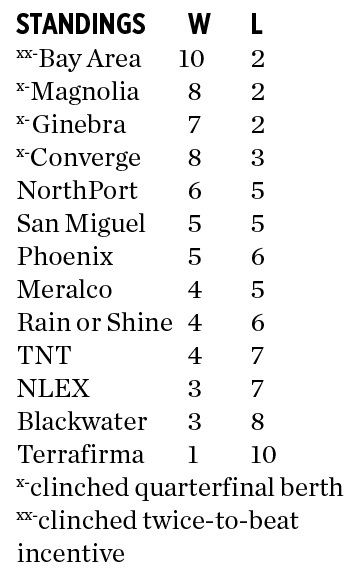
Barangay Ginebra braces for a rough ride as it traverses the road to the coveted quarterfinal incentive in the PBA Commissioner’s Cup.

Sitting third behind Bay Area (10-2) and Magnolia (8-2), the rampaging Gin Kings can climb their way to the Top 2 or even No. 1 but have to go through NLEX (3-7), NorthPort (5-5) and Converge (8-3) in a six-day span to pull through.

“We’ve got a tough road ahead of us but we control our own destiny,” said Ginebra coach Tim Cone on the eve of the opener of that killer schedule today against the No. 11 Road Warriors at the PhilSports Arena.

The crowd darlings put themselves in striking position with a bland 89-85 win over import-less and injury-hit TNT last Sunday. This extended their streak to five matches but gave Mr. Cone a bit of unease going to the stretch of the eliminations.

“I’m happy with the result but we got to be a little worried that TNT ripped us apart the way they did,” he said, referring to the game where Ginebra blew a 17-point lead and even trailed the Tropang Giga by four going to the last eight minutes.

The Gin Kings face an NLEX crew hungry to snap a five-game slump and keep their slim playoffs hopes alive in the 5:45 p.m. duel.

Mr. Cone pits coaching skills with Frankie Lim, who skippered his old Alaska team in the 1990s.

“He was my team captain with Alaska for like four years, he knows me really well. So looking forward to this matchup and seeing Frankie (Lim) again,” said the Ginebra mentor.

Meanwhile, ninth-running Rain or Shine (4-6) seeks to get back at the Magic 8 in the 3 p.m. curtain raiser against No. 12 Blackwater (3-8).

If they can score the two-game-skid-arresting win, the Elasto Painters will overtake idle Meralco (4-5) at No. 8 and match the 5-6 card of seventh-running Phoenix (5-6).

For their part, the Bossing are determined to put an end to a harrowing losing spell in their last five outings. — Olmin Leyba

Concio beats Sapenov of Kazakhstan, joins 4 others in second place

FILIPINO International Master (IM) Michael Concio, Jr. downed FIDE Master Daniyal Sapenov of Kazakhstan in the eighth and penultimate round yesterday to have a chance at a top three finish in the Asian Juniors Chess Championships at the Knights Templar Hotel in Tagaytay City.

The reigning 17-year-old Mr. Concio outplayed Mr. Sapenov in the opening where the reigning Asian juniors rapid king sacrificed a pawn to end up snatching two pawns several moves later and whipping up a vicious queenside attack that ended with an unstoppable passed pawn.

The win catapulted Mr. Concio to a five-way logjam at second with 5.5 points apiece, or a full point behind solo leader IM G.B. Hasrhavardhan of India, who smashed local bet Eric Labog, Jr. in 53 moves of an English duel to remain on top with 6.5 points.

Mr. Concio could secure at least a top three finish if he could beat IM Saha Neelash of India, the same player the former bested in the seventh and last round to rule the rapid meet several days ago. — Joey Villar

China’s coronavirus infections hit record as economic outlook darkens

REUTERS

BEIJING — China reported a record high number of coronavirus disease 2019 (COVID-19) infections on Thursday, with cities nationwide imposing localized lockdowns and other curbs that are darkening the outlook for the world’s second largest economy.

The surge in the number of infections, at record highs not seen since an outbreak in Shanghai earlier this year, is diminishing investors’ hopes that China will soon ease the rigid zero-COVID policy that, along with a downturn in the property market, is battering the economy.

The restrictions have also extracted a toll on China’s increasingly frustrated residents, as well as output at factories including the world’s biggest iPhone plant, which has been rocked by violent clashes between workers and security personnel in a rare show of dissent.

“We believe reopening is still likely to be a prolonged process with high costs,” Nomura analysts wrote in a note. The brokerage cut its gross domestic product (GDP) forecast for the fourth quarter to 2.4% year-over-year from 2.8%, and also cut its forecast for full-year growth to 2.8% from 2.9%.

China’s leadership has stuck by its zero-COVID policy, which includes some of the strictest restrictions in the world, saying it is necessary to save lives and prevent the medical system from being overwhelmed.

However, in an acknowledgement of the pressure on the economy, the cabinet said China would use timely cuts in bank cash reserves and use other monetary policy tools to make sure there is enough liquidity, state media reported on Wednesday, a hint that a cut in the reserve requirement ratio (RRR) may be coming soon.

China recorded 31,444 new local COVID cases for Wednesday, breaking the record set on April 13, when Shanghai was in a city-wide lockdown that would last two months.

China stocks fell on Thursday as concerns over the record-high caseload overshadowed optimism from fresh economic stimulus.

While official infection tallies are low by global standards, China tries to stamp out every infection chain, making it a global outlier under a signature policy of President Xi Jinping.

China recently began loosening some measures related to mass-testing and quarantine, and is trying to avoid catch-all measures such as lockdowns like the one imposed on Shanghai’s 25 million residents.

Recently, cities have been using more localized and often unannounced lockdowns. In Beijing, for example, numerous residents said they had received notices from their housing compounds in recent days informing them of three-day lockdowns.

Nomura analysts estimate that more than one-fifth of China’s total GDP is under lockdown, a figure that exceeds the size of the British economy.

“Shanghai-style full lockdowns could be avoided, but they might be replaced by more frequent partial lockdowns in a rising number of cities due to surging COVID case numbers,” Nomura analysts wrote. The bank has also lowered its GDP growth forecast for next year to 4.0% from 4.3%.

The city of Zhengzhou, where workers at the massive Foxconn 2317.TW factory that makes iPhones for Apple, Inc. staged protests, announced five days of mass testing in eight of its districts, the latest city to revive daily tests for millions of residents. — Reuters

US retailers add cameras to deter holiday crime

A Black Friday sale sign is displayed outside a makeup store at Roosevelt Field shopping mall in Garden City, New York, U.S., Nov. 24, 2017. — REUTERS

NEW YORK — Retailers ranging from Walmart to Barnes & Noble are installing cameras or locking away items to deter shoplifters and thieves as they brace for a post-pandemic rush of holiday shoppers this year.

Some, including Walmart, J.C. Penney, Apple and Walgreens, put in place new surveillance systems or more security guards. Others, like Target and Barnes & Noble, sealed merchandise behind plexiglass or tethered it with steel cables to store shelves.

The retail industry has decried theft this holiday season as it struggles with excess inventories and a pullback in consumer spending at a time of high inflation.

“Sales are suppressed. Profits are being punished at the time of the highest inflation in 42 years. And now with the cost of preventing crime going up, that’s going to be passed along in higher prices,” said Burt Flickinger, managing director at retail consulting firm Strategic Resource Group.

The effect on holiday sales and profits “will be horrific,” he added. “Nowadays you can see shampoos are locked up, along with acetaminophen and Tylenol and multipacks of toothpaste locked up…. people planning to shop in stores will not want to go in to these locked and over-secured stores. So overall retailers lose both the planned purchase and the impulse purchases.”

Crime has been in the spotlight since a spate of brazen, violent store thefts — including a “smash and grab” incident during the holiday season last year where 80 people rushed into a Nordstrom near San Francisco and ran out with armfuls of merchandise, injuring five employees. One survey by the National Retail Federation (NRF) cited a 26.5% jump last year in “organized retail crime” carried out by groups of people.

But it is unclear whether overall US retail crime is on the rise, with little data available on the problem. Total losses from shoplifting, theft, fraud and errors for US retailers in 2021 remained steady at an average rate of 1.4% of total sales, as it had been over the previous five years.

Still, retailers are diverting more resources towards security this quarter, which could add pressure on margins already squeezed by higher gas, transportation, labor and raw material costs.

Part of the problem is that prosecuting petty crime is a hassle, and some states raised their thresholds for the value of merchandise stolen to around $1,000 to trigger a felony charge.

That puts the onus on preventing crime in the first place, especially during the Thanksgiving weekend that is expected to see a record shopper turnout. The busy holiday season represents nearly 20% of total US retail sales for the year.

STROBE LIGHTS
A sign of the times can be seen in the small communities of Paducah, Kentucky, and Opelika, Alabama, where Walmart, J.C. Penney, Walgreens and other major retailers have brought in large, mobile surveillance units that record all activity in their parking lots.

Walmart, for example, said it has nine surveillance units outside three massive Supercenter stores in both cities. One of the retailer’s stores in Virginia on Tuesday was the scene of the latest mass shooting in the United States, when a manager opened fire and killed six people before turning the gun on himself.

In Paducah and Opelika, the units provided by LiveView Technologies as part of a pilot offer 24-hour video footage to retailers so they can alert authorities of any suspicious activity, said Brian Laird, Paducah’s chief of police. They also have flashing strobe lights and loud speakers to warn potential thieves that their actions are being observed.

Others retailers have focused their anti-theft efforts inside their stores. A Target in White Plains, New York, for example, placed all Ulta Beauty cosmetics behind locked plexiglass.

At a Barnes & Noble in the Galleria Mall in White Plains, American Girl ‘Wellie Wisher’ dolls are shackled to the shelves with electronic ties. At another Barnes & Noble store in Manhattan, customers have to carry empty Lego set boxes to cashiers and receive the pieces after their purchase.

‘PET PEEVE’
Major consumer products companies such as Procter & Gamble are annoyed — and so are shoppers.

P&G last week said it is investing in in-store displays to avoid having its razor blades stuck in glass casing, while shoppers complain the locked displays and cables slow them down and force them to find staff who can set the merchandise free.

“Target has a new feature!” TikTok user @manifest_makeup wrote in the caption of a video shared in September with her 20,000 followers. “Everything is now behind glass just like Walmart!”

Rex Freiberger, a 40-year-old Los Angeles resident, says he has noticed “more and more items” placed behind plexiglass at the Walmart where he shops for holiday gifts.

“My biggest pet peeve about having so many items behind locked doors is when stores don’t have enough workers on the floor to help unlock those doors,” he said.

Retailers rarely openly acknowledge the threat of theft or crime because they generally don’t want to spook shoppers.

But Target last week said it saw a “precipitous decline” in discretionary spending and disclosed that theft could wipe out more than $600 million in gross profit this year. That represents nearly 2% of the $31 billion in gross profits it earned last year.

“Along with other retailers, we’ve seen a significant increase in theft and organized retail crime across our business,” Target CEO Brian Cornell told investors on a November 16 conference call.

“As a result, we’re making significant investments in training and technology that can deter theft and keep our guests and store team members safe.”

Apple started posting a plainclothes security guard at its stores more often in recent weeks after thieves at a few locations stole iPhones straight out of employees’ hands, a person familiar with the matter said.

At one US store, an undercover guard roams the floor during the five busiest days of the week, up from two to three days a week a few months ago, the source said. — Reuters

Indonesia struggles to get aid to quake survivors, rescue continues

CIANJUR, Indonesia — Indonesian authorities struggled on Thursday to get aid to thousands of evacuees displaced by a deadly earthquake in western Java, as rain-triggered landslides and difficult mountainous terrain hampered the efforts of rescue teams.

Monday’s 5.6-magnitude earthquake in the town of Cianjur, about 75 km (50 miles) south of the capital Jakarta, killed at least 271 people with 40 missing, and left many sheltering in tents with scant medical and aid supplies.

Survivors included a woman who gave birth at a makeshift medical center in a tent.

“The conditions are steep,” President Joko Widodo said of the rugged terrain as he visited Cianjur. “It’s still raining and there are still aftershocks. The ground is shaky, so caution is needed.”

Evacuation remains a priority, he said, adding that he wants to make sure distribution goes well. He visited emergency tents, handing out food to children.

Suharyanto, the disaster mitigation agency chief, said many have not received aid and officials have gathered nearly 200 volunteers to help distribute water, instant food, tents and diapers.

With dozens missing, rescuers used earth diggers and other heavy machinery to clear mud and debris in search of victims. Some areas that have been cut off by landslides could only be reached by helicopter, disaster officials have said.

Search efforts focused on Cijedil village, where about 30 people were thought to be buried under a landslide, Joshua Banjarnahor of the national search and rescue agency, told reporters.

Rain-soaked slopes and potential landslides were delaying rescue efforts, the search and rescue agency said on Wednesday, adding the likelihood of finding survivors was getting slimmer.

Indonesia is one of the world’s most earthquake-prone nations, regularly recording strong earthquakes offshore where fault lines run.

Monday’s quake was particularly deadly because it struck a densely populated area at a depth of just 10 kilometers. Poor construction standards also caused buildings to collapse, leading to many deaths, officials said. — Reuters

Edtech platforms tout Web3 in ‘gamification’ of learning

PIXABAY

Educators are touting Web3, the decentralized version of the internet, as a way to “gamify” learning. 

“How do you use gamification to actually make learning interesting?” said Shiela L. Marcelo, co-founder and chief executive officer of Proof of Learn (POL), a Web3 education platform, at the recent Philippine Web3 Festival. “If you do it through games and something fun, it feels tangible.”   

Metacrafters, POL’s first project, is a “multichain learn-and-earn platform” that trains Web3 developers in an immersive gaming experience.  

National Teachers College signed up for the learn-to-earn game in order to learn Web3-centric skills such as writing smart contracts, minting nonfungible tokens (NFTs), and building social networks. 

“What we say at Metacrafters is, you learn-and-earn, and [then] you land Web3 jobs,” said Ms. Marcelo. “There’s the word crypto, there’s the word blockchain, there’s the word Web3 … Unpack all those words for simplicity and remove all the jargon so it’s not dependent on the Bitcoin whitepaper to explain it.”  

Web3 has its share of detractors given recent issues such as the implosion of FTX, one of the world’s biggest crypto exchanges; and the collapse of Axie Infinity, a play-to-earn game. 

The education platform Nas Company, for its part, created a Web3 Metaversity this August to “prepare individuals for careers of the future.”  

“For us, we’re looking at NFT artists, traders, marketers,” said Jacqueline Maye Lim, Philippine country head of the Singapore-based company. “You can’t be a marketer for a crypto company without understanding the basic principles and what’s happening around it.”   

Nico del Pino, co-founder of Ola.GG, a Spanish-speaking Web3 community out of Argentina, said that a lack of awareness hinders Web3 adoption. 

“The reality today is different from what it was just a year ago, so it’s very hard to catch up,” said Mr. del Pino. “It’s quite intimidating to participate, and maybe that’s where the guilds also play a role.”   

A “guild” refers to a community of “crypto-enabled developers, designers, and thinkers that share resources (be it knowledge or labor) in the pursuit of a common goal.” 

Mr. del Pino noted the growth of Web3 in the country since his first visit in 2017. “Watching how adoption has taken up in the Philippines, it’s fascinating,” he said. “This is a tiny community; the potential for growth is still so large.”   

The Philippines ranked 10th in the Cryptocurrency Adoption Index released this July by Australian-based financial technology website Finder. — Patricia B. Mirasol