Home Blog Page 5155

Europe experienced second warmest winter on record — scientists

PEOPLE are silhouetted against the setting sun at “El Mirador de la Alemana (The viewpoint of the German)” in Malaga, southern Spain, July 24, 2019. — REUTERS

BRUSSELS — Europe is emerging from its second-warmest winter on record, European Union (EU) scientists said on Wednesday, as climate change continues to intensify.

The average temperature in Europe from December to February was 1.4 degrees Celsius above the 1991-2020 average for the Boreal winter season, according to data published by the EU’s Copernicus Climate Change Service (C3S).

That ranks as Europe’s joint-second warmest winter on record, exceeded only by the winter of 2019-2020.

Europe experienced a severe winter heatwave in late December and early January, when record-high winter temperatures hit countries from France to Hungary, forcing ski resorts to close because of lack of snow.

The European Commission said on Jan. 2 hundreds of temperature records had been broken across the continent, including the Swiss town of Altdorf reaching 19.2C, smashing a record standing since 1864.

C3S said temperatures were particularly high in eastern Europe and the north of Nordic countries. While overall temperatures in Europe were above the norm, some regions were below-average, including parts of Russia and Greenland.

Scientists say Europe’s winters are becoming warmer as a result of rising global temperatures, due to human-caused climate change.

The unusually mild winter offered some short-term relief to governments struggling with high gas prices after Russia slashed fuel deliveries to Europe last year, with higher temperatures curbing gas demand for heating in many countries.

But the high temperatures pose risks to wildlife and agriculture. Winter temperature spikes can cause plants to start growing or coax animals out of hibernation prematurely, making them vulnerable to being killed off by later cold snaps.

Tilly Collins, deputy director of Imperial College London’s Centre for Environmental Policy, said the changing climate meant plants and animals were struggling to move to new locations to maintain their ideal temperature.

“For species with small populations or restricted ranges this can easily tip them on a path to extinction,” Collins said.

Copernicus pointed to other climate-linked extremes, including Antarctic sea ice, which last month dropped to its lowest level for any February in the 45-year record of satellite data.

“These low sea ice conditions may have important implications for the stability of Antarctic ice shelves and ultimately for global sea level rise,” said C3S Deputy Director Samantha Burgess. — Reuters

Women seen taking the lead in tech startups

By Brontë H. LacsamanaReporter.

Women are increasingly leading many startup ventures and companies, making significant contributions to innovation, research, and development, according to an industry leader.

“When I was starting out over a decade ago, as an intern for then-GrabTaxi, it wasn’t like this … Women in startups and tech companies were not as prevalent as they are now,” Natasha Dawn S. Bautista, the program management head of Globe’s venture incubator 917Ventures, told BusinessWorld in a recent Zoom interview.

917Ventures has 12 portfolio companies that have the potential to grow and scale quickly, with seven of them being led by women.

Ms. Bautista said that these companies have had a significant impact, particularly EdVenture, an edutech platform founded and led by Sarah A. Cortes. EdVenture, which was launched less than tow years ago, has already onboarded over 1,000 tutors.

“EdVenture solves problems of both moms and mostly women tutors, especially in this increasingly digital world,” she said. “It’s just one of almost 400 ideas we’ve vetted in the past three years. Ideas come from anywhere and they can be for anyone, whether women or not.”

For 917Ventures, giving women a seat at the table to present their ideas is only natural, and not an overly conscious effort towards gender parity.

Christina Jacinto-Gervasio, entrepreneur-in-residence for EdVenture, told BusinessWorld back in December that the current learning gap is due to a lack of access to technology, which the private sector can help improve.

“We’re trying to step in as much as we can … to provide internet and hardware to students, but it’s not nearly enough,” she said.

Ms. Bautista added: “We are in a very good position to come up with solutions for such problems. And we can’t do that if we’re not well represented across genders.”

LITERACY, ACCESSIBILITY, PROTECTION
Though the pandemic highlighted the importance of digitalization, a large gap between men and women remains when it comes to digital literacy and accessibility.

For Bataan First District Rep. Geraldine B. Roman, the lack of training for women can be addressed by opportunities that focus on improving their digital skills. With this comes the matter of online safety as well.

“We’ve found that electronic violence and cybercrimes are mostly committed against women. That’s why, on a committee level, we’ve already approved the expanded protection of women and children against electronic violence,” said Ms. Roman, who is also the chairperson of the house Committee on women and gender equality.

At a press conference on International Women’s Day, she said that Congress has approved eight bills that provide further clarification on electronic violence.

There are gender sensitivity sessions being developed for police officials and learning modules geared to educate perpetrators of violence against women, according to Maria Kristine Josefina G. Balmes, the Philippine Commission on Women’s (PCW) deputy executive director for operations.

“Gender is a crosscutting concern across government agencies, so PCW monitors all efforts addressing the digital gender divide in various industries,” she said.

She also said that agencies like the Department of Trade and Industry and the Department of Science and Technology have supported 831 women micro-entrepreneurs by providing them with capacity building and business development opportunities.

NOT NECESSARILY A QUOTA
Regarding the participation of women in the tech and startup industry, the numbers are not the most crucial factor.

Ms. Bautista of 917Ventures said: “It’s already a big deal seeing people like Martha Sazon, the president of GCash, representing the Philippines in a fintech conference. That’s finance, and it’s usually seen as a male-dominated industry, and women leaders are there.”

SM Supermalls has a similar mindset on gender parity, said its president Steven T. Tan, although women make up 63% of SM’s employees and 60% of SM’s senior management.

“True parity is about erasing gender biases. The key is to create safe spaces for everyone,” he said at the press conference. “That’s why we have financial literacy workshops, programs that help employees interested in small and medium enterprises, programs that support working moms.”

PCW’s Ms. Balmes said that both public and private sectors must understand that such initiatives are vital, and that a gender quota is only used as a temporary special measure.

“It’s never the permanent solution. It’s the culture we have to elevate. Aside from having more women, we have to upskill them, listen to them, support them,” she said.

CONVERGENCE 2023: Collabera Digital’s first-ever CIO Summit 2023 to drive innovation and collaboration in Asia-Pacific

Collabera Digital, the leading global digital engineering solutions firm, proudly announces its first-ever event in Asia-Pacific: “CONVERGENCE, Collabera Digital CIO Summit 2023,” which will occur on March 16, 2023 at Shangri-la The Fort, BGC.

Hosted by well-known business news correspondent Mimi Ong, the summit will include keynotes and panel discussions on topics such as the Tech Talent Paradigm, Data-Driven CX, the Future of Fintech, and Cloud Adoption & Economics.

The summit will be exclusively attended by  top CIOs, CTOs, and C-level executives of notable companies from the Philippines, Malaysia, Singapore & Australia. This will open the window for collaboration, networking, and exchanging of business strategies that can lead to innovative solutions.

CONVERGENCE 2023 marks a significant milestone for Collabera Digital as it transitions from virtual events to a face-to-face format. It opens the opportunity for executives to meet and engage with their peers and Collabera Digital team.

Collabera Digital Founder & Managing Director Mehul Shah said, “I’m excited to be hosting our very first CIO summit, CONVERGENCE 2023. With collaboration, innovation, and driving business growth becoming the bedrock of every CIO’s initiative, I am looking forward to interacting and gaining insights from business leaders, as we embark together in our digital transformation journeys.”

“It is a pleasure for us to welcome & host forward-thinking leaders. With interactive and collaborative sessions, CONVERGENCE 2023 has been thoughtfully designed and curated to explore and exchange the latest thinking on business strategies that drive value throughout our organizations,” said Collabera Digital SVP & Country Head – Philippines Manan Mehta.

About Collabera Digital

Collabera Digital engineers the next generation of solutions to power tech-forward organizations accelerate their digital journeys. Our digital engineering capabilities in data, analytics, cloud, automation and cybersecurity, coupled with a strong foundation in talent transformation and advisory and architecture, fosters continuous innovation and transformation, helping clients stay ahead in the digital curve. With our client-first and collaborative approach, we deliver solutions that are tailor-made, through speed and agility.

Established in 2010 and with 25 offices in 11+ countries across Asia-Pacific & Europe, we cater to 300+ clients, including Fortune 500 companies. Supported by over 10,000 professionals, we are a team of innovators and thinkers who chase excellence as much in the process as we do in the result.

For more information, visit www.collaberadigital.com.


Spotlight is BusinessWorld’s sponsored section that allows advertisers to amplify their brand and connect with BusinessWorld’s audience by enabling them to publish their stories directly on the BusinessWorld Web site. For more information, send an email to online@bworldonline.com.

Join us on Viber at https://bit.ly/3hv6bLA to get more updates and subscribe to BusinessWorld’s titles and get exclusive content through www.bworld-x.com.

Emerging market central bank pivot plans face a Fedache

 – Having beaten the Fed & Co off the blocks when it came to raising interest rates, parts of the developing world will be the front runners again when it comes cutting them, although the timing now looks increasingly in flux.

With the United States threatening to push its borrowing costs as high as 6%, economists are watching to see what happens in the emerging market countries that have lifted rates faster and further than anyone else.

Financial market expectations compiled by JPMorgan, for example, point to Hungary and Chile — which have hiked by more than 12- and almost 11 percentage points respectively over the last two years — starting major easing cycles as soon as this month.

Poland and Peru could also turn by June, followed by Czech Republic, Colombia and Brazil in Q3 and possibly India, Mexico and South Africa towards the end of the year or early in 2024.

“I do think it (an EM easing wave) is coming but it might not be coming as soon as the market expected,” said Pictet portfolio manager Guido Chamorro. “It is very difficult to go much before the Fed.”

While rate cuts might signal economic deterioration in the developing world, they could bring relief to investors who have regularly lost money on EM local currency debt since the so-called ‘taper tantrum’ – triggered by hints of Fed stimulus withdrawal – a decade ago.

Mirabaud’s head of emerging markets debt Daniel Moreno explained that rate cuts tend to lift prices of EM bonds as buyers try to cram into them before the interest rates they offer drops.

Between 2013 and 2015, after the taper tantrum and then Russia’s first invasion of Ukraine, EM local debt lost nearly 27% in total.

It lost nearly 12% last year too when global inflation, interest rates and the dollar surged against the backdrop of Russia’s invasion of Ukraine, and as the world recovered from COVID.

BofA’s analysts totted up that there were a staggering 167 EM rate hikes last year, which averages out at one every 1.5 days that financial markets were open.

“The rebound in the market is usually the strongest where the falls were the biggest,” Mirabaud’s Moreno said, adding Hungary’s local currency debt, which still offers as much as 15% interest, plummeted 27.5% last year.

This year it has rebounded almost 8% and market pricing points to a whopping 6 percentage point reduction in central bank rates over the next 12 months. Brazil is priced for a 1.25 percentage point cut, Chile for 3.5 percentage points and Poland and Czech Republic around 1 percentage point.


AHEAD OF THE FED

Despite 6% US rates now looking possible, Oxford Economics’ head of EM research Gabriel Sterne has done analysis suggesting that EM central banks will press on with policy “pivots” as long as domestic inflation rates are dropping sufficiently.

Nearly a third of EMs launched cutting cycles 12 months ahead of the Fed’s last seven ‘pivots’ since 1980, his data show, and in the last two decades there have been no instances where a major EM was forced to quickly reverse a cut.

“It is the domestic conditions that will really determine what the central banks do,” Mr. Sterne said. “They won’t hesitate because the Fed isn’t pivoting just yet.”

Not everyone is convinced it will be trouble-free though.

Morgan Stanley Investment Management’s Patrick Campbell thinks that while EM local debt looks “screamingly attractive” due to some of the best interest rate ‘risk premia’ since the financial crisis, US high-yield debt is also offering 9%.

UBS analysts have cautioned, meanwhile, that China, Indonesia, Chile and the Philippines could all see their currencies fall another 4-5% if the Fed goes all the way to 6%, and even more if markets started freaking out about recessions.

“The Fed is priced for no easing over the next year now whereas Hungary and Chile and Mexico are still priced for pretty hefty easing cycles,” UBS’ head of EM Cross Asset Strategy Manik Narain said. “That might be premature if the Fed is going to 6%.” – Reuters

Women’s Day protesters rally for rights, with focus on Iran and Afghanistan

STOCK IMAGE | Image by HANSUAN FABREGAS from Pixabay

 – Rallies marking International Women’s Day took place around the world on Wednesday with a focus on Afghanistan, where girls are denied the right to education, and Iran, which has seen mass protests on women’s rights in recent months.

Activists donned purple and held demonstrations from Jakarta and Singapore to Istanbul, Berlin, Caracas and Montevideo.

In the Americas, reproductive rights were a key theme after the landmark Roe v. Wade U.S. abortion ruling was overturned last year and with abortion tightly restricted in much of Latin America. Women have also demanded action on high rates of unsolved killings of women and girls.

In Mexico City, 67-year-old Silvia Vargas said she had been attending demonstrations since her daughter Maria Fernanda, who was lesbian, was killed in 2014.

“Not everyone gets human rights, governments and institutions determine them,” she said, saying authorities had made her feel her daughter’s sexuality and murder were shameful. “I’m going home to an absence that has marked me for life.”

Across South America, from Montevideo on the Atlantic coast to the Andean city of Quito, thousands took to the streets, including indigenous people, students and workers.

In Brazil’s Rio de Janeiro, women demanded the legalization of abortion and action on femicides, while in Chile’s Santiago protesters, dancers, artists and even pets crammed the streets.

In Manila, activists calling for equal rights and better wages scuffled with police blocking their protest. “Girls just want to have fun…damental rights”, read one poster. Turkish police fired pepper spray to disperse protesters in Istanbul.

In Paris, demonstrators marched to demand better pensions for women who work part-time and in Tel Aviv women formed human chains to protest against a judicial overhaul that they fear will harm civil liberties.

Protesters flooded the streets of several Spanish cities to demand equal rights and the rooting out of “machismo” but divisions in the feminist movement over issues such as transgender rights and prostitution led to competing rallies.

Many protests included calls for solidarity with women in Iran and Afghanistan.

“Afghanistan under the Taliban remains the most repressive country in the world regarding women’s rights, and it has been distressing to witness their methodical, deliberate, and systematic efforts to push Afghan women and girls out of the public sphere,” Roza Otunbayeva, head of the UN Assistance Mission in Afghanistan, said in a statement marking the day.

In London, protesters marched to the Iranian embassy in costumes inspired by the novel and television series “The Handmaid’s Tale”, while in Valencia, Spain, women cut their hair in support of Iranian women.

The death last September of 23-year-old Mahsa Amini while in the custody of morality police in Tehran unleashed the biggest anti-government protests in Iran in years.

In recent days, Iran’s clerical rulers have faced renewed pressure as public anger was compounded by a wave of poisonings affecting girls in dozens of schools. Iran has arrested several people it said were linked to the poisonings and accused some of connections to “foreign-based dissident media”.

As Washington marked International Women’s Day, the United States imposed sanctions on two senior Iranian prison officials it accused of being responsible for serious rights abuses against women and girls.

Britain also announced a package of sanctions against what it described as “global violators of women’s rights”, while the EU announced new sanctions on Tuesday.


NEW PLEDGES

Some governments marked Wednesday with domestic legislative changes or pledges.

Canada repealed historic indecency and anti-abortion laws, French President Emmanuel Macron said he backed the inclusion of the right to abortion in the constitution, and Ireland announced a referendum to remove outmoded references to women in its constitution.

Italy’s first female prime minister, Giorgia Meloni, said state-controlled companies should have at least one leader who is a woman.

In Japan, which ranked 116 out of 146 countries on gender parity in a World Economic Forum global report last year, chief cabinet secretary Hirokazu Matsuno said progress had been made on improving women’s working conditions but more had to be done.

“The situation for women, who are trying to balance household and workplace responsibilities, is quite difficult,” he said. “Measures to tackle this are still just halfway complete.”

In Russia, where International Women’s Day is one of the most celebrated public holidays, the head of its upper house of parliament used the occasion to launch a vehement attack on LGBT lifestyles.

“Men and women are the biological, social and cultural backbones of communities,” Valentina Matviyenko wrote in a blog on the Federation Council’s website.

“Therefore, there are no dangerous gender games in our country and never will be. Let us leave it to the West to conduct this dangerous experiment on itself.”

In the Colombian capital of Bogota, 45-year-old psychologist Paulina, who did not give a surname, said “invisible violence” was a problem for women everywhere.

“Even as we are victims of abuse, they say ‘You had a skirt on, a shirt showing cleavage, you were looking for it, right?’.” – Reuters


US, EU to launch talks on free-trade-like status, easing EV trade dispute -sources

 – US President Joe Biden and European Commission President Ursula von der Leyen are expected to agree on Friday to begin negotiations on ensuring freetrade agreement-like status for the European Union, two sources familiar with the plans said on Wednesday.

The leaders are set to meet in Washington on Friday.

Reuters reported last week that the United States and EU were working to make European minerals eligible for tax credits under the $430 billion US Inflation Reduction Act (IRA), citing a senior EU official.

That law requires rising percentages of battery minerals to come from the United States or a Free Trade Agreement (FTA) partner.

A US Treasury spokesperson said the department, which oversees the electric vehicle (EV) tax credits at the heart of the dispute, would evaluate any newly negotiated agreements to ensure they meet the critical minerals requirement of the tax credit during the rulemaking process.

“Given the extremely high concentration of Chinese control over critical mineral extraction globally, strengthening our supply chains for critical minerals along with like-minded partners is vital for the growth of the clean energy economy,” the spokesperson said.

Working with allies to reduce US reliance on China for critical minerals would aid US energy and economic security, the spokesperson added.

Up to $3,750 per vehicle of the available tax credits relate to critical minerals for batteries, taking effect when the US Treasury issues guidance, which is expected later this month.

The EU, South Korea, Japan and other US allies have harshly criticized the IRA’s provision requiring EVs to be assembled in North America to qualify for consumer EV tax credits.

But the EU in December praised a US Treasury Department decision to allow EVs leased by consumers to qualify for up to $7,500 in commercial clean vehicle tax credits. – Reuters

Bankman-Fried’s lawyers say October trial may need to be delayed

Sam Bankman-Fried, founder and former chief executive officer of now-bankrupt crypto exchange FTX. — WIKIMEDIA COMMONS

 – Sam Bankman-Fried’s lawyers said on Wednesday it may be necessary to delay the FTX cryptocurrency exchange founder’s scheduled Oct. 2 criminal trial, arguing it may take more time than expected to review the evidence and prepare a defense.

In a letter to US District Judge Lewis Kaplan, the 31-year-old former billionaire’s lawyers said federal prosecutors in Manhattan had not yet turned over evidence collected from electronic devices belonging to Caroline Ellison and Gary Wang, previously two of their client’s closest associates.

Both have since pleaded guilty and agreed to cooperate with prosecutors.

The lawyers also noted that prosecutors added new fraud and conspiracy charges late last month, boosting the number of counts to twelve, following the November collapse of Mr. Bankman-Fried’s now-bankrupt exchange and his arrest the next month.

In January, Bankman-Fried pleaded not guilty to the original eight counts that he cheated investors and caused billions of dollars in losses, in what prosecutors have called an “epic” fraud.

“While we are not making such an application at this time, we wanted to note this issue for the Court now,” Christian Everdell, one of Mr. Bankman-Fried’s lawyers, wrote in the letter.

A spokesman for the US Attorney’s office in Manhattan declined to comment.

Mr. Bankman-Fried rode a boom in the values of bitcoin and other digital assets to an estimated $26 billion net worth, and became an influential donor to US political campaigns.

But his fortune evaporated after concerns about commingling of funds between FTX and Alameda Research, a hedge fund he also owned, spurred the cryptocurrency equivalent of a run on the bank at FTX.

Bankman-Fried was released on $250 million bond and has been under house arrest at his parents’ Palo Alto, California home.

Kaplan has suggested his bail could be revoked after prosecutors said he may have tried to tamper with witnesses. Prosecutors over the weekend proposed Bankman-Fried remain free with strict limits on his use of technology.

The trial schedule and Mr. Bankman-Fried’s bail conditions are expected to be discussed at a court hearing on Friday. – Reuters

Globe is Most Reliable Mobile Network and Most Sustainability-Driven Network Operator in PHL

Reflecting its steadfast commitment to world-class service and sustainability, leading digital solutions platform Globe has been named the Philippines’ Most Reliable Mobile Network by Ookla®, as well as Most Sustainability-Driven Network Operator and Best Network Reliability in 2023 by Standard Insights.

Globe earned these awards for its unwavering commitment to delivering network consistency, accessibility, and reliability to customers, including its efforts in climate action as it integrates sustainability into its business operations.

“We are the only telco in the Philippines to land these back-to-back awards. We take these as international recognition of our commitment to the delivery of a #1stWorldNetwork and our leadership when it comes to green network practices. This is the best way to do business— integrating network expansion and optimization with sustainability,” said Globe Group President and CEO Ernest Cu.

Ookla, the global leader in network intelligence and connectivity insights, cited Globe as the country’s “Most Reliable Mobile Network” for retaining its top position over three consecutive quarters in 2022.

With only a select few providers globally achieving this much sought-after recognition, Globe has set itself apart by consistently obtaining the highest scores in All Technology Consistency and All Technology Availability.

For the fourth quarter, Globe maintained its dominance by receiving an All Technology Consistency Score of 83.13, beating its competitors’ scores of 80.83 and 72.59. The consistency score is determined by the percentage of a provider’s data samples that meet the minimum threshold of 5 Mbps for mobile download and 1 Mbps for upload.

Additionally, Globe led All Technology Availability with a score of 92.38 in the fourth quarter versus its competitors’ 91.03 and 90.71. Availability is a measure of the network on which users spend the most time on all technology and is based on the analysis of coverage scans taken on Android devices.

“This recognition is a testament to Globe’s steadfast dedication to providing our customers with unparalleled levels of consistency, availability, and reliability. We are relentless in our pursuit of excellence and never cease in our efforts to continuously enhance and upgrade our infrastructure, keeping pace with the dynamic and evolving needs of our customers,” stated Issa Guevarra-Cabreira, Globe’s Chief Commercial Officer.

On the other hand, Standard Insights acknowledged Globe for its network reliability and unrelenting efforts to protect the environment as it operationalizes climate action within its network operations.

In a survey that the independent market research firm conducted among major telco brands in the Philippines for the 2023 Consumer Awards, Globe received 37.5% of votes for having “the strongest and most reliable signal in the country” without worry of connectivity loss.

Globe also received 43.3% of the total votes among 1,215 survey respondents, edging out its competitors.

Globe secured an ISO 50001: 2018 certification for its Energy Management System (EnMS) implemented across its operations. The company also shifted 10 more high-energy sites to renewable energy, bringing the total number of green-powered sites to 24. The company invested in innovative network equipment and solutions to drive energy efficiency and network optimization.

It also partnered with several organizations including the United Nations Industrial Development Organization (UNIDO), the Department of Environment and Natural Resources – Environmental Management Bureau (DENR-EMB), Integrated Recycling Industries, Inc. (IRI), the Ecological Waste Coalition of the Philippines (EcoWaste Coalition), and the local government unit of Dampalit, Malabon with funding through the Global Environmental Facility (GEF) to establish a new Treatment, Storage, and Disposal (TSD) facility for hazardous electronic waste (e-waste) that facilitate e-waste recycling and create jobs for the local community.

The company also bannered climate education through its partnership with WWF Philippines, launching the online learning resource platform Camp Kalikasan. Last year, it also launched a mobile game, Globe Climate Champions, which encouraged customers to be more mindful of their carbon footprint and make more sustainable choices in their consumption.

“At the heart of our operations lies a commitment to sustainability, woven into our business practices and operations,” said Cu. “We are constantly pursuing strategies to lower our carbon emission as we advocate and practice responsible business. Our goal is to champion sustainability and the usage of digital solutions to create a sustainable future for all.”

In 2022, Globe maintained its B rating from the CDP, a global non-profit that runs the world’s leading environmental disclosure platform. It also earned an A rating from MSCI ESG, an international investment research firm, and has been listed in the FTSE4Good Index Series by FTSE Russell for seven consecutive years. Globe was also recognized by the Financial Times as part of the top 200 Asia-Pacific Climate Leaders.

To learn more about Globe, visit www.globe.com.ph.

Disclaimer:
Most Reliable Mobile Network in the Philippines:
Reliability based on analysis by Ookla® of Speedtest Intelligence® data for all technology Consistency and Availability data in the Philippines Q4 2022. Ookla trademarks used under license and reprinted with permission.
 
Consumer Choice Awards Philippines: Mobile Network 2023
In a survey of over 1,200 Filipino mobile subscribers conducted in January 2023
Source: Standard Insights


Spotlight is BusinessWorld’s sponsored section that allows advertisers to amplify their brand and connect with BusinessWorld’s audience by enabling them to publish their stories directly on the BusinessWorld Web site. For more information, send an email to online@bworldonline.com.

Join us on Viber at https://bit.ly/3hv6bLA to get more updates and subscribe to BusinessWorld’s titles and get exclusive content through www.bworld-x.com.

Keeping time with the beat of the heart

Dr. Pipin Kojodjojo, a cardiologist and heart rhythm specialist at Mount Elizabeth Hospital in Singapore

The world has collectively experienced a historic moment with the COVID-19 pandemic, and only time can fully reveal the extent of its impact. At present, however, there is evidence to support the claim that its effects on health goes beyond the obvious symptoms.

A study in the American Heart Association journal Circulation: Arrhythmia and Electrophysiology recently found new-onset atrial fibrillation (AFib) in one in 20 patients hospitalized with COVID-19. AFib is a quivering or irregular heartbeat (arrhythmia) that can lead to blood clots, stroke, heart failure and other heart-related complications.

Dr. Pipin Kojodjojo, a cardiologist and heart rhythm specialist at Mount Elizabeth Hospital in Singapore, has seen this phenomenon himself.

“In our clinics, we’ve seen over the last two years many patients presenting with heart rhythm disturbances or arrhythmia, one of which is atrial fibrillation, and many of these patients are coming with their arrhythmias for the first time a few weeks after developing a COVID-19 infection,” he said in an interview with BusinessWorld.

“Now whether this is a transient phenomenon whereby the arrhythmia gets better in the first year or it really creates a whole new pandemic of heart rhythm conditions over the next few years? We don’t know and we will see what happens over the next few years. I think the pandemic has a very long tail and I think that it has created potentially a lot more health problems for us in the years to come.”

The situation is made more difficult by how unaware the average person is about heart rhythm problems in general. “I think most people don’t realize that life depends on our heart beating regularly, and that regular beating is actually driven by the presence of electricity,” Dr. Kojodjojo said.

“For the general public, for a lot of them, their understanding of heart diseases is quite narrow. Most people think of blockages in the heart or coronary artery disease to define heart disease. Now what they don’t understand is that coronary disease is only one out of many types of heart disease. Just by having no blockages doesn’t mean that your heart is healthy.”

He explained that there are conditions that affect the strength of the heart muscles and those that affect the heart valves. If someone’s heartbeat is too slow or too fast or irregular, these are all considered as heart rhythm abnormalities that could result in symptoms such as dizziness, blackouts, palpitations, and in the worst cases, cardiac arrest or sudden death.

Fortunately, it is easier than ever for people experiencing these symptoms to check the health of their heart. Dr. Kojodjojo noted that even the most important diagnostic tool in their arsenal, the ECG, or electrocardiogram, can now be used through smartwatches.

“You don’t always feel the palpitations all the time or you don’t feel dizzy all the time. And so a lot of smart technology has allowed us to increase the detection of these conditions. Now we supplement the ECG diagnosis with better treatments for heart rhythm abnormalities,” he said.

Other key advancements in the field, he explained, include significant improvements in treatments and implanted medical devices. Through a procedure called catheter ablation, patients with irregular heart rhythms can be treated with a high degree of success, at least three or four times better than taking lifelong oral medication. And through breakthroughs in technology, a new kind of catheter ablation called pulse field ablation can correct atrial fibrillation without the side effects of older, conventional treatments.

Similarly, pacemakers and implants have gotten so sophisticated, with pacemakers now as small as one-sixths of a AAA battery, which allows for a quicker implant and much faster recovery. Mount Elizabeth Hospitals, as one of the Asia-Pacific’s most prominent medical centers, offers the latest and most up-to-date innovations and technologies along with a large team of dedicated professionals and specialists, which Dr. Kojodjojo is part of.

“Patients at Mount Elizabeth Hospitals have access to the latest ablation technology that are available anywhere in the world. In addition to that, we have access to a whole range of implants, which covers everything from pacemakers to left atrial appendage occluders to ICDs,” he said.

“There are more than 10 heart rhythm specialists in Mount Elizabeth Hospitals who collectively have done more than 10,000 cases. So we have a very experienced team of doctors and allied health team looking after the patients with the latest advancements in technology and I think that makes it a good center for the treatment of heart rhythm conditions.”

For inquiries, please contact our patient assistance center located at G/F-B, Marco Polo Hotel, Meralco Avenue and Sapphire Street, Ortigas Center, Pasig City 1600; e-mail manila.ph@ihhhealthcare.com or call 0917-526-7576. Follow us at facebook.com/MountElizabethHospitalsSGPhilippinesOffice.




Spotlight is BusinessWorld’s sponsored section that allows advertisers to amplify their brand and connect with BusinessWorld’s audience by enabling them to publish their stories directly on the BusinessWorld Web site. For more information, send an email to online@bworldonline.com.

Join us on Viber at https://bit.ly/3hv6bLA to get more updates and subscribe to BusinessWorld’s titles and get exclusive content through www.bworld-x.com.

Forex reserves slip to $99.3B at end-Feb.

Dollar and pound banknotes are seen in this picture illustration taken April 28, 2017. — REUTERS/DADO RUVIC/ILLUSTRATION

THE PHILIPPINES’ dollar reserves fell to $99.3 billion at end-February, as the government settled foreign currency debt obligations, the central bank said late on Tuesday.

Citing preliminary data, the Bangko Sentral ng Pilipinas (BSP) said gross international reserves (GIR) slipped by 1.4% as of end-February from the $100.67 billion at end-January.

Year on year, dollar reserves declined by 7.9% from $107.8 billion as of end-February 2022.

“The month-on-month decrease in the GIR level reflected mainly the National Government’s (NG) net foreign currency withdrawals from its deposits with the BSP to settle its foreign currency debt obligations and pay for its various expenditures,” the BSP said in a statement.

Foreign currency deposits dropped by 74.8% to $532.8 million from $2.12 billion a month earlier and by 11.8% from the $604.2-million level a year ago.

The central bank also attributed the lower GIR to the “downward adjustments in the value of the BSP’s gold holdings due to the decrease in the price of gold in the international market.”

BSP data showed the value of gold reserves dropped by 4.8% to $9.33 billion as of end-February from $9.8 billion as of end-January. It was also 2.7% lower from the $9.59-billion level a year earlier.

The end-February GIR level was enough to cover 7.5 months’ worth of the country’s imports of goods and payments of services and primary income.

It was also equivalent to about 6.1 times the country’s short-term external debt based on original maturity and 4.1 times based on residual maturity.

Ample foreign exchange buffers protect the country from market volatility and ensure the country is capable of paying its debts in the event of an economic downturn.

Security Bank Corp. Chief Economist Robert Dan J. Roces said dollar reserves slightly fell due to higher foreign debt payments for the month.

“However, foreign debt obligations this year are much smaller compared with last year, and the peso seems to be confined to a range which allows for some buildup of the reserves,” he said in a Viber message.

In a note, Rizal Commercial Banking Corp. Chief Economist Michael L. Ricafort said possible foreign exchange intervention activities through buying or selling of US dollars may have affected the latest GIR level.

The BSP intervenes in the foreign exchange market to smoothen volatility.

While the peso rebounded to the P54-a-dollar mark in January, it depreciated by 1.25% or P0.69 in February, closing the month at P55.33 against the dollar on Feb. 28 from its P54.64 close on Jan. 31.

Mr. Ricafort noted the decline in foreign exchange holdings and gold reserves were offset by the continued month-on-month increase in foreign investments amid net gains in global financial markets since January.

Gains from the BSP’s investments abroad edged 0.8% higher to $84.86 billion from $84.15 billion a month earlier, but it was lower by 8.6% than $92.89 billion a year ago.

According to the BSP, net international reserves declined by $1.3 billion or 1.3% to $99.3 billion as of end-February from $100.6 billion a month prior.

Net international reserves are the difference between the BSP’s reserve assets (GIR) and reserve liabilities such as short-term foreign debt, and credit and loans from the International Monetary Fund (IMF).

The country’s reserve position in the IMF also slipped by 1.4% to $785.8 million from $797.3 million a month earlier and 1.6% from the $798.9 million as of end-February 2022.

Special drawing rights — or the amount the country can tap from the IMF — inched up by 0.3% to $3.81 billion as of end-February from $3.8 billion as of end-January. But it fell by 3.1% from the $3.93 billion a year earlier.

The fast recovery in foreign tourism revenues amid China’s reopening, alongside the continued growth in structural inflows from remittances and exports, could help support the country’s dollar reserves in the coming months, Mr. Ricafort said.

For his part, Mr. Roces said the GIR may end the year higher than the $100-billion level.

The BSP projects the GIR level at $93 billion by end-2023. — Keisha B. Ta-asan

Banks’ NPL ratio inches up to 3.28% in January

PHILIPPINE STAR/KRIZ JOHN ROSALES

By Keisha B. Ta-asan, Reporter

SOURED LOANS held by banks increased for the first time in 10 months in January amid elevated inflation and rising interest rates, which brought the industry’s gross nonperforming loan (NPL) ratio to a two-month high.

Based on preliminary data from the Bangko Sentral ng Pilipinas (BSP), bad loans reached P405.138 billion in January, up by 1.6% from P398.79 billion in December 2022. Still, this is 12.2% lower than P461.66 billion a year earlier.

This brought the industry’s NPL ratio to 3.28%, inching up from the 3.16% in December but lower than the 4.14% in January 2022. This is the highest NPL ratio since the 3.35% seen in November last year.

Loans are classified as nonperforming when they are left unpaid at least 90 days beyond the due date. They are considered as a risk to banks’ asset quality as borrowers are likely to default on these debts.

“The prevailing environment of rising inflation and interest rates in the previous months of 2022 may have started to impact the capacity to pay of some consumers and firms, thus, resulting to the slight uptick in nonperforming loans of banks,” Union Bank of the Philippines, Inc. Chief Economist Ruben Carlo O. Asuncion said.

Mr. Asuncion added that the month-on-month pickup in soured loans reflects the inability of some borrowers, especially small businesses, to refinance existing loans at this time.

The Monetary Board has raised the key policy rate by a total of 400 basis points (bps), bringing the key policy rate to 6% to curb red-hot inflation.

Inflation averaged 5.8% in 2022, as food and utility prices continued to rise. In January, inflation accelerated to a fresh 14-year high of 8.7% from the 8.1% in December. It marked the 11th consecutive month of inflation exceeding the BSP’s 2-4% target range.

Based on BSP data, the banks’ loan book jumped by 10.8% to P12.348 trillion in January from the P11.143 trillion in the same month in 2022. It, however, inched down by 2.2% from P12.625 trillion in December.

Past due loans in January declined by 8.2% to P495.146 billion from P539.425 billion a year ago, but higher by 3.4% from P478.827 billion in December. The ratio eased to 4.01% from the 4.84% in January 2022.

Meanwhile, restructured loans decreased 9.6% year on year to P322.135 billion in January, from P356.449 billion. These made up 2.61% of total loans, slightly lower from 3.2% a year ago.

The industry’s loan loss reserves reached P430.481 billion in January, up by 6.8% year on year from P402.89 billion. This is equivalent to 3.49% of banks’ loans, up from 3.62% a year earlier.

The NPL coverage ratio in January stood at 106.26%, up from the 87.27% last year.

In an e-mail, ING Bank N.V. Manila Senior Economist Nicholas Antonio T. Mapa said the BSP’s aggressive tightening and high cost of living is making it more difficult for borrowers to service their debt obligations.

“Conditions at the start of 2023 (were) more challenging which could mean we (may) see a sustained increase in nonperforming loans until we see some relief in terms of borrowing costs and or price pressures,” Mr. Mapa said.

Mr. Asuncion also expects a slight rise in NPLs in the first half this year before easing in the second half due to a “potential pivot” in monetary policy.

BSP Governor Felipe M. Medalla earlier said the central bank might deliver two more rate increases at its March 23 and May 18 meetings, before pausing its tightening cycle.

The BSP expects inflation to average 6.1% this year, before easing to 3.1% in 2024.

Meralco to implement staggered hike in generation charges

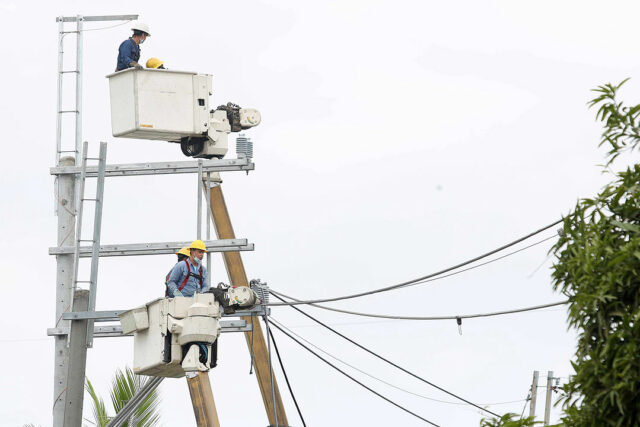
Linemen of Manila Electric Co. fix electric posts in Tondo, Manila in this file photo. — PHILIPPINE STAR/ RUSSELL PALMA

THE ENERGY Regulatory Commission (ERC) has approved the proposal of Manila Electric Co. (Meralco) to stagger the collection of an estimated P1.1 billion in generation charges over the next two months to cushion its impact on consumers.

In a Viber message, ERC Chairperson and Chief Executive Officer Monalisa C. Dimalanta said the regulator had no objections to Meralco’s request to defer the collection of the higher generation charges incurred for February.

“In its letter, Meralco advised that the deferral of P1.1 billion will result in an increase of P0.62/kilowatt-hour (kWh) in its total rate for March and April 2023. This total rate is less than the expected increase of about P0.92/kWh plus other adjustments for VAT (value-added tax) and systems loss for the February supply month,” the ERC said in a separate statement.

The regulator said a typical Meralco residential customer consuming 200 kWh will see a total rate increase of P1.11/kWh, when other billing components, such as systems loss and taxes, are included.

A Meralco representative said in a Viber message that it proposed the staggered collection of the generation charges after seeing a “significant increase based on initial computations.”

“We asked our suppliers to defer collection of portions of their generation costs. Our proposal is to collect these deferred costs over the next two months to help bring down this month’s generation charge increase,” Meralco said.

Meralco said the higher generation charge was mainly due to the maintenance shutdown of the Malampaya gas production facility from Feb. 4 to 18. During the two-week shutdown, power plants supplied by Malampaya ran on more expensive alternative fuels to ensure continuous power supply.

“We coordinated with our suppliers and the ERC for the deferral of a portion of the generation costs for the February supply month. This will help us bring down the generation charge increase in the March billing period to the benefit of our customers,” it added.

However, the ERC said that it will still validate the proposed increase if it complies with the power supply agreements (PSA) and the fuel pass-through structure.

Meralco also attributed the increase in generation charges to the spike in the Wholesale Electricity Spot Market (WESM) prices.

Latest available data from the Independent Electricity Market Operator of the Philippines show that spot market prices increased by P1.67 to P7.43/kWh from P5.76/kWh in January.

For the February supply period, Meralco has secured an emergency power supply agreement (EPSA) with Aboitiz Power Corp.’s GNPower Dinginin Ltd. Co. (GNPD) covering 300 MW of supply. This deal with GNPD has a full fuel pass-through structure with an implemented rate of P8.53/kWh.

Meralco’s decision to secure an EPSA came after its 670-MW power supply deal with South Premiere Power Corp. (SPPC), the administrator of the gas-fired power plant in Ilijan, Batangas, was subjected to a writ of preliminary injunction issued by the Court of Appeals (CA).

The 670-MW contracted capacity is supposed to be covered by Meralco’s PSA with SPPC, which was agreed upon in 2019 for a period of 10 years at P4.2455/kWh.

Meanwhile, Ms. Dimalanta also said that the commission will stick to its initial plan to defer the recovery of P22.64 billion in generation costs until the second half of this year.

To recall, the Supreme Court upheld in July the ERC’s order in 2013 allowing Meralco to implement a staggered power rate hike for the recovery of the generation costs.

The staggered rate increases also came after the shutdown of the Malampaya gas operations and the scheduled maintenance of power generation plants.

Meralco’s controlling stakeholder, Beacon Electric Asset Holdings, Inc., is partly owned by Philippine Long Distance Telephone Co. (PLDT). Hastings Holdings, Inc., a unit of PLDT Beneficial Trust Fund subsidiary MediaQuest Holdings, Inc., has a majority stake in BusinessWorld through the Philippine Star Group, which it controls. — Ashley Erika O. Jose

ADVERTISEMENT
ADVERTISEMENT