Home Blog Page 5100

BTr fully awards T-bonds at slightly higher rates

BW FILE PHOTO

THE GOVERNMENT made a full award of the reissued 20-year Treasury bonds (T-bonds) it auctioned off on Tuesday as the market awaits the policy decisions of the US Federal Reserve and the Bangko Sentral ng Pilipinas (BSP).

The Bureau of the Treasury (BTr) raised P25 billion as planned from the reissued 20-year bonds it offered on Tuesday as total bids reached P34.412 billion.

The bonds, which have a remaining life of 19 years and eight months, were awarded at an average rate of 6.631%, with accepted yields ranging from 6.5% to 6.745%.

The average rate of the 20-year bond was 10.60 basis points (bps) higher than the 6.525% quoted for the same series when it was last offered on Jan. 17 but 149.40 bps below the 8.125% coupon for the issue.

This was also 8 bps higher than the 6.551% quoted for the 20-year bond and 8.20 bps above the 6.549% seen for the same bond series at the secondary market prior to the auction, based on PHP Bloomberg Valuation Service Reference Rates data provided by the Treasury.

“The Auction Committee decided to fully award the reissued 20-year Treasury Bonds (FXTN 20-25) at today’s auction. With 19 years and 8 months to maturity, the reissued T-bonds fetched an average rate of 6.631%, lower than the original coupon rate of 8.125% set on its original issuance in November 2022,” the BTr said in a statement on Tuesday.

“The auction was 1.4 times oversubscribed with total tenders reaching P34.4 billion. With its decision, the Committee raised the full program of P25 billion, bringing the total outstanding volume for the series to P101.6 billion,” it added.

The Treasury made a full award of its T-bond offer at a higher average rate as the market was waiting for the result of the Fed and BSP’s policy meetings this week, a trader said by phone.

Rizal Commercial Banking Corp. Chief Economist Michael L. Ricafort likewise said in a Viber message that the average rate of the bond series was slightly higher “ahead of the Fed and BSP rate-setting meetings later this week, as markets priced in a possible +0.25 Fed rate hike on March 22, 2023 that could be matched locally on the following day.”

The Fed will hold its second policy meeting for the year on March 21-22. Markets are pricing in an increase of just 25 bps from the Fed following the failures of Silicon Valley Bank and Signature Bank.

The US central bank hiked its target interest rate by 25 bps at its Jan. 31 to Feb. 1 meeting to a range between 4.5% and 4.75%.

Since March 2022, the Fed has raised rates by a total of 450 bps.

Meanwhile, the BSP’s policy-setting Monetary Board will meet on March 23.

A BusinessWorld poll held last week showed 12 out of 14 analysts see the Monetary Board hiking rates by 25 bps on Thursday amid concerns over elevated inflation and the fallout from bank failures in the United States.   

The Philippine central bank last month raised benchmark interest rates by 50 bps for a second straight meeting, bringing its policy rate to 6%. The BSP has increased borrowing costs by 400 bps since May 2022.

The BTr wants to borrow P200 billion from the domestic market this month, or P75 billion via Treasury bills and P125 billion via T-bonds.

The government taps local and external sources to help fund its budget deficit, which is capped at 6.1% of gross domestic product this year. — A.M.C. Sy

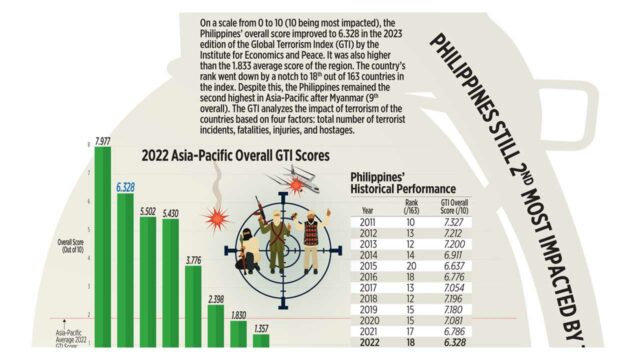
Philippines still 2nd most impacted by terrorism in Asia-Pacific

On a scale from 0 to 10 (10 being most impacted), the Philippines’ overall score improved to 6.328 in the 2023 edition of the Global Terrorism Index (GTI) by the Institute for Economics and Peace. It was also higher than the 1.833 average score of the region. The country’s rank went down by a notch to 18th out of 163 countries in the index. Despite this, the Philippines remained the second highest in Asia-Pacific after Myanmar (9th overall). The GTI analyzes the impact of terrorism of the countries based on four factors: total number of terrorist incidents, fatalities, injuries, and hostages.

Philippines still 2<sup>nd</sup> most impacted by terrorism in Asia-Pacific

Ballet dancers in sensor suits: new research explores how dance is used as a form of communication

KAZUO OTA/UNSPLASH

AUDIO guides, maps, traditional and interactive texts help people attending art exhibitions to understand the works in front of them. With dance, however, the audience’s understanding is usually taken for granted.

It’s assumed they will make sense of a performance thanks to the synopsis included in programs, or reviews published in newspapers and magazines. These supporting materials are optional and do not work during performance. However, the English National Ballet (ENB), for example, has produced versions of classical ballets for young audiences where dancers perform a shortened version of a well-known classical ballet while a narrator recites the story.

But words cannot translate everything dance expresses. Verbal and movement-based communication can convey similar meanings, but they do so in very different ways. Whereas verbal language is immediately understood, the language of dance can be lost to a general audience.

So how can dance performances become a more accessible source of cultural and social information for people who are not specialists?

Our research group focuses on Kinesemiotics, the study of meaning made by movement, an area we are developing. Our project, called The Knesemiotic Body, is carried out at Loughborough University in collaboration with researchers at the University of Bremen and the ENB.

The Functional Grammar of Dance (FGD) explains how body parts create meaning by interacting with the space and the people surrounding dancers in a performance. We used it to annotate and interpret data collected from live dance rehearsals.

The FGD draws on linguistics and semiotic theories (how people communicate through signs) and is based on “projections.” Projections are the trajectories designed by dancers when extending their body parts towards meaningful portions of the performance space.

Projections connect extended body parts to surrounding people or objects, creating a meaningful visual interaction. Imagine a dancer moving towards a lake, painted on the backdrop of a stage. They extend an arm forward towards the lake and a leg backwards towards a stage prop representing a shed. That extended arm will mean “going to lake” while the leg will mean “coming from shed.”

Projections can also be directed to the audience creating an “involving” effect. This is achieved, for example, when a dancer extends their arms towards the audience while facing them with their face and torso. This looks as if they are addressing them directly, acknowledging their presence and breaking the invisible wall between them.

Projections are like speech bubbles made by movement. Our research captured them through sensor suits that dancers wear during our data collection and we decoded them using the FGD. When we annotate the data produced by the suits, we basically fill those speech bubbles with meaning that people can understand without having background knowledge of dance. Our recordings and annotations capture not only movements, but also the intended meaning behind them.

During our sessions, we worked with two pairs of fantastic dancers: Junor Souza and Rebecca Blenkinsop from the ENB, and school graduates Elizabeth Riley and Jamie Constance.

We have achieved interesting results. By annotating choreography with our system, it is possible to discover patterns of movement-based communication. These patterns may not be immediately visible to the naked eye, but clearly inform the message the audience perceives.

We also found out that it is possible to study how movement patterns work in relation to costumes, which is especially interesting when choreographers experiment with innovative clothing and props.

For example, we worked on the effects of movement combined with elastic cloth that covered a dancer’s body almost entirely. This highlighted how a particular type of costume choice would impact on the expressive potential of movement.

Our data also highlighted how dancers playing the same role can create different versions of the same character according to variations they make in performing projections. For example, one dancer might decide to engage more with the audience than another by performing more projections that directly address the viewers.

We can also check how a dancer manages physical balance during a performance in relation to these projections, which is particularly clear in their legwork and footwork. This type of information can be particularly helpful for physical rehabilitation.

An injury can deeply affect a dancer’s or an athlete’s ability to manage body balance and our annotation highlighted the specific choices a dancer makes when managing it. The information provided by our data annotation can therefore provide valuable information on how a dancer works towards recovery.

In future our work will look at whether specific projections can help audiences with different degrees of familiarity with dance to engage with a dance performance more easily. — The Conversation via Reuters Connect

Arianna Maiorani is a Reader in Linguistics and Multimodality at Loughborough University while Chun Liu is a Research Associate at Loughborough University. Maiorani receives funding from AHRC.

Working to stop TB

A total of 1.6 million people died from tuberculosis (TB) in 2021. TB is the 13th leading cause of death worldwide and the second leading infectious killer after COVID-19, according to the World Health Organization (WHO).

March 24 is World Tuberculosis Day, with the theme “Yes, we can end TB.” This year’s World TB Day celebration aims to inspire hope and encourage high-level leadership, increased investments, faster uptake of new WHO recommendations, adoption of innovations, accelerated action and multisectoral collaboration to combat the TB epidemic.

The spotlight will be on urging countries to ramp up progress in the lead-up to the 2023 United Nations high-level meeting on TB. WHO will also issue a call to action, with partners urging member states to accelerate the rollout of the new WHO-recommended shorter all-oral treatment regimens for drug-resistant TB.

The Philippines is among the 30 high TB burden countries, which in 2021 accounted for 87% of new TB cases worldwide. Our country has the highest TB incidence rate in Asia, with 650 cases for every 100,000 Filipinos, according to the WHO Global TB Report 2022. The National Tuberculosis Control Program of the Department of Health (DoH) works closely with all stakeholders — National Government agencies, public and private sectors, nongovernmental organizations, professional societies, academe, patient groups, civil societies and development partners — in the country’s fight against TB.

TB is caused by bacteria (mycobacterium tuberculosis) that most often affect the lungs. It is spread from person to person through the air. TB mostly affects adults in their most productive years. However, all age groups are at risk.

Over 80% of cases and deaths are in low- and middle-income countries, the WHO said. Common symptoms of active lung TB are cough with sputum and blood at times, chest pains, weakness, weight loss, fever and night sweats.

It is to be emphasized that TB is preventable and curable where there are innovations, systems and resources in place to support its diagnosis and treatment.

The WHO recommends the use of rapid molecular diagnostic tests as the initial diagnostic test in all persons with signs and symptoms of TB.

Drug-susceptible TB disease is treated with a standard four-month or six-month course of four antimicrobial drugs that are provided with support to the patient by a health worker or trained treatment supporter. Without such support, treatment adherence is more difficult. Since 2000, about 74 million lives were saved through TB diagnosis and treatment, the WHO said.

However, challenges such as long treatment regimes, latent TB, stigma associated with the disease, difficulties administering drugs and the increase of multi-drug resistant TB has also made the disease difficult to eliminate.

The global health community recognizes that vulnerable people, especially those in lower middle-income countries, require more support and attention to effectively tackle TB. In 2018, the UN high-level meeting on TB made a call to action for enhanced multisector collaboration, resulting in the adoption of a political declaration to end TB.

The private sector is a key stakeholder supporting the WHO and global advocacy efforts to accelerate social and political action to end TB, including a multi-pronged approach from the biopharmaceutical industry. For instance, the industry is helping countries build capacity, develop manufacturing partnerships and create pooled procurement mechanisms. Beyond traditional models of care to tackle TB, the industry also focuses on including behavior change interventions to increase adherence to medicines and appropriate use of therapies to prevent the acceleration of drug resistance.

The biopharmaceutical industry is also working to develop treatments that act more rapidly, are effective at stopping the spread of the disease, are safe to use in conjunction with HIV treatments and prevent and treat latent TB — the biggest killer among people with HIV.

Partnerships have also been central to developing these novel treatments that give patients simpler, shorter treatment options and have the potential to transform access to treatment for vulnerable populations. The Global Health Progress developed by the International Federation of Pharmaceutical Manufacturers and Associations is an interactive hub highlighting collaborations between the biopharmaceutical industry and partners to help stop TB in its tracks.


Teodoro B. Padilla is the executive director of the Pharmaceutical and Healthcare Association of the Philippines, which represents the biopharmaceutical medicine and vaccine industry in the country. Its members are in the forefront of research and development efforts for COVID-19 and other diseases that affect Filipinos.

Robinsons Land extends share buyback program

LISTED property developer Robinsons Land Corp. has earmarked another P3 billion as it extends its share buyback program to reach a total of P9 billion, it said on Tuesday.

The company said in a stock exchange disclosure that the objectives of the program’s extension remain the same — similar to its term set on November 2021 and November 2022.

The share buyback program was initially set in 2021, earmarking an initial value of P3 billion for the company’s common shares. It was extended in 2022 with an additional P3 billion.

The corporation has already bought back 238,134,600 common shares valued at about P4.07 billion of the total P6 billion initially earmarked before the extension.

“The objectives of the share buyback program are to enhance the shareholder value and to manifest confidence in the Corporation’s value and prospects through the repurchase of the commons shares of the Company,” Robinsons Land said.

Robinsons Lands said that the share buyback program will not involve any active and widespread solicitation from stockholders and will be implemented in the open market through the Philippine Stock Market.

“The share buyback program shall commence upon approval by the Board and shall end upon utilization of the above-mentioned amount, or as may otherwise be determined by the Board,” the company said.

On the local bourse on Tuesday, RLC shares rose by P0.48 or 3.58% to close at P13.88 each. — Adrian H. Halili

HSBC Wealth set to launch new investment, insurance products

HSBC PHILIPPINES’ wealth management arm has been met with positive reception since its launch last year and is set to introduce new products, even with monetary authorities continuing to raise benchmark interest rates, officials said on Tuesday.

“We’ve been very pleased with the way our proposition has been received by the market. As we speak, we are adding more products to the shelf — both investment and insurance products,” HSBC Philippines President and Chief Executive Officer Sandeep Uppal said at a briefing.

HSBC Wealth, incorporated as HSBC Investment and Insurance Brokerage Philippines, Inc., was launched in August 2022 and is targeted mainly towards the country’s affluent citizens.

Mr. Uppal attributed the positive reception to HSBC Wealth to the company’s “holistic” approach towards customers, where products offered are made based on their personal needs instead of simply offering ready-made solutions.

He added that time deposits, both peso- and dollar-denominated, have become attractive for investors due to rising interest rates.

“What we find is that on an average basis, people are still wanting to see how they can enhance their yield on their portfolio,” Mr. Uppal said.

“From a regional standpoint, one big trend has been that as interest rates have gone up, people are deploying more in fixed deposits or time deposits. So, keeping your money in a bank account [gives] you a return, unlike in the past perhaps when it didn’t,” Surendra Rosha, group executive of HSBC Group and co-chief executive of HSBC Asia-Pacific, said.

“There is a bit of caution in investing into more risky asset classes,” he added.

The Bangko Sentral ng Pilipinas has increased borrowing costs by 400 basis points since May 2022 as it seeks to bring down elevated inflation.

MORE COMPANIES EXPANDING
Meanwhile, Mr. Rosha said more local companies are looking to expand overseas now.

“We are seeing interest from companies that have that experience set in the Philippines that they can put to use elsewhere. That’s something that we see not just in the Philippines, but see it in other emerging markets as well,” he said.

“Perhaps 25 years ago, you’d think that an emerging market corporate would largely remain within its own borders, but increasingly there are opportunities to take the scale and experience it and use that elsewhere. We do see that and we’re helping a few companies in that as they expand outside in the Philippines,” he added.

Mr. Uppal noted that most companies looking to expand are involved in retail, infrastructure and renewable energy.

“Traditionally, a lot of it is consumption. They’re…Philippine brands who know how to handle consumer goods or retailing. In fact, some have acquired reasonable-sized businesses,” he added. — AMCS

UP scientists celebrate art and science as tools for healing and growth

SANGHARSH LOHAKARE/UNSPLASH

WITH the struggles and changes brought on by the COVID-19 pandemic still fresh in their minds, scientists from the University of the Philippines – Diliman College of Science (UPD-CS) came together last February to look back on the things that helped them move above and beyond the bleakness of the times. Not surprisingly, art was a common denominator.

On Feb. 24, UPD-CS’ free public webinar entitled “Intersections: How scientists use art to explore the world” featured speakers who told their personal stories to an audience of hundreds of people, many of whom were still reeling from years of lockdowns.

The panel consisted of the Institute of Biology’s (IB) Dr. Joyce Ibana, who paints flower art and children’s art to advocate for health and Dr. Erika Marie Bascos, who started painting during the pandemic as a form of therapy; Institute of Chemistry’s Dr. Hiyas Junio, who explores natural dyes through chemistry; and the Institute of Environmental Science and Meteorology’s Dr. Benjamin Vallejo Jr., who writes prose and poetry on natural history.

SYNERGISM
Dr. Ibana shared her journey in the realms of science, art, and innovation.

“My journey in science is relatively straightforward, unlike art which I find more chaotic and uncertain. There are many unknowns and human factors [in art], but this is when I was more in touch with my humanity.”

She said innovation is a continuous iteration and prototyping process to improve things.

As a young girl, Dr. Ibana used to tag along with her parents, both educators in Daet, Camarines Norte. Seeing the chemicals and glassware in the school’s chemistry laboratory inspired her to become a chemist, which she proudly announced, to everyone’s surprise, during her graduation from Preparatory school. Even though she continued studying to become a scientist, her love for drawing and art remained in her blood, as she always illustrated models to explain her research.

Dr. Ibana’s study on Chlamydia trachomatis was used as the issue cover of the American journal Infection and Immunity, which she considered a significant milestone in her long journey as a scientist.

“What did you get out of this?” her mother asked her one day. “It was the most difficult question I’ve been asked in my whole journey as a scientist,” Dr. Ibana said. “My mother’s question prompted me to accept the invitation from the University of the Philippines to come home in 2013. Here, I found the joy of service in helping other younger generations of scientists realize their dream of becoming a scientist.”

The continuous pursuit of her research on Chlamydia trachomatis in the Philippines led Dr. Ibana to feel a strong desire to communicate the impact of science to humanity better. She painted flowers to express that Chlamydia is not a flower but a disease that can affect women and children. Some of her flower paintings were also included by an entrepreneur in one of their products. Dr. Ibana was fascinated with her ability to have something to give to the local industry.

“In science, our impact is based on citations. One of my most cited papers has 178 citations in about seven years. But when this one [the art featured in products] happened, you give joy to many people, to 500 people [buyers of the products] in just three months. It’s very fascinating how art can impact people in a very small way,” Dr. Ibana said.

During the pandemic, Dr. Ibana created flower paintings and children’s art to highlight the importance of holistic health. She created art featuring COVID-19 and immunology and art that narrates the challenges of being a Filipino scientist.

In her training as a university innovation fellow, Dr. Ibana learned that putting science and innovation together solves real-world problems. Adding art to the mix communicates the science behind the innovation and promotes the innovation to the world. “Putting the realms of art, science, and innovation together in a nurturing and enabling environment, I hypothesize, is what allows us to make a better social impact.”

CHEMISTRY AND COLORS
Dr. Junio’s extensive research on chemistry and natural dyes was a timely response to the surge in demand for natural dyes and textiles in the Philippines. In collaboration with the Philippine Textile Research Institute (PTRI), she assesses the quality of the natural indigo dyes produced from the Philippine indigo (Indigofera tinctoria). “Dyes from the Indigofera tinctoria are all considered indigo, but they actually have different colors. Some are pink, purple, or yellow. But it has something to do with the chemistry when they produce the dye.”

According to Dr. Junio, the molecules of the indigo dye undergo different chemical processes that result in various indigo components, such as indigotin (the blue component), indirubin (the red component), and isoindigo (the yellow-orange component). When mixed, these components would form different shades of indigo. “We wanted to ensure that the ones [indigo] produced by the local community have a higher indigotin content than the indirubin and the isoindigo,” she added.

Dr. Junio’s research analyzes small molecules from different sources, such as marine and plant extracts. The extractions they use for natural dyes follow the procedure suggested by PTRI’s handbook. “The molecule is broken down into pieces, and from those pieces, we can identify the particular structure of the molecule by using a reference library,” she explained.

Her research on natural indigo dyes will help standardize the indigo dyes sold in the country. This will give the Philippines a competitive edge and the capability to sell indigo dye powders outside the country for economic gain.

Aside from natural indigo dyes, Dr. Junio also researched producing dyes from other endemic Philippine plants, such as katmon (Dillenia philipinensis), mabolo (Diospyros discolor), Mindanao gum tree (Eucalyptus deglupta), makopa (Syzygium samarangense), and makopang-kalabaw (Syzygium malaccense).

Dr. Junio and her team plan to give natural dyes to the UP College of Fine Arts which the college can use for its artwork.

HEALING USING BOTANICAL ART
Despite being constantly surrounded by botanical drawings through her Rafflesia research and by instructing students to draw plant specimens, Dr. Bascos had no experience herself with painting and the arts.

It all changed when her daughters asked her to paint with them during the pandemic. Her youngest daughter asked her to paint flowers. Dr. Bascos then posted her paintings on social media. She received a lot of positive feedback, which motivated her to continue. Eventually, Dr. Bascos fell in love with painting as it helped her deal with anxiety and depression.

“Painting gave me an hour of peace per day and it’s nice to know that even a chaotic mind is still capable of creating something pretty,” Dr. Bascos said. “I didn’t really care if what I was doing was right or not, the technique or whatsoever, I just painted all my anxieties away.”

At some point, people started asking her if they could buy or commission a particular artwork, but Dr. Bascos was having a lot of self-doubt about her painting skills. Then, she met Bing Famoso, founder of the Philippine Botanical Art Society and the Philippine Fauna Art Society. Ms. Famoso, who uses acrylic paint as her medium, asked her to teach her how to paint using watercolor. “Imagine, it’s the founder of all these art societies asking me if I could teach her how to paint using watercolor, and I felt validated. After talking with Ma’am Bing, I was confident to accept commissions or even sell my paintings,” Dr. Bascos said.

After a year of painting, Dr. Bascos joined an online botanical art exhibition hosted by the Philippine Botanical Art Society with her portrait of the Medinilla magnifica.

Even though Dr. Bascos studies the Raflessia species, it is a flower she hasn’t tried painting yet. “I’m super intimidated by the Raflessia. I’m so scared that my painting will look like donuts.”

She advises people who want to try painting to just go for it. “Don’t be scared to try something different. I was in my mid-30s when I started painting. You’re never too old to try or learn something new,” she said. “If you want to go into botanical art, I suggest you use the actual plant specimen instead of photos because I feel that the colors are better if you see them in person.”

LIFE THROUGH LITERATURE
“One way to make [science] come alive is to put them in words,” said Dr. Vallejo as he showed a photo of a Sally Lightfoot crab, one of the species Nobel laureate John Steinbeck, Jr. described in his travelogue, The Log from the Sea of Cortez. Dr. Vallejo opined that the environment provides material for writing prose; writers of natural history manuals even try to put their scientific observations into lyrical prose.

“This is the point about the arts, the humanities, and the sciences,” he explained. “They are ways of gaining knowledge about the world. Their approaches are rather different, but the impetus to do so is more or less the same.”

Dr. Vallejo also mentioned the works of marine biologist and writer Rachel Carson, whose books, such as Silent Spring, influenced the global environmental movement. “We need science to improve, but the impetus to commit to improvement may be found in humanities with sciences in it,” he concluded.

The full video recording of “Intersections: How scientists use art to explore the world” can be found at: https://youtu.be/HcfuRM_OyWs


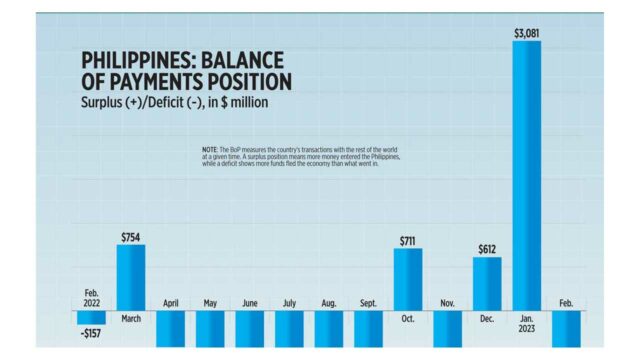
Philippines: Balance of payments position

DOLLAR OUTFLOWS rose in February, driving the balance of payments (BoP) position to its biggest deficit in five months, on the back of foreign loan payments and a wider trade gap, the Bangko Sentral ng Pilipinas (BSP) said. Read the full story.

Philippines: Balance of payments

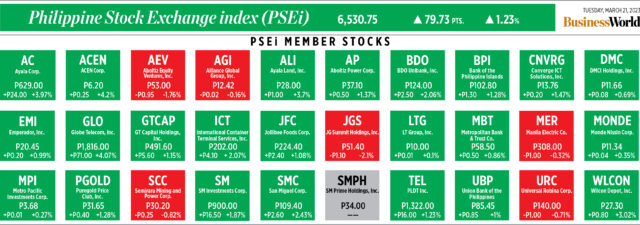
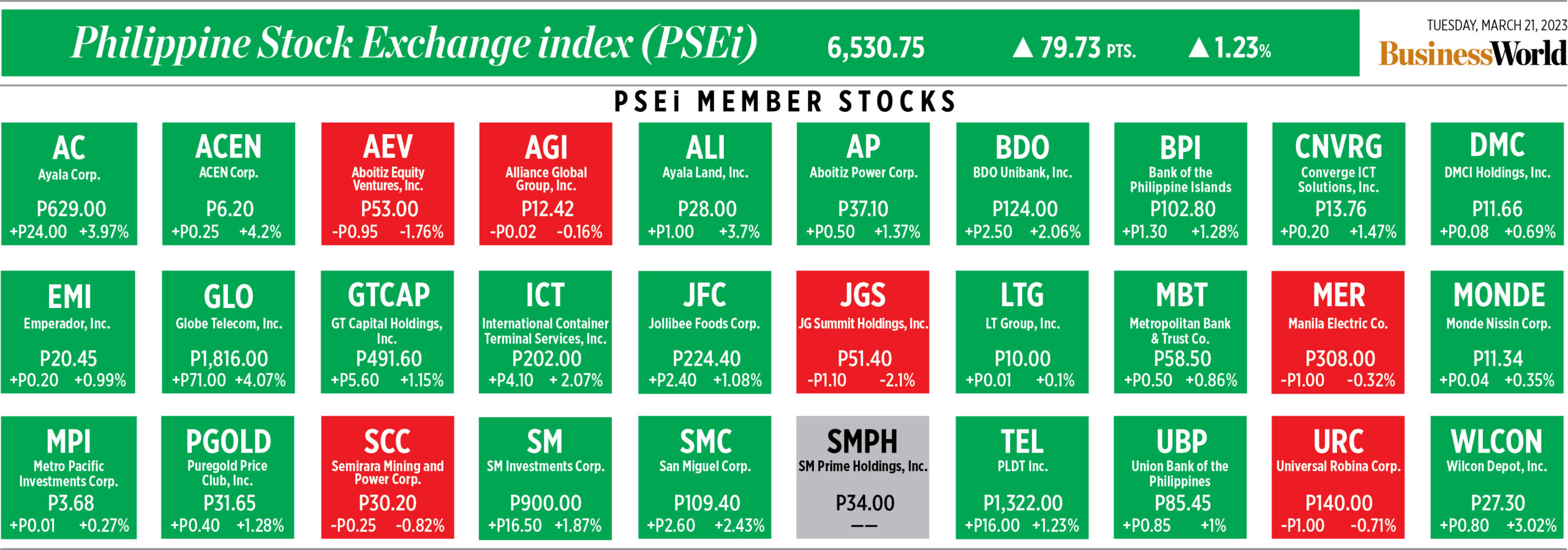
How PSEi member stocks performed — March 21, 2023

Here’s a quick glance at how PSEi stocks fared on Tuesday, March 21, 2023.


Adam Sandler honored with Kennedy Center’s Mark Twain Prize

ADAM SANDLER received the Kennedy Center’s Mark Twain Prize for American Humor. —TWITTER/THE KENNEDY CENTER

WASHINGTON —  Actor and comedian Adam Sandler became the 24th recipient of the Kennedy Center’s Mark Twain Prize for American Humor on Sunday, at an evening event featuring stars Jennifer Aniston, Chris Rock, and Conan O’Brien to celebrate his comedy and career.

Mr. Sandler, whose movies include Spanglish, The Wedding Singer, and The Waterboy, was celebrated for his comedic chops that, while not always winning the hearts of critics, have won over fans and generated billions of dollars.

Dressed uncharacteristically in business attire instead of his trademark shorts and T-shirt, Sandler, 56, said he thought his suit was baggy.

“I don’t know if this suit fits me or not, I just threw it on … for the second time,” he told reporters on the red carpet ahead of the show.

“But everything else … the honor itself, never thought about this in my entire life, never expected anything like this.”

Comedian Dana Carvey referred to Mr. Sandler’s longevity. “No one’s had a career like this,” Mr. Carvey told reporters ahead of the show. “Who’s lasted this long? He’s beloved.”

Mr. Sandler’s friends and acting partners, along with his mother and his wife, took to the Kennedy Center stage to gently rib the actor and highlight his development as a stand-up comic, movie actor, and singer.

“You’re making a terrible, terrible mistake,” comedian Mr. O’Brien quipped at the top of the show to the Kennedy Center for selecting Mr. Sandler, a former Saturday Night Live star.

Mr. Sandler’s mother, Judy, made light of his wardrobe preferences. “I say he’s a slob,” she said in her own quasi- comedy routine, before praising her son. “We are so proud of him.”

Comedian David Spade expressed mock awe at Mr. Sandler’s box office success. “Four billion dollars in movies, with this much talent!” Mr. Spade said, with a hand gesture that suggested a minute amount.

Ms. Aniston, who appeared with Mr. Sandler in films such as Just Go with It and Netflix’s Murder Mystery, praised her co-star. “Adam Sandler, you have no equal,” she said.

With the White House a short distance from the Kennedy Center, some presenters touched on politics.

Mr. Carvey did impressions of President Joseph R. Biden and former President Donald Trump, and comedian Chris Rock mentioned potential criminal charges against the Republican leader.

“Are you guys really going to arrest Trump?” Mr. Rock asked. “This is only going to make him more popular!”

Mr. Rock, who was slapped on stage at the Oscars in 2022 by actor Will Smith, also referred to Paul Pelosi, the husband of former House Speaker Nancy Pelosi, who was attacked by an intruder in their San Francisco home last year.

“Paul Pelosi —  only guy that knows how I felt,” Mr. Rock said, as the Pelosis sat in the audience.

Mr. Sandler joins the ranks of other comedians who have received the Mark Twain Prize, including Jon Stewart, Dave Chappelle, Julia Louis-Dreyfus, David Letterman, Carol Burnett, Eddie Murphy, and Ellen DeGeneres.

The prize is named after novelist and essayist Samuel Clemens, better known by his pen name, Mark Twain. The show will air on CNN on March 26. — Reuters

Peso climbs vs dollar on easing concerns over banking sector

BW FILE PHOTO

THE PESO strengthened to an over one-month high against the dollar on Tuesday as banking sector concerns eased and expectations of a dovish move from the Philippine central bank.

The local currency closed at P54.44 versus the dollar on Tuesday, appreciating by 23.50 centavos from Monday’s P54.675 finish, data from the Bankers Association of the Philippines’ website showed.

This is its best finish since Feb. 10, when it closed at P54.42 against the dollar.

The peso traded stronger against the dollar the entire day, opening Tuesday’s session at P54.30 per dollar. It climbed to as high as P54.26, while its worst showing for the day was at just P54.48 versus the greenback.

Dollars traded climbed to $1.077 billion on Tuesday from the $861.05 million recorded on Monday.

“The peso appreciated mainly due to easing investor concerns on the global financial sector,” a trader said in an e-mail.

The dollar steadied in a holiday-thinned Asia session on Tuesday, though it struggled to lift far from five-week lows as traders reckoned banking stress would keep the US Federal Reserve from hiking rates much further, or at all, later in the week, Reuters reported.

The greenback ticked about 0.1% higher to $1.0712 per euro and advanced a bit further on the Australian and New Zealand dollars. It held at 131.24 yen, just above a five-week low at 130.55.

The US dollar index rose by 0.06% to 103.40.

News of UBS’ planned takeover of rival Credit Suisse on Sunday — a shotgun merger engineered by Swiss authorities — gave cause for some relief that the most urgent risks were in hand.

The peso was also supported by dovish comments from Finance Secretary Benjamin E. Diokno, Rizal Commercial Banking Corp. Chief Economist Michael L. Ricafort said in a Viber message.

The Bangko Sentral ng Pilipinas may consider a smaller 25-basis-point (bp) rate hike or even pause its tightening cycle at its meeting on Thursday amid heightened global uncertainties, Mr. Diokno, a member of the central bank’s policy-setting Monetary Board, said on Monday.

The Monetary Board raised its benchmark interest rate by 50 bps for a second straight meeting last month, bringing the key rate to 6%.

The BSP has hiked rates by a total of 400 bps since May 2022.

For Wednesday, the trader said the peso could continue its climb against the dollar on expectations of a smaller rate hike from the Fed.

The trader expects the peso to trade between P54.35 and P54.55, while Mr. Ricafort sees it moving from P54.30 to P54.50 per dollar. — AMCS with Reuters

Shares rise on expectations of smaller rate hikes

BW FILE PHOTO

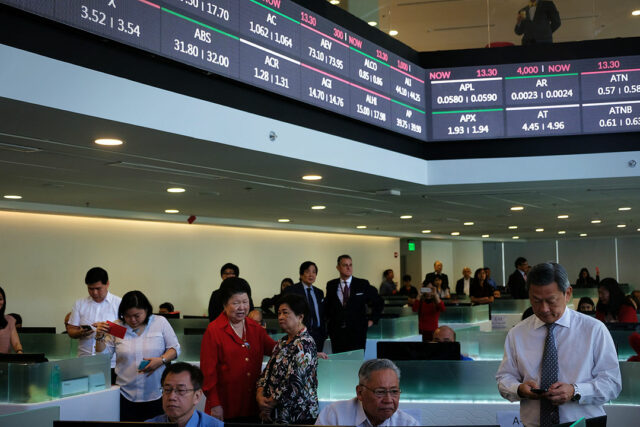
STOCKS closed in the green on Tuesday as market sentiment improved on easing worries over the banking sector and expectations of smaller rate hikes from central banks in the Philippines and in the United States.

The benchmark Philippine Stock Exchange index (PSEi) increased by 79.73 points or 1.23% to close at 6,530.75 on Tuesday, while the broader all shares index rose by 36.84 points or 1.06% to end at 3,493.50.

“Local shares bounced back on Tuesday, taking cues from US equities that rebounded overnight as markets calmed down days after fears of financial stress… Investors are pinning hopes that the current banking crisis fades and the world evades an economic downturn,” said Papa Securities Corp. Equities Strategist Manny P. Cruz said in a Viber message.

US stocks jumped on Monday after a deal to rescue Credit Suisse and central bank efforts to bolster confidence in the financial system relieved investors, while participants also weighed the likelihood of a pause in rate hikes from the US Federal Reserve this week, Reuters reported.

The Dow Jones Industrial Average rose by 382.60 points or 1.2% to 32,244.58; the S&P 500 gained 34.93 points or 0.89% to end at 3,951.57; and the Nasdaq Composite added 45.02 points or 0.39% to close at 11,675.54.

“Philippine shares managed to climb above the 6,500 level in the green after a forced takeover of Credit Suisse by UBS, which was engineered by the Swiss government… Investors now expect a slower pace of tightening from the Fed in light of the banking crisis,” Regina Capital Corp. Head of Sales Luis A. Limlingan said in a Viber message.

“Back home, investors remain optimistic ahead of the MB’s (Monetary Board) policy meeting on March 23. Finance Secretary Benjamin E. Diokno said recent global developments may prompt central banks all over the world to slow the pace of rate hikes. Thus, he said the only options are to hike by 25 basis points or to keep rates unchanged on Thursday,” Mr. Limlingan added.

The Fed will hold its second policy meeting for the year on March 21-22, while the Bangko Sentral ng Pilipinas’ review is on March 23.

All sectoral indices closed higher on Tuesday. Services climbed by 30.50 points or 1.95% to 1,591.99; mining and oil increased by 153.91 points or 1.46% to 10,667.15; financials went up by 23.01 points or 1.3% to 1,787.79; property rose by 31.85 points or 1.16% to 2,763.33; holding firms gained 67.35 points or 1.06% to end at 6,368.45; and industrials added 67.26 points or 0.71% to close at 9,417.17.

Value turnover dropped to P4.78 billion on Tuesday with 545.92 million shares changing hands from the P5.63 billion with 714.81 million issues traded on Monday.

Advancers outnumbered decliners, 109 versus 69, while 43 names closed unchanged.

Net foreign selling stood at P33.74 million on Tuesday versus the net buying worth P89.62 million seen on Monday. — A.H. Halili with Reuters

ADVERTISEMENT
ADVERTISEMENT