Home Blog Page 5061

NG debt inches up to P13.6T as of end-Nov.

A Philippines peso note is seen in this picture illustration on June 2, 2017. — REUTERS

By Luisa Maria Jacinta C. Jocson, Reporter

THE NATIONAL Government’s (NG) outstanding debt inched up to another record high of P13.644 trillion as of end-November, the Bureau of the Treasury (BTr) said on Tuesday.

In a statement, the BTr said the end-November debt was only up by 0.02% or P3.15 billion from the end-October level of P13.641 trillion, “primarily due to the effect of local currency appreciation against the US dollar on foreign currency loans.”

National Government outstanding debtYear on year, the debt stock rose by 14.35% from P11.93 trillion.

The NG debt also jumped by 16.33% from the P11.73 trillion seen at end-December 2021.

At end-November, almost three-fourths or 69.1% of the total outstanding debt came from domestic borrowings while the rest was sourced from foreign creditors.

Domestic debt increased by 11.69% to P9.43 trillion from P8.44 trillion a year ago. Month on month, it inched up by 0.78% from the P9.36 trillion in October.

“For November, the net issuance of government securities added P75.76 billion while peso appreciation trimmed P3.03 billion from the debt stock,” the BTr said.

The peso continued to strengthen against the US dollar in November. It hit a record-low close of P59 per dollar on Oct. 17.

As of end-November, the local currency appreciated by 2.5% to P56.598 against the dollar from the P58.047 at end-October, based on figures from the BTr.

Year to date, domestic debt climbed by 15.39% from P8.17 trillion at end-December 2021.

The government prefers to borrow from domestic sources in order to mitigate foreign currency risk.

Meanwhile, external debt jumped by 20.8% to P4.22 trillion at end-November from P3.49 trillion in the previous year. However, it was lower by 1.62% from the P4.29 trillion recorded at end-October.

The BTr said this was due to the P106.98-billion impact of local currency appreciation and P13.38-billion net repayment.

“This was tempered by the net impact of third-currency fluctuations against the US dollar amounting to P50.78 billion,” it added.

Broken down, external debt consisted of P1.87 trillion in loans and P2.35 trillion in global bonds.

Year to date, external debt jumped by 18.49% from the P3.56 trillion seen as of end-December 2021.

The NG’s overall guaranteed obligations went up by 0.38% to P388 billion from P386.53 billion in the previous month. Year on year, it dropped by 7.14%.

“For November, the higher level of guaranteed debt was due to the net availment of domestic guarantees amounting to P1.03 billion and the net effect of currency fluctuations that increased the value of external guarantees by P0.44 billion,” the BTr added.

UnionBank of the Philippines, Inc. Chief Economist Ruben Carlo O. Asuncion said that NG debt may rise if the peso does not depreciate further.

“This current debt stock is already higher than expected and we may see a softer fiscal stimulus as the 2022 fiscal year ends,” he added in a Viber message.

In December alone, the peso strengthened by 0.8% or P0.465 when it closed at P55.755 on Dec. 29 from its finish of P56.22 on Dec. 1.

“It’s primarily due to movements in currency, putting us at a disadvantage. This will tend to decline as the peso starts to appreciate relative to the dollar. As far as I know, we did not incur any other significant borrowings,” John Paolo R. Rivera, an economist at the Asian Institute of Management added in a Viber message.

The government’s debt as a share to the gross domestic product (GDP) stood at 63.7% at end-September. This is still above the 60% threshold prescribed by multilateral lenders.

According to the recently released Philippine Development Plan (PDP), the government aims to bring the debt-to-GDP ratio to 60-62% in 2023, 57-61% in 2024, and to 56-59% in 2025.

Rizal Commercial Banking Corp. Chief Economist Michael L. Ricafort said that the government should intensify revenue collections and tax administration, as well as adopt a more disciplined spending to address the high debt level.

“New taxes and higher tax rates need to be fair, equitable, and progressive, especially targeted to those that can afford them or those from the higher income brackets or at least prevent adding burden to the poor, most vulnerable sectors, and those hit hard by the pandemic,” he said in a Viber message.

Mr. Ricafort added that outstanding National Government debt could still go up, especially if government borrowings are frontloaded again in the early part of 2023 to finance the budget deficit.

In the 11 months to November, the budget deficit shrank by 7.2% to P1.24 trillion.

IMF says carbon pricing may raise $7-B revenues

MOTORISTS drive along the Antipolo Sumulong highway amid thick haze in this June 29, 2021 file photo. — PHILIPPINE STAR / MICHAEL VARCAS

THE IMPLEMENTATION of carbon pricing in the Philippines could raise around $7 billion in revenues by 2030, the International Monetary Fund (IMF) said.

In a report, the IMF said the Philippines will need to implement carbon pricing to achieve a “substantial reduction in emissions.”

The Philippines has committed to reducing its greenhouse gas emissions by 75% by 2030 under the Paris Climate Change agreement.

Ideally, carbon pricing would be the centerpiece of the Philippines’ mitigation strategy, as it promotes reduced energy use and a shift towards cleaner energy sources, the IMF said.

The Philippines could start at $20 per ton in 2023, and increase $4.30 a year to hit $50 per ton by 2030, it added.

“The policy could either represent a carbon tax, which would add a charge in proportion to carbon content to existing fuel excises and apply similar carbon charges to other fuels. Or it could represent an ETS (emissions trading system) which is imposed on top of existing fuel taxes, encompassing firms in the power and industry sectors and suppliers of fuels for other sectors,” the IMF said.

“A $50 (around P2,800) carbon price (per ton) could potentially raise revenues of 1.05% of GDP ($7 billion) in 2030 (accounting for the base erosion of pre-existing fuel taxes). About 44% and 37% of the revenue would come from new charges on road fuels and coal respectively,” it added.

At this carbon price, the IMF said carbon dioxide emissions would be reduced to 144 million tons or 13% below the baseline levels, with half of the reductions coming from the power sector.

“Indeed, the reform would raise the renewable share in electricity generation to more than 40% in 2030 — well above the authorities’ current target of 30% and the current renewable share of 21%,” it added.

Between 2023 and 2030, the IMF said this policy could potentially save 10,400 fatalities from exposure to local air pollution. About half of the averted death rate are Filipinos over 65 years old.

“Overall, carbon taxes have significant practical, environmental, and economic advantages due to ease of administration, price certainty which promotes investment, the potential to raise significant revenues, and coverage of broader emissions sources,” it added.

Earlier, Finance Secretary Benjamin E. Diokno said the government is currently conducting a carbon tax feasibility study.

A carbon tax is a type of carbon pricing for businesses that emit carbon dioxide, with the proceeds helping support greenhouse gas mitigation projects while forcing companies to address their own emissions to minimize their tax exposure.

“The carbon tax would impose a modest economic cost on the Philippines, equivalent to about 0.2% of GDP in 2030 but half of these costs would be offset by domestic environmental co-benefits,” the IMF said.

These economic costs consist of mitigation expenses, or mainly the annualized costs of using more expensive technologies rather than fossil-based machineries.

However, 87% of the domestic environmental co-benefits reflect lower local air pollution deaths and a 13% reduction in traffic congestion and accident externalities.

The IMF also said a $50 carbon price would have the most impact on coal and natural gas prices and moderately affect prices for electricity and road fuels.

The IMF recommended that a balance between carbon pricing and other instruments should help enhance an effective and politically acceptable mitigation strategy.

The government should also use carbon pricing revenues to boost the economy, such as lowering taxes on work effort or funding socially productive investments, and ensure that benefits are distributed across households.

“Reforms should also be phased in progressively to give households and firms time to adjust. Recent increases in fossil fuel prices, while likely transitory in nature, are at least to some extent another reminder of the need for low-carbon energy transition to shield the economy from recurrent fuel price shocks, but they also underscore the importance of a comprehensive and inclusive approach to reform to protect the vulnerable and gain social and political support,” the IMF said.

In a report from the Organisation for Economic Co-operation and Development (OECD), 52.4% of greenhouse gas (GHG) emissions in the Philippines are subjected to a positive Net Effective Carbon Rate (ECR) in 2021, unchanged since 2018.

Although the country does not use an explicit carbon price, fuel excise taxes covered 52.4% of emissions in 2021. There were no fossil fuel subsidies in 2021, although they covered 7.9% of emissions in 2018, the OECD said. — Keisha B. Ta-asan

Companies are going green. Now customers have to follow their lead.

PHOTO FROM THE PODIUM FACEBOOK PAGE

By Joseph L. Garcia, Reporter

WITH CLIMATE CHANGE and pollution changing the planet as we speak, it has become an imperative for people to change the way they live and consume.

Companies that provide these goods and services have adopted more conscious efforts to help preserve the planet. As an example, global beauty conglomerate L’Oreal has reported a 24% reduction in carbon emissions linked to the transport of products in their 2013-2020 Sustainability Commitment Closing Report.   

In an interview, L’Oreal Philippines Country Managing Director Yannick Raynaud said a launch was once delayed after products had to be shipped over sea, instead of through air freight as part of efforts to reduce the company’s carbon emissions. “It’s really significantly higher in terms of CO2 emissions,” said Ms. Raynaud of air freight. 

On a smaller scale, L’Oreal Philippines has committed to using zero plastic in their packaging for orders shipped through online shopping platforms Shopee and Lazada, and through social network Tiktok. “We fight against plastic,” she said in an interview on Dec. 9.   

To show their seriousness in the matter, she noted the new packaging from skincare brand La Roche Posay uses carton on the outside, with a thin layer of plastic on the inside. The product’s cap has been redesigned to use less plastic. Over at Kiehl’s, she said that some products are sold as refills so customers can reuse their containers.

“It’s a benefit for the planet, but also for your wallet. It’s less expensive. It’s a win-win, right?”

L’Oreal has since committed to using 100% biobased ingredients for their formulas by 2030. According to the company’s 2021 Annual Report, L’Oreal said it has already achieved 94% of this goal.   

The company committed to rejecting animal testing in 1989, 14 years before regulations against the practice came to pass. “The foray of L’Oreal into sustainability started more than 15 years ago, when it was not really in fashion,” Ms. Raynaud added.

More than the products themselves, the company has also adopted more sustainable measures internally. Ms. Raynaud said that she refused two carpet samples when they were changing carpets at the office, since the samples shown to her were not up-cyclable nor recyclable.

“It’s a mantra for everything we do: in our products, in our brand, but also in how we act,” she said.

SM TURNS OVER A GREEN LEAF
Meanwhile, the country’s biggest mall operator SM Prime Holdings, Inc., under SM Investments Corp., has also turned over a green leaf.   

Early in 2022, they released a line called SM Green Finds, which showed off products made with renewable materials. This was presented at SM Retail, Inc.’s new headquarters which features green facilities such as energy-saving glass, centralized air, lighting automation, and water recycling capabilities.

According to the Annual Integrated Report of SM Prime Holdings, the company has saved 8.8 billion liters of water through recycling and rain-catching, and reduced its overall carbon footprint by 14% in 2021.   

“Sustainability as a business strategy is no longer an option, but an imperative business decision,” Hans T. Sy, SM Prime executive committee chairman, was quoted as saying in the report.

CHANGING CONSUMERS’ PRACTICES
New businesses are taking up the same stance and showing that sustainability has become a new imperative in order to operate. One such company is Evegrocer, which offers home products and groceries delivered in reusable packaging. 

Ma. Leonelle de Leon-Sandoval started the business in 2019 with co-founder Czarlene de Leon. Evegrocer works by repacking goods like soap and food staples like rice into reusable containers. The online store gives discounts when customers return the packaging on the next order.

“The rewards system encourages customers to return the reusable packaging,” said Ms. De Leon-Sandoval in an e-mail. 

Evegrocer’s distribution network covers Metro Manila, Laguna, Cavite, Bulacan, Pampanga, and Cebu. In Cebu, Ms. De Leon-Sandoval said the store encourages customers to bring their own containers, “which is a simpler model.”

Of course, while businesses may attempt to change their ways to better suit the planet, the rest are still dependent on consumer behavior. “We’re looking at how we can reduce our footprint, but also educate the consumer,” Ms. Raynaud said.

With the current crop of Gen Z consumers (those born after 1996), Ms. Raynaud has little problem. “If you’re Gen Z today, you’re like, ‘Darn, my parents didn’t do good. My grandparents are leaving me a world that is in disarray.’ 

“Gen Z’s are influencing the use of products, but then they’re influencing behaviors as well. Waste is something that Gen Z is more conscious (of) than maybe their parents.”

In the case of Evegrocer, Ms. De Leon-Sandoval noted that it’s easier for her to run a business, with the resources available to them. “The technological advancement and access to information has made the operations possible,” she said. 

“The magnitude of the impact is somewhat dependent on the customer behavior change,” she said, adding that the returned container rate, despite the incentivization, comes up to only 18.5%.

WHY IS IT IMPORTANT?
For people like Ms. De Leon-Sandoval, the reasons for protecting the planet are personal.

“Me and my co-founder Czarlene… are very anxious over the devastating effects of climate change to the future generation, considering all our kids are asthmatic,” she said. “Putting sustainability in trend is the best way to secure the future of the next generation. We retire with a peace of mind that we have contributed something, paying forward to the world that has nurtured us, with breathable air, healthy food and drinkable water.” 

Surprisingly, despite differences in scale, a message of family rings true for both companies. Ms. Raynaud says, “We have the duty of legacy. You can’t just live (for) today. You have to be accountable for the world we are leaving to our children.”   

Speaking of scale, Ms. Raynaud noted the global impact of L’Oreal, and how changing behaviors across the board can help in activating change. By her count, L’Oreal had 85,000 employees across the globe, and approximately one billion customers.

“If you look at this, it is a powerful force. If we are able to communicate, to educate at the mass level, this is probably more power than many countries (have). At the end of the day, with one billion… together with other makers, it is our duty to do that.”

DDMP REIT targets new tenants from more sectors

DDMP REIT, Inc. (DDMPR) is looking to diversify its tenant mix in the next three years as it banks on its properties’ prime location and new locators, which include government offices.

“As new industries come, it is an opportune time for DDMPR to further diversify its tenancy mix across various industries,” the listed real estate investment trust sponsored by DoubleDragon Properties Corp. said in its three-year investment strategy.

The target tenants include those coming from the banking, insurance, financial services, technology, media, and service sectors as well as government agencies.

Among the company’s investment objectives is to achieve sustainable growth in distribution and returns through contracted escalation rates, cost-efficient operation, and augmented growth through acquisitions.

DDMPR will stick to giving long-term fixed rent contracts with its major tenants, which can provide the company with a stable income. Typical office lease terms will be fixed for three to 10 years.

Meanwhile, it aims to achieve organic growth through rental escalations, which will be in the range of 3-5% from contracted leases. The company said it is focusing on merits in terms of cash flow returns, stability, and the potential for long-term capital appreciation.

In its three-year investment strategy, the company’s occupancy rate has been placed at 92.55%, with the occupancy rate of its DoubleDragon Center East at 100%. Its three properties have a total of 172,252 square meters of total gross leasable area (GLA). It also has retail components in DD Meridian Park.

In 2023, the company expects the lease of 35.89% of its total GLA to expire, while in 2024 and 2025, up to 17.6% and 9.42% of leased areas are expected to expire, respectively.

As of Sept. 30, 2022, the company paid a total of P3.2 billion in dividends since its listing. It will pay an additional P482.21 million on Jan. 9 from last year’s third-quarter earnings.

On the stock exchange on Tuesday, shares in DDMPR closed unchanged at P1.29 apiece. — Justine Irish D. Tabile

MREIT eyes 500,000-sq.m. leasable area by end-2024

MREIT, Inc. is planning to increase its gross leasable area (GLA) to 500,000 square meters (sq.m.) by the end of next year, the real estate investment trust (REIT) of property developer Megaworld Corp. said.

The listed company is currently waiting for the conclusion of its latest property-for-share swap, which will expand its portfolio to 325,000 sq.m. The deal, announced in April 2022, will bring an additional four prime properties worth P5.3 billion.

Once done, the company expects this to cement MREIT’s presence in the Fort Bonifacio area, which it said could command one of the highest rental rates in the country. The company is also looking to expand to other high-growth geographic areas such as Cebu, Bacolod, and Pampanga.

MREIT’s operating statistics for nine months through Sept. 30, 2022 show a total GLA of 280,175 sq.m., while it leased a total of 266,965 sq.m.

The company achieved a 95% occupancy rate with total rents amounting to P2.05 billion, with its office segment accounting for 251,701 sq.m. of the total leased area.

“Diversification plans include investment in other types of real estate properties, to include industrial, logistics, warehouse, and other real property sectors that meet the company’s investment criteria,” MREIT said.

Properties that the company will be infusing into its portfolio must be Grade A, centrally located, stably occupied, and income producing.

In its three-year investment strategy, the company is aiming to achieve an annual total shareholder return of at least 10% through organic growth and acquisitions.

The unannualized total return since its initial public offering as of Nov. 29, 2022 was a negative 21.9%, while the dividend yield at share price as of the same date was 8.3%.

The listing price of MREIT was P16.10 apiece. Its share closed at P11.84 on Nov. 29, 2022.

On Tuesday, shares in MREIT declined by 24 centavos or 1.66% to P14.24 apiece. — Justine Irish D. Tabile

Prime Infra unit forms advisory council for Malampaya programs

PRIME Infrastructure Capital, Inc. has formed an advisory council and tapped technical experts for the exploration and development programs of the offshore Malampaya gas-to-power project.

Prime Infra through its subsidiary Prime Energy Resources Development B.V. said the new council will provide strategic and technical advice to extend the gas supply of the Malampaya gas field.

“The new advisory council will provide strategic advice and technical guidance to support me and the Board in this critical time when the company’s exploration and development programs are about to commence to prolong the gas supply, which is becoming increasingly scarce,” said Prime Energy General Manager Sebastian C. Quiniones, Jr. in a media release on Tuesday.

Mr. Quiniones said the board will also craft necessary measures and coordinate with authorities for the implementation of its plan.

Prime Energy holds a 45% stake in the Malampaya project, with UC38 LLC and state-led PNOC Exploration Corp. (PNOC-EC) holding 45% and 10%, respectively. They are the contractors for Service Contract 38, their agreement with the government covering the deepwater project off Palawan island.

Prime Energy said the Malampaya consortium and the Department of Energy (DoE) had agreed to the creation of the advisory council as the Malampaya gas field is expected to be depleted by 2027. It said that by 2025 to 2026, “gas exports will reach near technical minimum before new gas can be sourced.”

Prime Energy said the members of the advisory panel will include Cesar A. Buenaventura, an independent director at Pilipinas Shell Petroleum Corp., and Jose C. Ibazeta, a director of Prime Metro Power Holdings Corp. who served as president and chief executive officer of Power Assets and Liabilities Management Corp. and DoE secretary from January to May 2010.

Rufino B. Bomasang, former president and chief executive of PNOC-EC, will also be part of the council together with Antoine Bliek, former Shell project manager for the Malampaya project’s second and third phases, and Jose Jerome R.  Pascual III, former Shell Philippines Exploration B.V. finance director.

Prime Energy gave its assurance that it is “well equipped” to execute projects and extract gas from the reservoirs in the Malampaya project.

“The Prime Infra group supports Prime Energy in other areas such as project financing, supply chain and logistics, human resources, and government and external relations,” it said, adding that its energy portfolio is aligned with the government’s goal of energy security.

The Malampaya project supplies about 20% of the country’s total power requirements and 27% of the Luzon grid. Five power plants with a combined capacity of 3,453 megawatts are currently supplied by its natural gas.

The Malampaya concession agreement is set to expire next year. Prime Infra earlier said that it would seek necessary measures to extend the contract.

Last month, the DoE announced that the Malampaya project is scheduled for maintenance shutdown between Feb. 4 and 18. — Ashley Erika O. Jose

When children’s dresses and suits are an artist’s canvas

A LONG dress decorated with painted doll-like faces and detailed with ribbons, and suits sporting faces of popular cartoons are some of the creations of fashion designer Robbie Santos and artist Migs Villanueva. The clothes are custom-made items for pre-teen children.

In “A Day at the Atelier” fashion show-exhibit, pieces from Vares Jeune, Mr. Santos’ couture line for kids, serve as wearable canvases for artist Ms. Villanueva’s paintings.

This is Mr. Santos’ second collaboration with an artist. His Voyageur fashion show featured Mr. Santos’ Septieme Rebelle collection which used Juvenal Sansó’s archival textile prints. This time Art Lounge Manila brought Santos and visual artist Villanueva together.

“I was asked by the gallery if I wanted to collaborate with Robbie. I reacted very excitedly about that because I’ve always wanted to do something like this ever since, but I didn’t have idea who to partner with. When the opportunity came, I said ‘yes’ right away,” Ms. Villanueva told BusinessWorld in an interview via Zoom.

The artist and fashion designer had attended Mr. Santos’ Sanso print fashion show in June last year at the Art Lounge Molito.

“During that event, I was fortunate to have met Migs for the first time. I was asked if I would be willing to collaborate with Migs for a project,” Mr. Santos said in the same online interview.

A COLLABORATIVE CREATIVE PROCESS
The collaboration began in July 2022. The project was initially meant for a display exhibit featuring 16 looks with dresses, shirts, and suits for children. It later evolved to include a fashion show in September.

“Vares Jeune is bespoke luxury. It is a reflection of the child’s parents’ taste that would prompt him or her to wear the label. I advocate fashion that is beautiful and durable, a stark contrast to today’s fast fashion,” Mr. Santos said of the brand. “I love seeing kids in wonderful outfits, whether dressy or casual, while at the same time being their usual precocious selves.”

A three-time Palanca Award winner who ventured into the visual arts under Mauro “Malang” Santos’ tutelage, Ms. Villanueva’s works are recognizable with her signature depiction of children’s faces using only three dots for the eyes and mouth.

Ms. Villanueva said that the challenge with working on clothes rather than flat canvas is fitting the image to its shape.

“The canvas is treated before you paint on it so that the paint will adhere to the canvas very well. But in the case of [clothing] fabric, there is no medium on top of the fabric. It’s harder to paint and you have to follow the shape of the dress, unlike the square or rectangle in a canvas,” she said.

“To make it easier for the artist to paint on the dress, I made a lot of A-line silhouettes. If I were to make something like a circle skirt, then the artist requested to send the dress in pieces and not assembled,” Mr. Santos said.

Mr. Santos added that the process of creativity for a designer is different than that of an artist.

“How an artist creates is very organic,” he said. “So, she has a general idea in mind, but it depends on where that moment takes her until the development of idea becomes organic. Ito yung naisip niya sa una, pero ’yung ending iba na (She may have an idea at first, but the end is very different).”

For designers, limitations include the surface of the body, and the model’s height. Embellishments such as embroidery and beadwork are done afterwards.

“The suits are fabulous on their own. They are so well-made and it’s so scary to draw on them,” said Ms. Villaneuva of the boy’s clothes. “So, there’s an emotional difficulty for me to tamper with the clothes,” she admitted. “I tried to make the designs as simple as I can.”

“I was so happy and I’m very impressed with the way the dresses were made. It is my first collab[oration] with a designer,” she added. “It’s a very fulfilling experience.”

The exhibit and fashion show were held in December at Art Lounge Manila Molito in Alabang. The gallery is currently accepting commissioned works on Vares Jeune pieces with paintings by Ms. Villanueva. Measurements of the client will be taken, and the fabric will be sent to the artist to paint.

“Even after the exhibit has [closed], the gallery is still there to represent me the artist and to represent me for the collaboration,” Mr. Santos said.

Orders and inquiries about the collection can be made via @varesjeune on Instagram or contact 0917-814-2675. Michelle Anne P. Soliman

Arts & Culture (01/04/23)


Wander Manila opens tours for January

WANDER Manila will hold a crash course on the history of the Walled City and of Manila on Jan. 7, 9 a.m., using the historical sites of Intramuros as backdrop. To join, register at https://forms.gle/i6fQn3G2psQU8KLb9. Experience Intramuros through a darker lens in “One Night in Intramuros” on Jan. 14, 5 p.m. Hear stories of jealousy and murder, of violence and massacres committed within the storied walls of Intramuros. To register, visit https://forms.gle/vKZP8RBds2Y6gm38A. Both tours will last for two and a half hours. For more information, visit https://www.facebook.com/WanderManila/.


CCP Met Opera Live presents La Fille Du Régiment

THE CULTURAL Center of the Philippines (CCP) Met Opera in HD kicks off the New Year with the special screening of Italian composer Gaetano Donizetti’s La Fille Du Régiment on Jan. 10, 5:30 p.m., at Greenbelt 3, Ayala Malls Cinemas in Makati City. The Metropolitan Opera production features Bel canto stars Pretty Yende and Javier Camarena, baritone Maurizio Muraro, and mezzo-soprano Stephanie Blythe. La Fille Du Régiment is an opera in two acts conducted by Enrique Mazzola. It’s the story of an adopted daughter of the 21st Regiment of the French army, named Marie, who falls in love with Tonio, a boy who saved her life in spite of him being from the nation’s enemy. Their plans of getting married are shattered as Marie’s true identity is revealed. Instead, Marie’s mother wishes her to marry another. Catch how Tonio fights for his love and rescues Marie from the chaotic situation. Now on its 7th season, the CCP Met Opera in HD is a special program of the Cultural Center of the Philippines’ Film, Broadcast and New Media Division, Production and Exhibition Department, in partnership with the Metropolitan Opera of New York, the Filipinas Opera Society Foundation, Inc. and Ayala Malls Cinemas. The series showcases operatic productions through the high-definition digital video technology and Dolby sound, recreating the experience of watching an opera production at the Met “live.” Visit www.culturalcenter.gov.ph and follow the official CCP social media accounts on Facebook, Twitter, and Instagram for the latest updates.


MSO mounts anniversary concert

THE MANILA Symphony Orchestra (MSO) marks its 97th anniversary on Jan. 22, 8 p.m., at the Samsung Performing Arts Theater in Circuit Makati by performing some of the world most popular arias and overtures together with some of the country’s top opera stars. The Opera Gala 2023: The MSO 97th Anniversary Concert features performances by Bianca Camille Aguila, Ivan Niccolo Nery, Byeong In Park, and Rachelle Gerodias. For tickets, visit https://premier.ticketworld.com.ph/shows/show.aspx?sh=MSOPERAG23.


MCAD holds online exhibit ‘Tropical Climate Forensics’

DEREK Tumala, a trans-disciplinary artist based in Manila, presents “Tropical Climate Forensics,” an online project supported by the British Council’s Creative Commissions for Climate Action accessible through MCAD’s website and directly at porensiko.ph. This virtual exhibition, which aims to explore the climate crisis through history and its impending reality, is presented through a web application similar to that of a video game. Mr. Tumala’s project draws inspiration from his residency at the Manila Observatory. During his stay at the observatory, he gathered historical data from the meteorological and seismographic archives, and met with meteorologists from PAGASA to further understand current and future forecasts on the climate crisis. This project is also a part of the World Weather Network, an organization of 28 arts agencies globally, formed in response to issues in climate change. “Tropical Climate Forensics” can be accessed through MCAD’s official website, www.mcadmanila.org.ph, or porensiko.ph until July 22.


The Sound of Music tickets go on sale

TICKETS to Broadway International Group’s production of Rodgers and Hammerstein’s The Sound of Music go on sale today at ticketworld.com.ph. The touring production is led by Jill Christine-Wiley as Maria Rainer, Trevor Martin as Captain von Trapp, with Daniel Fullerton as Rolf, Lauren Kidwell as Mother Abbess, Joshua La Force as Max, Lauren O’Brien as Liesl, and Annie Sherman as Elsa. The musical features music by Richard Rodgers, lyrics by Oscar Hammerstein II, and book by Howard Lindsay and Russel Crouse, suggested by The Von Trapp Family Singers by Maria Augusta Trapp. The sound of music is presented in special arrangement with Concord Theatricals, NETWorks Presentations and Broadway Asia Company. For more information, visit www.broadwayasia.com.   


Ang Huling El Bimbo The Musical returns

FULL House Theater Company will bring back Ang Huling El Bimbo The Musical at the Newport Performing Arts Theater in April. Directed and choreographed by Dexter M. Santos, with a book by Dingdong Novenario, and musical arrangements by Myke Salomon, the production will include additional scenes and dialogue by Floy Quintos. Tickets will soon be available at all TicketWorld and SM Tickets outlets with prices ranging from P1,079 to P3,776. For inquiries and early bird offers and bulk ticket purchases, contact the following sales representatives: Girah Manaligod at 0917-872-8309; Jimmy Iglesias at 0917-872-8734, and Pie Olalde at 0917-872-8765. For more information, visit www.facebook.com/fullhousetheater


Benilde’s Romançon are inter-collegiate dance champions

THE AWARD-WINNING Saint Benilde Romançon Dance Company (SBRDC) was hailed as the champion of the recently concluded Campus Dance Drive 4: Love More, an inter-collegiate competition which provided a venue for Filipino movers to showcase their skills to the community. Established in 2017, the concert serves as a stage to share their mutual passion for the craft and as an inspiration to students and the youth. This was their first onstage tourney after the COVID-19 pandemic. Under the guidance and mentorship of their coach, music producer and Aftermath Creative Director and Head Choreographer Josh Vidamo, the 21-member crew exhibited a performance designed to mark a new era for the group. The participants from 15 other schools in the College Division were APC Dance Company (Asia Pacific College), UA&P Squadra Dance Varsity (University of Asia and the Pacific), PNU Balingsasayaw (Philippine Normal University), FEU-IAS Dance Troupe (Far Eastern University Manila), Grayhawks Dance Crew (Technological University of the Philippines), LPU Wildstyle Crew (Lyceum of the Philippines University) and Artist Connection Exude Dancers (FEU Institute of Technology). Also in the line-up were BPC Dagyaw (Bulacan Polytechnic College), PATTS Dance Company (PATTS College of Aeronautics), Siena Dance Troupe (Siena College Tigaon), Track 1 Tanauan Institute Dance Nation (Tanauan Institute, Inc.), Team Genesis (Jesus is the Lord Colleges Foundation, Inc.), Datamex Dance Alliance (Datamex College of Saint Adeline), Dr. Yanga’s Dance Alliance (Dr. Yanga’s Colleges, Inc.) and PLV Dance Company (Pamantasan ng Lungsod ng Valenzuela). The event was organized by MNLPH Events, a producer dance tourney such as the Philippine Dance Cup, Dance Nation Philippines, Isuzu Danz Max Championship, Groove: Search for Best Campus Crew by SM Supermalls, Illumination Dance Party and Samyang K-Street Dance Battle. The Campus Dance Drive 4: Love More concert was conducted at the Tanghalang Pasigueño in Pasig City. Part of the proceeds will be shared with non-profit organization Tondo Youth Pataas Community Care Foundation to help support the educational needs of the scholars. For more information about SBRDC, visit https://www.facebook.com/romancondanceco.benilde.

Petron gets regulatory nod on biofuels business

PETRON CORP. has secured regulatory approval on its planned biofuels venture, the company announced on Tuesday.

In a regulatory filing, Petron said the Securities and Exchange Commission (SEC) approved an amendment to the company’s articles of incorporation that will allow it to construct and operate a coco-methyl ester plant and secure relevant permits for the project.

Petron said the SEC approval will amend the company’s primary purpose under its second article of incorporation, which will allow the inclusion of biofuels in its business.

The company said the amendment will allow it to “acquire, store, hold, transport, use, experiment with, market, distribute, exchange, sell and otherwise dispose of, import, export, handle, trade, and generally deal in, refine, treat, reduce, distill, manufacture, produce, and smelt, as applicable, any and all kinds of petroleum and petroleum products, oil, gas and other volatile substances.”

In August, Petron got the approval of its board of directors to include biofuels in the company’s portfolio, while its stockholders, representing 75.93% of the total outstanding capital stock of the company, approved the proposed amendment in October.

Petron is the operator of the only remaining refinery in the country that provides 40% of local petroleum requirements. Its refinery in Bataan produces 180,000 barrels per day.

It also has about 50 terminals and around 2,700 service stations where it sells gasoline and diesel. Its combined refining capacity is 268,000 barrels a day, producing fuels and petrochemicals.

At the local bourse on Tuesday, shares in the company closed 1.25% lower or P2.37 apiece. — Ashley Erika O. Jose

Cebu Pacific takes its ninth A320neo

CEBU PACIFIC

CEBU PACIFIC received its ninth Airbus 320neo (new engine option) aircraft on Jan. 1 as part of the airline’s fleet modernization and sustainability plans.

In a statement on Tuesday, the budget carrier said that the delivery is the first of 10 expected brand-new Airbus NEO deliveries for 2023. Other planned deliveries include A320neo, A321neo, and A330neo aircraft.

According to Cebu Pacific, the newly delivered aircraft used sustainable aviation fuel heading to the Ninoy Aquino International Airport in Manila from the Airbus Hamburg facility in Germany.

“This sustainable aviation fuel (SAF)-powered aircraft delivery supports our sustainability strategy in shifting to a more fuel-efficient NEO fleet by 2028. We will continue prioritizing our sustainability journey as we maintain our position as the greenest airline in Asia,” Cebu Pacific Chief Strategy Officer Alex B. Reyes said.

Cebu Pacific said that SAF is a drop-in fuel, which is an interchangeable replacement for fossil fuels.

“It does not require any adaptations to the aircraft or engines and does not have any negative impact on performance or maintenance. The use of SAF results in an up to 80% reduction in carbon emissions across the SAF lifecycle,” the airline said.

With the new delivery, Cebu Pacific’s fleet consists of 21 A320ceo, nine A320neo, seven A321ceo, 10 A321neo, four A330ceo, four A330neo, 14 ATR 72-600, six ATR 72-500 and two ATR Freighters.

“Cebu Pacific’s sustainability goal is in line with global aviation’s commitment to achieve net zero carbon emissions by 2050. The airline has made various investments that enable it to become fuel-efficient in its operations to keep fares affordable for the passengers,” the airline said.

“Apart from fleet modernization, the airline’s major pillars on its sustainable journey are resource optimization, which includes pushing for fuel efficiency best practices; and utilizing SAF by launching green routes by 2025,” it added. — Revin Mikhael D. Ochave

Lovely local lullabies for the little ones

A SCENE from Milo Tolentino’s Hele

TAKING care of children can be very challenging to parents or babysitters, especially when lulling them to sleep. Singing to them might be just the solution.

Crooning “Rock-A-Bye-Baby,” “Twinkle Twinkle Little Star” or any popular English nursery rhyme to pacify an infant is one thing, but how about singing a lullaby in a Tagalog, Visayan or Mindanaoan language? It was a calming experience for the audience to hear such lullabies at the recent launch of Himig Himbing: Mga Heleng Atin (CCP Indigenous Lullabies) at the Cultural Center of the Philippines (CCP).

A project of the CCP Arts Education Department through its Audience Development Division, Himig Himbing featured eight music videos of lullabies from different regions of the country. The project is aimed at reintroducing the indigenous lullabies to contemporary audiences and developing nurturers who are grounded in Philippine songs and heles.

The music videos were developed based on the research of ethnomusicologist Sol Trinidad and arranged by musical director Krina Cayabyab. Eight filmmakers, namely Sigrid Bernardo, Alvin Yapan, Carla Ocampo, Teng Mangansakan, Milo Tolentino, Mes De Guzman, Thop Nazareno, and Law Fajardo, created their respective film interpretations of the featured lullabies.

The videos are of the songs “Sa Ugoy ng Duyan,” a Tagalog lullaby composed by National Artist for Music Lucio San Pedro with lyrics by National Artist for Music and Literature Levi Celerio; “Katurog na, Nonoy,” a Bicolano lullaby; “Wiyawi,” a traditional Kalinga lullaby often sung by Cordilleran fathers; “Aba-aba,” a lullaby indigenous to Southern Mindanao, particularly sung by the indigenous group Subanon; “Hele,” a lullaby from a 1986 field recording of Dr. Elena Mirano taken in San Mateo, Rizal; “Dungdungwen Kanto,” translated as “I Will Love You,” the first line of an Ilocano wedding song also often sung as a children’s lullaby; “Tingkatulog,” translated as “Sleeping Time,” a folk lullaby from Bohol; and, “Ili, Ili, Tulog Anay,” translated as “Little One, Go to Sleep,” a Visayan lullaby.

CCP Board Trustee and Vice-Chair Michelle Nikki Junia, who initiated the idea, said: “We want to make sure that we have good research. I requested to take a look at unpopular lullabies, not just the ‘Bahay Kubo’ (Nipa Hut) version, and dig deeper for a representation from various regions as we believe the country is very rich in traditions. We have to embrace and make that known.”

The eight videos integrated folk tales, putting added value to the lullabies as well. “That’s the beauty of it,” Ms. Junia said. “They were very creatively done and in high quality.”

“Most of the lullabies Filipino music teachers would use as available resources are western repertoire,” Ms. Junia, an early childhood music educator, said. “There are more western lullabies while traditional Filipino lullabies are very few. I see that the importance for the mothers, the elders, the caregivers is to be aware and to share our traditional lullabies, especially that we are giving value to developing in the young our own language. We are Filipinos, but sadly, the younger generation now are more eloquent in speaking English than in our own language.”

The CCP also pursued Himig Himbing to promote musical awareness, especially for the young ones in terms of its effect on brain development. “There have been a lot of studies that show that music has positive effects on brain stimulation, even before they are born. That’s why I encourage the moms to already listen and sing to lullabies during pregnancy,” Ms. Junia said. “That’s why it is amazing that when the baby comes out into the real world, and when you play the lullabies you have been listening or singing to when you were pregnant, the babies would respond to it. It’s because they already sense familiarity with what they heard. And this is very important in stimulation, because the way young children would learn successfully in the different stages of their development. All areas of the brain need to be stimulated. Music is actually more attractive to children because it has melody, it has beat, it has rhythm, as compared to just merely talking or speaking, this is how the young ones get attracted to it. This is a step for speech development,” she said.

The videos of Himig Himbing: Mga Heleng Atin can be viewed on the CCP Facebook page.

For more details, check out the CCP website (www.culturalcenter.gov.ph) or follow the official CCP social media accounts on Facebook, Twitter and Instagram.

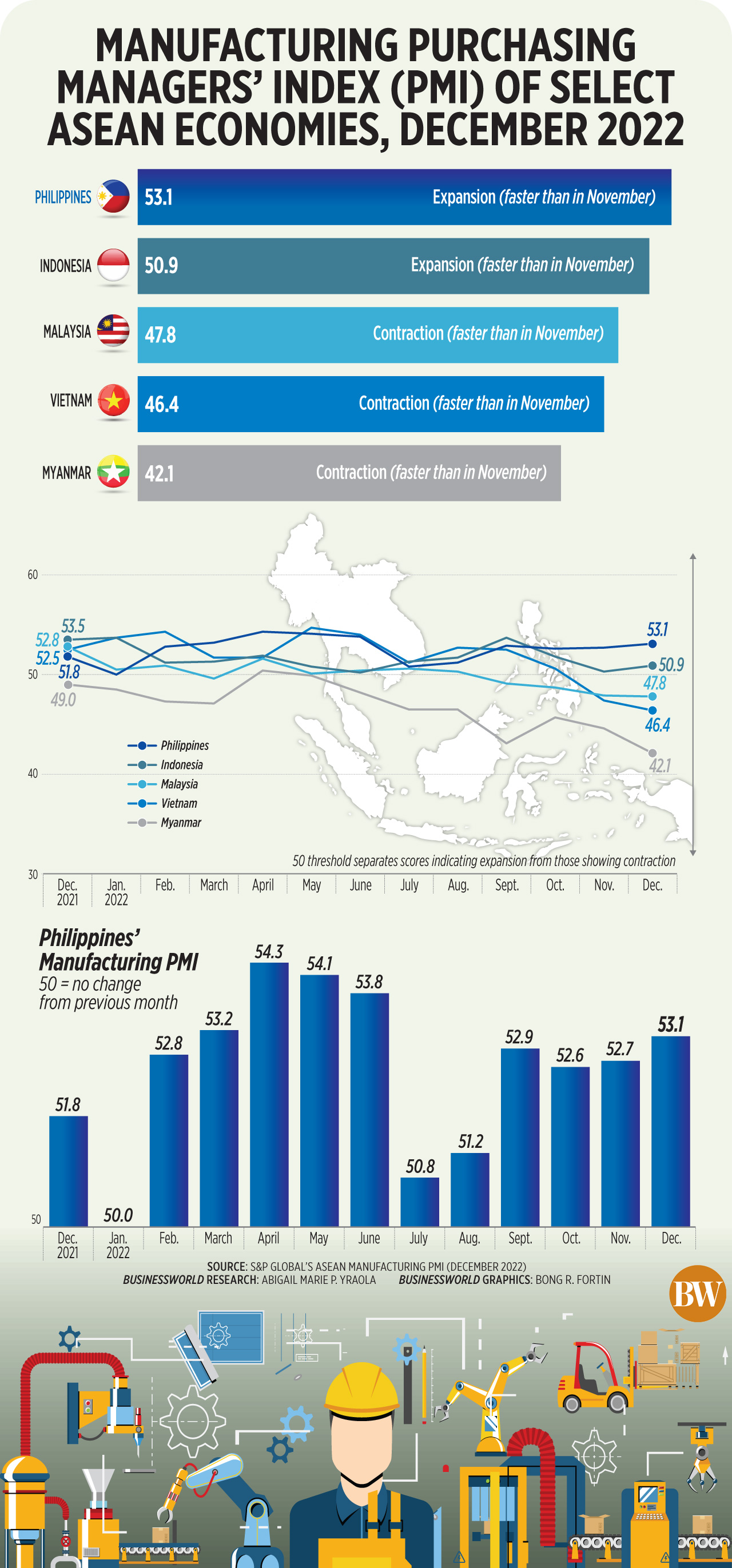
Manufacturing Purchasing Managers’ Index (PMI) of select ASEAN economies, December 2022

FACTORY ACTIVITY in the Philippines continued to expand in December, hitting a six-month high thanks to a rise in production and new orders, a survey by S&P Global showed on Tuesday. Read the full story.

Manufacturing Purchasing Managers’ Index of select ASEAN economies, December 2022