Home Blog Page 5041

Vehicle sales jump 24% in March

Vehicles enter Manila from the South Luzon Expressway. — PHILIPPINE STAR/EDD GUMBAN

NEW VEHICLE SALES rose by an annual 24% in March, fueled by strong consumer demand, an industry group reported.

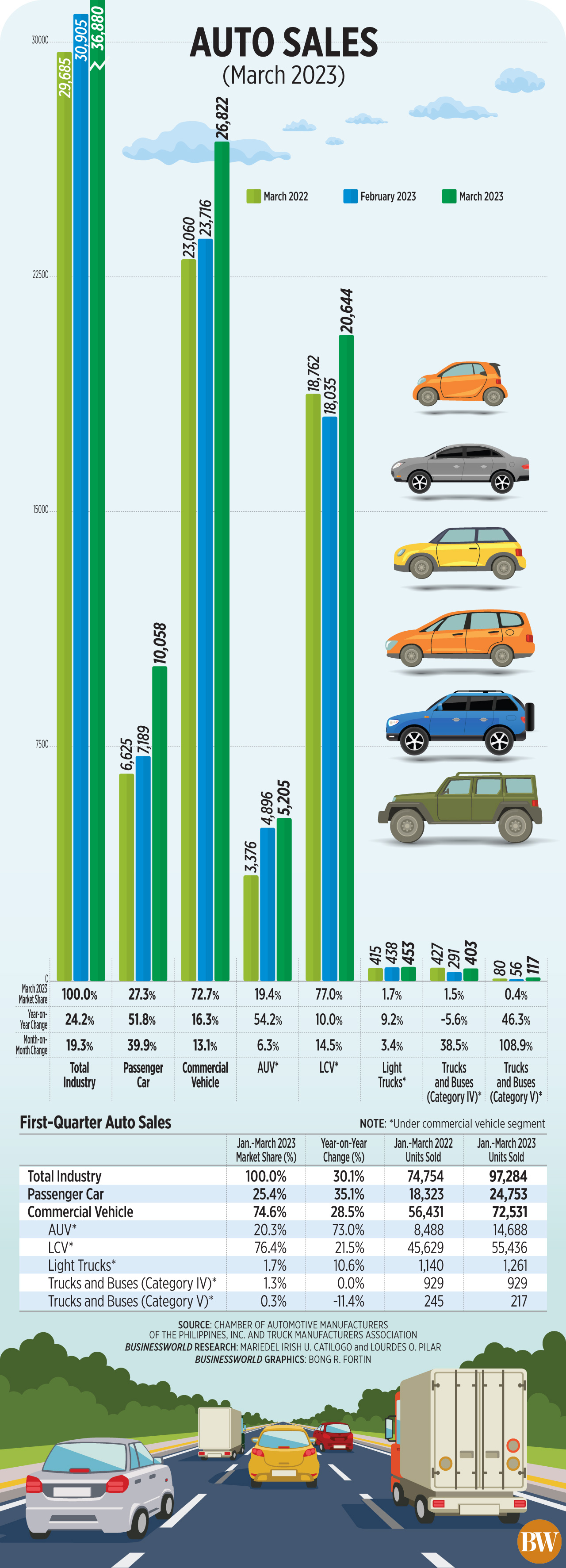
A joint report by the Chamber of Automotive Manufacturers of the Philippines, Inc. (CAMPI) and Truck Manufacturers Association (TMA) showed vehicle sales reached 36,880 units in March, nearly a fourth higher than the 29,685 units sold in the same month a year ago.

Month on month, March vehicle sales increased by 19.3% from the 30,905 units sold in February.

Auto sales“It is worth noting that the March 2023 sales performance is the second-highest monthly performance in this post-pandemic time, after the more than 37,000-unit sales level recorded in December last year,” CAMPI President Rommel R. Gutierrez said in a statement.

In March, 73% of the industry’s total sales came from the commercial vehicle segment.

Commercial vehicle sales rose by 16.3% to 26,822 units in March. Broken down, sales of light commercial vehicles (LCVs) increased by 10% to 20,644, while sales of Asian utility vehicles (AUVs) increased by 54.2% to 5,205. Light truck sales rose by 9.2% to 453.

On the other hand, sales of passenger vehicles surged by 51.8% to 10,058 units. The segment accounted for 27.27% of the month’s overall sales.

For the first quarter, vehicle sales of CAMPI-TMA members jumped by 30% to 97,284 from 74,754 in the same period in 2022.

Commercial vehicle sales increased by 28.5% to 72,531 in the January-to-March period. Sales of LCVs went up by 21.5% to 55,436, while AUV sales climbed by 73% to 14,688 units.

Passenger car sales rose by 35.1% to 24,753 units in the January-to-March period.

Mr. Gutierrez said the auto industry is hopeful consumer demand for new vehicles will continue to increase in the next few months.

“In the same way, favorable economic conditions are also an important driving factor for sustained growth,” he added.

Toyota Motor Philippines Corp. led all manufacturers in terms of sales during the January-to-March period with a 46.47% market share as it sold 45,205 units.

Mitsubishi Motors Philippines Corp. had the second-biggest market share with 18.26% after selling 17,765 units in the first quarter.

Nissan Philippines, Inc. ranked third with a market share of 6.57% (6,396 units sold), followed by Ford Motor Co. Phils, Inc. with a 6.06% market share (5,893 units sold), and Honda Cars Philippines, Inc. with a 4.79% market share (4,661 units sold).

CAMPI-TMA is aiming to sell 395,000 units this year, 12% higher than the 352,596 units sold last year.

The entire local vehicle industry, including sales from the Association of Vehicle Importers and Distributors exclusive members and MG Motors Phils., is targeting 408,300 sales this year, 10.4% higher than the 369,981 units sold in 2022. — Revin Mikhael D. Ochave

BSP sees no need to tap IMF lending programs

Signs for the spring meetings 2023 at the International Monetary Fund in Washington, April 3, 2023. — IMF PHOTO/JOSHUA ROBERTS

By Keisha B. Ta-asan, Reporter

WASHINGTON — There is no need for the Philippines to tap the International Monetary Fund’s (IMF) lending programs, the Bangko Sentral ng Pilipinas (BSP) chief said on Wednesday.   

BSP Governor Felipe M. Medalla said the country needs more official development assistance (ODA) from multilateral lending institutions. 

Asked if there is a need to tap the IMF lending program, he replied: “Right now, I don’t think so.”

“We’re relying very heavily on ODA from the World Bank and ADB (Asian Development Bank), and direct commercial borrowing from abroad,” Mr. Medalla said on the sidelines of the IMF and World Bank spring meetings here.

The IMF provides financial support to countries hit by crises to stabilize their respective economies. Countries often come to the IMF when they have no other lending options.   

The IMF does not lend for specific projects in countries unlike development banks.   

For 2023, the National Government expects to obtain around $19.1 billion worth of ODA — $9.2 billion worth of loans from multilateral development partners and $9.8 billion in loans from bilateral lenders. 

Also, Mr. Medalla said the country needs more capacity development from the IMF on monetary and fiscal operations.

“The last thing our central bank wants to do is to reinvent the wheel. So, we ask what other central banks are doing, how do (they) make monetary policy more effective,” he said.   

Whenever the Philippine central bank is set to do what it has not done before, Mr. Medalla said it is important to look at how other countries responded to the issue and see what exact tools were used.   

The IMF offers capacity development, which includes technical assistance and training, to its members upon request. Capacity development accounts for around a third of the IMF’s annual spending.

In 2021, the Philippines received $2.8 billion worth of Special Drawing Rights (SDRs) from the IMF, as part of the latter’s efforts to help countries recover from the coronavirus pandemic. 

Member countries were allocated SDRs — the fund’s unit of exchange backed by dollars, euros, yen, sterling and yuan — in proportion to their quota shares in the IMF.

The IMF’s last SDR distribution came in 2009 when member countries received $250 billion in SDR reserves to help ease the global financial crisis.

Regulators, banks grapple with risks arising from social media, digitalization

Social media logos are seen in this illustration taken on May 25, 2021. — REUTERS/DADO RUVIC/ILLUSTRATION

REGULATORS and banks in the Philippines need to develop a system on how to immediately respond to issues on social media that may affect public confidence, in order to prevent social media-driven bank runs as seen in the United States, experts said.

Fitch Asia-Pacific Financial Institutions Director Tamma Febrian said that social media has allowed information “to flow at a speed that was unthinkable a decade or two ago,” and has helped lenders market financial products to customers quickly.   

“On the other hand, both social media and digitalization could also increase contagion risks by compounding the effect at which a negative news could have on a bank with seemingly weak fundamentals, as demonstrated by the rapid demise of SVB (Silicon Valley Bank),” Mr. Febrian said in an e-mail interview with BusinessWorld.

The sudden collapse of SVB highlighted the risks arising from social media and digitalization. Last month, social media reports fueled panic among SVB customers, prompting massive withdrawals that ultimately led to the bank’s collapse.

While social media may have played a part in causing the bank runs, Mr. Febrian said the banks’ vulnerabilities and weaknesses ultimately caused their collapse.

“We do not think that the leading Philippine banks that Fitch rates suffer from the same issues that affected these failed institutions, helped by prudential liquidity requirements that BSP has instituted over the years,” he said.

Bangko Sentral ng Pilipinas (BSP) Governor Felipe M. Medalla earlier said Philippine banks have no reported exposure in SVB. He also said Philippine banks are strong and are well-capitalized to weather any risks stemming from the collapse of the two US banks.

“The unexpected failures of two specialized regional banks (SVB and Signature Bank) in the United States in mid-March 2023 and the collapse of confidence in Credit Suisse — a globally significant bank — have roiled financial markets, with bank depositors and investors reevaluating the safety of their holdings and shifting away from institutions and investments perceived as vulnerable,” the International Monetary Fund (IMF) said in its latest World Economic Outlook (WEO).

Meanwhile, Swarup Gupta, industry manager of the Economist Intelligence Unit, said banks in general, including lenders in the US and the Philippines, are not prepared to deal with social media-fueled bank runs.   

“The collapse of Silicon Valley Bank represents the most important cautionary tale of an era characterized by the proliferation of social media on one hand and the ubiquitousness of online banking on the other,” Mr. Gupta said.   

“Both of these phenomena have combined to transform bank runs into veritable bank sprints where deposit withdrawals mount within minutes leading to a quick and complete collapse,” he said.   

In SVB’s case, Mr. Gupta said social media posts on the bank’s troubles were spread by influencers online — some of which were later taken down. In the absence of any response from the bank, panic swirled among depositors.

“Most banks lack a preemptive crisis communications strategy which needs to be employed at the slightest hint of trouble. And most regulators employ an approach which is nearly a century-old which banks on periodic sanity checks, notably stress tests, to ensure that all is well with the banking system,” Mr. Gupta said.   

Contagion risks could spread rapidly in the digital era. He noted this would trigger a domino effect of bank runs even before authorities can help address the issues.   

This is why banks and regulators should closely monitor social media and develop a system to preemptively address any concerns raised on various platforms. There should also be protocols in place to minimize risks before they become a significant threat to the banking system, Mr. Gupta added.

Mr. Febrian said there is a need for banks and regulators to update their crisis scenario playbook.

“Systems and processes are likely to evolve in a way that would allow banks to monitor and respond to issues in real-time manner which could help to stem a loss in confidence during a crisis,” he added. — Keisha B. Ta-asan

Marcos OK’s creation of single operating system for gov’t transactions

PHILIPPINE STAR/ MICHAEL VARCAS

PRESIDENT Ferdinand R. Marcos, Jr. has approved the creation of a single operating system for government transactions, as part of efforts to improve the ease of doing business in the country, the Palace said on Wednesday.

The Presidential Communications Office said officials from the Department of Information and Communications Technology (DICT) and the Anti-Red Tape Authority (ARTA) told the President that they were working on a single system that would streamline the processes and transactions of all government agencies.

During the meeting, Mr. Marcos said the agencies should also consider how the single system would be implemented in local government units (LGUs).

“I think it may help when you’re writing the code or when you’re putting the system together, you’re going to have to think about the differences between the national bureaucracy and the different LGUs,” he said.

Officials from DICT and ARTA told the President they are now looking at the processes of different agencies in order to put them under a single system.

LGUs are also covered by the Ease of Doing Business law, which requires them to set up electronic business one-stop shops.

Mr. Marcos also ordered the DICT and ARTA to help LGUs in adopting simpler business permits and licensing systems in all cities and municipalities.

DICT and ARTA officials said they also plan to implement the system for processes involving migrant workers, maritime personnel, and shipping industries.

The Palace said ARTA also requested the approval of revisions to Executive Order No. 482 issued in 2005, which established a single system processing of trade documents. ARTA said the system needed to be updated in line with the agency’s other digitalization and streamlining initiatives. — J.V.D.Ordoñez

Multilateral banks urged to boost climate investments

Finance Secretary Benjamin E. Diokno speaks at the G24 Finance Ministers and Central Bank Governors Meeting during the 2023 Spring Meetings of the World Bank and International Monetary Fund in Washington, April 11, 2023. — IMF PHOTO/TOM BRENNER

WASHINGTON — Finance Secretary Benjamin E. Diokno on Tuesday called on multilateral development banks (MDBs) to boost climate investments by expanding private sector participation.

In his speech at the 2023 Intergovernmental Group of Twenty-Four (G24) ministerial meeting in Washington D.C., Mr. Diokno said the role of the World Bank (WB) and the International Monetary Fund (IMF) in supporting countries, especially emerging markets, is crucial in addressing multiple global crises.   

“The polycrisis we’re facing threatens to reverse the years of progress we’ve made towards poverty reduction and shared prosperity. Together, we must be decisive in tackling these challenges,” he said.

Mr. Diokno is the First Vice-Chair of the G24 Bureau and the WB Governor for the Philippines. The G24 coordinates the position of developing countries on monetary and development issues in the deliberations of the Bretton Woods institutions such as the World Bank Group (WBG) and the IMF.   

Mr. Diokno identified four areas that need to be addressed — inflation, climate, international tax reform, and ongoing reforms to the Bretton Woods institutions.

He told G24 member countries that the Philippine government has been aggressive in fighting inflation, which remains elevated due to high food and energy prices.

The country’s headline inflation eased for a second time in March to 7.6%, marking the slowest pace of price increase in six months. Inflation averaged 8.3% for the first quarter.

Mr. Diokno also said that countries must urgently respond to the climate crisis.   

“This is clearly one of the biggest adversaries of development. When disaster strikes, climate-vulnerable countries such as the Philippines stand to lose the most,” he said.   

The Finance secretary also noted the role of international tax reform and domestic resource mobilization in driving sustainable and inclusive growth.

“[W]e fully support the continued efforts of the G24 Tax Working Group to promote peer dialogue and cooperation on key tax challenges,” he said.

Mr. Diokno also noted that ongoing reforms to Bretton Woods institutions through the WBG Evolution Roadmap and the IMF 16th General Review of Quotas allows countries to reinvigorate the multilateral system.

He said that the proposed reforms to the bank’s financial and operating models should not negatively affect International Bank for Reconstruction and Development borrowers like the Philippines.

As for the IMF 16th General Review of Quotas, Mr. Diokno said boosting the voice and quota of emerging markets and developing economies at the IMF should be considered due to their growing share in the world economy.

“[W]e look forward to continued discussions on these efforts that will arm the World Bank and the IMF to better support economies against future shocks,” he added. — Keisha B. Ta-asan

Telcos struggle to meet SIM registration deadline due to lack of IDs

PHILIPPINE STAR/MIGUEL DE GUZMAN

SMART Communications, Inc., the wireless subsidiary of PLDT Inc., said on Wednesday that extending the registration period for subscriber identity modules (SIM) is needed to give subscribers more time to obtain government-issued identification cards (IDs).

“While we have led in the number of registrations to date with about 46% of our total number of subscribers already registered, which is higher than industry average, we see the need to give subscribers more time to secure the government IDs required to register their SIMs,” said Catherine Y. Yang, first vice-president and head of group corporate communications of PLDT and Smart.

Smart released a statement announcing its plan to submit a formal letter of request to the National Telecommunications Commission (NTC) and the Department of Information and Communication Technology (DICT) to extend the deadline, currently set for April 26, of the SIM registration process.

Globe Telecom, Inc. said on Tuesday that the low count of registrations was due to the shortage of government-issued IDs.

The Ayala-led telco has proposed expanding the acceptable forms of identification for registration and the implementation of conditional registration.

“I think these suggestions could be reasonable,”  DICT Assistant Secretary for CyberSecurity and Upskilling Jeffrey Ian C. Dy told BusinessWorld on Wednesday.

“What we can really do is to talk with the telecommunication companies, and if they have suggestions, they can write a position letter and send it to our office addressed to the Secretary,” he added.

“Maybe we can expand the identification cards that can be presented. I also think school IDs could be included with the aid of the registration form.”

According to Mr. Dy, the concerned agencies – DICT and NTC – is set to have an internal meeting on Friday.

The DICT, under Republic Act 11934 or the SIM Registration Act, has the prerogative to extend the SIM registration process for another 120 days.

“There is no policy yet for extension. It is currently being discussed and we are mindful of the April 26 deadline vis-a-vis the very low adoption or registration statistics,” Mr. Dy said.

At the same time, he expressed concern that if the department extends the registration deadline, unregistered subscribers may become more complacent.

“If we will extend it, perhaps we will extend it for a short period of time but we want to avoid complacency. We are still discussing it, we will have to discuss it too with the NTC,” he added. According to the DICT’s latest records on April 11, 66.22 million SIMs have been registered, representing 39.41% of the total number of subscribers in the country.

Of the total registered SIMs, 32.93 million were from Smart, 28.33 million from Globe, and 4.95 million from DITO Telecommunity Corp.

Meanwhile, Terry L. Ridon, public investment analyst and convenor of think tank InfraWatch PH, said that the government should extend full liberality to the public and allow the extension of SIM registration beyond its current deadline.

“However, without new rules relaxing registration requirements, the documentary requirements in both law and implementing rules should be maintained,” Mr. Ridon said.

He added that Congress should look at the ongoing results of SIM registration “if it is achieving its purpose.”

“Currently, the public continues to receive spam texts, particularly from online gaming outfits based in the Philippines. If SIM registration were in the least bit successful, there should be no SMS spams by now,” he said. — Justine Irish D. Tabile

Emperador bullish for 2023 after prior year’s growth amid challenges

EMPERADORBRANDY.COM

EMPERADOR, Inc. announced on Wednesday that its net income for 2022 had increased slightly to P10.1 billion from P10 billion in the previous year, attributed to a rise in sales in its brandy and whisky segments.

“Despite posting a relatively flat net profit last year, the company still managed to show profitability amid disruptions in global logistics and high inflation rates,” the company said in a statement.

“This can be attributed to the diversity of Emperador’s product portfolio, with its wide array of iconic and sought-after whisky and brandy products that are available in over 100 countries worldwide,” it added.

Revenues for 2022 totaled P62.8 billion, up 12.3% from P55.9 billion the previous year.

“We achieved top line growth to end the year with a banner performance in 2022 despite the challenges posed by high inflation, and supply chain and logistics issues,” Emperador President and Chief Executive Officer Winston S. Co said.

He also said that the company’s international business remained robust despite last year’s volatility, driven by high demand for its whisky segment.

“We look forward to an even better performance in 2023,” Mr. Co added.

The company reported that its whisky segment performed well last year due to increased sales of its single malt whiskies in major global markets, particularly in Asia, North America, and Europe. The recovery of travel retail also contributed to the segment’s performance.

Emperador is a global spirits conglomerate focused on brandy and whisky. It owns Whyte and Mackay and other brands including Fundador Brandy, The Dalmore, Jura, and Tamnavulin single malt Scotch whiskies.

The company is listed on the Philippine Stock Exchange and Singapore Securities Exchange.

Emperor shares closed 0.24% higher at P21 apiece on Wednesday. — Adrian H. Halili

EEI board OK’s P1B more investment in subsidiary

LISTED construction company EEI Corp. (EEI) on Wednesday said its board of directors had given the green light for an additional investment of P1.29 billion to be made to EEI Ltd.

In a disclosure to the stock exchange, EEI said the investment to its wholly owned subsidiary will provide funding for both its ongoing and future projects.

EEI is primarily engaged in construction of power generating facilities, oil refineries, chemical production plants, rails, ports, expressways, and high-rise towers.

EEI Ltd. was formed to expand the company’s construction business overseas.

Last month, EEI’s another wholly owned subsidiary, EEI Power Corp., through a consortium with Soosan ENS Co. Ltd., Soosan Industries Co., Ltd. and Mapalad Power Corp., was one of the seven qualified bidders for the 165-megawatt Casecnan hydroelectric power plant in Nueva Ecija.

State-led Power Sector Assets and Liabilities Management Corp. (PSALM) previously said that it had trimmed the number of qualified bidders for the Casecnan hydroelectric power plant to seven from the initial 14.

PSALM is the agency tasked to privatize state power assets. It said earlier that the asset, which has a limited water impounding area, is being privatized on an “as is, where is” and cash basis.

At the local bourse on Wednesday, shares in EEI declined by two centavos or 0.73% to end at P2.72 per share. — Ashley Erika O. Jose

RLC Residences targets millennials with 4th building in Sierra Valley Gardens 

ROBINSONS Land Corp.’s (RLC) residential division, RLC Residences, announced on Wednesday the launch of its fourth condominium building in Sierra Valley Gardens along Ortigas Avenue in Cainta, Rizal.

“[The] fourth building [has the goal of] empowering more young professionals to make their smart move through real estate investment,” RLC Residences said in a statement.

Citing a study conducted by online property portal Lamudi, RLC Residences said that there has been a rise in the number of millennials searching for condominiums online.

“This age group is now entering their prime years for home buying and has an increased desire to manage their finances through investments that can generate income,” it said.

The Sierra Valley Gardens offers city views, access to amenities, and proximity to daily necessities, according to the company.

The high-rise residential condominium project features “well-spaced studio, one-, and two-bedroom units with balcony options.”

The latest building in Sierra Valley Gardens offers millennials the opportunity to invest in one of its units for as low as P4 million, the company said.

The units in the condominium project range from 22 to 66 square meters, offering a range of options based on space requirements.

“These units are equipped with smart home features including Smart Lock, Audio-Video Intercom, Smart Switch, and Infrared Emitter —  all offering a high level of convenience, energy efficiency, security, cost savings, increased home value, and sustainability,” RLC Residences said.

The company noted that the Sierra Valley Gardens previously won the Best Sustainable Residential Development award at the DOT Property Southeast Asia Awards 2022, held in Bangkok, Thailand.

At the same time, the company said its Sierra Valley Gardens offers numerous indoor and outdoor amenities intended to assist residents in achieving their professional, fitness, and wellness objectives. These include a three-level clubhouse, function rooms, game room, fitness center and dance studio, work/study area, lap pool, jogging trail, and landscaped areas, among others.

“In designing Sierra Valley Gardens, we envisioned a property that millennials will be proud to call their smart investment,” RLC Residences Marketing Head and Chief Integration Officer Karen Cesario said.

“That’s why we incorporated all these features, because these are helpful in ensuring that this asset will exponentially grow with them in the coming years, until such time that Sierra Valley Gardens is fully built and ready to live in,” she added. — Adrian H. Halili

An ounce of prevention

Focusing on wellness at The Farm at San Benito

By Victoria M. Fritz

TAKE it from me. Wellness is cheaper than sickness.

A year ago, I was scrimping on healthy food to save money for something. Then I got a serious stomach illness and spent a fortune being hospitalized for a few days.

Wellness programs may seem expensive, but they are still cheaper than a hospital stay and prescription drugs. Need I say they’re a lot more enjoyable and effective in the long term?

A recent stay in The Farm at San Benito getting all my favorite treatments cost less than my hospital “staycation.” And I felt more revitalized afterward.

Days before I got to The Farm, I filled out a detailed questionnaire on my state of health and what I’d like to achieve. Armed with this info, the staff came up with a treatment program and diet.

I got there on a Monday, in time for a vegan lunch. Forget all the bad rap vegan food gets, it was pretty good — a surprising and delightful pureed corn soup and an eggplant lasagna meal capped with the most intense chocolate pecan pie for dessert. I asked for another glass of their welcome drink — a refreshing and invigorating mix of coconut juice with lime and ternate. I would ask for a glass every day that I stayed there.
I consulted briefly with The Farm’s Dr. Mark Tarronas, who reviewed my medical history and tweaked my program accordingly.

Before my next consultation, I snuck out for a swim at the infinity pool in the Healing Sanctuary.

Everything became quiet inside once I was immersed in the natural pool, which had a mesmerizing reflection of the surrounding pine trees.

Then I enjoyed a Monet-like view of trees, this time at the office of Jeanne Bruce, the in-house nutritionist, who tailor-made a blood type diet for me. It’s not a cookie-cutter type O+ (my blood type) diet, but one based on my medical history as well. I was tempted to share it with my family back home (we’re all type O +), but she said, no, that’s only for you.
Now I was ready for my first treatment at The Farm — the Purification treatment at the Healing Sanctuary (a.k.a. the spa).

As Jessa gave me a scrub and light massage using coconut oil and sea salt, this thought really crossed my mind,

“I must have died and gone to heaven.”

After 90 divine minutes, she led me to an outdoor shower completely surrounded by trees and right under the stars. It was an unforgettable experience.

All these took a while so dinner was a bit late. No worries, it was going to be a light one.

PRANA
That’s the name of the vegetarian/Ayurvedic restaurant. They were mindful of my sensitive stomach and served food that was not spicy or acidic. Cauliflower bites, Red lentil soup (which was actually yellow, let supervisor Peng explain why), and vegetable biryani.

In the morning, breakfast had to be extra light as I was undergoing the Colema treatment. This is a more convenient and pleasant form of enema. Due to my sensitive stomach, I was given chamomile instead of the usual coffee enema. Head nurse Cleo chatted with me throughout the process and told me stories about The Farm. It was done in no time.
Lunch was a fern salad and beetroot ravioli, the latter made using cashew cheese. I ate every morsel. How often will I get access to certified organic vegetables? Apropos of a place called The Farm, they grow most of the vegetables they serve right here.

I also got a bite of their vegan Carbonara. I didn’t miss the bacon or egg.

AQUA THERAPY
In the early afternoon, I went through a buffet of water therapies.  The first stop was an onsen. At 39 degrees, it was akin to the real thing. Then one walks to a jacuzzi, and onto rings of water jets that massage your head and upper body. This could be a lot of fun if you like playing in the water.

Below were four tubs that emitted different types and strengths of streaming water, massaging different parts of your body. After the massage, I went into a flotation pod. The water has Epsom salt, which will keep you afloat even if you try to sink yourself. After a few minutes, I fell asleep and felt I was lying on something solid.

The final treatment of the day was another type of detox — the Vital Dome. It’s like a sauna, but is shaped like an MRI machine. I was a bit tired, so I opted for the lowest temperature level, 45C — called Relaxation. I hardly broke a sweat and just meditated. A nice lady who went just before I did had used the next level, 65C, called Detoxification, and she felt so light and revitalized after, she said. The highest level, 80C, is usually chosen by athletes who have a lot of muscle soreness. This machine uses far infrared to regenerate the body from within, so it can heal as well.

Having relaxed to the max, I had a very restful sleep.

The next morning was Step 2 of my stomach detox, the step called Angel of Water. It uses plain water but a higher volume to reach the upper tract. It took just a little bit longer to do than the Colema, but this is when I really felt clean, light, and revitalized afterward.

ALIVE
I finally got to have my leisurely breakfast day. Breakfast is always at Alive, the vegan restaurant. There is a selection of homegrown fruits, a choice of mango or coconut yogurt (I always have both), salads, bread, and cereals. Then I moved on to empanada and sayote soup, a nice combination that was comforting to my stomach.

I had enough time to rest before my next treatment.

MYOTHERAPY
If there are two medical treatments I would recommend to most people, it would be the Colema (the colon cleanse) and the myotherapy. But myotherapy is my favorite. It’s a scientific and deep muscle massage that really loosens long atrophied tissue from years of sitting in one position at work, or watching TV, etc..

I thought I had minimal soreness in the neck and upper back. Jo, the myotherapist, examined me and said some parts were “hard as stone” already. She expertly loosened some deep muscles I wasn’t even aware of. In the end, she taught me some easy stretches to do daily. It’s not a one-time fix. Jo did step one, and I have to stretch regularly to continue loosening the muscles. Regular masseurs like to force loosen our knots in one go which can cause bruises. It’s also not the right way to get the job done. For days after, I felt a pleasant type of soreness as my muscles continued to loosen.

PESCE
My last meal was at the only restaurant at The Farm that serves seafood, the aptly named Pesce. The seafood ginger soup had a strong yet refreshing flavor. I also had tuna adobo, flavored with oyster sauce. The bestseller dessert is the tiramisu. Even without liqueur, it was worth it.

Aside from my stomach issues, my main goal was to destress and address my anxiety. My final activity at The Farm was a consultation with the head of the Holistic Center, Dr. Marian Alonzo, an anthroposophic doctor. We had a short calming session where she taught me tapping and the Sa Ta Na Ma meditation. Days later I am still using tapping to address my anxiety.

I learned my lesson well. No scrimping on wellness.


Five tips towards self-care

MANY people consider self-care as a luxury rather than a priority, which leaves them feeling exhausted, overwhelmed, and unprepared to handle day-to-day challenges.

Wellness coach, workshop leader and health educator Elizabeth Scott, PhD, explained that self-care is about more than finding ways to relax. It focuses more on addressing the basic needs of the body.

“All the stress relief activities in the world won’t help if you aren’t taking care of yourself,” she stated. “Meditation won’t do you any good if you aren’t getting adequate sleep. Hitting the gym once in a while won’t relieve much if you’re not regularly fueling your body with healthy, nutrient-dense food.”

Ms. Scott, author of The 8 Keys to Stress Management, who specializes in positive psychology, healthy relationships, and emotional well-being, likewise elaborated that it is not a “one size fits all strategy.”

“The demands of your daily life can dictate what you need most. Your self-care plan needs to be customized to what is currently going on in your life,” she noted. “You don’t want to wait until you’ve reached your breaking point.”

Echoing the expert, the Benilde Well-Being Center of the De La Salle-College of Saint Benilde shared Scott’s advice and the different types of self-care to guide the general public in restoring their balance and finding relief from stressors.

“Schedule time to focus on yourself,” Ms. Scott concluded. “Even when you feel like you don’t have time to squeeze in one more thing, make self-care a priority. When you’re caring for all aspects of yourself, you’ll find that you are able to operate more effectively and efficiently.”

Here are five reminders on how to best take care of ourselves:

1. Physical. Take care of your body if you want it to run efficiently. You will think and feel better, too. Get adequate sleep. Have enough exercise. Eat a balanced diet. Take charge of your health. Attend appointments. Take medications as prescribed.

2. Social. Put time and energy in cultivating and maintaining close connections. Create an optimal social life. Nurture relationships with peers and family. Get enough face-to-face time with them.

3. Mental. Keep your mind sharp. Engage in activities that mentally stimulate you. Answer some puzzles. Learn about a subject that fascinates you. Read books. Watch movies that inspire you. Maintain a healthier inner dialogue. Practice self-compassion and acceptance.

4. Spiritual. Nurturing your spirit doesn’t have to involve religion. Meditate. Pray. Attend a religious service. Develop a deeper sense of meaning, understanding, or connection with the universe.

5. Emotional. Allot time for tasks that aid you to acknowledge and express your feelings regularly and safely. Immerse yourself in leisure activities that help you process your emotions and recharge. Talk to a partner, a friend, or family about how you feel.

An additional tip: customize your own self-care plan. This can serve as a preventative measure to make sure that you don’t get overwhelmed. Make a list of the different aspects of your life. List down major daily activities. Assess your needs. Think about the possible stressors. Consider the things you can do to address it or help yourself feel better. Prepare for possible challenges. Identify a single small step to start caring for yourself.


 

Fili Hotel’s convention center soft launches this April

Fili Hotel

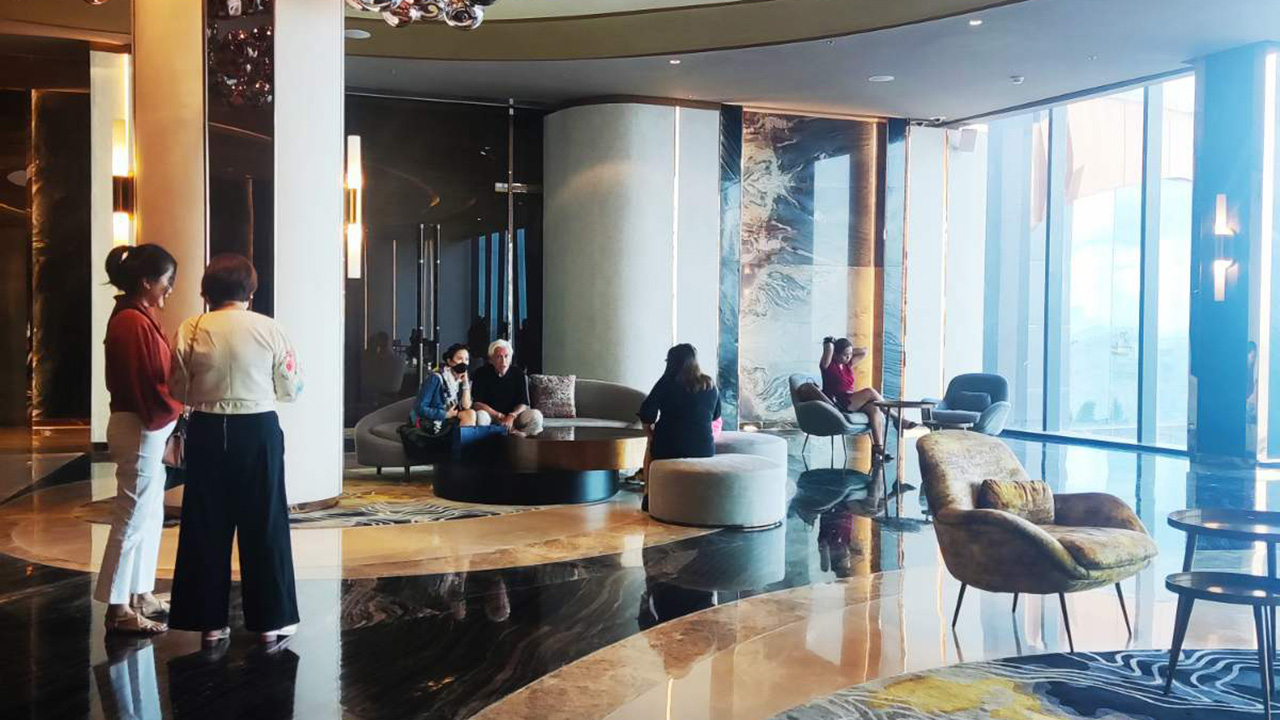
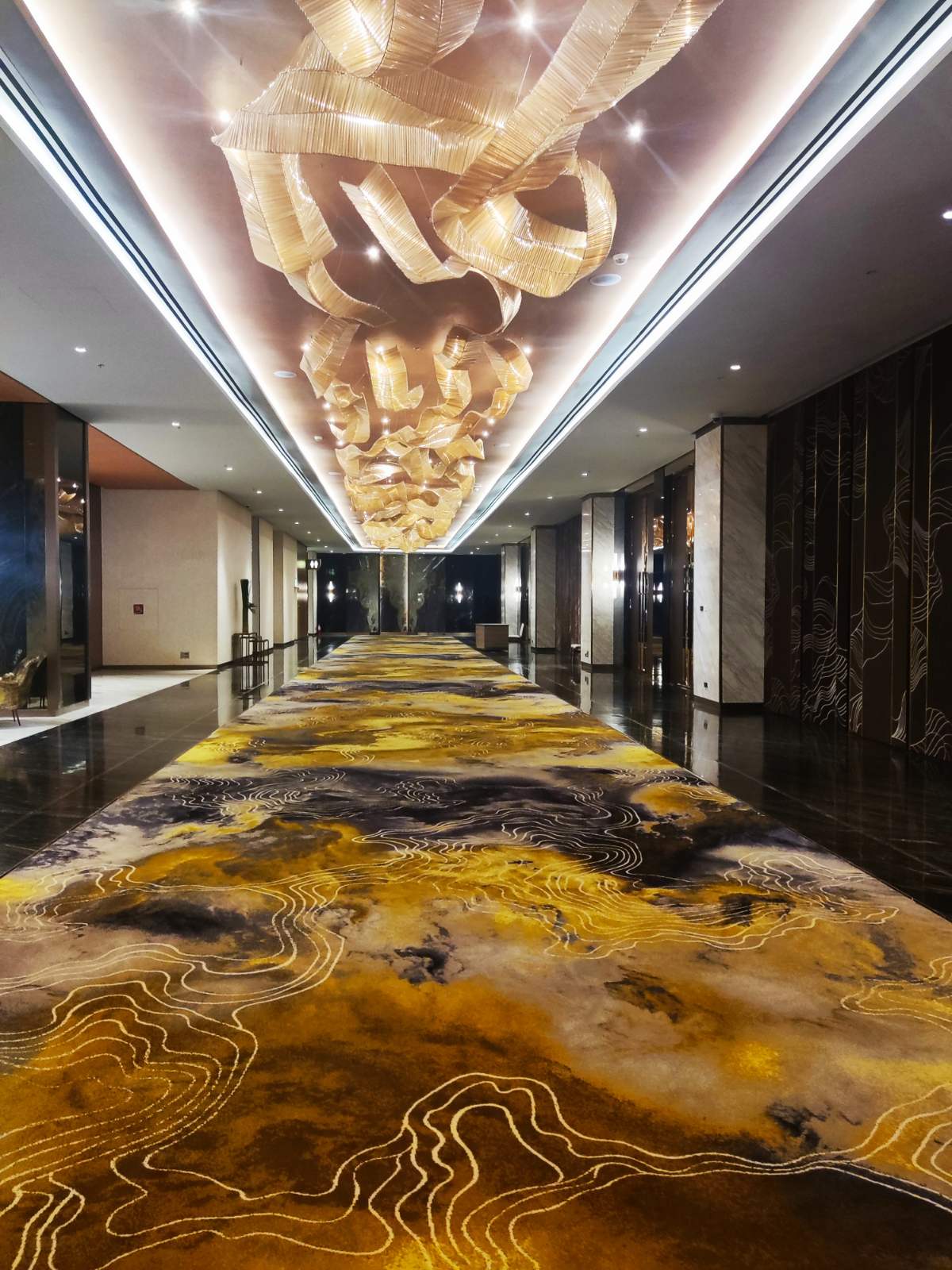
THE FILI Hotel, located within Cebu’s NUSTAR Resort and Casino, held the soft launch of its convention center this April.

“Noon, kung may budget tayo [In the past, for those with a budget], [there was only this one option] and nothing else. Nowadays, if you have the budget, why not also consider NUSTAR?,” said Jun Cordova, Fili Hotel’s director of sales and marketing.

The center has an area of 2,449 square meters with six-meter-high ceilings. It can be divided into three sections, with soundproof partitions in between, per Mr. Cordova during a March 31 media tour. The maximum capacity for a banquet setup using the entire space is 1,700, he added.

For theater seating, the capacity is 2,500.

“With the ongoing trend of wedding planners converting a ballroom into an oasis, ready na iyung ceiling and all [the ceilings and everything else are ready],” Mr. Cordova said.

“We can even have a car show here because we have car lifts,” he said, as he also noted the center’s usefulness for the MICE — or meetings, incentives, conferences, and exhibitions — industry.

(A 2020 forecast on the Philippines’s international and MICE tourism market projected revenues worth $22.5 billion by 2026.)

The Fili Hotel is the first of three hotel towers planned within NUSTAR Resort and Casino, which was developed by Robinson Land Corp.’s hospitality arm, Robinsons Hotels and Resorts.

The plan is for NUSTAR to be an integrated resort, according to its general manager, Paolo L. Campillo.

“It’s planned to be the largest and the best integrated resort outside of Metro Manila,” he told BusinessWorld.

“Coming up is the mall, with several luxury brands moving in there. We also have a water-themed park and theater coming up,” he said. “A lot of the events happening at resorts will soon be happening here.” — Patricia B. Mirasol

Danish company sees opportunities in solar solutions for PHL agri sector

STOCK PHOTO | Image by Pixabay from Pexels

GRUNDFOS Holding A/S, a Danish company, has announced its plans to expand its presence in the Philippines by introducing solar power solutions through local projects to boost the country’s agriculture sector.

“Solar energy presents an opportunity to tackle challenges in agriculture,”  Rick Holland, head of Grundfos Asia Pacific Water Utility Business, said in an e-mail to BusinessWorld on April 4.

“Grundfos continues to see climate smart farming tools and technologies make a difference by encouraging more efficient use of resources,” he added.

Grundfos, through its subsidiaries, provides liquid pumps for industries including agricultural, biofuel, wastewater, and water utilities.

“With agriculture being a highly resource intensive sector, more reliable, affordable and sustainable solutions are needed in the industry to meet these growing demands while boosting climate resilience across the food systems,” Mr. Holland said.

He also noted that as the Philippines transition to more renewables, solar energy presents opportunities to address challenges in the agriculture sector.

“There has been a surge in demand for the use of solar energy across different applications in the agriculture sector, including solar powered pumping systems, greenhouse heating, remote supply of electricity, and solar powered cooling systems,” he said.

Mr. Holland added that introducing such technologies also supports the country’s renewable energy targets.

Under the Philippine Energy Plan, the country is targeting to increase renewable energy in its energy mix to 35% by 2030, and 50% by 2040.

To date, coal-fired power plants still account for the biggest share in the country’s power mix with 57.5%, while renewable energy accounts for 23.4%. — Ashley Erika O. Jose

ADVERTISEMENT
ADVERTISEMENT