Home Blog Page 4948

Offshore wind farms seen to support country’s power needs

ABOITIZ Power Corp. said offshore wind resources will eventually support the country’s power needs as the technology becomes more competitive, its top official said.

“Eventually, as technology becomes more competitive, offshore wind is really going to be a viable option with a higher capacity factor than onshore wind and, of course obviously, than solar,” said Emmanuel V. Rubio, president and chief executive officer of AboitizPower, in a virtual press briefing.

Mr. Rubio said offshore wind is still quite expensive in the Philippines. He added that to date, a lot of questions remain regarding the technology, especially with pricing.

“On offshore, there’s still a lot of questions regarding the LCOEs (levelized cost of energy) and we have yet to see the numbers from DoE (Department of Energy) and the volume that DoE is allocating for offshore wind,” Mr. Rubio said.

He said that as of now, AboitizPower does not have any “material announcement” for future wind projects.

“First of all, we announced our plan, our 90-MW (megawatts) Libmanan wind project in Camarines Sur — that is onshore. This will be the first project of a long-term greenfield wind program that we have in [AboitizPower],” he said.

Last year, Aboitiz Power, through its subsidiary Aboitiz Renewables, Inc., signed a joint venture agreement with Mainstream Renewable Power for the development of the wind project in Camarines Sur.

On Sunday, the Energy department said that the issuance of Executive Order 21 would ramp up offshore wind projects in the country by providing clarity and harmonizing the permitting processes.

The order has directed the department to issue a policy and administrative framework for the optimal development of offshore wind resources. — Ashley Erika O. Jose

Comic and Curb Your Enthusiasm regular Richard Lewis diagnosed with Parkinson’s

RICHARD LEWIS (L) in a scene with Larry David in Curb Yor Enthusiasm.

LOS ANGELES — Comic actor Richard Lewis, a longtime regular on the HBO series Curb Your Enthusiasm, says he is under a doctor’s care for Parkinson’s disease but that despite giving up his standup act “everything is cool” as he focuses on writing and acting.

Mr. Lewis, 75, disclosed his diagnosis in a brief video posted to Twitter on Sunday, saying he learned he had Parkinson’s, a chronic degenerative disorder of the central nervous system, two years ago after he began walking stiffly and shuffling his feet.

Mr. Lewis said the Parkinson’s came on top of a series of shoulder, back and hip surgeries for various orthopedic ailments over the past 3-1/2 years, following an earlier decision to take a break from live performances.

“I’m finished with standup. I’m just focusing on writing and acting,” he said. As for the Parkinson’s diagnosis, “I got it late in life, and they say you progress very slowly, if at all, and I’m on the right meds.”

Mr. Lewis showed no sign of a tremor or other impairment in the video. “I’m under a doctor’s care and everything is cool,” he added. “I love my wife, I love my little puppy dog and I love all my friends and fans.”

The New York-born entertainer said he recently wrapped filming on the 12th season of Curb Your Enthusiasm, in which he plays a semi-fictional version of himself as a friend of the show’s star and creator, Larry David.

Mr. Lewis gained fame in the 1980s standup circuit for his self-deprecating, neurotic persona.

He co-starred with actress Jamie Lee Curtis on the workplace romantic sitcom Anything But Love, which aired on ABC from 1989 into 1992. He also played a prominent role in the 1993 Mel Brooks-directed film parody Robbin Hood: Men in Tights. — Reuters

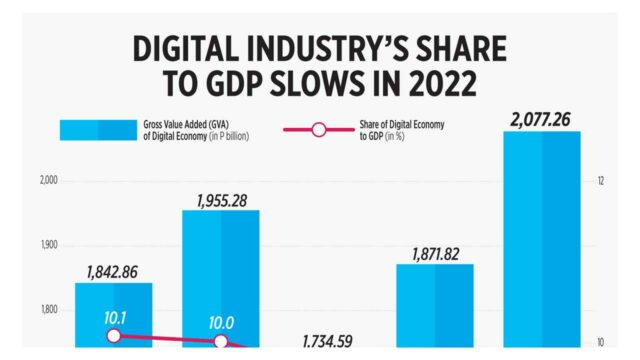
Digital industry’s share to GDP slows in 2022

THE DIGITAL SECTOR’S contribution to the Philippine economy slipped in 2022, even as its gross value added (GVA) breached P2 trillion, the Philippine Statistics Authority (PSA) reported on Tuesday. Read the full story.

Digital industry’s share to GDP slows in 2022

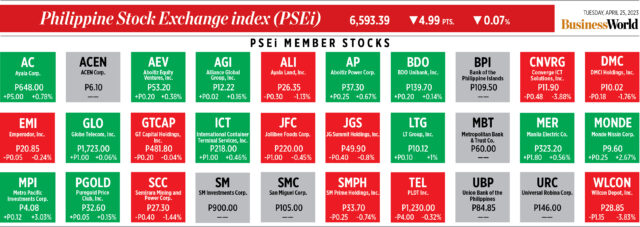
How PSEi member stocks performed — April 25, 2023

Here’s a quick glance at how PSEi stocks fared on Tuesday, April 25, 2023.


Peso climbs as BSP announces expansion of hedging facility

THE PESO appreciated against the dollar on Tuesday after the Bangko Sentral ng Pilipinas said it would expand the transactions covered by its Currency Rate Risk Protection Program (CRPP).

The local currency closed at P55.54 versus the dollar on Tuesday, rising by 23 centavos from Monday’s P55.77 finish, data from the Bankers Association of the Philippines’ website showed.

The local unit opened Tuesday’s session at P55.65 per dollar, which was also its worst showing for the day. Its intraday best was at P55.43 versus the greenback.

Dollars traded went up to $1.27 billion on Tuesday from the $1.21 billion recorded on Monday.

The peso climbed against the dollar after the BSP announced that it would expand the coverage of its CRPP to include non-trade transactions and investments, Rizal Commercial Banking Corp. Chief Economist Michael L. Ricafort said in a Viber message.

The CRPP offers non-deliverable forward contracts as an alternative to sourcing US dollars and could “somewhat ease pressure from the local foreign exchange spot market,” Mr. Ricafort said.

“The peso reacted positively to the BSP’s announcement of an expanded Currency Rate Risk Protection Program,” a trader likewise said in a Viber message.

The BSP also expanded the coverage of the CRPP to include sector foreign currency borrowings from both the public and private sector. It added foreign merchandise trade transactions, non-trade account and resident-to-resident foreign exchange transactions, and outward investments.

“As such, due to the possibility of renewed depreciation pressure in the peso following the continued interest rate hikes by the Fed (US Federal Reserve), we would like to remind all universal and commercial banks that the CRPP facility remains open,” BSP Deputy Governor Chuchi G. Fonacier said.

For Wednesday, Mr. Ricafort sees the peso moving from P55.40 to P55.60 per dollar, while the trader said that the peso could trade between P55 and P56 for the rest of the week. — AMCS

Shares drop on profit taking ahead of US reports

REUTERS

LOCAL SHARES declined on Tuesday as investors await the release of firms’ first-quarter results and due to profit taking after Monday’s rise.

The bellwether Philippine Stock Exchange index (PSEi) slipped by 4.99 points or 0.07% to close at 6,593.39 on Tuesday, while the broader all shares index went down by 3.30 points or 0.09% to 3,506.79.

“Philippine shares closed flat as investors await earnings releases from tech names and consumer discretionary firms, as well as a slew of economic data,” Regina Capital Development Corp. Head of Sales Luis A. Limlingan said.

“On the data front, investors will get a gauge on the state of the housing prices through the new home sales numbers in March, as well as the S&P/Case-Shiller 20-city home price index data for February. Consumer confidence data for April will also be released,” Mr. Limlingan said.

Asian stocks fell broadly and the US dollar also weakened early on Tuesday, reflecting investors’ uncertainty in a busy week for corporate earnings and economic data, Reuters reported.

MSCI’s broadest index of Asia-Pacific shares outside Japan was down 1.2% by 0510 GMT.

On Monday, the Nasdaq closed lower, underperforming the S&P 500 and the Dow, with pressure from high-profile mega-caps as investors awaited results from companies including Microsoft, while Tesla shares fell on concerns about its spending plans.

Philippine shares declined as some investors pocketed their gains from Monday’s rally, AB Capital Securities, Inc. Vice-President Jovis L. Vistan said in Viber message.

“It’s (the market) still on a wait-and-see mode as concerns of a global recession are keeping investors on the sidelines. Going forward, first-quarter earnings results should provide the needed guidance for market direction,” Mr. Vistan said.

Investor sentiment also remained mixed as the market awaits the policy decision of the US Federal Reserve at its May 2-3 meeting, Mercantile Securities Corp. Head Trader Jeff Radley C. See said in a Viber message.

The majority of sectoral indices went up on Tuesday except for property, which went down by 17.03 points or 0.62% to 2,708.91, and services, which declined by 5.36 points or 0.33% to 1,602.42.

Meanwhile, mining and oil climbed by 72.36 points or 0.68% to 10,694.27; industrials went up by 27 points or 0.28% to 9,392.14; financials increased by 2.93 points or 0.15% to 1,912.53; and holding firms rose by 9.21 points or 0.14% to 6,359.52.

Value turnover declined to P5.23 billion on Tuesday with 741.13 million shares changing hands from the P5.34 billion with 807.42 million issues traded on Monday.

Decliners outnumbered advancers, 106 versus 79, while 52 names closed unchanged.

Net foreign selling stood at P224.66 million on Tuesday versus the P822.04 million in net buying seen on Monday.

Mr. See placed the PSEi’s support levels at 6,368, 6,215 and 6,000 and resistance levels at 6,500 and 6,678. — A.H. Halili with Reuters

Electricity spot prices rise in April as demand peaks

BW FILE PHOTO

THE Independent Electricity Market Operator of the Philippines (IEMOP) said the average electricity spot market price in early April rose by P1.11 per kilowatt-hour (kWh) to P7.68 as power demand in Luzon surpassed the 2022 high recorded in May.

In a virtual briefing on Tuesday, Isidro E. Cacho, Jr., IEMOP’s head of Corporate Strategy and Communications, said Luzon’s peak demand came in at 12,221 megawatts (MW) in April, the high for the year so far, and exceeding the 2022 peak of 12,103 MW recorded in May.

“Year-to-date peak demand for all regions has breached its previous year’s peak demand level,” according to Christian Karla A. Rica, an IEMOP assistant manager for Knowledge Management Services.

Peak demand in the Visayas was 2,380 MW in April, exceeding the 2022 high of 2,297 MW recorded in September. Mindanao’s peak demand in April was 2,363 MW, exceeding the region’s 2022 peak of 2,167 MW recorded in June.

As of April 23, IEMOP said average supply was 14,612 MW against average demand of 11,033 MW. In March, average supply was 14,226 MW and average demand 10,244 MW.

Power distributors turn to the spot market when their contracted power supply is insufficient for their customers’ needs. Power generators sell their excess capacity at spot, which commands a premium over power sold via long-term contracts.

“While demand for electricity increased due to rising temperatures brought about by the summer season, the market remained stable, with ample supply levels across all grids,” IEMOP said in a statement.

Mr. Cacho said that with only two trading days remaining, spot market prices will likely settle at P7 per kWh in April, a trend possibly continuing next month.

“Given the current trends, especially with El Niño… the probability of prices remaining at the P7 per kWh level in May is high,” he added. — Ashley Erika O. Jose

ECCP pins hopes for improving logistics on maritime dev’t plan

STOCK PHOTO | Image by iliastefanidis30 from Pixabay

THE European Chamber of Commerce of the Philippines (ECCP) said the 10-year Maritime Industry Development Plan (MIDP) holds promise for further improving the country’s logistics.

The MIDP is the government’s plan for modernizing domestic shipping, improving ports, enhancing transport safety and security, and upgrading seafarer training.

The ECCP made the remarks after the Philippines moved up 17 places in the World Bank’s Logistics Performance Index to 43 out of 139 countries.

“Seamless and sustainable trade are essential. The Chamber further supports measures that will aid logistical efficiency as well as customs and trade facilitation,” the ECCP said in a statement.

Aside from the timely implementation of the MIDP, the ECCP said that the full operation of the National Single Window for trade and integrating it with the ASEAN Single Window “can also help the country’s logistics performance.” — Justine Irish D. Tabile

Hog industry water demand limited, pressure from El Niño seen unlikely

FREEPIK

THE swine industry’s water demand is lower compared to crops, and is thus less likely to be pressured during the El Niño dry spell, industry officials said.

“Unlike crops, (livestock) does not require huge amounts of water as compared to crops,” Jayson H. Cainglet, executive director of the Samahang Industriya ng Agrikultura, said in a phone interview.

Mr. Cainglet said that both commercial and backyard farmers have easier access to water compared to crops.

Rolando E. Tambago, president of the Pork Producers Federation of the Philippines, Inc., said separately that large commercial operation farms are also climate controlled to optimize growing conditions.

“They have controlled or air-conditioned buildings for piggeries. But smallholders will be affected… I cannot say by how many percent,” he said.

Mr. Tambago said the industry is still feeling the effects of African Swine Fever (ASF), which reduced supply, and the coronavirus disease 2019 (COVID-19) pandemic, which lowered demand.

The hog industry lost about 5 million head since the outbreak of ASF in 2019.

Last year, hog output rose 2.4% to 1.74 million metric tons on a liveweight basis, according to the Philippine Statistics Authority.

“Hogs are in short supply because of the large reduction in hog population so prices have risen,” he said, adding that future price increases could be muted, Mr. Tambago said.

Mr. Cainglet said there is no shortage of pork, with 60 million kilograms parked in accredited cold storage facilities, according to the National Meat Inspection Service.

Totoong may pagbaba sa local production, but the imports from the past three years, sobra-sobra kasi hindi pa gumagalaw ang nasa cold storage (It’s true that domestic production has dropped, but imports over the past three years have been excessive and cold storage inventory has not moved),” he said.

The Bureau of Animal Industry estimates pork imports of 710,362 tons in 2022.

Mr. Tambago said demand is unpredictable “because we are now in the post pandemic era, so we cannot be certain of the strength of the economic recovery,” he said.

According to Mr. Tambago, the average farmgate price of a liveweight pig has been stable in the last two weeks, averaging P220 per kilo.

“I think it will be stable in the next maybe two to three weeks. We have not yet confirmed but there are areas in Luzon where farmgate prices went down,” he said.

Mr. Cainglet noted the “disconnect” between farmgate prices and retail prices across all commodities.”

He called for separate retail pricing for domestic and imported pork.

“The rule of thumb is farmgate price plus P90 and maximum of P100 (to get the suggested retail price). So, if the farmgate price is between P200-P220, the retail price should be P300-P310,” he said.

He said the P150 per kilo landed price of imported pork suggests a retail price of about P260.

The prevailing price of pork shoulder (kasim) as of Tuesday was between P300 and P360 while pork belly (liempo) sold for between P360 and P420, according to price monitoring reports from the Department of Agriculture. — Sheldeen Joy Talavera

Newly proclaimed ecozones in Batangas, Bacolod expected to generate investment of P1.64 billion

ABOITIZLAND

THE Philippine Economic Zone Authority (PEZA) said new economic zones in Batangas and Bacolod City proclaimed by President Ferdinand R. Marcos, Jr. are expected to generate P1.64 billion worth of investment.

“The two economic zones will certainly bolster and spread economic growth outside the National Capital Region,” PEZA Director General Tereso O. Panga said.

The zone in Bacolod is on Lacson Street in the Banago district, and will be known as Robinsons Cyberpark Bacolod. It is expected to attract P777.35 million worth of investment.

It was proclaimed on April 14.

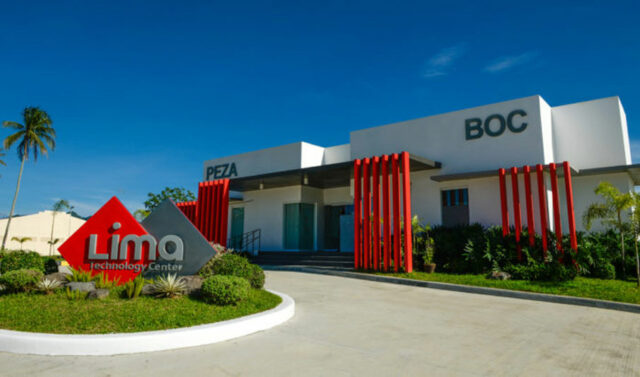
On April 19, the President proclaimed a site in Malvar, Batangas on which will rise the expansion component of Lima Technology Center Special Economic Zone. The expansion is expected to bring in P862.22 million worth of investment.

“With our 10% target growth for 2023, we remain on track in… establishing at least 30 ecozones every year that create centers of economic progress outside the National Capital Region to spur countryside development,” Mr. Panga said.

As of April 19, PEZA has 20 proposed ecozones awaiting proclamation — 11 of which are IT centers, eight manufacturing location, and one agro-industrial site.

Mr. Panga said that the recent zone approvals are needed for “inclusive economic development where thousands of jobs are created in the respective jurisdictions.” — Justine Irish D. Tabile

Automated fare collection system launch plan geared towards expanding consumer choice

PHILIPPINE STAR/ MICHAEL VARCAS

THE Department of Transportation (DoTr) said the rollout of the automated fare collection system (AFCS) will feature an expanded choice for commuters to encourage competition among potential vendors of fare media.

“In the long run sana mabigyan po natin ng pagkakataon na tayong mga mananakay ang mamimili kung ano ang gusto nating gamitin na [fare media] (we want to give our commuters the chance to choose the fare media they want to use),” Randolph Ian V. Clet, the DoTr’s AFCS Program Office project manager, said in a webinar on Tuesday.

Ang gusto po natin marami tayong issuers na pagpipilian at mag-create ng competition (We want to have more fare media issuers to choose from and create competition),” he added.

Mr. Clet said the AFCS is safe and secure, future-proof, provides revenue protection for operators, environment-friendly, and helps improve governance.

Mr. Clet said added that AFCS use can help operators collate mass transport passenger data.

The current fare media market entrants include Beep Card, Green Frog, BayadCard, BeepRides, TripKo, Star8, Squidpay, ePLUS, and Filipay.

“The lack of government regulations and clear policies for AFCS has made the environment conducive for non-interoperability,” Mr. Clet said.

On average, Mr. Clet said users in the Philippines spend 33% more in purchasing or reloading multiple transit cards.

Mr. Clet said that the Philippines should aim for an open AFCS ecosystem with low entry barriers and universal usability across all forms of transport.

The DoTr plans to implement AFC National Standards (NS) to reduce market fragmentation.

“With the implementation of the NS, DoTr will be able to consolidate the fragmented set up of AFCS brought about by closed loop systems,” Mr. Clet said. — Justine Irish D. Tabile

Hitachi Rail issued notice to proceed with NSCR project 

HIGHLIGHTS.HITACHI.COM

THE Department of Transportation (DoTr) has issued a notice to proceed to Hitachi Rail S.T.S. SpA for the North-South Commuter Railway (NSCR) Tutuban to Malolos, Bulacan segment.

“Notice is hereby given to Hitachi Rail S.T.S. SpA., to commence the implementation of the project in accordance with item 8.1(c) section VIII of the Particular Conditions of the Contract,” the DoTr said in its notice. 

Contract package 04 involves the electrical and mechanical systems and track work of the NSCR valued at P13.13 billion, 361.96 million euros, $153.88 million, and 7.89 billion yen.

The Tutuban-Malolos segment is part of the 163-kilometer NSCR urban rail transit system from Calamba in South Luzon to Clark in Central Luzon.

The project is co-financed by the Japan International Cooperation Agency and the Asian Development Bank.

Under the notice, Hitachi Rail is directed “to mobilize, deliver an advance payment security, and submit an invoice for advance payment upon receipt of notice.

The notice was signed by Kim Robert C. de Leon, head of the procuring entity and Transportation undersecretary for administration and finance. — Justine Irish D. Tabile