Home Blog Page 4920

PHL breaks two world obstacle records; gold, silver guaranteed

PRECIOUS CABUYA — CAMBODIA 2023

PHNOM PENH — Two world obstacle records and a pair of guaranteed gold and silver medals.

The high-caliber obstacle race aces delivered a for-the-books performance in the OCR 100m qualifying rounds, ensuring early success for a slow-grinding Team Philippines in the 32nd Southeast Asian Games (SEAG) here.

Pumping life into campaign two days before the glitzy opening, men’s stalwarts Mark Rodelas and Kevin Pascua arranged an all-Filipino duel for the mint after placing 1-2 in yesterday’s heats at the Chroy Changvar Convention Center.

This mirrored the Pinay-only golden contest set up by Precious Cabuya and Kaizen dela Serna over in the distaff side.

The precious mints from obstacle course racing (OCR) will be formally claimed by the 840-strong delegation supported by the Philippine Sports Commission and the Philippine Olympic Committee in Saturday’s final rounds. What made this feat even greater was the fact Mr. Rodelas and Ms. Cabuya shattered the old global marks and pending confirmation, the Guinness World Record, while Mr. Pascua and Ms. Dela Serna gained new personal bests.

Mr. Rodelas’ roaring 25.0921 bettered the 26.42 world record he himself set as Mr. Pascua, the 2019 SEAG kingpin, improved to 26.1896.

Ms. Cabuya ripped Dela Serna’s old world standard of 35.42 with a 33.1278 sizzler. But the latter reset her best clocking to 34.8634.

With a lock on the individual golds, the women’s team crew of Milky Mae Tejares, Mecca Cortizano, Sandi Abahan and Tess Nocyao and the men’s squad of Ahgie Radan, Elias Tabac, Mervin Guarte and Jay-R de Castro look to duplicate the success in the team relay that starts today.

The OCR stalwarts are on track for a sweep of the four golds in the sport’s SEAG comeback. They brought out the broom previously in 2019 at home, winning all six.

“Our athletes have trained hard for today. They went through a lot of obstacles to reach where they are today,” said Pilipinas Obstacle Sports Federation (POSF) President AAl Agra.

Obstacle course  race’s triumph came after the women’s doubles 60-minute entries in ouk chaktrang chess and women’s T10 in cricket secured virtual silvers with a game to spare in other fronts.

Meanwhile, jiu jitsu experts join the action beginning today at the Chroy Changvar Convention Center with the men’s duo, women’s ne-waza gi -52kgs and women’s show events on tap. — Olmin Lebya

Biado and Chua eye sweep of 9-ball two gold medals

CARLO BIADO — PHILSTAR FILE PHOTO

THE PHILIPPINES will try to preserve its long-cherished tradition as the best cue masters in the region as Carlo Biado and Johann Chua aim to sweep the only two gold medals staked in 9-ball of the Phnom Penh Southeast Asian Games.

Mr. Biado, a former world champion, and Mr. Chua, the reigning titlist, are the early favorites to dominate the event where Filipinos are known to excel having produced legendary winners in the past.

Unfortunately, that could probably be the most gold the country can snare after the host country removed women’s 9-ball and other events where the Filipinos have pretty much dominated the whole time.

Unless, of course, other Filipino entries — Efren “Bata” Reyes and Francisco dela Cruz (carom) and Jeffrey Roda and Alvin Barbero (snooker) — can whip up a miracle or two and top their respective events.

“Hopefully, two golds in 9-ball singles and doubles,” Billiards and Snookers Congress of the Philippines secretary-general Robert Mananquil yesterday told The STAR. “But other countries like Singapore, Vietnam and Myanmar have good pool players.”

“For carom, we may not get the bronze as host Cambodia has many good players. In snooker, silver or gold in singles as our players have gone international training,” he added.

Mr. Mananquil said women’s 9-ball was removed but multiple SEA Games gold winners Rubilen Amit and Chezka Centeno will still compete as they were entered in women’s carom.

“No women’s pool but both Mmess. Amit and Chezka agreed to play because organizer Cambodia requested the Philippines to enter to complete the required four countries,” he said. — Joey Villar

DLSU ousts Santo Tomas, advances to UAAP finals

PHILPPINE STAR/RUSSEL PALMA

TOP-SEEDED De La Salle University (DLSU) took care of business and marched into the finals in just one try, eliminating tormentor University of Santo Tomas (UST) with a 26-24, 25-22, 20-25, 25-19 victory in the UAAP Season 85 women’s volleyball Final Four yesterday (May 3) at the Smart Araneta Coliseum.

Super rookie Angel Canino hammered 19 points on 18 hits along with 10 digs as the Lady Spikers maximized their twice-to-beat advantage as the No. 1 seed in the elimination round for their second straight and 20th overall finals appearance.

Jolina dela Cruz added 10 with Thea Gagate and Alleiah Malaluan chipping in nine points apiece in De La Salle’s triumphant revenge on UST after a costly loss in the second round.

UST handed the lone loss of De La Salle in four sets last time out that denied the latter a potential free passage in the finals and in the process turned the women’s semifinals to a traditional format instead of a stepladder one.

This time, there was no denying De La Salle with Mars Alba (12 sets) and Justine Jazareno (22 digs and 16 receptions) also providing solid coverage.

De La Salle, with sweet vengeance in mind, raced to a 2-0 start but faltered in the third frame before regaining their act with a bang in the clincher highlighted by a 14-7 lead.

That proved to be the telling tale for the Lady Spikers as they advanced to await the winner between No. 2 National University (NU) and No. 3 Adamson University, which were still playing as of press time.

Eya Laure (15) and Imee Hernandez (12) paced the Golden Tigresses in a valiant effort to end their campaign.

Meanwhile in the men’s division, top gunner Mark Calado fired 22 points as No. 3 Far Eastern University (FEU) toppled No. 4 De La Salle, 25-21,19-25, 25-22, 25-22, in the first phase of the stepladder semifinals.

FEU thus earned a right to face No. 2 UST on Sunday in another knockout duel with the survivor advancing in the finals against defending champion NU, which gained an automatic ticket after a 14-0 elims sweep. — John Bryan Ulanday

Japanese head coach Munehiro Kugimiya gives seal of approval to Cambodia-bound men’s gymnastic squad

JAPANESE head coach Munehiro Kugimiya gave his seal of approval to all six members of the national men’s artistic gymnastics squad, bannered by two-time world champion and Tokyo Olympian Carlos Yulo, at the close of a weeklong training camp last Tuesday at the GAP gym inside Philippine Sports Commission’s Rizal Memorial Sports Complex in Malate, Manila.

Mr. Kugimiya was profuse in gratitude as he shook hands and thanked the athletes and coaches who are scheduled to leave today for the 32nd Cambodia Southeast Asian Games (SEAG).

“We would like also to thank Gymnastics Association of the Philippines President Cynthia Carrion, Secretary General Weng Bautista and, of course, the Philippine Sports Commission for making our training camp and participation of our athletes in the Cambodia SEA Games possible,” Mr. Kugimiya said.

Ms. Bautista said that Mr. Kugimiya wanted media to witness the last day of camp so that the athletes would exert their best while simulating the conditions of playing in front of a live audience in the Cambodian capital.

Mr. Kugimiya, however, won’t be in Phnom Penh when the SEA Games gymnastics competitions start on May 6, preferring to hand the reins to assistant coaches Reyland Capellan and Allen Aldrin Castañeda.

“Both Messrs. Capellan and Castañeda are competent coaches and I am sure that they will be able to handle the job with our gymnasts well,” he noted.

Aside from Mr. Yulo, who flew in from Tokyo last week, the other members of the squad are Juan Miguel Besana, Jan Gwynn Tymbang, John Ivan Cruz, Justine Ace de Leon and rookie Jhon Romeo Santillan.

Mr. Yulo, who suffered a strained left ankle ligament that forced him to skip the FIG World Cup Series in Cairo, Egypt last month, said he was recovering well after rehabilitation in the Japanese capital.

He was also happy to be back training with his teammates as they hope to surpass their silver medal finish in the 31st Vietnam SEA Games last year.

Due to the “handicapping” system of the Cambodian hosts, however, he won’t be able to duplicate the five gold and two silver medals he won in Hanoi.

On top of the team competition, Mr. Yulo will also see action in the individual all-around event, which will determine the two apparatuses he will compete in during the finals depending on the outcome of his performances.

Mr. Capellan, a two-time SEA Games gold medalist, said they will make a decision on the matter after the individual all-around event, which also serves as the qualifying competition for the gymnasts who will make it to the apparatus finals.

World champion Yulo determined to lead teammates to SEAG glory

CARLOS YULO — PHILPPINE STAR/JUN MENDOZA

PHNOM PENH — Filipino world champion Carlos Yulo shrugs off ankle issues as he prepares to spearhead the Philippine gymnastics team in the 32nd Southeast Asian Games here.

Mr. Yulo sprained his left ankle during training in Japan, which forced him to sit out the fourth and final leg of the 2023 FIG Artistic Gymnastics World Cup series in Cairo last week.

But the pocket-sized gymnastics star isn’t missing the biennial meet here.

Mr. Yulo said he felt good when he did his routines during the men’s artistic gymnastics team’s final evaluation process Tuesday ahead of its departure from Manila.

Winner of five gold medals in the Hanoi edition, Mr. Yulo is eyeing a maximum of four this time considering the limitations brought about by the affected ankle and the cap on events an athlete can take part in.

Mr. Yulo is determined to lead MAG teammates Juancho Besana, Jan Gwynn Timbang, Jhon Romeo Santillan, Ivan Cruz and Justine Ace de Leon to the team glory.

MAG competitors will have two days of podium training from May 6 before fighting for the all marbles on May 8-9. Bets in aerobic gymnastics, meanwhile, will see action May 13 to 14. — Olmin Leyba

NY Knicks race past Miami Heat in fourth quarter, level series 1-1

JALEN Brunson scored 30 points to fuel the host New York Knicks to a 111-105 victory over the Miami Heat on Tuesday, leveling their Eastern Conference semifinal series at one win apiece.

Mr. Brunson made 10 of 19 shots from the floor — including six of 10 from 3-point range — for the fifth-seeded Knicks. Game 3 of the best-of-seven series is Saturday in Miami.

New York’s Julius Randle collected 25 points, 12 rebounds and eight assists in his return after sitting out the series opener due to a sprained left ankle. RJ Barrett sank five 3-pointers to highlight his 24-point performance. Josh Hart added 14 points, 11 rebounds and nine assists.

Miami leading scorer Jimmy Butler sat out Game 2 after sustaining a sprained right ankle during the fourth quarter of the series opener on Sunday afternoon.

Caleb Martin recorded 22 points and eight rebounds and Gabe Vincent added 21 points for the eighth-seeded Heat. Max Strus finished with 17 points and Bam Adebayo collected 15 points, eight rebounds and six assists.

Miami built a 93-87 lead before New York scored 14 of the next 17 points to claim a five-point advantage with 2:48 remaining in the fourth quarter. Mr. Brunson sank two 3-pointers and a pair of jumpers during that sequence before Kyle Lowry and Mr. Adebayo each made a basket to trim the Knicks’ lead to 101-100 with 1:58 to play.

Mr. Hart halted that momentum by draining a 3-pointer, and New York added four free throws to extend its lead to 108-100 with 31.5 seconds left. Vincent made a driving layup and Duncan Robinson drained a 3-pointer to bring Miami within three points before Mr. Hart sank 3 of 4 free-throw attempts to seal the win.

Mr. Vincent sank a pair of 3-pointers and added a driving layup to give Miami a 90-85 lead with 7:45 remaining in the fourth quarter. Isaiah Hartenstein countered with a short jumper, but Mr. Martin answered by draining an uncontested 3-pointer.

Mr. Martin sank a 3-pointer to extend Miami’s lead to 46-38 with 3:43 remaining in the second quarter. Mr. Randle answered by scoring the next eight points for his team to highlight a 13-5 run before Kevin Love sank a 3-pointer to give the Heat a 54-51 advantage entering halftime. — Reuters

Philadelphia 76ers big man Embiid wins first MVP award

PHILADELPHIA 76ers center Joel Embiid has won the NBA’s Most Valuable Player (MVP) award for the first time, the league announced on Tuesday.

Mr. Embiid was chosen over Denver Nuggets center Nikola Jokic, to whom he lost the award in the past two seasons, and Milwaukee Bucks forward Giannis Antetokounmpo, who won back-to-back awards in 2019 and 2020.

The Cameroonian big man received 73 first-place votes from a panel of 100 broadcasters and journalists, marking the fifth consecutive win for an international player.

The 29-year-old is only the second African player to become MVP after Nigerian-American Hakeem Olajuwon from the Houston Rockets in the 1993-94 season.

The third overall 2014 draft pick led the league in scoring for a second straight year, averaging a career-high 33.1 points per game on 54.8% shooting from the field, 10.2 rebounds and 4.2 assists in addition to 66 three-pointers.

Mr. Embiid suffered a lateral collateral ligament sprain in his right knee during the third game of the first-round series against the Brooklyn Nets, forcing him to miss the final game of the 76ers’ 4-0 series win and their Monday win in the first game of the Eastern Conference semi-finals victory the Boston Celtics.

The MVP trophy was renamed this season after Michael Jordan, widely regarded as one of the greatest players of all time. — Reuters

Content is King

LEVI STUTE-UNSPLASH

A key upshot of the state visit of South Korea’s President, Yoon Suk Yeol, to the United States around the end of April was the announcement by Netflix CEO Ted Sarandos of the investment by the live streaming giant of $2.5 billion over four years in South Korean content for one of the world’s top content aggregators.

AFP reported from Seoul on April 25, what could be the largest commitment of Netflix in content development and is expected to further accelerate the transformation of the television/video industry. But perhaps more important is that the Netflix commitment will also affirm, per AFP, the enviable role of South Korea as a “global cultural powerhouse in recent years.” AFP gives some of the credit for this “explosive success” to the Oscar-winning film Parasite and the hit Netflix series Squid Game.

In a statement given to AFP, Sarandos said: “Netflix is delighted to confirm that we will invest $2.5 billion in Korea including the creation of Korean series, films, and unscripted shows over the next four years. The investment plan is twice the total amount Netflix has invested in the Korean market since we started our service in Korea in 2016.”

Sarandos added, “Netflix had great confidence that south Korea’s creative industry would continue to tell great stories,” pointing to the recent success of global hits such as The Glory and the reality show Physical 100. The former is the story of a vengeful woman who hatched a plan to get back at people who made life in high school hellishly unpleasant for her. Physical 100 is a reality competition show which lives true to its name of extremely demanding physical competitions.

Sarandos continues with justified bullishness to rave about what lies at the end of this gigantic deal, the importance of quality content. “It is incredible that the love towards Korean shows has led to a wider interest in Korea, thanks to the Korean creator’s compelling stories. Their stories are now at the heart of the global cultural zeitgeist.”

While Sarandos has heaped praises on Korean creativity and the latest export earner of the world’s 10th largest economy, what is clearly the reason for this huge investment is “we’re in the market for content. And extraordinary content is what television, newspapers, magazines and all media are all after.”

Netflix reports that Korean content, whether K-dramas or game shows, has taken the world by storm with over 60% of Netflix viewers watching a Korean show in 2022, which the AFP states are company data.

As the Korean example obviously shows, content is key to value creation. That’s a reality. But hand in hand with that reality is the fact that, as pointed out by John Hall in the Forbes article “From TV to Digital Media: How Technology Changes Development,” “Today’s content consumers make up some of the most powerful audiences that most brands have ever seen. They dictate the content, where you publish it and how you distribute it… Technology has empowered audiences to take control of conversations and the messaging. They have the power to research, advocate, share ideas and hold leaders and brands accountable.”

The power of content (which influences and is influenced by consumers) has created a situation where platform does not make that much difference.

To have a better understanding of the evolution of content and how it has achieved the position of primacy in the video/television industry, it might be informative to briefly trace the history of change of the television industry based on various accounts. One such source is “The Value of Content” by Liberty Global.com.

According to Liberty Global, content was first recorded on film, then on videotape, and later on, on digital media. Content was delivered via live broadcasts, then cable, satellite, and online platforms. Content was consumed in a variety of ways: via television sets, computers, tablets, and mobile phones. These changes have brought new players with new business models to the landscape. But through all of these changes the fundamental structure of the industry has remained relatively constant.

Liberty Global adds that the most fundamental change in the television industry was the evolution from one value chain, Free to Air (FTA), to two value chains, FTA and subscription TV. Content creators and rights holders provide programming to and package content into channels for so-called linear consumer viewing that, for most part of the day, are locked into the channel. Distributors then deliver the content to TV sets and other viewing devices. Liberty Global notes that each of these roles within the value chain has, for the most part, retained its key relationship with others and has thrived in the face of all this change.

One change stimulus is the shifting consumer landscape which is slowly being dominated by the millennials or Gen Y, traditionally identified as that portion of the world population born in the period 1982-1994 and to whom technology is said to be part of their everyday lives, and post-millennials or Gen Z (born at the turn of the century), who, according to some accounts, “arrived with a tablet and smart phones under their arms and are expected to take the lead in a few decades.” How they affect the dynamics of the video industry deserves one or more columns.

At this time, it is instructive to bear in mind that, as pointed out by Liberty Global, those who own and control content will help steer the direction (or change in the industry) from one of steady evolution but likely to a more revolutionary pace. And to stay relevant, and to continue to thrive, industry participants (networks, distributors and aggregators, etc.) need to change in fundamental and, most likely, in unfamiliar ways.

Without diminishing the role and casting aspersions on the talent and competence of network managers and strategists and studios, it may be worthwhile to be mindful of the point raised by Liberty Global, that whatever ecosystem or business model one employs, FTA, subscription TV, content will remain at the core of these ecosystems. Data from several years ago, the latest we could access, shows that 36% of total industry value went to content creators and rights holders, and 34% went to broadcast networks.


Philip Ella Juico’s areas of interest include the protection and promotion of democracy, free markets, sustainable development, social responsibility and sports as a tool for social development. He obtained his doctorate in business at De La Salle University. Dr. Juico served as secretary of Agrarian Reform during the Corazon C. Aquino administration.

An airport in dire need of a fix

PHILIPPINE STAR/ MIGUEL DE GUZMAN

On May 1, as thousands of Filipinos ended the long weekend, Terminal 3 of the Manila international airport shut down due to a seven-hour power outage. Many flights were either delayed or cancelled, affecting an estimated 9,000 passengers. Investigators initially pointed to the tripping of the terminal’s main circuit breaker, due to either faulty wiring or a short circuit.

Last New Year’s Day something similar happened. Radios and radars at the airport’s air traffic management center went offline, also because of electrical problems. Most flights to the Philippines had to be put on hold, diverted, or told to return to their point of origin. An estimated 56,000 passengers traveling to or from the country were affected.

In September 2022, the international airport was also hit by a seven-hour power outage interrupting operations. At the time, an electrical audit was reportedly ordered, and airport authorities promised to provide enough generator sets to address future outages. Reports indicate that 16 international flights and 15 domestic flights were affected by the outage.

Three major power outages in eight months must be a record of sorts for the Manila airport, or for any international airport. And while I understand that power reserves are now thin because of the dry season, this was not the case in September 2022 and January 2023. Obviously, what needed to be done since September 2022 has not been done.

In late January, Philippine airspace was even closed for two hours to allow airport maintenance to replace the broken cooling fan of one of the power supplies. Another airspace shut down is scheduled for May 17, for about six hours, also for maintenance, but this time of the uninterrupted power supply (UPS) of the country’s air traffic management system. Maintenance activity was also scheduled yesterday at the air traffic management center, “to repair the Automatic Voltage Regulator, replace the UPS and upgrade the ATMS A/B power supply.”

It is bad enough that power outages and airport shutdowns have become commonplace at the country’s main international gateway in the last eight months. But there is something utterly wrong with a system where Philippine airspace will have to be shut down for as long as six hours just so maintenance activities can be conducted at the air traffic management center.

At the center of all this is Manila International Airport Authority general manager Cesar Chiong and Transportation Secretary Jaime Bautista. On May 2, a day after the Terminal 3 outage, Chiong was preventively suspended for up to six months by the Office of the Ombudsman based on an anonymous complaint for alleged grave abuse of authority and misconduct when he reassigned 285 airport employees in less than a year. Also suspended was Chiong’s assistant general manager, Irene Montalbo.

Chiong said in press statement that the reassignments were intended to improve airport operations, and that he was confident he would be “vindicated and cleared in the end after I am allowed to present my side as a result of my vision and plan to improve airport efficiency and the financial standing of the authority.” Chiong claimed airport finances even improved under his watch, “without any government subsidy.”

Talk about bad timing. Just when leadership matters most in fixing airport infrastructure and operations. Is it simply coincidence that Chiong’s suspension notice was served now? I don’t know Chiong or Bautista personally, but there seems to be a lot happening behind the scenes at the international airport. More than meets the eye, for sure.

Secretary Bautista himself fueled the controversy when he told a media interview, “because this is the second time that it happened on a long weekend, I think you cannot really discount the possibility of having somebody do it to embarrass the government, or to prove that they have something that we should give in to.

“We’re not discounting the possibility that there might be sabotage. I hope it’s not. That’s the reason why we asked the other agencies to join us,” he said, referring to the joint committee of the Department of Transportation, Office of Transport Security, Manila International Airport Authority, National Intelligence Coordinating Agency (NICA), National Bureau of Investigation, and Philippine National Police.

He also belied earlier claims by investigators that the Terminal 3 outage was a “circuit breaker problem,” alleging that “it’s not a regular fault that entered the system of NAIA-Terminal 3.” Bautista also said, “a lot of angles [were being] considered by NICA.”

The thing is, sabotage or not, the airport situation may just force the President to kick out Chiong, and maybe Bautista.

The thing with the sabotage theory is that it cuts many ways. Bautista alleges it might be intended to embarrass the government. But to what end? What will such embarrassment benefit the perpetrators? Was it politically motivated? Again, to whose benefit? The administration’s critics? Possible, but not plausible.

The other theory is that the sabotage was intended by the perpetrators “to prove that they have something that we should give in to.” Does this mean then that Bautista or Chiong had been approached previously by people or groups with certain interests? Also, does this mean that the September 2022 and January 2023 incidents were also sabotage? Or do the perpetrators intended to embarrass particularly Bautista and Chiong for the President to kick them out?

The timing of the Terminal 3 outage is suspicious in the sense that it happened just a day before Chiong was served his suspension notice. Obviously, his detractors see this as a win. But it is also a concern how the Terminal 3 incident, and indirectly, the previous two incidents involving power supply issues, might be used to justify “emergency” terminal upgrades, including a P1-billion budget for the purchase of new generator sets for the airport.

“One of the problems is that there are areas in the airport where the temperature is quite warm because the existing power provided by the generator is not enough to support the whole operations of Terminal 3,” said Bautista. “We need to acquire more generators so that we can support the 100% power requirement of our Terminal 3… You know this terminal is a 25-year-old terminal.”

Airport assistant general manager Bryan Co also told a radio interview that airport authorities would need to secure the necessary budget and undergo procurement activities for the purchase of new generator sets before conducting a full electrical audit. This was after Secretary Bautista reportedly ordered a “full electrical audit” at the airport terminals. Bautista also said the last electrical audit was done sometime in 2017 and the recommendations from that audit were not implemented.

And this is where I get confused. Didn’t airport officials, after the September 2022 power outage, also order an electrical audit? Precisely to prevent an outage from happening again? What happened to that audit? Or was that just lip service? And why order another audit again now if one was actually done just eight months ago? What has changed since then? And didn’t airport officials promise in September to get enough generator sets to meet the airport’s emergency power requirements?

Moreover, shouldn’t the audit be done ahead of budgeting and procurement? The recommendations from six years ago may need updating, but they may be just as good now as they were in 2017. Ideally, we should start with the 2017 electrical audit and update it, considering the last three incidents involving power supply. Then, after updating the audit, terminal upgrades can be properly planned, budgeted, and requisitioned. Unfortunately, time is not on the public’s side. To pull off a quick but lasting fix, competent and effective leadership will matter.


Marvin Tort is a former managing editor of BusinessWorld, and a former chairman of the Philippine Press Council

matort@yahoo.com

Rising oil-gas reserves and their unstable prices

The persistent lobby for energy transition from fossil fuels (oil, gas, coal) to renewables (wind, solar, etc.) and moving to “net zero” carbon dioxide emissions is anchored on the assumptions (among others) that fossil fuels are non-renewable and will soon be depleted, and that this will cause large-scale global economic turmoil if the alternative renewables are not ready in high volumes.

Are these assumptions correct and realistic? If yes, fine. If no, then all the economic and energy policies leading to net zero are also wrong and distortionary.

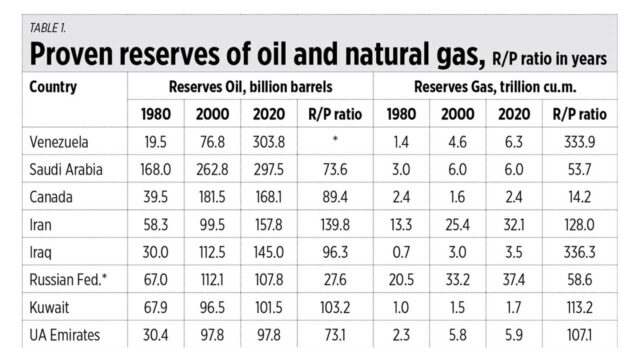
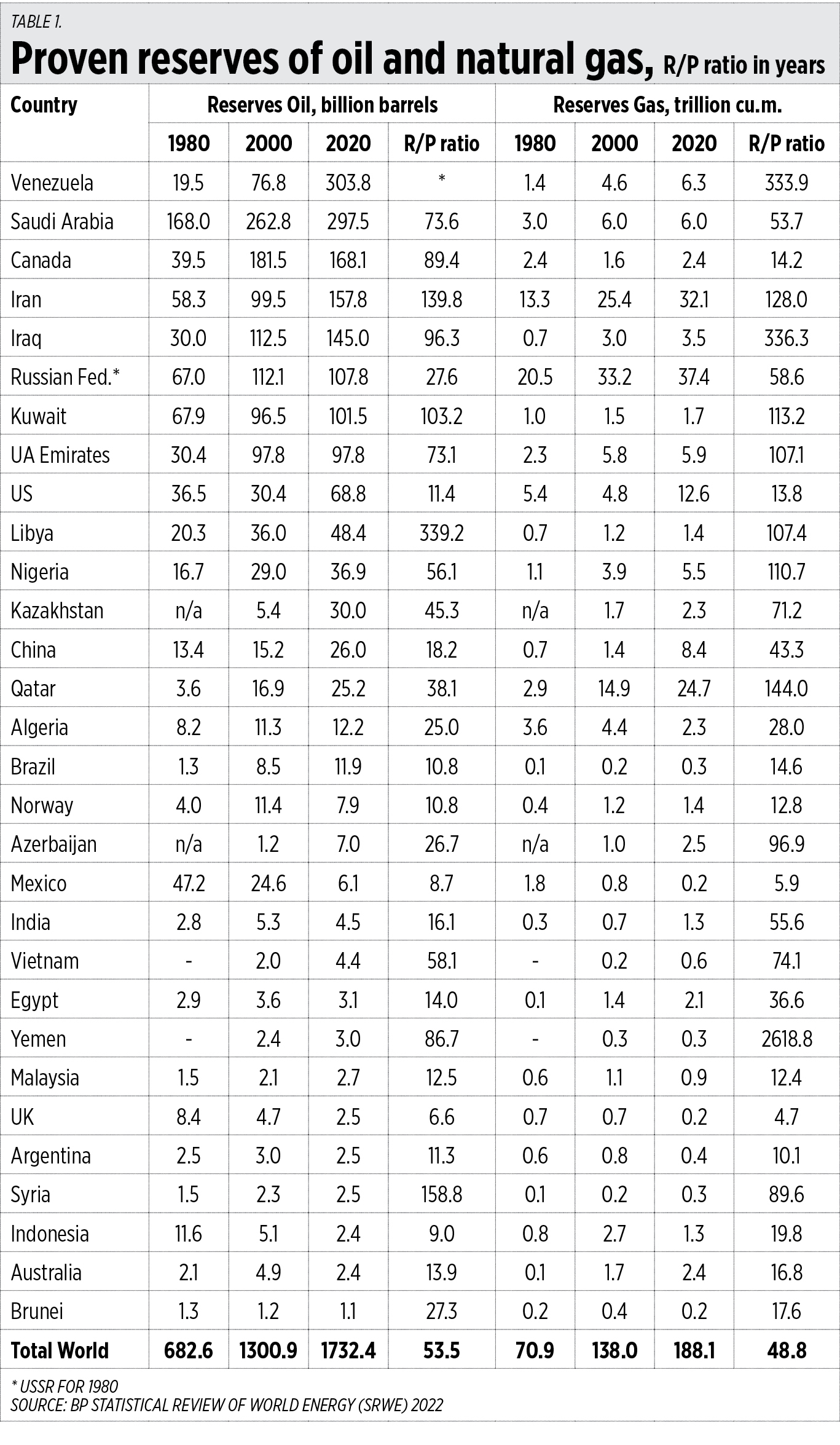
To help answer this question, I put together this table and limited the annual data for proven oil and natural gas reserves to 1980, 2000, and 2020. Reserves/Production (R/P) measures how many years the reserves will last if current production by a country (both for domestic use and exports) is constant. So, an oil R/P ratio in 2020 of 27 for Brunei means it will take 27 years before its oil reserves will be totally depleted (in 2047), assuming the production volume is constant, and no new reserves are discovered.

The numbers show the following:

One, proven reserves for both oil and gas for all countries keep rising through the years. Research and drilling technology keeps improving. Before, machines could drill down one kilometer only, now they can drill 10 kilometers or deeper. Modern fracking technology also allows for vertical then horizontal extraction of oil and gas, unlike traditional vertical drilling only.

Two, the R/P ratios for 2020 show that some countries can keep pumping and extracting oil for hundreds of years. Libya can keep it up for 339 years, Syria for 159, and Iran for 140. For gas, Iraq and Venezuela can keep producing for an average of 335 years, Qatar for 144 years, Iran for 128 years, Syria for 90 years, and so on.

Three, China, India, and Vietnam are ramping up their oil-gas reserves discovery — their gas R/P ratio now reach from 43 to 74 years.

Four, the US has a low R/P ratio of only 11 years for oil and 14 years for gas. This should be the main reason why US troops went to Iraq, Libya, Yemen, Syria, etc., to secure more oil supply for itself. US troops went to Syria uninvited from 2014 to the present and occupy a big oil-gas producing region. Such a practice is part of what the US calls “rules-based international order.” What a joke.

To criticize Russia’s invasion of Ukraine is understandable. But to criticize the occupation of Ukraine while justifying the occupation of a big portion of Syria is a joke.

Five, the total world reserves are almost doubling every 20 years (see Table 1).

So, to the question: Are fossil fuels — oil and gas in particular — soon to be depleted?

The quick answer based on the above numbers is “no.” The world will never run out of oil and gas, and coal too, so long as research, exploration, and extraction are left unpoliticized. The Earth’s crust is up to 70 km deep. Current drilling for oil and gas is not even 1/5 of the Earth’s crust.

So, if reserves and potential supply seem unlimited, why are oil and gas prices rising, or at least unstable (see Table 2)?

The quick answer is politics — too much politics in the world — military conflict and threats. Prior to the Yom Kippur war (1973) in the Middle East, Dubai crude was only $2/barrel in 1972. It jumped to $10.40 in 1974. Then there was the Iran revolution in 1979, followed by the Iran-Iraq war in 1980-1988. Dubai crude in 1978 was only $13/barrel, and it jumped to $30 in 1979 and $35.70 in 1980.

Most recently, the Russia-Ukraine war in February 2022 led to a big jump in oil prices by the middle of last year, but these have gone down to the pre-war level of below $85/barrel. The problem is not the war itself because Russia’s oil-gas production and exports were continuing. It was the economic sanctions where Russia would not be paid in US dollars or euros, and its central bank reserves of $300 billion were frozen. When more countries started paying Russia in rubles or China yuan or Indian rupees, Russian oil and gas began trading normally, leading to current low prices.

There are two lessons for the Philippines here. One, we should distance ourselves from the heavy net-zero lobby and narrative because it is based on false and dishonest claims that future fossil fuel supply will be depleted while demand keeps rising. Two, we should further expand and diversify our international reserves to more foreign currencies plus gold. This will help us address high price fluctuations on dollar-denominated merchandise trade.


Bienvenido S. Oplas, Jr. is the president of Bienvenido S. Oplas, Jr. Research Consultancy Services, and Minimal Government Thinkers

minimalgovernment@gmail.com

Managing talent

PRO CHURCH MEDIA-UNSPLASH

THERE has already been a proliferation of “chiefs” in the corporate world. (Yes, they don’t cook.) There is even a name for this collection of organizational fauna — the C-Suite. These managers report directly to the CEO, “the chief of chiefs.” The C-Suite includes the Chief Financial Officer (CFO), Chief Information Officer (CIO), and new-fangled ones like the Chief Risk Officer — does he raise risk or lower it?

Renaming functions to make them more awesome to outsiders is the job of what used to be called “Admin.” The department in charge of people needs a lift too and has opted in the past to call its role simply, “Human Resources.” Recently it has appropriated the title: Chief Talent Officer. The head of this unit wants you to know he does not just handle sick leave and job descriptions, but something more cosmic — the recruitment and nurturing of gifted individuals.

Managing talent is a serious corporate endeavor. (Our greatest assets are people.) The paradigm for designating employees and managers as “talent” borrows from the entertainment industry, like film and television.

There are some similarities.

Casting is an important aspect of management. In the acquisition of a company, the new stockholders ask what kinds of talent are needed. Is it the villainous and formally attired cost-cutter or a dressed down and nurturing father-figure? It all depends on the plot, or corporate strategy.

Do you grow talent and promote from within or just poach them from other studios? Home-grown talents are seen to be in a rut. They embrace the status quo too much — yeah, we tried that before, and it didn’t work. Plucking stars from other planets not only brings up the talent fees; they also upset the existing compensation structure, encouraging underlings to plot revenge.

Is the outsider’s advantage of starting with a “clean slate” an admission of cluelessness? What does a food franchise marketer have to do with managing a hospital?

Only in an entertainment-based organization does talent management really apply. Selecting the right actor for the role can turn a movie or mini-series into a blockbuster… or a flop.

“Divas” are the hardest to manage. Are their demands, both emotional and financial, more than made up for by revenues generated? Are they too obsessed with titles and hierarchies? The delicate balance between pleasing a prima donna and building a high fence around her (also called a retention strategy) should be driven by costs and benefits.

And when the diva doesn’t bring in the ratings? It is time to let go, pointing to health reasons and her desire to spend more time with her family. The script is simply adjusted with the demise of her character in the mini-series — she was kidnapped by terrorists.

The adroit talent manager needs to find a landing spot for the costly overhead to be ditched. Can he foist the diva on a competitor who may even pay a premium to recruit her? (In professional basketball, talent swapping is almost routine.) Passing on a headache to the competition is the height of finesse.

Managing talent is a matching game. It determines what the organization (or movie) needs and then hiring (or casting) the right star at a reasonable cost. Getting the ingredients and the mix right leads to the perfect dish — not too wet, not too sour, and matched with rice of the right gooey texture. If the pairing (say, the cost of the talent versus the value she brings) doesn’t work, the dish may not be edible.

Talents too have an expiry date. The blockbuster movie in the talent’s resume’ may not even have been due to skill on her part but simply good timing with the absence of competition.

It’s still the numbers that tell the story. It’s a tricky thing to assess what each talent brings to the table. Claiming credit for somebody else’s effort has been raised to a high art. The real question is how the whole organization is performing. Is it a winner?

Managing talent is like conducting an orchestra. Not every talent can play the soloist. And the volume of the performance needs to be synchronized as some parts need softer renditions. To get the right performance and the proper blending of the music, the talents need to understand their roles. Are they all on the same page?


Tony Samson is chairman and CEO of TOUCH xda

ar.samson@yahoo.com

Training company GoIT targets Filipinos looking to change careers to IT

RACOOL_STUDIO-FREEPIK

GoIT, an international technology education company, has announced its first local course to be launched in June. 

It will be a 10-month Fullstack program designed for Filipino professionals interested in transitioning their careers to information technology (IT), Khrystyna Gankevych, GoIT group head of growth, said in an e-mailed statement on Wednesday.

GoIT, which was launched in the Philippines early this year, has had 15,000 graduates over its past eight years of activity in Europe and America, with almost all participants seeking a career change and starting from scratch in IT, she noted.

The company offers free marathons for interested participants to test different courses and select a suitable specialization, along with free consultations and webinars to ensure they are ready to start a new career in tech. 

Participants will have the option to customize the course to their schedule, with a suggested load of two to three hours a day and on weekends.

GoIT has partnered with financial service BillEase, owned by First Digital Finance Corporation, to provide installment plans. 

The revenues of the IT and business process management (IT-BPM) sector increased by 10.3% in 2022, driven by banking, financial services, and healthcare activities. 

It posted $32.5 billion in revenues last year, higher than the $29.5 billion in 2021.

The IT-BPM industry expects a growth of $58.9 billion and 1.1 million direct jobs by 2028, according to the IT and Business Process Association Philippines (IBPAP).

“The biggest opportunity really for us to continue to grow and deliver the 1 million jobs is if we can address the talent crisis,” Jack Madrid, IBPAP president and chief executive officer, told reporters on the sidelines of the IT-BPM Talent Summit on April 26. 

“And I use the word crisis, because this is really important to drive home the urgency of talent, because, you know, the Philippines is a world capital already in IT-BPM.” 

Mr. Madrid noted the need for joint efforts from the government and the private sector to bring educational reform, have companies give jobs to the Filipinos, and eradicate the identified talent crisis. 

GoIT is organizing the new batch of students for its next course for the local market, the QA manual program, targeted at a broader range of people looking to learn a complex programming language. — Miguel Hanz L. Antivola

ADVERTISEMENT
ADVERTISEMENT