Home Blog Page 479

Top 1,000 companies in the Philippines post P19.51-trillion gross revenues in 2024

By Abigail Marie P. Yraola, Deputy Research Head
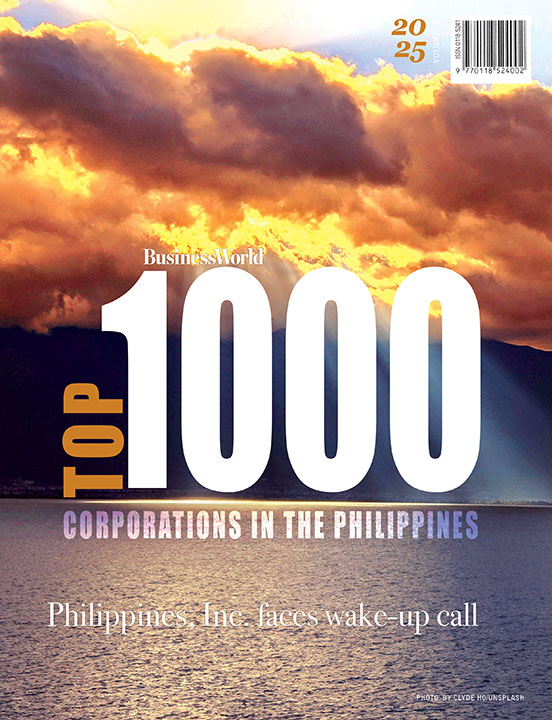
THE TOP 1,000 corporations in the Philippines weathered economic shocks in 2024 as their balance sheets remained stable despite geopolitical tensions and subdued global demand.

While profit growth slowed, the top corporations’ resilience was buoyed by easing inflation and the central bank’s rate cuts in 2024.

The latest edition of BusinessWorld Top 1000 Corporations in the Philippines showed their combined gross revenues climbed by 8.1% to P19.51 trillion in 2024, a tad faster than the 7.2% revenue growth in 2023.

However, their aggregate net income grew by 10.2% to P2.16 trillion in 2024, slowing from 16.6% growth in 2023.

BusinessWorld defines gross revenue as the sum of net sales and nonoperating income while net income is the profit realized by the company after deducting cost of sales, operating and other expenses and taxes.
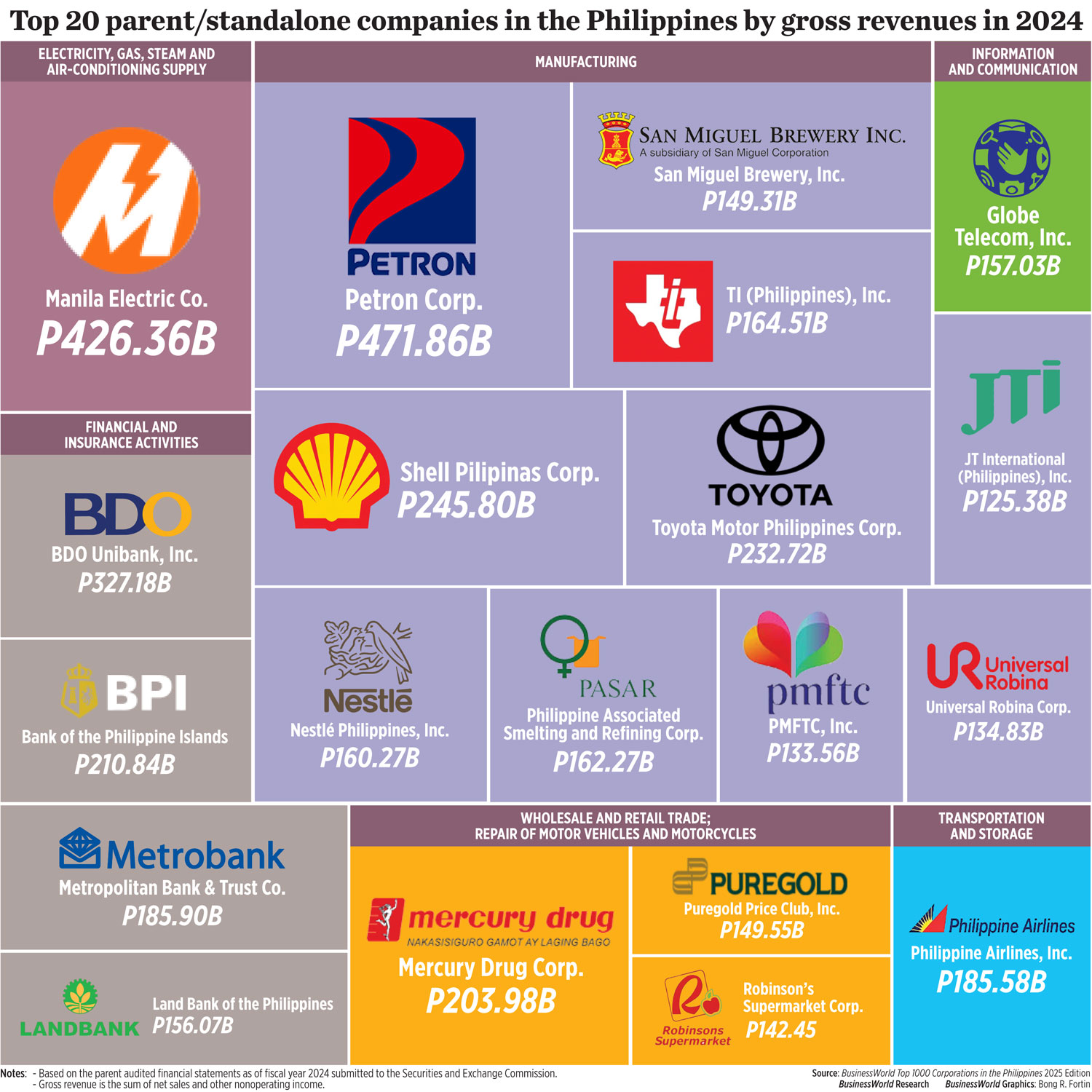
Top corporations’ financial performance in 2024 reflected the Philippine economy’s resilience amid easing inflation and lower interest rates.

The country’s gross domestic product (GDP) expanded by 5.7% in 2024, slightly better than the 5.5% expansion in 2023 and was the strongest reading in two years or since the 7.6% growth in 2022. Still, this was below the government’s goal of 6% to 6.5%.

Headline inflation in 2024 quickened to 3.2%, settling within the Bangko Sentral ng Pilipinas’ (BSP) 2% to 4% target. This was the slowest print since the 2.4% logged in 2020.


Low inflation allowed the BSP to begin its easing cycle in August 2024. Since then, the BSP has slashed interest rates by a cumulative 200 basis points.

BusinessWorld’s annual Top 1000 ranks private and public stock corporations in the Philippines according to their gross revenues for the most recent year.

Using the latest available full-year audited financial statements, the latest edition of the annual magazine had a gross revenue cutoff of P3.94 billion, higher than the previous edition’s of P3.15 billion.

Of the 1,000 companies included in the list, 733 saw their gross revenues grow in 2024, higher than the 683 in the previous year.

In terms of profitability, 628 companies reported a net income, while 372 recorded a net loss.

TOP SECTORS
Companies that secured their spots in the Top 1000 league represented 17 out of the 21 major sectors classified under the 2009 Philippine Standard Industrial Classification (updated 2019).

Similar to the previous edition, 10 sectors posted double-digit growth in gross revenue, with public administration and defense sector’s leading the list as revenues climbed by 31.1% in 2024.

This was followed by arts, entertainment and recreation with a 27.6% increase in revenues, and water supply, sewerage, waste management and remediation activities with 25.1% growth.

On the other hand, agriculture, forestry and fishing sector logged the steepest decline, with its revenues declining by 7.7% during the period.

The manufacturing sector accounted for 31.3% of the total gross revenue of the Top 1000 companies in 2024. The list included 257 manufacturing companies.

At the same time, the list had 273 companies from the wholesale and retail trade sector, which accounted for 22.2% of the total gross revenues.

The services sector, which is a main driver of Philippine economic growth, contributed 57% of the aggregate gross revenue in 2024. This was followed by the industry sector which accounted for 41.8% of gross revenues, and agriculture with a 1.2% share.

Meanwhile, multinational companies (MNC) in the Top 1000 league reported a total of P6.35 trillion in gross revenues in 2024, 12.9% higher than P5.63 trillion in the previous year. MNCs accounted for 32.5% of the Top 1000’s total gross revenues.

Exporting companies’ revenues grew by 4.3% to P3.07 trillion in 2024 from P2.94 trillion previously. Exporters made up 15.7% of the total gross revenues of the Top 1000.

In the latest edition of the annual rankings, 97 corporations were first-time entrants.

PETRON TOPS THE LIST
For the third straight year, Petron Corp. dominated the list of the largest companies in the Philippines by gross revenue in 2024.

The oil refiner and distributor’s gross revenues jumped by 7.1% to P471.86 billion in 2024 from P440.6 billion in the previous year. It also led the list in terms of net sales with P461.17 billion.

Petron’s net income rose by 20.6% to P7.71 billion and ranked 83rd on the list in terms of profits.

Manila Electric Co. (Meralco) ranked second as its gross revenues reached P426.36 billion in 2024. In terms of net sales, it ranked second with P418.33 billion. Meralco also posted a net income of P33.55 billion.

BDO Unibank, Inc. secured the third spot in the rankings as its gross revenue jumped by 17.1% to P327.18 billion from P283.75 billion in 2023. The banking arm of the SM Group placed third in terms of net sales (P260.75 billion) and led the list in terms of net income (P82.12 billion).

Also included in the top 10 corporations in terms of gross revenues were Shell Pilipinas Corp. (P245.8 billion); Toyota Motor Philippines Corp. (P232.72 billion); Bank of the Philippine Islands (P210.84 billion); Mercury Drug Corp. (P203.98 billion); Metropolitan Bank & Trust Co. (P185.9 billion); Philippine Airlines, Inc. (P185.58 billion); and TI (Philippines), Inc. (P164.51 billion).

TOP CONGLOMERATES
The Top 1000 annual rankings include a separate table comparing largest companies in the Philippines on a consolidated basis which will allow readers see and assess how the impact of additional revenues from subsidiaries can boost conglomerate’s rank.

Top Frontier Investment Holdings, Inc. and subsidiaries continued to be the largest conglomerate in the list of the top 200 conglomerates in 2024.

The holding company, which is the largest shareholder of San Miguel Corp. (SMC), posted P1.66 trillion in gross revenue, 8.4% higher than in 2023. Meanwhile, its net income plunged by 20.4% to P36.18 billion.

Listed diversified conglomerate SMC and its subsidiaries landed second place, with P1.66 trillion in gross revenue, up by 8.4% from P1.53 trillion in 2023.

Petron and its subsidiaries claimed third place with P876.24 billion in gross revenues, rising by 8.9% from P804.97 billion in 2023.

The rest of the top 10 conglomerates included SM Investments Corp. (P660.53 billion); Meralco (P487.32 billion); San Miguel Food and Beverage, Inc. (P405.22 billion); Mermac, Inc. (P397.83 billion); Ayala Corp. (P397.83 billion); JG Summit Holdings, Inc. (P391. 03 billion); and BDO Unibank, Inc. (P349.78 billion).

The BusinessWorld report is based on financial statements submitted by private companies to the Securities and Exchange Commission, listed companies’ annual reports disclosed to the Philippine Stock Exchange; and government-owned and -controlled corporations’ annual reports submitted to the Commission on Audit.

The BusinessWorld Top 1000 Corporations in the Philippines can be purchased directly by reaching out to BusinessWorld’s Circulation Department at (+63 2) 8527-7777 locals 2651 to 2654 or via e-mail at circ@bworldonline.com. The portable document format (PDF) version will also be available for purchase at https://bworld-x.com/. For further inquiries about the magazine, you may contact the Research Department via e-mail at research@bworldonline.com.

Meralco says to kick off nuclear adoption study with USTDA in Q1

FREEPIK

MANILA ELECTRIC CO. (Meralco) plans to begin a study with the United States Trade and Development Agency (USTDA) on the adoption of small modular reactors (SMR) within the first quarter, the company said in a disclosure to the local bourse on Monday.

“The study is expected to commence during the first quarter and is expected to be completed by the fourth quarter this year,” it said.

The power distributor is set to issue a request for proposal this month to select a contractor that will conduct the feasibility study.

Meralco earlier secured a $2.7-million (P160 million) grant from USTDA to fund the assessment of SMR deployment in the Philippines.

The initiative forms part of Meralco’s Nuclear Energy Strategic Transition (NEST) program, under which the company has been carrying out pre-feasibility work and partnership discussions to evaluate nuclear technologies suitable for local conditions.

The study supports the Department of Energy’s (DoE) goal of incorporating at least 1,200 megawatts (MW) of nuclear power into the country’s energy mix by 2032 as part of efforts to diversify supply and reduce reliance on fossil fuels.

Starting in April, Meralco said it would begin identifying potential sites suitable for SMR facilities, in coordination with government agencies such as the DoE and Philippine Nuclear Research Institute. Site selection will consider technical, environmental and regulatory factors.

SMRs are designed to generate up to 300 MW each and can be built in a shorter timeframe compared with conventional large-scale nuclear power plants. Proponents say their smaller size and modular construction could allow more flexible deployment.

Aside from the technical study, Meralco said it would carry out stakeholder engagement and consultations, capability-building initiatives and support work related to the country’s legal and regulatory frameworks governing nuclear energy.

By the fourth quarter, the company expects to produce a shortlist of potential sites for submission to the DoE and Philippine Atomic Energy Regulatory Authority, the recently established independent regulator overseeing nuclear and radiation-related activities.

“The NEST program is in its preparatory phase, thus no material impact is expected on the company’s business, operations, and financials at this juncture,” Meralco said.

Meralco is the country’s biggest private electric distribution utility, serving 39 cities and 72 municipalities. It also has interests in power generation through wholly owned units and equity stakes.

Its controlling shareholder, Beacon Electric Asset Holdings, Inc., is partly owned by PLDT Inc. Hastings Holdings, Inc., a unit of PLDT Beneficial Trust Fund subsidiary MediaQuest Holdings, Inc., has an interest in BusinessWorld through the Philippine Star Group, which it controls. — Sheldeen Joy Talavera

Tiered IPO rules may draw more tech stocks

FREEPIK

A PROPOSAL seeking a tiered minimum public ownership framework could encourage more technology companies to pursue an initial public offering (IPO), analysts said.

“The Securities and Exchange Commission’s (SEC) draft proposal for a tiered minimum public ownership framework marks a meaningful shift away from a one-size-fits-all IPO rule toward a more flexible, size-based approach that better reflects the realities of today’s capital market,” Toby Allan C. Arce, head of sales trading at Globalinks Securities and Stocks, Inc., said in a Viber message.

Last month, the SEC released a draft memorandum circular proposing a tiered minimum public ownership framework for companies seeking to list shares on the stock exchange.

The draft circular aims to establish varying public ownership requirements based on the size of the issuer, as well as factors such as market liquidity, investor protection, capital formation and market competitiveness.

Mr. Arce said the proposed framework aligns with the Department of Information and Communications Technology’s (DICT) push to encourage more technology companies to list locally.

The ICT secretary has said Globe Fintech Innovations, Inc. (Mynt), the parent of GCash, and Grab Philippines have strong potential to go public. However, both firms have said an IPO is not a priority for them.

Under the draft circular, companies planning to go public will be assigned to one of five tiers based on their expected market value at listing.

Tier I companies with a market value of up to P500 million must maintain a minimum initial public float of 33%. Tier II companies valued between P500 million and P1 billion must have at least a 25% public float, with a minimum value of P165 million.

Tier III companies with market values ranging from P1 billion to P50 billion will need to maintain at least a 20% public float worth at least P250 million. Tier IV firms valued between P50 billion and P150 billion must have a minimum public float of 15%, equivalent to at least P10 billion. 

Tier V companies with a market value exceeding P150 billion must maintain a public float of at least 12%, or a minimum of P22.5 billion.

After listing, companies must maintain a fixed minimum level of public ownership corresponding to their assigned IPO tier.

DICT Secretary Henry Rhoel R. Aguda earlier said he is pushing for more technology firms to go public to help deepen the country’s capital market.

“On the positive side, marquee tech IPOs would deepen the market, widen the investor base and create clear exit paths for venture capital and private equity backers,” Mr. Arce said.

But Rizal Commercial Banking Corp. Chief Economist Michael L. Ricafort said technology firms are waiting for more favorable market conditions before proceeding with IPO plans.

Mr. Arce added that limited market depth and liquidity, as well as investor appetite for tech stocks, could discourage listings. He also cited macroeconomic and valuation concerns that could weigh on post-listing performance. — Beatriz Marie D. Cruz

Gov’t hikes Treasury bill award as demand soars

BW FILE PHOTO

THE GOVERNMENT upsized the award of the Treasury bills (T-bills) it offered on Monday as it saw strong market demand, with rates also lower than those quoted at the secondary market.

The Bureau of the Treasury (BTr) raised P34.2 billion via the T-bills it auctioned off, higher than the P27-billion plan as the offer was more than four times oversubscribed, with total tenders reaching P108.1 billion. This was also well above the P87.456 billion in bids recorded on Dec. 15 for a P20-billion offering.

The Auction Committee increased its award as the auction was met with strong demand, with all T-bill tenors quoted at average yields that were lower than secondary market rates, the Treasury said in a statement.

This led the BTr to double its acceptance of noncompetitive bids for the 91- and 182-day T-bills to P7.2 billion each. 

Broken down, the government awarded P12.6 billion in 91-day T-bills, above the P9-billion plan, as demand for the tenor reached P36.235 billion. The three-month paper fetched an average rate of 4.755%, up by 2.4 basis points (bps) from 4.731% in the previous auction. Yields accepted were from 4.69 to 4.78%.

The Treasury also increased the award for the 182-day debt to P12.6 billion from the P9-billion program as tenders hit P41.15 billion. The average rate of the six-month T-bill was at 4.895%, down by 0.8 bp from 4.903% previously. Tenders awarded carried yields from 4.83% to 4.923%.

Lastly, the BTr sold P9 billion as planned in 364-day securities as the tenor attracted bids totaling P30.715 billion. The one-year paper’s average yield was at 4.937%, up by 1.3 bps from 4.924% the previous auction. Accepted rates were from 4.875% to 4.937%.

At the secondary market before Monday’s auction, the 91-, 182-, and 364-day T-bills were quoted at 4.8547%, 4.9769%, and 5.0375%, respectively, based on PHP Bloomberg Valuation Service Reference Rates data provided by the Treasury.

The government hiked its T-bill award as the offer was received well, a trader said in a phone interview. “Traders were looking to load up their portfolios for the year.”

The trader added that average rates were mostly higher than those fetched at the Dec. 15 auction amid inflation concerns due to the United States’ attack on Venezuela and its potential impact on global oil prices.

The Philippines is a net importer of petroleum products.

“Treasury bill average auction yields mostly corrected slightly higher… as markets adopted a wait-and-see attitude after the recent developments on the US’ invasion of Venezuela over the weekend,” Rizal Commercial Banking Corp. Chief Economist Michael L. Ricafort said in a Viber message.

Oil prices fell on Monday as adequate global supplies offset concerns about supply disruptions due to the US capture of Venezuelan President Nicolas Maduro in an audacious raid over the weekend, Reuters reported.

Brent crude futures were down 50 cents or 0.8% to $60.26 a barrel at 0752 GMT, while US West Texas Intermediate crude was 53 cents or 0.9% lower at $56.79 a barrel.

The key benchmarks were volatile in early Asian trade as investors assessed the political upheaval in the Organization of the Petroleum Exporting Countries member Venezuela and the potential impact on oil supply.

US President Donald J. Trump said Washington would take control of the country and that a US embargo on Venezuelan oil remained in full effect, after detaining Mr. Maduro in New York on Sunday.

In a global market with plentiful oil supply, analysts said any further disruption to Venezuela’s exports would have little immediate impact on prices.

On Tuesday, the government is looking to raise up to P50 billion from a dual-tenor Treasury bond (T-bond) offering, as it could borrow between P20 billion and P30 billion each in reissued seven-year papers with a remaining life of two years and seven months and via reissued 10-year debt with a remaining life of nine years and three months.

The BTr is looking to raise P268 billion from the domestic market this month, or P106 billion in T-bills and P160 billion in T-bonds

The government borrows from local and foreign sources to help fund its budget deficit, which is capped at P1.647 trillion or 5.3% of gross domestic product this year. — Aaron Michael C. Sy with Reuters

Long-term deals could cushion power firms amid weak spot prices

STOCK PHOTO | Image from Freepik

ENERGY COMPANIES are likely to pursue capacity expansion and secure long-term supply agreements to cushion the impact of an extended period of weak spot power prices, analysts said.

“We think margins will generally fare better this year as most companies are seeking to increase their portfolio mix of contracted capacity to mitigate the impact of the persistent softness in spot prices that is expected this year,” Andrei Jorge G. Soriano, a research associate at China Bank Securities Corp., said in an e-mailed reply to questions.

He said some power distribution utilities posted lower energy sales volumes in the first nine months of 2025, largely due to cooler temperatures and weather-related disruptions that dampened electricity demand.

He said energy sales of distribution firms such as Manila Electric Co. are expected to rebound as demand normalizes, while companies that already posted improved volumes, including Aboitiz Power Corp., are likely to sustain their growth trajectory.

For power generation companies, he said the addition of operating capacity last year was weighed down by subdued spot prices, lower irradiance levels that hurt solar generation output, and power failures at some facilities.

“We expect those with scheduled project completions this year… to benefit from incremental capacity,” Mr. Soriano said, noting that expansion projects could help lift volumes even in a low-price environment.

Peter Louise D. Garnace, an equity research analyst at Unicapital Securities, Inc., said the financial performance of generation companies was mixed last year, largely depending on how early companies adjusted their contracting strategies and expansion plans.

“Generation companies with larger exposure to the spot market saw margin squeeze, while those that pivoted early by entering into bilateral contracts were able to cushion the impact of weak spot prices,” he said in a Viber message. 

Mr. Garnace said power companies that have secured bilateral supply contracts are more attractive from an earnings standpoint because these agreements provide predictable cash flows and reduce exposure to price volatility in the spot market.

Data from the Independent Electricity Market Operator of the Philippines showed that prices at the Wholesale Electricity Spot Market (WESM) fell to multi-year lows, with the effective price averaging P4.32 per kilowatt-hour (kWh) from January to November last year.

This was lower than the full-year average of P5.58 per kWh in 2024 and P6.44 per kWh in 2023.

WESM serves as the trading venue where energy companies get electricity when long-term contracted supply is insufficient.

“We anticipate a lower-for-longer spot price environment, driven by an oversupply of coal globally, coupled with the growing adoption of renewable energy, natural gas and nuclear power,” Mr. Garnace said.

“With more capacity expected, this should limit upside risks to electricity prices that will be passed through to end-users,” he added. — S.J. Talavera

Passing the torch: Leading for the next generation and the Age of AI

STOCK PHOTO | Image by Tonodiaz from Freepik

Three decades — that’s how long it has taken me to build the AHEAD Education Group into the most awarded supplementary education organization in the Philippines.

But it’s time to close that chapter. The fast-paced world where technology constantly evolves has shown me a truth that I’ve been hesitant to accept for a while: no founder stays at the helm forever. They eventually need to “pass the torch” to the next generation. The question is: Will the next generation carry it higher? Or, will it simply survive before being snuffed out?

The answer to that question will depend on how effectively the torch has been passed.

ART OF MINDFUL CREATION, SURRENDER
Leadership doesn’t just preserve; it creates with purpose. When others thrive, innovate, and expand the mission’s reach despite the odds, I believe that is leadership done right. As family business expert Dennis Jaffe wrote, “A legacy that lasts isn’t about keeping control, it’s about releasing purpose.” In other words, an organization’s lifespan isn’t decided by the founder’s grip on the reins. Rather, it’s by how confidently those who come after can take them.

AHEAD has always been about empowering students, transforming lives, and contributing to the nation’s growth. I hope that my sons, Nicolo and Paolo, as they assume the operational helm of AHEAD, keep that in mind.

As leadership expert John Maxwell reminds us, “Success without a successor is failure.” True success is not about personal milestones but about ensuring the mission continues, generation after generation.

Since 2000, I’ve personally funded AHEAD’s School Leaders Training Program because I believe leadership development is not an expense but an investment — better leaders build a stronger, brighter future together. I hope Nicolo and Paolo continue and expand this legacy, ensuring that leadership excellence remains at the heart of Philippine education.

PREPARING THE NEXT GENERATION
While many see succession as just a transfer of titles, for me, it is more of a dedicated process that focuses on protecting the company’s DNA while adapting it to the changing times. As Russell Reynolds Associates says, “Effective succession is a process, not an event. It requires years of structured mentorship, measured exposure, and shared accountability.”

AHEAD remains the same in principle. The next generation must:

• Take real operational responsibility, not symbolic roles.

• Embody the values of responsibility, excellence, and leadership in every decision.

• Understand both the legacy they inherit and the transformation required in the age of artificial intelligence (AI), globalization, and lifelong learning.

EMBRACING CHANGE AS THE CONSTANT
As online and AI-enabled learning take center stage, AHEAD — now 30 years strong — must redefine its place. Nicolo and Paolo’s challenge is not just to stay relevant, but to equip today’s and tomorrow’s students for a changing world. Digital learning, hybrid models, and evolving teacher-student dynamics promise progress, but tools alone aren’t enough.

To survive is one thing; to thrive requires the will to learn, adapt, and teach others to do the same.

When we discussed their college path many years ago, I asked them about their life goals.

One answered, “Free education for the poor.”

The other said, “Quality education for Filipinos.”

Their answers made us resilient against so many problems, including the Asian Financial Crisis, the K to 12 transition, and the COVID-19 pandemic.

MY HOPE FOR MY SONS
My hopes for Nicolo and Paolo, as they handle the future of AHEAD, are simple yet profound:

• That they treat responsibility as a privilege, not a burden.

• That they face systemic challenges, such as improving operational efficiency or expanding digital platforms, with persistence and creativity.

• That they remain committed to excellence, continuing AHEAD’s research-based, results-driven tradition.

• That they lead with integrity, guiding the organization with clarity, empathy, and discipline.

• That they respect every teacher, staff member, and student as equal stakeholders in our shared mission.

• That they act with humility in success and courage in adversity.

• That they understand that world-class leadership is not inherited, it is earned, every day, through service and integrity.

CHALLENGE AND OPPORTUNITY
To all founders, educators, corporate leaders, and next-generation executives: the torch you hold is not just a symbol, it is a responsibility. You do not just inherit what was built; you are the engineers of what must come next.

With change accelerated by AI, global connectivity, and social transformation, there’s a demand for courage and adaptability. It’s time we ask, “How do we prepare for what’s next without compromising our original purpose?”

At AHEAD, we embrace this question daily. Our mission remains the same: to deliver responsible, excellent, and ethical education. However, our methods will evolve: AI-enabled tutoring, data-informed learning, and new programs designed to elevate Filipinos out of poverty through access to opportunity and quality education.

PASSING THE TORCH
I don’t see succession as the end of an era, but the start of a stronger one. AHEAD’s torch will burn brighter while staying true to its purpose.

Founders don’t leave monuments; they blaze trails for those brave enough to follow. As I pass the torch to Nicolo and Paolo, I hope they carry it not for themselves, but for every student who dreams, every teacher who inspires, and every Filipino family that believes education is the surest way to rise.


Rossana Llenado is member of the Education Committee of the Management Association of the Philippines (MAP). She is the founder and chair of the AHEAD Education Group.

map@map.org.ph

rll@ahead.edu.ph

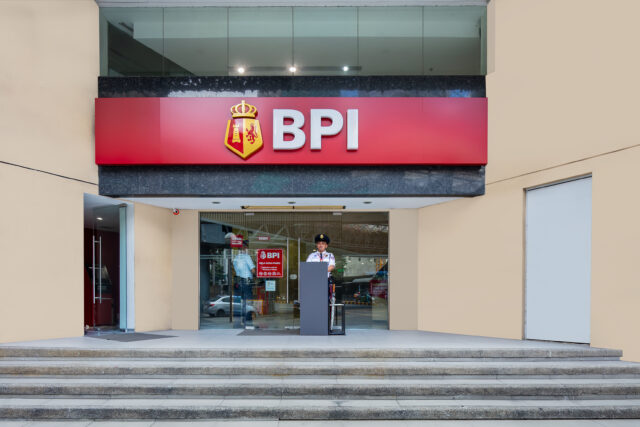
BPI looks to raise at least P5 billion via social bonds

BPI/BW FILE PHOTO

BANK of the Philippine Islands (BPI) wants to raise at least P5 billion via the sale of social bonds.

The listed bank is set to offer two-year fixed-rate peso-denominated papers called BPI Supporting Individuals Grow, Lead, and Achieve Bonds or BPI SIGLA Bonds, and is looking to raise P5 billion in fresh funds, with the option to upsize, it said in a disclosure to the stock exchange on Monday.

The public offer period is scheduled to start on Jan. 26 and end on Feb. 4, unless adjusted by the bank. The bonds are expected to be issued and listed on the Philippine Dealing and Exchange Corp. on Feb. 13.

“The net proceeds of the offer will be used for the financing or refinancing of eligible social projects under BPI’s Sustainable Funding Framework consistent with the ASEAN Social Bond Standards,” the bank said.

The Securities and Exchange Commission affirmed the notes’ “ASEAN Social Bond” label on Dec. 18, it added.

The BPI SIGLA Bonds issuance will mark the second issuance out of the bank’s P200-billion bond and commercial paper program approved in October 2024.

BPI Capital Corp. and ING Bank N.V., Manila Branch are the joint lead arrangers and selling agents for the offer.

BPI last tapped the domestic market in May last year, raising P40 billion from its offering of 1.5-year Supporting Inclusion, Nature, and Growth or SINAG Bonds. This was well above the initial P5-billion plan and marked the bank’s largest peso bond issuance to date.

The papers were priced at an interest rate of 5.85% per annum to be paid quarterly.

BPI’s attributable net income inched up by 0.6% to P17.526 billion in the third quarter of 2025. This brought its nine-month profit to P50.48 billion, up by 5.21% year on year.

The bank’s shares went down by 50 centavos or 0.42% to close at P118.10 apiece on Monday. — A.M.C. Sy

Live music for the next 5 months

The concerts of 2026, so far

THIS YEAR has a lot in store for music lovers, with local and international acts populating the live concert lineup. Filipinos can expect performances from hitmakers, indie artists, rock stars, rappers, and balladeers all throughout the year.

Here is a rundown of live music performances to look forward to (and to block off on your calendar for) over the first five months of 2026, so far.

JANUARY
Air Supply’s 50th anniversary tour
Jan. 11, 24, 25, 27

Australian rock duo Air Supply will stage four concerts in the Philippines for their 50th anniversary tour. The venues are: City of Passi Arena in Iloilo on Jan. 11, Jose Rizal Coliseum in Laguna on Jan. 24, Aquilino Pimentel International Convention Center in Cagayan de Oro on Jan. 25, and Waterfront Cebu City Hotel and Casino in Cebu on Jan. 27.

Wendy of Red Velvet’s W:EALIVE
Jan. 17

Korean solo artist Wendy, previously the vocalist of K-pop group Red Velvet, will be performing at the New Frontier Theater in Quezon City on Jan. 17. The concert is part of her first-ever world tour.

RIIZE’s RIIZING Loud
Jan. 17

K-pop group RIIZE will be holding a concert in Manila as part of their concert tour across Asia. It will take place at SM Mall of Asia Arena on Jan. 17.

Colde’s BLUEPRINT+
Jan. 17

South Korean singer‑songwriter and music producer Colde will return to Manila this January. The Manila leg of his BLUEPRINT+ tour will be held at the Music Museum, Greenhills Shopping Center, in San Juan City.

1st.One’s UNA
Jan. 18

P-pop boy group 1st.One’s UNA Asia tour will be kicking off in Quezon City this January. The concert will take place at the SM North EDSA Skydome on Jan. 18.

Day6’s The DECADE
Jan. 24

South Korean rock band Day6 will come to Manila for their 10th anniversary world tour called The DECADE. It will be held on Jan. 24 at the SM Mall of Asia Arena, Pasay City.

The Lumineers’ Automatic World Tour
Jan. 26-27

American alternative folk band The Lumineers will return to the Philippines to stage a two-night show at the New Frontier Theater in Quezon City. Their return to the country is part of their world tour.

Wisp’s If Not Winter
Jan. 28

American shoegaze artist Wisp is returning to the Philippines for a show at the SM North EDSA Skydome in Quezon City. The Asia tour celebrates If Not Winter, her latest album released in August 2025.

Bryan Adams’ Roll with the Punches
Jan. 31

Canadian singer-songwriter Bryan Adams will hold another Manila concert on Jan. 31 at the SM Mall of Asia Arena, Pasay City. It is part of his Asia tour.

FEBRUARY
Men I Trust’s Equus Tour
Feb. 1

Canadian indie trio Men I Trust is returning to the Philippines following their Wanderland 2023 performance. This time, they will perform at Filinvest Tent, Alabang, on Feb. 1 for their Equus tour.

Samm Henshaw’s It Could Be Worse…
Feb. 3

At Teatrino Greenhills in the Greenhills Shopping Center in San Juan City, British soul singer-songwriter Samm Henshaw will be taking the stage for the Manila leg of his It Could Be Worse… Asia tour.

GIVÉON: Dear Beloved, The Tour to Manila
Feb. 4

American hitmaker Giveon will be bringing his Dear Beloved, The Tour to Asia, with a Philippine stop at the New Frontier Theater, Cubao, Quezon City. The show will highlight his hits like “Heartbreak Anniversary.”

KZ Tandingan, TJ Monterde’s
In Between
Feb. 6-9

Filipino singer-songwriters KZ Tandingan and TJ Monterde are teaming up for a concert in February. For four nights, from Feb. 6 to 9, they will bring their best hits to the Smart Araneta Coliseum in Quezon City.

Wolfgang’s The Reunion concert
Feb. 7

Filipino rock band Wolfgang is returning onstage for the 30th anniversary of their debut album, Wolfgang. Founding members Basti Artadi, Manuel Legarda, and Wolf Gemora will reunite at the New Frontier Theater in Quezon City, for the Feb. 7 show.

Underoath’s Underoath Live in Manila
Feb. 12

American metal/rock band Underoath will be coming to the Philippines for the first time in February. Their concert is set to take place at the SM North EDSA Skydome in Quezon City on Feb. 12.

Josh Groban’s GEMS World Tour 2026
Feb. 18

Renowned American singer-songwriter Josh Groban is slated for a Feb. 18 concert at the SM Mall of Asia Arena in Pasay City. It marks his third time performing in the Philippines.

Cavetown’s Running With Scissors Tour
Feb. 18

The Running With Scissors concert in Manila will be English indie musician Cavetown’s first time in the Philippines. Taking place at the New Frontier Theater in Quezon City, the show is part of his world tour.

Maki’s KOLORCOASTER
The Concert: One More Ride
Feb. 21

Filipino singer-songwriter Maki is bringing his KOLORCOASTER concert series to Quezon City’s Smart Araneta Coliseum. Known for the hit song “Dilaw,” Maki will perform more of his hits at the venue on Feb. 21.

Kim Sejeong’s Tenth Letter
Feb. 21

South Korean singer and actress Kim Sejeong is celebrating her 10th anniversary with a concert tour, which has a Manila leg on Feb. 21 at the New Frontier Theater in Quezon City.

Chen’s Arcadia tour
Feb. 28

Fans of Korean group EXO’s vocalist, Chen, will want to catch his Arcadia solo tour stop in Manila this February. It is set to take place at the FYM Hall, EVM Convention Center, in Quezon City.

VXON’s Kalawakan concert
Feb. 28

To open the year, P-pop boy group VXON is mounting a concert, Kalawakan, at the SM North EDSA Skydome in Quezon City. It marks the group’s first-ever concert.

MARCH
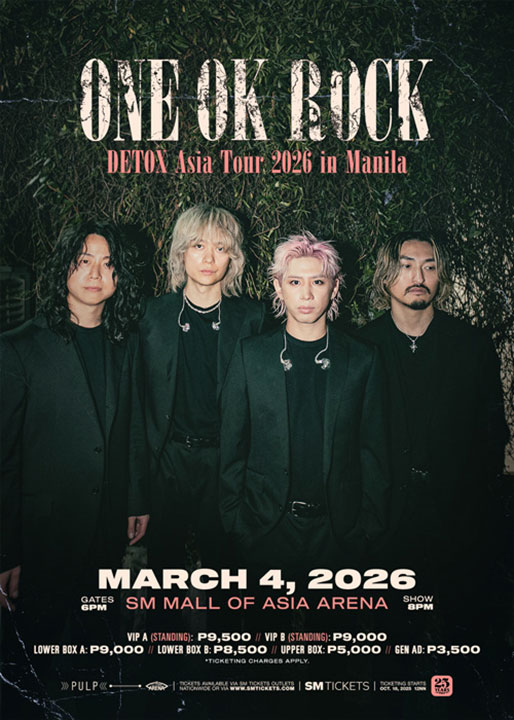
ONE OK ROCK’s DETOX
March 4

The Japanese rock band ONE OK ROCK will hold a concert this March, marking their fourth show in the Philippines. Their DETOX Asia tour will be coming to the SM Mall of Asia Arena, Pasay City.

Peabo Bryson’s The Golden Touch tour
March 8

Contemporary balladeer Peabo Bryson is returning to Manila in March for The Golden Touch tour. His concert will take place at The Theatre at Solaire in Parañaque City.

NCT Wish’s Into the Wish tour
March 14

Korean group NCT Wish is bringing their tour to the Philippines. The Manila stop will be at the New Frontier Theater in Cubao, Quezon City.

ATEEZ’s In Your Fantasy tour
March 14

K-pop boy group ATEEZ is returning to the Philippines for their In Your Fantasy tour. The Manila concert will take place at the Smart Araneta Coliseum, Quezon City.

Central Cee’s Can’t Rush Greatness
March 16

British rapper Central Cee will be bringing his world tour to Manila in March. Slated for March 16 at the Smart Araneta Coliseum, it marks his first-ever concert in Manila.

SEVENTEEN’s New_ world tour
March 21

South Korean boy group SEVENTEEN will be in the country in March for their world tour, New_, with a Manila stop on the 21st. The venue will be the Philippine Sports Stadium in Bulacan.

APRIL
Treasure’s Pulse On tour
April 18

K-pop boy group Treasure is set to have a concert in the Philippines in April. It will take place at the SM Mall of Asia Arena in Pasay City, as part of their Pulse On world tour.

IVE’s Show What I Am world tour
April 25

K-pop girl group IVE will be bringing their Show What I Am world tour to the Philippines in April. The Manila stop is part of their first wave of shows, with the venue set to be the SM Mall of Asia Arena.

MAY
Playback Music Festival
May 8-9

The Playback Music Festival, known as the Philippines’ punk, rock, and emo festival, will be held over two days in two cities: at the SM Mall of Asia Arena in Pasay City on day one, and at the Waterfront Hotel in Cebu City on day two. It will feature Faber Drive, The Red Jumpsuit Apparatus Dashboard Confessional, and other punk, rock, and emo performers.

Pixies 40 in Manila
May 10

At the Filinvest Tent in Alabang, Muntinlupa City, 1980s alt-rock band the Pixies will be celebrating their 40th anniversary with a show in the Philippines. Pixies 40 in Manila is part of their world tour. — Brontë H. Lacsamana

SEC sukuk guidelines may boost investor pool

BW FILE PHOTO

THE SECURITIES and Exchange Commission’s (SEC) proposed revised guidelines on sukuk issuance are expected to deepen the Philippine capital market by broadening the range of investment instruments and drawing in more domestic and global investors, an analyst said.

“This would help develop the local capital markets, especially with more diversity in terms of investment instruments and tapping more investors locally and internationally,” Michael L. Ricafort, chief economist at Rizal Commercial Banking Corp., said in a Viber message.

Sukuk consists of equal-value certificates that represent undivided ownership interests in underlying assets, investments or projects structured in accordance with Shari’ah principles, which prohibit interest and emphasize asset-backed financing and risk-sharing.

In November, the SEC released the second exposure draft of its proposed sukuk guidelines, setting out a regulatory framework for issuance and disclosure in the Philippines. The draft places emphasis on Shari’ah compliance, transparency and investor protection.

Under the proposed rules, sukuk offered to the public must be registered with the SEC and may be listed, traded and settled in line with the rules of a SEC-registered exchange, fixed-income market or other organized trading platforms.

Eligible issuers include listed and nonlisted stock companies, the National Government and its agencies, local government units, government-owned and -controlled corporations and Bangko Sentral ng Pilipinas-supervised banks including Islamic banks.

Special Purpose Entities may also issue sukuk under exemptions provided by the Securities Regulation Code.

The SEC said special purpose entities must be incorporated and registered in compliance with existing regulations and may be formed separately from originators solely for sukuk issuance, asset holding on behalf of investors and adherence to international standards including Shari’ah principles.

Mr. Ricafort said the proposed framework could widen both the investor and issuer base by opening access to major markets in the Middle East, Asia and other regions with strong demand for Shari’ah-compliant instruments.

“It would also give issuers more options to raise funds, especially through these specialized investment instruments,” he said.

The draft guidelines allow various Shari’ah-compliant sukuk structures, including sukuk ijarah, which is based on asset sale and leaseback arrangements; sukuk murabahah, involving cost-plus financing; and sukuk istisna, which is typically used to fund manufacturing or construction projects.

Other permitted structures include sukuk wakalah bil istithmar (agency-based investment), sukuk mudarabah (profit-sharing) and sukuk musharakah (joint ownership). Any additional structures would require SEC approval and full documentation to ensure compliance with Shari’ah principles.

The SEC also requires issuers to establish a Shari’ah Committee or appoint a Shari’ah adviser to certify that sukuk structures, assets and transactions comply with Shari’ah rules and to oversee ongoing monitoring and audits throughout the life of the sukuk. — Alexandria Grace C. Magno

The end of the Marcos political dynasty is near

PPA POOL/MARIANNE BERMUDEZ

A month before Ferdinand “Bongbong” Marcos, Jr. was to be inaugurated as the 17th president of the Philippines, his sister, Senator Imee Marcos, expressed the hope that the family would finally be given the platform to “clarify” the legacy of their father. She bared, “We have been there; the truth is our return to the Palace is not that important. What is most important to us is our name, the family name that has become so controversial and so difficult at times to bear. The legacy of my father is what we hope will be clarified at last.”

At his inauguration as president, Ferdinand Marcos, Jr. said: “I once knew a man who saw what little had been achieved since independence in a land filled with people with the greatest potential for achievement, and yet they were poor. But he got it done. Sometimes, with the needed support. Sometimes, without. My father built more and better roads, produced more rice than all administrations before his.”

In his conversation with World Economic Forum President Borge Brende in Davos, Switzerland, in January 2023, President Ferdinand Marcos, Jr. said: “I was determined not to go into politics. I could see the sacrifices he had to make to do a good job. But after we came back from the United States, after exile, the political issue was Marcos. And for us to defend ourselves politically, somebody had to enter politics and be in the political arena so that not only the legacy of my father but even our own survival required that somebody go into politics.”

So, that was what his entry into politics was all about — to defend the legacy of his father and themselves politically, not to serve the people. Bongbong has told the Filipino people how great his father was. He must also tell the whole world. After all, the Guinness World Record attributes to his father the record for “the greatest robbery of a government.”

The Marcos family has had the platform to clarify the legacy of the patriarch for three years now, but all they have said about the widespread corruption and rampant abuse of human rights with which their father’s martial law regime is associated is that it is “all political propaganda.” That is no clarification.

The widespread corruption during the Marcos Regime is supported by testimonies of their father’s own accomplices in the plunder of the national coffers and by documentary evidence. The rampant abuse of human rights is also backed up by the accounts of surviving victims of torture and by the admission of guilt by some of the violators of human rights.

What Ferdinand Marcos, Sr. had done can no longer be undone. His deeds are history. The family name Marcos will remain controversial and difficult to bear, as Imee intimated.

The entry of Imee and Bongbong into the political arena to ensure the family’s own political survival only brings about the final exit of the Marcos dynasty from the national political scene.

Bongbong ran on a campaign of national unity, a subtle way of telling the electorate to forget the corruption and brutality of his father’s regime and to think of the reprise of the Golden Era that his father supposedly brought about. Upon his election, his sister Imee said “I think now is the time to show what we can still do for the country.”

But for most of his years as president, Marcos Junior has introduced no major policy initiatives, nor launched a comprehensive all-inclusive plan for economic transformation.

The P20 per kilo of rice was a major campaign promise. He vowed to recommend a price cap for rice and task government agencies to serve as middlemen in the procurement of harvests. To this day, the P20 per kilo of rice is still not available in the local markets. Regularly milled rice at the markets in Metro Manila sells for P36 to P42 per kilo. Well-milled rice is priced at P40 to P46 per kilo.

In September 2022, President Marcos Jr. vowed that his administration would build, under the Philippines’ Pambansang Pabahay Para sa Pilipino (4PH) program, at least one million low-cost housing units every year until his term ends in 2028 — or a total of six million units. But challenges punctured the overblown promise. As of late 2025, there is no definitive figure for the total number of houses completed and turned over to beneficiaries as many projects are still under construction.

The program’s initial target of six million units by the end of his term has been revised. The current focus is on a target of 3.2 million units by 2028.

In a press conference on Dec. 18, he said it will be an unhappy Christmas for those involved in the flood control corruption mess. “I know their cases will be done before Christmas. The cases filed against them are complete and they will be jailed. They will not have a Merry Christmas,” the President said in Filipino.

While he did not explicitly name any lawmaker, the extremely infuriated citizenry assumed that Senators Francis Escudero, Joel Villanueva, and Jinggoy Estrada were among those he referred to as the three have been prominently implicated with the flood control grand scam. Christmas passed but no senator or congressman was jailed.

The latest Social Weather Stations (SWS) survey, conducted from Nov. 24 to 30, 2025, shows that Bongbong has a net trust rating of -3%. I expect the next SWS survey will show Bongbong’s trust rating to have gone into a free fall.

As for his sister Senator Imee Marcos, she self-destructed during the Iglesia Ni Cristo (INC) rally in November last year when she accused Bongbong and his wife, Liza, of using illegal drugs. Critics saw it as a “desperate move” designed to destabilize the government amidst ongoing anti-corruption protests. Senator Panfilo Lacson, who questioned the motive behind such a public family dispute, found her act of publicly discrediting her own brother in front of a massive crowd “un-Filipino.”

Political scientists opined that Imee’s “big miscalculation” eroded her political base. Marcos loyalists reportedly felt betrayed, believing that if she could turn on her brother, she could very well betray political allies.

Political pundits saw her emotional behavior of crying when she was putting her brother down as juvenile, utterly unbecoming of a senator, and most inappropriate in a rally that called for “accountability, transparency, and justice.” Because of that childish behavior, the INC decided to cut short its scheduled political three-day rally.

The Marcos political dynasty will disappear permanently from the national landscape when the respective terms of office of President Bongbong Marcos and Senator Imee Marcos end — June 30, 2028 for the former, June 30, 2030 for the latter.


Oscar P. Lagman, Jr. has been a keen observer of Philippine politics since the mid-1950s.

House bill seeks to allow scrutiny of foreign currency deposit accounts

US dollar banknotes are seen in this photo illustration taken Feb. 12, 2018. — REUTERS

A BILL seeking to allow authorities to look into foreign currency deposits suspected to be involved in illegal activities was filed in the House of Representatives last month.

House Bill No. 6902 seeks to allow authorities to examine foreign currency deposit accounts in “exceptional” cases involving impeachment, bribery or dereliction of duty of government officials, or where the funds are the subject of court proceedings.

It also proposes to remove their exemption from governmental processes.

The bill seeks to amend the deposit secrecy provisions under Republic Act (RA) No. 6426 or the Foreign Currency Deposit Act of the Philippines as amended by Presidential Decrees Nos. 1034, 1035, and 1246.

Under the law, all foreign currency deposits are absolutely confidential, with the only exception to secrecy being when there is written permission of the depositor, preventing authorities from examining accounts that may be tied to crimes or needed in trial. These funds are also exempt from attachment, garnishment, or any other order or process of any court, legislative body, government agency or any administrative body.

These provisions were meant to help encourage the inflow of foreign funds into Philippine banks to boost lending and investment activity and stimulate the economy.

The bill’s proposed exemptions are already in RA 1405 or the Law on Secrecy of Bank Deposits.

The bill’s authors, Party-list Reps. Antonio L. Tinio, Sarah Jane I. Elago and Renee Louise M. Co, said in the measure’s explanatory note that the special protections provided by the Foreign Currency Deposit Act are now “obsolete” as there is no longer a lack of foreign currency in the domestic financial system amid the regular inflow of funds via remittances and other traditional sources.

“Furthermore, recent history has shown how the absolute and unqualified secrecy of foreign currency deposits, and their exemption from government orders and processes, is exploited to cloak financial transactions by individuals and entities involved in illegal activities,” they added. “For instance, government officials, including those conferred with immunity from suit during their incumbency and removable only through impeachment, may make use of foreign currency deposits to amass ill-gotten wealth.”

“If this bill is enacted into law, foreign currency deposits will, in these respects, enjoy the same level of protection as deposits in the national currency.”

Congressmen had earlier approved a bill amending the decades-old RA 1405 to provide regulators stronger oversight to monitor financial institutions and prevent cases of insider abuse or illegal funding activities.

The International Monetary Fund said in a December report that the Philippines should amend its deposit secrecy laws to enhance the BSP’s supervisory powers and support its efforts to combat money laundering and terrorist financing. — Kenneth Christiane L. Basilio

Developers urged to revamp aging offices to boost take-up

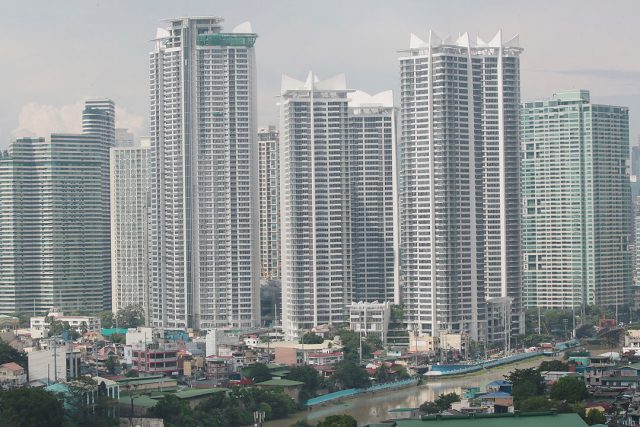
A VIEW of buildings in Makati City. — PHILIPPINE STAR/MICHAEL VARCAS

By Beatriz Marie D. Cruz, Reporter

OFFICE DEVELOPERS with aging buildings should invest in redevelopments and green upgrades to sustain tenant demand, as occupiers increasingly favor higher-quality workspaces, property consultants said.

“Older buildings do not necessarily require full redevelopment to remain competitive,” Mikko Barranda, director for commercial leasing at Leechiu Property Consultants, said in an e-mailed reply to questions.

“Submarkets like Makati central business district and Ortigas Center, which have a higher concentration of aging office stock, will increasingly require thoughtful repositioning strategies to defend both occupancy and rental levels,” he added.

In Makati alone, about 320,000 square meters of vacant office space sits in buildings aged 20 years and older, according to Leechiu’s fourth-quarter property market report.

Consultants said this segment faces the strongest pressure as tenants reassess space requirements and operating costs.

Mr. Barranda said developers could preserve appeal by upgrading lobbies, elevators and common areas, while improving air-conditioning efficiency and building systems. These measures can help narrow the gap with newer offices without requiring a complete rebuild.

Sustainability upgrades are also becoming more important as tenant requirements evolve. Developers are gradually adopting green building certifications as occupiers place greater weight on environmental and workplace standards.

Certifications drawing tenant interest include the Philippine Green Building Council’s Building for Ecologically Responsive Design Excellence, the International Finance Corp.’s Excellence in Design for Greater Efficiencies and the International WELL Building Institute’s WELL Health-Safety Rating.

“We’re observing flight to quality by tenants from aging assets to newer quality-grade buildings,” Janlo C. De Los Reyes, head of research and strategic consulting at JLL Philippines, said in a Viber message. “Landlords can address this by investing in their buildings to help retain and attract tenants.”

Joey Roi H. Bondoc, director and head of research at Colliers Philippines, said proposed legislation could help accelerate redevelopment activity.

The Condominium Redevelopment bill seeks to set clearer rules for maintaining, repairing and redeveloping condominium projects, including office buildings.

“If passed into law, it would provide an easier process for tearing down old condominiums and redeveloping them,” he said by telephone.

Several measures have been filed in Congress, including House Bill No. 2286 and Senate Bill Nos. 235, 922 and 1442, though these remain pending at the committee level.

ADVERTISEMENT
ADVERTISEMENT