Home Blog Page 4786

Actor Al Pacino, 83, expecting his fourth child

Al Pacino (R) with Josh Radnor and Tiffany Boone in the 2020 TV show Hunters. —IMDB.COM

LONDON — Oscar winner Al Pacino is expecting his fourth child at the age of 83, a representative for the actor confirmed on Wednesday.

Citing sources, celebrity news website TMZ said Pacino’s girlfriend, producer Noor Alfallah was eight months pregnant. It added that Pacino had been linked to Ms. Alfallah, 29, since April last year.

A representative for Mr. Pacino confirmed the actor and Ms. Alfallah were expecting a baby, without giving further details.

The Hollywood veteran, known for films such as Scarface, The Godfather, The Irishman, and Scent of a Woman for which he won a best actor Oscar, has three adult children: Julie Marie, his daughter with acting coach Jan Tarrant, and twins Anton James and Olivia, with actress Beverly D’Angelo.

Earlier this month, fellow Oscar winning actor Robert De Niro, Mr. Pacino’s co-star in several films including most recently The Irishman, confirmed he had welcomed his seventh child at the age of 79. — Reuters

PayMongo eyes further growth in transactions

MERCHANT PAYMENTS solutions provider PayMongo Philippines, Inc. is looking to double its transaction volume this year from the 2022 level, an official said.

The increase in transactions will be driven by the travel, food and beverage, and events sectors, PayMongo Philippines Head of Operations Jaime Amiel “Miel” Pahati told BusinessWorld on Wednesday, but did not give details about their 2022 performance.

“Actually, we’re seeing growth in terms of online payments. It’s a good indication that Filipinos in general have adapted already in terms of using digital accounts, and in terms of buying online,” PayMongo Payments, Inc. President Laurice Rachelle A. Lupisan told reporters at the same event.

PayMongo Payments is a subsidiary of PayMongo Philippines and was granted an electronic money issuer license by the Bangko Sentral ng Pilipinas (BSP) in 2022.

There is demand from consumers who are looking for new merchants online to transact with, she said.

Since its launch in 2019, PayMongo has seen exponential growth in terms of merchant partners and transactions, even after the lifting of mobility restrictions imposed due to the coronavirus pandemic, Mr. Pahati said.

To date, PayMongo’s partner merchants stood at 15,000, which Ms. Lupisan said they expect to continue growing.

Mr. Pahati added that the BSP’s advocacy of pushing digital payments adoption will boost financial technology companies and contribute to the industry’s growth.

Meanwhile, PayMongo is also looking to offer loan products to its merchants in the future through partnerships with banks, he said.

Besides its existing partnerships with Bank of the Philippine Islands, and Union Bank of the Philippines, Inc., PayMongo is also looking to partner with BDO Unibank, Inc., Mr. Pahati said.

It is pushing back its plan to raise capital for this year as it has secured $31 million or around P1.6 billion in Series B funding last year, Ms. Lupisan said. It will also delay its regional expansion plans for now.

“There is always an opportunity outside of the Philippines. But I think for the Philippines alone, there’s a lot of effort already, so that’s our focus. Being a Filipino-owned company, our priority is to serve the merchant base,” Ms. Lupisan said. — A.M.C. Sy

The Supreme Court celebrates Pride Month. It shouldn’t.

STEVE JOHNSON-UNSPLASH

(First of two parts)

The function of the Supreme Court is pretty clear cut: to exercise judicial power, which “includes the duty of the courts of justice to settle actual controversies involving rights which are legally demandable and enforceable, and to determine whether or not there has been a grave abuse of discretion amounting to lack or excess of jurisdiction on the part of any branch or instrumentality of the Government.”

Article VIII does also provide that the Supreme Court shall exercise “administrative supervision over all courts and the personnel thereof,” as well as “promulgate rules concerning the protection and enforcement of constitutional rights, pleading, practice, and procedure in all courts, the admission to the practice of law, the Integrated Bar, and legal assistance to the underprivileged.” However, the foregoing “shall not diminish, increase, or modify substantive rights.”

In essence, the mandate of the Supreme Court is to decide cases in accordance with the Constitution and the laws made by Congress. It does not make policy or create rights. It instead is supposed to uphold the policy and rights determined by the two political branches (i.e., the Congress and the Executive) in accordance with the Constitution.

PRIDE AMONGST EQUALS?
Hence, it is a bit baffling why the Supreme Court, through its Court Administrator “Officer in Charge,” would issue a Memorandum (dated May 12, 2023), addressed to all judges and court personnel, that “in celebration of the Pride Month” it will “hold its first ever nationwide ceremony on June 13, 2023 (Tuesday), to acknowledge and honor the LGBTQIA++ community by putting up the Pride Month tarpaulin bearing the official theme in all court stations and the placement of the Freedom Wall in every office.” Furthermore, “all are encouraged to wear the Pride shirts during the event.”

Baffling because it raises quite substantial questions that could affect the Supreme Court’s objectivity and the public’s perception of such objectivity. Perhaps this may be error, but as far as can be determined, the Supreme Court has not gone to such extents “to acknowledge and honor,” for example, indigenous peoples, handicapped children, single mothers, Muslims, entrepreneurs, or any other such sector in society, as it stated to do for the LGBTQIA++ community.

Ironically, it is indigenous peoples, handicapped children, single mothers, Muslims, and entrepreneurs that have actual specific laws enacted by Congress (some even with Constitutional provisions) that recognize them and their rights. This is important because, to repeat, the function of the Supreme Court is not to create policy but merely to uphold (by way of its rulings) the policy created by Congress and the Executive.

In the case of the LGBTQIA++, no law explicitly recognizes it. Not even the Safe Spaces Act refers to it. What the latter does mention is “sexual orientation.” However, heterosexuality is also an orientation and yet why hasn’t the Supreme Court expressly and specifically acknowledged and honored that as well? In fact, the recognition of the LGBTQIA++ as a legal category is still being debated in Congress, as can be seen in the years-long running deliberations on the SOGIE (Sexual Orientation and Gender Identity Expression Equality) bills. Which is as it should be. But it also means that the Supreme Court should refrain from judicially legislating a concept that the elected branches of government have deemed so far not to give official or legal recognition to.

POWERFUL BUT MARGINALIZED
Also consider that it would be profoundly inappropriate to excuse the Supreme Court’s decision to give particular treatment to the LGBTQIA++ by classifying it as a “marginalized community” because,

a.) as provided for in the immediately preceding paragraphs here;

b.) there is the indecipherable issue of what and who exactly makes up the LGBTQIA++ community; even setting aside the question of how the courts can determine if one is really a member of that community so as to enable the legal apportionment of rights, there are also the inherent contradictions (e.g., how can “L” be said to have any commonality with “T,” and what shared interests could “L” and “G” have vis-à-vis “B”?, and so on) that have been long ignored and need to be addressed; then, finally,

c.) how can a community that has “every June of the year” set aside to celebrate it be seriously called marginalized?

A community with likely 2-5% share of the Philippine population, a smaller share than the indigenous peoples (20%) and Muslims (10%), and yet one able to make universities, local government units, businesses, and even the Supreme Court itself feel obligated to pay homage to it can hardly be considered marginalized. The LGBTQIA++’s influence goes beyond the month of June: corporate policies, university courses, advertising, public parades, restaurants, and churches are compelled to adapt their facilities, even legislation or ordinances proposed or enacted. The LGBTQIA++ are practically extolled and celebrated every day all year round. That is not a marginalized community.

But to reiterate the crux of the issue, unlike the other aforementioned entities, the Supreme Court is duty bound to exhibit neutrality. Such practically is its inherent nature, as well as its job description.

What is interesting is that June is the anniversary month of the Supreme Court’s founding. June is also significant for the celebration of the National Flag and Independence Day. Finally, it is the month dedicated to the Sacred Heart of Jesus, a matter important to Catholics, of which 80% of the population belong to. And yet, it is the LGBTQIA++ that get not merely a day but an entire month to be acknowledged and honored by the Supreme Court.

(To be continued.)


Jemy Gatdula is a senior fellow of the Philippine Council for Foreign Relations and a Philippine Judicial Academy law lecturer for constitutional philosophy and jurisprudence

https://www.facebook.com/jigatdula/

Twitter  @jemygatdula

Vikings’ digital shift brings greater operating efficiency

ALL-YOU-CAN-EAT restaurant Vikings recognized improvement in its operations after its shift to digitalization.

In a press release, Vikings said that by using solutions from PLDT Enterprise, it is now accommodating a higher volume of calls, inquiries, and reservations.

“Digital advancements in restaurants have brought about significant changes in the way these businesses operate,” said Ding V. Villarino, vice president and head of enterprise revenue group at PLDT Enterprise.

“It’s always been our mission to help them stay competitive, grow, and succeed in a rapidly changing digital landscape,” she added.

Vikings said that before the incorporation of PLDT Enterprise’s solutions, it had to handle incoming calls manually with just two lines in each of its stores.

“Intermittent internet connections slowed down our operations when we had to accommodate approximately 1,500 reservations daily,” said Jackson Go, managing director at Vikings.

Vikings implemented PLDT Enterprise’s iGate Premium, which it said guaranteed reliable and stable connectivity to support its day-to-day operations.

“Without connectivity, businesses may risk losing customers, fall behind in the market, or miss out on growth opportunities,” Ms. Villarino said. “For our partners, subscribing to our iGate solution provides them secure connectivity so they may thrive in the digital age.”

The companies’ partnership is now a decade old, with the restaurant also relying on PLDT for its communications support.

“We haven’t been experiencing any internet downtime which is essential to the business, so we had to support this further in our operations,” said Mr. Go. “Now, as we continue to grow, we also use around 80 Smart Prepaid accounts for a number of our employees which helps us connect with each other and our clients better and easier.”

Vikings has also expanded its phone lines in its stores from two to 10, which now also include message-recording features for the security of their transactions.

“PLDT Enterprise helps us connect with our clients better, and that allows us to increase our sales and improve the overall customer experience,” Mr. Go said. — Justine Irish D. Tabile

The impact of AI on the financial services industry

Artificial Intelligence (AI) has emerged as a transformative force in various sectors, revolutionizing the way industries operate and deliver services. One such domain experiencing significant disruption is the financial services industry. AI technologies, such as machine learning, natural language processing, and robotic process automation, are reshaping traditional financial processes and enabling new possibilities. Indeed, AI has a profound impact on the financial services industry, with its attendant benefits, challenges, and future implications.

One benefit of AI in the financial services industry is the enhanced data analysis and decision making. AI-driven algorithms have the capacity to process vast amounts of financial data quickly and accurately. This capability enables financial institutions to analyze market trends, assess risks, and make informed investment decisions with greater precision and speed. AI-powered tools can detect patterns, anomalies, and potential fraud, enhancing the accuracy and efficiency of fraud detection and risk management.

Another is in personalizing customer experiences. AI allows financial service providers to deliver highly personalized customer experiences. By leveraging customer data, AI algorithms can offer tailored recommendations, insights, and financial advice. Chatbots and virtual assistants equipped with natural language processing capabilities can provide real-time customer support and answer queries, enhancing customer engagement and satisfaction. Personalized robo-advisory services have gained popularity, offering customized investment portfolios based on individual risk profiles and goals.

AI technologies also automate repetitive and time-consuming tasks, reducing human error and increasing operational efficiency. Robotic process automation (RPA) enables the automation of routine processes like data entry, document processing, and compliance monitoring. This not only saves time but also reduces costs associated with manual labor and frees up employees to focus on higher-value tasks. Additionally, AI-powered chatbots and virtual assistants can handle customer inquiries and routine transactions, improving response times and reducing wait times.

In risk management and fraud detection, AI plays a crucial role within the financial services industry. Machine learning algorithms can analyze historical data and identify potential risks and anomalies, enabling proactive risk mitigation. AI-powered fraud detection systems can detect fraudulent activities in real-time by analyzing transaction patterns, customer behavior, and other data sources. This helps financial institutions mitigate losses and safeguard customer assets.

Lastly, AI has its benefits in regulatory compliance. The financial services industry is subject to complex regulatory frameworks, where AI can streamline compliance processes by automating data analysis and reporting. AI algorithms can ensure adherence to regulatory guidelines, detect potential compliance breaches, and generate accurate reports in a timely manner. This reduces compliance costs, minimizes errors, and improves overall regulatory compliance.

While the impact of AI in the financial services industry is promising, certain challenges and considerations must be addressed.

One is that financial institutions must ensure that AI is deployed in an ethical and responsible manner, respecting customer privacy, security, and fairness. Transparency and explainability of AI algorithms are crucial for building trust.

Another challenge involves data quality and privacy. AI systems heavily rely on quality data. Ensuring data accuracy, integrity, and security is essential. Financial institutions must also navigate the regulatory landscape surrounding data privacy and protection.

AI adoption may also require reskilling or upskilling the existing workforce to adapt to new roles and responsibilities. Collaboration between humans and AI systems will be vital for achieving optimal outcomes.

Artificial Intelligence has, indeed, become a game-changer in the financial services industry. Its ability to analyze vast amounts of data, enhance decision-making, and automate processes has led to improved operational efficiency, personalized customer experiences, and enhanced risk management.

However, addressing ethical considerations, data quality, and workforce transformation are crucial to maximize the potential of AI in the financial services industry. As AI continues to evolve, financial institutions must embrace its transformative power while ensuring responsible and ethical implementation to drive future growth.


Reynaldo C. Lugtu, Jr. is the founder and CEO of Hungry Workhorse, a digital, culture, and customer experience transformation consulting firm. He is a fellow at the US-based Institute for Digital Transformation. He is then chairman of the IT Governance Committee of FINEX Academy. He teaches strategic management and digital transformation in the MBA Program of De La Salle University.

rey.lugtu@hungryworkhorse.com

Entertainment News (06/02/23)


Sports demos at Euro Village

THE EMBASSY of Hungary is introducing its own version of table tennis called “teqball” during the Euro Village this weekend in Capitol Commons Park, Pasig. Meanwhile, the Embassy of Finland will demonstrate  Mölkky, a Finnish throwing game with characteristics similar to games like bowling, kubb and pétanque. The Euro Village offers a sample of European Union culture, arts, music, food and gastronomy, products, crafts, languages, sports — all in two days and in one hub. For those aspiring to learn a European language but who have not yet had the time to try, the Euro Village cultural and language center will offer French, German, Italian and Spanish lessons in a snap, thanks to the collaboration of Alliance Française de Manille, Goethe Institut, Instituto Cervantes Manila and the Philippine-Italian Association. The Euro Village will include the best novelties from Belgium, Czech Republic, Denmark, Germany, Spain, France, Italy, Hungary, the Netherlands, Poland, Austria, Romania and Finland. In solidarity with Ukraine, the Euro Village will also feature Ukrainian participation. The Euro Village will have guest performers from Romania, Ukraine and a serenade from the Manila String Machine, who will be rendering European songs and pieces. Mimes and buskers will also entertain guests throughout the two-day European festival. Admission is open to the public for free from 4 p.m. to midnight. For more details, visit the FB page facebook.com/EuroVillage.


Zonta Club holds charity sale

THE ZONTA Club of Makati and Environs Foundation, Inc. will hold The Little Vintage Shop sale on June 3 and 4, at the Makati Garden Club, Ayala Ave. Corner EDSA, Makati. The sale will be in support of the Marilac girls. Check this Instagram account for sample items: The Little Vintage Shop by FilipinaZ (@thelittle_vintageshop) | Instagram


Peabo Bryson is making 3 stops in his PHL Concert Tour 2023

OVATION Productions brings back adult contemporary balladeer Peabo Bryson to the Philippines. The two-time Grammy winner and Living Legend Trumpet Awardee is set to hold his Philippine concert tour 2023 in Manila on July 19 at the New Frontier Theater, in Cebu on July 21 at the Waterfront Hotel, and in Davao on July 23 at SMX Convention Center.  He is best known for his albums Reaching for the Sky, Crosswinds, We’re the Best of Friends, Live & More and Born to Love both with Roberta Flack. His duets with Natalie Cole — “What You Won’t Do for Love” — and Roberta Flack — “Tonight, I Celebrate My Love,” a Top 15 pop smash — had earned Bryson the tag “King of Balladeers.” Two songs for Disney animated films earned Peabo his two Grammys: 1991’s “Beauty and the Beast” with international pop singer Celine Dion and “A Whole New World (Aladdin’s Theme)” from Aladdin which he performed with Regina Belle. Peabo Bryson’s Philippine Tour 2023 is promoted and produced by Ovation Productions. Tickets have started selling for the Manila concert and are available at ticketnet.com.ph with prices ranging from P2,955 to P6,055. Ticket selling for Cebu and Davao will start on June 4, available at smtickets.com. Cebu concert tickets will range in price from P1,000 to P,5000 while the prices of the Davao concert tickets range from P2,000 to P5,000. All concert tickets are inclusive of ticketing charges. For more details and updates about the concert, check the official website and Facebook Page of Ovation Productions at https://ovationproductionsmanila.com/ and https://www.facebook.com/ovationproductions/ .     

Employee discipline without punishment

I’m the newly hired human resource (HR) manager with a family-owned business, which is managed by an extremely paternalistic owner. Whenever a worker commits a violation, the 76-year-old chief executive officer (CEO) will not approve punishment, even for those committing major offenses like pilferage. The CEO believes in compassionate justice, preferring to demote violators to firing them. The middle managers, including the CEO’s two sons, have no choice except to follow their father’s dictates. About 30% of our workforce are the CEO’s distant family members. How should I manage this situation? — Rainbow Connection.

You have no choice but to follow the CEO’s “compassionate justice system.” It’s his business, unless you can prove that such a system is doing more harm than good to the organization. Take the pulse of all line leaders, supervisors and managers on their perceptions of the system’s effectiveness.

Try using free survey software. You can ask questions about the compassionate justice system, and how effective it is in instilling employee discipline. Does the system produce repeat offenders? Given the choice, would you rather fire violators or manage them?

The survey can also give you an idea of the number of violators currently working, and whether they pose challenges that are difficult to resolve. What are these challenges? How are you managing them? And so on.

The result of this survey should help you understand the advantages and disadvantages of compassionate justice. Before conducting the survey, obtain the approval of your CEO so your efforts do not go to waste. The idea is to get as much information about the workings of compassionate justice so you can fully appreciate the logic of the system.

POSITIVE DISCIPLINE
Speaking of family members, consider a positive discipline system in lieu of compassionate justice. If you don’t want to directly challenge the CEO, then you might want to offer “positive discipline” to manage troublemakers. It’s a type of progressive disciplinary system that seeks to go the extra mile before penalties are imposed, depending on the nature of the offense:

One, double the number of verbal warnings. If an employee has violated the tardiness policy, for instance, the line leader must immediately talk to the violator, first thing in the morning. This verbal warning must be documented by a formal memo stating that the employee was reprimanded. Such a memo must be signed by both line leader and worker. This memo establishes the fact that a reprimand has been issued.

The same procedure must be repeated in the event of another such violation, with a more strongly worded memo. Such reprimands are typically delivered in the afternoon or one hour before the close of office hours. The reprimand must also include an offer of assistance from the boss to discover the challenges the worker is facing in and out of the workplace.

Two, ask the violator to take a paid leave of absence. Instead of penalizing a violator with suspension without pay, offer three to five days of paid time off, or even longer depending on the circumstances. Deduct such leave from the violator’s vacation and sick leave credits.

This “penalty” is an opportunity for self-reflection. The ideal outcome is that the violator understands the consequences of their behavior on their career and on the organization. This type of leave is considered effective, especially if the organization allows the cash conversion of unused leave credits at the end of the year.

Three, allow the violator to resign rather than be dismissed. This option is preferable to going through the trouble of the substantive and procedural due process that accompanies dismissals. This can replace the extremely paternalistic approach of demoting a violator, which tends to be more challenging for line leaders.

The sooner the violator agrees to resign, require them to submit the resignation letter within one hour after the discussion with HR and the department boss. If the violator fails to submit the resignation letter at the agreed time, then prepare an incident report, issue a notice to explain, and all the other steps required to comply with due process requirements.

Four, require all line leaders to report all violations to HR. There’s a saying — “Trust, but verify.” HR must be informed of all employee violations, big or small, so it can take the necessary action, including the issuance of memo-circulars reminding all workers and their managers of certain policies that are frequently violated.

MISSION, VISION AND VALUES
As a new HR manager, this is your best chance to prove your worth to the CEO, middle managers, and workers. Consult with them extensively. Make sure any move towards positive discipline is consistent with the company’s mission, vision and value (MVV) statements.

If compassionate justice is inconsistent with the MVV, make an appeal to reason with the CEO. Many CEOs would not hesitate to agree with positive discipline if you can prove it to be superior to compassionate justice.


Join Rey Elbo’s June 23, 2023 Benchmarking Event on Managing Problem Employees at Dusit Thani Hotel. For details, chat with him via Facebook, LinkedIn, Twitter or e-mail elbonomics@gmail.com or via https://reyelbo.com

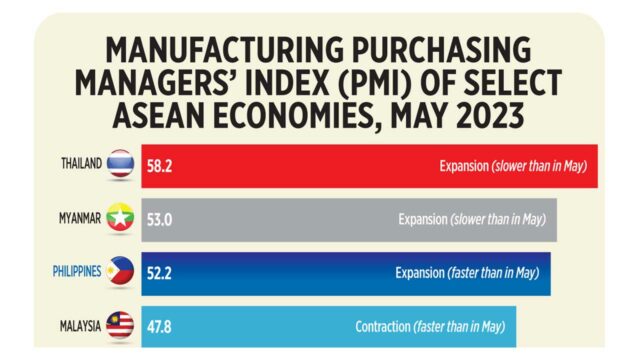
Manufacturing Purchasing Managers’ Index (PMI) of select ASEAN economies, May 2023

MANUFACTURING ACTIVITY in the Philippines further expanded in May as new orders and production grew at a faster clip, S&P Global said. Read the full story.

Manufacturing Purchasing Managers’ Index (PMI) of select ASEAN economies, May 2023

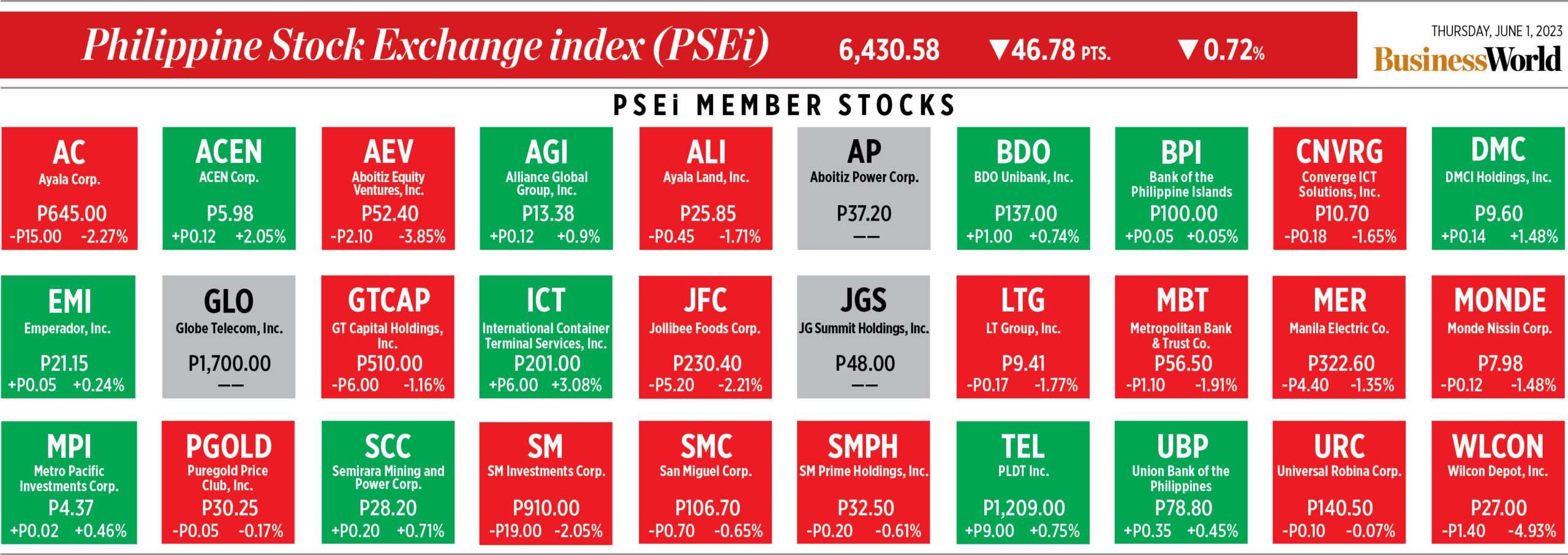
How PSEi member stocks performed — June 1, 2023

Here’s a quick glance at how PSEi stocks fared on Thursday, June 1, 2023.


Shares down on cautiousness over debt limit deal

PHILIPPINE SHARES dropped on Thursday as investors remained cautious while awaiting the passage of the bill seeking to suspend the US debt ceiling until 2025.

The Philippine Stock Exchange index (PSEi) fell by 46.78 points or 0.72% to close at 6,430.58 on Thursday, while the broader all shares index went down by 14.45 points or 0.41% to end at 3,443.85.

“Philippine equities fell again as investors kept an eye on the federal debt ceiling debate in Washington in the final trading day of May. The measure passed a key procedural hurdle in the House on Wednesday, clearing its path to a final vote on the floor later in the evening,” Regina Capital Development Corp. Head of Sales Luis A. Limlingan said in a Viber message.

“Congress is rushing to approve the measure by Monday, the earliest date the US risks a sovereign default,” Mr. Limlingan added.

Philstocks Financial, Inc. Research Analyst Claire T. Alviar likewise said in a Viber message that the PSEi tracked Wall Street’s decline amid caution in the market due to the debt limit deal.

“Moreover, foreigners continued exiting the bourse pulling down the market further,” Ms. Alviar said.

A divided US House of Representatives passed a bill to suspend the $31.4-trillion debt ceiling on Wednesday, with majority support from both Democrats and Republicans to overcome opposition led by hardline conservatives and avoid a catastrophic default, Reuters reported.

The Republican-controlled House voted 314-117 to send the legislation to the Senate, which must enact the measure and get it to US President Joseph R. Biden’s desk before a Monday deadline, when the federal government is expected to run out of money to pay its bills.

The legislation suspends — in essence, temporarily removes — the federal government’s borrowing limit through Jan. 1, 2025. The timeline allows Mr. Biden and Congress to set aside the politically risky issue until after the November 2024 presidential election.

It would also cap some government spending over the next two years, speed up the permitting process for certain energy projects, claw back unused COVID-19 funds and expand work requirements for food aid programs to additional recipients.

Back home, sectoral indices were split on Thursday. Services increased by 10.25 points or 0.67% to 1,528.19; mining and oil rose by 32.14 points or 0.32% to 9,996.92; and financials inched up by 0.45 point or 0.02% to 1,812.46.

Meanwhile, holding firms went down by 108.52 points or 1.67% to 6,381.74; property declined by 22.64 points or 0.85% to 2,631.51; and industrials fell by 50.39 points or 0.54% to 9,150.93.

Value turnover declined to P5.41 billion on Thursday with 801.27 million shares changing hands from the P24.54 billion with 2.27 billion issues traded on Wednesday.

Decliners outnumbered advancers, 105 versus 78, while 50 names closed unchanged.

Net foreign selling dropped to P475.68 million on Thursday from P4.15 billion on Wednesday. — A.H. Halili with Reuters

Peso weakens anew vs dollar

BW FILE PHOTO

THE PESO dropped anew against the dollar on Thursday due to weak China manufacturing data.

The local currency closed at P56.26 versus the dollar on Thursday, weakening by 11 centavos from Wednesday’s P56.15 finish, data from the Bankers Association of the Philippines’ website showed.

The local unit opened Thursday’s session at P56.23 per dollar. Its intraday best was at P56.155, while its worst showing for the day was at P56.31 against the greenback.

Dollars traded dropped to $990.35 million on Thursday from the $1.065 billion recorded on Wednesday.

The peso was dragged down by a stronger dollar following China factory output data, Rizal Commercial Banking Corp. Chief Economist Michael L. Ricafort noted in a Viber message.

“The peso weakened from safe-haven demand after the downbeat Chinese manufacturing PMI (purchasing managers’ index) renewed global growth concerns,” a trader likewise said in an e-mail.

The dollar index, which measures the currency against a basket of six peers, rose 0.22% to 104.38 and was off a two-month high of 104.7 touched on Wednesday as traders pared back their expectations of another US Federal Reserve rate hike this month.

The Chinese offshore yuan last bought 7.1320 per dollar, after touching a six-month low in early London trading after briefly gaining some support after China’s factory activity unexpectedly grew in May from a decline in April.

China’s official manufacturing PMI fell to a five-month low of 48.8, the National Bureau of Statistics said on Wednesday, down from 49.2 in April and below the 50-point mark that separates expansion from contraction.

For Friday, the trader said the peso could depreciate further due to potentially strong US labor data.

The trader sees the peso moving between P56.10 and P56.35 per dollar, while Mr. Ricafort sees it trading from P56.15 to P56.35.

PESO WEAKNESS TO PERSIST
Meanwhile, the peso’s weak run since April could continue this month as it enters a period of seasonal underperformance against the dollar, ANZ Research said.

The local currency has a “strong tendency” to weaken against the dollar in June, a note written by ANZ Research Foreign Exchange Analyst Kausani Basak, Economist Debalika Sarkar and Head of Asia Research Khoon Goh said.

“Looking at historical trends since 2000, over the last 23 years, the peso has weakened against the dollar on 18 occasions during the month of June. The average spot decline was 0.9%, and in the years when the seasonal pattern occurred, the average decline was 1.6%,” ANZ Research said.

From April until end-May, the peso traded at around P54 to P56 per dollar. In May alone, the peso depreciated by 77 centavos or 1.37% to P56.15 from its April 28 close of P55.38.

“The June weakness is statistically significant, though the exact cause is not clear. We could not find any distinct pattern in the trade balance or remittances flows data that can explain the peso’s June swoon,” ANZ Research said.

The peso could also face a stronger dollar in the near term as markets expect another rate hike from the Fed in their June 13-14 meeting.

“Progress on bringing US inflation back towards target is too slow for some Fed officials, and the US economy remains resilient with the labor market staying very tight,” ANZ Research said.

“The regional banking stresses have eased, and now that the debt ceiling uncertainty is out of the way, markets are pricing in more than an even chance of another 25-bp (basis point) rate hike at the June meeting,” it said.

“This sets the peso up for a very challenging month, which could see it slide towards P57 in June,” it added.

The Fed has raised borrowing costs by 500 bps since March last year, with its target rate now at 5-5.25%.

“Looking past the near-term peso weakness, we expect the currency’s prospects to improve over the second half of the year. By then, we expect the Fed’s tightening cycle to have drawn to a close, which will reduce support for the dollar,” ANZ Research said. — AMCS and KBT with Reuters

Japan dev’t bank hopes to back PHL LNG, renewables projects

REUTERS

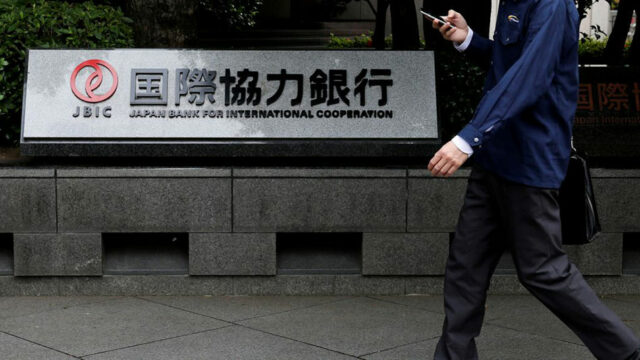
THE Japan Bank for International Cooperation (JBIC) has expressed interest in finding Philippine partners to develop gas and renewables projects, the Palace said. 

The bank’s interest was conveyed during JBIC Chairman Tadashi Maeda’s courtesy call on President Ferdinand R. Marcos, Jr. in Malacañang on Wednesday, the Presidential Communications Office (PCO) said in a statement.

It said JBIC is interested in “addressing the role” of liquefied natural gas (LNG) as a traditional source of power in the Philippines.

The bank also wants to support hydropower, solar, and wind projects, the PCO added.

“We have the potential… between Japan and the Philippines to work together,” Mr. Maeda was quoted as saying.

He said he has met with Aboitiz Equity Ventures, Inc., Metro Pacific Investments Corp., and San Miguel Corp. He did not provide details.

JBIC is a development-focused Japanese government bank formed from the merger of Japan Export-Import Bank and the Overseas Economic Cooperation Fund. The PCO said it operates in conjunction with private investors.

Meanwhile, Dato’ Sri Tahir, the founder of Indonesia’s Mayapada Group, told Mr. Marcos of his interest in exploring socially oriented Philippine ventures.

Mr. Tahir, who like many Indonesians goes by one name, operates banking, real estate, and other businesses. He is a member of Indonesian President Joko Widodo’s advisory council.

Mr. Tahir met with Mr. Marcos in Malacañang and told the chief executive of his interest in social-welfare projects, the PCO said in a separate statement.

“I would like to see explore (if) we can work together in social work,” Mr. Tahir was quoted as telling Mr. Marcos. “We have been working in the region. I hope that, with your permission, with your support, let me arrange to explore.”

Mr. Marcos briefed Mr. Tahir on the current government social welfare programs for children and the elderly, as well as ongoing initiatives in housing, the PCO said. 

“We have a program that we are going to start for street children. Unfortunately, we still have people who are homeless. So, we are trying to look after them,” Mr. Marcos said.

Mr. Marcos told Mr. Tahir that the government has set a target of one million housing units a year to address a housing backlog estimated at 6.5 million units in the socialized segment. — Kyle Aristophere T. Atienza

ADVERTISEMENT
ADVERTISEMENT