Home Blog Page 4785

Philippine Robotics National team wins Breakthrough Award in FLL Morocco Open

Exhibiting the country’s science, technology, engineering and mathematics (STEM) brilliance to the world, the Philippine Robotics National Team, represented by Grace Christian College, won the first place in the Breakthrough Award category in this year’s FIRST LEGO League (FLL) Morocco Open Invitational.

Over 48 countries participated in the international robotics event last May 18-22, which was held in Marrakesh, Morocco. Mexico won 2nd place in the Breakthrough Award category.

FLL is a science, technology and educational event which aims to offer promising elementary and secondary students an opportunity to expand their horizons through the exploration of robots and robotic systems in schools. Moreover, it aims to provide a host of opportunities to stimulate early design, engineering and computing skills highly relevant towards progressive education.

The Philippine Robotics National Team’s winning entry, the Adaptive Regulated Innovative Solar Energy (ARISE), has the following features: tilting mechanism that can tilt to where there is most sunlight; batteries for storage of harnessed sunlight; a converter that converts the energy into electricity; and machine learning for determining the time of day and location where sunlight is most abundant and for weather forecast.

“The project ARISE invented by the Philippine Robotics National Team presents a viable solution in providing electricity and even in preventing greenhouse gases which can harm humans, especially as the world recovers from the COVID-19 pandemic,” said Mylene Abiva, president and CEO of FELTA Multi-Media Inc., the national organizer of FLL Philippines since 2011.

The Champion’s Award (overall excellence in Robot Game, Innovation and Core Values) went to Brazil, while the 1st runner-up went to Germany and the 2nd runner-up went to Japan.


Spotlight is BusinessWorld’s sponsored section that allows advertisers to amplify their brand and connect with BusinessWorld’s audience by enabling them to publish their stories directly on the BusinessWorld Web site. For more information, send an email to online@bworldonline.com.

Join us on Viber at https://bit.ly/3hv6bLA to get more updates and subscribe to BusinessWorld’s titles and get exclusive content through www.bworld-x.com.

Inflation further eased in May — BSP

A vendor displays fish for sale at the Marikina Public Market. — PHILIPPINE STAR/WALTER BOLLOZOS

By Keisha B. Ta-asan, Reporter

HEADLINE INFLATION may have decelerated within the 5.8% to 6.6% range in May due to lower prices of fuel, poultry and fish, the Bangko Sentral ng Pilipinas (BSP) said on Wednesday.     

If realized, inflation would exceed the BSP’s 2-4% target for the 14th consecutive month. Inflation eased for a third straight month in April to 6.6%.

The lower end of the BSP’s forecast or 5.8% would be the slowest pace recorded in a year or since the 5.4% recorded in May 2022.

The Philippine Statistics Authority will release the May inflation data on June 6.

“The cumulative rollback in domestic petroleum prices as well as lower poultry and fish prices and electricity rates of various regional power distributors could lead to lower inflation in May,” the BSP said.

In May alone, pump price adjustments stood at a net decrease of P1.45 a liter for gasoline, P2 a liter for diesel, and P3.2 a liter for kerosene.    

“Higher prices of rice, vegetables, and other key food items as well as the increase in liquefied petroleum gas and Manila Electric Co. (Meralco) electricity rates are the primary sources of upward price pressures for the month,” the central bank said in a statement.

Cooking gas prices rose by P0.85 per kilogram in May, ending two months of price cuts.

Meralco customers faced higher electricity bills in May as the overall rate for a typical household went up by P0.1761 to P11.4929 per kilowatt-hour.

“Going forward, BSP will continue to monitor developments affecting the outlook for inflation and growth in line with its data-dependent approach to monetary policy formulation,” the central bank added. 

BSP Governor Felipe M. Medalla earlier said he expects inflation to ease back to the 2-4% target by September or October.

The BSP sees inflation averaging 5.5% for this year, before slowing to 2.8% in 2024.    

Makoto Tsuchiya, assistant economist from Oxford Economics Japan, said he expects inflation to slow to 6.3% this month, due to base effects for fuel prices and electricity rates.

Last year, global and local pump prices spiked amid the Russia-Ukraine war. This prompted the government to raise the minimum public transport fare, which fueled inflation. 

“We also expect food prices to decline amid easing supply-side bottlenecks, in part thanks to the ramped-up food importation,” he said.

Colegio de San Juan de Letran Graduate School Associate Professor Emmanuel J. Lopez said he expects May inflation to settle at 6%, slower than April’s 6.6% amid persistently high food, energy, and transport costs.

Mr. Lopez also noted that supply pressures due to “high energy cost, fluctuating price of basic petroleum products plus the threat of El Niño that serves to distract agricultural productivity,” are still risks to the inflation outlook. 

Meanwhile, Mr. Tsuchiya said inflation will continue to ease for the rest of the year, settling within the 2-4% central bank target band by October.

“Favorable base effects will bring down annual growth, while we expect modest sequential price momentum,” he said, adding that weather disturbances such as typhoons and the El Niño phenomenon are still upside risks.

Still, easing inflation would prompt the Monetary Board to keep policy rates on hold for the rest of the year, before it starts cutting borrowing costs in the first quarter next year, Mr. Tsuchiya said.

“Barring any large-scale supply chain disruptions, the BSP now has less incentive to hike given declining inflation as well as our expectation that the US Fed reached the peak in its tightening cycle,” he said.

Earlier, Mr. Medalla signaled that the Monetary Board (MB) may keep policy rates on hold at the next two to three meetings as inflation cools.

The MB paused its aggressive tightening cycle at its May 18 meeting. Since May last year, the BSP has raised key interest rates by 425 basis points to 6.25%.

The MB’s next three policy meetings are scheduled on June 22, Aug. 17 and Sept. 21.

NG debt inches up to P13.9T as of April

BW FILE PHOTO

By Luisa Maria Jacinta C. Jocson, Reporter

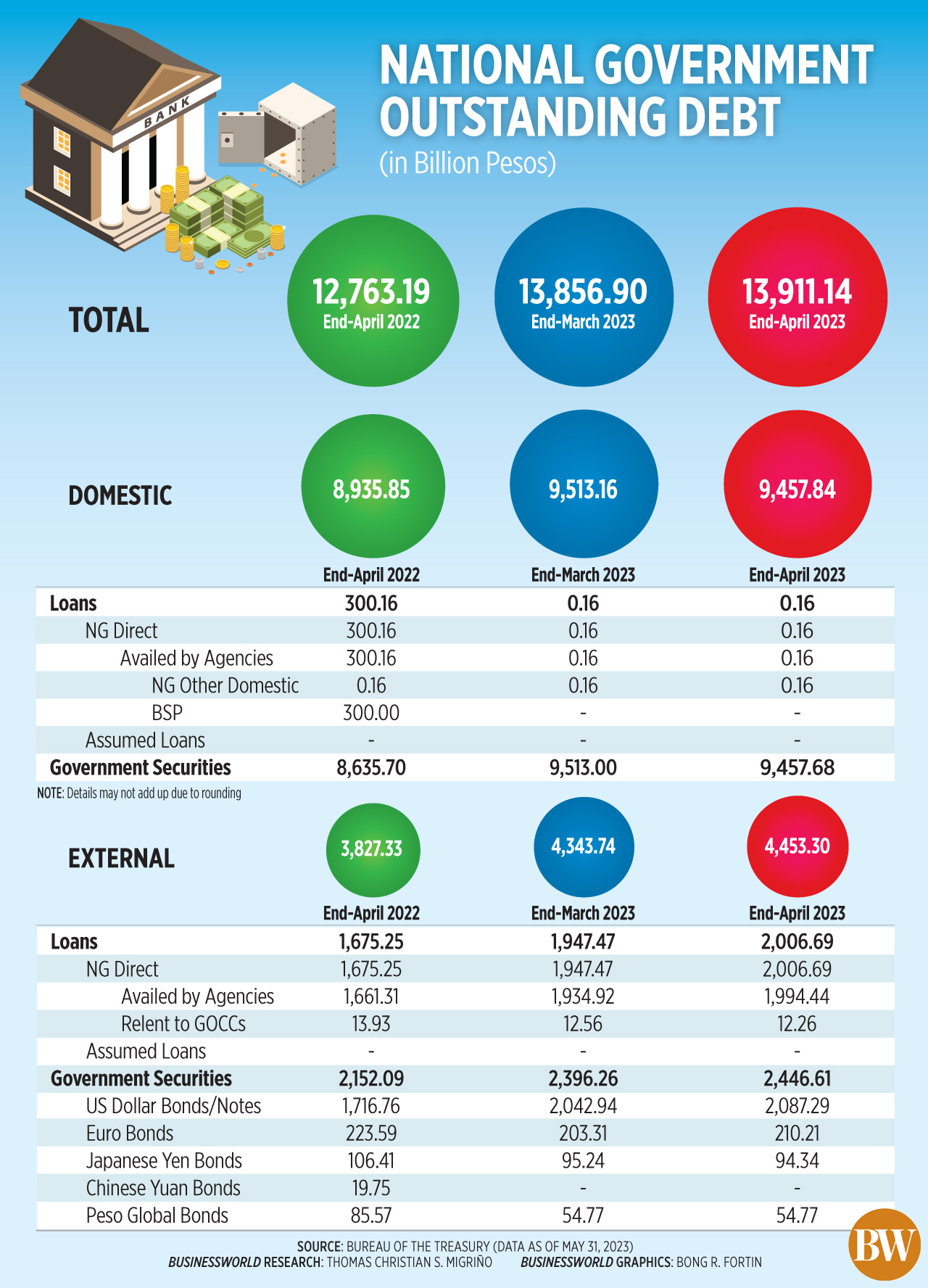
THE NATIONAL Government’s (NG) total outstanding debt hit a fresh high of P13.91 trillion at the end of April, the Bureau of the Treasury (BTr) said.

Data from the BTr showed that the outstanding debt inched up by 0.4% from P13.86 trillion at the end of March.

“NG outstanding debt increased by P54.24 billion or 0.4% from the previous month due to the net issuance of external debt and local currency depreciation against the US dollar,” the BTr said in a press release on Wednesday.

National Government outstanding debt

Year on year, the debt stock rose by 9% from P12.76 trillion. Outstanding debt went up by 3.7% from P13.42 trillion as of end-December 2022.

More than two-thirds or 68% of total outstanding debt as of end-April was from domestic sources.

As of end-April, domestic debt increased by 5.8% to P9.46 trillion from P8.94 trillion a year ago.

Month on month, it slipped by 0.6% from the P9.51 trillion at end-March, due to the net redemption of domestic securities amounting to P57.79 billion.

“This was slightly offset by the P2.47-billion effect on onshore foreign currency-denominated securities caused by peso depreciation against the US dollar,” it added.

Based on figures from the BTr, the peso weakened by 2% to P55.497 against the dollar at the end of April, from P54.318 at the end of March.

The government mainly borrows from domestic sources to mitigate foreign currency risk.

Meanwhile, external debt climbed by 16.4% to P4.45 trillion from P3.83 trillion a year ago. It also rose by 2.5% from P4.34 trillion as of end-March.

Broken down, external debt consisted of P2 trillion in loans and P2.45 trillion in global bonds.

“For April, the increment to external debt was due to the P27.98-billion net availment of external loans and P94.28-billion impact of local-currency depreciation against the US dollar,” the BTr said.

“On the other hand, third-currency adjustments against the US dollar trimmed P12.3 billion from the peso value of foreign currency debt,” it added.

As of end-April, the NG’s overall guaranteed obligations declined by 7.9% to P380.69 billion from P413.43 trillion a year ago. Month on month, this was 0.9% lower than the P384.12 billion as of end-March.

Analysts expect the NG debt to continue climbing this year.

“We will continue to see government debt rise this year but at a slower pace due to the limited fiscal space,” China Banking Corp. Chief Economist Domini S. Velasquez said in a Viber message.

However, Ms. Velasquez said the improvement in the fiscal balance may lead to less borrowings.

“Recent budget surpluses could also ease some pressure on government borrowing. If we look at the fiscal performance of the National Government, the deficit has continued to outperform the program mainly because spending is lower. This is challenging though because we still need government spending to support economic growth,” she said. 

The NG’s budget surplus ballooned to P66.8 billion in April from P4.9 billion a year ago. In the January-to-April period, the fiscal deficit narrowed by 34.57% to P204.1 billion.

This year, the government has set a budget deficit ceiling of P1.499 trillion, equivalent to 6.1% of the gross domestic product.

“As long as revenues rise due to the reopening narrative and economic growth prospects get better due to further disinflation and less restrictive monetary policy down the line, we may see a more robust NG debt stock scenario,” Union Bank of the Philippines, Inc. Chief Economist Ruben Carlo O. Asuncion said in a Viber message.

The government’s outstanding debt as a share of the gross domestic product (GDP) stood at 61% at the end of March, slightly higher than the 60.9% seen as of end-December.

This was lower than the 61.8% annual target under the medium-term fiscal framework but still above the 60% threshold considered manageable by multilateral lenders for developing economies.

The government aims to cut the debt-to-GDP ratio to less than 60% by 2025, and further to 51.5% by 2028.

This year, the government’s borrowing plan is set at P2.207 trillion, where 75% will be sourced domestically.

House adopts Senate version of MIF bill  

By Beatriz Marie D. Cruz, Reporter

THE HOUSE of Representatives on Wednesday adopted the Senate version of the proposed sovereign wealth fund bill, after the Senate approved the measure in the wee hours after 12 hours of debates. 

The Maharlika Investment Fund (MIF) bill will now be sent to Malacañang just a week after President Ferdinand R. Marcos, Jr. declared it an urgent measure.

“On behalf of the Congress panel, we accept the Senate version in principle, subject to style,” House Banks and Financial Intermediaries Committee Chairman and Manila Rep. Irwin C. Tieng said during the Bicameral Conference Committee meeting at the Manila Golf and Country Club in Makati City.

Albay Rep. Jose Ma. Clemente S. Salceda, one of the members of the Bicameral Conference Committee, said he expects the President to announce that he has signed the MIF bill into law at the State of the Nation Address (SONA) on July 24.

“The House has decided to adopt the Senate version, so that the Executive can begin crafting the rules and regulations — which no doubt will be as significant as the law itself,” Mr. Salceda said in a statement.

Under the bill, the initial capital for the MIF will come from the Land Bank of the Philippines (LANDBANK), which will invest P50 billion. The Development Bank of the Philippines (DBP) will infuse P25 billion, while the P50 billion will come from the National Government.

The Senate included a provision in the bill that explicitly prohibits government pension funds to contribute seed capital for the MIF. These include the Government Service Insurance System (GSIS), Social Security System (SSS), and the Philippine Health Insurance Corp. (PhilHealth).

The measure also requires the Bangko Sentral ng Pilipinas (BSP) to contribute 100% of its dividends to the MIF in its first two years.

Mr. Marcos on Wednesday said the pension funds should not contribute to the sovereign wealth fund.

“We have no intention of… getting money [from the] pension fund. That’s not the (intention). We will not use it as a seed fund,” he told reporters on the sidelines of the 87th anniversary of the GSIS on Wednesday.

National Economic and Development Authority (NEDA) Secretary Arsenio M. Balisacan said the economic team respects the senators’ decision to change portions of the MIF bill.

“The changes made in the bill were supposed to address those concerns to ensure there are enough controls and safeguards. The fact that it is now passed I think it strengthens our platforms for investments because we in the economic team have been saying that we need to augment, to compliment the platforms that we have,” he said on the sidelines of a forum in Makati City on Wednesday.

Mr. Balisacan said the MIF should focus on investing in strategic areas that are also profitable.

“They will be investing in profitable areas, like energy. We have so much need for capital so we will not run out of areas for investment,” he added.

Mr. Balisacan also noted that there are a number of interested overseas investors in the Philippines’ first sovereign wealth fund.

In a phone interview, Philippine Chamber of Commerce and Industry (PCCI) President George T. Barcelon said it would be up to the government how to “sell” this fund locally and internationally.

IBON Foundation Executive Director Jose Enrique A. Africa said the latest version of the bill still makes the MIF vulnerable to misuse, corruption, and undue influence.

“The haste in pushing the Maharlika fund is dubious with Congress and the economic managers unfortunately acting on political compulsion rather than based on the better development interests of the nation,” Mr. Africa said in a Viber chat.

“The need to spend more on cash assistance, wage subsidies, agriculture and MSMEs (micro, small, and medium enterprises) today is so large that setting funds aside is unjustifiable,” he added.

David Michael M. San Juan, a professor at De La Salle University and convener at the Professionals for the Progressive Economy, said the MIF is backed by the government and the taxpayers’ money.

“Its investments are not guaranteed to reap profits and there’s a possibility that the fund would lose money,” he said via e-mail. — with Luisa Maria Jacinta C. Jocson

World Bank approves $176-million loan for Philippine fisheries project

PHILIPPINE STAR /EDD GUMBAN
FISHERIES output rose by 3% in the first quarter, reversing the 5.8% decline in the same period in 2022. — PHILIPPINE STAR /EDD GUMBAN

THE WORLD BANK has approved a $176-million loan for a new fisheries project in the Philippines.

In a May 30 statement, the multilateral lender said its board of executive directors gave the go signal for the Philippine Fisheries and Coastal Resiliency Project (FISHCORE), which aims to improve fisheries management and production.

“This project aligns with the country’s commitment to environmentally sound practices in fishing and aquaculture expansion while ensuring improved incomes for those involved in the fishing industry — including those involved in production, processing and marketing,” Ndiamé Diop, World Bank country director for Brunei, Malaysia, Philippines, and Thailand, said.

FISHCORE aims to widen opportunities for fishery products, ensure a steady supply of fish for national food security, and boost competitiveness of small and medium fishery enterprises, the World Bank said.

The project is expected to positively impact over 1.15 million fisherfolk, small-to-medium businesses, and residents in coastal communities.

According to the World Bank, the fisheries sector contributes about 1.3% to gross domestic product (GDP) and accounts for 4% of the labor force or around 1.6 million jobs.

“Despite its importance, the sector has faced challenges with fish stocks declining by an average of 20% over the past decade due to overexploitation, destructive fishing methods, habitat degradation, and negative impacts from land-based activities,” it added.

The project will also support investments to expand aquaculture and fish farming, as well as support the creation of businesses among fishers’ associations and provide livelihood grants to eligible beneficiaries.

The project will be implemented in Fisheries Management Areas (FMA) 6 and 9. FMA 6 covers the coastal waters that include Pagudpud Bay, Subic Bay, and Manila Bay while FMA 9 consists of the coastal waters of the Bohol Sea, Panguil Bay, Iligan Bay, Gingoog Bay, Butuan Bay, and Sogod Bay. 

“FISHCORE will support the Philippine government in designing and establishing improved fisheries management systems in the selected FMAs’ coastal and municipal waters,” World Bank Senior Environmental Economist Jingjie Chu said. 

The World Bank was the country’s third-largest source of official development assistance (ODA) as of 2021, representing 24% of total ODA or $7.66 billion.

The National Government expects to obtain around $19.1 billion worth of ODA this year. — Luisa Maria Jacinta C. Jocson

Century Properties to fully own  PHirst as Mitsubishi sells stake

CENTURY Properties Group, Inc. is set to acquire full ownership of its two affordable housing subsidiaries as its Japanese partner Mitsubishi Corp. has decided to sell its share, the listed developer said on Wednesday.

“This acquisition is part of the group’s strategic move to consolidate interests in the business segment where the market is robust, allowing us to create more value for our stakeholders, contribute more to serving the needs of our fellow Filipinos for decent, quality and affordable first homes while helping address the huge housing backlog that the administration is working on,” said Century Properties Executive Chairman  Jose E.B. Antonio in a statement.

The company said the acquisition of the full stake in PHirst Park Homes, Inc. and Tanza Properties, Inc. was due to Mitsubishi redirecting its focus to other market opportunities in the country and the Asian region.

“As [Mitsubishi] has already achieved its optimal goal for this particular investment, we believe that it is the ideal opportunity to pursue new seeds of growth in other emerging markets both in the Philippines and the Asian region,” said Takuya Kuga, Mitsubishi executive vice-president and group chief executive officer for urban development.

The joint venture was initially launched in 2017 with Century Properties owning 60% and Mitsubishi acquiring 40%.

Century Properties said in a separate disclosure that its board of directors on May 31 approved the acquisition of Mitsubishi’s 40% stake or 1.06 billion shares valued at P1 apiece and its 256,000 preferred B shares valued at P1,000 each.

“The said acquisition is subject to agreed conditions precedent and credit and regulatory approvals, including the Philippine Competition Commission,” the company said.

Once a decision has been made, both parties are to execute a deed of absolute sale of shares and a closing transaction.

Additionally, Century Properties said that it would explore, with Mitsubishi, new asset classes in real estate to coinvest in.

Century Properties President and Chief Executive Officer Marco R. Antonio said that with the success of their partnership, “the two companies maintain a solid relationship and will continue to explore opportunities for future collaborations.”

“In fact, plans are already being arranged to talk about the next [Century Properties-Mitsubishi] venture,” he added.

Meanwhile, the company said that is set to achieve the launch of 15 projects during the year, which began with the launch of three flagship developments in Laguna, Batangas, and Bataan provinces under its new subsidiary Century PHirst Corp.

“We remain cognizant of the strong fundamentals of the affordable housing market,” Mr. Antonio said “Century Properties is committed to meeting the housing needs of first-time homebuyers and will continue to explore opportunities to expand its portfolio.”

PHirst, which targets first-time homebuyers, has projects in Lipa and Batulao in Batangas; San Pablo and Calamba in Laguna; Naic, General Trias and Tanza in Cavite; Baliwag and Pandi in Bulacan; Tayabas in Quezon; Magalang in Pampanga; Balanga in Bataan; and Gapan in Nueva Ecija

On Wednesday, Century Properties’ shares rose 1.37% to close at P0.37 each. — Adrian H. Halili

SC backs order allowing any public telco in BGC

PHILSTAR FILE PHOTO

THE Supreme Court (SC) has affirmed the legality of a 2002 National Telecommunication Commission (NTC) order that allowed any enfranchised public telecommunications provider to install high-speed landline and internet connectivity within Bonifacio Global City (BGC).

In a 28-page ruling made public on May 31, the tribunal denied the petition of Bonifacio Communications Corp. (BCC) and its parent company PLDT Inc. seeking damages after another telecommunications firm removed one of its conduit units in buildings located in BGC without permission.

The High Court said the NTC had primary jurisdiction to hear disputes between the telecom companies.

“If certain facilities are necessary for the operation of a public utility, it stands to reason that the same becomes part and parcel of telecommunication services,” according to the ruling penned by SC Associate Justice Ramon Paul L. Hernando.

The Bases Conversion and Development Authority (BCDA), BCC, Fort Bonifacio Development Corp. (FBDC), and Smart Communications, Inc. inked a deal in 1997 that gave BCC the “exclusive right to install, construct and maintain communication infrastructure” within BGC.

In 2002, the NTC issued a memorandum circular declaring BGC as a free zone where any duly enfranchised public telecommunications entity can install and provide high-speed networks and connectivity within the area.

In that year, PLDT owned 75% of the total shares of Smart and FBDC.

Five years later, Innove Communications, Inc. was commissioned to provide landline, data, and internet connectivity to Net 1, 2 and 3 buildings in BGC. In the process of installing the equipment, its contractor, Avecs Corp., disconnected a BCC conduit and replaced it with an Innove conduit without seeking permission from the firm.

Innove and its parent company Globe Telecom, Inc. asked the NTC to clarify their right to install and operate telecommunications infrastructure within BGC.

The NTC then asked the Department of Justice to issue a legal opinion on the matter, but the agency declined to render one as it could not do so “without passing upon the contracts concerned as it involves the substantive rights of private parties.”

The incident prompted a demand letter from BCC and PLDT, and eventually civil lawsuits against Innove that sought damages for the “contractual interference.”

A Quezon City trial court dismissed the petitions, holding that the NTC had primary jurisdiction to hear the dispute.

The appellate court affirmed the ruling as it said the NTC had the authority to issue cease-and-desist orders to enforce compliance with the 2002 order.

“In summary, it is apparent that NTC may exercise jurisdiction over BCC insofar as BCC’s activities affect the enforcement of authorities granted to duly authorized public telecommunications entity and violate the rules and regulations of the Commission,” the High Court said. — John Victor D. Ordoñez

Eton Properties  plans township  project in Cebu

The 35-hectare township will feature a 600-meter beachfront. — ETON PROPERTIES PHILIPPINES INC.

LUCIO C. TAN’S Eton Properties Philippines, Inc. plans to build a 35-hectare integrated township in Lapu-Lapu City, Cebu as it continues to expand its core businesses.

“The company’s plan to expand its core businesses is a strategic move that will help drive the company’s growth for the next five to 10 years,” said Kyle C. Tan, who was recently appointed president and chief executive officer.

“Though still in the planning stage, the company is excited to share plans to develop a new integrated township,” Mr. Tan said in a statement, adding that the project “will leverage partnerships and joint ventures to further scale the market’s needs and support nation-building.”

The proposed Central Visayas township, the company’s entry into the region, will be located in Lapu-Lapu City on Mactan Island, Cebu. It will feature a “harmonious integration of history, culture, and modernity in a relaxing seaside lifestyle community.”

The 35-hectare property will house residential and office facilities and amenities, mid-rise condominiums, upscale hotels, buildings for business process outsourcing firms, and commercial and retail centers.

A 600-meter beachfront will also be featured in the property with an internal lagoon area “perfect for a modern but suburban feel.”

“This project will be envisioned as the next business and leisure destination in one secured and exclusive community in Cebu,” Mr. Tan said.

Meanwhile, the company is planning to expand its 641-hectare township Eton City in Sta. Rosa, Laguna.

The company said the township is set to cater to the office demand of the information technology and business process management or IT-BPM sector. It plans to commission “world-renowned architectural firms” to infuse their “unique expertise in developing world-class and sustainable office buildings within the township.”

Eton City offers a commercial and retail district, Eton City Square, apart from four residential villages TierraBela, West Wing Residences, South Lake Village, and RiverBend, the company said.

Eton Properties specializes in office projects, commercial centers, and mixed-use township developments as well as high-end and mid-income high-rise and horizontal residential developments.

The company is the real estate brand of the Lucio Tan group, one of the business conglomerates in the Philippines. Its foreign counterpart, Eton Properties Ltd., is a real estate brand in Hong Kong and mainland China. — Adrian H. Halili

MPIC studies pivot to food and  logistics industries — Pangilinan

METRO Pacific Investments Corp. (MPIC) is looking to pivot to less-regulated industries such as food and logistics, its chairman said, pointing to the need to balance the firm’s risk portfolio.

“We started in food and agriculture, that’s one part of it. We’re looking at the possibility of logistics as a major investment area for us,” MPIC Chairman Manuel V. Pangilinan said in an interview with Cathy Yang for Thought Leaders.

The MPIC group entered the logistics business through MetroPac Movers, Inc., which started operations in May 2016.

“We did try once and we failed. So, this time we’ll try to be more careful about the effort for the logistics. That’s less regulated than what we have now,” Mr. Pangilinan said.

The pivot to the two industries is seen to improve the risk portfolio of MPIC, whose businesses are in power, water, tollways, and light rail, among others.

“It’s just the question of balancing the risk portfolio as we see it, because part of the criticism leveled against MPIC, which affected its share price, is the regulatory capture,” he said, pointing out that its existing businesses are regulated.

“The hospitals are not that much regulated. I think that’s the only exception in our portfolio now. So, we have to review and balance it a bit more because it will flow through MPIC itself and to First Pacific,” he said, referring to First Pacific Co. Ltd.

MPIC is one of three key Philippine units of First Pacific, a Hong Kong-based investment management and holding company.

The pivot also aims to provide the basic needs of Filipinos, especially in light of the current situation on food supply.

“Food is an area where the country needs help and I think it is sad that we need to import increasing food items. We’re even looking at aquaculture now. And the logistics — the logistics cost in the country is too expensive,” Mr. Pangilinan said.

Mr. Pangilinan said MPIC is not seeing the real estate business as a core driver, following its full acquisition of Landco Pacific Corp. in 2022.

“Landco is a very focused real estate business,” he said, adding that the company is not going to compete with other real estate companies’ horizontal or vertical developments.

“We are not into that because that requires a lot of money. That will drive us away from the core businesses that we want to develop,” he said.

“But I think there is a niche market for Landco in terms of the resort, tourist-driven — whether domestic or foreign — resort-type developments. They have been quite successful at it and I think for the first time in so many years we are profitable in 2021 and 2022, and more profitable in 2023 in that niche market,” he added.

Mr. Pangilinan said that he doesn’t want to compete against conglomerates, which usually have banking and real estate in their portfolio.

“The less we butt heads with them, I think, the better,” he said.

MPIC’s units include Manila Electric Co., Maynilad Water Services Inc., MetroPac Water Investments Corp., Metro Pacific Tollways Corp., Metro Pacific Hospital Holdings Inc., and Light Rail Manila Corp.

Aside from MPIC, First Pacific’s Philippine units are Philex Mining Corp. and PLDT Inc.

Hastings Holdings, Inc., a unit of PLDT Beneficial Trust Fund subsidiary MediaQuest Holdings, Inc., has a majority stake in BusinessWorld through the Philippine Star Group, which it controls.

On Wednesday, MPIC shares declined nine centavos or 2.03% to P4.35 each. — Justine Irish D. Tabile

The Taste of Fate

Coincidences abound in the tale of the Fatted Calf

THE FOOD is good, but the taste of someone’s dream come true tastes even better.

The Fatted Calf in Silang, Cavite has since 2019 been known in dining circles as an off-road must-visit — but several setbacks, including the Taal Volcano eruption of 2020 and the beginning of the COVID-19 pandemic just months after resulted in four closures. For chefs Jayjay and Rhea Sycip, there was a final glimmer of hope in the waning months of 2022, but even that was extinguished when their landlord decided not to renew their lease.

Which was a real shame, since the property held sentimental value for the couple. During lunch on May 25 in the new Tagaytay property they occupy, the couple recalled how in the early 2000s, while out on a date, they had missed a turn and got lost, and found a property for sale. Ms. Sycip joked that she would be fine living there. When they quit corporate life 12 years later to open up their own restaurant, they found the same property still up for grabs on a lease deal, and they decided to build there.

After their lease ended, Ms. Sycip said, “We felt that that was it.”

However, a visit from Senator Loren Legarda during their last days changed their fate (or perhaps it was simply another one of the guiding hands that would sweep them towards their true destiny). Upon being told of their impending closure, the senator is said to have said, “You cannot close this because you’re helping so many people.” Ms. Legarda then gave them the lease for a property she owns in Tagaytay, the new site of the Fatted Calf. It is slated to open today (June 1), after having closed the Silang branch earlier this year.

During our tasting, the restaurant’s new sign was just about to be installed.

“Some people believed that we shouldn’t stop what we’re doing,” said Ms. Sycip. “It’s an answered prayer in such a way that it was impossible,” she said during a speech at the lunch with the press.

When Ms. Legarda said that the couple were helping so many people, it’s because a lot of the produce that they served in the restaurant came from small producers in the area. For example, Mr. Sycip pointed out that the eggplants they use come from a nearby farmer who just has a stall in front of their house. When they mean they source locally, they really mean locally, with many of their sources being their neighbors.

Mr. Sycip says that it boils down to specialization: industrial farms will maximize the use of their lands with diverse crops, but smaller producers will maximize by filling their land with a single crop, probably more well-tended.

“The synergy between farmers and chefs cannot be broken,” he said. Added Ms. Sycip, “Not all farmers will have the courage to tell you to [just] go pick it up and eat it,” which she says is usually how they test their produce. “The food we’ll all be partaking in is mostly from farmers, who, like us, have been struggling,” said Ms. Sycip in a speech.

They do source from farther regions — as far as Davao and Palawan, and the beef in the galbi bao comes from Australia. But we’re getting ahead of ourselves.

DISHES OLD AND NEW
The meal that day consisted of old and new items, from the old restaurant and for the new one. Lunch started with two salads, one with smoked duck, and the other completely vegan. The smoked duck salad had a five-spice vinaigrette, and the Vegan Glow salad had a maple black sesame dressing, and a spice-roasted slice of squash. It’s easy to ignore a salad, but this one is a great testament to natural and organic farming techniques. The leaves had a depth and flavor that only nature can give, and we found ourselves chewing through this course very slowly, savoring each bit of foliage.

There were then Vietnamese Shrimp Balls that were chunky and a bit rustic, made with wild-caught shrimps, but this paled in comparison to the cod cured in pastis and gin for half a day, served with creme fraiche, kaffir oil, lemon puree, and red radish. Served as lacy, translucent slices, the delicate fish was very expressive and explosive with its flavor.

The aforementioned galbi bao with the Australian Wagyu, Ssam sauce, radish carrots, and homemade mantou (buns) was great and filling and satisfying, but was easily overshadowed by the silky Shrimp Spaghetti. This one was made by tossing it in an oil infused with shrimp heads and spices like cardamom, cumin, and star anise; served with wild-caught shrimp, kaffir leaves, karipatta, and brined kesong puti (a local cheese). Wonderfully subtle and elegant, it tasted like a song.

That was a nice prelude to the Thick Cut Porkchop, made from organic pork, braised red cabbage, Cebu corn grits, applesauce, and corn ribs. It was all wonderfully mild, better so we could enjoy the fiery Red Curry Beef Pot Roast, made of local beef, Benguet potatoes, the eggplants from their neighbor farmer, and fresh coconut milk. Delightfully spicy and staying in the tongue, we regret not having this with rice.

The piece de resistance was a Signature Whole Roasted Leg of Beef (torched by Ms. Sycip as we watched), which had been roasted for 10 hours with aromatic spices, roasted vegetables, and rum jus. This was a true masterpiece (our notes said, “My God!”) and along with the powerful beef flavor, also had more than a hint of loving labor.

We had been inclined to skip dessert, averse as we are to ube (purple yam), but we were assuaged with a Tablea Chocolate Cake made with local chocolate from a farmer’s cooperative in Davao. A woman at our table said that she had committed a sin, and was grasping for the word “gluttony,” but had a smile on her face all the same.

FAMILY AND FEASTS
The couple had met first as children in the third grade and then again as adults (again adding another note to this story of fate and destiny — a little more and we’d believe in anything at this point).

The name The Fatted Calf comes from the biblical tale of The Prodigal Son — the son, after squandering his inheritance, came home destitute, only for his father to welcome him home with a fatted calf. “It’s about family and feasts. That’s the essence of The Fatted Calf,” said Mr. Sycip.

The pair had been working in the food industry under the Discovery group — Mr. Sycip had been the Executive Chef of Discovery Country Suites, while his spouse worked as the Assistant Food and Beverage Manager over at Discovery Primea. “Although they’re very good to us, we can’t do what we want to do. Of course, we had to meet a certain budget,” said Ms. Sycip of being corporate chefs. For example, they recall passing up on great produce several times because the farmer couldn’t issue receipts.

The couple discussed the pros and cons of giving up corporate life and living their dream. Mr. Sycip says, “There will be days when you’re ‘in poverty.’” She says, “We don’t have a stable income. It’s not for the faint of heart.” Ms. Sycip recalls that their first stove had been a raffle prize, and the equipment they use now in the kitchen was mostly donated. She recalls fundraisers held for them when Mr. Sycip was mortally ill with COVID-19, and when friends and customers helped them sweep up volcanic ash from their driveway in 2020 so they could open again. “This is really such a nice place, but this is a story of blessing,” she said.

“It’s something that we don’t really look at,” said Mr. Sycip, still answering the question of the pros and cons of leaving stability for a dream. “At the end of the day, we wake up, we do what we do, and we get tired. It’s a struggle. We sleep, and then the following day, we do it all over again because it’s what we love to do.”

Ms. Sycip added, “It’s difficult not to get up in the morning knowing that people depend on you.”

Still, despite the struggles, we asked them what makes a dream worth all of it in the end. Mr. Sycip said, “It’s your dream. It’s everything that you’ve ever wanted.

“How many people can say that they’re living their dream?”

The Fatted Calf is now located on the Tagaytay-Nasugbu Highway, Barangay Neogan, Tagaytay City. Reservations for breakfast, lunch, and dinner starting June 1 are now being accepted. Call 0977-643-7477 or 0917-789-2352 to reserve or send a direct message on Instagram @thefattedcalf_ph. — Joseph L. Garcia


Tripping incidents declined in 3 main grids, says NGCP

BW FILE PHOTO

PRIVATELY owned National Grid Corp. of the Philippines (NGCP) said on Wednesday that fewer tripping incidents had been recorded across the country’s main grids since it took over the transmission system.

“Since NGCP took over transmission operations in 2009, we performed over and above our targets year-on-year. This is a result of the company’s commitment to deliver on our mandate to provide quality transmission services,” NGCP said in a statement.

NGCP said its overall performance had been “significantly better” since it took over the transmission system. It said the frequency of tripping for the 2009-2022 period decreased to 1.3386 from 6.4732 in the 2000-2008 period in the Luzon power grid alone.

The frequency of tripping measures the number of times high-voltage transmission lines tripped or went on forced outages for every 100 circuit kilometers.

In the Visayas power grid, tripping incidents were down by 85.7% to 0.9508 from 6.6530, while in Mindanao, these dropped 83.6% to 1.3285 from 8.0788.

NGCP has also introduced improvements to the grid’s capability to mitigate the impact of power interruptions on grid operations, it said.

For the 2009-2022 period, the system availability (SA) indicator and system interruption severity index (SISI) for the three main grids improved versus the 2000-2008 period.

It said that for Luzon, SA is 99.3160%, while those of the Visayas and Mindanao were at 99.6538% and 99.7206%, respectively.

SISI for Luzon averaged 10.7236 system minutes of interruption versus 13.8978 in 2000-2008. The Visayas logged 47.3318 system minutes of interruption from 176.3350 previously, while Mindanao averaged 9.124 system minutes from 10.434.

Earlier, NGCP said that it had invested about P300 billion in improving the power transmission system since taking over it in 2009.

Between 2009 and 2022, the company said that it had completed about 56 projects deemed vital to the energy industry. The grid operator said its ongoing transmission projects would further improve the country’s transmission sector.

“We assure our stakeholders that NGCP’s ongoing projects and programs seek only to further improve our services,” it said.

The Department of Energy has said that it expects to start its review of the operations of NGCP within this year, amid calls to renationalize grid operations. The call to review NGCP’s performance stemmed from the tripping of a transmission line on May 8, which raised red and yellow alerts over the Luzon grid.

The department has also blamed delayed transmission projects for the tight power supply in the country.

NGCP has committed to completing its transmission projects, which are considered vital to further improve the supply of energy this year. — Ashley Erika O. Jose

It’s time to leave the Paleo Diet in the past: Recent studies have failed to support its claims

THE PALEO DIET urges us to mimic our prehistoric ancestors’ food choices. In practice, this means eschewing dairy products, cereals, pulses, and processed sugar, and consuming vegetables, fruit, nuts, pasture-raised meat, and wild-caught seafood instead.

The Paleo Diet’s proponents contend that by eating this way, we will lose weight and reduce our risk of chronic diseases.

The roots of the Paleo Diet can be traced to the 1950s, but it owes its current popularity to a book by Loren Cordain called The Paleo Diet: Lose Weight and Get Healthy by Eating the Food You Were Designed to Eat, the first edition of which was released in 2001.

In the 22 years since the publication of Cordain’s book, the Paleo Diet has been adopted by several million people and a multi-billion dollar industry has developed in connection with it, including premium-priced foods and a certification scheme.

While the Paleo Diet has many adherents, clinical research has yet to substantiate its purported health benefits.

To begin with, it does not seem to outperform conventional recommended diets as a means of losing weight in the medium- to long-term. The only published multi-year study to have evaluated the Paleo Diet’s impact on weight loss found that following the Paleo Diet was no more effective than following the Nordic countries’ official nutrition recommendations after two years.

It is a similar story with the claims that have been made about the Paleo Diet’s impact on chronic diseases. For example, a recent review found that studies examining the Paleo Diet’s impact on Type 2 diabetes have been “inconclusive.”

Similarly, the authors of a 2020 study reported that following the Paleo Diet resulted in a higher relative abundance of gut bacteria that produce a chemical associated with cardiovascular disease, which is at odds with the claim that the Paleo Diet will reduce the probability of experiencing chronic diseases.

Why have the health benefits claimed for the Paleo Diet not been supported by clinical research? As evolutionary anthropologists, we think the problem is that the Paleo Diet is based on a flawed premise and faulty data, and in what follows we’ll try to show why our research brought us to this conclusion.

The idea underlying the Paleo Diet is that the ongoing surge in obesity and associated diseases in many countries is the result of a mismatch between the foods we eat and the foods our species evolved to consume.

This mismatch, so the argument goes, is a consequence of there having been too little time since agriculture appeared, 12,000 years ago, for evolution to have adapted our species to deal with a high-carbohydrate, low-protein diet or to process domesticated food.

This argument seems reasonable because there is a perception that evolution is a very slow process. However, it is not in fact supported by research on diet-related genes.

Work on lactase persistence — the continued ability to produce the enzyme lactase as an adult — illustrates this. Lactase enables us to digest the milk sugar lactose, so lactase persistence is useful for a diet involving dairy products. Lactase persistence is found in just a few regions, one of which is Europe. Ancient DNA research indicates that lactase persistence is less than 5,000 years old in Europe.

Similarly, an analysis of genetic data from African populations published last year found evidence of recent adaptation in a family of genes connected with metabolizing alcohol. In this case, natural selection operated within the last 2,000 years.

This evidence shows the mismatch rationale for adopting the Paleo Diet is not supported by genetic studies. Such studies demonstrate that evolution can produce diet-related adaptations in much less time than has elapsed since agriculture first appeared.

There is also an issue with the Paleo Diet’s recommendations regarding the contributions of the three macronutrients — protein, carbohydrate, and fat — to a person’s diet.

According to the current version of the Paleo Diet, we should aim for a diet consisting of 19-35% protein, 22-40% carbohydrate, and 28-58% fat, by energy. This makes the Paleo Diet lower in carbohydrate and higher in protein than conventional recommended diets, such as those promoted by Health Canada and the United States Department of Agriculture.

The macronutrient ranges recommended by the Paleo Diet are based on a study from 2000 that estimated macronutrient percentages for more than 200 hunter-gatherer groups. However, recently we have found there is a problem with this study.

The problem lies in the macronutrient values the researchers used for plant foods. While they employed several sets of macronutrient values for animal foods, they only used one set of macronutrient values for plant foods. They obtained the plant data from an analysis of foods traditionally eaten by Indigenous Australians.

In our study, we evaluated the effects of this decision with two plant macronutrient datasets, both of which consisted of values for plants consumed by hunter-gatherers from several continents.

Using multi-continent plant data produced significantly different macronutrient estimates. These in turn produced macronutrient ranges that are wider than the ones recommended by the Paleo Diet. The ranges we calculated are 14-35% protein, 21-55% carbohydrate, and 12-58% fat, by energy.

These ranges overlap those recommended by Health Canada (10-35% protein, 45-65% carbohydrate, and 20-35% fat) and the United States Department of Agriculture (10-30% protein, 45-65% carbohydrate, and 25-35% fat).

That the macronutrient ranges of hunter-gatherer diets overlap government-approved macronutrient ranges casts doubt on the idea that the Paleo Diet is healthier than conventional recommended diets.

Given that the rationale for adopting the Paleo Diet isn’t supported by the available scientific research, and its macronutrient recommendations aren’t scientifically robust, it is, we suggest, not surprising that the diet’s purported health benefits haven’t been supported by clinical studies.

The Paleo  Diet has been a worthwhile experiment, but at this point it seems likely that people following it might just be wasting money. Conventional, government-recommended diets offer comparable outcomes at a lower cost. In our view, it’s time to leave the Paleo Diet in the past. — The Conversation via Reuters Connect

Mark Collard is the Canada Research Chair in Human Evolutionary Studies, and Professor of Archaeology, at Simon Fraser University. Amalea Ruffett is  a PhD Student in Archaeology at the Simon Fraser University. Mr. Collard receives funding from the Canada Research Chairs Program, the Canada Foundation for Innovation, the British Columbia Knowledge Development Fund, and Simon Fraser University. Ms. Ruffett does not work for, consult, own shares in or receive funding from any company or organization that would benefit from this article, and has disclosed no relevant affiliations beyond their academic appointment.