Home Blog Page 4773

Appellate court denies PAL’s P20-M refund

CTA.JUDICIARY.GOV.PH

THE Court of Tax Appeals (CTA) has denied Philippine Airlines, Inc.’s (PAL) refund claim totaling P20.06 million representing its excise taxes for importations of liquor, wine, and tobacco for the period covering August 2014 to February 2018.

In a 25-page decision dated May 30 and made public on June 2, the CTA Special First Division said it did not find any illegal excise taxes that were refundable in favor of PAL.

“Petitioner (PAL) failed to present sufficient and convincing evidence to prove that the imported tobacco and alcohol products were not locally available in reasonable quantity, quality, or price, at the time of importation,” according to the ruling penned by Associate Justice Catherine T. Manahan, citing Presidential Decree No. 1590, or the law establishing the flag carrier.

The tribunal added the firm failed to provide evidence such as price lists of the said products to show that they were not locally available, which is mandated under law.

Under the law, PAL is exempted from the payment of excise tax on its tobacco and alcohol if the said products are not locally available in a reasonable quantity, quality, or price, and if the said supplies are important for the use of the franchisee in its transport and other incidental operations.

The case stemmed from separate demand letters issued by the Bureau of Customs that sought payment from PAL on imports worth P20.06 million.

In a separate dissenting opinion, Associate Justice Marian Ivy F. Reyes-Fajardo said PAL should be excused from excise tax imposition on its wines and liquors based on the testimony of its manager for in-flight materials purchasing division.

Citing Supreme Court jurisprudence, the magistrate said the manager’s declaration that the products were not locally available and the presented price lists from various local suppliers should be enough to grant the refund claim.

The tax court ruled that the manager’s testimony, standing alone, was not enough to prove that the imported tobacco products were not locally available.

“Taking my cue from PAL, petitioner adequately proved that its liquor and wines, imported from August 2014 to February 2018, were not locally available in a reasonable quantity, quality, or price,” Ms. Fajardo said. — John Victor D. Ordoñez

Logistics firm takes delivery of full-electric Foton Tornado

The Foton Tornado 3.6 EV — PHOTO FROM FOTON PHILIPPINES

DB SCHENKER PHILIPPINES, the local arm of 150-year-old German logistics solutions supply chain management firm DB Schenker, recently took delivery of the country’s first commercially available fully electric truck, the Foton Tornado 3.6 EV, from Foton Motor Philippines, Inc.

The Foton Tornado 3.6 EV, available in cab and chassis form, is priced at P3.6 million. “We at Foton Motor Philippines are thrilled to have been chosen by DB Schenker Philippines to be the provider of their first fully electric truck. It is an honor for us to be an integral part of this game-changing partnership,” said Foton Philippines General Manager Levy Santos.

The vehicle features similar EV technology found in more premium electric cars and SUVs. It employs a permanent-magnet synchronous motor with peak output of 154hp and 300Nm — enough to accelerate the electric truck from zero to 50kph in nine seconds and reach a top speed of 90kph. It boasts a full-charge range of 208 kilometers (per global WLTP standards), and charging may be done via AC or DC charger (two to four hours on DC and 12 hours on AC from 20% to 100% charge).

The braking system is a traditional hydraulic, said to promise ease of maintenance and repair. The truck’s gradeability — the steepest hill a truck can climb using maximum torque at the lowest gear — is said to be rated at 20%. The Foton Tornado 3.6 EV truck has a gross vehicle weight (GVW) of 6,000 kilograms with a payload of 3,600 kilograms and a curb weight of 2,400 kilograms. It measures 5,960mm x 1.925mm x 2,260mm (LxWxH) and boasts a 3,360-mm wheelbase.

Comfort, convenience, and safety features include an air-conditioning system, multimedia (MP3/Aux/USB) audio system, adjustable steering wheel, power windows, central locking with remote key, reverse sensor, ABS, electronic brakeforce distribution (EBD) — among others.

“It is Foton Motor Philippines’ aim to help Filipino businesses achieve a zero-cost strategy on fuel, experience more efficient logistics, lower operating costs, and reduce carbon footprint, while enjoying accessible charging opportunities and excellent after-sales services,” added Mr. Santos.

Building on its strengths year on year for the last 16 years and as the first Chinese brand to enter the list of top 10 car companies in the Philippines in terms of sales volume, Foton Motor Philippines has established itself as one of the best-selling automotive brands in the country and a leader in the commercial vehicle industry. The company has forged partnerships with large local, regional, and multinational companies like J&T Express, Shopee Philippines, YTO Express, Flash Express, Coca-Cola, Arrow Go Express, GoGo Xpress, San Jose Del Monte Transport Cooperative, and even the Province of Pampanga.

Skills development strategies for future labor markets in the Philippines

JASON GOODMAN-UNSPLASH

In today’s fast-paced and rapidly evolving business environment, the need for skilled and adaptable labor is more vital than ever before. The Philippines, like other nations, is facing a steadily evolving job market, with novelty technology and digitization transforming the way we do business. The current pandemic crisis has only accelerated this shift, necessitating the need for skilled labor to function in a remote and digital world. To stay ahead of the curve, the Philippines must formulate strategies aimed at advancing workforce skills development, enabling the workforce to adjust to changing market patterns and stay competitive in the future labor market.

There are several skills development strategies that policymakers and organizations can implement to address the needs of the future labor market in the Philippines. First and foremost, education and training must be regarded as a fundamental driver of skills development. Institutions of higher learning must emphasize the education and training of skills relevant to a variety of professions, including finance, commerce, human resources, and information technology. The Philippine government should also increase investments in education to ensure that the youth are equipped with the necessary skills to thrive in the future workforce. Curriculums should prioritize the teaching of critical thinking, analytical skills, and problem-solving skills for the benefit of the incoming workforce. Furthermore, the education system should also emphasize the importance of “soft skills” such as teamwork, communication, and adaptability, which are all necessary in any work environment.

More importantly, education and training must be accessible to all, especially those in rural areas.

Another effective way to develop skills is through work experience. Employers should encourage job placements and internships for students and fresh graduates to gain firsthand experience in their respective fields. Offering opportunities for apprenticeships, mentorships, or job shadowing can help bridge the gap between what is taught in universities and what is demanded by the industry. Furthermore, companies can also promote job rotation to allow employees to gain exposure to different departments within a company, leading to a diverse and well-rounded set of skillsets.

Additionally, lifelong learning should also be emphasized to ensure that those already in the workforce are equipped with the necessary skills to remain relevant in an ever-changing work environment. The government should encourage measures that promote continuous learning, such as subsidizing training and development programs or offering tax incentives to companies that invest in upskilling their employees. Employers and employees alike should also take the initiative to continuously educate themselves and stay abreast of the latest trends and technological advancements in their respective fields. Adaptive reskilling programs would help employees transition into new roles or sectors, ensuring that their talents and experience do not become obsolete.

Encouraging public and private partnerships and collaborations is also essential in promoting skill development. An active public-private association would increase access to training, facilitate new training opportunities, and develop relevant industry skill certification systems. Furthermore, the close collaboration of universities and industries would better align the academic curriculum with industry needs, ensuring that future graduates have the relevant skills and knowledge required by the labor market.

Moreover, the government and private organizations must put digital change at the core of their strategies, as digitization is one of the most prominent agents of change and the ability to adapt to technological advancements and innovation will be essential for future labor markets. Technology and automation will play a significant role in the Philippines’ future workforce, and individuals who possess the necessary skills to navigate these technological advancements will have an advantage in the job market. Investment in technical and vocational education will be crucial in staying up-to-date with the new technological advancements. Focusing on data-driven analysis and decision-making, digital innovations, and optimization will assist in attracting and retaining employees while also contributing to the growth of local and international companies.

The government must be proactive in devising laws and policies that support the advancement of a fluid labor market. Concerns about employee mobility across sectors and international boundaries must be addressed. Policies can be put in place, such as customizing laws that permit the hiring of remote freelancers, to enable a more dynamic job market in the Philippines.

As the Philippines progresses into the future, the landscape of the labor market is expected to constantly change and evolve. The emergence of new industries and advancements in technology will require individuals to develop new skills in order to remain competitive and relevant in the job market. In order to prepare for these changes, it is imperative that the country adopts new and effective strategies to develop various skills essential for future labor markets.


Kristine C. Francisco-Alcantara is the founding partner of Legalgorithm Law, a member of the Board of Trustees of the Foundation for Economic Freedom, and co-author of Momen2m: More Reforms for Economic Growth.

Roberto Cavalli launches ‘disruptive’ capsule collection in London

INSTAGRAM.COM/ROBERTO_CAVALLI

LONDON — Roberto Cavalli launched a “disruptive” capsule collection outside the traditional catwalk calendar on Thursday as the Italian fashion label seeks to rebrand itself after a few shaky years.

Designer Fausto Puglisi looked to a 1994 print drawn by the brand’s founder Roberto Cavalli, itself inspired by a rococo depiction of the Greek myth of Leda and the swan, for the “Wild Leda” line, on show at London’s Selfridges department store.

Previously seen in the fashion house’s spring-summer 2023 line, the depiction, matched with animals prints, features on floaty dresses, beachwear, accessories and homeware.

“So rather than saying ok let’s have the ritual of September fashion week and all the trimmings… how do we twist that, how do we give a better understanding of what the brand stands for… and therefore do something that is, in a way, disruptive,” Chief Executive Sergio Azzolari told Reuters.

“Roberto Cavalli was always famous for obviously the gowns but… he created really a lifestyle… So you have your plates, you have your coffee cups, you have your shoes, you have your bag, you have everything…. (we thought) let’s do something that is a bit larger and invites you to discover the world of Roberto Cavalli.”

The label, founded by designer Roberto Cavalli in the early 1970s and known for its animal prints, is owned by Dubai’s Damac Properties founder Hussain Sajwani, who rescued the Florence-based group in 2019 through his private investment company Vision Investments.

The fashion house had been struggling for years to relaunch its sales.

Mr. Azzolari joined in April.

“We are really in the midst of recreating a brand that was the epitome of luxury over the last 50 years,” he said, adding he was looking to do things “very respectful to the past but bring the brand in another dimension with a different… point of view.”

“We’ll relaunch the website… we’re working on expanding quite a bit on retail, we’re opening a couple of new stores in the US, we’re looking at London to have a stronger presence… we’re looking at revamping our flagship in Milan.” — Reuters

AppleOne considers expansion outside Cebu

PROPERTY DEVELOPER AppleOne Properties, Inc. is looking at growing outside its base in Cebu province as it is keeping a positive outlook for developments in Visayas and Mindanao areas.

“At this point, we are unable to disclose upcoming developments, but AppleOne group is working on expanding and growing our portfolio both in and outside Cebu,” AppleOne President and Chief Executive Officer Ray Go Manigsaca told BusinessWorld last week.

“We are taking advantage of the demand for hospitality, commercial, residential, and mixed-use properties and developments anchored on the positive outlook for growth in the VisMin region,” he added.

Mr. Manigsaca said several branded projects are in the company’s pipeline, one of which is a branded luxury development in Bohol.

Asked about why the company plans to expand outside Cebu, Mr. Manigsaca said: “AppleOne has quite established its footing in Cebu. With this, our main goal is to really expand and grow AppleOne group’s portfolio outside Cebu.” 

“We are continuously working with partner companies and global brands in bringing developments in and outside Cebu. As we grow and expand, and with the company’s wide range of property portfolio, we also aim to bring these developments and enrich the industries in the regions, particularly the VisMin area,” he added.

In the short term, the company is focusing on growing its existing portfolio and not looking at venturing into other property segments.

“Right now, we are channeling our energy in growing our portfolio in residential, hospitality, commercial, and mixed-use properties and developments anchored on the positive outlook for growth in the VisMin region,” said Mr. Manigsaca.

“Coming off from the pandemic, people are very much eager to travel and we’re banking on that in advancing our hotel or resort properties and developments, such as Sheraton and Mahi Center. As we continue to expand, we are also always on the lookout for new opportunities that are aligned with our business strategy and values,” he added.

In 2022, the company recorded a 152% sales growth, driven by sales in its The Residence at Sheraton Cebu Mactan Resort.

Meanwhile, the company is interested in doing an initial public offering.

“Entering the equity market is also in the pipeline. AppleOne is still looking into it. But as of now, we are more focused on our upcoming partnerships and projects that bring world-class facilities and properties in the regions,” he said.

AppleOne is a real estate company in Visayas with two residential, four commercial, four hotel and resort developments. It also has three healthcare facilities under its Apple medical group subsidiary. — Justine Irish DP. Tabile

Hog industry seeking details of ASF vaccine trials

REUTERS

THE hog industry pressed the government for detailed results of clinical trials for a vaccine against African Swine Fever (ASF), and to prepare a plan to subsidize hog farmers seeking to use it.

“We welcome all efforts in developing vaccines against ASF on a commercial scale, but we caution (against) the promotion of a particular vaccine brand without the proper protocols, testing procedures and prescribed guidelines,” Jayson H. Cainglet, executive director of Samahang Industriya ng Agrikultura, said in a Viber message.

Mr. Cainglet called on the Bureau of Animal Industry (BAI) to release in detail the field trial results to allow the industry to assess the efficacy of the vaccine.

He also asked the government to stand ready with subsidies for the vaccine to help hog farmers recover from the outbreak, which began in the Philippines in 2019.

“The hog industry remains predominantly backyard and small-scale. The cost of vaccines should at least be subsidized by the government so that backyard hog raisers are given the same chance of recovering lost income and destroyed livelihoods for the past four years,” Mr. Cainglet said.

BAI Assistant Director Arlene V. Vytiaco announced on Friday that the safety component of the trials was conducted by the BAI while the efficacy trials were conducted at six Luzon farms.

She said that the vaccine tested is the AVAC ASF LIVE vaccine from Vietnam. It has been established that the vaccine produced no side effects on pigs receiving it.

“At the end of the trial, 100% of the vaccinated (pigs) produced antibodies against ASF,” she added.

The bureau has sent a letter of endorsement to the Food and Drug Administration (FDA) for the issuance of a certificate of product registration.

The AVAC vaccine is the third vaccine to undergo clinical trials. The manufacturer is ready to supply 600,000 doses of ASF vaccines, according to Ms. Vytiaco.

Alfred Ng, vice-president of the National Federation of Hog Farmers, Inc., said there might be reluctance to use the vaccine with farmers burdened by the expense of repopulating their herds.

“If the (vaccine) has low levels of protection, then it would be easy for the virus to enter but if the vaccine itself causes the infection within the farm, that is a bigger risk. Those are the things we think might happen,” he told BusinessWorld by phone.

He added a bigger sample size of successful vaccinations might persuade more farmers.

“I am not sure how FDA evaluates and approves vaccines for use, but commercial farmers need to be convinced that the commercial trials are successful and indeed give protection to the pigs against ASF,” he added.

FDA spokesman Job Aguzar said in a Viber message that the BAI endorsement remains subject to a pre-assessment process.

“If acceptable, the FDA shall facilitate the evaluation of the submitted dossier to determine the quality, safety and efficacy of the ASF vaccine,” he said.

“At the same time, a request for permit to import additional doses of the vaccine was received today to support the ongoing phase 2 clinical trials being conducted by the applicant with BAI,” he added.

Janice S. Garcia, cluster coordinator of the BAI-National African Swine Fever Prevention and Control Program, said 15 provinces had active ASF cases as of June 1.

“For the last two weeks, the cases have been confined to the Visayas region. We have few detections from very few municipalities and provinces in Luzon and Mindanao,” Ms. Garcia said. — Sheldeen Joy Talavera

T-bill, bond rates likely steady

BW FILE PHOTO

RATES of Treasury bills (T-bills) and bonds (T-bonds) on offer this week could be broadly steady as investors await the next policy meetings of central banks here and in the United States.

The Bureau of the Treasury (BTr) will auction off P15 billion in T-bills on Monday, or P5 billion each in 91-, 182-, and 364-day papers.

On Tuesday, it will offer P25 billion in reissued 10-year T-bonds with a remaining life of four years and nine months.

Rates on the papers may move sideways as investors expect the US Federal Reserve to pause its tightening cycle this month, which could be matched by the Bangko Sentral ng Pilipinas (BSP) in its own review, Rizal Commercial Banking Corp. Chief Economist Michael L. Ricafort said in a Viber message.

“The larger market risk is whether the BSP will match the upcoming Fed rate hike of 25 bps (basis points) if the latter event materializes,” Union Bank of the Philippines, Inc. Chief Economist Ruben Carlo O. Asuncion said in a report.

The US central bank raised borrowing costs by 25 bps for a 10th straight time at its May 2-3 meeting, bringing the Fed funds rate to 5% to 5.25%.

The Fed has hiked borrowing costs by 500 bps since March 2022.

Its next policy meeting is on June 13-14.

Meanwhile, the BSP on May 18 paused its tightening cycle, keeping its policy rate unchanged at 6.25% for the first time after nine meetings.

Since it began its aggressive monetary tightening cycle in May 2022, the central bank had raised borrowing costs by 425 bps.

The Monetary Board will next meet to review policy on June 22.

T-bill rates could also track the week-on-week declines seen at the secondary market after the BSP on Friday said it would start offering 56-day bills on June 30, which could siphon off some of the excess liquidity from the financial system, Mr. Ricafort added.

At the secondary market on Friday, the 91-, 182-, and 364-day T-bills went up by 2.43 basis points (bps), 9.98 bps, and 3.53 bps week on week to end at 5.7657%, 5.963%, and 5.9314%, respectively, based on the PHP Bloomberg Valuation (BVAL) Service Reference Rates data published on the Philippine Dealing System’s website.

Meanwhile, the five-year tenor, the benchmark closest to the remaining life of the bonds on offer on Tuesday, inched down by 2.09 bps week on week to 5.7394%. The 10-year bond’s rate likewise went down by 10.22 bps week on week to end at 5.8375% on Friday.

Last week, the BTr raised P15 billion as planned from the T-bills as the offer was more than thrice oversubscribed, with total bids reaching P48.726 billion.

Broken down, the Treasury borrowed P5 billion as programmed via the 91-day T-bills, with tenders reaching P13.68 billion. The average rate of the three-month papers inched up by 0.6 bp to 5.783%, with accepted rates ranging from 5.688% to 5.799%.

The government likewise made a full P5-billion award of the 182-day securities as bids for the tenor reached P16.53 billion. The six-month T-bill was quoted at an average rate of 5.879%, down by 1.9 bps from the previous week, with accepted rates from 5.748% to 5.9%.

Lastly, the BTr raised the planned P5 billion from the 364-day debt papers as demand reached by P18.516 billion. The average rate of the one-year T-bill climbed 0.3 bp to 5.948%. Accepted yields were from 5.813% to 5.975%.

Meanwhile, the reissued 10-year T-bonds to be auctioned off on Tuesday were last offered on Dec. 4, 2018, where the government raised P38.136 billion. The papers were awarded at an average rate of 6.975%.

The Treasury wants to raise P185 billion from the domestic market this month, or P60 billion via T-bills and P125 billion via T-bonds.

The government borrows from local and foreign sources to help fund its budget deficit, which is capped at 6.1% of gross domestic product this year. — A.M.C. Sy

AXA Philippines, Toyota introduce first ‘pay-how-you-drive’ insurance product

PHOTO FROM AXA PHILIPPINES

INSURANCE PROVIDER AXA Philippines partners with Toyota Motor Philippines (TMP) for Connected Toyota Insure, the first “pay-how-you-drive” car insurance product in the country. Connected Toyota Insure is an advanced and comprehensive car insurance product under the MyToyota Connect suite of services. It factors in how the vehicle is used when computing for the premium due. This insurance product makes use of a connected device, a technology that monitors vehicles via a network to achieve safe, secure, comfortable, and convenient vehicle usage which users can access through the MyToyota app. Customers will be given a driving score based on driving habits such as cornering, braking, and acceleration. A higher score with low mileage driven corresponds to a bigger premium discount wherein customers can receive a renewal premium reduction of up to 25%.

The product also offers comprehensive coverage for loss and damage, third-party liability, and medical expenses for injuries to the driver and any passenger in the vehicle in case of an accident. It also comes with exclusive value-added services for policyholders such as 24/7 claims assistance, easy filing of claims through the Emma by AXA Ph app, exclusive access to AXA Motor Club’s personal emergency assist services, and repairs through the Toyota Insure Program.

“AXA Philippines and TMP are both committed to further advance road safety through improved driving behavior. Connected Toyota Insure aims not only to incentivize drivers to drive safely and protect what matters, but to help teach drivers how to be smarter and safer on the road to benefit both themselves and society,” said AXA Philippines Chief Marketing Officer Nandy Villar. The offer is exclusively available on Toyota vehicles with connected devices (RAV4, Hiace, Hilux, and Fortuner). For more information, go to https://bit.ly/axatytcti and download the MyToyota app for Android or iOS.

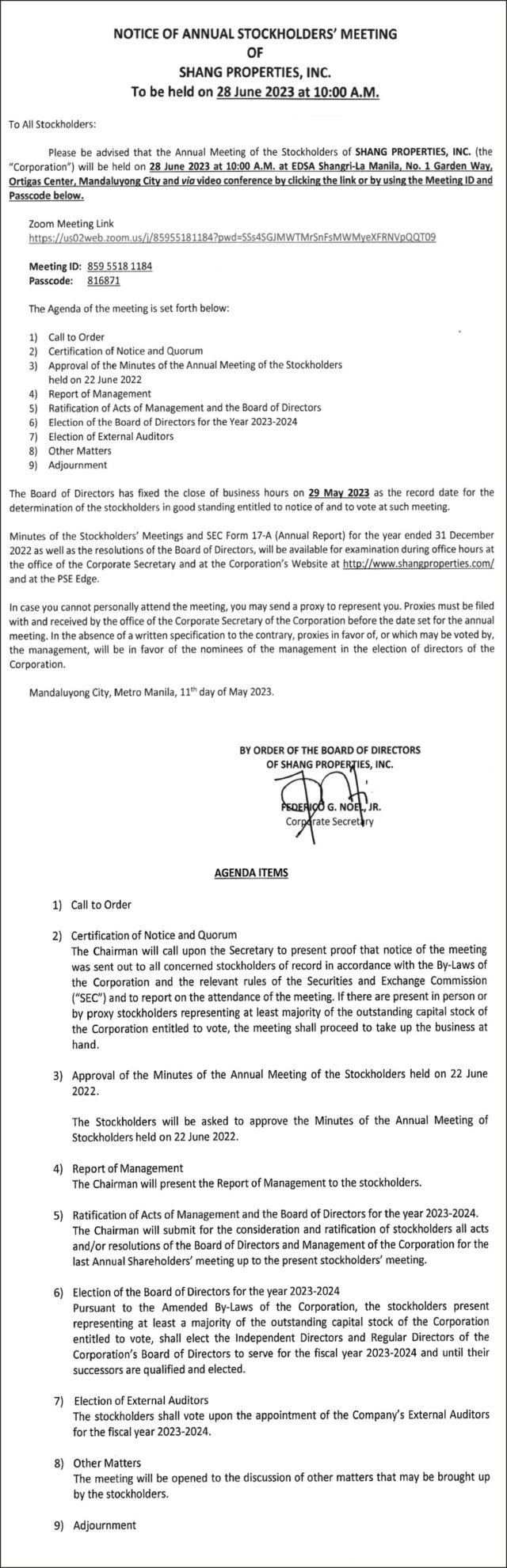
Shang Properties, Inc. to hold 2023 Annual Meeting of Stockholders on June 28


Spotlight is BusinessWorld’s sponsored section that allows advertisers to amplify their brand and connect with BusinessWorld’s audience by enabling them to publish their stories directly on the BusinessWorld website. For more information, send an email to online@bworldonline.com.

Join us on Viber at https://bit.ly/3hv6bLA to get more updates and subscribe to BusinessWorld’s titles and get exclusive content through www.bworld-x.com.

Population policy at a crossroads as population growth dramatically slows

CHARLEIN GRACIA-UNSPLASH

The Philippine Statistics Authority (PSA) recently came out with a preliminary report on births and deaths in 2022: Filipinos are having fewer children, and smaller families are now the norm. The births in 2022 are lower by 111,000 compared to 2021 (1,364,739 in 2021, down to 1,253,472 last year).

The trend for Total Fertility Rate (TFR) has been going down. The TFR was 3.1 children per woman in 2013. In 2017, TFR was 2.7 children per woman. And in 2022, TFR went down to 1.9 children per woman.

In “Population Planning Policy in the Philippines” (1973), Dr. Juan M. Flavier wrote that the country’s Commission on Population and Development (POPCOM) had recommended “to examine legal and administrative policies and measures affecting family size, and if necessary, to revise them to bring about a balance between family size and social and economic goals.”

Apparently, the Responsible Parenthood and Reproductive Health (RPRH) Law was the final measure that brought about that “balance between family size and social and economic goals.” But do we achieve the “social and economic goals” automatically? Why has poverty persisted, despite smaller family sizes? The legally mandated wages continue to fall below the minimum level of income that defines the poverty line.

Dr. Flavier was crystal clear in his paper: “Economic considerations are felt to be the most compelling reason for the national population planning policy. Written documents invariably comment on the economic implications of unbridled population growth.”

Clearly, population policy should not be about responsible parenthood and family planning alone. Even during the COVID pandemic, POPCOM has been drawing attention to increasing poverty and the need for a living wage. Most Filipino families need two jobs to sustain two children, which is now the average Filipino family size.

In 2021, at the height of the pandemic, President Rodrigo Duterte called out POPCOM and the Department of Health (DoH) to address population and urban growth, which was contributing to the country’s vulnerability to COVID. The recommendations of Secretary Karl Chua of the National Economic and Development Authority as POPCOM Chair, Secretary Francisco Duque of DoH and the writer of this column still have to be carried out.

The Department of Budget and Management convinced the Duterte administration to pass on the functions in health and population and family planning completely to local government units (LGUs). This disregarded the complementarity of health and population and family planning programs. The DoH was required to reduce budgets for family health, and family planning was made a partially devolved program, thus affecting the sustainability of the program.

Now that the major assumption for the country’s poverty has seemingly been solved (“too many Filipinos”), policy makers are talking about transforming the large labor force into inputs for economic recovery.

They quickly forget that the decline in fertility has come at a cost that must be maintained. The family planning (FP) program more than doubled, from 3.94 million women in 2012 to over 8 million women and couples in 2021. This came about due to the heroic efforts of local government health and population workers, the POPCOM, and the DoH. Family planning was the only public health program that expanded during the pandemic.

In a Social Weather Stations’ survey in November 2020 on the most important problem of women, a majority cited avoidance of pregnancy as their major problem during the pandemic. Their cited reasons: higher costs, fear of infections in hospitals, and lack of maternity services. It was also noted that marriages declined by 50% in 2020. This resulted in only 1.3 million births in 2021. As over 872,000 Filipinos died that year, the population grew at the lowest rate by around 400,000.

With the pandemic receding in 2022, the assumption is that marriages, births, and population growth might increase, but not to pre-pandemic levels.

These assumptions are only partially true: Marriages are up to around 401,000 (still 10% lower than 2019) and population growth is now 700,000 (from 400,000 in 2021).

However, births have continued to decline, with births down by 111,000 compared to 2021.

One reason is that Filipinos are now more comfortable with smaller family sizes. Only a few regions such as the Bangsamoro Autonomous Region in Muslim Mindanao continue to have more than two children per average family.

A second reason is that couples are still wary of the effects of the pandemic on the health system. They worry over increased health costs and fear of infection.

A third reason is that even if marriages are up, women are choosing to have children at later ages, with highest fertility at the 25-29 age group of women (Source: PSA).

A fourth reason is that women and increasingly men have accepted FP as a part of their daily lives. They see FP as a means to postpone having children or to limit the number of children through modern methods (leaving behind traditional methods). FP is accepted as a method to avoid poverty.

FP demand has been noted to increase as economies worsen and poverty increases. With stagnant wages that cannot sustain more than one or two children, modern FP has become an essential commodity.

Despite all the successes of FP in the previous nine years, erosion has started to set in due to complacency.

In 2021, maternal deaths numbered 2,478 or seven mothers dying in childbirth every day. It was the highest number of deaths in 69 years. They did not die of COVID. They fell victim as collateral damage of the pandemic as birthing centers closed and hospitals limited admissions. The most probable cause would have been a delay in referral for proper care. With the maternal mortality rate now up to 189 per 100,000 births, our Sustainable Development Goals (SDG) target by 2030 now seems insurmountable.

The family health budget in DoH has remained stagnant and will be reduced starting 2024. Unprepared LGUs are now being asked to buy pills and condoms, but their share of national taxes is due to decline in the next two years.

The signs are now clear. The Medicines, Technologies, and Pharmaceutical Services (MTaPS) Program reports that from a high of 50% free contraceptives in 2018 from government, the share of free contraceptives has gone down to 17% in early 2022. Women are now getting their pills from boticas (pharmacies) and supermarkets as health centers run out of pills.

Even POPCOM has closed its family planning clinic and converted it into an employees’ clinic, just as the demand for tubal ligations and vasectomies is increasing. That clinic alone performed over 4,000 tubal ligations and 1,000 vasectomies in the last four years, even during the pandemic.

To further the success of family planning and reproductive health, what we need is a commitment for more resources, not complacency and reduced services.


Juan A. Perez III specializes in public health administration and primary healthcare. He was undersecretary for Population and Development and executive director of the country’s Commission on Population and Development up to Sept. 8, 2022. He occasionally writes for Action for Economic Reforms.


Walmart has not made changes to LGBTQ-themed merchandise

WALMART.COM

BENTONVILLE, Arkansas — Walmart on Wednesday said it has not made any changes to its LGBTQ-related merchandise tied to Pride Month, or to security measures in place at its stores, a week after rival Target pulled some LGBTQ-themed products following customer backlash.

“We haven’t changed anything in our assortment,” Latriece Watkins, Walmart’s chief merchandising officer, said.

Last week, Target pulled some Pride-related merchandise, including items by transgender designer Erik Carnell, saying the products led to “volatile circumstances,” such as confrontations between customers and Target employees, and customers throwing Pride merchandise on the floor.

Walmart also offers LGBTQ-themed merchandise tied to Pride Month, which is celebrated in June, including rainbow-adorned flags, clothing, and accessories. Its “Pride & Joy” collection includes a $7.98 set of enamel pins with messages such as “Be you. Be Proud.” and “You are enough.”

Walmart’s Ms. Watkins said the retailer hasn’t changed its security measures in response to the confrontations Target cited at its own stores, adding that Walmart hasn’t seen similar issues.

“In this particular case, when we think about security …we have not done anything in particular differently related to security in our stores,” Ms. Watkins said. — Reuters

Maynilad hastens initiatives to hit carbon neutrality

MAYNILAD Water Services, Inc. is ramping up its sustainability initiatives to reach carbon neutrality in the coming years.

“We have already commissioned a 1-megawatt (MW) solar panel in our La Mesa treatment plant. We’ve already constructed another 1 MW within the compound also. It will be commissioned in the succeeding months,” Ronald C. Padua, Maynilad’s head of supply operations, told reporters last week.

According to its website, the company is aiming to become climate neutral by 2037.

Mr. Padua said the company is looking at installing solar panels in open spaces within water reservoirs, and gradually shifting its vehicle fleet to electric vehicles (EVs).

Roel S. Espiritu, Maynilad’s quality, sustainability and resiliency head,  said the company is aiming to fully transition to EVs by 2037. At least half of its vehicles are now EVs.

“We are also very aggressive with reforestation,” Mr. Espiritu said.

“We are particularly looking at Ipo for reforestation [and] carbon sequestration,” he said, referring to the reservoir from which the company sources raw water for treatment.

Maynilad serves Manila, except some portions it, as well as Quezon City, Makati, Caloocan, Pasay, Parañaque, Las Piñas, Muntinlupa, Valenzuela, Navotas, and Malabon. It also serves Cavite areas.

Metro Pacific Investments Corp., which has a majority stake in Maynilad, is one of three Philippine units of Hong Kong-based First Pacific Co. Ltd., the others being Philex Mining Corp. and PLDT Inc. 

Hastings Holdings, Inc., a unit of PLDT Beneficial Trust Fund subsidiary MediaQuest Holdings, Inc., has an interest in BusinessWorld through the Philippine Star Group, which it controls. — Ashley Erika O. Jose

ADVERTISEMENT
ADVERTISEMENT