Home Blog Page 4768

Financing sustained growth: MUP pension reform
(First of four parts)

This is the first of a four-part series on the subject of financing sustained growth. We start by looking at the cash operations report as of April this year which the Bureau of the Treasury (BTr) released last week.

HIGHER REVENUES, ANOTHER BUDGET SURPLUS
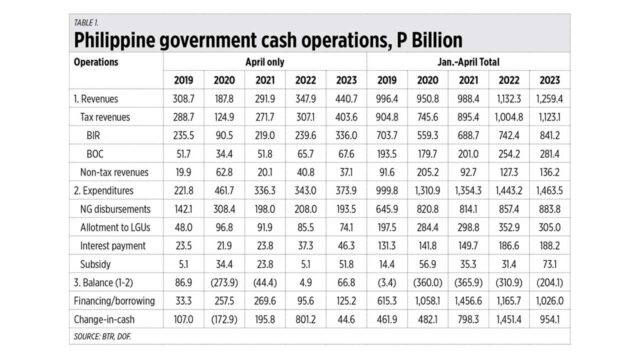
The good news is that tax revenues have reached P400 billion for the first time, while expenditures have not increased by a proportional amount — so we experienced a big fiscal surplus of P67 billion in April, compared with a deficit of P274 billion in 2020.

I computed the comparable January-April totals from 2019 to 2023 — the good news is that the deficit this year is the lowest since 2020, and while borrowings are still at P1 trillion, this is lower than in 2020. National Government (NG) spending and interest payments for public debt are the highest this year (see Table 1).

So, revenues have acquired a momentum of their own as the economy expands its recovery and this is good. The immediate and medium-term goals are to significantly reduce the deficit and annual borrowings, and reduce interest payments and amortization. There must also be a significant reduction in some items of the expenditure side.

During non-crisis years (whether caused by economic issues, a virus, etc.), the government should aim to have a fiscal surplus and retire some public debt so that the debt/GDP ratio can go down to 30%, even 20%, and we can save on interest payments and get higher credit ratings. Then, when a crisis hits, the debt/GDP ratio can go up again to 40% or higher. Once a crisis is over, it is time to again retire more public debt and aim to get the debt/GDP ratio back to 30% or less. We should target more fiscal responsibility, with a government living within its means, and welfare dependents learning how to let go of subsidies and contributing to the economy someday.

MUP PENSION REFORM
The annual pension for military and uniformed personnel (MUP) remains a big and major deficit generator yearly. The full amount is taken from taxpayers because MUPs themselves make no contributions to their retirement — they keep all their salaries and bonuses monthly.

I computed government revenues, expenditures, and public debt per employed person in the Philippines, then the MUP pension burden. The bad news is that public debt per employed person has jumped from P193,000 in 2019 to P294,000 in April 2023.

Expenditures for active personnel include their a.) basic pay, b.) other compensations (combat duty pay, combat initiative pay, hazard duty pay, etc.), and, c.) other benefits (terminal leave, retirement gratuity, PhilHealth and Pag-IBIG contributions by government, etc.).

Active-duty personnel like soldiers are not just put in harm’s way, they are well protected by taxpayers with high spending on capital outlay (CO) like tanks and trucks, fighter jets and choppers, boats and battle ships, and with high maintenance and other operating expenses (MOOE) like ammunition, bombs and gasoline.

The numbers show the following.

One, for active personnel, CO + MOOE rose from P106 billion in 2019 to P145 billion this year. Their basic pay also rose consistently.

Two, the MUP pension burden per employed person has increased from P2,400 in 2019 to P3,300 in 2022, and is projected to reach P4,400 this year.

Three, the MUP pension alone over the basic pay of active-duty personnel has increased, from 63% in 2019 to 94% last year, and is projected to reach 115% this year. And pension over total expenditures for active personnel has increased from 24% in 2019 to 41% this year (see Table 2).

The economic team led by the Department of Finance (DoF) and Department of Budget and Management (DBM) recently conducted consultations with the Armed Forces of the Philippines, the Philippine Air Force, and the Presidential Security Group.

The MUPs’ optional retirement beneficiaries can choose from any of these three options: 1.) Receive all their pension benefits in one lump sum upon retirement, 2.) Get 60 months pension in advance then a monthly pension after five years, and, 3.) receive pension benefits at the age of 57.

These proposals are fine. What I am proposing to the economic team — and I hope the MUP pensioners will consider this — is that their pensions should be taxed. Currently their generous pension is tax-free. The pensioners contributed zero to the fund when they were still on active duty, and as pensioners contribute zero to it in the form of tax. Since they benefit from tax money, they should contribute to such a fund.

PDEAA HOMECOMING
On June 22, the Program in Development Economics Alumni Association (PDEAA) of the UP School of Economics (UPSE) will hold a homecoming, with two prominent alumni of the program as guest speakers. They are Finance Secretary Benjamin Diokno (the 7th PDE batch) and DBM Secretary Amenah Pangandaman (the 33rd PDE batch). The two speakers will talk about sustaining economic growth and how to finance it, and how to better allocate spending given limited fiscal space.

After the lectures, there will be some programs for the alumni. So, graduates of PDE from the late 1960s to recent batches are all invited to attend this very important event.

(To be continued.)


Bienvenido S. Oplas, Jr. is the president of Bienvenido S. Oplas, Jr. Research Consultancy Services, and Minimal Government Thinkers
minimalgovernment@gmail.com

Lumina Homes unveils ‘eco-bins’ in projects

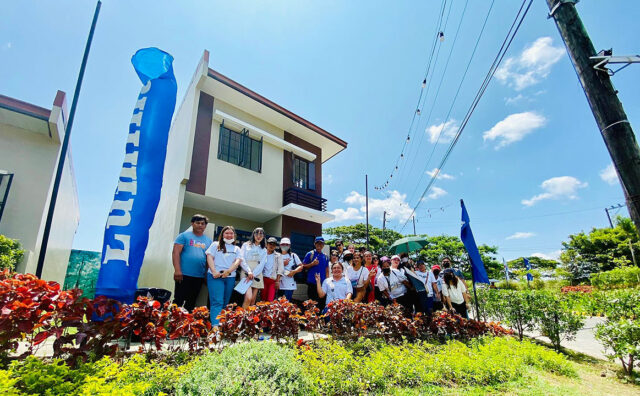
LUMINA HOMES introduced an eco-bins system at its residential project in Pandi, Bulacan last April.

“Eco-bins function as an efficient waste management system that is built right into the property’s wall. With such convenient access to waste containers, homeowners will generally find it easier and simpler to keep their dwellings cleaner, neater, and healthier,” Lumina Homes said in a statement.

Lumina Pandi is a 22-hectare house and lot development with amenities such as a 24/7 guarded entrance with CCTV, covered basketball court, mini gardens and a playground.

Prospective homeowners check out the eco-bin system by visiting Lumina’s model home in Barangay Pinagkuartelan, Pandi, Bulacan.

Lumina Homes is also planning to launch projects in Plaridel, Calumpit, Baliwag, and San Miguel in Bulacan.

BPI eyes $200-million syndicated term loan facility

BPI FACEBOOK PAGE

BANK of the Philippine Islands (BPI) is looking to secure a syndicated term loan facility worth at least $200 million to partly refinance $600 million in debt maturing in September, it said on Monday.

The Ayala-led bank said the loan could be upsized to $300 million if the offer is oversubscribed, according to the indicative term sheet and timeline for the loan.

BPI is eyeing a three-year maturity term for the loan, with an offer term of two months after the loan has been made official.

The Hongkong and Shanghai Banking Corp. Ltd., Singapore Branch (HSBC) and Standard Chartered Bank (Singapore) Ltd. will be the mandated lead arrangers, bookrunners and underwriters for the loan.

BPI is looking to have the loan signed on July 12, and to have the participating banks commit on either June 30 or during the week of July 3.

“We mandated a few weeks ago but only just recently launched. We just had the call with participating banks yesterday,” BPI Chief Finance Officer and Chief Sustainability Officer Eric Roberto M. Luchangco told reporters on Friday.

BPI booked an attributable net income of P12.134 billion in the first quarter, 51.98% higher year on year, driven by improved net interest earnings and lower loan loss provisions.

Its shares went up by 70 centavos or 0.7% to end at P100.70 apiece on Monday. — A.M.C. Sy

PetroGreen, state entities meet for offshore wind project

PETROGREEN Energy Corp. on Monday said that it had conducted a port evaluation meeting for its 2,000-megawatt (MW) offshore wind power project in Ilocos Norte.

In a statement, the renewable energy (RE) arm of listed PetroEnergy Resources Corp. said the meeting was conducted by its joint venture entity called BuhaWind Energy with the Department of Energy (DoE) and other relevant agencies.

BuhaWind Energy is jointly owned by PetroGreen and Copenhagen Energy. The other agencies involved in the meeting are the Department of Transportation, Philippine Ports Authority (PPA), Philippine Coast Guard, and Maritime Industry Authority.

PetroGreen said the “high level” ports evaluation will determine additional works, improvements, and costs needed for the candidate ports in Ilocos Norte, which are deemed suitable for offshore wind development and operations.

“The PPA was tasked to validate the initial findings in order to make the facility ready by 2026,” PetroGreen said.

“The potential of an economic zone development around the ports for industrial and commercial activities powered by clean energy from the Northern Luzon offshore power project was also raised,” the company added.

Separately, the DoE said that it is set to release a policy and administrative framework for the optimal development of offshore wind resources in the country.

“We are pleased with the positive response from local and foreign investors eyeing our RE potential. We are working on policies that would minimize roadblocks, especially for offshore wind installations,” Energy Secretary Raphael P.M. Lotilla said in a media release.

In May, the DoE issued implementing guidelines for Executive Order 21, which will adopt a whole-of-government approach to expedite the processing of permits and requirements for offshore wind energy projects.

Last month, the department said it had awarded 65 offshore wind contracts with a combined potential capacity of 51.23 gigawatts (GW), which it deemed enough to supply the country’s future energy demand.

Under the Philippine Offshore Wind Roadmap, the Philippines has an estimated potential capacity of 178 GW from offshore wind resources. This is expected to help the country reach its aim of increasing the share of renewables to 35% of the country’s energy mix by 2030 and 50% by 2040. — Ashley Erika O. Jose

New SM mall opens in Bataan

BW FILE PHOTO

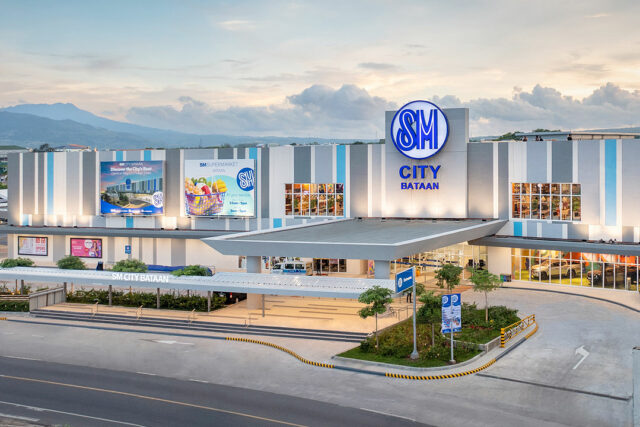
SM Prime Holdings, Inc. recently opened its first mall in Bataan province.

Located in the city of Balanga, SM City Bataan is also the company’s 83rd shopping mall.

Bataan Rep. Albert S. Garcia said the new mall has create jobs for many residents not just in Balanga, but also Pilar, Orani, Orion and Hermosa.

“I’m happy to know that these jobs are filled by Bataeños. That is really what we were aiming for to begin with — to present more job opportunities that will help make the lives of every Bataeño better,” he was quoted as saying in a statement.

Mr. Garcia also noted that SM City Bataan features homegrown businesses, including family-owned brands and locally managed franchises, in prominent spaces within the mall.

“It’s a big thing that homegrown local brands are now in SM. In addition to helping fellow Bataeños, many will be motivated as well to go out and do business with SM to promote the local food industries of the province,” Roberto Santos, the owner of Chedeng’s Snack Bar, said.

SM City Bataan also serves as a center of accessibility as the Bataan Common Terminal is located within the mall compound.

“The common terminal serves all public utility vehicles in and out of the city. Not only will this help the general workforce of the mall, but it will also bring comfort to all our commuting customers,” Jhoanalyn Gatdula, assistant mall manager of SM City Bataan, said.

Mallgoers are greeted by a mural with clay pots or “banga” that capture a part of the cultural identity of Balanga’s residents. Another entrance features gel lights-formed birds representing the Ibong Dayo festival that are integrated into another mural as a nod to the efforts of the city’s Wetland and Nature Park, an outdoor sanctuary in the protection of migratory birds.

Religiosity, ethical leadership, and good governance

NATALIE PEDIGO-UNSPLASH

As a staunch advocate of good corporate governance, I have been both happy and dismayed by the developments on good corporate governance. Happy because there have been major strides in improving corporate governance practices and dismayed because many companies continue to be embroiled in governance controversies.

In the last few months, we have seen two banks, Silicon Valley Bank (SVB) and Credit Suisse, go under.

It makes one think: what else is needed since regulating bodies and institutions have created enough structures and mechanisms to prevent corporate disasters? These bank failures show that rules and policies are not enough. Despite universally accepted codes, corporate governance has different meanings and implications in the country where it is practiced and shaped by its culture.

I recently published a study about the role of religiosity and ethical leadership in good corporate governance. This study is particularly significant as the Philippines presents a cultural context that manifests in a unique corporate setup, such as the prevalence of family-ownership structure and cultural values, specifically religiosity, as espoused by the organization.

According to Gallup International, 90% of Filipinos declared themselves religious (having a strong religious feeling or belief). But does this religiosity lead to ethical behavior? A person’s upbringing is influenced by the values espoused by one’s religion. These values include social justice, ethical behavior, and good governance. We can capitalize on the role of religion as an enabler of ethical business cultures among board members. However, despite the inherence of religion as a positive influence on good governance, history has shown us how individuals have failed in their primary roles as stewards of their organizations. Similarly, companies with excellent corporate governance indicators did not guarantee ethical behavior or business success.

Behavioral transformation is a long and tedious process that requires psychological techniques but may benefit governing organizations in the long run. Ethical behaviors play a crucial role in forming and developing good governance behavior. Religion as a precept needs to be stronger to ensure good corporate governance. The link between religion and ethics has been, at best, ambiguous. As an educator and practitioner of good governance, I propose that board ethical leadership must be a component of corporate governance.

Ethical leadership is the demonstration of normatively appropriate conduct through personal actions and interpersonal relationships and promotion of such conduct to followers. This can be related to how directors in organizations promote ethical behaviors and consequently communicate this behavior through examples and decisions made by the board.

To improve corporate governance practice, I strongly believe there is a need to provide a deeper understanding of director behavior by focusing on a specific foundational value (religion) and how this can be used to strengthen ethical leadership. Boards may use these insights to assess director behavior and how this can guide them in performing their roles as stewards of their organizations, not just through compliance and set structures but beyond compliance through behavioral and ethical foundations. Enterprise, ethics, and religion are interdependent components of good corporate governance behavior that organizations can harness toward organizational success.


Leveric T. Ng is a management consultant and faculty member of De La Salle University and the Ateneo Graduate School of Business. A DLSU DBA graduate, his research interests are in the areas of corporate governance and leadership. He is also a fellow of the Institute of Corporate Directors and a member of the Philippine Academy of Management.

leveric.ng@dlsu.edu.ph

Central bank launches commemorative coins

THE CENTRAL BANK has launched a new commemorative coin set for the 125th Anniversary of Philippine Independence and Nationhood.

On Monday, the Bangko Sentral ng Pilipinas (BSP) issued the coin set with 100-Piso, 20-Piso and 5-Piso denominations.

The 100-Piso coin celebrates the declaration of Philippine independence in 1898, while the 20-Piso coin commemorates the birth of the country’s first republic at the Barasoain Church in Malolos, Bulacan.

Meanwhile, the 5-Piso coin honors the Filipinos who fought in the Philippine-American War in 1899 for the country’s sovereignty.

The central bank used the latest digital printing technology in creating the coin set, which features the first colored, non-circulation, commemorative coins developed by the BSP.

The BSP will announce when the coin set will be available for sale.

In his speech during the launch event with President Ferdinand R. Marcos, Jr. in Malacañan Palace, BSP Governor Felipe M. Medalla said the three colors on the coins represent aspirations: the blue color for kapayapaan (peace), red for kagitingan (valor), and yellow for kalayaan at soberanya (freedom and sovereignty).   

“As such, we are issuing these commemorative coins as part of BSP’s effort to preserve the cultural heritage and promote pride in our shared history,” Mr. Medalla said. — Keisha B. Ta-asan

Federal judge rejects Tennessee drag show ban as unconstitutional

FREEPIK

WASHINGTON — A federal judge has ruled that Tennessee’s law restricting drag performances in public or where children were present was unconstitutional, striking a blow to efforts in US states to regulate LGBTQ conduct.

Tennessee Governor Bill Lee in February had signed the bill passed by the state’s assembly that aimed to restrict drag performances, putting the state at the forefront of a Republican-led effort to limit drag in at least 15 states in recent months.

US District Judge Thomas Parker, an appointee of former Republican President Donald Trump, ruled late on Friday that the law was “both unconstitutionally vague and substantially overbroad.” The First Amendment to the Constitution commands that laws infringing on freedom of speech must be narrow and well defined, Mr. Parker said in the 70-page ruling.

“Simply put, no majority of the Supreme Court has held that sexually explicit — but not obscene — speech receives less protection than political, artistic, or scientific speech,” Mr. Parker said in the ruling.

Under the law, offenders could face fines and up to a year in prison and repeat offenders could have faced prison sentences of up to six years.

Ahead of the 2024 elections, Republican lawmakers across the country have introduced more than 500 bills this year regulating the conduct of gay and transgender people, ranging from what can be taught in schools to bathroom use and medical care. At least 48 of those have passed, according to the Human Rights Campaign, an advocacy group.

Mr. Parker had temporarily blocked the law on March 31, just before it was set to go into effect, siding with Friends of George’s, a Memphis-based LGBTQ theater group that filed suit against the state.

GLAAD, an LGBTQ advocacy group, praised Mr. Parker’s decision. “This ruling is a turning point and we will not go back,” GLAAD said in a release.

“Every anti-LGBTQ elected official is on notice that these baseless laws will not stand and that our constitutional freedom of speech and expression protects everyone and propels our culture forward,” the group said. — Reuters

D&L considers new product offerings

D&L INDUSTRIES, Inc. is developing new products and considering new industries for product expansion, its top official said on Monday.

“We do have a lot of new plans and new industries that we are targeting… but they are still very new,” said D&L President and Chief Executive Officer Alvin D. Lao in a media briefing.

Mr. Lao declined to disclose the products being developed by the company, saying its competitors might copy them.

“We are always exploring new products and new industries, and our [research and development] is very busy because they are constantly coming up with new formulations and solutions for our customers,” he added.

Also on Monday, the company’s board of directors appointed former National Economic and Development Authority (NEDA) Director-General Karl Kendrick T. Chua as its new independent director.

“He brings a fresh perspective with his distinguished experience as an economist, working for the World Bank for over a decade and serving the government in various strategic leadership roles thereafter,” Mr. Lao said in a statement.

“With independent directors continuing to hold a majority of our Board, the company remains committed to upholding good governance and transparency,” he added.

Mr. Chua was previously with the World Bank as an economist, NEDA secretary, and undersecretary for strategy, economics, and results at the Department of Finance.

Meanwhile, the company declared a cash dividend of P0.30 per share, which consists of a regular cash dividend of P0.24 per share and a special cash dividend of P0.06 per share, to shareholders of record as of June 20.

The company’s dividends for the year amount to P2.14 billion, up 25% from the P1.71 billion issued the previous year.

D&L Industries is engaged in product customization and specialization for industries such as food, chemicals, plastics, and consumer product original design manufacturing.

The company’s principal business activities include manufacturing of customized food ingredients, specialty raw materials for plastics, and oleochemicals for personal and home care use.

On Monday, its shares rose by 2.29% or 16 centavos to P7.15 apiece. — Adrian H. Halili

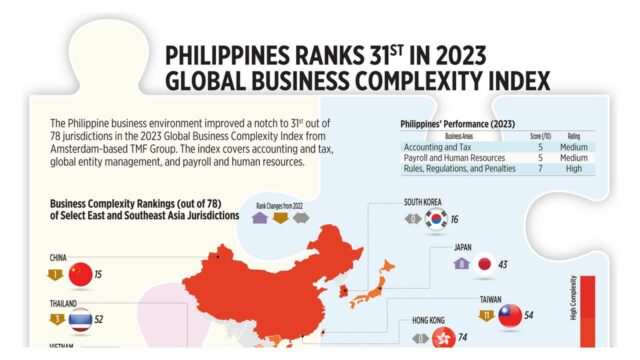
Philippines ranks 31st in 2023 Global Business Complexity Index

The Philippine business environment improved a notch to 31st out of 78 jurisdictions in the 2023 Global Business Complexity Index from Amsterdam-based TMF Group. The index covers accounting and tax, global entity management, and payroll and human resources.

Philippines ranks 31<sup>st</sup> in 2023 Global Business Complexity Index

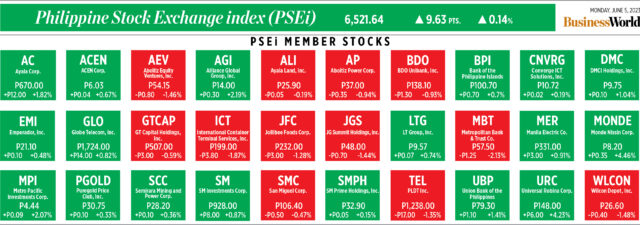
How PSEi member stocks performed — June 5, 2023

Here’s a quick glance at how PSEi stocks fared on Monday, June 5, 2023.


PHL shares climb as Biden signs debt limit deal

REUTERS

LOCAL EQUITIES rose on Monday as investors remained cautious ahead of the release of May consumer price index (CPI) data and after US President Joseph R. Biden signed the debt ceiling deal over the weekend.

The benchmark Philippine Stock Exchange index (PSEi) went up by 9.63 points or 0.14% to 6,521.64 on Monday, while the broader all shares index rose by 11.46 points or 0.33% to close at 3,486.33.

“The local bourse gained by 9.63 points to 6,521.64 after US President Joe Biden signed into law a debt ceiling bill, erasing the worries among investors,” Philstocks Financial, Inc. Research Analyst Claire T. Alviar said in a Viber message.

“However, market participation remained weak… Many were still on the sideways as they await May’s inflation rate to be released [on Tuesday],” Ms. Alviar added.

Value turnover declined to P3.36 billion on Monday with 1.7 million shares changing hands from the P4.88 billion with 1.21 billion issues traded on Friday.

Unicapital Securities, Inc. Senior Equity Research Analyst Carlos Angelo O. Temporal likewise said that investors remained cautious ahead of the release of May CPI data.

“Investors are likely weighing the positive resolution of the US debt ceiling last Saturday against these uncertainties,” Mr. Temporal added.

Mr. Biden on Saturday signed a bill that suspends the US government’s $31.4-trillion debt ceiling, averting what would have been a first-ever default with just two days to spare, Reuters reported.

The House of Representatives and the Senate passed the legislation last week after Mr. Biden and House of Representatives Speaker Kevin McCarthy reached an agreement following tense negotiations.

The Treasury department had warned it would be unable to pay all its bills on Monday if Congress had failed to act by then.

Meanwhile, a BusinessWorld poll of 15 analysts yielded a median estimate of 6.1% for May headline inflation, near the lower end of the Bangko Sentral ng Pilipinas’ (BSP) 5.8-6.6% estimate for the month.

If realized, this would be slower than 6.6% in April but quicker than the 5.4% print in the same month a year earlier.

The May CPI would also exceed the BSP’s annual 2-4% target range for the 14th consecutive month.

The majority of sectoral indices went up on Monday except for services, which declined by 14.22 points or 0.91% to 1,536.32, and financials, which went down by 6.92 points or 0.37% to 1,829.17.

Meanwhile, industrials increased by 125.12 points or 1.35% to 9,334.02; holding firms rose by 31.49 points or 0.48% to 6,514.49; property went up by 7.92 points or 0.29% to 2,658.26; and mining and oil inched up by 10.03 points or 0.1% to 10,049.17.

Advancers outnumbered decliners, 114 versus 64, while 37 names closed unchanged.

Net foreign selling stood at P108.35 million on Monday versus the P218.62 million in net buying seen on Friday. — A.H. Halili with Reuters

ADVERTISEMENT
ADVERTISEMENT