Home Blog Page 4673

Unlocking a new era of security: Embracing the Zero Trust revolution

TRUSTPAIR.COM

WHILE the concept of Zero Trust emerged in 2010, it has recently gained significant relevance in the Philippines, particularly in light of the country’s rapid digital transformation and expanding connectivity landscape. As organizations in the Philippines have shifted to remote work policies, the need to secure sensitive data accessed from outside the network is paramount. Traditional security measures designed for a single location is proving inadequate to address the unique challenges presented by the country’s evolving digital landscape.

Administrators have had to adapt and enhance security protocols to mitigate vulnerabilities arising from remote work arrangements. In this context, Zero Trust has emerged as a crucial framework that goes beyond traditional security models, providing a more robust approach to protect sensitive data and combat cyberthreats. By implementing Zero Trust principles, organizations in the Philippines can establish a strong cybersecurity foundation, aligning with the country’s pursuit of a secure and resilient digital environment.

Zero Trust has changed the age-old security axiom “trust, but verify” to “never trust; always verify.” Zero Trust is a security concept that assumes any user, device, or application seeking access to a network is not to be automatically trusted, even if it is within the network perimeter. Instead, Zero Trust requires verification of every request for access, using a variety of security technologies and techniques such as MFA, least privilege access, and continuous monitoring.

The Philippines’ rapid growth in the business process outsourcing  industry, coupled with handling of sensitive data on behalf of global clients, further emphasizes the significance of implementing Zero Trust principles in the country. Adopting a Zero Trust approach ensures that every access request, whether from within the organization or by external sources, undergoes rigorous verification, safeguarding valuable data from potential breaches and unauthorized access. By embracing Zero Trust, Philippine companies can demonstrate their commitment to maintaining a secure and reliable environment, fostering trust and confidence among global partners.

Why should Zero Trust be a part of your disaster recovery strategy?

Disaster recovery is a critical component of any organization’s IT strategy, helping to ensure that business operations can continue even in the event of a major outage or cyberattack. In recent years, the concept of Zero Trust has emerged as a powerful new approach to cybersecurity, and now plays an important role in disaster recovery planning.

At its core, Zero Trust is all about ensuring that only authorized users and devices can access a network or application. In the context of disaster recovery, by adopting a Zero Trust approach, organizations can ensure that only authorized personnel can initiate or modify backup tasks and perform restorations, and that the access granted to them is revoked once the operation has been completed.

One of the key benefits of Zero Trust is that it can help minimize the risk of insider threats. This is because Zero Trust assumes that all users and devices are potentially compromised, and each of them requires continuous authentication and verification in order to access resources.

How to implement Zero Trust in your disaster recovery strategy

Implementing Zero Trust in your disaster recovery strategy is a complex process that requires careful planning, execution, and ongoing maintenance. Here are some key steps that organizations can take to implement Zero Trust and improve their disaster recovery capabilities.

• Assess your current environment.

The first step in implementing Zero Trust is to conduct a thorough assessment of your current environment, including your network infrastructure, applications, and data. This will help you identify any potential security gaps or vulnerabilities that could be exploited in the event of a disaster. It’s also important to evaluate your current disaster recovery plan, and ensure that it is aligned with the principles of Zero Trust.

• Define your Zero Trust architecture.

Once you’ve assessed your current environment, the next step is to define your Zero Trust architecture. This will involve identifying the types of security controls and technologies that you will need to implement, such as multi-factor authentication (MFA), micro-segmentation, immutable backup storage, and continuous monitoring. You’ll also need to determine how these controls will be deployed and integrated with your existing infrastructure.

• Implement Zero Trust controls.

With your Zero Trust architecture in place, the next step is to implement the necessary controls and technologies. This may involve deploying new hardware or software, configuring access policies and rules, and training your staff on how to use these new tools effectively.

Your disaster recovery solution should always require users to authenticate themselves via MFA before any operation is performed. When users are authorized, access to configure and operate the backup and restoration modules should be provided for a limited duration.

• Monitor and review your Zero Trust environment.

Implementing Zero Trust is an ongoing process that requires continuous monitoring and review. You’ll need to establish metrics and KPIs to measure the effectiveness of your Zero Trust controls, and regularly review your environment to identify any potential weaknesses or areas for improvement.

• Test and refine your disaster recovery plan.

Finally, it’s important to test and refine your disaster recovery plan on a regular basis to ensure that it is aligned with the principles of Zero Trust. This may involve conducting regular tabletop exercises or full-scale simulations to test your response to various disaster scenarios. Based on the results of these tests, you can refine your plan and adjust your Zero Trust controls as needed.

Implementing a Zero Trust strategy is not without its challenges. It requires a significant investment in security technologies and expertise, and may require changes to existing IT infrastructure and workflows. However, for Philippine organizations that are serious about disaster recovery and business continuity, Zero Trust is a powerful methodology that can help ensure the security and resilience of critical systems and data.


Dhilip R is a product consultant for ManageEngine.

It’s just a matter of routine

JON TYSON-UNSPLASH

ROUTINE is part of the corporate executive’s life. The word itself comes from French “route,” which is also English for road or way, from which one does not stray. This corporate routine was indeed shaken up for three years with the lockdown and work-from-home protocol of the coronavirus pandemic. But slowly, the old routine of working in the office is coming back — with or without face masks.

Just like monks, school children and soldiers, the business executive is often ruled by routine. His authority is defined. He has a list of tasks and goals assigned to him, even how his performance of such tasks will be evaluated and rewarded with variable pay. His guaranteed annual cash compensation, if he fails in all his key result areas, is predetermined anyway. His continuing stay, however, is not always assured.

Work hours, including the time he needs to make available for motivational talks, team building, culture change and product launches are set. The executive is given an assigned workspace with a desk, sometimes also with a view of the outside cubicles. The benefits he is entitled to like health insurance, car, foreign travel, parking space and access to the executive dining room are defined. Some outside meals are chargeable if he is with a client or an industry regulator. He doesn’t always submit a call report.

Routine brings predictability to corporate life and sets mutual expectations. It is a comfort zone that relieves stress that can arise from new and unexpected developments. Custom ensures entrenchment of authority and privilege. In a static system, the ones on top can be secure in the knowledge that they will not be shaken out of their perch… until they are.

This routine is not always guaranteed. There are sometimes crises and developments that shake up the organization. The disequilibrium arises from many sources.

Technology, like online banking and AI, may change to favor outside consultants who will find the present set of skills (or talents) inadequate or unnecessary. A new leader may have been hired from outside who has no inkling of the current social structure (and the informal hierarchy that goes with it) and worse, little regard for its continued relevance. The traditional protector of the status quo may have retired or has been given a new job that limits his sphere of influence to the menu for lunch on Wednesday. It may even be a combination of all three — the organizational equivalent of a perfect storm.

When these strong winds of change blow, little remains nailed down to the ground. The corner office, unlimited doughnuts, trips overseas on business class, security detail against kidnapping and a regular car replacement every four years are all under review (This is not a country club). New sets of people are called to meetings, involving fewer than six participants, including the minute taker who concentrates only on the “next steps.”

Routine can be so embedded in the workplace that one who retires, either willingly or not, is thrown into a handicapped bathroom with no handrails.

Habits can be addicting. Executives who retire and lose their cherished routine end up with insomnia. Sometimes, they decide to become entrepreneurs and open a restaurant. This only exacerbates the uncertainty and volatility of the cash flow, and exhausts the retirement pay altogether. Changing the menu doesn’t always work.

Another option is working for a smaller company — better if very much smaller than the previous one. The habits are similar even if the perquisites are diminished. There are fewer free trips abroad and the lines to get to the plane are longer with the leg room for seats more cramped. Life, like seats, can be adjusted.

The creative executive, when pried out of years-long habits, needs to change his paradigm or shift it a little. From pampered guest, the metaphor changes to paying customer. Instead of clinging to routine, why not welcome the unexpected? The escape from monotony can be liberating.

Some routines of daily life persist. These include eating, shaving, taking a bath (and not slipping), tying one’s shoes and paying credit card bills that provide enough predictability (and anxiety) to approximate the cycles of the corporation.

Each day with a different routine is a gift. It doesn’t always come with ribbons.


Tony Samson is chairman and CEO of TOUCH xda

ar.samson@yahoo.com

Globe eyes stronger growth to come from non-telco business

GLOBE Telecom, Inc. expects its non-core businesses to post stronger growth this year and contribute more to the listed telecommunications company.

“To capture the share of ICT (information and communication technology) solutions, in terms of growth, we are expecting more from non-core services moving forward. This is where we are putting our biggest bet,” said Globe Business Senior Director Anne A. David.

She made the statement on the sidelines of the launch of Globe Business Retail Revolution, which is the brand’s commitment to supporting small businesses in their digital shift.

In the first quarter, revenues from Globe’s non-telco segment rose to P1.4 billion, up by 80% from P791 million in the same period last year.

The segment recorded the biggest revenue growth within Globe during the first three months of the year.

From January to March, the company invested a total of P220.1 million in its non-telco business segment.

On Tuesday, the company launched new solutions aimed to support the journey of micro-, small- and medium-sized enterprises in adapting to the digital space.

These solutions are Prosperna, a do-it-yourself website creator, and an inventory management system.

“Even according to the Department of Trade and Industry, the last step for businesses is to have your own presence because it legitimizes your business,” said Ms. David.

“Of course, there are people who would choose going to marketplaces like Lazada and Shopee but there’s also an advantage of getting your own website because you don’t have to pay fees to the marketplaces,” she added.

The inventory management solution provides an end-to-end digitalization of supply chain operations from inventory, purchasing, accounting, order management, and sales account management to the delivery of products to customers.

According to Ms. David, Globe is looking to bring these retail-centered solutions to other parts of the country as its customer base has grown beyond the National Capital Region (NCR).

“It is surprising because we thought that NCR will be the one to boom in solutions but even in Metro Davao and Metro Cebu they are also starting to be receptive,” she said. — Justine Irish D. Tabile

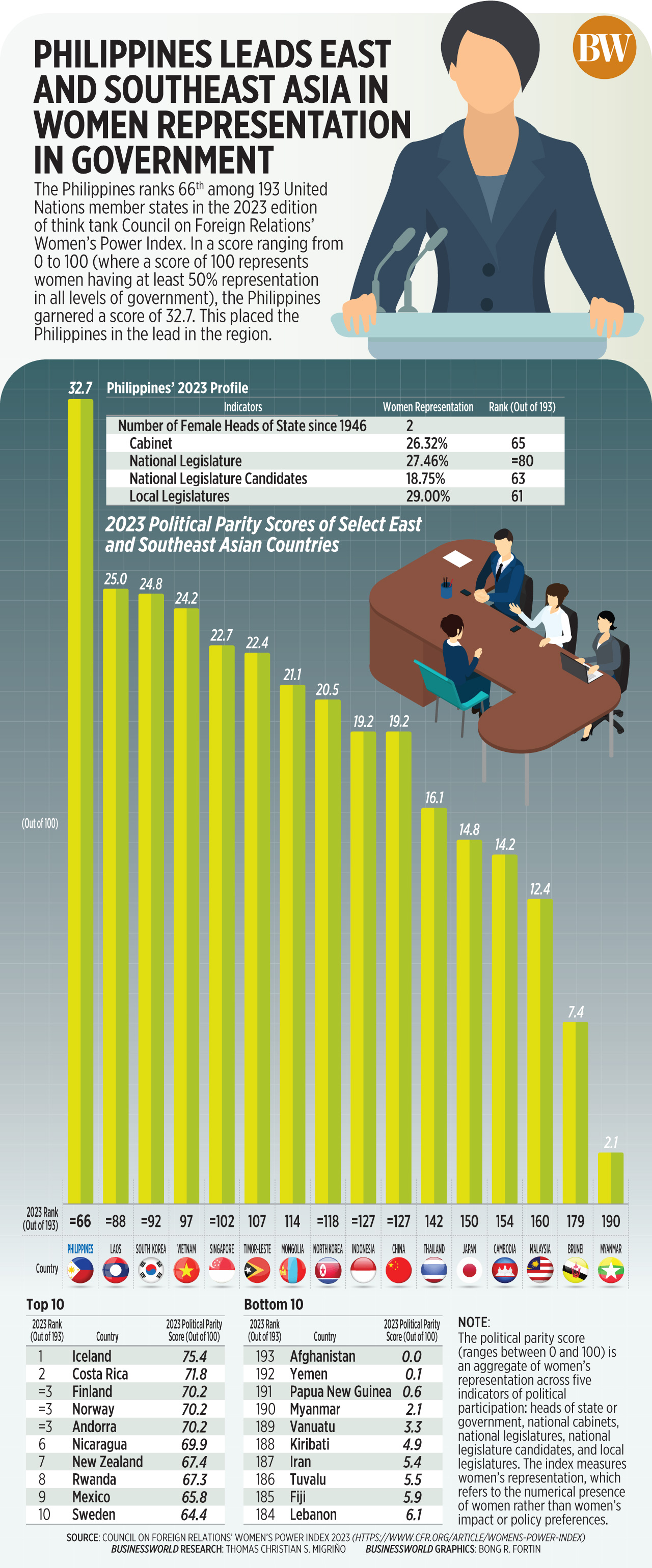
Philippines leads East and Southeast Asia in women representation in government

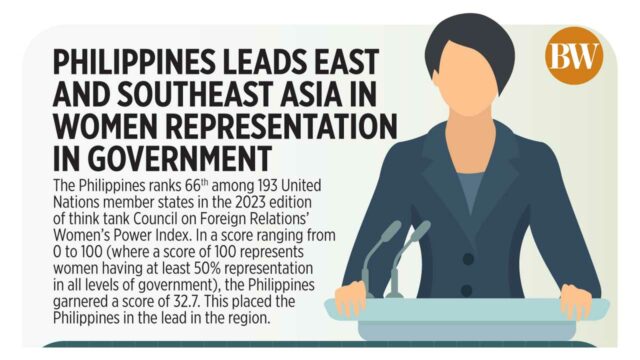
The Philippines ranks 66th among 193 United Nations member states in the 2023 edition of think tank Council on Foreign RelationsWomen’s Power Index. In a score ranging from 0 to 100 (where a score of 100 represents women having at least 50% representation in all levels of government), the Philippines garnered a score of 32.7. This placed the Philippines in the lead in the region.

Philippines leads east and Southeast Asia in women representation in government

Month-end window dressing may drive trading

REUTERS

PHILIPPINE STOCKS may move sideways with an upward bias on Thursday due to month-end window dressing and following a one-day trading break.

On Wednesday, the benchmark Philippine Stock Exchange index (PSEi) dropped by 20.24 points or 0.31% to 6,502.85, while the broader all shares index went down by 6.65 points or 0.19% to close at 3,463.81.

The stock market was closed on June 28 for a regular holiday in observance of Eid’l Adha.

“Towards the end of the week, the PSEi may move sideways with some upward bias given the potential window dressing as the first half concludes and general sentiment remaining cautious ahead of key inflation data next week,” Unicapital Securities, Inc. Senior Equity Research Analyst Carlos Angelo O. Temporal said in a Viber message.

“Following a strong bounce last Monday from the 6,400 levels and with the likely window dressing, coupled with high expectations of a sustained downtrend in inflation,… we anticipate the index to hold above 6,500 levels on Friday, which is higher than the May 31 close of 6,477,” Mr. Temporal added.

On Monday, the PSEi returned to the 6,500 level and closed at 6,523.09, rising by 129.54 points or 2.02% from its previous finish.

Philippine inflation data for June will be released on July 5.

Headline inflation slowed to 6.1% in May from 6.6% in April. For the first five months, the consumer price index averaged 7.5%, still well above the Bangko Sentral ng Pilipinas’ (BSP) 2-4% target and 5.4% forecast for the year.

The BSP has said it expects inflation to return within its target range by the third quarter.

Meanwhile, China Bank Securities Corp. Research Director Rastine Mackie D. Mercado said there could be some weakness in the market when trading resumes on Thursday as profit taking could ensue.

“Ideally, we’d like to see the market continuing to hold above the 6,480 level as this keeps prospects of another rally in play. We also note that we may see some volatility on Thursday as markets react to developments from overseas markets, as many would remain open on Wednesday,” Mr. Mercado said in an e-mail.

“With respect our view for the end of the week, we think that the index could post a steep move in either direction given quarter-end window-dressing, especially given how thin liquidity has been in the local market. That said, we think investors should brace for a possible uptick in volatility,” he added.

Asian shares stalled on Wednesday as surprisingly upbeat US economic news warred with global growth concerns, while the embattled yen hit a 15-year low on the euro and Japan hinted at intervention to prevent further losses, Reuters reported.

The strength of US data also combined with hawkish commentary from the European Central Bank to undermine bonds as markets narrowed the odds on further rate hikes.

The rate risk kept markets cautious and MSCI’s broadest index of Asia-Pacific shares outside Japan was off 0.2%. — A.H. Halili with Reuters

Court junks ill-gotten wealth case vs elder Marcos

OFFICIAL GAZETTE OF THE REPUBLIC OF THE PHILIPPINES

THE PHILIPPINES’ anti-graft court has dismissed an ill-gotten wealth case against the late dictator Ferdinand E. Marcos, Sr., his wife Imelda and their business associates for insufficient evidence.

In a 45-page decision dated June 27, the Sandiganbayan Second Division said government prosecutors had failed to prove the late president and his wife conspired with their cronies to acquire ill-gotten wealth.

“A judicious perusal of the evidence on record shows that the plaintiff failed to sufficiently prove the allegations in its amended complaint,” Associate Justice Arthur O. Malabaguio said. “In particular, the plaintiff failed to establish that the subject properties were ill-gotten.”

The Presidential Commission on Good Government (PCGG) filed the case in 1987 and accused the Marcos family’s business associates of acting as their dummies by buying shares in several companies.

Cleared were spouses Modesto and Trinidad D. Enriquez and their heir Leandro Enriquez, spouses Rebecco and Erlinda E. Panlilio, Don M. Ferry, Roman A. Cruz, Jr. and Gregorio R. Castillo. Most them have died and were substituted by their heirs.

The shares in question were of Fantasia Filipina Resorts, Inc., Hotel Properties, Inc., Monte Sol Development Corp., Ocean Villas Condominium Corp., Olas del Mar Development Corp., Philippine Village Hotel, Philroad Construction Corp., Puerto Azul Beach and Country Club, Inc., Silahis International Hotel, Sulo-Dobbs Food Services, Inc. and Ternate Development Corp.

The court said most of the documentary evidence presented by the prosecutors were mere photocopies and were barely readable.

A record custodian of the PCGG, the government’s sole witness, could not verify the documents.

Citing the court’s rules of evidence, the Sandiganbayan said documents presented as evidence should abide by the “best evidence rule,” which requires original documents to be presented in court.

“Nothing on the face of these documents shows that defendants Ferdinand E. Marcos and Imelda R. Marcos had any interest or control over the subject corporations,” it said.

“Verily, nothing in these documents would show that said corporations or the amounts paid in the stock came from the government nor were acquired by them through illegal means or through their relationship with the Marcoses.”

Earlier this month, the Sandiganbayan rejected a government plea to allow it to present a new witness in another ill-gotten wealth case against the business associates of Mr. Marcos and the former first lady.

A popular street uprising toppled the dictator’s regime in February 1986, forcing him and his family to flee into exile in the United States.

That same year, his successor, the late Corazon C. Aquino, set up the PCGG to go after ill-gotten assets of the elder Marcos, his family and cronies that were amassed during his two-decade rule.

His son and namesake is now the Philippine president.

The Sandiganbayan last month denied the Marcos family’s appeal to regain control of some frozen bank accounts and properties seized by the government.

Political experts have said an unfavorable judgment against the Marcoses could lead to a constitutional crisis since law enforcers are under the president.

In 2003, the Philippine Supreme Court awarded the Philippine government $658 million (P36.4 billion) of the dictator’s frozen Swiss bank deposits. — J.V.D. Ordoñez

Tribunal disbars Marcos Jr.’s anti-poverty czar over profane remarks vs local journalist

PHILSTAR FILE PHOTO

By Kyle Aristophere T. Atienza, Reporter

THE PHILIPPINE Supreme Court  has disbarred President Ferdinand R. Marcos, Jr.’s anti-poverty czar for cussing and yelling at a local journalist.

In a statement on Wednesday, the tribunal said it had barred Lorenzo “Larry” G. Gadon from practicing law based on a 2021 viral video that showed him cursing, which the court found “indisputably scandalous that it discredits the legal profession.”

“The privilege to practice law is bestowed only upon individuals who are competent intellectually, academically and, equally important, morally,” it said. Lawyers should “impose a standard of propriety and maintain the appearance of propriety in personal and professional dealings.”

Mr. Gadon, who was appointed presidential adviser for poverty alleviation this week, was also cited in contempt after he accused Senior Associate Justice Marvic M.V.F Leonen and Associate Justice Alfredo Benjamin S. Caguioa of bias.

The lawyer in a statement on Tuesday night said he had been informed of his disbarment ahead of the court’s statement and would appeal the ruling.

Last year, the High Court suspended him indefinitely over the same incident. It had suspended him for three months for using “malicious and arrogant language” during a 2019 disbarment proceeding.

Mr. Gadon told the ABS-CBN News Channel on Wednesday he does not regret his actions, adding that the ruling would not affect his job as a presidential adviser. “This has nothing to do with how I will do the job.”

“A disgraced former attorney does not inspire confidence in the Cabinet,” opposition Senator Ana Theresia “Risa” N. Hontiveros-Baraquel said in a statement. “Gadon holds neither title nor expertise to justify his appointment. Pushing through with the decision will only demoralize the bureaucracy by incentivizing an official whom the court unanimously does not trust.

She also praised the High Court “for its indignation about misogyny and sexism in our institutions, which is vital to the government’s integrity.”

Political analysts said his appointment undermines the credibility of the government’s anti-poverty drive.

It would be “tainted by association with Mr. Gadon’s past actions,” Ateneo de Manila University School of Government Dean Philip Arnold “Randy” P. Tuaño said in a Facebook Messenger chat.

“He has made irresponsible remarks, as reported in various media outlets, on the COVID-19 pandemic, and on the supporters of various government officials and political candidates, and has made misogynistic, sexist and abusive language,” he said.

“Any pronouncements from him on the government’s poverty alleviation programs will focus, not on the projects and activities, but on his character.”

Executive Secretary Lucas P. Bersamin said the Marcos administration was aware of Mr. Gadon’s cases before the High Court before his appointment.

‘PATRONAGE POLITICS’
“But the president felt that his work as presidential adviser will not get affected by his status as a lawyer,” he said in a statement. “This is a matter which he will have to personally attend to.”

Mr. Gadon’s appointment speaks more about Mr. Marcos’ leadership, said Maria Ela L. Atienza, former chairwoman of the University of the Philippines’ Political Science department.

“Mr. Gadon does not inspire confidence,” she said in a Viber message. “He also is not qualified in anti-poverty programs. He is not an economist or a development worker or specialist. Who will listen to him or believe him?”

Mr. Gadon’s appointment is a clear example of political accommodation, policy analyst Michael Henry Ll. Yusingco said via Messenger chat. “It is the unholy product of patronage politics. And sad to say, such an anomaly happens in every administration.”

He urged Mr. Marcos Jr. to bring in nonpartisan political figures in his team.  

“Appointing an obviously rabid political supporter will only cause headaches for the president,” Mr. Yusingco said.

Mr. Gadon, 65, ran for senator under the Marcos slate last year but lost.

Mr. Yusingco said the creation of the poverty alleviation adviser position, which is equivalent to a Cabinet secretary post, goes against the president’s rightsizing push.

“The position itself is a superfluity,” he said. “It is a complete waste of public funds. There are already nonpolitical and technocratic agencies with the primary mandate of poverty alleviation.”

“It doesn’t matter who the appointee is,” he said. “This appointment goes against the very principle of right-sizing the government. The president seems blind to the fact that the bureaucracy is getting even more bloated under his watch with these redundant appointments.”

The National Anti-Poverty Commission has been overseeing the poverty reduction programs of the government.

It has been exercising “oversight functions in the incorporation of anti-poverty strategies and programs in the government’s development plans,” according to the Official Gazette.

The presidential palace has said Mr. Gadon would advise Mr. Marcos Jr. on strategies aimed at combatting poverty and would work closely with various government agencies, nongovernment groups and other sectors in designing anti-poverty programs.

Rodrigo R. Duterte, Mr. Marcos’ predecessor, did not have an anti-poverty czar.

“The president “does not walk the talk” because he has appointed so many consultants and undersecretaries on the basis of patronage and not qualifications,” Ms. Atienza said. “They also overlap in terms of functions, and they are a waste of taxpayers’ money.”

The Marcos government in April said it would evaluate redundant positions and functions that could be merged as the government pursues its rightsizing plan

In March, the House of Representatives passed a bill seeking to debloat the National Government.

Three Senate bills on the rightsizing push are pending at the committee level. — with John Victor D. Ordoñez

Marcos gov’t told to adhere to SC ruling that voided poll deferment

PHILIPPINE STAR/EDD GUMBAN

THE GOVERNMENT of President Ferdinand R. Marcos, Jr. should heed the Supreme Court (SC) ruling that voided the law postponing this year’s village and youth council elections, political analysts said on Wednesday.

“The decision provided a clear and coherent outline about postponing elections and both Congress and the Commission on Elections (Comelec) should adhere to these guidelines,” Michael Henry Ll. Yusingco, a lawyer and policy analyst, said in a Facebook Messenger chat.

“This is not just in regard to the barangay and Sangguniang Kabataan elections but for all elections in the future,” he said. “This decision should deter our political leaders from ever contemplating postponing an election.”

Comelec Chairman George Erwin M. Garcia on Tuesday said they would not change preparations for the elections. “The decision is more addressed to the political departments of our government for future guidance,” he said.

In its decision, the tribunal said there was no compelling reason to delay the vote. “There was no legitimate government interest or objective to support the legislative measure,” it said in a statement, citing the decision written by Associate Justice and former Election Commissioner Antonio T. Kho, Jr.

“The law unconstitutionally exceeds the bounds of Congress’ power to legislate,” it added.

The court also set village and youth elections on every first Monday of December starting in 2025.

“The decision itself is a victory for democracy,” Mr. Yusingco said. “Holding genuine periodic elections is an integral element of our democracy and cannot simply be set aside by Congress.”

Mr. Marcos in October signed into law setting the village elections, which were originally scheduled for December last year, on the last day of Monday of October 2023 and every three years thereafter.

Cleve Kevin Robert V. Arguelles, president of WR Numero Research and a political science professor at De La Salle University, said Congress “abused its power” when it postponed the elections.

“It should be clear to Congress that they cannot make it a habit of delaying any elections in this country to protect their political interests and partisan considerations,” he said in a Viber chat.

Albay Rep. Edcel C. Lagman, who voted against the measure, said the tribunal’s decision showed that transferring funds “earmarked for the barangay and Sangguniang Kabataan elections to pandemic response violates the constitutional ban on transfer of funds.”

The ruling “will now foreclose any capricious and unnecessary attempt of Congress to postpone future village and youth council elections,” he said in a statement.

Mr. Yusingco also said the public should take the decision as a “signal that we need to be utterly responsible in exercising our right to vote.”

Arjan P. Aguirre, who teaches political science at the Ateneo De Manila University, said postponing elections has “long been politicized.”

“They promise long and extended tenure of office for barangay officials, with the condition that they give their support during an approaching electoral cycle,” he said in a Facebook Messenger chat. — Beatriz Marie D. Cruz

ILO chief urges dialogue among labor stakeholders

ILO.ORG

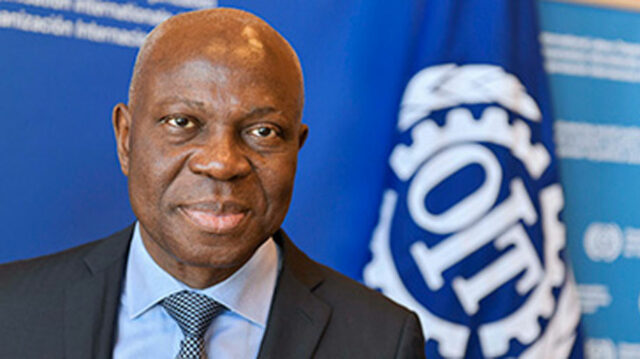
INTERNATIONAL Labour Organization (ILO) Director-General Gilbert F. Houngbo concluded his first official visit to the Philippines on Wednesday, during which he cited the need to strengthen social dialogue among the government, employers and workers.

At a conference with employers in Manila, he also urged them to invest more in education and skill programs, adding that work environments should be conducive to growth and productivity.

“In the fast-moving job market, life-long learning is now essential for workers and these skills allow workers to thrive,” Mr. Houngbo said. “Employers and businesses must maximize productivity because without this, they cannot create jobs and provide prosperity.”

Mr. Houngbo said it is crucial for employers to incorporate new technologies such as artificial intelligence to upgrade workers’ skills.

The ILO chief said the government and employers should start educating and training young people to build the foundation for the future workforce, and to address youth unemployment.

“It will be critical to invest in youth empowerment programs to equip young people with the tools they need to succeed to help build a better future for the country,” he said.

The ILO chief met with President Ferdinand R. Marcos, Jr. on Tuesday as the two agreed for the Philippines and ILO to continue to collaborate to address labor issues, Labor Secretary Bienvenido E. Laguesma said at the same event.

“The government and its stakeholders will continue to work towards increasing employability and equal access to work opportunities,” he said, citing a plan that would be sent to the Cabinet for approval.

The plan includes providing worker skills, such as raising the quality of teachers and modernizing training institutions, he said. He added that his agency would consult labor stakeholders to seek improvements for the labor roadmap.

Mr. Laguesma earlier said his agency plans to narrow the gap between worker skills and employer needs this year through upskilling programs.

“Together with our tripartite partners, we will continue working towards decent work and improved quality of life for our workers,” he said. “We invite our partners from the employers’ sector, workers, and other stakeholders to help us implement our labor and employment plan.”

During his visit, Mr. Houngbo also held a dialogue with representatives of workers’ and employers’ organizations.

“This visit has provided an excellent opportunity to discuss a wide range of world of work issues faced by the Philippines,” he said in a separate statement. “The open and productive talks we have held leave me confident that the Philippines is on track towards a bright future.”

“However, I encourage greater social dialogue between representatives of government, employers and workers in order to make progress on outstanding issues as well as to make decent work and social justice a reality for all,” the ILO chief said.

He took part in celebrations to mark the 75th anniversary of the Philippines joining the ILO and delivered the keynote address at a global seafarers’ summit.

Mr. Houngbo also met with the president of the Asian Development Bank (ADB), heads of agencies and members of the United Nations Country Team, and the UN resident coordinator.

While in Metro Manila, he also visited the Migrant Resource Centre (MRC) in Quezon City where he had a chance to interact with migrant Filipino workers and their families.  

“What I have seen and heard during this visit and from my discussions at the Department of Migrant Workers confirms the excellent work being carried out to support Filipino migrant workers and their families,” Mr. Houngbo said. “I sincerely hope that these best practices from the Philippines can be shared with other countries in this region and beyond.” — John Victor D. Ordonez

MWSS water allocation cut 

BW FILE PHOTO

THE NATIONAL Water Resources Board (NWRB) will cut the water allocation of the Metropolitan Waterworks and Sewerage System (MWSS) starting next week to ensure adequate supply. 

“For Metro Manila’s water allocation, the board decided to grant the 50 cubic meters per second (m3/s) water allocation for the month of July,” NWRB Executive Director Sevillo D. David, Jr. told reporters on Wednesday.  

The agency decided to cut the allocation amid fears that the water level in Angat Dam could no longer supply the water needs of Metro Manila and due to the threat of El Niño.  

He said the 50 cms water allocation would cover July, subject to adjustments depending on Angat Dam’s water level.   

The NWRB earlier approved 52 m3/s for June 1-15, which it extended until June 30. Normally, MWSS only draws 48 cms from the dam. 

As of 6 a.m. on Wednesday, the water level in Angat Dam had declined to 183.25 meters from 183.52 meters a day earlier, data from Philippine Atmospheric, Geophysical and Astronomical Services Administration’s (PAGASA) website showed.  

Angat Dam is the main source of water for Metro Manila, accounting for about 90% of the capital’s potable water. — Ashley Erika O. Jose 

Marcos cites value of sacrifice 

PRESIDENT Ferdinand R. Marcos, Jr. on Wednesday urged Filipinos to remember the value of sacrifice and selflessness, as the local Muslim community observed Eid’l Adha of the feast of sacrifice.   

In a statement, Mr. Marcos Jr. recognized Filipino Muslims for helping “weave our rich tapestry of diversity.”  “Let their devotion to these beliefs shine above all throughout the festivities and further strengthen the bond among our families, friends and communities,” he said. 

Eid’l Adha commemorates the willingness of the prophet Abraham to sacrifice his son Ishmael as an act of obedience to God. 

Muslims make up about 6% of the Philippine population, which is predominantly Catholic. — Kyle Aristophere T. Atienza 

Mindoro shooting suspect yields 

BAGUIO CITY — The suspected gunman in the May 31 killing of Mindoro Oriental radio commentator Cresenciano Bundoquin surrendered to the National Bureau of Investigation (NBI) in Manila on Tuesday afternoon.   

“The arduous road towards uncovering the truth and giving justice to Bundoquin just hurdled a major obstacle,” Presidential Task Force on Media Security Executive Director Paul Gutierrez said in a statement. 

The suspect denied shooting the victim several times at close range, and promised to cooperate with the NBI probe, Mr. Gutierrez said.  

Mr. Bundoquin, a radio block timer at DWXR, was shot and killed by two armed motorcycle-riding men in front of his store at the Sta. Isabel village in Calapan City at dawn on May 31. — Artemio A. Dumlao

ADVERTISEMENT
ADVERTISEMENT