Home Blog Page 4654

The Secretary of Tourism should be both a marketing man and a politician

At the 50th anniversary celebration of the Department of Tourism (DoT) at The Manila Hotel last Tuesday, June 27, Secretary Christina Frasco launched the DoT’s “enhanced” tourism campaign slogan — “Love the Philippines.” She said, “The campaign ‘Love the Philippines’ is not a mere branding campaign, but rather a call to action to every Filipino citizen to remember the beauty of our country, to honor our past, and to look forward to the future armed with the virtues, values of being a Filipino. ‘Love the Philippines’ is a recognition of our natural assets, our long and storied history, our rich culture and diversity.”

I infer from the statement of Secretary Frasco that she wants the new slogan to instill nationalism in every Filipino citizen, for every one of them to be proud of the country’s natural wonders, history, culture, and diversity. She expressed the hope that the new slogan would sustain interest and bring attention to places not necessarily highlighted in DoT’s typical branding campaign.

A well-known acronym in advertising, one which students of Advertising come across in their freshman year, is AIDA. It stands for attention, interest, desire, and action — the process an advertisement is supposed to set off. The visual element or sound of the advertisement should draw the attention of the newspaper or magazine reader, television viewer, or radio listener and its message should arouse interest, then stimulate desire, and eventually stir action — to buy the product or service advertised. The new tourism slogan is in reverse of AIDA. It calls for action first — love the Philippines — then, as Secretary Frasco hopes, the viewer develops an interest in the Philippines, and thus bring attention to less-publicized places.

The slogan demands blind love — love the Philippines first, then get to know about it. The slogan is commanding when it should be enchanting and beguiling.

Absent in the new promotional video are the tourist attractions featured in previous campaigns “Wow, Philippines” and “It’s more fun in the Philippines.” The end-result, Secretary Frasco desires — which is every Filipino taking pride in our natural wonders, culture, heritage, cuisine, music, and diversity — will not be achieved. The video “Tara na, biyahe tayo,” which invites the audience to embark on a journey to see the beauty of the Philippines and to witness the talent of Filipinos, is more effective in instilling pride in things Philippine.

To justify the replacement of the slogan “It’s more fun in the Philippines,” Marie Adriano, brand and strategic planner of the marketing firm DDB Group Philippines, pointed out that “love” is the positive theme travelers associate with the Philippines and is “frequently mentioned in high volume globally.” “While ‘fun’ remains a positive theme and certainly part of the Pinoy DNA, there’s less volume of mentions,” she added.

Ms. Adriano noted that the pandemic that prompted revenge travel also birthed the kind of tourists that value not only leisure but also meaningful experiences. “Coming from a culture shift, naturally, changes in the consumers follow. Who are they? We call them the ‘changed traveler’ for the very reason that traveling has come to mean more than just leisure,” she said. She explained that travelers are now looking for “real world experiences” where they can immerse themselves in other cultures, as well as curated experiences that are unique or out of the ordinary. “Brand enhancement is imperative to stay competitive and relevant. We can choose to stay where we are or choose to pivot and realize the vision of the future,” she elaborated.

I conclude that Ms. Adriano understood “love” as used by travelers in the context of action, a verb. That is why the video says, “Love the fun, love the adventure, love the flavors, love the culture, …” She didn’t take “love” in the sense of emotional feeling or as a noun, as in Sandals Resorts’ ad which says “All inclusive, all in the name of love” and “Where love comes to stay.” If Ms. Adriano’s research finding had been that culinary delight is the subject travelers frequently mentioned in high volume globally, the video would probably have said, “Delight in our lechon, delight in our adobo, delight in our sisig, delight in our lumpiang ubod.”

The promotional video for Iloilo City — it calls it “The City of Love” — will draw more travelers to the Philippines than the “Love the Philippines” video. The graphics on our natural wonders, culture, heritage, and cuisine in the film are authentic while many of those in DDB’s production appear staged. The video on Iloilo City can pass for a video on the Philippines for the city, as presented in the promotional material, can be considered a microcosm of the Philippines.

But it seems as if the primary function of the Secretary of Tourism is to produce a new promotional ad. As former secretary of the DoT Richard Gordon, when asked to comment on the new slogan, said, “What is important is the product. The little things count, such as the cleanliness of the airports. The honesty of people working in tourism is as important. These things combined with nature and historical sights and other wonderful places that tourists come to visit, comprise the tourists’ whole experience, which will make them want to come back.” The production of a new video promoting these destinations comes only after the products — the destinations and supporting services — have been developed to the level of global standards.

As a fellow of the De La Salle University Angelo King Institute of Economic and Business Studies, I was commissioned in the early part of 2004 to conduct a USAID-sponsored study of the tourism industry with a view to identifying areas of adjustments and upgrading. Among my findings were the negative comments of tourists, as gathered by the DoT Research and Statistics Division itself:

1. poor security and safety measures for tourists;

2. arrogant and discourteous Immigration and Customs officials;

3. terrible traffic in Metro Manila;

4. ugly mounds of garbage all over;

5. heavily polluted air;

6. poor standards of international and domestic airports;

7. poor quality of bus terminals and seaports;

8. poor quality of roads to tourist destinations.

One of my recommendations was the appointment of an accomplished marketing practitioner.

In August of that year, I read my report before a panel of resource persons. One of them was my good friend Bertie Lim, he being then the president of the company that ran El Nido Resorts, a director of the company behind the world-class resort Amanpulo, and president of the Palawan Tourism Council and the El Nido Foundation.

Bertie asked: “Why does everybody expect the DoT Secretary just to be a good marketing person, as if that were his only responsibility? Should he not develop the product too so that we can give tourists superior value for money?” In response I said marketing is not synonymous with advertising, that marketing is satisfying the needs of the customer by means of the product and the whole cluster of things associated with creating, delivering, and finally consuming or using it. Marketing in Tourism is basically “creating” products, in this case attractions, and that includes the whole cluster of things associated with delivering and finally enjoying it.

I was elated when Bertie was appointed secretary of the DoT by President Noynoy Aquino in 2010 because he was the most qualified for the job among previous DoT secretaries as he was coming directly from the business of tourist destinations. He knew what attracts tourists and the problems they encounter and which turn them away. On top of that he has two master’s degrees in Business and in Public Administration, both from Harvard.

Upon his appointment, I sent him the same report I read before him in 2004. I was surprised when I read in the papers that the DoT had made a grand presentation of the concept of the new advertising campaign just four and a half months after Bertie and company had taken over the department. I had expected them to be deeply involved in the upgrading of the tourism infrastructure and services first before coming up with the advertising theme and logo.

Succeeding him as secretary of the DoT was Ramon Jimenez, a very successful and highly respected advertising practitioner. I found his first public statements as DoT secretary disappointing. “The Philippines, with its picturesque destinations, should be as easy to sell as Chickenjoy,” he said.

I became more distressed when he said further, “I am a marketing communications person. When you think about it that’s what we need. In fact, job No. 1 is to galvanize the DoT staff into an honest to goodness selling unit. Kasi ’yun naman ang trabaho namin eh. Mga tindero kami. (Because that is our job. We are shopkeepers.”

The legendary Harvard Business School marketing professor Theodore Levitt wrote in his Harvard Business Review article “Marketing Myopia,” marketing starts with the idea of satisfying the needs of the customer by means of the product and that a truly marketing man tries to create value-satisfying goods and services. He also wrote: “Selling focuses on the needs of the seller, marketing on the needs of the buyer.”

As expected, Mon Jimenez went right to work on a new advertising campaign. He was the man behind the “More fun in the Philippines” slogan. But in fairness to Mon Jimenez and to all those who have been DoT secretary, the authority of the Secretary of the Department of Tourism does not extend far beyond the realm of advertising and selling.

Mon had a convergence program with Rogelio Singson, secretary of the Department of Public Works and Highways. Tourism roads to far-flung destinations were built or upgraded.

However, Joseph Emilio Abaya, secretary of the Department of Transportation and Communications, never signed a convergence program with Mon. While the DoT secretary had a voice in the boards of the various agencies under Abaya, such as the Civil Aviation Authority and the Manila International Airport, Mon could not do anything about the upgrading of airports and seaports. Bureau of Internal Revenue Commissioner Kim Henares refused to give tax incentives for tourist destinations even if these are enshrined in the Tourism Act of 2009.

That is why I now propose that the DoT secretary should not only be an accomplished marketing person, but he should also be a seasoned politician (not the trapo kind). As a marketing man, he knows that only a good product will sell. As a politician, he knows how to gain the cooperation of the heads of government agencies that have something to do with tourism.

Northwestern University Marketing guru Philip Kotler and his co-authors wrote in their book Marketing Places: “The fortunes of places depend in the final analysis on the collaboration of the public and private sectors — teamwork among government units, business firms, voluntary and civic associations, and marketing organizations. Unlike purely business or commercial product marketing, place marketing requires the active support of public and private agencies, interest groups, and citizens.”


Oscar P. Lagman, Jr. is a retired executive, management professor, and business consultant. His work experience includes as account group director at the ad agency J. Walter Thompson Company, Marketing professor at the Asian Institute of Management and at the graduate schools of Business of Ateneo and De La Salle, and Advanced Marketing professor in the Master of Science in Tourism and Hospitality Management program of the College of St. Benilde.


Spotify in talks to test full-length music videos in app

ALEXANDER SHATOV-UNSPLASH

SPOTIFY Technology SA is considering adding full-length music videos to its app, which could help the streaming service better compete with Alphabet, Inc.’s YouTube and ByteDance Ltd.’s TikTok.

The service has already begun talking to partners about the product, according to people familiar with the plan who asked not to be identified because they weren’t authorized to speak about it publicly.

Spotify declined to comment.

The feature would add to Spotify’s growing efforts to establish video — which in the streaming media era has tended to be more lucrative than audio — as a core part of its app. Spotify already allows musicians to upload “canvases,” or looping GIFs under 10 seconds long, that populate the screen while music plays. Earlier this year, it debuted a feature called “clips,” which are videos shorter than 30 seconds designed to give artists a storytelling tool to communicate about their music, similar to how they might use TikTok.

The company also launched a new, TikTok-esque music home screen in March that allows users to preview and swipe through surfacing videos before committing to listen to a full track. Earlier this week, Spotify announced that the platform has surpassed more than 100,000 podcasts with video.

Spotify is responding to growing competition for the Gen Z audience by YouTube and TikTok. YouTube operates a streaming music service and appeals to fans with full-length music videos, as well as the more concise Shorts. It has also added podcasts to YouTube Music. ByteDance has reportedly looked to expand its music streaming service Resso, which already operates in countries where Spotify is offered, and TikTok has become an important discovery platform for musical artists.

Earlier this month, Spotify said it would cut 200 jobs from its podcast unit in its second round of layoffs, as it looks to restructure after years of heavy investment.

Spotify previously set its sights on video by creating its own original series and working with media companies, including Paramount Global and Vice Media, to place TV content in the app, such as clips from the Comedy Central show Broad City. Those deals eventually lapsed. — Bloomberg/Reuters

Capstone-Intel offers benefits of analytics

LOCAL research and intelligence company Capstone-Intel Corp. is seeking to use data analytics and research to help in the decision-making of businesses, governments, and investors.

Capstone-Intel Chief Executive Officer and President Eero Brillantes said that the firm aims to help clients in adapting to the rapid pace of technology development and in managing daily data consumption.

“Our research surveys and social analytics findings provide evidence-based inputs that enable clients to make informed decisions,” he said when the company was launched on June 30 in Taguig City.

“Capstone-Intel employs a variety of analytics tools to ensure that they maximize the value and outputs of these tools, constantly searching for the best analytics tools and programs available,” he added.

According to Mr. Brillantes, the company was launched following the effects of the coronavirus disease 2019 (COVID-19).

“The agency combines traditional and digital research methodologies to create key action points that are based on both evidence and wisdom, resulting in better strategies that benefit customers and the public,” he said.

Mr. Brillantes said COVID-19 showed the need for increased readiness and awareness amid the lack of detailed data on the severity of the impact, the outcomes of cases, the accessibility and effectiveness of vaccines, and other relevant information.

“Recognizing the importance of these realizations, Capstone-Intel was founded with the same goal of advancing research with actionable intelligence as a resource in a variety of organizations, society, and economies,” he said.

Mr. Brillantes said Capstone-Intel uses “innovative research technologies, tools and methods” to convert data and information to breakthrough insights and actionable intelligence outputs.

Based on its website, Capstone-Intel’s services include brand campaign preparation, strategic communication operations plan, crisis management operations, brand campaign management operations plan, and social influence operations.

“Capstone-Intel was established with the mission of advancing research through actionable intelligence, recognizing the critical role it plays in various organizations, societies, and economies. Our firm recognizes the significance of these realizations and is committed to providing valuable insights to our clients,” Mr. Brillantes said. — Revin Mikhael D. Ochave

Year 1 of Marcos Jr.: Budget deficit and unemployment

(Part 1 of 4)

The Ferdinand Marcos, Jr. administration turned one year old last week on June 30. This column will produce a four-part assessment of the economic performance of the Marcos Jr. administration leading to the second State of the Nation Address (SONA) on July 24.

The goal of this informal exercise is to assess if the first year performance so far would help the Philippines achieve fast growth — create more jobs, expand the production of more goods and services, further industrialize and modernize the Philippines in the medium- to long-term.

Eight economic sectors, two per article, will be assessed this month: the budget deficit, unemployment, inflation, the interest rate, GDP growth, agriculture, trade, and investment.

CASH OPERATIONS REPORT
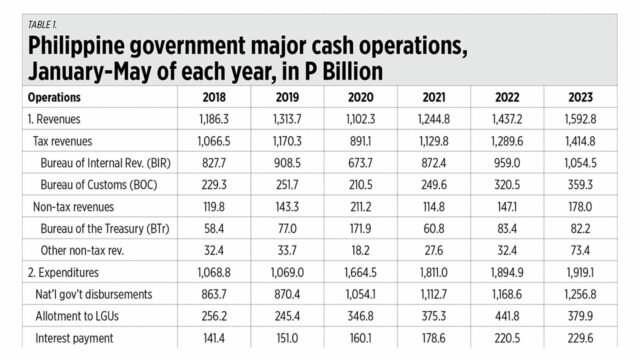
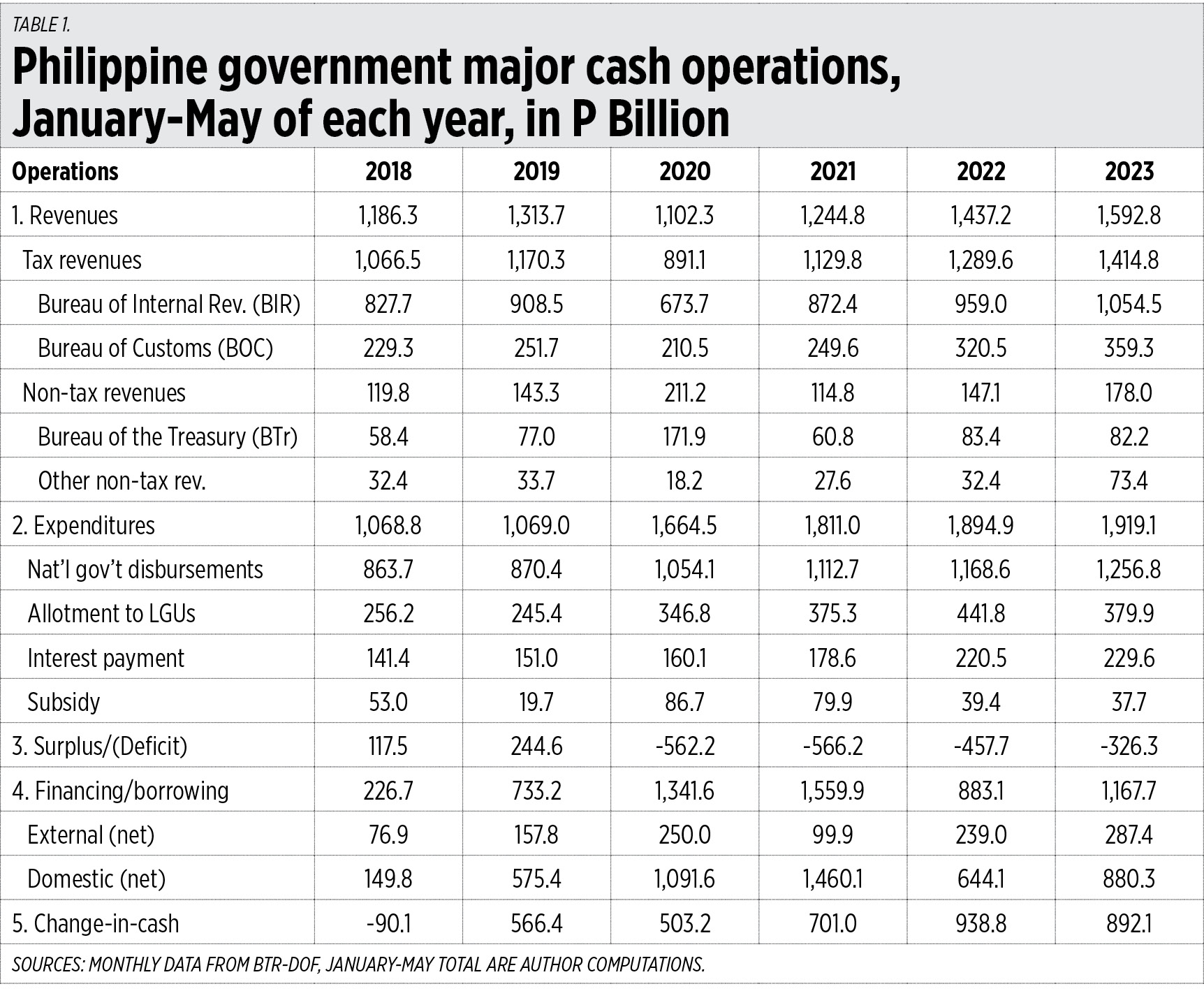
Last week, the Bureau of the Treasury (BTr) released the cash operations report for May 2023. The January-May 2023 data are available, so I will compare the numbers with performance in the same months of 2018 to 2022. The results are generally good.

One, revenues this year have significantly improved, reaching P1.59 trillion from P1.44 trillion last year. This is important for two reasons: there was no tax hike, and lockdown-era tax cuts still remained in place. So, an improvement in economic activities, not a tax hike, expanded the tax base.

Two, expenditures have mildly increased to P1.92 trillion this year from P1.89 trillion last year. While allocations for local government units have declined this year, National Government disbursement remains high as there is spending that continues to remain bloated like the military and uniformed personnel (MUP) pension. This fund must decline significantly if we must control the annual deficit, financing, and borrowing.

Three, the budget deficit has declined to only P326 billion this year from an average of P529 billion/year in the last three years 2020-2022, so this is good news. Financing or borrowing has mellowed to P1.17 trillion this year, higher than 2022 but lower than in 2020 and 2021 (see Table 1).

Interest payment is high, already P230 billion in the first five months of 2023 alone. This is a reflection of the huge increase in public debt during the lockdown years of 2020-2021 and this is not good. We should aim to reduce the annual budget deficit, reduce the need for borrowing, find new revenues like the large privatization of some government assets, in order to retire more public debt while controlling the rise in spending.

DECLINING UNEMPLOYMENT
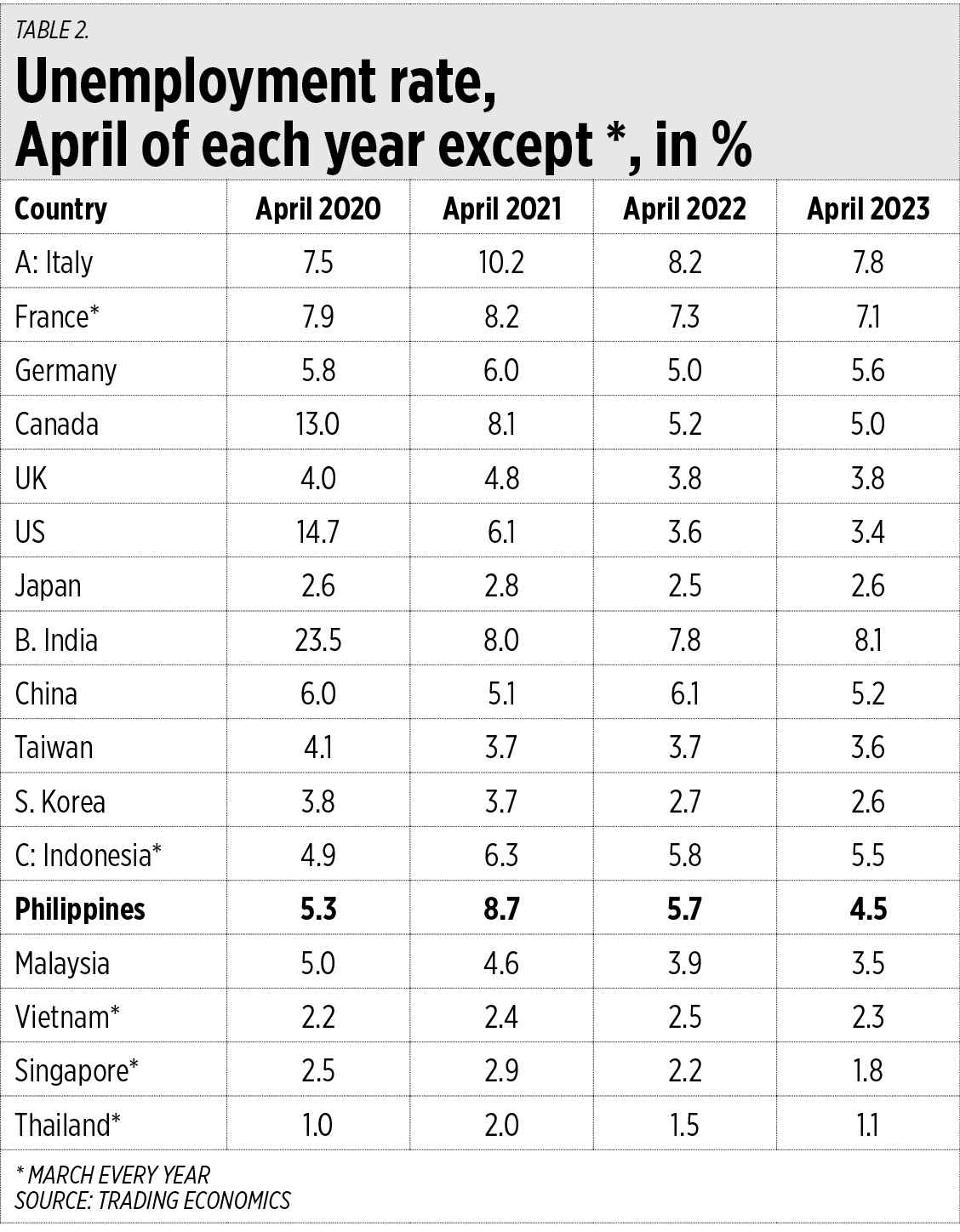
Next is the labor market. In Table 2, I group countries into three: group A are G7 member countries, group B are the big North and South Asian economies, and group C are the ASEAN-6 or the six large economies of the regional bloc.

As of April 2023, four of the G7 countries, plus India and China, and Indonesia in the ASEAN-6 countries had unemployment rates of 5% and above of the labor force. The Philippines’ unemployment rate has significantly declined to only 4.5% which is almost half the 8.7% registered in April 2021, so this is good news.

More Filipinos now have jobs and, hence, have money to spend and buy, which will create more consumer demand and invite more business expansion and innovation.

So far, considering these two indicators — budget deficit and unemployment rate — the Philippines under the Marcos Jr. administration is doing well. These are consistent with the economic team’s high growth target of 6-7% in 2023 and 6.5-8% in 2024-2028. Meaning if both the deficit and unemployment rate continue their downward trends, the high growth targets are achievable, and, better yet, may be surpassed.

We should target high employment, high productivity, and high economic ambition. Go for high revenues and high investments, and a low deficit and low borrowings. Aim for becoming an upper middle-income country — with a per capita income of $4,046 to $12,535 per year — by 2028 or earlier, vs. the current level of $3,623 in 2022.

This is achievable if we have a single-track goal: more growth, expanded production, more economic and business competition. Aim for a larger economic pie, not “well-distributed” shares in a small economic pie.


Bienvenido S. Oplas, Jr. is the president of Bienvenido S. Oplas, Jr. Research Consultancy Services, and Minimal Government Thinkers.

minimalgovernment@gmail.com

Competitive Philippine property landscape

MPTC PHOTO HANDOUT

By Joey Roi Bondoc

Editor’s note: This is the first of a two-part column on the Philippines’ competitive property landscape.

OVER THE YEARS, Colliers has seen the proliferation of more office and residential hubs outside Metro Manila. In our view, this bodes well for the Philippine economy as more economic centers rise. This means that economic development also spreads outside of Metro Manila and indicates that property sector growth is broad-based and not just focused on a single location.

Colliers believes that this pace of progress has been facilitated by an improving infrastructure and overall local government competitiveness, as measured by economic dynamism, innovation, quality of manpower, resiliency, among other factors.

Major property firms are expanding their options as they see a strong revival of the country’s property market post-COVID-19. Undeniably, Metro Manila remains a major investment destination, but developers are setting their sights on other urban areas.

In our view, this decentralization thrust is likely to be supported by the continued implementation of public projects outside Metro Manila. These include airports, bus rapid transits, cargo and passenger railways. Overall, the country’s infrastructure push should guide the expansion plans of developers around the country.

The infrastructure projects implemented by previous administrations have dictated developer strategies. The implementation of key infrastructure projects nationwide has provided access to properties that could be redeveloped into mixed commercial, residential, hotel/leisure and industrial estates. These projects also helped the government bring economic opportunities to areas outside the Philippine capital.

Due to road projects, for instance, business opportunities have spilled over to nearby areas such as Cavite, Laguna, Bulacan, Tarlac, and Pampanga in Luzon.

In the Visayas region, Cebu remains the primary property investment hub, but other locations are starting to catch up with the likes of Iloilo and Bacolod cornering substantial investments from national and homegrown developers.

In Mindanao, Davao remains the most attractive property investment destination.

Overall, Colliers Philippines believes that developers will continue to venture into residential projects in second-tier and third-tier cities all over the country, where demand comes from end-user buyers. The markets may be smaller compared to Metro Manila but more stable in terms of end-user housing demand.

With a thriving property landscape post-pandemic, Colliers also projects the development of offices, malls, hotels, and industrial parks outside of the capital region.

Moving forward, we see local government units competing for more investments and this competitive landscape should result in a more diverse Philippine property market, eventually benefiting investors and end-users.

POST-PANDEMIC ‘CEBOOM’
Cebu remains one of the most attractive and largest residential hubs outside of Metro Manila. The launch of higher-priced condominium units outside of Cebu City such as Mandaue also indicates property firms’ confidence in the purchasing power and rising affluence of Cebuano investors.

Colliers is starting to see the proliferation of upscale to luxury condominium units in major residential hubs outside Metro Manila, especially Metro Cebu. In our view, demand for these projects will partly be sustained by the recovery of the tourism sector which should propel renewed interest in leisure-oriented properties.

Cebu’s improving infrastructure also plays an important role in retaining the locale’s stature as a residential investment destination. The recently-completed Cebu–Cordova Link Expressway (CCLEX) should raise the attractiveness of fringe locations such as Talisay, Liloan and Consolacion for residential developments. Other upcoming infrastructure projects include the Metro Cebu Expressway and Cebu Bus Rapid Transit, both of which are due for completion in 2025.

DAVAO: MINDANAO’S MAJOR PROPERTY HUB
Colliers Philippines believes that the entry of national players in Davao has paved the way for substantial development of integrated communities. Hence, developers should continue with their land banking initiatives and capitalize on the city’s improving infrastructure backbone.

The National Government has lined up vital infrastructure projects in the city which, once completed, should further solidify the city’s attractiveness as a residential investment hub. These include the Davao Coastal Road, Davao City Bypass and the expansion of the Davao Airport.

Residential developers should further test the market and even diversify, especially with the rising viability of upscale and luxury projects amongst investors and end-users. In our view, Davao’s competitiveness and stature as an outsourcing hub in Mindanao, backed by regional economic growth, should retain the city’s attractiveness for more residential projects.

BACOLOD: A PROPERTY SWEET SPOT
Bacolod City is attracting national players and we see this resulting in the development of more township developments and a further expansion of the city’s residential stock. The entry of national developers is also raising the prices of vertical projects, reflecting property firms’ confidence in the purchasing power of Bacolod city’s investors and end-users.

Developers should further assess Bacolod market’s reception towards luxury projects, especially in light of newly launched residential towers by national developers.

In our view, property firms are likely to further test the upscale and luxury segments over the next 12 to 24 months. Colliers believes that residential demand will also be supported by the development of integrated communities in the city. Bacolod should also benefit from the upcoming Panay-Guimaras-Negros Link Bridge. Construction for the project will begin in 2025.

ILOILO RISING
Iloilo’s thriving business landscape is partly buoyed by a continuously expanding outsourcing sector which continues to attract national developers to launch more residential projects in the city.

While residential condominium developments are concentrated in Mandurriao, Iloilo’s main business district, some developers are beginning to explore other districts for upscale and luxury residential developments. We encourage national players to take advantage of the city’s growing investor and end-user market.

Developers should also maximize their projects’ proximity to infrastructure. Major public projects in the city include the Ungka II Flyover which will traverse Pavia, Hibao-an and Buhang. The flyover is expected to reduce travel time from Iloilo City to Iloilo International Airport from 45 minutes to 20 minutes. The flyover is set to be completed in 2025.

Iloilo is one of the most competitive cities in the Philippines backed by skilled workforce and quality infrastructure backbone. Hence, we see Iloilo attracting major local and foreign investments in the near to medium term.

(To be continued next week)


Joey Roi Bondoc is the research director at Colliers Philippines.

Harrison Ford is back as an 80-year-old Indiana Jones — and a 40-something Indy.

HARRISON FORD in Indiana Jones and the Dial of Destiny

The highs (and lows) of returning to iconic roles

SADDLE UP, don the fedora and crack that whip: Harrison Ford is back as the intrepid archaeologist in Indiana Jones and the Dial of Destiny. The film premiered at Cannes, where Ford was awarded an Honorary Palme d’Or in recognition of his life’s work.

Reviews for the fifth film in the franchise have been mixed, and it is the first Indy film not to be directed by Steven Spielberg (this time, it’s James Mangold, best known for his motor-racing drama Ford v Ferrari).

But this is “event” cinema that combines nostalgia, old-school special effects and John Williams’ iconic score.

So, Ford is back, aged 80. What draws actors back after all this time?

Ford first played Indy in 1981 and last played him in 2008. That is a full 15 years since the most recent film in the series, and 42 years since his first outing in Raiders of the Lost Ark.

Ford has form in returning to celebrated characters. One of the great pleasures of watching The Force Awakens back in 2015 was seeing Ford play Han Solo again for the first time in over 30 years.

Actors return to roles for numerous reasons:

Financial (Ford was reportedly paid $25 million for Dial of Destiny)

Protection of their brand, image and star persona (Michael Keaton returning to play Batman after three decades and three other actors who have embodied the role)

Professional (Tom Cruise admitted over the 36 years between Top Gun films he wanted to make sure the sequel could live up to the original)

Personal (once-huge stars are working less and less, and only feel the need to return to a built-in fan base every few years — Bill Murray in the 2021 Ghostbusters sequel springs to mind).

It’s not always a successful endeavor.

Arnold Schwarzenegger and Sylvester Stallone — two of the biggest action stars of the 1980s off the back of iconic roles as The Terminator, Rocky Balboa, and John Rambo — have repeatedly returned to those roles, and critics have been particularly harsh.

It did not work for Sigourney Weaver in Alien: Resurrection in 1997, 18 years after her first time as Ripley; nor for Keanu Reeves in The Matrix Resurrections in 2021, 23 years after the original.

And still, I’m intrigued to see what Michael Mann could do with his long-rumored sequel to Heat, his definitive 1995 crime film. Ever since Mann published his novel Heat 2 last year — a kind of origin story for Heat’s key protagonists — fans have been hoping a de-aged Al Pacino (now aged 83) might return as LA cop Vincent Hanna.

“Digital de-ageing” first entered the Hollywood mainstream in 2019 with The Irishman and Captain Marvel.

Via this process, older actors (Robert De Niro, Al Pacino, and Samuel L. Jackson have all been subject to the technology) move back and forwards in time without younger actors having to play them.

Films still tend to cast two actors to play older and younger versions of the same character, a choice that dates back at least to 1974’s The Godfather Part II, in which a young Robert de Niro plays Vito Corleone, portrayed by the much older Marlon Brando in the first film.

In 1989, Indiana Jones and the Last Crusade features a delightful opening scene where River Phoenix plays the young version of Indiana Jones, before Ford takes over for the rest of the film.

Actors used to just play characters of their own age when reprising earlier roles. Paul Newman finally won a Best Actor Oscar for his role as “Fast Eddie” Felson in The Color of Money (1986), a quarter of a century after first playing him in The Hustler.

The sequel plays on Newman’s age, and his role as a mentor to an upcoming Tom Cruise, and bathes viewers in nostalgia and memories of a younger Newman.

But actors no longer have to exclusively play their age.

The first part of Dial of Destiny is an extended flashback, set in 1944, in which Ford has been digitally de-aged to appear in his 40s. This process used an artificial intelligence (AI) system that scanned used and unused reels of footage of Ford from the first three Indy films to match his present-day performance.

Here, it is as if we are getting two Fords for the price of one: the “younger,” fitter Indy and the older, more world-weary version. It makes for a powerfully emotional connection on screen.

Yet there are some pitfalls to de-ageing. Some viewers complain that the whole process is distracting and that the hyper-real visual look of de-aged scenes resembles a video game.

Even so, de-ageing in Hollywood cinema is here to stay. Tom Hanks’s next film is using AI-based generative technology to digitally de-age him.

Given its reduced cost, speed, and reduced human input, AI-driven innovation might have industry-changing ramifications.

Harrison Ford remains a bona fide “movie star” in an industry profoundly buffeted by COVID, the rise of streaming platforms, the demise of the monoculture, and the changing nature of who constitutes a star.

In the midst of all this industry uncertainty, it seems there is no longer a statute of limitations on actors returning to much-loved characters.

The next big ethical issue for the film industry as it further embraces AI is whether to resurrect deceased actors and cast them in new movies.

Still, I’m looking forward to seeing more actors de-aged as the technology improves and audiences acclimatize to watching older actors “playing” younger versions of themselves. We are only at the start of Hollywood’s next big adventure. — The Conversation via Reuters Connect

Ben McCann is an Associate Professor of French Studies at the University of Adelaide.

Gov’t partially awards T-bills as rates rise

BW FILE PHOTO

THE GOVERNMENT made a partial award of the Treasury bills (T-bills) it offered on Monday as rates climbed due to hawkish remarks from the US Federal Reserve chief.

The Bureau of the Treasury (BTr) raised just P9.219 billion via the T-bills it auctioned off on Monday versus the P15-billion program, even as total bids reached P17.419 billion.

Broken down, the Treasury raised only P2.954 billion via the 91-day T-bills out of the planned P5 billion, even as tenders for the tenor reached P6.584 billion. The average rate of the three-month papers went up by 6.4 basis points (bps) to 6.15% from the 6.086% quoted for the tenor last week, with accepted rates ranging from 6.044% to 6.198%.

The government also made a partial P2.67-billion award of the 182-day securities versus the P5-billion program as bids reached just P4.63 billion. The six-month T-bill was quoted at an average rate of 6.266%, up by 12.2 bps from 6.144% the previous week, with accepted rates from 6.11% to 6.293%.

Lastly, the BTr raised just P3.595 billion via the 364-day debt papers out of the P5 billion on the auction block, even as demand for the tenor reached P6.205 billion. The average rate of the one-year T-bill rose by 6.7 bps to 6.286% from the 6.219% fetched last week. Accepted yields were from 6.18% to 6.375%.

At the secondary market before Monday’s auction, the 91-, 182- and 364-day T-bills were quoted at 6.1113%, 6.1815%, and 6.2175%, respectively, based on PHP Bloomberg Valuation Reference Rates data provided by the Treasury.

“The awarded T-bill rates [rose] this week as market participants reacted from the strong hawkish policy remarks by the US Federal Reserve and the European Central Bank (ECB) during the ECB forum in Sintra, Portugal last week,” a trader said in a Viber message.

Rates rose on expectations that the Fed could increase rates at its next two meetings, which could be matched locally, Rizal Commercial Banking Corp. Chief Economist Michael L. Ricafort likewise said in a Viber message.

Leaders of the world’s top central banks reaffirmed on Wednesday they see further policy tightening as needed to tame stubbornly high inflation but still believe they can achieve that without triggering outright recessions, Reuters reported.

US Federal Reserve Chairman Jerome H. Powell did not rule out further hikes at consecutive Fed meetings, while European Central Bank President Christine Lagarde confirmed expectations the bank will raise rates in July, saying such a move was “likely.”

“Policy hasn’t been restrictive enough for long enough,” Mr. Powell told an annual gathering of central bankers hosted by the ECB in the Portuguese mountain resort of Sintra.

“I wouldn’t take moving in consecutive meetings off the table at all,” he said. The next rate-setting Federal Open Market Committee meeting is scheduled for July 25-26.

The US central bank last month paused its tightening cycle after hiking rates for 10 straight meetings by a total of 500 bps to a range between 5% and 5.25%.

Meanwhile, the Bangko Sentral ng Pilipinas (BSP) last month kept benchmark interest rates unchanged for a second straight meeting on expectations of easing inflation.

The BSP raised borrowing costs by 425 bps from May 2022 to March 2023. Its next policy review is on Aug. 17.

On Tuesday, the BTr will auction off P30 billion in reissued 10-year Treasury bonds (T-bonds) with a remaining life of nine years and two months.

The BTr wants to raise P180 billion from the domestic market this month, or P60 billion via T-bills and P120 billion via T-bonds.

The government borrows from local and foreign sources to help fund its budget deficit, which is capped at 6.1% of gross domestic product this year. — A.M.C. Sy with Reuters

BSP cancels licenses of two money service firms

BW FILE PHOTO

THE MONETARY BOARD has revoked the operating licenses of two money service firms, the central bank said.

The policy-setting body of the Bangko Sentral ng Pilipinas (BSP) has canceled the registration of Jane Money Changer and Efinancing, Inc., according to a circular letter signed by BSP Deputy Governor Chuchi G. Fonacier on June 26.

The two firms violated the provisions and requirements of section 901-N of the Manual of Regulations for Non-Bank Financial Institutions, the BSP said.

“The non-registration with the Anti-Money Laundering Council and violation of the duly executed Deed of Undertaking with the BSP are among the grounds for the cancellation of the BSP registration of Jane Money Changer,” the central bank said.

Pawnshops, along with foreign exchange dealers, money changers, and remittance agents, are considered as money service businesses (MSBs) by the BSP.

Last week, the Monetary Board also disqualified six money service firms from securing a license with the BSP for operating unregistered businesses.

Pawnshops and MSBs are seen by the BSP as access points for the financially unserved and underserved areas in the country.

As of end-December 2022, BSP-registered money service businesses had 7,584 head offices and branches nationwide. — KBT

Españo joins Alternergy as board advisor 

ALTERNERGY Holdings Corp. on Monday said the former chairperson of Punongbayan & Araullo Grant Thornton has joined the renewable energy company as an advisor to the board.

In a stock exchange disclosure, Alternergy announced the appointment of Maria Victoria C. Españo as an independent advisor to the board effective July 1.

“We look forward to working closely with Marivic Españo and learning from her experience. We believe her background would be an excellent complement to the expertise of Alternergy’s non-executive board in banking, government, law, and sustainable finance,” Vicente S. Perez, Jr., chairman of Alternergy, said in a separate media release.

The company’s independent directors are Maria Theresa Dela Peña Marcial and Gregory L. Domingo.

“I was most interested in being able to contribute my experience to a growing company like Alternergy in a very relevant industry. As a renewable power pioneer, Alternergy has strong prospects for growth. I look forward to working with the Alternergy board,” Ms. Españo said.

Punongbayan & Araullo Grant Thornton, which offers professional services, is a Philippine member firm of Grant Thornton International Ltd.

Ms. Españo joined Punongbayan & Araullo Grant Thornton in 1997 and was appointed as its chief operating officer in 2009 before becoming chairperson and chief executive officer in 2011 until June 2023.

Alternergy aims to develop up to 1,370 megawatts of renewable energy sources such as onshore and offshore wind, solar, and run-of-river hydropower projects.

At the local bourse on Monday, shares in the company fell by four centavos or 3.67% to close at P1.05 each. — Ashley Erika O. Jose

Celebrating milestones as friends, partners, allies

STOCK PHOTO | Image from Pixabay

THIS JULY 4, Americans all over the world are celebrating the 247th anniversary of US independence. Here in the Philippines, we are also commemorating the 69th Philippine-American Friendship Day, making July 4 doubly special — a time to celebrate all that the Philippines and the United States have accomplished together as steadfast friends, partners in prosperity, and ironclad allies.

Since I arrived in July last year, I’ve had the opportunity to see the deep, multifaceted US-Philippine relationship at work. During a recent trip to Cebu, I met talented new friends from the vibrant network of US exchange alumni in the Visayas. In Ilocos Norte, I learned how our development efforts are improving energy efficiency standards, a key part of the Philippines’ clean energy transition. Last October, I had the honor to share the stage with President Ferdinand R. Marcos, Jr. in Tacloban to commemorate the Leyte Gulf landing, honoring our shared history; while during a recent visit to Isabela province, I witnessed how US and Philippine troops are working together today to modernize our alliance — training at Camp Melchor Dela Cruz. These trips and the many other milestones mark strong momentum in US-Philippine relations.

This year’s highlight in our bilateral ties was the resoundingly successful visit to Washington, DC by President Marcos Jr. During President Marcos’ Oval Office meeting with President Joe Biden, our leaders discussed the full spectrum of our relationship as friends, partners, and allies. President Biden reaffirmed our ironclad commitment to the Alliance and announced a first-of-its-kind Presidential Trade and Investment Mission to the Philippines. Our leaders also discussed new efforts to promote clean energy, expand science and technology cooperation, and protect the environment. President Marcos also met with multiple US cabinet members. I was particularly struck by the lively, substantive discussion President Marcos had with Secretary of Agriculture Tom Vilsack, resulting in innovative programs to tackle food and nutrition insecurity.

This year, we also saw the successful conclusion of the largest, most complex iteration of Exercise Balikatan. Over 17,000 troops from the United States and the Philippines, as well as a contingent from Australia, trained shoulder-to-shoulder on land, at sea, in the air, and — for the first time — in cyberspace. Together, we announced four new locations where our countries will make investments to improve Philippine military infrastructure and capabilities under the Enhanced Defense Cooperation Agreement, or EDCA. Projects implemented at these EDCA locations will advance the Philippine Armed Forces’ modernization goals and bring tangible economic benefits to local communities, creating jobs and opportunities for local businesses. The Philippines is the largest recipient of US security assistance in the Indo-Pacific. Strengthening our Alliance helps secure peace and prosperity for our peoples.

US-Philippine economic partnerships are flourishing. In May, I visited two top-tier US businesses in Cebu — Timex and Teradyne. Like many US companies operating in the Philippines, Timex and Teradyne provide thousands of Filipinos with high-quality, high-paying jobs — including as managers and executives. US businesses value the talent of the Filipino workforce and, more and more, are looking to the Philippines as an attractive place to trade and invest. For example, Moderna has chosen the Philippines as its first-ever operational hub in Asia. We look forward to building on this momentum as partners in prosperity.

The United States is committed to supporting the Philippines’ growth and development goals. Through USAID, the United States recently invested P1 billion to help small- and medium-sized enterprises compete in the country’s e-commerce ecosystem. This investment helps build a robust, inclusive, secure, and resilient digital economy. USAID is also supporting the Philippine government and private sector to increase access to fast and reliable internet across the archipelago, train Filipino workers to meet the evolving requirements of the high-tech manufacturing sector, and help youth develop the skills they need to succeed.

This Fourth of July, I hope you’ll agree we have much to celebrate!


MaryKay Carlson is the US ambassador to the Philippines.

Rogers: The Musical, first Marvel musical at Disneyland, opens

ROGERS: The Musical

ANAHEIM, California -— For the first time ever, Marvel fans will be able to watch heroic super soldier Steve Rogers sing and dance on stage in Disneyland Resort’s one-act musical theater production Rogers: The Musical.

As part of Walt Disney’s 100th anniversary celebration, Disneyland opened the 30-minute musical on Friday at the Hyperion Theater in Disney California Adventure Park. It runs until Aug. 31.

ROGERS: The Musical

Rogers: The Musical was introduced as a fictional Broadway musical in the first episode of the Disney+ miniseries Hawkeye, a show about the superhero Clint Barton, an archer who uses high-tech weaponry.

“From the moment we saw that first episode of the Hawkeye series, we started to imagine ‘What if? What if we could turn Rogers: The Musical into a real show?’,” Dan Fields, executive creative director for Disney Live Entertainment, told Reuters.

“And clearly the fans online were wondering the same thing — practically demanding it!”

The musical follows the life of Steve Rogers, otherwise known as the patriotic American superhero Captain America, and includes the musical number, “Save the City,” from Hawkeye along with five new songs with music by Grammy-winning composer Christopher Lennertz.

Marvel introduced the first live performance of “Save the City” during the Disney Convention, D23, last year, which helped launch the new production.

“When Kevin Feige and the studio brought ‘Save the City’ to D23 Expo, that sparked the conversations that led to the show guests will enjoy this summer at Disney California Adventure Park,” Mr. Fields said.

In addition to Steve Rogers, audiences can expect to see characters Peggy Carter, Nick Fury, and some of the Avengers members as they go from Steve’s origin story into the future.

Rogers: The Musical will perform multiple times per day, Tuesday through Saturday most weeks.

Disney is also offering themed food and beverage options and merchandise around the musical. — Reuters

Discovery Hospitality opens five-star resort hotel in Davao

DISCOVERY Hospitality Corp. is opening a new five-star resort hotel in the Island Garden City of Samal, Davao this month.

“The launch of Discovery Samal Resort under the newly rebranded Discovery Resorts marks a significant step forward for Discovery Hospitality,” Jose Parreño, Jr., chief operating officer of Discovery Hospitality and president of Discovery World Corp., said in a statement.

“This is a testament to our commitment to continually provide the highest level of hospitality service across the country. With the introduction of this magnificent resort in Samal, we are further strengthening our portfolio and emphasizing our dedication to making the Philippines a world-class destination.”

Located 5 minutes away from Davao City, the resort features nine private villas each with their own dipping pool. It also offers 128 hotel suites, 15 executive suites, and the Grand Signature Suite.

Discovery Samal features the biggest stretch of resort beach in Samal Island, as well as an infinity pool.

The resort has several restaurants Morning Catch, Haribar, The Shoreline and Garden City Cafe. Another specialty restaurant is expected to open soon.

Discovery Samal is the first and only Discovery Resort brand in Mindanao with the biggest resort convention facilities in Davao. Its facilities can accommodate up to 1,200, which can be used for corporate events as well as weddings.

ADVERTISEMENT
ADVERTISEMENT