Home Blog Page 4631

Few Filipinas get cancer tests

ONLY 1% OF FILIPINO women are screened for breast and cervical cancer, according to a government think tank, the Philippine Institute for Development Studies (PIDS) said in a statement on Sunday.

“Screening for breast and cervical cancer among Filipino women could be the lowest in the world with just 1% of eligible women getting themselves screened, the first step to cancer prevention,” the state think tank said.

The Philippines’ cancer screening rate is way lower than that of Malaysia and Thailand at 20% each, PIDS said.

“Cambodia and Myanmar have better numbers than the Philippines,” it said, citing PIDS senior research fellow Valerie Gilbert Ulep, who made a study on the issue last year. “The West has a 50% screening rate.”

PIDS said the low screening has been traced to lack of government funds especially for the poor.

“This results in very few government hospitals offering this screening service,” it added. — Kyle Aristophere T. Atienza

Carmona now a city of Cavite 

THE TOWN of Carmona in Cavite province is now a city after residents on Saturday voted in favor of a law on the conversion, the Commission on Elections (Comelec) said on Sunday, paving the way for a bigger share in national taxes for the city.

More than 30,000 residents voted yes for the town’s conversion into a city, while 1,016 opposed it, Comelec told reporters in a Viber message.

President Ferdinand R. Marcos, Jr. signed the law for the town’s conversion in February.

The former first-class municipality is now the eighth city in the Cavite province, after Cavite City, Trece Maritres, Tagaytay, Dasmariñas, Bacoor, Imus and General Trias

Carmona was the wealthiest municipality last year with assets worth P6.212 billion, based on data from the Commission on Audit. — John Victor D. Ordoñez

Poor mental health tack cited

THE PHILIPPINES lags in mental health care due to poor enforcement of its laws, as well as the lack of psychologists in the country, experts said at the weekend.

“We have fewer than 3,000 psychologists in the country,” Arsenio S. Alianan, Jr., associate director of the Ateneo Bulatao Center, said in a video interview.

He cited the lack of scholarships available to students who wish to take up a psychology degree, as well as the shortage of psychologist positions in government hospitals. The cost of mental health services has also increased.

Alyanna Lagasaca, national secretary-general of Youth for Mental Health Coalition, Inc. cited unreported mental health cases especially during the coronavirus pandemic.

The Mental Health Act was signed in 2017 to make mental health services more accessible to the public. The National Center for Mental Health got a P2.15-billion budget this year, while the Mariveles Mental Wellness and General Hospital got P466.6 million. — Beatriz Marie D. Cruz

Three provincial airports could undergo Swiss challenge this year

DOTR PHOTO

THE Department of Transportation (DoTr) said it hopes to kick off the public procurement process for three provincial airports within the year, starting with Swiss challenges on three projects.

“There are three pending proposals with the National Economic and Development Authority (NEDA) right now. Then we will have the other provincial airports which we expect to submit to NEDA in the coming months,” DoTr Undersecretary for Aviation and Airports Robert C.O. Lim told reporters last week.

Asked whether the three proposals can undergo Swiss challenge this year, Mr. Lim said: “I think for the three proposals, yes, I believe so as the three are already with the Investment Coordination Committee (ICC).”

The unsolicited proposals for the three airports — Laguindingan Airport in northern Mindanao, Bohol-Panglao International Airport, and Bicol International Airport — were submitted by Aboitiz Infracapital, Inc. during the last administration.

“Remember… They are subject to policy changes, and then they got stranded during the pandemic. And then, early on last year, the ICC came up with new regulations. They also had to make the changes to their proposals to comply with the new ICC regulations in October,” Mr. Lim said.

Aboitiz Infracapital confirmed that its proposals for the regional airport projects are still currently under evaluation.

“We remain optimistic though that the government will find great value and decide in favor of our proposal soon as we share the local government’s vision to transform the Bohol-Panglao International Airport into a world class gateway while keeping the distinct Filipino brand identity alive,” the company said in a Viber message.

Mr. Lim said that the DoTr is hoping for the NEDA to make its decision on the three unsolicited proposals in July or August.

“We hope that this month or next month, NEDA comes up with a decision and then after that, finishing touches like negotiations will take place and then the Swiss challenge can be within the year,” he said. — Justine Irish D. Tabile

Water interruptions seen likely as Angat Dam levels dwindle

PHILSTAR

DECLINING water levels at Angat Dam will likely result in water interruptions and power generation, water and energy regulators said.

On Saturday, the National Water Resources Board (NWRB) reduced the water allocation for Metropolitan Waterworks and Sewerage System (MWSS) to 48 cubic meters per second (CMS) from 50 CMS, according to Patrick James B. Dizon, head of the MWSS Angat/Ipo operations management division.

Last week, the NWRB said it will automatically modify the allocation for MWSS once the elevation in Angat Dam drops below the 180-meter minimum operating level.

As of 6 a.m. on Sunday, the water level in Angat Dam had declined to 179.56 meters from 179.99 meters a day earlier.

Mr. Dizon said that the reduced water allocation is expected to affect almost 600,000 customers in areas served by Maynilad Water Services, Inc.

“We think it will replenish for the next months; this is consistent with the projection of PAGASA (the government weather service) for the near-normal rainfall in the watershed,” Mr. Dizon said in a Viber message on Sunday.

PAGASA said El Niño has started, and is expected to last until next year. Nevertheless, it continues to count on an enhanced southwest monsoon until September.

Mr. Dizon, citing historical records, said even during El Niño years, the dams usually replenish between July and October.

He said that MWSS is not expecting any further reduction in its water allocation as reservoir elevation is only expected to hit a low of 177-178 meters by the end of the month.

This water elevation remains adequate for the current MWSS water allocation of 48 CMS, Mr. Dizon said.

Separately, Energy Undersecretary Rowena Cristina L. Guevara said that the Department of Energy is also monitoring the dam water levels because they can also affect the power supply.

“We are monitoring our hydroelectric power plants, particularly Angat Dam which has 218 megawatts (MW) capacity,” Ms. Guevara said in a Laging Handa briefing on Friday.

Ms. Guevara said the department is expecting a reduction in hydroelectric power output of about 75% in December.

She said that due to El Niño the Luzon power grid may likely experience thin reserves which may result in four yellow alerts in the July to August period.

“The National Grid Corp. of the Philippines is preparing ancillary services in case generation supply is inadequate,” she said. — Ashley Erika O. Jose

Tourism industry lobbies for more gov’t infra support to improve destinations’ accessibility 

Tourists flock to surfing spots in Baler, Aurora during summer. — PHILIPPINE STAR/ MICHAEL VARCAS

SINGLING OUT President Ferdinand R. Marcos, Jr., as the chief executive most supportive of tourism, the travel industry said it is hoping the support will continue in the form of infrastructure projects that help raise access to destinations.

Roberto Z. Zozobrado, Tourism Congress of the Philippines president, told reporters at a travel expo in Pasig City last week that he expects continued programs addressing the industry’s concerns when Mr. Marcos delivers his second State of the Nation Address on July 24.

“No other President in the past has given so much emphasis to the tourism industry as Mr. Marcos has. We hope that continues,” Mr. Zozobrado said.

Mr. Zozobrado said on top of the industry’s wish list is infrastructure support to improve connectivity to the destinations.

“I would have expected the government to move faster (on infrastructure) since some of the bridges are damaged or may be impassable soon. They have to work fast on these things,” Mr. Zozobrado said.

The government should also tell other government agencies “to work together with the Department of Tourism (DoT) so that we can improve on our shortcomings,” he added.

Michelle G. Taylan, Travel Sale Expo 2023 chair, said in separate remarks to reporters that Mr. Marcos should also crack down on “fly-by-night” travel agencies that are crowding out legitimate businesses.

“I hope Mr. Marcos mentions strict monitoring of travel agencies that are operating fly-by-night because they affect the tourism industry,” Ms. Taylan said.

Ms. Taylan, general manager of Klik ‘N Fly Travel and Tours and a former Philippine Travel Agencies Association president, said typical issues with less-established travel firms are the inability of travelers to reach a contact person after plane tickets or travel packages are purchased.

“Customers are getting scammed with very cheap tickets that are not confirmed at the airport,” Ms. Taylan said.

The Department of Tourism estimates international visitor arrivals at 2.67 million as of June 29.

It has a target of 4.8 million foreign visitors this year, against actual arrivals of 2.65 million in 2022.

South Korea accounted for 665,757 travelers as of late June, followed by the US (509,526), Australia (128,232), Japan (127,139), and Canada (123,439).

Preliminary estimates from the Philippine Statistics Authority indicate that the tourism industry accounted for 6.2% of country’s gross domestic product last year, higher than the 5.2% share in 2021. — Revin Mikhael D. Ochave

PHL food and beverage sales growth slows with end of ‘revenge spending,’ USDA says

A woman shops for snacks at a supermarket in Quezon City, Jan. 16, 2023. — PHILIPPINE STAR/MIGUEL DE GUZMAN

GROWTH in the Philippine food and beverage sector is projected to slow to 6% this year with the end of the “revenge spending” cycle, according to the United States Department of Agriculture (USDA).

“Strong domestic demand anchored to sustained food and beverage spending should lead to increased food and beverage retail sales,” the USDA said in its report.

The 2023 projection marks a slowdown from the “unexpected” 8% growth last year with sales reaching $33 billion.

“With lower unemployment rates this year, household income growth is set to outpace consumer price inflation,” the USDA added.

June inflation slowed to 5.4% from 6.1% in May, the lowest level in 14 months, which the Philippine Statistics Authority (PSA) attributed to easing food and transport prices.

In food services, the USDA said the revival of tourism and hotel activity will help drive growth.

“Dining in restaurants, catering, and events will continue to contribute to the growth, while food deliveries provide convenience,” the USDA said.

“As tourism, events and dining-in thrive, more hotels and restaurants will buy in bulk (compared with) households,” it said.

The PSA said household consumption rose to 8.3% in 2022 from 4.2% in 2021, driven by restaurant and hotel spending.

“While most consumers have returned to buying from brick-and-mortar stores, food and beverage e-commerce sales continue to grow as a niche market, showing potential for imported products,” it added.

The USDA projected slower growth for convenience stores, groceries, hypermarkets, and warehouse clubs, also due to the end of “revenge spending.”

“As more consumers spend prudently, food and beverage inflation declines,” it added.

The USDA noted that the Philippines presents “a substantial opportunity” for US processed food, with the country becoming the seventh-largest market for the US last year.

US consumer-oriented exports to the Philippines were the highest in Southeast Asia last year at $1.6 billion. — Sheldeen Joy Talavera

Providing value for the tech-reliant consumer

(First of two parts)

The emergence of disruptive technologies along with ongoing global crises are impacting the consumer product and retail (CPR) sector, and the consumer value proposition working today may not be successful tomorrow. With this in mind, regional and local business strategy, Climate Change and Sustainability Services, and CPR leaders from SGV and EY-Parthenon, along with distinguished industry leaders shared the latest insights on the CPR sector in a seminar on June 20, “Getting ahead of the changing consumer and disruption.”

Additional EY research has also found that consumers are attempting to maintain their resiliency in the face of ongoing economic concerns and cost-of-living pressures. This has led to them adopting new technologies more frequently, making changes in the way they purchase, live, and work with the goal of making daily life more affordable.

The most recent EY Future Consumer Index, which surveyed over 21,000 consumers in 27 countries, examines how consumers worldwide perceive the personal advantages of technology. Insights from the Index also show that the way people consume as well as what they consume is influenced by their experiences using digital tools. This provides opportunities for brands that comprehend and influence these shifting attitudes and foresee the potentially transformative changes these may bring. However, this goes beyond simply choosing appropriate technologies, overseeing their implementation, and developing the infrastructure necessary to support them.

Digital innovation must safeguard and promote the relationship with the customer. Trust, respect, and value in particular are the key factors. Companies must show they can be trusted to use technology securely and responsibly and utilize technology to benefit their consumers. Any innovation a company implements must provide fair value to its consumers. Being unable to strike the right balance between the three factors can result in hard-to-fix damage. However, striking that balance successfully can strengthen relationships with customers and gain their consent to expand and deepen that relationship when new technologies become more widely used.

TECHNOLOGY-RELIANT, VALUE-DRIVEN CONSUMERS
The rate of digital innovation and adoption has become so rapid that users can easily become reliant on new tools without realizing how integrated they’ve become in daily life. Consumers are relying on digital technologies more and more to simplify their lives, save time and money, work from home, or lessen their environmental impact. According to Think With Google: Year in Search 2022, a report that shares insights and trends based on billions of Google searches, Filipino consumers are turning to digital services such as electronic payments to simplify offline in-store purchases, as well as online doctor consultations to save time.

Consumers use digital for a variety of purposes, including managing their finances, selecting what shows or music to enjoy, keeping in touch with friends, keeping track of their health, and many others. For instance, 42% of consumers use a smart device to measure their health and physical activity, and 33% of consumers use facial recognition on their mobile phones.

This disruption from technology presents business opportunities across real and digital worlds, such as providing a seamless consumer shopping experience through an omnichannel, orchestrating a digital ecosystem to best serve consumers along the consumer life journey, and designing a new meta-retail experience through the metaverse. Olivier Gergele, APAC Consumer Products & Retail Leader – EY Parthenon, said at the CPR seminar, “Though the metaverse isn’t ready, it will change the way we do business. It will be especially important to know its implications for us as retailers in the industry.”

People are also placing more importance on issues that directly affect them as individuals than those that feel like collective challenges, such as their concern for the environment. Many are trying to cut back on their expenditure, though how they handle their finances depends on where they reside. Consumers around the world are focusing even more on value, with 64% of consumers believing private-label products to be just as good as branded ones and 73% reporting shrinking pack sizes but unchanging prices.

The Index indicates that consumers have drastically boosted their use of both established and developing technologies at work and at home during a time when consumers are more concerned about a wide range of economic and personal problems. There is a significant pivot toward two concerns in particular: finances and health.

When using new technology to engage consumers, retailers and consumer product businesses should keep these financial and health concerns in mind. Digital innovation can play a significant role in enhancing organizational performance by maintaining competitive prices, identifying efficiencies, and enhancing marketing. Trendipedia 2023, a consumer behavior study conducted by Tetra Pak, identifies two new trends in the Philippines, Malaysia, Singapore, and Indonesia: “flexi-shopping” and “eatertainment.” In flexi-shopping, consumers adopt a flexible mindset and reduce spending when needed but indulge in additional benefits they deem valuable, such as those related to health. The eatertainment trend shows that consumers, particularly Gen-Zs, look to be entertained with new flavors and trends in the online space, which brands should explore to reach them.

However, it is important to weigh the need to address any ongoing business challenges against a longer-term strategy that already considers the benefits brought about by ongoing technological change. Companies also need to be careful not to take any actions that will prevent them from participating in long-term progress for the sake of short-term advantages. Brands that let their customers down run the danger of losing future digital relationships with them, and consumers will be more likely to reject digital innovations that don’t provide them with what they want. To understand how consumers feel about the digital advances that are permeating every area of their life today, it is crucial to pay attention to how consumers perceive these advances.

NEW TECHNOLOGIES RAISE TRUST ISSUES
Customers and new technologies often have contradictory connections — consumers can become very dependent on a tool while also expressing concern about the risks it poses to their psychological and financial well-being. For instance, people take for granted that their mobile devices are always connected, but at the same time, they want to disable notifications and reminders because they can find continuous connectivity to be too much.

Familiarity by itself cannot establish trust. For example, the use of AI (artificial intelligence) is becoming increasingly popular in areas such as customer care and an increasingly common part of brand engagement for many consumers. Moreover, disruptive business models leverage AI capabilities for robust decision-making. For example, the CPR presentation at the SGV CPR event revealed that Amazon heavily relies on consumer data it obtains from its platform for marketing and personalization costs. These costs aim to attract a higher wallet share from consumers and increased consumer engagement. However, many consumers are apprehensive about how AI may be used, with 24% of respondents fearing it may fully replace their jobs.

Though the availability and accessibility of digital innovation continue to grow, the same cannot be said for trust in technology and its usage of personal data. Each annual release of the Index has seen no significant change in the willingness of consumers to share data with companies or brands. Consumers remain wary over how much data they provide — as much as 55% say they are very concerned about identity theft and fraud, 53% are very concerned about data security/breaches, and 53% are very concerned about companies selling their personal information to a third party. This shows how much consumers want to weigh the benefits of sharing data against the risks and the value they receive in exchange.

According to Ashish Midha, Managing Director and CEO of ZALORA Philippines and Indonesia, speaking at the CPR seminar, “What’s important is to show people what’s relevant to them. It is a very fine line to balance between personalization and privacy, and it should be value-adding to the customer. One can very easily do the wrong thing, so it’s better to err on the side of conservatism.”

In the second part of this article, we will discuss how technological innovations must prioritize providing tangible benefits to the consumer, how technology will redefine the consumer of tomorrow, and how companies must build trust with, earn the respect of, and provide value that consumers will appreciate.

This article is for general information only and is not a substitute for professional advice where the facts and circumstances warrant. The views and opinions expressed above are those of the author and do not necessarily represent the views of SGV & Co.


Maria Kathrina S. Macaisa-Peña is a business consulting partner and the consumer products and retail sector leader of SGV & Co.


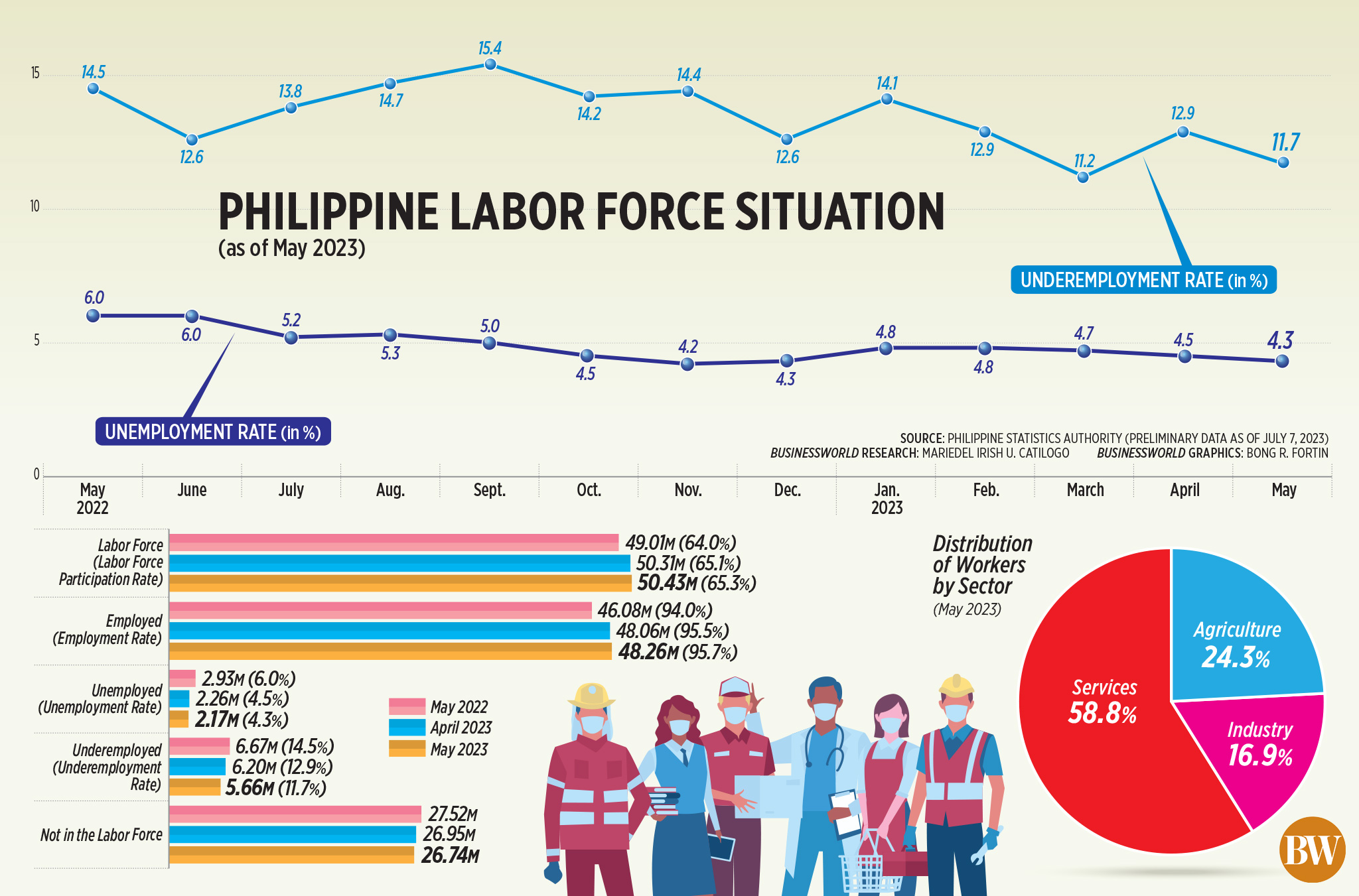
Philippine Labor Force Situation

The Philippines’ unemployment rate in May eased to 4.3% as more Filipinos found employment, the Philippine Statistics Authority (PSA) said on Friday. Read the full story.

Philippine Labor Force Situation

Orlando suffers a 89-78 defeat to Detriot; Kai Sotto not in the lineup

KAI SOTTO — ORLANDO MAGIC/FACEBOOK

KAI Sotto wasn’t able to strut his stuff in a highly-anticipated NBA Summer League debut as the Orlando Magic absorbed an 89-78 loss against the Detroit Pistons yesterday at the Thomas Mack and Arena in Las Vegas, Nevada.

Mr. Sotto did not play a single second and was stuck in the Magic bench, dashing the hopes of the hyped Filipino fans who anticipated the 7-foot-3 sensation to show his wares against the NBA’s top rookies and prospects.

Without Mr. Sotto, who’s the tallest in the team’s 22-man roster, Orlando fielded only 10 players and was overpowered by James Wiseman and Jalen Duren.

Mr. Wiseman, the 2020 No. 2 pick originally drafted by the Golden State before being traded to the Pistons, punished Orlando with 16 points, 12 rebounds and two blocks as Mr. Duren added 17 points and eight boards.

Detroit’s Ausar Thompson, the No. 5 rookie pick this year, tallied seven points, nine rebounds and three blocks in a duel against sixth overall pick Anthony Black, who had a 17-5-5-3 line for Orlando.

Mr. Sotto is among the only three centers for Magic but Dylan Murphy, mentor of the Osceola Magic in the G League, relied heavily on Robert Baker II and veteran DJ Wilson to man their frontline.

Mr. Baker played 14 minutes for eight points, two rebounds and a block as Mr. Wilson had four points, three rebounds, two assists and two steals in 26 minutes of action.

Kevon Harris led the way for Orlando with 21 points as Jett Howard, the No. 11 pick, had eight points, four assists and three steals.

Orlando, with Mr. Sotto hoping to finally see action, eyes to bounce back against Indiana tomorrow before wrapping up campaign against New York and Portland on Thursday and Friday, respectively. — John Bryan Ulanday

Tolentino tells athletes to focus on the Asian Games

FOCUS on the Asian Games.

This was the advice given by Philippine Olympic Committee President Abraham Tolentino to Filipino athletes who were disheartened following the last-minute postponement of the Asian Indoor and Martial Arts Games and the cancellation of the World Beach Games.

“These are beyond our control. I understand the sentiments of our athletes but this is something that we don’t have a choice about,” said the Tagaytay City mayor and PhilCycling chief. “But as athletes, I trust them to make the adjustments.”

The World Beach Games, originally slated Aug. 5 to 15 in Bali, Indonesia, was scrapped due to budgetary reasons.

Same with the oft-delayed Asian Indoor and Martial Arts Games, which was reset from Nov. 17 to 26 this year to Feb. 24 to March 8 next year in Bangkok and Chonburi, Thailand.

But since most of the country’s contingent that were supposed to see action in the AIMAG are also participating in the Asiad, Mr. Tolentino said they would have to shift their attention at preparing for Hangzhou.

“They can totally focus on the Asian Games, the biggest competition in Asia,” said Mr. Tolentino. — Joey Villar

Hidilyn Diaz and Elreen Ando moving up to 64-kg for Hangzhou Asian Games

IS Tokyo Olympics gold medalist Hidilyn Diaz climbing up the 64-kilogram division from 59kg  just for the Hangzhou Asian Games?

It appeared so as there were reports the world champion lifter from the Philippines is contemplating on seeing action in the heavier division in the weeklong Smart-bankrolled National Championships unfurling today (July 10)  in Bacolod City.

Interestingly, fellow Olympian and Southeast Asian Games gold winner Elreen Ando is also thinking of moving up to 64kg that could pave the way for another collision course between the two veteran internationalists.

“I will personally talk to both of them and sort this out,” Samahang Weightlifting ng Pilipinas president Monico Puentevella yesterday told The STAR.

Mmess. Diaz and Ando are both campaigning to earn that one Olympic slot for the country in the 59kg class for next year’s Paris Games with the former gaining the early upper hand after finishing higher than the latter in last May’s Asian Championships in Jinju, South Korea.

Mr. Puentevella said the National tilt would serve as a tryout for several international meets like the Hangzhou Asiad set Sept. 23 to Oct. 8 as well as the Asian Youth and Junior Championships in India also this year.

It would be ideal, Mr. Puentevella explained, if Mmess. Diaz and Ando, just for Hangzhou, would compete in different weight categories since participating nations are allowed just one entry per class.

It would also increase the country’s chances of snaring more medals, possibly gold.

And then they could go back battling each other in the 59kg for that precious slot to Paris as the Olympic qualifying process resumes with the staging of the World Championships from Sept. 4 to 17 in Riyadh, Saudi Arabia.

Ms. Diaz was forced to ascend to Ms. Ando’s natural class after the former’s original division—55kg—where she delivered the country’s historic Olympic mint was scratched out of the Paris calendar.

There is also no women’s 64kg in Paris.

“Hidie (Diaz) has arrived today (yesterday) and Ms. Ando will arrive tomorrow (today) and I will clear everything up after I talked to them both,” said Mr. Puentevella.

Also seeing action in Bacolod are Vanessa Sarno and John Fabuar Ceniza, who have both zoomed to the top 10 in their respective divisions — women’s 71kg and men’s 61kg — and closer to making the Olympic cut. — Joey Villar

ADVERTISEMENT
ADVERTISEMENT