Home Blog Page 4630

SGV names new partners, principals, one readmission

SGV & Co. has announced nine new partners, three new principals, and one readmission to the largest professional services firm in the country.

The new partners are Jay Loren C. Malig-Castañeda, Anna Maria Rubi B. Diaz, Winnie S. Estrella, Dexter Allan Noel N. Madamba, Alvin G. Manuel, Miguel Carlo S. Rancap, Hanna S. Rojo, Erickson Errol R. Sabile, and Dara Ledda A. Urbiztondo.

Designated as principals are Alden Patrick C. Labaguis, Donna Frances G. Ylade-Torres, and Cecille M. Santillan-Visto. SGV also announced the readmission to the partnership of Francis J. Ricamora.

The move, which took effect on July 1, 2023, brings SGV’s partners and principals to 151 outstanding leaders, mentors, and stewards leading the firm’s nearly 6,000 professionals and supporting staff from various disciplines.

SGV said its partners and principals are“deeply committed” to guiding the firm in its purpose “to nurture leaders and enable businesses for a better Philippines and a better working world.”

Seaoil obtains two ISO certifications

SEAOIL Philippines, Inc. has reinforced its quality and environmental program by getting certified for ISO 9001:2015 Quality Management System and ISO 14001:2015 Environmental Management System.

In a press release, the company said Bureau Veritas presented the certificates after Seaoil had built, continuously improved, and maintained its integrated management system.

It said the certificates prove its “continued dedication to provide its customers with quality and innovative products and services, while protecting the environment.”

DMCI Holdings honored at Asian Excellence Awards

ISIDRO A. Consunji and Herbert M. Consunji, the top executives of DMCI Holdings, Inc., have been recognized as Asia’s top chief executive officer and chief financial officer, respectively, during the 13th Asian Excellence Awards in Hong Kong.

Cherubim O. Mojica was also awarded Best Investor Relations Professional while DMCI Holdings was honored as Best Investor Relations Company.

“We are extremely honored to receive these recognitions. They are a testament to the hard work and dedication of our team and their commitment to delivering excellence in all aspects of our business,” said DMCI Holdings’ chief executive.

The diversified engineering conglomerate described the Asian Excellence Awards, which was launched in 2011, as designed to recognize and celebrate exceptional achievements in management acumen, financial performance, corporate social responsibility, environmental practices and investor relations.

Film Joy Ride takes group of friends on raunchy rollercoaster to China

JOY RIDE (2023) — IMDB.COM

LOS ANGELES — When actress Stephanie Hsu realized there were no limits to how outrageous she could be in the film Joy Ride, she was confident it was going to be a “good time.”

JOY RIDE (2023) —IMDB.COM

Director Adele Lim, a co-writer for Crazy Rich Asians, was similarly grateful that no one ever told her that the raunchy US comedy, which arrives in theaters on Friday, was “too much.”

“To be so unhinged actually does take a lot of craft but it’s really rare that you can just let it all hang out and find ways to go harder and harder and harder and more extreme,” said Ms. Hsu, a 2023 Oscar best supporting actress nominee for her role in Everything Everywhere All at Once.

Joy Ride follows childhood friends Audrey and Lolo, who are joined by Lolo’s cousin Deadeye and Audrey’s former college roommate Kat as they embark on a wild journey to China to find Audrey’s birth mother.

It features an all-Asian main cast with queer and non-binary actors that introduce multi-faceted characters who reach beyond racial or gender stereotypes.

Alongside Ms. Hsu as Kat, the Lionsgate movie, which debuted at the 2023 South by Southwest film festival, features Emily in Paris star Ashley Park as Audrey Sullivan, Sherry Cola as Lolo, and Sabrina Wu as Deadeye.

“This is led by three women and me, and it’s awesome. We definitely throw the patriarchy around in a way that is awesome,” said Ms. Wu, who is non-binary. The film is aimed at “all humans,” Ms. Wu added.

One of the most rewarding things for many in the cast is knowing that the R-rated movie is not boxed in by assumptions that every Asian character has the same outlook on their identity.

“I think people like to just kind of lump us all into one,” Ms. Hsu said.

“I think what makes this film even more special on so many other levels other than it’s the first of its kind for the Asian community is also this intersection of gender queerness that feels valuable and important and that we haven’t seen before.” — Reuters

The future of money

Money has been an integral part of human civilization, serving as a medium of exchange, store of value, and unit of account. However, with the rapid advancement of technology, the concept of money is undergoing a transformative shift. The future of money lies in a digital and decentralized landscape, where traditional currencies coexist with cryptocurrencies, and financial transactions become faster, more efficient, and inclusive. What does the future hold for the concept of money?

One apparent evolution of money is the rise of cryptocurrencies, such as Bitcoin and Ethereum, which have emerged as significant disruptors in the financial world. Based on blockchain technology, cryptocurrencies offer decentralized and secure transactions, independent of traditional banking systems. They provide individuals with greater control over their financial assets and enable peer-to-peer transactions across borders without the need for intermediaries.

A CoinMarketCap study, as reported by Forbes, revealed that “there are approximately 22,932 cryptocurrencies, with a total market capitalization of $1.1 trillion.” As cryptocurrencies gain wider adoption, they have the potential to redefine the concept of money by providing alternative means of payment and store of value.

Another shift is the growth of central bank digital currencies (CBDCs). Central banks are exploring the development of CBDCs as a response to the rise of cryptocurrencies. CBDCs are digital versions of fiat currencies issued and regulated by central authorities. They offer the benefits of faster transactions, increased financial inclusion, and improved transparency. They can streamline government payments, enable direct peer-to-peer transactions, and enhance the efficiency of monetary policy.

According to a recent Reuters report, “a total of 130 countries representing 98% of the global economy are now exploring digital versions of their currencies, with almost half in advanced development, pilot or launch stages.” The introduction of CBDCs may reshape the financial landscape, blending the features of cryptocurrencies with the stability of traditional fiat currencies.

The future of money is also driven by the rapid growth of financial technology (fintech) and digital payment systems. Fintech companies are revolutionizing the way we conduct financial transactions, providing convenient and secure digital payment solutions. According to a recent Boston Consulting Group report, there are currently over 26,000 fintech startups worldwide, which has grown dramatically over the past few years (up from only around 12,000 fintech startups in 2019).

Mobile payment platforms, such as PayPal, Venmo, and Alipay, have gained significant popularity, enabling seamless transactions and financial inclusion. Additionally, emerging technologies like blockchain and AI are being leveraged to create innovative financial products and services, further transforming the way we interact with money.

The digital future of money holds great promise for financial inclusion. As technology becomes more accessible, individuals in underserved communities and developing economies can access financial services through their smartphones. Digital wallets and mobile banking solutions offer opportunities for the unbanked and underbanked populations to participate in the formal financial system, empowering them with greater control over their financial lives.

A 2021 Financial Inclusion Survey (FIS) of the Bangko Sentral ng Pilipinas (BSP) revealed that 60% of those with mobile phones and internet access in 2021 performed online financial transactions, such as payments and fund transfers, which increased from 17% in 2019. The survey also showed that the number of Filipino adults with financial accounts increased from 20.9 million in 2019 to 42.9 million in 2021, growing by more than double. The convenience of transacting online truly shifted financial behavior during the pandemic, with more Filipinos saving and using online banking and digital payments. This increased access to financial services can drive economic growth, reduce poverty, and promote social development.

While the future of money presents exciting possibilities, it also raises challenges that must be addressed. Security and privacy concerns surrounding digital transactions require robust measures to safeguard personal and financial information. Regulatory frameworks need to evolve to ensure consumer protection, prevent fraud, and combat money laundering and illicit activities. Additionally, the digital divide must be bridged to ensure equitable access to digital financial services, considering disparities in internet connectivity and digital literacy.

The future of money is characterized by the growing influence of digital currencies, decentralization, and technological innovation. Cryptocurrencies, CBDCs, fintech, and digital payment systems are reshaping the financial landscape, offering faster, more inclusive, and secure transactions. This evolution holds the potential to drive financial empowerment, spur economic growth, and foster global financial integration. However, careful attention must be given to address regulatory, security, and inclusivity challenges to ensure a sustainable and equitable future of money. By embracing technological advancements while maintaining a focus on security, privacy, and accessibility, we can navigate this evolving landscape and unlock the full potential of digital currencies and financial technology.


Reynaldo C. Lugtu, Jr. is CEO of Hungry Workhorse Consulting, a digital and culture transformation consulting firm. He is the chairman of wAcademy. He is fellow at the US-based Institute for Digital Transformation. He teaches strategic management in the MBA Program of De La Salle University.

rey.lugtu@hungryworkhorse.com

Confidential employees in a nonunionized company

A worker is asking why we have so many confidential employees in our rank-and-file workforce. That worker said in jest that the human resource (HR) manager could be getting ready for the entry of an employees’ union. I’m puzzled. How would you look at this situation? — Puzzled Look.

The joker is correct. “Confidential employees” are usually used in unionized establishments. Such employees are typically excluded from the bargaining unit and therefore not eligible to join any union due to the nature of their jobs. They are trusted by management to handle the company’s trade secrets and confidential information.

In general, “confidential employees” are trusted with three types of sensitive data: One, information pertaining to all employees. Two, information related to management strategy. And three, information involving trade secrets or business information.

The pertinent Supreme Court decision on “confidential employees” is San Miguel Foods, Inc. vs. San Miguel Corp. Supervisors (G.R. 146206, promulgated in 2011).

“Confidential employees are defined as those who (1) assist or act in a confidential capacity, in regard (2) to persons who formulate, determine, and effectuate management policies in the field of labor relations.” They are non-management workers assigned to work in the HR department, especially those who are handling payroll, the safekeeping of 201 folders, record-keeping of attendance policies and related tasks.

Many confidential employees are also assigned to accounting, collection, finance, and purchasing departments. They handle sensitive information which, if leaked to competitors, trade unions or other entities, may result in a disadvantageous or precarious situation for management and the organization.

This is why “executive assistants” and secretaries of senior management executives are classified as “confidential employees.” The San Miguel case indicates that such definitions are made within the context of labor relations. Unfortunately, when some people hear the terms “confidential employees” and “labor relations,” they automatically assume that a company has a union or several unions representing various bargaining units.

To avoid that confusion, it’s better for organizations to use the term “employee relations” as a neutral or objective term.

UNION MEMBERSHIP
If “confidential employees” are not qualified to join a union, can they form a new union purposely to protect its interests? The answer is no. They can’t form or join a union as their “access to confidential information may become the source of undue advantage” when they try to negotiate with management.

It can work both ways as they could be charged with being spies. This was the conclusion reached in another case, National Association of Trade Unions – Republic Planters Bank Supervisors Chapter vs. Hon. Ruben Torres (G.R. No. 93468 promulgated 1994).

Essentially, the problem is conflict of interest. If such activities are allowed, imagine the chaos that could result, possibly causing the organization to self-destruct.

PROACTIVE STRATEGIES
Just the same, take the joker seriously. Watch his every move. He may be joking, but he may be planning something that could upset the HR department, top management, and the organization, in general. I hope I’m wrong. Per my experience, a person like this usually has the capacity to organize a union.

I’m not saying that organizing a union is wrong. It is the right of every worker to organize a union. However, this same right is also tempered by the right of every worker not to join a union.

What I’m saying is that the joker and his cohorts may not be happy with many of your management policies and could be thinking of testing the waters. Better come out soon with some proactive strategies, like a “sophisticated welfare” program. This is also known as paternalism, with the intent of making a union irrelevant.

Proactive employee relations strategies include the development and maintenance of a positive work environment that is advantageous to both labor and management. It is based on the belief that the organization is better served when the employees are working in harmony with management.

Many proactive employee relation strategies involve two-way communication tools like a morale survey, town hall meetings, and quality circles or related problem-solving activities designed to empower and engage. In summary, the best question to ask is: Do a majority of employees feel their interests are being neglected by management?

When management fails to maintain regular dialogue, chances are, both the rumormongers and rabble-rousers have a decent chance at ultimately destroying the organization. Don’t be surprised if the joker is part of this.


Chat your workplace issues with Rey Elbo on Facebook, LinkedIn, Twitter or e-mail elbonomics@gmail.com or via https://reyelbo.com

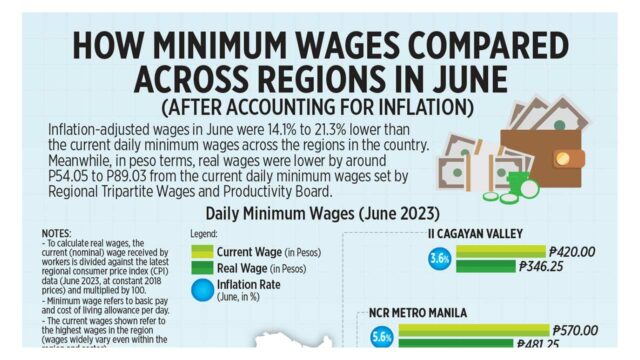
How minimum wages compared across regions in June

(After accounting for inflation)

Inflation-adjusted wages in June were 14.1% to 21.3% lower than the current daily minimum wages across the regions in the country. Meanwhile, in peso terms, real wages were lower by around P54.05 to P89.03 from the current daily minimum wages set by Regional Tripartite Wages and Productivity Board.

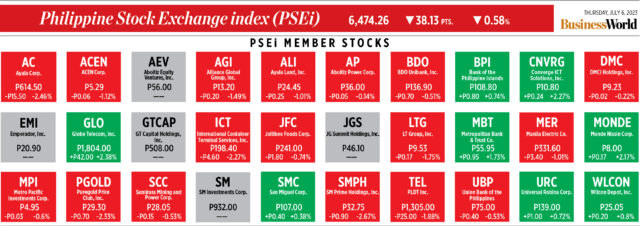
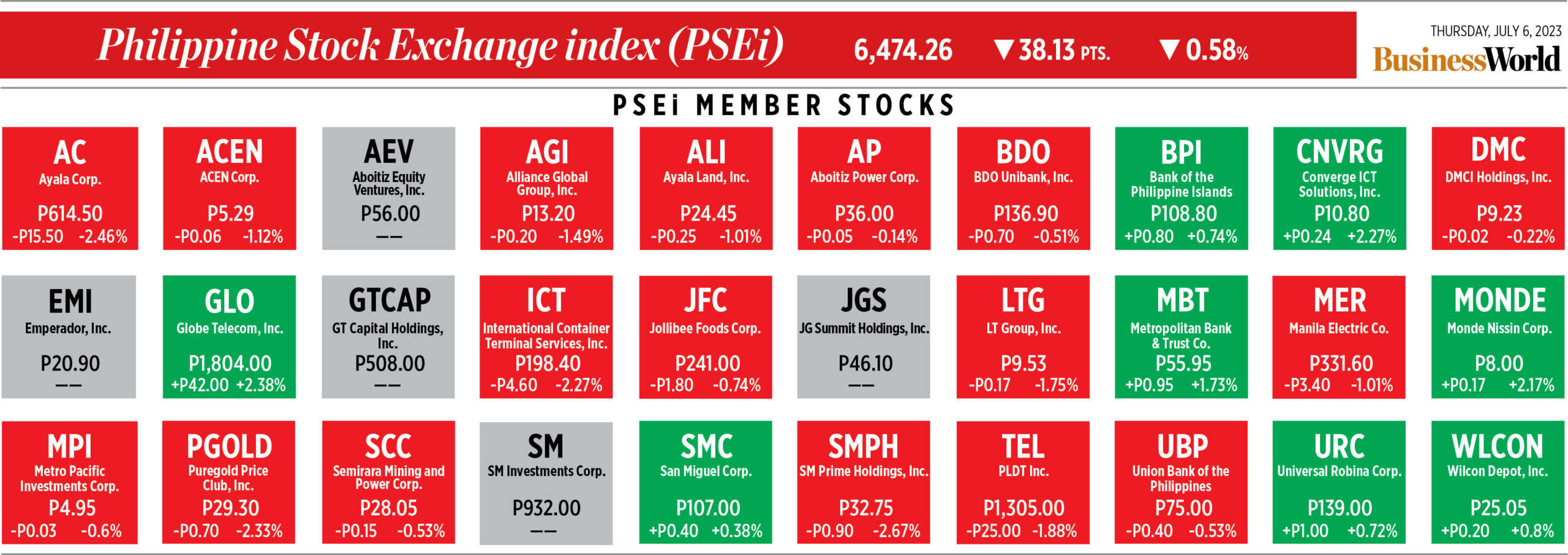
How PSEi member stocks performed — July 6, 2023

Here’s a quick glance at how PSEi stocks fared on Thursday, July 6, 2023.


PSEi drops further after release of Fed minutes

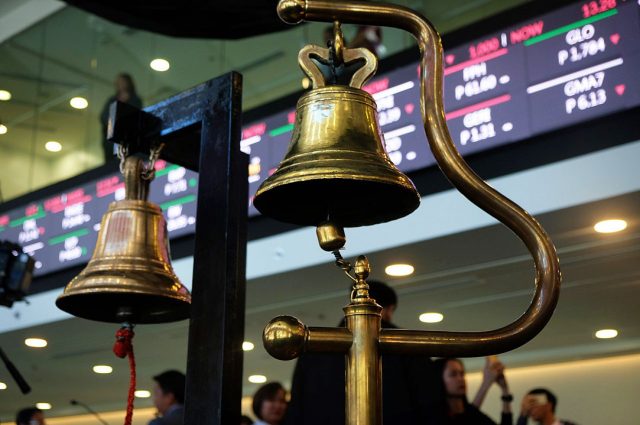
BW FILE PHOTO

PHILIPPINE SHARES declined further on Thursday as minutes of the US Federal Reserve’s June meeting supported expectations of further rate hikes this year.

The Philippine Stock Exchange index (PSEi) dropped by 38.13 points or 0.58% to 6,474.26 on Thursday, while the broader all shares index declined by 13.82 points or 0.39% to 3,455.93.

“The index fell as investors turned negative after a review of the minutes of the Federal Reserve’s June meeting reaffirmed the hawkish trajectory of US monetary policy,” China Bank Capital Corp. Managing Director Juan Paolo E. Colet said in a Viber message.

“The lack of sustained market strength even after the release of the Philippine June inflation print shows traders have already priced in the deceleration of domestic inflation and are looking for other news to drive stock prices,” Mr. Colet added.

Regina Capital Development Corp. Head of Sales Luis A. Limlingan likewise said in a Viber message that market sentiment was affected by the minutes of the Fed’s meeting last month.

A united US Federal Reserve agreed to hold interest rates steady at the June meeting as a way to buy time and assess whether further rate hikes would be needed, even as the vast bulk expected they would eventually need to tighten policy further, according to meeting minutes released on Wednesday, Reuters reported.

While “some participants” wanted to move ahead with a rate hike in June because progress in cooling inflation had been slow, “almost all participants judged it appropriate or acceptable to maintain” the federal funds rate at the existing 5% to 5.25%, the minutes said.

Meanwhile, headline inflation slowed to 5.4% in June from 6.1% in May 2023 and June 2022, but marked the 15th straight month that the consumer price index exceeded the Bangko Sentral ng Pilipinas’ 2-4% target for the year.

For the first six months, inflation averaged at 7.2%, still higher than the central bank’s 5.4% forecast for 2023.

All sectoral indices declined on Thursday except for financials, which went up by 3.71 points or 0.2% to 1,842.45.

Meanwhile, property went down by 45.91 points or 1.73% to 2,597.75; services dropped by 15.93 points 1.01% to 1,555.90; holding firms fell by 30.15 points or 0.46% to 6,450.40; industrials declined by 9.16 points or 0.1% to 9,159.14; and mining and oil lost 4.66 points or 0.04% to end at 9,896.59.

Value turnover increased to P4 billion on Thursday with 745.77 million shares changing hands from the P3.82 billion with 522.37 million issues seen on Wednesday.

Decliners outnumbered advancers, 100 versus 73, while 51 names closed unchanged.

Net foreign selling rose to P99.41 million on Thursday from P22.2 million on Wednesday. — A.H. Halili with Reuters

Peso weakens on tightening view

BW FILE PHOTO

THE PESO continued to weaken against the dollar on Thursday as minutes of the US Federal Reserve’s June meeting affirmed views of further tightening.

The local currency closed at P55.50 versus the dollar on Thursday, dropping by 11.50 centavos from Wednesday’s P55.385 finish, data from the Bankers Association of the Philippines’ website showed.

The local unit opened Thursday’s session weaker at P55.51 per dollar. Its weakest showing was at P55.64, while its intraday best was at P55.43 against the greenback.

Dollars traded dropped to $1.06 billion on Thursday from the $1.16 billion seen on Wednesday.

The peso was dragged lower by the hawkish tone of the minutes of the Fed’s June 13-14 meeting, Rizal Commercial Banking Corp. Chief Economist Michael L. Ricafort said in a Viber message.

A united US Federal Reserve agreed to hold interest rates steady at the June meeting as a way to buy time and assess whether further rate hikes would be needed, even as the vast bulk expected they would eventually need to tighten policy further, according to meeting minutes released on Wednesday, Reuters reported.

While “some participants” wanted to move ahead with a rate hike in June because progress in cooling inflation had been slow, “almost all participants judged it appropriate or acceptable to maintain” the federal funds rate at the existing 5% to 5.25%, the minutes said.

“Most of those participants observed that leaving the target range unchanged at this meeting would allow them more time to assess the economy’s progress,” toward returning inflation to 2% from its current level more than twice that.

The minutes added detail to the policy statement and economic projections issued after the June 13-14 session, when the Fed ended its 10-meeting streak of rate hikes with a decision to hold the benchmark federal funds rate steady.

That sent the dollar slightly higher alongside Treasury yields, as bets firmed that the Fed will resume its rate-hike campaign this month and that rates would stay higher for longer in order to tame inflation.

Against the dollar, the euro touched a near one-week low of $1.0843 in early Asia trade, while sterling dipped by 0.08% to $1.26925.

The dollar index rose by 0.04% to 103.38.

For Friday, Mr. Ricafort sees the peso weakening further and moving from P55.80 to P55.90 per dollar. — AMCS with Reuters

PHL trade delegation targets German infra, RE investment

GERMAN infrastructure, renewable energy (RE), and high-tech manufacturing companies are among the potential investors that a trade delegation currently in Europe is seeking to attract to the Philippines, the Department of Trade and Industry (DTI) said.

In a speech at the Philippine-German Investment Forum on July 3, Trade Secretary Alfredo E. Pascual directed his remarks specifically to infrastructure companies in light of the Philippine government’s push to address the gaps in its infrastructure.  

“We enjoin Germany to partner with the Philippines in projects involving the construction of airports, railways, and bridges, all designed to enhance connectivity within our country and with the rest of the world,” Mr. Pascual said.  

The forum was attended by representatives from the German Federal Ministry for Economic Affairs and Climate Action State Secretary Udo Philipp, Philippine Ambassador to Germany Irene Susan B. Natividad, Association of German Chambers of Commerce, and Industry Chief Executive of Foreign Trade Volker Treier, as well as representatives from German companies.  

Mr. Pascual added that German businesses might find opportunity in the Philippine renewable energy industry, where foreign investors are now allowed to own 100% of their projects, up from the Constitutional limit of 40% previously.

Mr. Pascual also urged German businesses to consider locating high-tech manufacturing operations to the Philippines, including aerospace, automotive, electronic devices, pharmaceuticals, and innovation-focused sectors.

Mr. Pascual also had a separate meeting with German Electronics and Digital Industry Association (ZVEI) President Gunther Kegel on possible collaboration in electronics manufacturing with the Semiconductor and Electronics Industries in the Philippines Foundation, Inc.  

The specific businesses being targeted are original design manufacturer, original equipment manufacturer, and electronics manufacturing outsourcing in the Philippines.  

“This is in light of the continuing challenges of the lack of skilled labor, the rising cost of production, and the diversification and de-risking aspirations in Germany,” the DTI said.

ZVEI represents over 1,000 companies in Germany employing 879,000 workers, with combined turnover of €200 billion in 2021.

The Philippine Statistics Authority reported that Germany was the top source of foreign investment pledges at P156.96 billion in the first quarter, accounting for 90.9% of the total.

The DTI European Investment Roadshow wrapped up yesterday, July 6. — Revin Mikhael D. Ochave  

Bataan-Cavite bridge expected to get financing approval by Nov.

DPWH

THE Department of Public Works and Highways (DPWH) said it expects the Asian Development Bank (ADB) to approve financing for the Bataan-Cavite Interlink Bridge (BCIB) project by November.

The DPWH cited a report from Undersecretary Emil K. Sadain that an ADB fact-finding mission will appraise “overall project readiness prior to the preparation of loan agreement for the 32-kilometer BCIB project.”

The ADB and the Asian Infrastructure Investment Bank (AIIB) had committed to co-finance the civil works associated with the bridge, which is targeted to start by 2024, according to the DPWH.

The ADB has estimated the first tranche of the financing package to be worth $1 billion, with $650 million to be provided by the ADB and $350 million by the AIIB. The cost of the project has been estimated at P175.66 billion. 

The 32.15-kilometer four-lane bridge crosses Manila Bay from barangay Alas-asin, Mariveles, Bataan to Barangay Timalan, Naic, Cavite.

The DPWH will also be building the North and South Channel Bridges that will facilitate ship navigation. They are expected to span 400 meters and 900 meters, respectively.

The project will be divided into seven contract packages. The first two will involve the construction of a five-kilometer Bataan Land Approach and a 1.35-kilometer Cavite Land Approach to the crossing.

Packages 3 and 4 will cover marine viaducts in the north and south, while packages 5 and 6 are the north and south channel bridges. The last package will include the project-wide ancillary works.

The DPWH said that the final design of the BCIB includes a long cable-stayed bridge at the south channel with tower height set at 380 meters above sea level.

The bridge is expected to reduce travel time between the provinces of Bataan and Cavite to 45 minutes from the current five and a half hours. — Justine Irish D. Tabile

ADVERTISEMENT
ADVERTISEMENT