Home Blog Page 4538

AirAsia group, UnionDigital Bank forge finance partnership; airline pledges to invest $1 billion

CAPITAL A Berhad, the parent firm of low-cost carrier AirAsia Philippines, entered into a finance partnership with the digital bank subsidiary of listed lender Union Bank of the Philippines.

In a media release, Capital A and UnionDigital Bank announced the tie-up, which they forged on Sunday via a press conference during the APEC Business Advisory Council (ABAC) meeting in Cebu.

“For Capital A, the vision has always been to provide low cost, best value services, connecting people and realizing dreams, for people of ASEAN and beyond,” Anthony Francis Fernandes, chief executive officer of Capital A, said.

The partnership will involve three of Capital A’s subsidiaries: AirAsia, airasia Superapp, and BigPay. UnionDigital Bank will be providing embedded finance in partnership with Capital A’s fintech arm BigPay within the booking channel airasia Superapp.

“With UnionDigital as our proud partner, we are now on our way to creating a future where travel meets innovative financial solutions that facilitate everyone’s dream journeys with unparalleled ease,” Mr. Fernandes said.

He said seven out of 10 of AirAsia’s customers in the Philippines save up for their travel plans.

“It is this inspiring dedication that fuels our determination to break down barriers and create a more connected and inclusive global community,” he added.

The partnership will allow BigPay, a mobile wallet providing financial services in Malaysia and Singapore, to expand into the Philippine market.

“As tourism flourishes in the region, we are excited to elevate the end-to-end travel and payment experience of Filipinos through our collaboration with UnionDigital Bank and airasia,” said Zubin Rada Krishnan, chief executive officer of BigPay.

“Through this partnership, BigPay is one step closer to making our financial services highly accessible in the Philippines, with the mission of empowering people to level up their lives, one transaction at a time,” he added.

Henry Rhoel R. Aguda, president and chief executive officer of UnionDigital Bank, described the move as a “pivotal moment for the two important sectors in the Philippines.”

“We are forging a path towards greater convenience, accessibility, and innovation to empower Filipinos to live better lives,” he said.

“As we make these partnership announcements at ABAC, we are not just setting the stage but building a solid foundation for a brighter future with BigPay and AirAsia by our side,” he added.

INVESTMENT IN THE PHILIPPINES
Meanwhile, Mr. Fernandes said he had pledged to invest $1 billion to expand Capital A’s operations in the Philippines at a meeting with President Ferdinand R. Marcos, Jr.

Mr. Fernandes told reporters on Sunday that the majority of the investment will be on aircraft in connection with his company’s logistics business.

“We discussed many things, obviously airports being one. I think we are committed to invest $1 billion mostly in the field of aircraft. But the aircraft also has enormous benefits for the logistics business,” he said.

Mr. Fernandes said the Philippines is perfectly placed to grow in the logistics business because of its proximity to other countries in Asia as well as its connection to the US.

Aside from aircraft and logistics, he said Capital A will also invest in BigPay, airasia Superapp, and in engineering.

“People don’t know how great this country is and one thing AirAsia group is good at is promoting, and Superapp is gonna be a major vehicle to tell the world how good this country is,” Mr. Fernandes said.

For its engineering business, the company is planning to build a maintenance, repair, and overhaul (MRO) facility in Cagayan de Oro.

“We want to build an MRO with 1,300 workers and our team is looking at Cagayan de Oro,” said Mr. Fernandes. — Justine Irish D. Tabile


Chery Auto Philippines sold most-ever 382 units in June

PHOTO FROM CHERY AUTO PHILIPPINES

CHERY AUTO PHILIPPINES sales continue to trend upward, as the company reported an all-time high of 382 units moved last June — surpassing its previous highest monthly record of 323 vehicles set just in May. Even as industry sales average dipped by five percent in June, the Chery brand grew by 18% — enabling the company to land 10th spot in top auto sales for the month.

In a release, Chery said that the “June market performance was bannered by the strong sales of the Tiggo 5X with 247 units sold, enabling it to climb to a strong number-two ranking with 26% market share in the subcompact SUV segment.” The firm also said that the shortage of Tiggo 8 Pro Luxury version units was compensated by the initial deliveries of the hybrid version. “This allowed the Tiggo 7 Pro to sell a total of 76 units which represents a four-percent growth compared to last May.”

Chery’s H1 total is 1,668 units, representing eight-percent growth year on year — good enough to land the company in 11th place overall with 0.8% market share. The sales of the Tiggo 5X and Tiggo 8 Pro at 834 and 271 units, respectively, also contributed to Chery’s sales growth in the first half of the year.

“We are very pleased that more and more Filipinos are trusting the Chery brand. We are confident that this upward sales momentum will continue as we introduce the new Tiggo 5X Pro Comfort and hybrid version this month,” said UAAGI Chairman Rommel Sytin. “(Our) good sales continues to attract new dealer investors and we are excited to announce the new dealer outlets in key areas very soon.”

For more information, visit https://cheryauto.ph/; like and follow (Chery Auto Philippines) on Facebook and Instagram. The 24/7 Chery Auto Philippines hotline is 0917-552-4379; its e-mail is chery@uaagi.com.

BSP’s coin deposit machines collect P12 million following June launch

THE BANGKO SENTRAL ng Pilipinas (BSP) has collected coins worth P12 million through its coin deposit machines (CoDMs) a month after their rollout in select retail establishments in Manila.

BSP Deputy Governor Bernadette Romulo-Puyat told reporters on the sidelines of the central bank’s annual reception for the banking community on Friday that members of the public have been using the coin deposit machines.

“We’ve only deployed 10 machines in one month, but we were able to collect P12 million worth of deposits and about six million pieces of coins,” she said in mixed English and Filipino, adding that the highest value the BSP got from just one depositor was P50,000.

She said six CoDMs were only deployed in the last two weeks, while the first four machines launched by the BSP were popular among the public, resulting in long lines.

The BSP began deploying CoDM units in June in partnership with Filinvest Lifemalls Corp., Robinsons Supermarket Corp., and SM Retail, Inc.

The most popular units so far are those located in the SM Mall of Asia in Pasay City, in Robinsons Place Ermita in Manila, and in Festival Mall in Muntinlupa City, Ms. Romulo-Puyat said.

The central bank is looking to deploy more machines in those locations to cater to the high demand, she added.

The value of coins deposited in CoDMs may be credited to the depositor’s e-wallet account or converted into a shopping voucher for over-the-counter transactions.

All denominations of the BSP Coin Series and New Generation Currency Coins Series are accepted by the CoDM. Unfit and demonetized coins, foreign currency, and foreign objects are rejected by the machine and returned to the depositor.

The central bank is looking to improve the circulation of coins in the country through the coin deposit machines, Mr. Romulo-Puyat said.

As of now, customers depositing coins can only credit the equivalent amount to their GCash e-wallets. The BSP is looking to include other electronic money issuers, such as Maya, in the project’s next implementation phases.

“We’re still waiting for Maya. We’ve been inviting them to join the project. Hopefully by August, Maya will be available as well so people could have more options,” Ms. Romulo-Puyat said.

She added that 98% of deposits were credited to clients’ e-wallets while the rest were converted to shopping vouchers.

Pasig City Mayor Victor Ma. Regis “Vico” N. Sotto has reached out to the BSP as he also wants to have CoDMs in Pasig City, Ms. Romulo-Puyat noted.

A total of 25 machines will be deployed across the greater Manila area until August. The rollout of the machines in select retail establishments of the SM Store, Robinsons Supermarket, and Festival Mall is part of the first phase of the project’s implementation.

The BSP will determine if the project will be expanded to other regions and if the number of machines will be increased a year after the launch. — Keisha B. Ta-asan

Crowning glory

RAMAN BHARDWAJ, L’Oreal Professionel India Artistic Ambassador with models all in black, with their new highlights framing their faces.

On bayalage, $350 hairdos, and the ‘skin-ification’ of hair

RAMAN BHARDWAJ, L’Oreal Professionel India Artistic Ambassador with models all in black, with their new highlights framing their faces.

“A WOMAN who cuts her hair is about to change her life,” once said Coco Chanel, but what happens when a woman changes her hair color?

Last week, over a thousand hairstylists and salon owners went in droves to Okada Manila’s Grand Ballroom for L’Oreal Professionel’s Unleash the Future You: Manila Hair Show 2023. The guests of honor were Raman Bhardwaj, L’Oreal Professionel India Artistic Ambassador, and L’Oréal Professionnel Global Ambassador Min Kim. Both shared their techniques in coloring hair, particularly in the French technique balayage — literally translated, it means sweeping, alluding to the strokes used by a hairstylist to paint subtle highlights on the hair (as opposed to the fuller effect achieved by foils).

Mr. Bhardwaj was presented with a host of models all in black, with their new highlights framing their faces and shimmering their ends. “Isn’t hair the canvas of emotion? You express yourself through hair,” he said. With a mannequin’s head, he demonstrated what he did to the models using a brush and palette on the mannequin’s hair — truly earning his title as an Artistic Ambassador.

Ms. Kim, meanwhile, appeared on stage bringing with her the attitude of a pop star — and considering the location of Butterfly Studio, the salon she works for at New York’s 5th Avenue, she may have done the hair of more than one already. Her models, in white, came out so she could show what she did to their hair. Also, a screen showed the formula that she used for each one so that the stylists in attendance could do the same at their own salons.

She does take hair seriously: “This is something that’s really important when we’re in the salon, it’s taking a look at the haircut and the shape. That way we’re really creating a customized look that works for each individual.” She showed models with face-framing highlights that looked as if they had just stepped back from the beach, or else had natural light hitting the hair where it should. “I think about what’s going to be best for them, their face shape, their haircut, and their lifestyle.”

When she first started doing balayage, she said she hated it. “I started investing in my education, and I realized: it wasn’t balayage that was terrible. It was me!”

Ms. Kim said that balayage is an add-on service she does to a full color job. “We love add-on services because this is how we make more money. Who likes making money?” she said, and the crowd cheered in response. “I can’t hear enough noise!” she said, egging them on.

“Who wants to know how much I charge?” she asked, noting that she works for a salon in 5th Ave., not to mention her client list and her own prestige as a L’Oreal Ambassador. She charges between $285 to $350. “Yeah, honey,” she said.

While painting the hair of a mannequin, she talked about the years of practice that took her to where she is today. “I took it upon myself to make sure that I practice. When you try something new, don’t beat yourself up if you don’t get the result that you want. Every time I do anything, I look at it with a critical eye. That way, instead of beating yourself up, you have to think to yourself: ‘how do I make this better?’”

“Be solution-oriented. It’s not about perfection in the beginning. It’s about progress,” she said.

HAIR TRENDS
Meanwhile, in a group interview prior to the July 25 hair show, L’Oréal Philippines Professional Products Division General Manager Brian Duruin talked about current hair trends.

During the COVID-19 pandemic they noted an increase in treatments for hair fall and loss — a trend that continues today. He said that people are going back to hair salons, and while some are getting routine dye jobs with ashen colors, some are going red.

“In terms of hair treatments, hair fall, for some, continues to be the top concern,” he said. “Our sales reflect that, as to the top concerns.” These concerns include hair fall, oiliness, and dandruff, which derive from scalp issues. Hair treatments from L’Oreal’s Scalp Advanced line, as well as Kerastase’s Genesis line are meant to treat those issues. “Possibly because of stress, possibly because of the environment,” he said of the causes.

This attention to the scalp reflects L’Oreal’s new approach of treating the scalp the same way one cares for the face. “We call it the ‘skin-ification’ of hair. For us, as a company, what we have done is we have brought the very best of skincare technology — you know we have huge skincare brands globally, right? — in the formulations into our scalp solutions,” said Mr. Duruin.

“The foundation of great hair is a healthy scalp,” he said. — Joseph L. Garcia

Investing in a declining economy

(This article is based on the research undertaken by the Research Team of Regina Capital Development Corp., a member of the Philippine Stock Exchange.)

The World Bank in its June 2023 report, Global Economic Prospects, projected global growth (GDP) to decelerate from 3.1% in 2022 to 2.1% in 2023. For the Philippines, the World Bank projected GDP growth to decline from 7.6% in 2022 to 6% in 2023, 5.9% in 2024, and 5.9% in 2025.

Our fellow columnist, Romeo L. Bernardo in his column of June 19, “Growing Pains,” projected a lower GDP growth of 5.5% in 2023 but a recovery to 5.8% in 2024.

On a quarterly basis, Nomura Securities in its June 9, 2023 “Asia Economic Monthly Report” projected 2nd Quarter 2023 growth to decline from the 1st Quarter 2023 growth of 6.4% to 5.6%. Moreover, Nomura projects 3rd Quarter growth to decline further to 4.8%.

When the economy declines, we can also expect the stock market to decline.

Fortunately, market declines, like tropical storms, can be detected early and their probable path plotted, giving us time to prepare for the coming storm.

Moreover, in coping with the coming storm we can look for guidance from the foremost investor in the world, Warren Buffett. According to Buffett, a contrarian, a recession is one of the best times to look for investment opportunities. In 2008, he wrote “Bad news is an investor’s best friend. It lets you buy a slice of America’s future at a marked-down price.”

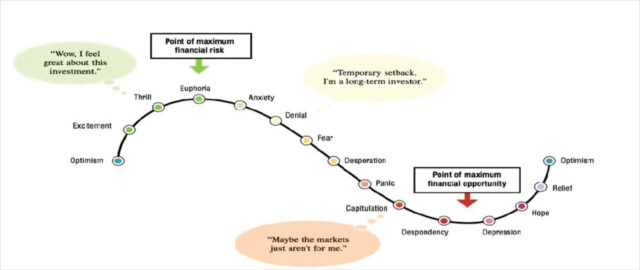
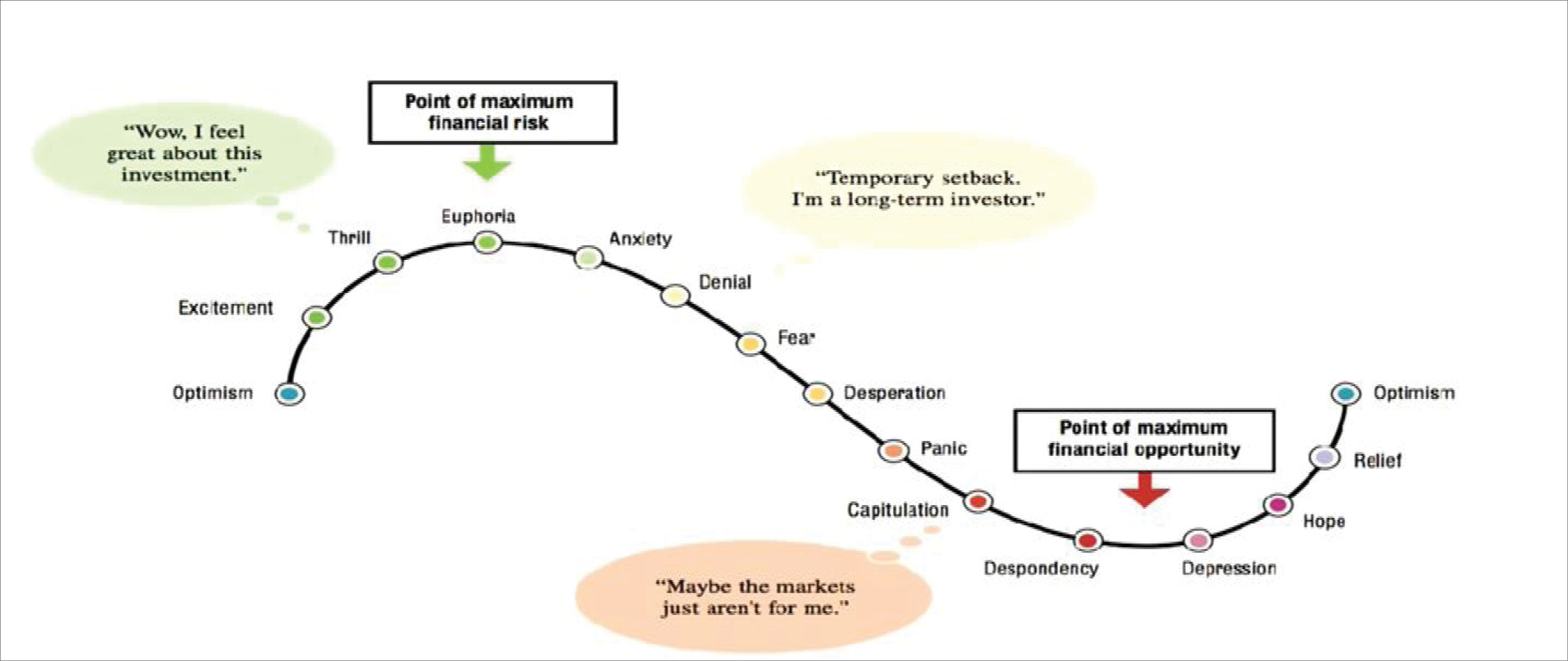
Buffet’s comments reflect the view of some investors that stocks go through a cycle as shown in the first chart (See Figure 1).

This chart shows that the best time to buy is when the cycle is on the downturn. Or, as Buffett states more colorfully, “When people are greedy, I am fearful and when people are fearful, I am greedy.”

Drawing from this and other sayings of Buffet, we propose the following plan.

LIQUIFY YOUR PORTFOLIO
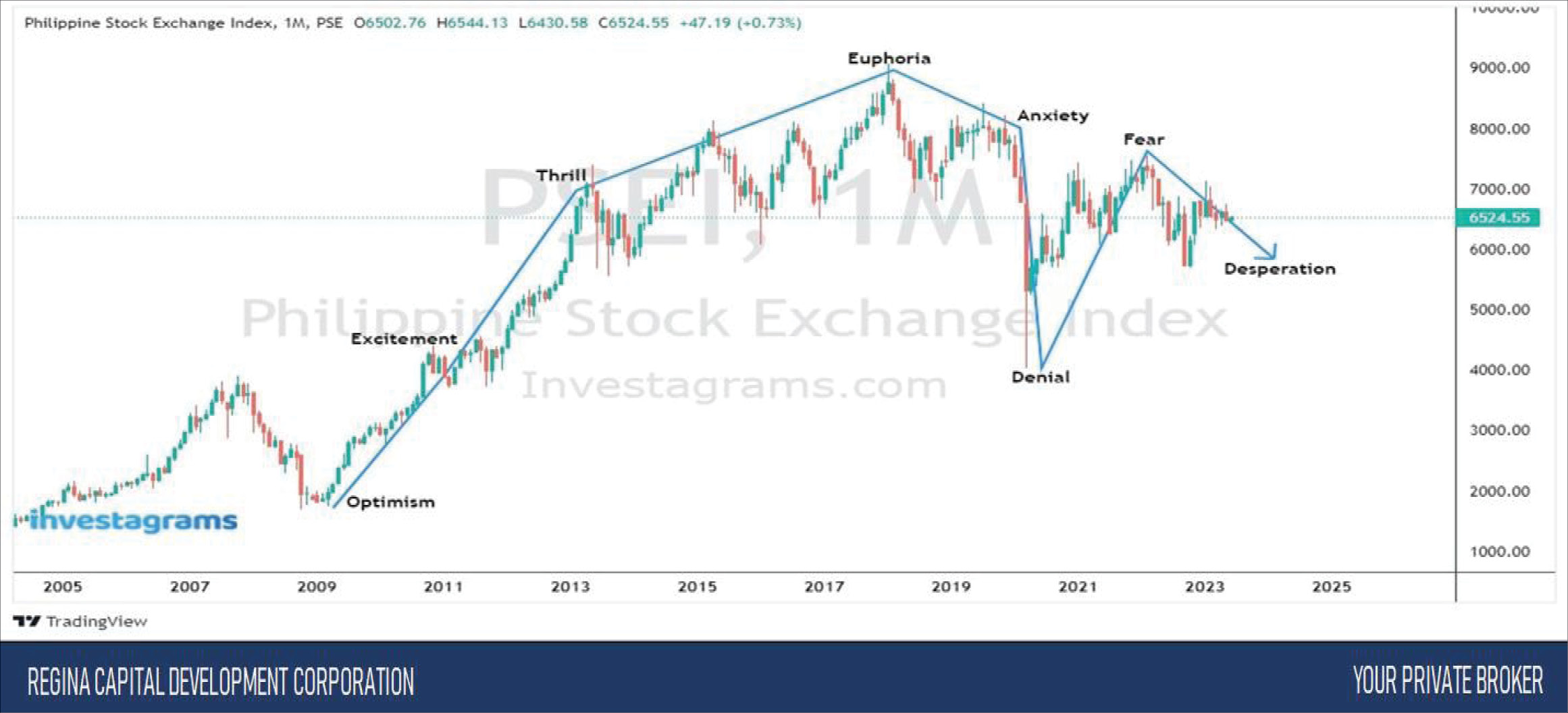
As stated, we can roughly predict when the stock market will decline. Using the investment cycle, we have charted the movement of the Philippine stock market from 2009 to the present (See Figure 2).

Note that with the exception of 2020 when the COVID-19 epidemic started and the market dropped precipitously and then rebounded sharply in 2021, the Philippine stock market has followed the investment cycle and so is expected to continue dropping until 2024.

Knowing this, the prudent strategy would be to conserve your cash and dispose of some of your stock investments to increase your cash position.

But which stocks to sell? For that we need a short course in Investment Analysis 101.

Stocks are valued for what they presently earn and what they are expected to earn. If a stock is expected to earn more in the future, then the price of the stock, a growth stock, will be higher than a stock which has the same present earnings but is not expected to earn more in the future.

Let us take the case of two American companies; General Motors Co. and Tesla, Inc. In 2022, General Motors had a profit of $9.9 billion while Tesla had a profit of $12.6 billion or 27% higher. And yet the market value of Tesla of $816.3 billion ($257.50 market price per share as of June 29, 2023 times 3.17 billion outstanding shares) is 15.4 times higher than the market value of General Motors at $53.1 billion ($38.20 market price per share as of June 29, 2023 times 1.39 billion outstanding shares).

Investment analysts use a ratio called Price/Earnings Ratio (Market Price per share divided by Earnings per share) to measure how highly the market values the share of the company. In the case of Tesla, the P/E ratio is 65.02 times while in the case of General Motors the P/E ratio is only 5.4 times. Thus, when times are good, Tesla is considered a growth stock compared to General Motors. Conversely when times are bad, the prospects of Tesla are direr than General Motors and so we can expect Tesla shares will fall deeper. In sum then, if we liquefy our stocks in anticipation of a declining market, we should sell Tesla and not General Motors shares.

BALANCING YOUR PORTFOLIO
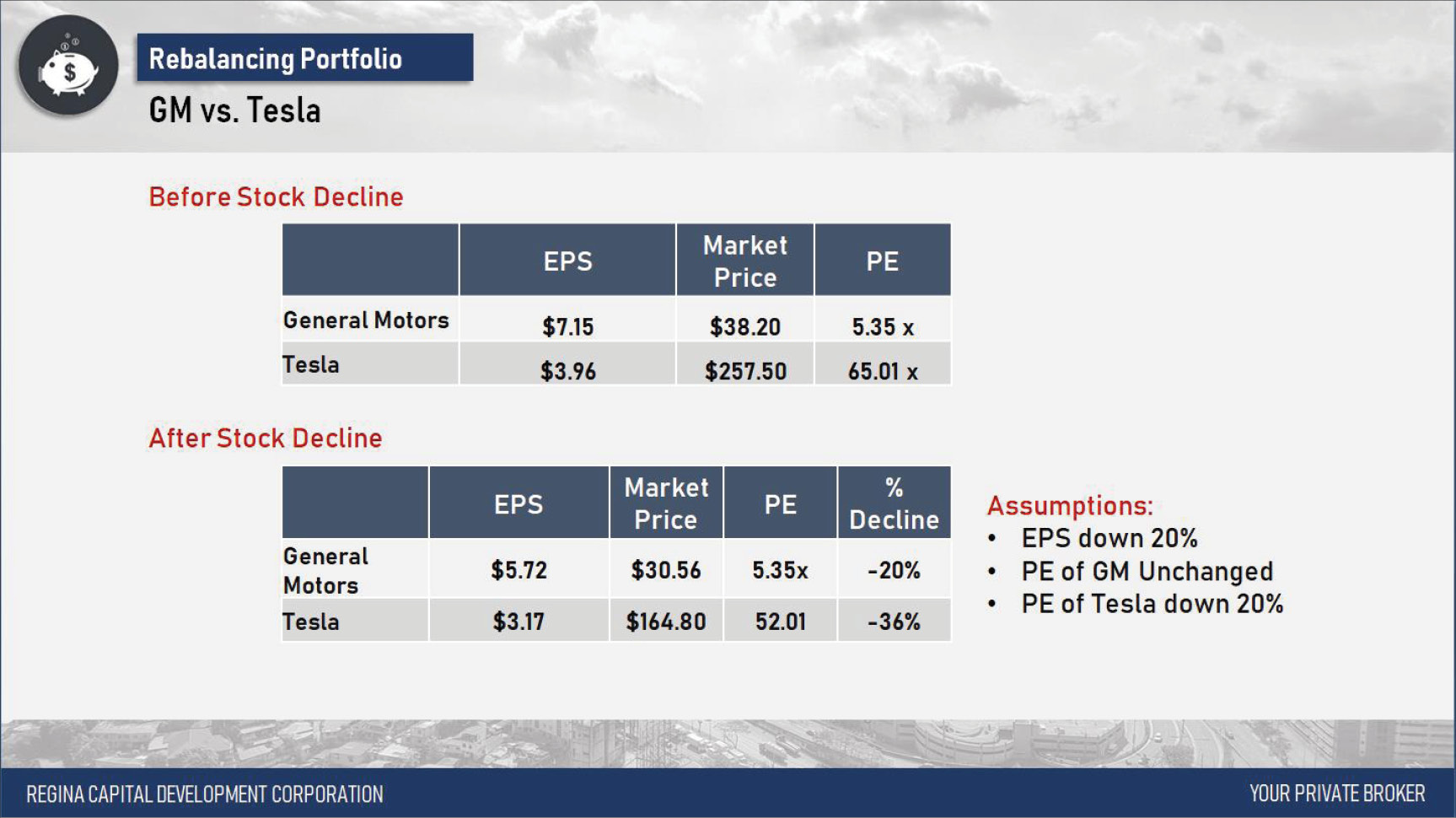
When the market does decline —i.e., Tesla shares declining after we have sold our Tesla shares — we get the opportunity to correct past investment mistakes. Let us say you invested in General Motors but now wish you had invested in Tesla Motors. Now that Tesla shares have fallen further than General Motors shares, we can switch from General Motors — i.e., sell your General Motors shares to Tesla Motors, i.e., buy Tesla Motors shares. This is based on the assumption that Tesla Motors shares will have declined more than the General Motor shares. (See Figure 3.)

This transaction involves you taking a loss of 20% in the price of your General Motors shares in exchange for a prospective gain of 36% on the price of your newly acquired Tesla Motors shares.

REVERSING PORTFOLIO STRATEGY
At a certain point, the economy will recover and so will the stock market. Unfortunately, the stock market is a leading indicator for the economy. This means stock prices will recover before the economy recovers. We should therefore reverse our strategy of conserving cash to expending cash well before the economy recovers.

Again, we are fortunate given the advice of BlackRock, a leading investment advisory firm, which stated, “History suggests investors may be rewarded when stepping out of cash and moving into investment grade fixed income and equity exposures when the fed stops raising rates.”

And when will our Bangko Sentral ng Pilipinas stop raising rates? We quote Finance Secretary Benjamin Diokno: “Our expectation is that inflation may hit below 2% by the first quarter next year because of base effects. That will be the time for considering the cuts because globally, inflation remains persistent. We’re just trying to be more conservative.”

In sum, we should start reversing our portfolio at the start of the fourth quarter this year.


Dr. Victor S. Limlingan is a retired professor of AIM and a fellow of the Foundation for Economic Freedom. He is presently chairman of Cristina Research Foundation, a public policy adviser and Regina Capital Development Corp., a member of the Philippine Stock Exchange.

Ford PHL sees 55% sales hike in H1

The Ford Territory kept its position as the country’s best-selling small SUV. — PHOTO FROM FORD PHILIPPINES

FORD PHILIPPINES reported a strong retail performance in the first half of the year — totaling 13,838 vehicles or 55% growth over the same period of 2022 — “on the back of continued demand for its next-generation vehicle lineup” comprised of the Ranger, Territory, and Everest.

The Ford Ranger emerged as the brand’s top-seller in the country, with sales of 5,436 vehicles — representing 25% year-on-year growth. In addition, the next-generation Ranger Raptor’s introduction to the lineup also helped boost sales, said the company. Almost 600 units of the Ranger Raptor, which “showcases Ford’s class-defining off-road engineering through a mix of sophisticated suspension, commanding look and design, and smart technologies powered by the reliable and proven 2.0-liter biturbo diesel engine, have been sold since its launch in late May.”

The newly launched Territory also contributed to the company’s strong sales during the first six months of the year — moving 4,493 units in H1 (up by 22%) to solidify its position as the leading small SUV in the country. It achieved the feat less than three months after its launch at the Manila International Auto Show. Meanwhile, Ford Everest sales grew by 503% from last year as it moved 3,786 vehicles.

The next-gen Ranger, Territory, and Everest come with a five-year warranty. In the early part of the year, Ford Philippines also introduced new service initiatives designed to provide ease and convenience in owning a Ford vehicle, boosting the overall ownership experience for its customers. Express service is offered to customers who prefer to have their vehicles serviced in a faster and more efficient way than regular maintenance. The program is designed to be performed within 90 minutes.

Pickup and delivery, on the other hand, is available to customers who are interested to have their Ford vehicle serviced without interrupting their day. Participating Ford dealers will pick up the vehicle from the customers, service their vehicles, and bring the vehicles back to the customers’ preferred location.

“These milestones testify to our commitment to enhance the Ford ownership experience with vehicles and services that our customers need and deserve,” said Ford Philippines Managing Director Mike Breen. “We celebrate these milestones with our customers who continue to patronize the Ford brand, as well as with our dealers for their partnership and commitment to enhance the customer experience. We are truly energized and excited for what’s to come for the second half of the year.”

PSE adds Figaro, CREIT, Raslag to sector indices

BW FILE PHOTO

THE Philippine Stock Exchange (PSE) is adding three newly listed companies to the composition of sector indices but is keeping unchanged the 30-constituent main index, it said over the weekend.

In a media release, the exchange said Figaro Coffee Group, Inc., Citicore Energy REIT Corp. (CREIT), and Raslag Corp., which held their initial public offering in the previous year, will be included after a composition review.

The local bourse operator said that after its review covering the trading period of July 2022 to June 2023, the 30 most liquid and well-capitalized listed firms in the PSE index (PSEi) will be unchanged.

“The regular screening of these barometers ensures that only the most eligible companies comprise these indices since they are used as benchmarks to gauge the market’s performance,” PSE President and Chief Executive Officer Ramon S. Monzon said.

The PSE said there will be no changes in the member companies of the financials and holding firms indices.

In the services sector, the PSE is adding Belle Corp., DFNN, Inc., DigiPlus Interactive Corp., and Harbor Star Shipping Services, Inc. and removing Transpacific Broadband Group International, Inc.

The property index will see the inclusion of CREIT, Ever-Gotesco Resources and Holdings, Inc., and MRC Allied, Inc., while D. M. Wenceslao and Associates, Inc. and Primex Corp. will be removed.

Shakey’s Pizza Asia Ventures, Inc. and Roxas and Co., Inc. will be removed from the industrial index, with Raslag and Figaro as their replacement.

Figaro will also be included in the PSE’s dividend yield index, replacing CREIT.

Additionally, Lepanto Consolidated Mining Co. will be taken out of the mining and oil index.

“In order to qualify for PSEi and sector indices inclusion, a listed firm must be among the top companies in terms of liquidity and market capitalization and it should also have a free float level of at least 20%of its outstanding shares,” the exchange said.

“Relevant financial criteria as well as eligibility for early inclusion are also taken into account by the PSE in the index review,” it added. 

Meanwhile, Ginebra San Miguel, Inc. and Philippine National Bank will take the slots of AyalaLand Logistics Holdings Corp. and Petron Corp. in the PSE mid-cap index.

The exchange said that year-to-date, the PSEi rose by 0.9% while the PSE mid-cap index increased by 4.12% and the PSE dividend yield index by 0.15%.

The changes to the new composition of the sector indices are set to take effect on Aug. 7, 2023. — Adrian H. Halili

Yields on government debt mixed

YIELDS on government securities (GS) ended mixed last week following the US Federal Reserve’s rate hike and the release of the August domestic borrowing plan.

GS bond prices went up as yields dropped by an average of 0.54 basis point (bp) week on week, based on PHP Bloomberg Valuation Service Reference Rates as of July 28 published on the Philippine Dealing System’s website.

GS volume traded rose to P9.52 billion on Friday from P7.43 billion on July 21.

The rates at the short end of the curve went down, with the 91-, 182-, and 364-day Treasury bills (T-bills) decreasing by 10.83 bps, 2.18 bps, and 2.63 bps, respectively, to yield 5.6997%, 5.9347%, and 6.1188%.

At the belly, the two-, three-, four-, five-, and seven-year Treasury bonds saw their yields climb by 2.59 bps (to 6.2067%), 2.86 bps (6.2451%), 3.77 bps (6.2670%), 4.77 bps (6.2805%), and 7.11 bps (6.3173%), respectively.

At the long end of the curve, the 10-year debt inched up by 6 bps week on week to yield 6.3562%, while the 20- and 25-year tenors declined by 6.82 bps and 10.58 bps, respectively, to fetch 6.6045% and 6.5996%.

ING Bank N.V.-Manila Senior Economist Nicholas Antonio T. Mapa said in an e-mail that it was an eventful week for central banks and bond traders, with yields reflecting changes in monetary policy.

“The US Fed and the ECB (European Central Bank) hiked rates as expected while also outlining their bias for future policy moves. The Fed showed a more hawkish tone, but also left the door open for a pause in the September decision,” Mr. Mapa said.

“Local bond yields tracked the directional moves of global bond yields with some yields moving higher, reflecting the rate hikes while longer dated tenors reflected expectations that the major central banks were approaching the end of their tightening,” he added.

The Fed last week raised its interest rates by 25 bps. This brought the benchmark overnight interest rate to a 22-year high of 5.25%-5.5% range, the highest increase in 2022 years, as it continues to ramp up its combat against inflation.

The Fed hike is the 11th rate increase in its last 12 meetings directed in fighting high inflation when policy makers began tightening in March 2022, Reuters reported.

Meanwhile, the ECB raised interest rates for the ninth consecutive time last week. With the latest 25-bp move, the ECB’s deposit rate stands at 3.75%, its highest level since 2000 — before euro notes and coins were even in circulation. The main refinancing rate was set at 4.25%.

“Sellers pushed yields 5-11 bps higher across the curve after the Bureau of the Treasury (BTr) announced their borrowing schedule for August,” ATRAM Trust Corp. Chief Investment Officer Alessandra P. Araullo said in a Viber message.

The BTr last week said it plans to raise P225 billion from the domestic market in August. This is 25% higher than the P180-billion borrowing plan for July.

The government plans to borrow P75 billion via T-bills, and P150 billion through T-bonds in August.

The government will offer P5 billion worth of 91-day, 182-day, and 364-day T-bills on July 31, Aug. 7, 14, 22, and 29.

For the long-term tenors, the BTr will auction off P30 billion in five-year T-bonds on Aug. 1, and P30 billion in six-year T-bonds on Aug. 8.

It also will offer P30 billion in 10-year debt on Aug. 15, P30 billion in 15-year notes on Aug. 23 and P30 billion in five-year bonds on Aug. 30.

Ms. Araullo said most selling activity was seen in the belly to the long end of the curve as fresh supply of bonds is expected next month.

“Some de-risking of GS investors continued following the widely expected 25-bp hike at Wednesday’s FOMC (Federal Open Market Committee) meeting. Bid and offer levels in the secondary market remained wide by 20-30 bps with lack of local catalysts and the overall defensive tone in the GS space,” she added.

For this week, Ms. Araullo expects yields to edge lower, with traders positioning ahead of the release headline consumer price index data on Aug. 4 and the Bangko Sentral ng Pilipinas’ (BSP) policy meeting on Aug. 17, which will be the first review to be held with new BSP Governor Eli M. Remolona.

“At the moment, the BSP governor’s tone is quite mixed as they believe that the tightening cycle is not yet done. However, a pause in their monetary policy tightening is also considered if headline inflation shows more signs of cooling than expected,” she said. “Upward pressure in local yields is still on the table as well driven by the supply risk, considering that the GS market expects fresh bonds on the five-year and 6-year tenor in the coming weeks.”

Mr. Mapa added that markets will continue to react to reports out this week, such as domestic inflation data to be released on Friday. — Lourdes O. Pilar with Reuters

Site selection ongoing for agri mechanization facility

PHILIPPINE STAR/KRIZ JOHN ROSALES

THE Department of Agriculture (DA) said it is evaluating locations for an agri-machinery assembly center to be established in partnership with the Korea Agricultural Machinery Industry Cooperative (Kamico).

“For the site, the President gave us three months,” Agriculture Assistant Secretary Arnel V. de Mesa told reporters on the sidelines of Post-State of the Nation Address briefings last week.

“There are now candidate sites that we are looking at, one of which is in Cabanatuan, the second in Tiaong, Quezon, and a third in Batangas,” he added.

The DA and Kamico signed a memorandum of understanding on the assembly center partnership last month.

The facility will have a research and development center and a training area.

Kamico’s initial investment is $30 million for phase one of the project, rising to $90 million in the second phase, the Presidential Communications Office said.

A technical working group was created to finalize the details of the project, including the project site, investment scheme, institutional arrangement, among others.

“Kamico is the umbrella organization of the Korean agri-machinery industry. The group will bring in private investments,” Mr. De Mesa said.

Kamico has a membership of about 700 Korean agricultural machinery manufacturers. — Sheldeen Joy Talavera

Career platform Bossjob aims to double users by end-2023

HOMEGROWN chat-first career platform Bossjob is looking at doubling the number of users to more than 5 million by the end of 2023, its top official said.

“As we progress towards broader internationalization and diligently nurture our talent mobility ecosystem, we conservatively estimate that the number of registered users will double to over 5 million by the end of 2023,” said Bossjob Co-Founder and Chief Executive Officer Anthony Garcia in an e-mail interview.

As of July, the company has 2.9 million users across Southeast Asia. By 2026, the company is targeting to increase its users to over 30 million.

As part of its international expansion, the company is looking at entering the Hong Kong market by the third quarter of this year.

“Bossjob’s expansion in Hong Kong is currently in a steady progress phase. Our current strategy emphasizes on continuously building and strengthening our global capabilities, constructing bridges between international talents and companies in various countries, and fostering a talent mobility ecosystem,” the company said.

This month, the company announced its expansion in Japan, which it said has companies that exhibit high demand for talent.

“Japan currently faces a talent deficit, especially in the information technology (IT) industry, despite a growing demand for recruitment driven by its rapidly recovering economy,” the company said.

“The Japanese Ministry of Economy, Trade, and Industry projects that its IT industry could face a talent shortfall ranging from 160,000 to a staggering 790,000 by 2030,” it added.

Back in May, the company entered the Singapore and Indonesian markets as the two showed an actual demand for talent and exhibited speed of economic growth.

Bossjob said the Philippines remains the source for tech talent recruitment from companies in Singapore, Japan, the United States, and Germany.

“The Philippines remains the preferred destination for global business process outsourcing primarily due to its high transaction volume, cost-effectiveness, proficient English skills among Filipinos, and entrepreneurial tech mindset,” it said.

“Over the past decade, the Philippine market has held strong appeal for mainstream technology and innovation-driven companies,” it added. — Justine Irish D. Tabile
Adidas plans next Yeezy stock sale in August

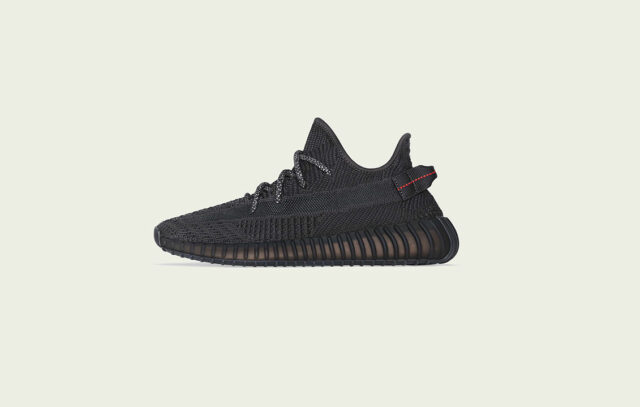
THE YEEZY Boost 350 V2

LONDON — Adidas will sell more of its stock of Yeezy products in August, it said on Friday, and reiterated a pledge to donate part of the proceeds to groups fighting discrimination, without saying how much it would give.

Adidas stopped selling Yeezy shoes and abandoned its collaboration with their designer, rapper Ye, late last year after the artist, formerly known as Kanye West, went on a string of antisemitic rants in interviews and on social media.

But as its large Yeezy inventory weighed on the business, Adidas began selling the highly profitable shoes again at the end of May, and their enduring popularity despite Ye’s fall from grace helped to narrow the company’s projected loss for the year.

“As previously communicated, Adidas will donate a significant amount to selected organizations working to combat discrimination and hate, including racism and antisemitism,” Adidas said in a statement.

Adidas added the Foundation to Combat Antisemitism (FCAS) to the list of charities it pledged support to, having already announced it would donate to the Anti-Defamation League (ADL) and the Philonise & Keeta Floyd Institute for Social Change.

Some Yeezy shoes sold directly by Adidas in North America will come with a square blue pin, the symbol of the Stand Up To Jewish Hate campaign run by FCAS.

While the antisemitic rants cost Ye his talent agent and partnerships with Gap and Balenciaga as well as Adidas, the Yeezy shoes remain in demand and sell at high premiums on resale sites.

Adidas said the August drop will include some of the most popular designs, including the Yeezy Boost 350 V2, 500, and 700, as well as the Yeezy Slide and Foam Runner.

Adidas has sold 100 million euros of its Yeezy stock so far, according to Deutsche Bank analysts, who said the risk of a write-down of the inventory was now “remote.”

Fascinating Viet Nam

JB-UNSPLASH

Visit Viet Nam or Japan? This was the question I faced weeks ago.

Viet Nam was about work. I was invited to attend the Vietnam Economist Annual Meeting (VEAM) and present studies on health taxes in the Philippines.

Japan was about leisure and the company of family, including my 93-year-old mom.  But much as I love bonding with mom and family on a foreign trip, I chose work. I could forgo a week without being with my mom since anyhow I would be seeing her in frequent family get-togethers in the coming months. More, I wouldn’t like to miss the rare opportunity of meeting the Vietnamese economists. I wished to listen to the Vietnamese themselves to explain their country’s spectacular economic performance.

Since embarking on a strategy that transformed its command economy to a “socialist market economy” in 1986, Viet Nam has made spectacular progress in achieving high economic growth and achieving social development.  Since 1986, the strategy of doi moi (“rejuvenation” or “renovation”) has sustained an average annual growth rate of over 6%.

And the poverty rate, defined as the proportion of the population living below the national poverty line, was brought down from over 50% in the 1980s to 4.4% in 2021. In 2022, the proportion of the employed population in Viet Nam living below the international poverty line, or those living in extreme poverty, was 1.2%.

The year 1986 was also historic for the Philippines. Viet Nam had its doi moi; the Philippines had the people-power revolution that toppled the Marcos dictatorship.  Alas, what some called the restoration of “elite democracy” was characterized by anemic growth and persistent poverty for almost 25 years. It was only in 2012 onwards — to be interrupted by a deep recession arising from COVID-19 — that the Philippines managed to sustain an average growth rate of above 6%.

In short, doi moi Viet Nam has outclassed “people-power” Philippines in growth and development performance.

To see is to believe. And thus, the invitation from VEAM was providential.

I do not tire of visiting Viet Nam.

My visits to Hanoi, Da Nang, and Hué were pleasant and enjoyable despite the intense summer heat. The streets, whether boulevards or narrow lanes, are dotted with roadside trees.

Even the presence of too many motorcycles, which can be annoying, is tolerable. An odd combination of formal and informal rules makes traffic navigation work. But what a surprise to see that some taxis are electric cars. Perhaps, an appropriate symbol of Viet Nam’s transformation is the manufacture of its own electric vehicles, branded Vinfast.

The tourist destinations are as attractive as those in the Philippines. To be sure, Philippine beaches stand out, but Viet Nam has its share of world-famous beaches. It is tempting though debatable to compare the beaches of the city of Da Nang to those in Rio de Janeiro. Rio wins because of the Brazilian sensuality and sexiness. But what the Philippines does not have much of but that Viet Nam is mightily proud of are the reminders of old civilizations, ancient towns, and imperial cities.

Further, Viet food is fragrant and aromatic. The fruits are as sweet and refreshing as those found in the Philippines, except that our mangga — those from Zambales and Guimaras — are far superior to the Viet mangoes.

But this time, my visit was not mainly about tourism. It was about meeting people and learning from them.

The Vietnamese, like Filipinos, always smile. And they are easy-going and casual. For the meeting of economists, I thought it was customary to wear a coat and formal leather shoes. I was overdressed. The attire of an elder economist, the organizer and host of the meeting, was informal. He, too, wore a pair of sandals.

Some of the Vietnamese economists I met have an affinity with the Philippines. A young associate professor told me that he and other Vietnamese colleagues — there were 10 of them — had studied at the University of the Philippines Los Baños College of Economics and Management, circa 2005. Another Viet economist, now a professor in a US university, said that he was once a volunteer helping the Vietnamese refugees who temporarily stayed in Palawan.

The annual meeting of the Vietnamese economists was a unique learning experience. The topics, presentations, and discussions were of high quality. The agenda covered economic theory, green economy and climate change, health economics and health taxes, employment, migration, human capital, global value chain, institutions, behavioral economics, pandemic response, etc.

Most notable was the participation of many young people. In fact, they constituted the majority. And many of them submitted papers that competed for best paper awards.

Vietnamese economists have been schooled in many parts of the world. The language of the conference was English, and there was a special and amusing reason behind it. Other than the attempt to master the global language of science, the annual conference deliberately uses English as medium to avoid surveillance and censorship of local authorities. Yes, Viet Nam is authoritarian despite doi moi.

The economics profession in Viet Nam has contributed significantly to the country’s rapid progress. For example, an independent Viet Nam Initiative for Energy Transition has been established “to accelerate the transition of Vietnamese energy system in a sustainable and reliable manner.” The Development and Policies Research Center (DEPOCEN), an economic consultancy group, has published peer-reviewed economic papers which serve as inputs to Vietnamese policymaking.

I asked Le Thi Thu, a senior policy adviser for the global Campaign for Tobacco Free Kids, what in gist can explain Viet Nam’s economic success. Her response was pithy: rich resources that Viet Nam has parlayed through greater value-adding, cheap labor aided by cheap prices, and a sound policy environment. Of course, a sound policy environment requires sophistication and contextualization.

The Vietnamese economists are also good at telling narratives. Cuong Le Van, the senior research fellow at DEPOCEN, has an unusual but funny metaphor to describe Viet Nam’s economic strategy. He says that Viet Nam’s three economic pillars can be compared to a father having three children — the legitimate biological son, the illegitimate son from a mistress, and an adopted child. The biological son, pampered for so long, symbolizes the state-owned enterprises. The illegitimate son, who is now the favorite, represents foreign direct investments (FDI). And the adopted son is the domestic private sector.  The “apple of [Viet Nam’s] eye” is FDI, the primary source of its rapid growth and technological innovation.

And this is the lesson I can take back home:  how the Philippine policymaker can become more loving to the figurative mistress and illegitimate son. That is, how the Philippines can entice investments, not only FDI, which will generate growth and improve the people’s living standards.


Filomeno S. Sta. Ana III coordinates the Action for Economic Reforms.

www.aer.ph

ADVERTISEMENT
ADVERTISEMENT