Home Blog Page 4507

PESONet, InstaPay transactions rise as of June

STOCK PHOTO | Image by David Dvořáček from Unsplash

FUND TRANSFERS coursed through the PESONet and InstaPay continued to surge at end-June as more Filipinos use digital payment platforms, data from the Bangko Sentral ng Pilipinas (BSP) showed.

The total value of transactions coursed through the BSP’s automated clearing houses InstaPay and PESONet climbed by 30.6% to P5.93 trillion as of June from P4.54 trillion in the same period in 2022.

In terms of volume, transactions done through the clearing houses stood at 398 million, 35.3% higher than the 294 million in the comparable year-ago period. 

Rizal Commercial Banking Corp. Chief Economist Michael L. Ricafort said the increase in the value and volume of transactions done via InstaPay and PESONet is about 4-5 times faster than the country’s economic growth of 6.4% in the first quarter. 

“There is still a strong adoption of digital fund transfers by the banking public, as this may also reflect the continued faster growth as well in online transactions,” Mr. Ricafort said, adding that consumers find digital transactions more convenient as fund transfers can be done anywhere with an internet connection.

The value of PESONet transactions rose by 24.4% to P3.66 trillion in the first half of the year from P2.94 trillion a year prior, BSP data showed.

The volume of PESONet transactions went up by 10.1% to 44.89 million in the January-to-June period from 40.76 million in the same period in 2022.

Meanwhile, the value of transactions done through InstaPay soared by 41.2% year on year to P2.26 trillion in the first six months from P1.6 trillion in the comparable year-ago period.

The volume of InstaPay transactions likewise increased by 39.3% to 352.9 million as of end-June from 253.2 million a year earlier.

PESONet and InstaPay are automated clearing houses launched under the BSP’s National Retail Payment System (NRPS) that was rolled out in December 2015 to promote a safe, efficient, affordable, inclusive and reliable retail payment system.

Operated by the Philippine Clearing House Corp., PESONet enables high-value transactions and is considered as an electronic alternative to the paper-based check system and recurring payments. 

InstaPay is a real-time, low-value electronic fund transfer facility for transactions up to P50,000 and is handled by BancNet, Inc.

Under its Digital Payments Transformation Roadmap, the BSP aims to digitize 50% of total retail transactions and onboard at least 70% of Filipino adults to the financial system by the end of this year.

The share of digital payments in total retail transactions increased to 42.1% in 2022 from 30.3% in 2021.

The BSP’s NRPS mainly promotes interoperability or enabling consumers to transfer funds from one account to another account in any BSP-​​supervised financial institution.

“By enabling interoperability, sustained adoption of electronic payments is plausible as electronic transactions are made more convenient,” the BSP earlier said.

The ​NRPS likewise facilitates the delivery of a wide range of financial products that cater to the needs of consumers. — Keisha B. Ta-asan

LRT-1 operator aims to finish Cavite line extension by 2027

LIGHT RAIL Manila Corp. (LRMC), the operator of Light Rail Transit Line 1 (LRT-1), is looking at completing the last two sections of the Cavite line extension project by 2027, its top official said.

“I think that that is what we are targeting, [but it has to be] with a lot of work from the Department of Transportation (DoTr),” Juan F. Alfonso, president and chief executive officer of LRMC, told reporters in a chance interview last week.

According to Mr. Alfonso, LRMC has an agreement with the government for the complete turnover of the right of way for the remaining segments of the project before the company starts its construction activities.

“We are waiting to hear from the DoTr because it is supposed to be turned over to us. Our agreement is when they turn it over to us, it is free and clear,” he said.

He added that a timeline has not been set for the turnover of the complete right of way for the remaining segments of the project.

However, a company representative said that the 2027 completion target will largely depend on the right-of-way acquisition.

“For the year for phases 2 and 3, it will depend on when we will receive the right-of-way acquisition completely, then count three to four years from there for us to complete the works,” a representative of the company said in a Viber message.

As of last week, Mr. Alfonso said that the government had not yet turned over any right of way to the LRT-1 operator for the second and third phases of the project.

However, he said that the first segment of the project, which constitutes the first five stations of the LRT-1 Cavite extension project, is on track to be completed by the fourth quarter of next year.

Data from the company showed that the first phase of the project is at an 88% completion rate, with the five stations more than 50% complete.

The first segment covers the MIA Station, Ninoy Aquino Station, Redemptorist Station, Asia World Station, and Dr. Santos Station, while the remaining segments will cover the construction of the Las Piñas, Zapote and Niog stations.

Last week, the company started running its first fourth-generation train set which is also expected to serve not only the main line of LRT-1 but also the Cavite extension. 

LRMC is the joint venture of Ayala Corp., Metro Pacific Light Rail Corp., and Macquarie Infrastructure Holdings (Philippines) Pte. Ltd. Metro Pacific Light Rail is a unit of Metro Pacific Investments Corp., which is one of three Philippine subsidiaries of Hong Kong’s First Pacific Co. Ltd., the others being PLDT Inc. and Philex Mining Corp.

Hastings Holdings, Inc., a unit of PLDT Beneficial Trust Fund subsidiary MediaQuest Holdings, Inc., maintains interest in BusinessWorld through the Philippine Star Group, which it controls. — Justine Irish D. Tabile

Seaoil opens 750th station; 100 more expected by yearend

The 750th Seaoil station is located in Valle Verde 1, Pasig City. — PHOTO FROM SEAOIL

INDEPENDENT FUEL COMPANY Seaoil recently opened its 750th station. The facility, located at C5 corner Atis Ugong in Valle Verde 1, Pasig City, is expected to be joined by “100 more stations” before the end of year — bringing Seaoil’s network to 850 stations.

Apart from expanding its retail network, Seaoil is also growing its car maintenance service arm, LubeServ. Three new sites were opened in Zabarte, Caloocan; Bancal, Carmona; and Telabastagan, Pampanga. At least seven more are expected to be operational in Luzon this year.

Meanwhile, with the launch of the second run of its “Alagang Seaoil” campaign, the company is looking to improve its products and services — offering better convenience and value for money. “This also includes making Seaoil’s quality products and exclusive offers accessible to more Filipino motorists nationwide through retail expansion,” it said in a release.

Last year, the company revamped its loyalty program, Seaoil VIP, as a mobile application so customers can easily access exclusive promotions and offers. More points can be earned from Seaoil VIP, which customers can convert to cash. The new loyalty program has three versions to cater to different segments: VIP Rides for TNVS riders, VIP Biz for business accounts, and VIP for regular motorists.

PriceLocq, which was introduced in 2020 as a fuel-hedging app, has expanded its features to accommodate other mobility services. Now available in over 350 Seaoil stations nationwide, PriceLocq launched its own payment feature called LocqPay wallet, which allows customers to enjoy regular discounts and earn Seaoil VIP points with every transaction. Users can also now top-up their RFID load for their AutoSweep or EasyTrip accounts, and book car care services through LubeServ or LubeServ on Wheels through PriceLocq.

Seaoil now also offers Seagas, an LPG product line that is the company’s first foray into the LPG market as it “marks its shift toward providing cleaner fuel to its consumers.” An initial 11-kg cylinder product is being sold at 14 stations around Metro Manila.

“Tugon sa Gutom” addresses food insecurity issues in communities through the establishment of family farms. Since its launch in 2020, the program has helped 1,328 families nationwide and will be rolled out to communities in Batangas, Cebu, and Zamboanga by the end of 2023.

Through the “Alagang Seaoil 2.0” campaign, still promoted by award-winning actress, entrepreneur, and philanthropist Anne Curtis, the firm reiterates its commitment to treat customers from all walks of life with equal care when they gas up. “We’re proud of the work we’ve done in fueling Filipinos to a brighter tomorrow. We’re not yet done and our customers can look forward to more initiatives in the years to come. We will continue to deliver Alagang Seaoil through our CSR efforts and continuous innovations in our products and services that bring value to Filipinos’ day-to-day living,” said Seaoil CEO Glenn Yu.

400 tenants set to open stores in Davao’s NCCC-Ma-a

HOMEGROWN retail chain New City Commercial Corp. (NCCC) Mall Ma-a promises a good mix of local and international brands and targets 400 tenants by the end of 2024.

The mall’s construction, which started in 2021, is currently at 50%, and is in full swing since the construction’s resumption post-pandemic. With a total lot area of 28,200.64 square meters, it is set to top off in the first quarter of 2024. Dubbed Davao’s homegrown mall, its design is inspired by the Philippine Eagle and will have an earthy color palette resembling the natural hues and appearance of the bird.

“The construction team has worked diligently to ensure that we remain on schedule, and we are excited to bring this exceptional shopping destination to the community. The progress so far has instilled confidence that NCCC Mall Ma-a will soon stand as a landmark in the cityscape with its swift execution and efficiency demonstrate the dedication and expertise of the project team,” said Rodolfo Saturos, NCCC Malls Assistant Vice President for Operations in a statement.

In addition to anchor stores such as NCCC Supermarket, a department store, Hardwaremaxx, HB1 and NCCC Cinemas, the mall will see tenants dealing in fashion and jewelry, footwear and leather goods, sporting goods, health and beauty, appliances, home furnishings, and other services. The mall will have different sections including one devoted to Davao-based brands, a fashion center, a food section, and a “gizmo center”. The mall will have a rooftop terrace with panoramic views of the Davao skyline, a landscaped park called The Nook, as well as a food hall called The Nest.

A mix of local and national brands have shown interest to open in NCCC Mall Ma-a including Guess, Penshoppe, Hukad, and New Davao Famous Restaurant.

“The mall aims to curate a diverse tenant mix, featuring a blend of beloved local establishments and prominent brands. This combination of shopping, dining, and services, along with NCCC anchor brands, will create a vibrant and dynamic retail environment,” said Suelita Longakit, Leasing Manager for NCCC Malls. She added that the variety presents an exciting opportunity for businesses to be a part of the mall’s ecosystem.

Visit NCCC Mall Ma-a’s Facebook page (facebook.com/OfficialNCCCMalls) for more information about leasable space. — Maya M. Padillo

Trusting technology

JOHN SCHNOBRICH-UNSPLASH

When was fire discovered?

“The earliest creatures that predated human beings were probably well aware of fire. When lightning would strike a forest and create a fire, it probably intrigued and amazed them. Today, many scientists believe that the controlled use of fire was likely first achieved by an ancient human ancestor known as Homo erectus during the Early Stone Age. Archeologists have uncovered evidence of what they believe to be the controlled use of fire in Wonderwerk Cave in South Africa, as well as the Lake Turkana region of Kenya.”

That was from Google-search, which opened on https://wonderopolis.org. Wonderopolis, the website created by the US National Center for Families Learning (NCFL) in 2010, and is one of the most popular education sites today.

Up to about 30 years ago, the Encyclopedia Britannica would have been the go-to for young students, researchers and curious or passionate learners, and others who wanted to know factual expositions on various subjects to historical timelines, background, and events of history, among other topics of interest and investigation. At the height of its popular use, Britannica had 32 hardbound volumes and 32,640 pages.

But in the 21st century, Britannica suffered due to competition with the free online crowdsourced encyclopedia Wikipedia, which was established in 2001. The 2010 version was the last printed edition. Since 2016, it has been published exclusively as an online encyclopedia. Technology has converted many physical and mental activities to digital, operable on the internet.

Jan. 1, 1983 is considered the official birthday of the Internet. It was the Soviet Union’s launch of the Sputnik satellite that challenged the US Defense department to consider ways information could still be disseminated even after a nuclear attack. The formation of the ARPANET or Advanced Research Projects Agency Network ultimately evolved into what we now know as the internet. Prior to this, the various computer networks did not have a standard way to communicate with each other. A new communications protocol, established called Transfer Control Protocol/Internetwork Protocol or TCP/IP, allowed different kinds of computers on different networks to “talk” to each other, according to the University System of Georgia, usg.edu.

Consequently, the number of websites grew from 130 in 1993 to over 100,000 at the start of 1996. By 1995, the internet and the World Wide Web were established phenomena: Netscape Navigator, which was the most popular browser at the time, had around 10 million global users. Note: The internet is the networking infrastructure that connects devices together, while the World Wide Web is a way of accessing information through the medium of the internet, according to scienceandmediamuseum.org.uk, Dec. 3, 2020.

In 2023, there are 5.18 billion internet users in the world. The total number of internet users around the world grew by 147 million during the past 12 months. Globally, internet user numbers are growing at an annual rate of 2.9%, but year-on-year growth is much higher in many developing economies, says datareportal.com. In the Philippines, there were 73 million internet users, 64.1% of the 113.88 million population as of 2021, according to Wikipedia.

At the KPMG-sponsored conference on July 20 on Digital Transformation, “Innovating Ideas to Execution,” the objective was to showcase digitization efforts and accomplishments of the local government units and startup digital technology businesses focusing on small and medium-sized enterprises. City Administrator Mike Alimurung reported on the various Quezon City government’s former manual processes that were converted to digital, through the Biz Easy Online Unified Business Permit Application System (OUBPAS), an online processing system of business permits applications, which was ordered for the creation of the Task Force for Ease of Doing Business and Automation in the city. Citizens who have already registered for a QCitizen ID Card can expect an expedited processing system for the city’s services and privileges through the digital conversion of the IDs into a unified database. Quezon City was recognized by the Department of Information and Communications Technology, the Department of the Interior and Local Government, and the National ICT Confederation of the Philippines for its best practices in utilizing information and communications technology in delivering services to the people during the Digital Governance Awards for 2022 at the National Museum on March 30.

Three small, startup digital tech businesses presented their strategic plans and operating processes towards transforming small businesses like sari-sari stores and other small retailers to digitize their own operations. Packworks, Peddlr and Prosperna, all started by computer-savvy young men during the lethargy of the three-year COVID pandemic, sold low-priced software for sales, accounting and inventory control of erstwhile technology-challenged small entrepreneurs who were then indoctrinated into digitization and guided in simple computerized processes. Peddlr, which is based in Samar, was chosen to attend the digitization summit in Portugal in November. Prosperna packaged a fintech option with the software subscription, by which a client-user would be able to borrow some money short-term from the float of the community pool of funds at a rate near the lending rate of credit cards.

There was no Q&A at the KPMG conference, but a few questions were asked among participants/guests at the lunch tables. Question #1: Is the government ready and able for this burst of energy and interest in digitization of data and processes? It was pointed out that many government websites are not updated, with data and statistics lagging by at least two years. Can the government offices at least provide working contact numbers for land calls, since e-mail and website contacts are more often not replied to. There still have to be the physical, face-to-face visits to the government, in the ubiquitous bureaucratic waiting-in-queue for your turn to be served. And then, the paperwork and documentation will not go away — for the protection of the citizen. One person at the lunch table told of how some electronic payments for her quarterly income taxes were not in the database.

The second question raised was: Is the ordinary, lower/lowest class citizen ready for the sophistication of advanced technology? Okay, jeepney driver Juan has a cell phone loaded with pre-paid Wi-Fi, which he uses for Facebook and games, sometimes for noonday TV entertainment. But can he understand and do online access to city services like registrations, permits, statistical data, and inquiries? At the Land Transportation Office (LTO), Juan had to renew his professional driver’s license. No more manually-written renewal applications are allowed. All license applications and renewals had to be inputted onto an electronic application on the computer and sent directly to the LTO computer. Poor Juan, who was physically there, had to stand behind an LTO staff who sat before a computer, typing out Juan’s verbal inputs into the electronic form and sending the application electronically to the same LTO!

And the third and most important question asked around the lunch table was: Can we really trust digital technology? What about the data privacy of users? “Hacking, identity theft, trolling, doxxing will become increasingly commonplace and a daily cost of doing business on the internet,” said a Pew Research Center survey and analysis dated Aug. 10, 2017. “One cannot have any faith in secrecy of digital correspondence… because so many of us use technologies that necessitate a third party to have access to metadata and content, as a product of that transaction. Apps that upload address books to servers and e-mail providers that read e-mail have become the norm,” the same survey pointed out. “People sold their personally identifiable information a long time ago with Google, Netflix, Twitter, etc. The genie is out of the bottle for most with regard to the interest of privacy,” one respondent said.

Bernardo A. Huberman, senior fellow at Hewlett Packard, warned: “Unless people learn of a big breach in security at a level that affects them, they will continue to trust blindly the new technology, mostly because of their ignorance of how intrusive it is.” In the report of Pew Research, many agreed that “the inexorable march toward mass adoption of online interactions will proceed…the public will not have the energy, interest or capacity to resist because most aspects of daily life will require compliance. Tech usage and acceptance will simply become normalized — (but) acceptance does not imply trust. Users will be coerced into using online technology more as alternatives are phased out.”

Like fire, when Homo erectus first discovered it, digital technology and its full conflagration in artificial intelligence are fearsome and threatening for their risks — but useful and convenient for a faster and fuller life.

Just Google search or go to Yahoo for further discussion and analysis.


Amelia H. C. Ylagan is a doctor of Business Administration from the University of the Philippines.

ahcylagan@yahoo.com

Globe seeking more reforms for country’s sustained digital shift

GLOBE TELECOM, Inc. is looking forward to the government’s support in the electrification of cell towers and the rationalization of the spectrum user fees (SUF), among others, to sustain the country’s digital efforts.

“With the government and private sector aligned on the path to digital advancement, the Globe Group is counting on the administration to continue regulatory reforms that would enable the country’s sustained transformation,” Globe said in a press release on Friday.

The company said that the timely electrification of information and communications technology (ICT) infrastructure would lead to better connectivity.

“Globe hopes for the government’s support in ensuring the timely electrification of ICT infrastructure, particularly cell towers, so that telcos can provide life-enabling connectivity to more areas in the country,” it said.

It also called for the rationalization of the 26-year-old SUF, which it said currently penalizes greater use of more spectrum-efficient 4G and 5G and other fixed wireless access technology.

“It also disincentivizes network expansion, as fees are charged for every station even for the same frequencies. This hampers the industry’s push for stronger and wider connectivity as demand continues to grow,” it added.

It also sought the amendment of the Intellectual Property Code and the National Building Code to require the mandatory provision of ICT infrastructure in property development.

“At 46 years old, the country’s building code is already antiquated and was crafted at a time when connectivity was not yet considered a basic human need,” it said.

“Globe is also eager to see the passage of amendments to the Intellectual Property Code, also a 26-year-old policy that needs to catch up with the times to allow stronger measures such as site blocking to combat content piracy,” it added.

Meanwhile, Globe has backed the government for supporting the country’s greater digital transformation through the creation of the Private Sector Advisory Council, the issuance of Executive Order No. 32, the SIM (subscriber identity module) Registration Act, and the signing of the memorandum of understanding for the creation of the connectivity index rating.

“We’ve had an accomplished first year. As we move forward as partners in digital transformation, the Globe Group hopes to see more policy reforms that will sustain our progress so that in time, the Philippines will no longer be just catching up. Rather, the Philippines will set the standard,” Globe President and Chief Executive Officer Ernest L. Cu in a statement. — Justine Irish D. Tabile

BPI expects steady demand for loans

The Philippine central bank is set to unwind the relief measure allowing banks to use loans to small businesses and large enterprises as alternative compliance with the reserve requirements. — REUTERS

BANK of the Philippine Islands (BPI) expects steady demand for credit for the rest of the year, even after the slowdown seen in the first half.

“Loan demand has slowed down a bit in the first half, but we expect it to maintain the same pace in the second half,” BPI President and Chief Executive Officer Jose Teodoro K. Limcaoco told reporters on the sidelines of BPI Foundation’s Financial Wellness Fair last week.

BPI saw its loans expand by 10.5% to P1.7 trillion in the first half, driven by the corporate, credit card, and auto portfolios, it reported last week.

Mr. Limcaoco said the bank’s growth in the second half will continue to be driven by “a strong economy [and] accommodative macro fundamentals.”

Meanwhile, Mr. Limcaoco said the Ayala-led bank is not looking to apply for a digital banking license, even as the Bangko Sentral ng Pilipinas (BSP) said it is considering reopening applications next year following a moratorium imposed after it gave permits to six new lenders.

“Particularly for BPI, we’re pushing very hard on the digital front, which means we don’t really need a specific license for digital banking. What the specialized license does is it sends new players into the banking system with less of a physical presence. But I don’t think that’s necessary for existing banks because we already have a presence,” he said.

Big commercial banks, in general, do not need to venture into the digital banking market as they already operate with the advantage of having a physical presence, Mr. Limcaoco said.

“We can do exactly the same thing a digital bank does with our license, so I can see why a new player wants it. But for an existing bank, we don’t need that license to be digital,” he added.

BPI saw its net income rise by 4.5% year on year in the second quarter to P13 billion amid an increase in revenues.

This brought its first-half net income to P25.1 billion, up by 23% year on year.

The Ayala-led bank’s shares rose by 50 centavos or 0.44% to end at P115 apiece on Friday. — A.M.C. Sy

Jetour dealership set to rise in Fairview

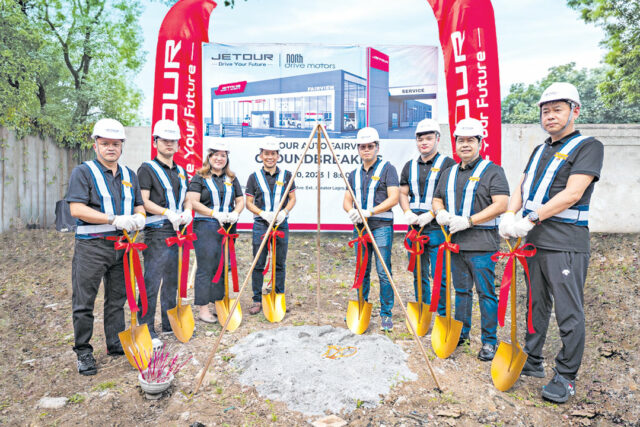
At the ground-breaking ceremony are (from left): Jetour Auto Philippines After-Sales Director Eryx Guiang, Jetour Auto International Country Sales Manager Zhong Zhiqian, Jetour Auto Philippines Marketing Director Cherry May Delos Santos, Jetour Auto Fairview General Manager Alexie Von Chavez, Jetour Auto Fairview Dealer Principal Harold Co, Jetour Auto Philippines President Yves Licup, Jetour Auto Philippines Managing Director Miguelito Jose, and Jetour Auto International After-Sales Director Jia Yuchang. — PHOTO FROM JETOUR AUTO PHILIPPINES

JETOUR AUTO PHILIPPINES, Inc. (JAPI), the exclusive distributor of Jetour vehicles, parts, and services in the country, along with its new dealer-partner North Drive Motors, formally broke ground on a 3S (sales, service, and spare parts) facility in Greater Lagro, Novaliches City.

To be known as Jetour Auto Fairview, the 1,200-sq.m. dealership will rise along Mindanao Avenue Extension, and will be able to display up to five vehicles on its showroom floor. Customers will soon be able to appreciate the design and features of the Jetour X70, the Jetour X70 Plus, the Jetour Dashing, and the Jetour Ice Cream mini electric vehicle in person. They will also be able to schedule test drives of these models and be taken care of by highly skilled sales and after-sales personnel of the dealership once it opens. Jetour Ice Cream EV owners will also have access to the new dealership’s battery charging facilities.

Jetour Auto Fairview will also feature two fully equipped service bays, a dedicated pre-delivery inspection area, and a parts storage area.

North Drive Motors was established in the second half of 2021 by five long-time friends headed by Harold Co. Jetour Auto Fairview has a vision to be a premier car dealer, “driven by strong passion to serve with integrity, honesty, and outstanding customer care.”

“JAPI believes that making the purchase and maintenance of Jetour vehicles easy and hassle-free is key to establishing trust and nurturing peace of mind between our brand and our current and future customers,” said Jetour Auto Philippines Managing Director Miguelito Jose. “The new Jetour Auto Fairview dealership will soon be of service to our customers here in the north of Metro Manila. We believe that more Filipinos should be able to enjoy the freedom and joy that their vehicle purchase affords, and this is why Jetour is making sure we are there not only when the car-buying decision is finalized but also when our clients and their vehicles need attention, support, and service.”

Jetour Auto Fairview is expected to open by early next year.

Style (07/24/23)


Levi’s opens biggest store in the Philippines

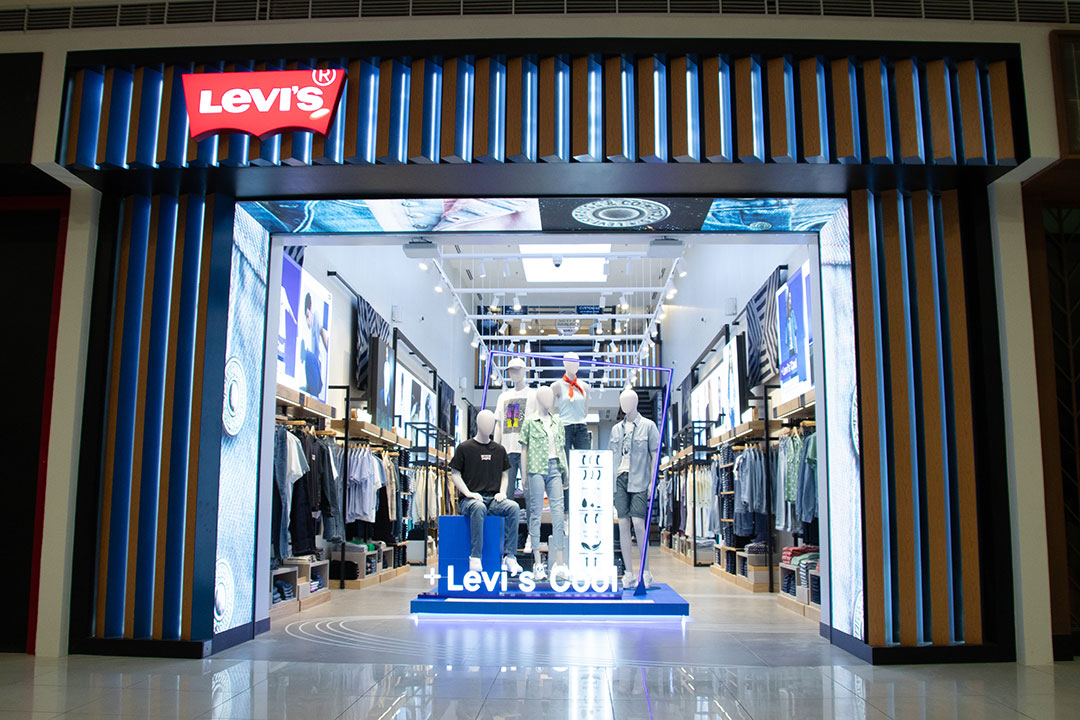
LEVI’S opened its biggest store in the Philippines (in terms of sales floor area) with a new 217 square meter-space in SM North EDSA on July 20.

The store houses one of the few Levi’s Tailor Shops in the country, offering patching, alterations, and customization services. It also includes an expanded line of Levi’s Vintage Clothing, a line designed from the brand’s century-old archives (this collection is present on a smaller scale at its SM Mall of Asia store).

According to Charisse Chua, country manager for Levi’s Philippines, they also plan to open nine new stores within the year. Monthly releases and seasonal launches are to be expected from the brand for the rest of the year.

“It’s a complete assortment…It’s not just jeans for us,” she said, pointing out non-denim items such as T-shirts and knitted vests. “That’s our intention: to be a real lifestyle brand.”

Visit the store at the second floor of SM North EDSA’s main mall.


Longchamp collaborates with Toiletpaper

FRENCH biannual publication Toiletpaper collaborated with French leather goods brand Longchamp for a brash new collection.

The collection was launched in the Philippines on July 20 at Rustan’s Shangri-La, following a July 12 launch in London.

The collection consists of bags and pouches printed with images from Toiletpaper co-founders Maurizio Cattelan and Pierpaolo Ferrari. These images include a skull crossed with two baguettes, a banana being licked, a fist wearing brass knuckles spelling out the word “love,” a leaping horse on a background of clouds, and a dog with a pipe (an homage to Longchamp’s origins as a pipe shop).

Longchamp Creative Director Sophie Delafontaine (and descendant of Longchamp founder Jean Cassegrain) was amused to receive the leather-wrapped pipes she had lent from their archives, once belonging to her grandfather, covered in the dog’s bite marks. “The dog was smoking,” joked Mr. Cattelan (a statement emphasizes that no animals were harmed during filming) as an apology. “Now, they are works of art,” said Ms. Delafontaine.

These were photographed over the course of a few days in the Toiletpaper studio in Milan in March 2023; each vibrant, hyperreal image meticulously composed to a surreal and humorous effect.

“Me and Maurizio like to be on set, because we have the most fun taking real photographs. We use post-production every now and again, but mostly what you see is what we shoot,” explains Mr. Ferrari in a statement.

The capsule comprises five original designs in a palette of candy pink, sky blue, and sunshine yellow, with the images reproduced on recycled polyester canvas, as well as a series of cowhide leather keychains.

In the Philippines, Longchamp is exclusively available at Rustan’s Makati, Rustan’s Shangri-La, Rustan’s Cebu, Greenbelt 5 and Rustans.com.


Fendi introduces C’mon

FENDI introduces the C’mon, a satchel bag expressing the Maison’s leather craftsmanship, inspired from the pure lines of the Fendi Women’s Autumn/Winter 2023-24 Collection.

The minimal silhouette of the Fendi C’mon hides a meticulous assembling process of 20 different components that make the bag, carried out by Fendi leather artisans in a masterpiece of craftsmanship.

The impeccable proportions create a round and soft outline with feminine curves, complemented and contrasted by slight angles and a similarly smooth-edged FF logo in vintage golden metal placed on the magnetic flap closure.

Available in three sizes, each one differs from the other through small but distinguishing traits. The construction of the Medium Fendi C’mon sees a flap crafted from smooth leather with a refined shiny finish and is slightly longer than the body of the bag, while the sides are in grained leather.

The Small, gracefully petite, is fully crafted from the same semi-shiny calfskin and just like the Medium features embossed leather details and a versatile back pocket.

The tiny Nano version has a loop on the back, so the Nano Fendi C’mon becomes a functional belt bag. It transitions from day to night and shows versatility with the adjustable and removable leather strap and can be worn as a functional cross-body or shoulder bag. The metal loops holding the strap, reminding of a piercing shape hinting at the punk attitude of the collection turn into a detail of round studs when the bag opens.

Colorways include a classic neutral beige to white and black leather versions, ciclamino fuchsia and iconic FF jacquard styles. Completing the offer, a luxurious croco flap gets a glossy look on sophisticated black and warm brandy hues, perfectly showcasing Fendi’s mastery in materials.

The C’mon is available starting this month in Fendi boutiques worldwide and on fendi.com.

Philippines: 47 years in lower middle-income country limbo

WIRESTOCK-FREEPIK

Since 1976, or for 47 years, the Philippines has languished in the category of a lower middle-income country.  But a breakthrough is possible next year.

The country has never been closer to attaining upper middle-income country status. Its income growth, fertility decline and lower population growth in the last half-decade can bring about the status as early as 2024.

Every July 1, the World Bank (WB) announces the classification of countries by income based on gross national income (GNI) divided by the population based on the latest census or civil registration systems. It is a classification that has been in place since 1987 and is meant to be a tool for the country’s public policymaking and private sector assessments. The Philippines has been classified a lower middle-income country since 1987, according to World Bank data.

But the Asian Development Bank (ADB) in an economic paper in 2012 retrospectively established that the Philippines had been a lower middle-income country since 1976. The ADB study proposed that countries with a lower middle-income status beyond 28 years could be considered in a “middle income trap.”

UNREACHABLE GOAL?
Since 2018, the Philippines has been aspiring to attain upper middle-income status as the country’s GNI per capita approached the World Bank threshold for the category. The Philippines even started recruiting countries into an upper middle-income bloc in the United Nations.

Over a year ago, former National Economic and Development Authority (NEDA) Director-General Dante Canlas said it would take the country at least a decade to reach upper middle-income status. Specifically, it would require 7% growth sustained for a decade to double gross domestic product (GDP) per capita and attain upper middle-income status.

The latest Philippine GNI per capita announced by the World Bank was $3,950 for 2022. Next year, the threshold for upper middle-income status will go up by $515 to $4,465. The highest increase this century in GNI per capita has not gone higher than $400.

Economic managers singularly focus on GNI annual growth and take the population denominator for granted since demographic changes take time. Economic interventions are regularly budgeted in annual and multi-year economic planning in pursuit of higher GNI or GDP, while social programs that affect population growth and development must live with budget “leftovers,” from “limited fiscal space,” that education, health, population, and social services have to divide. Existing social programs usually get budget increases that just cover inflation year on year.

DEMOGRAPHIC TRANSITION
The 2012 Reproductive Health (RH) law presaged a fertility decline in the country (see my June 5 column “Population Policy at a Crossroads” in BusinessWorld).  The decline in fertility accelerated further in 2016 when the law’s full implementation was made part of the Philippine Development Plan and an executive order in early 2017 called for zero unmet need for family planning.

The country’s fertility shift was confirmed in the 2020 census of population and housing, which showed a low population growth pattern compared with the 2015 census. The following year (February 2021), the Civil Registration System showed that the total fertility rate dropped to 1.8 in 2020. Similarly, the 2022 national demographic health survey put the rate at 1.9 children per woman.

The above should have been factored in the economic indicators, which are all pegged to population numbers. Simply put, a lower population growth rate leads to a lower population number than previously projected, which is used in per capita calculations. By using updated and this time lower population data, economic indicators improve year on year, such as the GNI per capita.

By using the 2020 population census (109.035 million) and adding crude natural increase in population for 2021 and 2022, the Philippine population would have been estimated at 110 million in 2022.

The country’s GNI in dollars was $457.02 billion in 2022 and if this is divided by 110 million Filipinos, the result is $4,154 per capita, just $101 short of the World Bank threshold of $4,255 for upper middle-income status. The gap from this status for the country even with a higher threshold of $4,465 would be $311, which the country could easily achieve in 2023.

Why WB came up with $3,950 GNI per capita
Because the government failed to inform the World Bank of the changing demographics and rapid fertility decline in the country in the past six years, the multilateral lender used outdated and inflated population projections from the 2010 census, which still showed high fertility.

Thus, the World Bank used a population count of 115.559 million. This was 6% higher than the census of 2020 and less than 5% higher than the actual population in 2022.

The World Bank uses population data derived from the World Population Prospects 2022, published by the United Nations, and supposedly updated by country censuses or civil registration systems. This publication predicted that the Philippines would be one of eight countries that would contribute to 50% of the world population growth by 2050, again based on projections from 2010.

Apparently, the UN had not been informed of the recent census and civil registration, in time for the publication. It is still possible for the country to update the population data, as Moldova did in 2021 when it completed its census.

Once the country reaches upper middle-income status, probably in 2024, one might ask how many more years to get to the next, high-income stage? ADB has estimated it takes an average of 14 years to move out of upper middle-income status, which would take us to the end of the next decade and to Ambisyon 2040 territory.

ECONOMIC PERFORMANCE
Economic growth alone and population dynamics may get us to a higher classification and a better credit standing in the world of nations, but certain indicators in human development in the country would not be consistent with an improved economic classification:

• Stunting prevalence among children under five years is almost 29%

Maternal mortality ratio was 189 per 100,000 births in 2021 (more than double the Sustainable Development Goal target of 90)

• Out-of-pocket share of households in current health expenditure is increasing.  In 2021, the out-of-pocket share of households was 44%

• Tuberculosis (TB) incidence is increasing. It was 650 per 100,000 in 2021

• Regional mandated minimum wage nationwide falls below the poverty threshold of P20,000 in the National Capital Region (March 2023) and P15,000 outside NCR

• The Human Development Index rank of the Philippines in 2022 slipped to 116 from 113

• The Philippines ranked 73rd among the poorest countries of the world based on GDP-PPP (purchasing power parity) this year

• The Philippines is the only one left in the lower middle-income classification among the original ASEAN member states

Even if the country attains upper middle-income status next year, there is still a long march ahead to the next economic level.


Juan “Jeepy Perez” A. Perez III, a doctor, specializes in public health administration, primary healthcare and demographic and population development policy. He has worked with nine Health secretaries and three NEDA secretaries since 1992. He was undersecretary for population and development and executive director of the Commission on Population and Development, until he retired in September 2022.


Angkas expects better business as yearend seasonal demand nears

PHILIPPINE STAR/EDD GUMBAN

DBDOYC, Inc., the company behind the motorcycle ride-hailing application Angkas, is betting on good progress in the second semester amid seasonal demand towards the end of the year.

George Royeca, chief executive officer and co-founder of Angkas, described the “Ber” months as good for retail businesses “as a lot of people are out.”

“Our [demand] seasonality is always good in the ‘Ber’ months so we are expecting good progress,” he said in a chance interview, referring to the last four months of the year.

The positive outlook comes as the company’s performance in the first half came out “good,” Mr. Royeca said, adding that “all of the retail outlets are up now.”

However, the wet season brings risks as fewer people book motorcycle rides when it is raining, he said.

Meanwhile, Mr. Royeca said the company is optimistic about using artificial intelligence (AI), especially in the transport segment.

“I think it helps us a lot. AI allows us to be able to do many more things,” he said, citing repetitive tasks, analysis and keeping big data. “Now we are able to analyze bigger sets of data faster and quicker and I think it’s all to machine learning and artificial intelligence.”

“It is still the beginning and there’s a lot of positive outcomes and results that we can expect from that. But we also have to be careful and take caution on how this is used. But at the very least for us we are very optimistic about AI,” he added.

Motorcycles-for-hire services are operating under a four-year pilot study as Republic Act (RA) No. 4136, or the Land Transportation and Traffic Code, prohibits the use of two-wheeled vehicles for public transport.

At present, the government has limited the operation of motorcycle taxis to three companies: Angkas, Joyride, and Move It.

The proposed motorcycles-for-hire law, which will amend RA 4136, is pending at the committee levels in both the Senate and the House of Representatives. — Justine Irish D. Tabile

Yields on government debt end lower

YIELDS on government securities (GS) mostly fell last week amid a lack of catalysts, with the result of a bond auction affecting rate movements, analysts said.

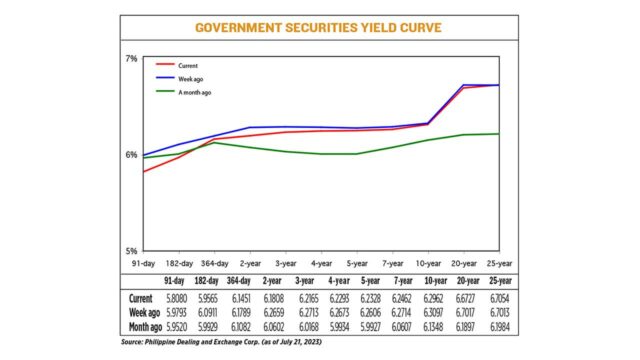
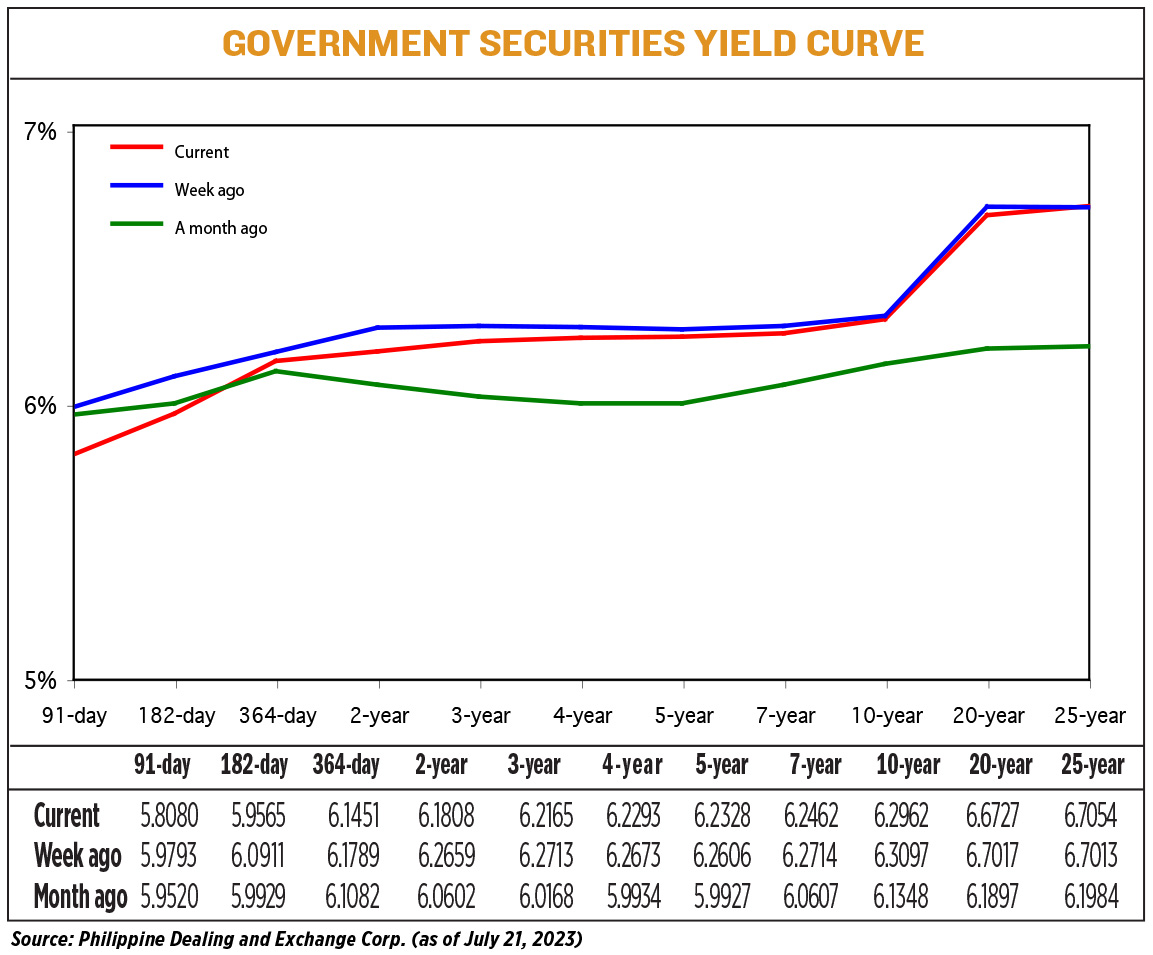
Bond yields, which move opposite to prices, declined by an average of 5.54 basis points (bps) week on week, based on PHP Bloomberg Valuation Service Reference Rates as of July 21 posted on the Philippine Dealing System’s website.

At the short end of the curve, the 91-, 182- and 364-day Treasury bills fell by 17.13 bps, 13.46 bps and 3.38 bps to 5.808%, 5.9565%, and 6.1451%, respectively.

The belly of the curve likewise declined as yields on the two-, three-, four-, five- and seven-year Treasury bonds (T-bonds) went down by 8.51 bps (to 6.1808%), 5.48 bps (6.2165%), 3.8 bps (6.2293%), 2.78 bps (6.2328%) and 2.52 bps (6.2462%), respectively.

Meanwhile, the long end of the curve ended mixed, with rates of the 10- and 20-year debt papers decreasing by 1.35 bps (to 6.2962%) and 2.9 bps (6.6727%), while the 25-year debt paper saw its yield inch up by 0.41 bp to 6.7054%.

Traded volume fell to P7.43 billion last week from P44.96 billion a week prior.

GS rates ended mostly lower amid a lack of fresh leads, a bond trader said in a Viber message.

“Yields were lower because the market is now focusing more on the domestic fundamentals,” the trader added. “The bounce of yields in the latter part of the week resulted to lower trading volume as less players are inclined to sell.”

Meanwhile, last week’s auction of reissued seven-year T-bonds also affected GS yields, Jose Miguel B. Liboro, head of local markets at ATRAM Trust Corp., said in an e-mail.

“The key driver for short-term market movements recently has been the action in global bond yields. A drop in yields after the six-year auction provided a lift in buying sentiment and drove a shallow rally in the local bond market. Global bond yields have since retraced the move but buying sentiment remained broadly positive for local bonds towards the end of the week,” Mr. Liboro added.

Last week, the government fully awarded the reissued seven-year T-bonds it auctioned off amid strong demand for the offer.

The Bureau of the Treasury (BTr) raised P30 billion as planned from the reissued seven-year bonds, with total bids reaching P57.788 billion.

The bonds, which have a remaining life of six years and two months, were awarded at an average rate of 6.299%, with accepted yields ranging from 6.2% to 6.348%.

For this week, the result of the BTr’s auction of fresh seven-year T-bonds on Tuesday could drive GS yield movements, Mr. Liboro said.

“As a new issuance, we could see a slight concession on the awarded coupon which could tilt towards the higher end of the indicative 6.25%-6.5% range that it potentially prices within. We see value particularly if it prices at least at 6.375% (or higher),” he said.

The US Federal Reserve’s policy meeting on July 25-26 could also affect rates, Mr. Liboro added.

“Consensus expectation is for the Fed to hike by 25 bps at their policy meeting — but this is unlikely to move the market unless their guidance is hawkish,” he said.

“We expect global bond yield action to drive short-term onshore movements but remain broadly positive on the prospects for Philippine bonds,” he added. — A.M.P. Yraola