Home Blog Page 4439

Winter is coming to Gucci GB4

GUCCI’s new boutique opened just in time to accept the brand’s Fall/Winter 2023 collection which arrives in September.

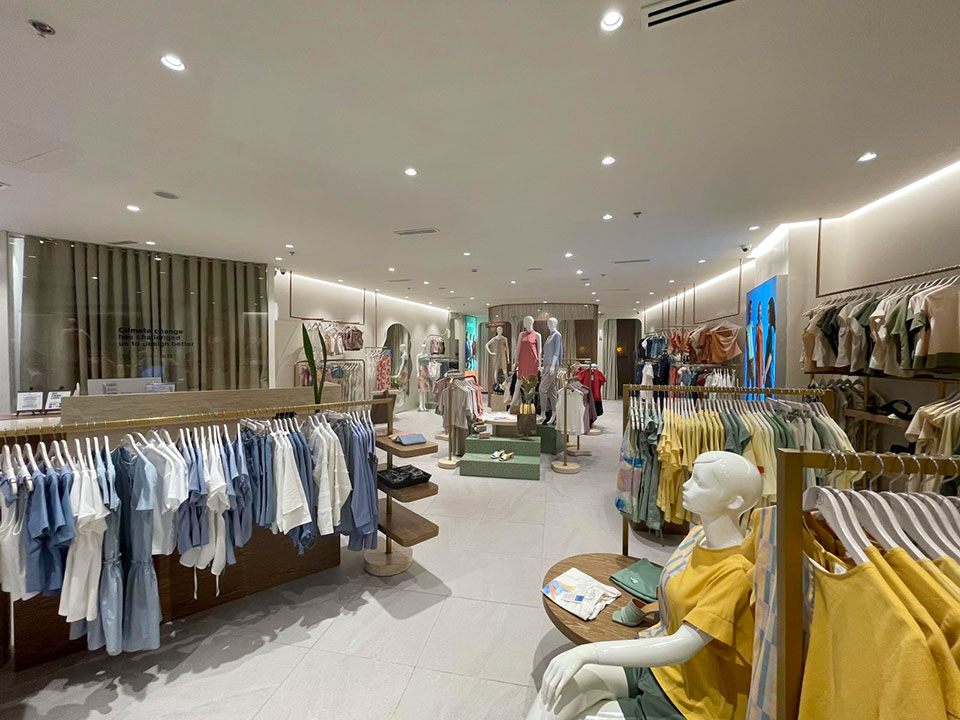
The space — which opened this month in Greenbelt 4 (GB4) in Makati — spans over 7,475 square feet and carries a wide selection of ready-to-wear, handbags, travel bags, shoes, belts, silks, eyewear, small leather goods, jewelry and watches.

The store is faced in marble, and an LED screen video wall, presenting Gucci’s latest campaigns, adds dynamism to the exteriors. Hand-painted wood flooring features decorative motifs that reference details from the House’s collections while fabrics in lighter tones adorn the walls. The store is framed with built-in displays reminiscent of walk-in closets while newly designed racks inspired by classic brass designs accommodate diverse product categories. Velvet armchairs and sofas, and shaggy wool monochrome rugs are placed throughout to create intimate corners.

As part of Gucci’s commitment to implement and enhance eco-friendly initiatives and energy-efficient technologies, the new boutique is designed using LED guidelines and principles to monitor and promote energy efficiency.

Meanwhile, the Fall/Winter line which will soon hit stores premiered on the runway in February. This line sees plays in texture through heavy pastel coats and oversized knits featuring brushed mohair and looped yarns. The collection also has androgynous clothing, as evidenced by models clad in baggy gray suits, or trench coats worn with dress shirts and baggy jeans.

As for the bags, there are new takes on the rounded trapezoid chain bag, now adorned with the Gucci horsebit and interpreted in padded, shearling, crystal, and contrast-leather manifestations. Honoring an archival icon, the Jackie bag appears in its original shape but softened in construction and adapted in two-tone colors and GG-embossed leather. — JLG

Lessons from illicit opium and coca cultivation

CORINA ARDELEANU-UNSPLASH

In July, the Philippine Rural Reconstruction Movement (PRRM) organized a forum at its office in Quezon City to discuss how my research findings on illicit opium and coca cultivation in Afghanistan, Myanmar, Colombia, and Bolivia may provide a new lesson or two on rural reconstruction and development.

Since illicit crop cultivation often follows conflicts and crises, the core question is how to rebuild from the ruins of war and rural displacement. Answers may be particularly relevant to many places in rural Philippines, especially in the Muslim south.

The first lesson is about choosing crops or the mix of crops to grow. Peasants affected by conflict and agricultural commercialization will avoid growing regular crops (rice, wheat, cassava, or corn) because the land they hold is not their own or cannot be secured. They live under the constant threat of having to move at a moment’s notice due to fighting and displacement. Therefore, most engage in “guerrilla agriculture” — growing food in abandoned or neglected land and taking risks that harvests may be easily lost or confiscated. Most will not invest in making the land more productive — like building protective trenches, planting hedges, or constructing water systems — because why make the effort that will be wasted anyway?

Under such conditions, the most logical choice is crops that would grow on hillsides, rocky soil, and in dry conditions; that will not easily spoil if not brought to market quickly enough; that are low-mass and low-weight and can be easily transported in a backpack over bad roads or broken bridges; that are of better value than high-value crops such as saffron or avocado; that can easily be processed into intermediate, higher-value and lower-volume products using backyard means; that have relatively stable prices over the short-term; and that have an assurance that it will always be bought, unlike other regular crops. Opium, coca, and cannabis emerge as the most likely crops to grow or mix with other crops. Illicit crop growing forms part of building strategies to survive and have an income.

It is not just about the mix of crops to grow, but also the combination of livelihoods to build that is central to survival. Many households develop a blend of on-farm, off-farm, and non-farm income opportunities — a pattern also prevalent in many places in Mindanao I’ve seen. Some become agricultural workers on other farms or commercial farms while growing on their farm plots or keeping livestock. Others look for new forms of cost reduction — like sharing tools and farm animals, cooperating on water collection, or setting up pools for collective insurance against man-made and natural disasters. Others send their young men to work seasonally in city centers. In rural Philippines, long-term investment is in the education of children and the next generation, who will be expected to bring poverty relief to their elders.

Decisions to balance risk and opportunity, or harms and possibilities, are complex. For example, in the semi-arid regions of southwestern Afghanistan, expert David Mansfield refutes the greed-versus-need assumption that households plant opium because of its much higher prices. He stresses that families decide how much land to allocate to wheat or opium poppy, not because of the prices but based on estimates of water availability. Wheat will be grown if water is expected to be sufficient. But if water is scarce, the land is better allocated to the more drought-resistant opium poppy instead. I wonder how Filipino farmers make crop choices based on the expected frequency and severity of typhoons and storms.

A second lesson is on how illicit crops enable poor households to access life-sustaining credit. These households are typically undocumented — because of extreme poverty and conflict conditions, most do not have birth certificates, tax identification numbers, community tax receipts, much less passports that give them some form of formal identification. They do not have permanent addresses — again, another requirement that is needed to qualify for bank accounts or postal boxes to, among others, receive remittances, income support, or ayuda. As such, they are ineligible to even apply for credit with rural banks or microfinance institutions. They are too poor to be considered.

But if they choose to grow opium or coca, not only drug traffickers but licit entrepreneurs, too, will compete with each other to offer them credit or advance payments for the crops they will produce. Many find it useful to pay their loans not with cash but with kilograms of opium or coca harvests. Illegal crops become their means of survival.

A third lesson is about market access. Illicit crops will always be sold, unlike other crops. We all know about onions and vegetables with no buyers in the Philippines, leaving them to rot. In many areas of Myanmar and Afghanistan, buyers themselves knock on the growers’ doorsteps, saving these households the prohibitive transport costs and allowing them to use their time more productively. In many cases, the buyers even bring essential consumer items — like cooking oil, salt, or farm tools — to trade for illicit crop harvests. Like it or not, illicit crops reconnect economically marginalized and excluded households back to commercial and market circuits.

In other words, the great paradox is that to their growers and despite their illegality, illicit crops can reduce or spread risks and provide more predictability. Growing illicit crops — like rural reconstruction — has become a way to minimise risks, avoid the pitfalls of land insecurity, preserve the value of rural labor, access credit, and prepare for future contingencies. It has become a form of alternative development.

The July PRRM forum was titled Kapit sa Patalim — a Filipino saying that desperate people will grab on even to a knife that cuts them, so they won’t fall off a cliff. In Afghanistan, Myanmar, Colombia, and Bolivia, illicit crop growing has become a principal form of kapit sa patalim.

In the Philippines, many other forms of informal and illicit means of survival are still mostly understudied. I think it is time for rural reconstruction and development practitioners to think about tackling this phenomenon, which I will elaborate on further in future columns.


Eric D U Gutierrez’s book Rethinking Illicit Economies in Opium and Cocaine: Policy Responses to Drug Crops in the Global South is due to be published by Routledge in November.


US agriculture delegation visiting Davao in Sept.

US AMBASSADOR to the Philippines MaryKay L. Carlson — MAYA M. PADILLO

DAVAO CITY — Eight US agricultural companies will visit Davao in September, US Ambassador to the Philippines MaryKay L. Carlson said on Friday.

Ms. Carlson said the delegation is seeking investment and trade opportunities in the region, which is a major producer of Philippine agricultural exports.

“Agriculture is the strength of this region. A trade mission is coming next month, big firms like John Deere. I go back to agriculture because you have such a great advantage here when it comes to agriculture and I know that you gain a lot of foreign exchange from export of agricultural products,” she told BusinessWorld at the Park Inn by Radisson Davao.

“The US is the largest export market for the Philippines. Of the services and products you are sending overseas, the greatest destination is in the US,” she added.

Beyond trade and investment, Ms. Carlson said the US sees opportunities to work with the Philippines through its foreign aid organization.

“In some areas, we hear President Ferdinand Marcos, Jr. speaks often about the importance of food security and nutrition security. I think there is a lot that we can do in this area through USAID (the US Agency for International Development).”

President Ferdinand R. Marcos, Jr. met with US businesses in Washington, DC, during his four-day visit to the US in May.

Ms. Carlson cited the strong people-to-people ties with the Philippines as the basis for building the relationship further, noting the large numbers of Filipino students in the US, the significant Filipino-American population, and the 350,000 Americans living in the Philippines. — Maya M. Padillo

LANDBANK digital transactions rise in the first half

BW FILE PHOTO

DIGITAL TRANSACTIONS facilitated by Land Bank of the Philippines (LANDBANK) in the first six months grew by 22% year on year in terms of volume and by 41% in terms of value.

The state-run lender recorded 94.7 million digital transactions in the first half of the year, translating to P1.9 trillion in terms of value, LANDBANK said in a statement on Sunday.

“More customers continue to embrace the advantages of using LANDBANK’s digital banking solutions. We will drive investments to upgrade our digital infrastructure further, to continue providing convenient, accessible, and secure services,” LANDBANK President and Chief Executive Officer Lynette V. Ortiz said.

“The combined digital transactions were made through the LANDBANK Mobile Banking App (MBA), Electronic Modified Disbursement System (eMDS), LANDBANK Bulk Crediting System (LBCS), Link.BizPortal, iAccess, and weAccess,” LANDBANK said.

Broken down, LANDBANK MBA accounted for the majority of the number of digital transactions. The platform facilitated 76.1 million transactions amounting to P140.5 million, up year on year by 27% and 36%, respectively.

LANDBANK said MBA was used for fund transfers, bills payments, and government bonds purchases. This includes the retail Treasury bonds offered in February.

Meanwhile, the eMDS accounted for majority of the value of digital transactions at P1.3 trillion, equivalent to 1.4 million transactions. This was a 36% jump in terms of value from P966.2 billion and a 15% growth in terms of volume from 1.2 million.

eMDS is LANDBANK’s internet facility for National Government agencies.

LBCS saw the most significant increases in utilization and value in the first half of the year, with total transactions jumping by 6,737% to 3.6 million, amounting to a 398% rise in value to P32.3 billion.

LBCS is LANDBANK’s electronic bulk disbursement facility.

“The LANDBANK Link.BizPortal, a web-based payment channel for paying for products and services online, also posted a 44% rise in volume to 4 million transactions worth P6 billion,” the bank added.

The value of transactions facilitated through iAccess, LANDBANK’s online retail banking channel, inched up by 3% to P9.1 billion.

Lastly, the value of transactions done through LANDBANK’s corporate internet banking platform weAccess rose by 53% to P433.3 billion.

The value of transactions facilitated via LANDBANK’s online retail banking channel iAccess and its corporate internet banking platform weAccess likewise improved by 3% and 53% to P9.1 billion and P433.3 billion, respectively.

LANDBANK saw its net income rise by 2.7% year on year to P20.9 billion in the first half on the back of improved income from loans and investments. — AMCS

PBEd, Wells Fargo partner to boost youth employability

NONPROFIT organization Philippine Business for Education (PBEd) is seeking to boost the skills and employability of out-of-school youth under a partnership with Wells Fargo International Solutions LLC–Philippines.

In a statement on Sunday, PBEd said the tie-up with Wells Fargo is under the Human Capital Investment for Work Readiness and Employment or HIRE program, which will give mentoring and training subsidies during on-the-job training for 200 out-of-school youth.

The nonprofit group added that the HIRE program would also provide four to eight weeks of skills training specific to companies in the sectors of food service and tourism, construction, information and communication technology and analytics, agriculture and agribusiness, manufacturing, logistics, banking and finance, energy and renewables, and health service.

“Investing in our youth and developing our human capital is the key to driving growth and innovation in the country. By providing them with the right training and bridging them to meaningful employment, the industry plays its part in empowering the youth,” PBed Deputy Executive Director for Programs Hanibal E. Camua said.

According to PBEd, the program will also provide interventions that would help the out-of-school youth to develop life skills such as leadership and communication, interpersonal and professional skills, and critical thinking.

“Wells Fargo is committed to building an inclusive, sustainable future for all, as well as making a positive impact in its communities. We are excited to collaborate with PBEd to upskill and train the youth, helping pave the way for a more resilient and skilled workforce,” Wells Fargo Philippines Country Head Mike Whyte said.

The Philippine Statistics Authority recently reported that the country’s unemployment rate eased to 4.5% in June from 6% a year ago. However, the June figure was higher than the 4.3% unemployment rate in May. — Revin Mikhael D. Ochave 

Style (08/21/23)


Artefino holds Upcycled Design Challenge

THE 2023 ARTEFINO Festival is bringing nearly 150 brands across categories such as men and women’s fashion, home, jewelry, and accessories, to The Fifth at Rockwell in Power Plant Mall, Makati from Aug. 24-27. This year’s artisanal fair will also be holding the ArteFino Maker’s Lab: Totally Upcycled Design Challenge 2023 to support the call for Filipino craftsmanship and sustainability, as embodied in this year’s theme of “Heritage meets Innovation.” The ArteFino denim upcycling challenge showcases Filipinos’ creativity, resourcefulness, and innovation through the upcycling of old and used materials. Entries will use 80% upcycled materials with 60% coming from denim, wood, scrap fabric, plastic, and paper and 20% coming from other materials of choice. The entries will be displayed in a special setting on the ground floor of Power Plant Mall from Aug. 18-27, with an awarding ceremony in August as a culmination of the ArteFino Festival. The contest is done in partnership with Security Bank. “We are one with ArteFino’s advocacy to promote responsible retail highlighting local products crafted with purpose, impact, and intention. All this is anchored on our commitment to sustainability and our mission to enrich lives, empower businesses, and build communities sustainably,” said Tanya Deakin, FVP and Head of Corporate Communications and Brand at Security Bank, in a statement. Security Bank credit card holders will enjoy exclusive benefits at ArteFino when they use their Security Bank Platinum or World Mastercard, including early preview VIP access to the fair, a free gift upon entry, and access to a limited edition tote bag and other souvenir goods. Furthermore, Security Bank credit card shoppers are entitled to 0% installment for three months.


Montblanc creates homage to Robert Louis Stevenson

MONTBLANC’s latest annual limited edition writing instrument celebrates the storytelling genius of the author of classic literary favorite Treasure Island. The Montblanc Writers Edition Homage to Robert Louis Stevenson pays tribute to Scottish novelist, poet and travel writer Robert Louis Stevenson (1850 – 1894), who, aside from Treasure Island, is also best known for his horror story “The Strange Case of Dr. Jekyll and Mr. Hyde.” Every design detail of the four different editions — featuring fountain pens, rollerballs, ballpoint pens, and mechanical pencils — that make up the collection illustrates his work, Treasure Island in particular. The shape of the writing instrument is inspired by the spyglass used by sailors and pirates, with the lower geometry of the cone evoking the opening of the spyglass. Each edition features an original interpretation of the skull and crossbones, universally recognized symbol for pirates around the world. The compass rose that appears throughout the collection is a nod to Treasure Island’s legendary treasure. A reference to his final years on Samoa is his local nickname “TUSITALA” or “teller of stories,” adorns each nib in the collection. The four editions are the Limited Edition whose details focus on Treasure Island; the Limited Edition 1883, based on the year of publication of Treasure Island, has a barrel depicts the three-mast ship Hispaniola, which thanks to a special mechanism, the British Red Ensign flag flying from the ship turns into the Jolly Roger when the switch is turned, symbolizing its capture by the pirates; the Limited Edition 94 which draws inspiration from the bank note issued by the Royal Bank of Scotland to commemorate the author with the limitation number marking the year of the one pound bank note’s release in 1994, and the cap tube is embellished with hand engravings of pirate tale symbols like a treasure chest, revolver and pipe alongside an inlay of Long John Silver, while the engravings on the barrel of the map of Treasure Island are paired with an inlay of his parrot; and the Limited Edition 8, whose solid gold cap is 3-D hand-engraved with various decorative elements including a large skull that seems to break through the back of the cap and set with Black sapphires, amongst other unique symbols from the novel.


Uniqlo, Clare Waight Keller to unveil collaboration

GLOBAL apparel retailer Uniqlo announced the Sept. 15 launch of Uniqlo : C, a women’s collection created by acclaimed British fashion designer, Clare Waight Keller. The name Uniqlo : C was selected to reflect the many elements throughout the collection that are inspired by the letter C: curiosity, conversation, city, clarity, connection, and creativity, as well as the designer’s name, Clare. For the collection, the classic trench coat is redefined in a four-season gabardine twill. Pufftech blousons and coats are warm yet lightweight, and the light down is specially treated with anti-static technology. Soft luster satin is heat-pressed to create the perfect knife pleated maxi skirt. The trousers cut a casual attitude while fluid skirts and dresses come in delicate micro-floral and paisley prints which can be mixed and matched with a collection of relaxed sweaters, and shrunken cardigans. Uniqlo’s iconic round shoulder bag comes in a chic, oversized version, and a variety of shoes are also available to complete the style. More information about the collection is available at the special Uniqlo : C Website https://www.uniqlo.com/ph/en/contents/collaboration/uniqlo-c/23fw/


Rustan’s holds children’s promo 

RUSTAN’s Department Store is holding the annual Style & Play Fair at the Kids Department until Sept. 3. The Style & Play Fair is an opportunity to explore the latest trends for children, with a wide array of shoes, bags, accessories, and apparel. Shoppers can enjoy up to 40% off on participating brands and products from the Kids department, with gifts with purchase on all participating kids’ apparel, shoes, bags, and accessories brands. As part of its campaign to empower kids, Rustan’s has partnered with non-profit organization CRIBS Foundation, Inc. where customers can donate old school bags and get 10% off from Glitter Love, Penny Scallan, Smiggle, Stephen Joseph, and Supercute. Rustan’s is also working with Precious Heritage Children’s Home where shoppers can donate their children’s used or unused clothes. In return, they can enjoy 10% off Yawning Yolk. The annual event is ongoing at Rustan’s Makati, Shangri-La, Alabang, and Cebu.


Bayo Group opens multi-brand store in Glorietta

THE BAYO Group — whose portfolio includes such familiar Filipino brands as Bayo, Viseversa, and Tela — has opened a multi-brand concept store at Glorietta in Makati. More than just a shared space online, the most striking common thread is the shared focus of these brands towards sustainable design. From the commitment of the brands in their design philosophies and responsible productions, such as the Journey to Zero initiative, a pledge towards a circular business model of Bayo, the sustainable solutions through fabric usage of Tela, and the style made simple of Viseversa, to the repurposed décor in the flagship boutique, there exists an ecosystem of ethically sourcing raw materials and breathing new life into what would otherwise be discarded. Earth-friendly consumer practices are exercised every step of the way such as ensuring that its products are made with natural materials (prints from water-based ink, packaging derived from cornstarch, hangtags fashioned from recycled paper), locally produced (made in partnership with communities in Aklan, Argao, and Bulacan), and recycling textile cut-offs. The flagship store has repurposed the Holiday 2022 display as barricades, mannequins, and recycled hangers. Apart from its sustainable multi-brand offering, this store is the beginning of Bayo Group’s efforts to seamlessly combine in-person and online shopping experience. Its multi-brand online shopping destination becomes more visible in the physical space, all made possible by interactive fitting rooms and application of online-to-in-store pick-ups. Bayo Group’s multi-brand store featuring Bayo, Tela, and Viseversa is now open at the ground level of Glorietta. Shop online at www.styleshops.com.ph and www.telamnl.com.

‘People are clamoring for it’

Mr. See — PHOTO BY KAP MACEDA AGUILA

Sojitz G Auto PHL VP for Vehicle Sales Reginald ‘Reggie’ See says the GX3 Pro allows Geely to compete in the A crossover segment

Interview by Kap Maceda Aguila

VELOCITY: Out of the Geely models still not here, why was the GX3 Pro chosen specifically to be launched in the Philippines now?

REGGIE SEE: There’s no Geely presence yet in the subcompact SUV segment, so we introduced this car to compete in that A segment. I think that with this car, with its higher ground clearance and features that it provides, it will compete well in the subcompact crossover category.

What are you seeing in this category that you’ve mentioned? Do you see a lot of movement or growth that makes you want to fill this gap? Are people looking for it, at least in the local market?

Yes. That’s one of the reasons why we’re bringing in this model. People are clamoring for it. We have people asking for a more value-added version of the Coolray.

In terms of the electrified offerings of Geely, are we going to see more hybrids or possibly even an EV soon?

Thank you for asking. Actually, that’s in the pipeline. As you know, Geely globally has a lot of EVs and hybrids in its lineup of models. So, we’re studying which models would best suit the Philippine market and in what price point we should come in with these models.

Having said that, can you say about the local market with regard to its appetite for hybrids and even full EVs? Of course, we’re seeing a growing number of brands already releasing electrified options.

It’s gaining momentum. Of course, the charging infrastructure is still not where we it to be. But I think we can slowly ease some EV products into the market right now.

Not all COVID ‘misinformation’ is equal — or even misinformation

HEIKE TRAUTMANN-UNSPLASH

THOUSANDS of Americans have died because they didn’t get COVID vaccinations. A sea of anti-vaccine misinformation contributed to the problem, from rumor-mongering about the shots causing mass death to propaganda touting the benefits of ivermectin. Public health officials seemed powerless to stem the tide of lies. One of the big challenges public health officials now face is how to restore trust so that people listen to future guidance on everything from flu shots to childhood vaccines.

But a new study on COVID misinformation, published this week in the Journal of the American Medical Association (JAMA), makes it clear that doctors and public health experts have some way to go in figuring out how to do that. Overdiagnosing “misinformation” — as the study does — will do more harm than good.

The study, by six researchers at the University of Massachusetts, Amherst, started with a worthy goal: examining the role of doctors in spreading dangerous misinformation on social media. But the study undermines its own purpose by wrongly classifying value judgments and some scientifically valid points as misinformation.

For example, consider this statement, which a doctor posted on Facebook in February 2022: “It’s time to recognize natural immunity as at least as good as vaccinations and end the mandates.”

Paul Offit — who has decades of experience fighting anti-vaccine misinformation — called foul at the JAMA study author’s classification of this statement as misinformation. The first part about natural immunity is true, he said. And the call to end vaccine mandates was one view in a legitimate debate — a value judgment, not a fact.

Offit is a physician, director of the Vaccine Education Center at Children’s Hospital of Philadelphia, and a member of the panel advising the Food and Drug Administration on COVID vaccine policy. He reminded me that when the vaccines were first being rolled out and in limited supply, there were questions about whether healthcare workers who were previously infected should be vaccinated. Those in charge of planning the rollout realized that it was just too cumbersome to test everyone to find out who had already been infected. It was expediency that motivated the policy, he said, not any doubt about infection-induced immunity.

“Vaccines are ineffective at preventing COVID-19 spread,” was another claim posted on social media by a physician that was also listed as misinformation by the JAMA authors. But the clinical trials for vaccines didn’t test participants unless they reported symptomatic disease, so the trials couldn’t determine whether getting vaccinated protected against under-the-radar cases — mild or asymptomatic infections that could potentially spread to others.

Subsequent observational studies did show that while not perfect, the vaccines did reduce the odds of all infections, said Monica Gandhi, an infectious disease doctor at University of California San Francisco. But that changed in the summer of 2021 with the emergence of the delta variant. After that point, she said, the benefit of vaccination was only to protect against severe disease and death.

The JAMA paper also labeled as misinformation statements questioning the efficacy of masks — but that’s just one side of a complex debate, argues Gandhi. Wearing a well-fitted mask can protect the wearer, but there’s disagreement about the costs and benefits of universal masking, especially masking children in day care or at school. Offit says he interprets “masks work” to mean high-quality masks protect the wearer — not that we should go back to forcing cloth masks on toddlers in day care.

The JAMA article also labeled as misinformation statements about downsides of masking. But several studies concluded that having to wear a mask all day can impede the ability of children (and adults) to interact and communicate. It’s not “misinformation” to discuss downsides of public health measures.

Gandhi, author of Endemic: A Post-Pandemic Playbook, says the fight against misinformation has been corrupted by the way Americans tend to send messages in sound bites, from “just say no to drugs” to “vaccines work” to “wear a damn mask.” It’s not helpful or scientific to define misinformation as anything that contradicts such slogans.

And some in public health may wrongly assume people are misinformed because they’ve chosen to accept some degree of infection risk. Yet a public that is unwilling to make every possible sacrifice — indefinitely — to prevent even the tiniest chance of infection isn’t necessarily misguided.

Policing misinformation carefully and thoughtfully is becoming a wider problem in public health. “Respectful scientific discourse and debate is how science was done prior to COVID, and something broke when COVID arrived,” said Shira Doron, an epidemiologist at Tufts University Medical Center.

Public health scientists have to figure out how to get back to the kind of nuanced, thoughtful discussions that were the pre-pandemic norm. Overgeneralizing and politicizing information breeds public distrust, which increases the appeal of contrarians who peddle anti-vaccine rumors and innuendo.

When people at high risk of dying from COVID are more afraid of the vaccine than the disease, something’s gone very wrong. That’s the kind of misinformation that can kill.

BLOOMBERG OPINION

Fisherfolk call for support during closed season

PAMBANSANG LAKAS ng Kilusang Mamamalakaya ng Pilipinas (Pamalakaya), an organization of fisherfolk, said the government’s primary policy response to closed fishing seasons should be to support the fishing communities rendered idle, rather than importing fish.

“It seems like the government isn’t learning when it comes to solving the production crisis,” Pamalakaya Vice Chairman Ronnel Arambulo said in a statement.

“They are aware that the major fishing grounds (observe) a closed fishing season every year, but they don’t have any contingency plan (for the fisherfolk),” he added.

Last week, the Department of Agriculture (DA) approved imports of 35,000 metric tons (MT) of fish for wet markets, which are to be brought in between Oct. 1 and Dec. 31.

The species to be imported are frozen round scad or galunggong, bigeye scad or matang baka, bonito, moonfish, and mackerel.

Bureau of Fisheries and Aquatic Resources (BFAR) spokesman Nazario C. Briguera told reporters that the imports will cover the expected shortfall caused by the closed season.

In its supply and situation outlook, the BFAR estimated a fish deficit of 57,830 MT by the fourth quarter.

Closed fishing seasons are declared to allow fish to spawn and restore their numbers.

“Prior to the three-month closed fishing season every last quarter of the year, local production should be strengthened by providing support to fishers such as fuel subsidies,” Mr. Arambulo said.

He also said that the government should ensure availability of cold storage to ensure the adequate supply of fish during the closed season.

“It is unacceptable that just because there is a temporary ban on catching round scad, it will allow imports,” Mr. Arambulo said.

“The government should take the lead in promoting our local fish instead of imports,” he added.

As of Thursday, DA price monitors put the price of domestically-caught round scad at between P200 and P280 while imported round scad fetched P200.

The prevailing price of tilapia in Metro Manila markets was P120-P160. Milkfish or bangus sold for P150-P240. — Sheldeen Joy Talavera

Wall Street banks rush to reclaim edge in market for buyout debt

WALL STREET’S top banks are rushing back into the lucrative market for leveraged buyouts to reclaim business from private creditors.

Banks are committing financing for a slew of new deals — from the $1-billion loan for the purchase of book publisher Simon & Schuster, Inc. to the roughly $1.7 billion of debt for the acquisition of packaging firm Veritiv Corp. They can win this business, in part, because they’ve cleared out so much of the older debt stuck on their books that made it harder to compete for new offerings.

Investors, meanwhile, are eager to buy syndicated loans, which gives banks more confidence in bidding for deals. Competition is fierce: There’s been just $13.3 billion of leveraged buyout loans issued so far this year in syndicated markets, versus $65 billion in the same period of 2022, according to JPMorgan Chase & Co.

“Money is coming flying into credit,” said Richard Zogheb, head of global debt capital markets at Citigroup. “The real challenge is creating supply.”

Demand for high-yielding assets has been soaring as the US economy proves resilient in the face of the Federal Reserve’s most aggressive monetary tightening in decades.

“There’s a face-off between private lenders and the syndicated market for leveraged buyout transactions,” said Kim Harris, a partner and portfolio manager in liquid and structured credit based at Bain Capital Credit. In the end, private equity sponsors are “going to go with whoever has the best execution.”

Banks, though, have gotten a boost in confidence in the wake of deals like Apollo Global Management, Inc.’s acquisitions of aluminum products maker Arconic Corp. and chemical company Univar Solutions, Inc. Both deals were met with strong demand from investors.

Chris Blum, head of corporate finance at BNP Paribas, said banks have been able to use the success of recent transactions as a way to credibly propose other deals to their risk committees.

That, and the Fed’s current fight against inflation, means investors are more willing to support transactions with lower leverage and more lender-friendly documentation — especially to firms with a credit rating equivalent to a “B2” or above from Moody’s Investors Service.

But not every transaction is ready to rely on bank lending. While banks can often offer more-attractive initial pricing than private creditors, they’ll sometimes rely on step-up clauses that increase costs if transactions take longer to close.

“You could get stuck in transactions for some time,” said Zogheb of Citigroup. “Especially given the current regulatory environment.”

Private creditors, meanwhile, can offer a firmer guarantee on pricing. Banks lost out on a recent €1.5-billion ($1.65-billion) loan package to help fund the buyout of Constantia Flexibles GmbH, with financing instead coming from private lender HPS Investment Partners. — Bloomberg

Yields on gov’t debt drop

YIELDS on government securities (GS) traded in the secondary market fell last week following Tuesday’s auction of fresh 10-year bonds.

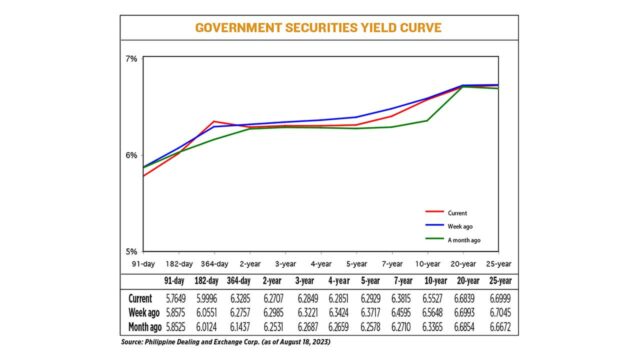
GS yields, which move opposite to prices, dropped by 3.7 basis points (bps) on average week on week, based on PHP Bloomberg Valuation Service Reference Rates as of Aug. 18 published on the Philippine Dealing System’s website.

Rates were mixed across all tenors last week as yields on the 91- and 182- Treasury bills (T-bills) declined by 9.26 bps and 5.55 bps to 5.7649% and 5.9996%, respectively. Meanwhile, the 364-day T-bills went up by 5.28 bps to fetch 6.3285%.

The belly of the curve went down as yields on the two-, three-, four-, five-, and seven-year Treasury bonds (T-bonds) fell by 2.78 bps (6.2707%), 3.72 bps (6.2849%), 5.73 bps (6.2851%), 7.88 bps (6.2929%), and 7.80 bps (6.3815%), respectively.

At the long end, the rates of the 10-, 20-, and 25-year debt papers inched down by 1.21 bps (6.5527%), 1.54 bps (6.6839%) and 0.46 bp (6.6999%), respectively.

Total GS volume traded on Friday amounted to P10.68 billion, higher than the P4.65 billion seen on Aug. 11.

“Yields declined over the week as the new 10-year bond issuance auctioned last Aug. 15 saw strong market participation garnering over [twice] the demand oversubscription into the Bureau of the Treasury’s (BTr) P30-billion bond offering,” Lodevico M. Ulpo, Jr., vice-president and head of Fixed Income Strategies at ATRAM Trust Corp., said in an e-mail.

Yields declined last week following a recent bond maturity, a bond trader said, adding that the latest central bank decision did not have an immediate effect on the market.

Last week, the BTr fully awarded the new 10-year bonds it auctioned off as total bids amounted to P66.824 billion.

The bonds were awarded at a coupon rate of 6.625%. Accepted yields ranged from 6.4% to 6.625% for an average of 6.558%.

Meanwhile, the Bangko Sentral ng Pilipinas (BSP) kept benchmark interest rates steady for a third straight meeting on Thursday, but signaled it is prepared to resume tightening if needed amid risks to inflation.

The Monetary Board left its overnight reverse repurchase rate unchanged at a near 16-year high of 6.25%, as expected by 13 economists in a BusinessWorld poll. Interest rates on the overnight deposit and lending facilities were maintained at 5.75% and 6.75%, respectively.

The BSP has raised borrowing costs by 425 basis points (bps) from May 2022 to March 2023 to tame inflation.

“Post the BSP action, we anticipate markets to focus on global economic data and market movements as medium-term disinflation expectation by the BSP is tempered by near term inflationary risks on food, climate, and energy,” Mr. Ulpo said.

He added that global curve’s steepening may temper the persistent demand for duration, but this may be temporary as the market looks forward to better global and local monetary conditions in 2024 and 2025.

“We expect demand for bonds and duration to persist albeit at specific yield levels given broadly anchored front-end yields,” he said.

For this week, Mr. Ulpo said the 15-year bond reissuance will likely test the market’s resolve.

On Wednesday, the BTr will offer P30 billion in reissued 20-year papers with a remaining life of 15 years and five months. — A.M.P. Yraola

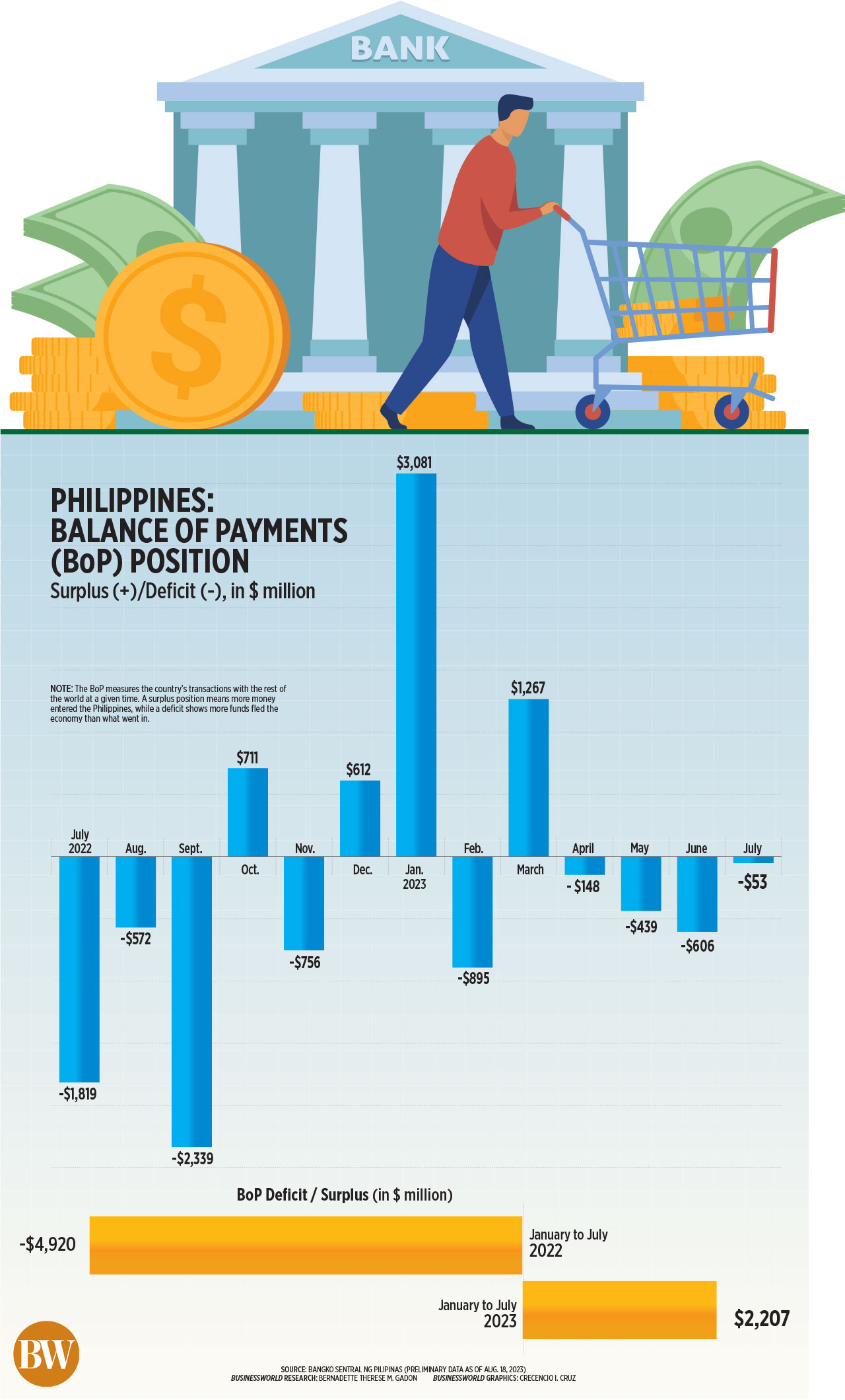
Philippines: Balance of payments (BoP) position

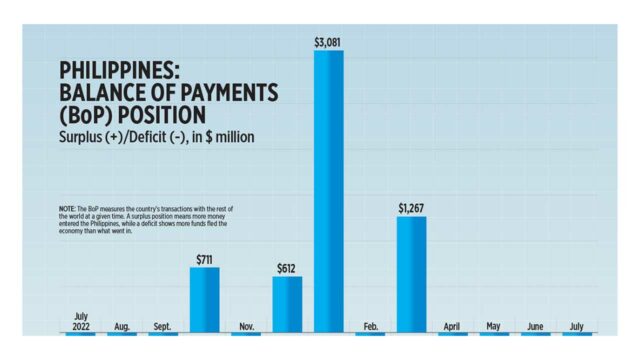
THE OVERALL balance of payments (BoP) deficit sharply narrowed to $53 million in July, as more dollars flowed out of the country to pay for the government’s foreign debt. Read the full story.

ADVERTISEMENT
ADVERTISEMENT