Home Blog Page 4437

Globe says it is most consistent in 31 locations

GLOBE Telecom, Inc. said that it had been recognized by a global benchmarking firm as the most consistent broadband provider in 31 locations.

Citing a report from Ookla, the company identified the locations to include Las Piñas, Bustos in Bulacan, Mandaluyong, Don Carlos in Bukidnon, Sogod in Cebu, Mexico in Pampanga, General Tinio and Jaen in Nueva Ecija, Barotac Nuevo and Dumangas in Iloilo, and Santo Tomas in Batangas.

Consistency determines the internet performance and quality that network operators’ customers enjoy. Globe had the highest consistency score in Las Piñas with 89.16 points.

The consistency score is analyzed by Ookla through “logistic regression” which helps adjust the comparisons and provide more accurate assessments.

“We will continue to strive for excellence and set new benchmarks in the industry to ensure greater digital experiences for our customers,” said Raymond Policarpio, vice-president of Globe At Home brand management, in a statement.

Globe said that it recognizes the need for “more robust and quicker connections” as its customers are becoming more dependent on connectivity.

“To address this need, Globe has accelerated its fiber deployment, rolling out a total of 3.7 million fiber-to-the-home lines, 1.4 million of which were installed in 2022 alone,” the company said in a press release.

Knowing that quicker connection can be best achieved through fixed wired solutions, the company is also actively transitioning its fixed wireless and legacy technology customers to fiber connections.

Globe previously earmarked a capital expenditure of P71.5 billion or $1.3 billion for 2023. So far this year, the company’s spending reached P37.7 billion.

In the first half, the company said that it built 542 new cell sites, upgraded 5,087 mobile sites, and installed 356 5G sites.

At the stock exchange on Friday, shares in the company declined by P26 or 1.36% to P1,884 each. — Justine Irish D. Tabile

‘AC’celerating EV adoption

The Atto 3 is set to be introduced within the year. — PHOTO FROM AC MOTORS

Ayala-led AC Motors looks to crank up electric mobility volume as BYD distributor

By Dylan Afuang

IN THE RACE to carbon-neutral mobility via battery electric vehicles (BEVs), the Philippines falls some ways behind the world, as a number of hurdles continue to hinder our country’s adoption of this mobility type.

EVs command a considerable price premium over their internal-combustion-engine-powered counterparts, and public-access charging facilities are generally still few and far between. More glaring issues include our power grid continuing to rely on coal-fired plants. To be fair, nations across the world are in various state of readiness to switch to electric mobility.

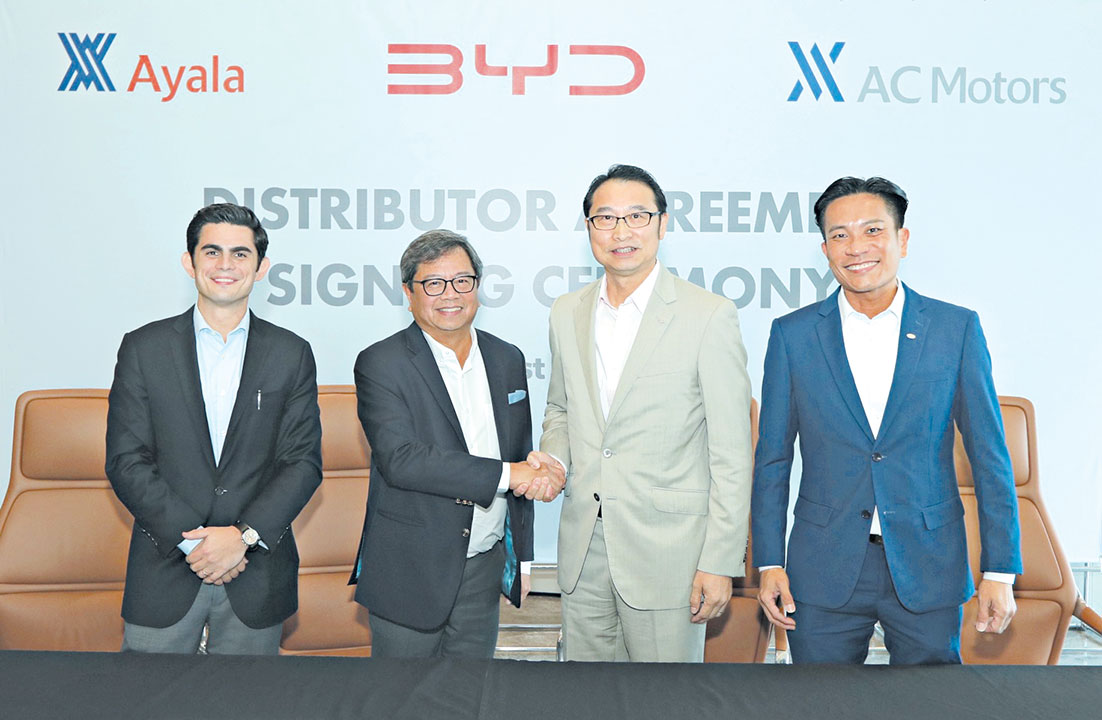
Enter the automotive business led by the Ayala conglomerate, AC Motors. It now has taken over the local reins of distribution for BYD, an established Chinese EV brand. The vision, as explained during a recent press conference, is to not only add EV options in the market, but (through AC Motors and the Ayala Group in general) help develop an “EV ecosystem” — of which charging networks are part of.

The hope is that the AC Motors distributorship focus on BYD — a company which has recently marked a milestone five million EVs produced — could solve some problems facing BEV use.

During a media round-table discussion in Makati City, AC Motors Chief Executive Officer Jaime Alfonso Zobel de Ayala stated that distributing BYD plays a key component in the Ayala Group’s plans to lead the country’s transition to EVs.

“The Ayala portfolio is uniquely positioned to provide long-term value to customers in this emerging ecosystem,” Mr. Zobel de Ayala added. “Through our capabilities and efficient energy management of our strategic real estate assets for charging infrastructure or existing automotive distribution and dealership network and capabilities in digital connectivity and financing, we believe we are in a position to provide value to customers.”

The “efficient energy management” and “charging infrastructure” can be provided by ACEN Corp. and Ayala Land, Inc. (ALI). ACEN (formerly AC Energy) is the Ayala Group’s energy platform that aims to provide 100% renewable energy by 2025, while ALI is the company’s real estate arm that opened EV chargers in the country last year.

And as mentioned, the company’s “existing automotive distribution network” is handled by AC Motors, under which are Kia, KTM, Maxus, Volkswagen, and now BYD. The company is building BYD to “become a key brand in the Philippine market, with leading share among EV brands and meaningful presence in the automotive market as a whole,” declared Mr. Zobel de Ayala.

Leading the local BYD distributorship is industry veteran Antonio “Toti” Zara III, former AC Motors Automobile Group president.

With him at the helm, how will this EV brand make its mark here? “We need to communicate the BYD story, we need to communicate the technology, and we need to have a strong dealer network established in the Philippines,” Mr. Zara expressed to the media.

“BYD has an expansive lineup of both passenger and commercial vehicles at competitive price points, allowing the vehicles to be deployed at a larger scale,” AC Motors described in a statement, adding, “Its operations as an automotive manufacturer are also fully integrated, with capabilities not only in designing and assembling the final vehicles, but even in battery technology, electric powertrain development, and semiconductors.”

Mr. Zara stated that in the coming 12 months, the business aims to have at least 12 BYD outlets operational — 10 in Metro Manila and North Luzon, and two in Visayas and Mindanao.

“The plan is (to open) around 40 outlets in five years, but the growth would really depend on the adoption of EVs. We are looking at 15% to 20% EV adoption of total industry sales within about (a) five-year time frame,” the executive added.

And what about BYD cars?

In addition to growing and improving the dealer network, Mr. Zara revealed that the Atto 3 electric crossover will be introduced within the year. The Dolphin hatchback, Han sedan, and Tang SUV comprise the current BYD models.

Regarding pricing, Mr. Zara stated that vehicles supplied by AC Motors would be priced “competitively” as a result of relief and incentives under the Electric Vehicle Industry Development Act (EVIDA).

“We will have a stronger brand, a stronger dealer network, and a stronger product portfolio at price points that are now within reach of more Filipinos. We are coming in at the right time with EVIDA (and the exemption) of import duties and excise tax, so BYD products and its technologies will be made more accessible,” he announced.

“These are compelling models that target different market segments and allow us to promote EV adoption across a wide range of customers,” Mr. Zobel de Ayala joined. “With BYD’s leading presence globally in EVs and given its recent success in other Southeast Asian markets, we at AC Motors aspire to build the same level of respect and relevance for the brand in the Philippines.”

H&M says it will ‘phase out’ sourcing from Myanmar

LONDON — The world’s second-biggest fashion retailer H&M  has decided to gradually stop sourcing from Myanmar, it told Reuters on Thursday, as reports of labor abuses in garment factories in the country increase.

H&M became the latest brand to cut ties with suppliers in the country after Zara owner Inditex, Primark, Marks & Spencer and others.

“After careful consideration we have now taken the decision to gradually phase out our operations in Myanmar,” H&M said in an e-mail to Reuters.

“We have been monitoring the latest developments in Myanmar very closely and we see increased challenges to conduct our operations according to our standards and requirements.” — Reuters

No drama

PHILIPPINE STAR/KRIZ JOHN ROSALES

The State of the Nation Address (SONA) message of President Ferdinand “Bongbong” Marcos, Jr. on July 24 was very revealing of his style of leadership and perhaps what we can expect from him in the future.

The President’s SONA was very clinical and reportorial — crammed with facts, figures, and lists of programs. It was dramatically different from what we got from former President Rodrigo Duterte who peppered his speeches with cuss words and lambasted his enemies. Former President Duterte could ramble on and on, from promising the death and destruction of drug lords to condemning the depredations of alleged oligarchs.

What came to mind about President Marcos Jr. after the SONA was the American press’ description of the cerebral and unflappable former US President Barack Obama, “No drama, Obama.”

The SONA indeed was chill, not meant to bring offense to anyone. One could say it had a “friends to all and enemy to none” theme. Even on the controversial Military Pension Reform, he assured there would be no ill effects on the military personnel. “We are inclusive in our pursuit of social protection. The pension of the military and the uniformed personnel is as important, as urgent, and as humanitarian as that of all other civilian Filipino employees. Efforts are underway to make it fully functional and financially sustainable. We are once again working closely with Congress to ease the transition from the old system to the new one, to be able to guarantee that no effects are felt by those in the uniformed services.”

Come to think of it, this “friends to all and enemy to none” mindset can be traced as far back as candidate Bongbong Marcos’ campaign. His campaign theme was “Unity.” He refrained from attacking his political opposition, saying a nary bad word about Leni Robredo. You didn’t hear any red tagging from him, as you would have from his vice-presidential teammate. He relied on nostalgia and a recognizable brand name to move his campaign. In Pinoy lingo, he was “chill lang.”

Perhaps, President Marcos Jr. is trying hard to prove what he’s not. While he tries to evoke nostalgia or recycles some of his father’s programs like the Kadiwa stores and Masagana 99, he’s certainly not his father in some ways.

For example, before the election, I heard it said that “he will be a dictator like his father.” The very first thing he would do is declare martial law and jail the opposition, said the critics. Of course, these critics were exaggerating but the consensus, not the confrontational or bullying, style seems more suited to Marcos fil.

I’m wondering, however, whether this friend to all, enemy-to-none strategy can work, especially on difficult issues like food liberalization. We are facing a possible perfect storm of food crises: India has banned exports of non-Basmati rice, driving rice prices higher; Russia has rescinded the grain deal allowing Ukraine to ship out wheat, increasing speculation on wheat prices; and El Niño, or the unusually dry spell phenomenon, which is expected later this year and could negatively affect food production.

For sure, we must import more food. Not just rice, but also corn, which had also increased in price as corn is a substitute for wheat. Increased corn prices will mean higher prices for livestock since corn accounts for as much as 60% of the cost of livestock.

Allowing more food imports to quell possible rising food inflation will be a politically sensitive issue. The protectionist farmer groups will make noise. President Bongbong Marcos is unlike former President Rodrigo Duterte who could not care less when farmer groups protested the Rice Tariffication Law. And unlike former President Duterte, who was the former City Mayor of Davao who had no farmers among his constituents, President Marcos Jr. was a former Ilocos Norte Governor who is aware of the plight of farmers.

Tackling the food issue will test President Marcos Jr.’s political skills. There’s also no way forward in increasing agricultural production but by allowing more land consolidation. It’s fine to talk about farm consolidation through cooperatives but cooperatives don’t work in the Philippines. The only possible solution is to promote bigger and better-managed farms.

Again, this is a politically sensitive issue because the small, marginalized farmer has been romanticized in Philippine political culture. How President Marcos Jr. modernizes Philippine agriculture without being criticized for displacing the poor Filipino farmer will test his political skills. If he does not move toward greater farm consolidation, by ownership or leasing, Philippine agriculture will remain stagnant, and the economy will likely be weighed down by high food prices.

Another example of how President Marcos Jr.’s political skills will be tested is the issue of the flooding of the North Luzon Expressway. The only long-term solution, according to the President himself, is to build a catchment basin in the Candaba area. But this is being opposed by politicians and farmers in the area. Can he craft a win-win solution and get the catchment basin done? Contrast this with former President Duterte who had a damn-the-torpedoes approach to rehabilitating Boracay.

President Marcos Jr.’s slow, consensus style, however, doesn’t mean he’s afraid to make strong political decisions. Charging Negros Oriental Congressman Arnie Teves, the suspected mastermind and ringleader behind the assassination of Negros Governor Roel Degamo, with terrorism is indicative of a strong state determined to squash warlordism and uphold the rule of law.

I also suspect that President Marcos Jr. sometimes takes extra steps not to appear to be like his father, at least when the issue of cronyism is raised. Cronyism is what his critics during the election said he would practice, but the first thing he did when he assumed office was to veto the bill creating the Bulacan Airport Economic Zone.

It was also expected that the Marcos Jr. administration would favor the unsolicited proposal of the Manila International Airport Consortium (MIAC), which consisted of the country’s big business groups in rehabilitating the Ninoy Aquino International Airport (NAIA). The MIAC had a tempting offer of P267 billion at a concession period of 25 years. Many of the members of the MIAC were also members of the Presidential Advisory Council, so it was assumed that the unsolicited proposal was a slam dunk.

However, lo and behold, the government said it would go for a solicited proposal for 15 years, but extendible for another 10 years. It was a good signal since a solicited proposal would mean it would have to go through competitive bidding.

In appointing the new Governor of the Central Bank, President Marcos Jr. didn’t choose a politically connected banker, but instead selected an internationally recognized central banking expert, Eli Remolona. Eli spent 19 years at the Bank of International Settlements and 14 years at the Federal Reserve Bank of New York. He has a Ph.D. in economics from Stanford University. He probably doesn’t even know President Marcos Jr. personally.

I sometimes yearn for the drama associated with Duterte, his cuss words notwithstanding. There were no boring days during Duterte’s presidency and you either loved him or hated him. (I once described him as the “finger in the ass of the oligarchy.”) On the other hand, President Bongbong Marcos is indicating that he’s bringing a new style to the presidency: less drama, more technocracy, more good vibes. However, the country faces major headwinds: economic growth is decelerating, food inflation shows no sign of abating, and geopolitical tensions are rising. Can President Marcos Jr. do much-needed structural reforms and remain chill? Let’s see.


Calixto V. Chikiamco is a board director of the Institute for Development and Econometric Analysis.

idea.introspectiv@gmail.com

www.idea.org.ph

Supermarkets await stronger sales ahead of school opening

EDUARDO SOARES-UNSPLASH

SUPERMARKETS are expecting stronger sales ahead of the opening of classes for the school year 2023-2024, particularly for items consumed by students.

“Supermarkets are hopeful that with most schools going face-to-face completely, sales for ‘baon,’ bread spreads, and drinks will be revived this year,” Philippine Amalgamated Supermarkets Association President Steven T. Cua told BusinessWorld in a Viber message.

“Household expense on these have been put on hold since the pandemic with schooling done from home,” he added.

The Department of Education previously announced that all public schools would start classes on Aug. 29 for the school year 2023-2024, while private schools are allowed to open classes starting from the first Monday of June but not later than the last day of August, as provided under Republic Act No. 11480.

According to Mr. Cua, local supermarkets have prepared their inventories ahead of the school opening.

“Supermarkets have prepared for this but operators have been scratching their heads as to the official class opening for which type of school and grade level. Most are looking forward to end of August as the start for majority of pupils for 2023,” he added.

“It is that time of the year when school supplies sell well,” he added.

The Department of Trade and Industry (DTI) previously said the pending increases in the suggested retail prices (SRPs) of basic necessities and prime commodities range from 10 centavos to P7 for food products and P1.50 to P9.75 increase for nonfood products on the back of surging prices of raw materials.

It added that 43 shelf-keeping units (SKUs) from 13 manufacturers have pending price hikes. These products include canned sardines, condensed milk, evaporated milk, powdered milk, coffee, instant noodles, bottled water, canned meat, and toilet soap.

The latest DTI SRP bulletin was released on Feb. 8, which granted SRP increases ranging from 45 centavos to P7 for 76 SKUS, while the prices of 141 SKUs were carried over from the previous SRP bulletin issued in August last year.

Separately, the DTI released its updated price guide for school supplies on July 25, which covers specific brands of notebooks (composition, spiral, and writing), pad paper (Grades 1-4 and intermediate), pencils, ballpoint pens, crayons, erasers, sharpeners, and rulers.

The DTI’s guide reflected price increases ranging from P4 to P8 on various school supplies. Before the July 25 issuance, the last school price guide issued by the DTI was on Aug. 12 last year.

School supplies are deemed prime commodities under Republic Act No. 7581 or the Price Act. — Revin Mikhael D. Ochave

Power to the people mover

Stargazer X units are lined up onstage at the Hyundai section of the Gaikindo Indonesia International Auto Show (GIIAS) 2023. — PHOTO BY KAP MACEDA AGUILA

We check out the alpha version of Stargazer at its unveiling in Indonesia

A RECENT TRIP to Indonesia courtesy of Hyundai Motor Philippines (HMPH) continued to confirm two things on this side of the planet: Electric vehicles are becoming increasingly ubiquitous, and ASEAN customers remain crazy over — in addition to SUVs, of course — those multipurpose vehicles (MPVs) that promise bang (i.e., passenger and cargo real estate) for the buck. Small wonder then that Indonesia gets a lot of MPV action by way of OEM plants churning out unit after unit. Not a few in our group wondered out loud if our country could ever realize business in this regard.

Because, frankly speaking, Filipinos also love to move in groups. But the calculus isn’t really that simple. Economies of scale and feasibility must surely come in to play. Not only must a local market adequately crave for the product, the cost of doing business must be manageable as well.

With a population nearing 300 million, Indonesia snapped up more than a million new vehicles last year. And not only do its factories sate domestic demand; the country is said to account for more than half of the world’s compact MPV production.

Hyundai is among the brands doing serious manufacturing business in the country. In fact, two of the models sold by the company in the Philippines come directly from its sprawling 77.7-hectare facility in West Java which boasts a 150,000-unit-a-year output. These two nameplates are the Creta subcompact crossover, and the Stargazer MPV — the latter waging war in yes, a very competitive segment.

One of the items on the agenda during our trip to our ASEAN neighbor was to attend the Gaikindo Indonesia International Auto Show (GIIAS) 2023 at the ICE BSD City in Tangerang, Banten. The highlight of Hyundai’s presentation at its large corner of the pavilion was the unveiling of the Stargazer X, which undoubtedly takes its place as the highest version of the nameplate.

The “X” suffix denotes “crossover” values imbued to the MPV. If you’re still not familiar with the concept, remember fusion cuisine which became very popular not too long ago? Well, the crossover similarly blurs lines in hopes of, well, appealing to a broader spectrum of palates seeking the best values of once very distinct vehicle categories.

Far from being a purely utilitarian point-A-to-point-B tool, the Stargazer X builds on the vaunted values of the nameplate. PT Hyundai Motors Indonesia President Director WooJune Cha described the vehicle as one “that can answer and meet society’s need and demand for a vehicle with a spacious and luxurious interior that provides comfort for dynamic driving performance and (is) equipped with superior features and high-tech specifications.”

The Stargazer X gets black cladding on the outside (which, among other things, serves to make it appear a little higher off the ground) along with some minor stylistic tweaks on the bumper and grille. Inside, the light gray bezel around the floating-style instrument cluster and infortainment display has been ditched in favor of a piano black surround — which I think works to make it look more elegant and unobtrusive. The screen has also been redesigned in this regard.

Significantly, the Stargazer X is available either as a conventional seven-seater or with a couple of freely adjustable captain seats. Wrapped with fabric or synthetic leather, the Stargazer X gets red stitching accents, and a backseat table for second-row occupants. Hyundai is also leveling up on its entertainment system — fitting the Stargazer X with eight Bose speakers. Further sweetening the pot are wireless charging, and a sundry of safety features.

Obviously, we are justified in anticipating the arrival of this alpha model of the Stargazer. HMPH has the answer. “Customers can look forward to seeing the Stargazer X in the Philippines by the fourth quarter of this year,” said the company in a statement. Expect the brand to be plenty busy before 2023 is done and dusted. “We will also be offering additional variants (for) some of our current vehicles. Lastly, a new model that will further fortify HMPH’s range of MPVs will be introduced by then.”

There’s no reason for us to get that FOMO (fear of missing out), either. HMPH appears ready and willing to grow its model lineup. “Filipinos can be rest assured that we constantly study market trends, growth and profitability. Which means if there is an opportunity to expand our lineup then we will maximize it,” the firm concluded.

Winter is coming to Gucci GB4

GUCCI’s new boutique opened just in time to accept the brand’s Fall/Winter 2023 collection which arrives in September.

The space — which opened this month in Greenbelt 4 (GB4) in Makati — spans over 7,475 square feet and carries a wide selection of ready-to-wear, handbags, travel bags, shoes, belts, silks, eyewear, small leather goods, jewelry and watches.

The store is faced in marble, and an LED screen video wall, presenting Gucci’s latest campaigns, adds dynamism to the exteriors. Hand-painted wood flooring features decorative motifs that reference details from the House’s collections while fabrics in lighter tones adorn the walls. The store is framed with built-in displays reminiscent of walk-in closets while newly designed racks inspired by classic brass designs accommodate diverse product categories. Velvet armchairs and sofas, and shaggy wool monochrome rugs are placed throughout to create intimate corners.

As part of Gucci’s commitment to implement and enhance eco-friendly initiatives and energy-efficient technologies, the new boutique is designed using LED guidelines and principles to monitor and promote energy efficiency.

Meanwhile, the Fall/Winter line which will soon hit stores premiered on the runway in February. This line sees plays in texture through heavy pastel coats and oversized knits featuring brushed mohair and looped yarns. The collection also has androgynous clothing, as evidenced by models clad in baggy gray suits, or trench coats worn with dress shirts and baggy jeans.

As for the bags, there are new takes on the rounded trapezoid chain bag, now adorned with the Gucci horsebit and interpreted in padded, shearling, crystal, and contrast-leather manifestations. Honoring an archival icon, the Jackie bag appears in its original shape but softened in construction and adapted in two-tone colors and GG-embossed leather. — JLG

Lessons from illicit opium and coca cultivation

CORINA ARDELEANU-UNSPLASH

In July, the Philippine Rural Reconstruction Movement (PRRM) organized a forum at its office in Quezon City to discuss how my research findings on illicit opium and coca cultivation in Afghanistan, Myanmar, Colombia, and Bolivia may provide a new lesson or two on rural reconstruction and development.

Since illicit crop cultivation often follows conflicts and crises, the core question is how to rebuild from the ruins of war and rural displacement. Answers may be particularly relevant to many places in rural Philippines, especially in the Muslim south.

The first lesson is about choosing crops or the mix of crops to grow. Peasants affected by conflict and agricultural commercialization will avoid growing regular crops (rice, wheat, cassava, or corn) because the land they hold is not their own or cannot be secured. They live under the constant threat of having to move at a moment’s notice due to fighting and displacement. Therefore, most engage in “guerrilla agriculture” — growing food in abandoned or neglected land and taking risks that harvests may be easily lost or confiscated. Most will not invest in making the land more productive — like building protective trenches, planting hedges, or constructing water systems — because why make the effort that will be wasted anyway?

Under such conditions, the most logical choice is crops that would grow on hillsides, rocky soil, and in dry conditions; that will not easily spoil if not brought to market quickly enough; that are low-mass and low-weight and can be easily transported in a backpack over bad roads or broken bridges; that are of better value than high-value crops such as saffron or avocado; that can easily be processed into intermediate, higher-value and lower-volume products using backyard means; that have relatively stable prices over the short-term; and that have an assurance that it will always be bought, unlike other regular crops. Opium, coca, and cannabis emerge as the most likely crops to grow or mix with other crops. Illicit crop growing forms part of building strategies to survive and have an income.

It is not just about the mix of crops to grow, but also the combination of livelihoods to build that is central to survival. Many households develop a blend of on-farm, off-farm, and non-farm income opportunities — a pattern also prevalent in many places in Mindanao I’ve seen. Some become agricultural workers on other farms or commercial farms while growing on their farm plots or keeping livestock. Others look for new forms of cost reduction — like sharing tools and farm animals, cooperating on water collection, or setting up pools for collective insurance against man-made and natural disasters. Others send their young men to work seasonally in city centers. In rural Philippines, long-term investment is in the education of children and the next generation, who will be expected to bring poverty relief to their elders.

Decisions to balance risk and opportunity, or harms and possibilities, are complex. For example, in the semi-arid regions of southwestern Afghanistan, expert David Mansfield refutes the greed-versus-need assumption that households plant opium because of its much higher prices. He stresses that families decide how much land to allocate to wheat or opium poppy, not because of the prices but based on estimates of water availability. Wheat will be grown if water is expected to be sufficient. But if water is scarce, the land is better allocated to the more drought-resistant opium poppy instead. I wonder how Filipino farmers make crop choices based on the expected frequency and severity of typhoons and storms.

A second lesson is on how illicit crops enable poor households to access life-sustaining credit. These households are typically undocumented — because of extreme poverty and conflict conditions, most do not have birth certificates, tax identification numbers, community tax receipts, much less passports that give them some form of formal identification. They do not have permanent addresses — again, another requirement that is needed to qualify for bank accounts or postal boxes to, among others, receive remittances, income support, or ayuda. As such, they are ineligible to even apply for credit with rural banks or microfinance institutions. They are too poor to be considered.

But if they choose to grow opium or coca, not only drug traffickers but licit entrepreneurs, too, will compete with each other to offer them credit or advance payments for the crops they will produce. Many find it useful to pay their loans not with cash but with kilograms of opium or coca harvests. Illegal crops become their means of survival.

A third lesson is about market access. Illicit crops will always be sold, unlike other crops. We all know about onions and vegetables with no buyers in the Philippines, leaving them to rot. In many areas of Myanmar and Afghanistan, buyers themselves knock on the growers’ doorsteps, saving these households the prohibitive transport costs and allowing them to use their time more productively. In many cases, the buyers even bring essential consumer items — like cooking oil, salt, or farm tools — to trade for illicit crop harvests. Like it or not, illicit crops reconnect economically marginalized and excluded households back to commercial and market circuits.

In other words, the great paradox is that to their growers and despite their illegality, illicit crops can reduce or spread risks and provide more predictability. Growing illicit crops — like rural reconstruction — has become a way to minimise risks, avoid the pitfalls of land insecurity, preserve the value of rural labor, access credit, and prepare for future contingencies. It has become a form of alternative development.

The July PRRM forum was titled Kapit sa Patalim — a Filipino saying that desperate people will grab on even to a knife that cuts them, so they won’t fall off a cliff. In Afghanistan, Myanmar, Colombia, and Bolivia, illicit crop growing has become a principal form of kapit sa patalim.

In the Philippines, many other forms of informal and illicit means of survival are still mostly understudied. I think it is time for rural reconstruction and development practitioners to think about tackling this phenomenon, which I will elaborate on further in future columns.


Eric D U Gutierrez’s book Rethinking Illicit Economies in Opium and Cocaine: Policy Responses to Drug Crops in the Global South is due to be published by Routledge in November.

US agriculture delegation visiting Davao in Sept.

US AMBASSADOR to the Philippines MaryKay L. Carlson — MAYA M. PADILLO

DAVAO CITY — Eight US agricultural companies will visit Davao in September, US Ambassador to the Philippines MaryKay L. Carlson said on Friday.

Ms. Carlson said the delegation is seeking investment and trade opportunities in the region, which is a major producer of Philippine agricultural exports.

“Agriculture is the strength of this region. A trade mission is coming next month, big firms like John Deere. I go back to agriculture because you have such a great advantage here when it comes to agriculture and I know that you gain a lot of foreign exchange from export of agricultural products,” she told BusinessWorld at the Park Inn by Radisson Davao.

“The US is the largest export market for the Philippines. Of the services and products you are sending overseas, the greatest destination is in the US,” she added.

Beyond trade and investment, Ms. Carlson said the US sees opportunities to work with the Philippines through its foreign aid organization.

“In some areas, we hear President Ferdinand Marcos, Jr. speaks often about the importance of food security and nutrition security. I think there is a lot that we can do in this area through USAID (the US Agency for International Development).”

President Ferdinand R. Marcos, Jr. met with US businesses in Washington, DC, during his four-day visit to the US in May.

Ms. Carlson cited the strong people-to-people ties with the Philippines as the basis for building the relationship further, noting the large numbers of Filipino students in the US, the significant Filipino-American population, and the 350,000 Americans living in the Philippines. — Maya M. Padillo

LANDBANK digital transactions rise in the first half

BW FILE PHOTO

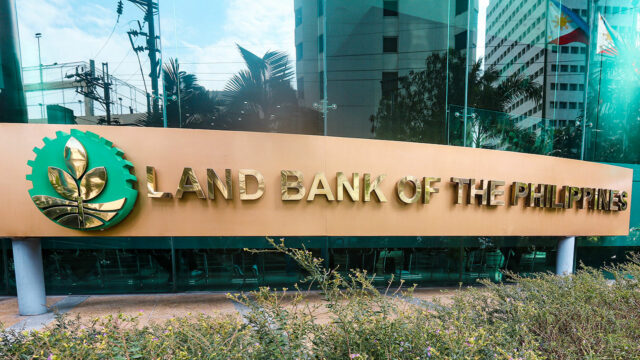
DIGITAL TRANSACTIONS facilitated by Land Bank of the Philippines (LANDBANK) in the first six months grew by 22% year on year in terms of volume and by 41% in terms of value.

The state-run lender recorded 94.7 million digital transactions in the first half of the year, translating to P1.9 trillion in terms of value, LANDBANK said in a statement on Sunday.

“More customers continue to embrace the advantages of using LANDBANK’s digital banking solutions. We will drive investments to upgrade our digital infrastructure further, to continue providing convenient, accessible, and secure services,” LANDBANK President and Chief Executive Officer Lynette V. Ortiz said.

“The combined digital transactions were made through the LANDBANK Mobile Banking App (MBA), Electronic Modified Disbursement System (eMDS), LANDBANK Bulk Crediting System (LBCS), Link.BizPortal, iAccess, and weAccess,” LANDBANK said.

Broken down, LANDBANK MBA accounted for the majority of the number of digital transactions. The platform facilitated 76.1 million transactions amounting to P140.5 million, up year on year by 27% and 36%, respectively.

LANDBANK said MBA was used for fund transfers, bills payments, and government bonds purchases. This includes the retail Treasury bonds offered in February.

Meanwhile, the eMDS accounted for majority of the value of digital transactions at P1.3 trillion, equivalent to 1.4 million transactions. This was a 36% jump in terms of value from P966.2 billion and a 15% growth in terms of volume from 1.2 million.

eMDS is LANDBANK’s internet facility for National Government agencies.

LBCS saw the most significant increases in utilization and value in the first half of the year, with total transactions jumping by 6,737% to 3.6 million, amounting to a 398% rise in value to P32.3 billion.

LBCS is LANDBANK’s electronic bulk disbursement facility.

“The LANDBANK Link.BizPortal, a web-based payment channel for paying for products and services online, also posted a 44% rise in volume to 4 million transactions worth P6 billion,” the bank added.

The value of transactions facilitated through iAccess, LANDBANK’s online retail banking channel, inched up by 3% to P9.1 billion.

Lastly, the value of transactions done through LANDBANK’s corporate internet banking platform weAccess rose by 53% to P433.3 billion.

The value of transactions facilitated via LANDBANK’s online retail banking channel iAccess and its corporate internet banking platform weAccess likewise improved by 3% and 53% to P9.1 billion and P433.3 billion, respectively.

LANDBANK saw its net income rise by 2.7% year on year to P20.9 billion in the first half on the back of improved income from loans and investments. — AMCS

PBEd, Wells Fargo partner to boost youth employability

NONPROFIT organization Philippine Business for Education (PBEd) is seeking to boost the skills and employability of out-of-school youth under a partnership with Wells Fargo International Solutions LLC–Philippines.

In a statement on Sunday, PBEd said the tie-up with Wells Fargo is under the Human Capital Investment for Work Readiness and Employment or HIRE program, which will give mentoring and training subsidies during on-the-job training for 200 out-of-school youth.

The nonprofit group added that the HIRE program would also provide four to eight weeks of skills training specific to companies in the sectors of food service and tourism, construction, information and communication technology and analytics, agriculture and agribusiness, manufacturing, logistics, banking and finance, energy and renewables, and health service.

“Investing in our youth and developing our human capital is the key to driving growth and innovation in the country. By providing them with the right training and bridging them to meaningful employment, the industry plays its part in empowering the youth,” PBed Deputy Executive Director for Programs Hanibal E. Camua said.

According to PBEd, the program will also provide interventions that would help the out-of-school youth to develop life skills such as leadership and communication, interpersonal and professional skills, and critical thinking.

“Wells Fargo is committed to building an inclusive, sustainable future for all, as well as making a positive impact in its communities. We are excited to collaborate with PBEd to upskill and train the youth, helping pave the way for a more resilient and skilled workforce,” Wells Fargo Philippines Country Head Mike Whyte said.

The Philippine Statistics Authority recently reported that the country’s unemployment rate eased to 4.5% in June from 6% a year ago. However, the June figure was higher than the 4.3% unemployment rate in May. — Revin Mikhael D. Ochave 

Style (08/21/23)


Artefino holds Upcycled Design Challenge

THE 2023 ARTEFINO Festival is bringing nearly 150 brands across categories such as men and women’s fashion, home, jewelry, and accessories, to The Fifth at Rockwell in Power Plant Mall, Makati from Aug. 24-27. This year’s artisanal fair will also be holding the ArteFino Maker’s Lab: Totally Upcycled Design Challenge 2023 to support the call for Filipino craftsmanship and sustainability, as embodied in this year’s theme of “Heritage meets Innovation.” The ArteFino denim upcycling challenge showcases Filipinos’ creativity, resourcefulness, and innovation through the upcycling of old and used materials. Entries will use 80% upcycled materials with 60% coming from denim, wood, scrap fabric, plastic, and paper and 20% coming from other materials of choice. The entries will be displayed in a special setting on the ground floor of Power Plant Mall from Aug. 18-27, with an awarding ceremony in August as a culmination of the ArteFino Festival. The contest is done in partnership with Security Bank. “We are one with ArteFino’s advocacy to promote responsible retail highlighting local products crafted with purpose, impact, and intention. All this is anchored on our commitment to sustainability and our mission to enrich lives, empower businesses, and build communities sustainably,” said Tanya Deakin, FVP and Head of Corporate Communications and Brand at Security Bank, in a statement. Security Bank credit card holders will enjoy exclusive benefits at ArteFino when they use their Security Bank Platinum or World Mastercard, including early preview VIP access to the fair, a free gift upon entry, and access to a limited edition tote bag and other souvenir goods. Furthermore, Security Bank credit card shoppers are entitled to 0% installment for three months.


Montblanc creates homage to Robert Louis Stevenson

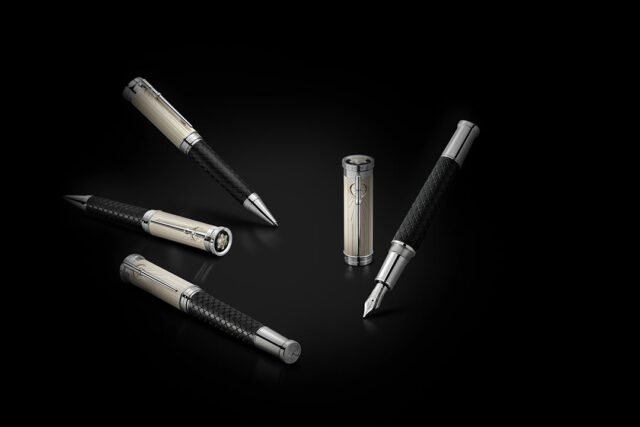
MONTBLANC’s latest annual limited edition writing instrument celebrates the storytelling genius of the author of classic literary favorite Treasure Island. The Montblanc Writers Edition Homage to Robert Louis Stevenson pays tribute to Scottish novelist, poet and travel writer Robert Louis Stevenson (1850 – 1894), who, aside from Treasure Island, is also best known for his horror story “The Strange Case of Dr. Jekyll and Mr. Hyde.” Every design detail of the four different editions — featuring fountain pens, rollerballs, ballpoint pens, and mechanical pencils — that make up the collection illustrates his work, Treasure Island in particular. The shape of the writing instrument is inspired by the spyglass used by sailors and pirates, with the lower geometry of the cone evoking the opening of the spyglass. Each edition features an original interpretation of the skull and crossbones, universally recognized symbol for pirates around the world. The compass rose that appears throughout the collection is a nod to Treasure Island’s legendary treasure. A reference to his final years on Samoa is his local nickname “TUSITALA” or “teller of stories,” adorns each nib in the collection. The four editions are the Limited Edition whose details focus on Treasure Island; the Limited Edition 1883, based on the year of publication of Treasure Island, has a barrel depicts the three-mast ship Hispaniola, which thanks to a special mechanism, the British Red Ensign flag flying from the ship turns into the Jolly Roger when the switch is turned, symbolizing its capture by the pirates; the Limited Edition 94 which draws inspiration from the bank note issued by the Royal Bank of Scotland to commemorate the author with the limitation number marking the year of the one pound bank note’s release in 1994, and the cap tube is embellished with hand engravings of pirate tale symbols like a treasure chest, revolver and pipe alongside an inlay of Long John Silver, while the engravings on the barrel of the map of Treasure Island are paired with an inlay of his parrot; and the Limited Edition 8, whose solid gold cap is 3-D hand-engraved with various decorative elements including a large skull that seems to break through the back of the cap and set with Black sapphires, amongst other unique symbols from the novel.


Uniqlo, Clare Waight Keller to unveil collaboration

GLOBAL apparel retailer Uniqlo announced the Sept. 15 launch of Uniqlo : C, a women’s collection created by acclaimed British fashion designer, Clare Waight Keller. The name Uniqlo : C was selected to reflect the many elements throughout the collection that are inspired by the letter C: curiosity, conversation, city, clarity, connection, and creativity, as well as the designer’s name, Clare. For the collection, the classic trench coat is redefined in a four-season gabardine twill. Pufftech blousons and coats are warm yet lightweight, and the light down is specially treated with anti-static technology. Soft luster satin is heat-pressed to create the perfect knife pleated maxi skirt. The trousers cut a casual attitude while fluid skirts and dresses come in delicate micro-floral and paisley prints which can be mixed and matched with a collection of relaxed sweaters, and shrunken cardigans. Uniqlo’s iconic round shoulder bag comes in a chic, oversized version, and a variety of shoes are also available to complete the style. More information about the collection is available at the special Uniqlo : C Website https://www.uniqlo.com/ph/en/contents/collaboration/uniqlo-c/23fw/


Rustan’s holds children’s promo 

RUSTAN’s Department Store is holding the annual Style & Play Fair at the Kids Department until Sept. 3. The Style & Play Fair is an opportunity to explore the latest trends for children, with a wide array of shoes, bags, accessories, and apparel. Shoppers can enjoy up to 40% off on participating brands and products from the Kids department, with gifts with purchase on all participating kids’ apparel, shoes, bags, and accessories brands. As part of its campaign to empower kids, Rustan’s has partnered with non-profit organization CRIBS Foundation, Inc. where customers can donate old school bags and get 10% off from Glitter Love, Penny Scallan, Smiggle, Stephen Joseph, and Supercute. Rustan’s is also working with Precious Heritage Children’s Home where shoppers can donate their children’s used or unused clothes. In return, they can enjoy 10% off Yawning Yolk. The annual event is ongoing at Rustan’s Makati, Shangri-La, Alabang, and Cebu.


Bayo Group opens multi-brand store in Glorietta

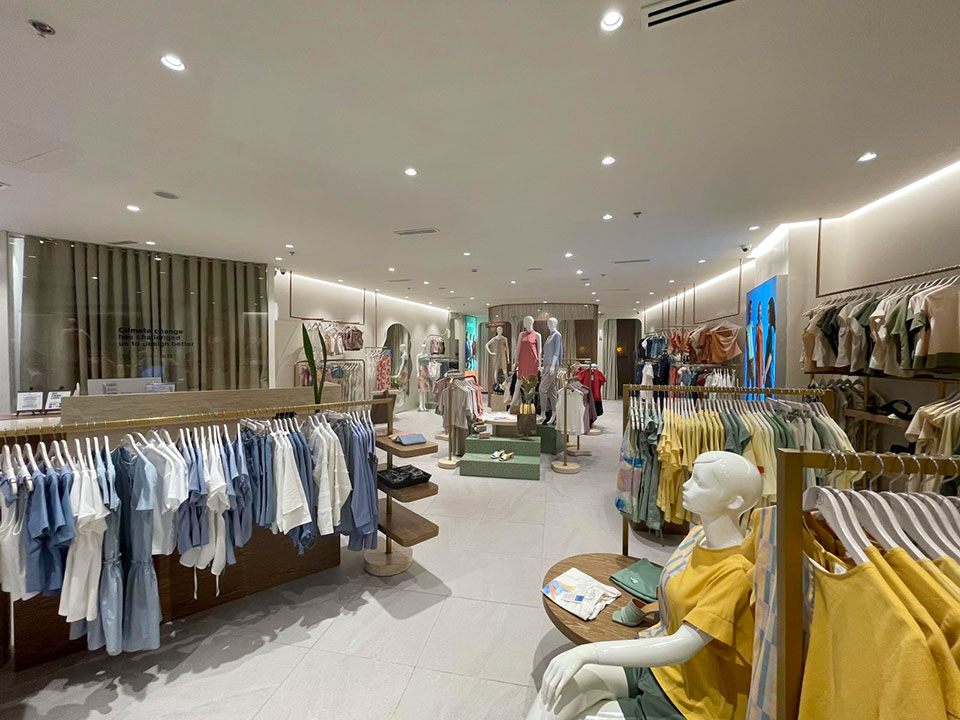
THE BAYO Group — whose portfolio includes such familiar Filipino brands as Bayo, Viseversa, and Tela — has opened a multi-brand concept store at Glorietta in Makati. More than just a shared space online, the most striking common thread is the shared focus of these brands towards sustainable design. From the commitment of the brands in their design philosophies and responsible productions, such as the Journey to Zero initiative, a pledge towards a circular business model of Bayo, the sustainable solutions through fabric usage of Tela, and the style made simple of Viseversa, to the repurposed décor in the flagship boutique, there exists an ecosystem of ethically sourcing raw materials and breathing new life into what would otherwise be discarded. Earth-friendly consumer practices are exercised every step of the way such as ensuring that its products are made with natural materials (prints from water-based ink, packaging derived from cornstarch, hangtags fashioned from recycled paper), locally produced (made in partnership with communities in Aklan, Argao, and Bulacan), and recycling textile cut-offs. The flagship store has repurposed the Holiday 2022 display as barricades, mannequins, and recycled hangers. Apart from its sustainable multi-brand offering, this store is the beginning of Bayo Group’s efforts to seamlessly combine in-person and online shopping experience. Its multi-brand online shopping destination becomes more visible in the physical space, all made possible by interactive fitting rooms and application of online-to-in-store pick-ups. Bayo Group’s multi-brand store featuring Bayo, Tela, and Viseversa is now open at the ground level of Glorietta. Shop online at www.styleshops.com.ph and www.telamnl.com.