Home Blog Page 4395

IRR on streamlined telecom permits expected next month

PHILSTAR FILE PHOTO

THE implementing rules and regulations (IRR) of the Executive Order (EO) No. 32, which calls for the telecommunications permit process to be streamlined, are due for launch by the third week of September, the Anti-Red Tape Authority (ARTA) said on Wednesday. 

“The IRR of EO 32 is required to be formulated by the technical working group (TWG) within 60 working days upon the EO’s effectivity on July 5,” ARTA said in a statement.

ARTA is a member of the TWG.

“The TWG members expressed optimism that… the IRR will be finalized ahead of schedule and submitted to the Office of the President,” it added.

On July 4, President Ferdinand R. Marcos, Jr. issued EO 32, also known as “Streamlining the Permitting Process for the Construction of Telecommunications (telco) and Internet Infrastructure,” which is intended to accelerate the Philippines’ digital transformation.

On Aug. 17, ARTA met with the other members of the TWG and consulted with stakeholders to finalize the IRR.

ARTA said that the TWG members tasked to complete the draft are the National Telecommunications Commission and the Departments of Public Works and Highways, and Interior and Local Government.

“The IRR provides the specific procedures to be followed by all regulating government agencies and local government units and outlines the requirements that must be complied in applications for constructing, operating, repairing, and maintaining telco and internet infrastructures,” it said.

“This is not just about making it easier to build telco infrastructure. It is about creating an environment where communication knows no bounds and technological progress becomes an accessible reality for all,” ARTA Secretary Ernesto V. Perez said in a statement.

In Ookla’s Speedtest Global Index in July, the Philippines ranked 89th with a mobile internet speed measurement of 25.88 megabytes per second (mbps), four places lower than its rank last month and last year. 

In fixed broadband, the Philippines ranked 49th with a median speed of 91.56 mbps, two places down from a month and a year earlier. — Justine Irish D. Tabile

PHL GDP target still within reach — Market Call

STOCK PHOTO | Image Dmitry Berdnyk from Unsplash

THE economy will likely hit the lower end of the government’s growth target this year, driven by improved employment numbers, First Metro Investment Corp. (FMIC) and the University of Asia and the Pacific (UA&P) said.

“We think the economy has sufficient vitality to still meet the lower part of the government’s target of 6-7%. The growth in employment in the second quarter should feed into second-half income and spending,” FMIC and UA&P said in their latest Market Call.

Gross domestic product (GDP) grew 4.3% in the second quarter, well below the 6.4% posted in the first quarter and the 7.5% from a year earlier. It was also the weakest GDP reading in over two years.

GDP growth averaged 5.3% in the first half, falling behind the pace on the 6-7% full-year target.

“Despite the slowdown in GDP expansion to 4.3% year on year in the second quarter, other key economic data do not preclude full-year growth of 6-7%. Sustained job growth, especially in manufacturing, construction, accommodation and food services and other services, and a slight uptick in exports, with an added boost from the peso depreciation in August, provide some glow for the economy,” it added.

According to the Philippine Statistics Authority, the unemployment rate averaged 4.6% in the first half, lower than the year-earlier reading of 6.1%.

FMIC and UA&P said growth in the second half will need to be driven by “robust gains” in employment and tourism, accompanied by tame inflation.

Government spending is also expected to accelerate in the second half, it added.

“National Government expenditures should accelerate in the second half as it ramps up infrastructure spending, with the Metro Manila subway and North-South Commuter Rail projects leading the way,” it added.

The lower-than-expected growth reading in the second quarter had been partly driven by a decline in government spending, which contracted by 7.1%.

“There remains more work to be done in the second half before we achieve the GDP growth target of 6-7% for the year,” the report added.

Meanwhile, FMIC and UA&P also revised upward their inflation forecast.

“Barring a possible transitory jump in rice and oil prices, inflation continues to move southward. Given these risks, we have upped our full year inflation forecast back to 5.7% from 5.5% last month,” it said.

Inflation eased to 4.7% in July. However, this was the 16th straight month of inflation exceeding the central bank’s 2-4% target.

Inflation averaged 6.8% in the first seven months, still above the central bank’s revised 5.6% full-year forecast.

“While inflation will likely spike in August and September due to higher oil and food prices, we think this will prove transitory as the supply response to high prices should prove adequate to bring year-on-year inflation to BSP’s 2-4% (target) by the fourth quarter,” it added. — Luisa Maria Jacinta C. Jocson

Coal-fired capacity for retirement in clean-energy shift seen at 5,000 MW

PEXELS-PIXABAY

THE Department of Energy (DoE) said its plan to retire or repurpose coal-fired power plants will involve up to 5,000 megawatts (MW) as the Philippines shifts to cleaner forms of energy.

“There will be retirement of coal capacity (of) around 4,000 or 5,000 megawatts or even more under the Clean-Energy Scenario,” Michael O. Sinocruz, DoE director for Energy Policy and Planning Bureau, said at a virtual public consultation on Wednesday.

“We are going to come up with an investment plan for the retirement and repurposing of (coal-fired power plants). And again, it is not only the Philippines that looking at the repurposing of coal. Even those countries that have RE (renewable energy) are also looking at the repurposing of coal,” he added.

The DoE estimates current coal power capacity at 12,473 MW, with dependable capacity at 11,394 MW, as of June.

This accounts for 44.1% and 46.1% of the Philippines’ energy capacity, respectively.

The Clean-Energy Scenario of the Philippine Energy Plan (PEP) 2020-2040 aims to increase the share of RE in the power mix to 35% by 2030, then to 50% by 2040.

Separately, Gerry C. Arances, convenor of the Power for People Coalition, said in a statement on Wednesday that his organization remains opposed to the major role played by gas in the PEP’s clean-energy transition.

“The continued presence of gas in the PEP does not achieve any of the goals of the DoE under the law. Gas is expensive, which will not benefit consumers. Gas is imported, meaning the supply will be at the mercy of the international market… Gas, in short, is the worst energy source that the DoE can rely on to fulfill its duties,” he said.

Mr. Arances said the DoE should release “its assumptions for the computation of electricity prices in the interest of transparency and to see if these assumptions are based on science and policy.”

Center for Energy, Ecology, and Development Deputy Executive Director Avril de Torres urged the DoE to heed the results of consultations, which demonstrated significant opposition to the transition plans.

“As the DoE moves forward to next rounds of consultations with stakeholders in Mindanao and Visayas, we urge it to learn from the feedback it received from an overwhelming number of participants raising alarm over these matters,” she said in a separate statement. — Sheldeen Joy Talavera

Nickel mining blueprint lays down industry ‘expectations’ for regulators

REUTERS

THE Philippine Nickel Industry Association (PNIA) said it is planning to review the mining industry blueprint to highlight its “expectations” for the removal of regulatory roadblocks that it said will unlock the industry’s economic potential.

PNIA President Dante R. Bravo said: “We drafted a set of expectations or course of action for each agency.”

These include the Departments of Environment and Natural Resources, Trade and Industry, Finance, Science and Technology, Interior and Local Government, as well as the Board of Investments and the Mines and Geosciences Bureau.

The PNIA said the blueprint will also contain credible data on the economic potential of Philippine nickel reserves and propose a strategy for the Philippines’ role in the global nickel production and processing trade.

It added that the draft should help investors navigate the complexity of mining regulations.

“Having an industry blueprint will help sustain interest and boost investor confidence as it signifies clear direction and commitment in the execution of policy and programs needed to promote the growth of nickel and to make it globally competitive,” PNIA Chairman Antonio L. Co said in a statement.

Mr. Co said the blueprint will also propose to simplify the process of establishing mines.

“Hopefully, the industry blueprint will help resolve policy and regulatory factors that (drag down) the development of the industry and unlock the economic opportunities from the… estimated 9 million hectares of land with mineral potential,” he said.

The revival of the plan is part of a broader PNIA push to fast track and streamline the approval of mining permits.

Mr. Bravo said the blueprint’s aim is to shorten the mining permit approval process to between six months and one year. — Adrian H. Halili

Coconut industry bats for 12-15% biodiesel blend

CHEN MIZRACH-UNSPLASH

THE coconut industry said on Wednesday that it is hoping that the government ultimately raises the share of coconut oil in the biodiesel blend to 12-15% from the current 2%, a move which it said has the potential to significantly lower prices for diesel users.

United Coconut Association of the Philippines, Inc. (UCAP) Chairman Dean Lao, Jr. said the current 2% biodiesel blend (B2) sells for less than P60 per liter, against regular diesel, whose price has already breached P60.

Speaking at a World Coconut Congress briefing on Wednesday, Mr. Lao said even an intermediate increase to a 5% blend could lead to the production of about 280 million liters of biodiesel a year, which can easily be supported by the available coconut oil supply.

“The coconut industry needs a value-added market that is sizeable, that is dependable, and that is not subject to the influence of foreign markets,” Mr. Lao said. “It can make a huge amount of difference to the coconut industry (to develop) a value-added market over time,” he added.

“In fact, we are also pushing for a (12% or 15%) blend as we have that much coconut oil,” he said.

Republic Act No. 9367, also known as the Biofuels Act of 2006, requires biofuels to make up a growing share of the energy mix to help reduce reliance on imported fuel.

Additionally, UCAP Vice-Chairman Marco Reyes cited the pollution-reduction benefits of a biofuel shift.

“Just by increasing the blend to 5%, the particulate matter in the air goes down by 83%. This will also result in P1.5 trillion in savings,” Mr. Reyes added.

“We need to rediscover our coconuts. We cannot just be importers of crude oil. We need to wean ourselves from dependence of crude oil,” he said. — Adrian H. Halili

Farm, fisheries census initial results due in March

PHILIPPINE STAR/KRIZ JOHN ROSALES

THE Philippine Statistics Authority (PSA) said it hopes to release by March the preliminary results of its 2022 Census of Agriculture and Fisheries.

“The PSA is committed to release the preliminary important results during the first quarter of next year,” National Statistician Claire Dennis S. Mapa said in a media on Wednesday.

Final data from the census, conducted every 10 years or so, will be released by July on a staggered basis.

Mr. Mapa said land dedicated to farming has been declining since 1980, when farmland was tallied at 9.73 million hectares.

“In 1991 (there were) close to 10 million hectares; in 2002 9.67 million hectares; and in 2012 it further declined to 7.27 million hectares,” he said.

The PSA’s Census of Agriculture for 2012, the latest edition of the census, tallied 5.56 million farms covering about 7.19 million hectares, for an average area of 1.29 hectare per farm.

In 2002, there had been 4.8 million farms across 9.67 million hectares.

“We need to update the data (from the last census) to discover the real situation on the ground,” he said.

The PSA said it applied new technology, including satellite imaging, to estimate crop volumes and the size of aquaculture farms.

The PSA will use satellite imaging and artificial intelligence, as well as a computer aided personal interview for data gathering. — Adrian H. Halili 

The statute of limitations extension

Earlier this year, the World Health Organization declared an end to the global public health emergency at the outbreak of coronavirus disease 2019 (COVID-19). Even so, we still have to deal with COVID-19 and all the disruption it inflicted at the height of the pandemic.

Similarly, from a tax perspective, the extension of the filing deadlines and the suspension of the running of the statute of limitations implemented at the height of the pandemic have had ripple effects which may still be felt today. There are still lingering questions such as “Was the running of the three-year prescriptive period to assess internal revenue taxes during the COVID lockdowns validly suspended by the Commissioner of Internal Revenue (CIR)?” And, “Was the CIR actually prohibited during the lockdown from assessing deficiency taxes?” The answers are still up for debate and there is no jurisprudence to settle these questions as yet.

For the sake of argument, however, let us assume that the CIR validly suspended the running of the statute of limitations via Revenue Memorandum Circular (RMC) No. 34-2020. The next question to be asked is, “For how many days has the running of the statute of limitations been suspended, thereby extending the Bureau of Internal Revenue’s (BIR) period to assess deficiency taxes?”.

Citing Section 4(z) of Republic Act No. 11469 otherwise known as the Bayanihan to Heal as One Act, Revenue Regulations (RR) No. 7-2020 suspended the running of the statute of limitations pursuant to Section 223 of the National Internal Revenue Code of 1997, as amended (Tax Code). The suspension commenced from March 16, 2020 and extended the statute of limitations by 60 days after the lifting of the state of emergency. RR No. 7-2020 was later amended by RR Nos. 10-2020, 11-2020, and 12-2020, which kept the policy that the extended due dates (e.g., 60 days after the lifting of the quarantine in the case of the suspension of the running of the statute of limitations) are to remain in effect, regardless of any extension or modification of quarantine.

Following these RRs, the BIR issued several RMCs (i.e., RMC Nos. 136-2020, 52-2021, 80-2021, and 93-2021) to clarify the number of days’ extension afforded by the suspensions. These issuances are also the same ones cited by the BIR in the recent Preliminary Assessment Notices and Final Assessment Notices/Formal Letters of Demand (collectively, Assessment Notices) it issues to assess taxpayers.

The recent set of Assessment Notices contains the following paragraph on the period of prescription:

“The running of the statute of limitations upon assessment was suspended in light of the declaration of an Enhanced Community Quarantine (ECQ) and Modified Enhanced Community Quarantine (MECQ) pursuant to Revenue Memorandum Circular (RMC) Nos. 136-2020, 52-2021/80-2021 and 93-2021 for 212 days, 107 days 101 days, respectively, as clarified by Operations Memorandum No. 66-2022. Therefore, the period of prescription is extended from the original prescriptive date up to (date of 420th day).”

Upon scrutiny, however, there seems to be a discrepancy between the total number of days expressly extended under the RMCs (i.e., 345 days) and the total number of days reflected in the Assessment Notices (i.e., 420 days). For better appreciation, below is a side-by-side comparison of number of days per RMCs and per Assessment Notices.

As noted from the table below, there is a difference of 75 days between what is actually stated in RMC No. 136-2020 and what the Assessment Notices have been reflecting. Looking back on the period covered by RMC No. 136-2020, the 137 days may have just considered the period from March 16, 2020 until May 31, 2020 when the majority of the heavily populated areas in Luzon were placed under either ECQ or MECQ, depending on the location.
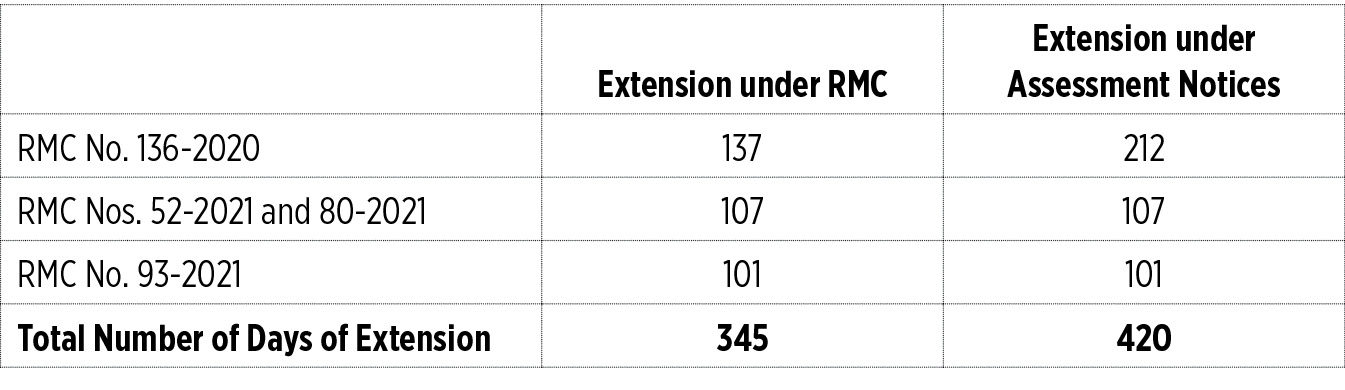
There was, however, another declaration placing the National Capital Region and the provinces of Bulacan, Laguna, Cavite, and Rizal back on MECQ between Aug. 4, 2020 and Aug. 18, 2020, which is 15 days. Counting these 15 days plus the 60-day extension under RR No. 11-2020, as amended, such may have been the basis used to account for the additional 75 days being used in the Assessment Notices for RMC No. 136-2020.

While it may be argued that RR No. 7-2020 and its amendments justify the counting of 212 days used by the Assessment Notices, taxpayers may also argue that the BIR is estopped from considering the period from Aug. 4-18, 2020 since RMC No. 136-2020 (dated Dec. 7, 2020) clearly states that the total number of days excluded from the running of the statute of limitations is 137 days.

As of this writing, there is no separate BIR issuance published that covers the period from Aug. 4, 2020 to Aug. 18, 2020 since the subsequent RMCs (i.e., RMC Nos. 52-2021, 80-2021, and 93-2021) already take into consideration the ECQ and MECQ declarations in 2021. Considering the principle highlighted in the case of Tanada v. Tuvera (G.R. No. L-63915) on the obligation of the government to publicize all presidential issuances “of a public nature” or “of general applicability” as a requirement of due process, there should have been an RMC that clarified the basis for the 212 days currently indicated in the Assessment Notices.

Thus, in my view, assuming the statute of limitations was validly extended, the total adjustment to the prescriptive period of assessments should only be 345 days instead of the 420 days as proposed in the BIR’s Assessment Notices. As I mentioned earlier, however, whether any actual extension at all is valid is another matter altogether — one that I hope will reach the high court in due time.

The views or opinions expressed in this article are solely those of the author and do not necessarily represent those of Isla Lipana & Co. The content is for general information purposes only, and should not be used as a substitute for specific advice.


Paolo John Dantes is a manager at the Tax Services department of Isla Lipana & Co., the Philippine member firm of the PwC network.

+63 (2)8845-2728

paolo.john.dantes@pwc.com

VP’s 2024 budget breezes through House body with no questions asked

VICE-PRESIDENT SARA DUTERTE-CARPIO — PHILIPPINE STAR/KRIZ JOHN ROSALES

By Beatriz Marie D. Cruz, Reporter

PHILIPPINE Vice-President Sara Duterte-Carpio’s P2.39-billion budget request for 2024 breezed through the House committee on appropriations on Wednesday after her congressional allies voted to end the hearing on “parliamentary courtesy.”

“In line with the longstanding tradition of giving the Office of the Vice President (OVP) parliamentary courtesy, I move to terminate the budget [hearing],” Senior Deputy Majority Leader and Ilocos Norte Rep. Ferdinand Alexander A. Marcos said.

Twenty-one congressmen voted yes. Three from the minority voted against ending the budget hearing.

“Lawmakers will do their best not to antagonize a potential president like Carpio,” Arjan P. Aguirre, who teaches political science at the Ateneo De Manila University, said in a Facebook Messenger chat. “What we are seeing here is an effort to protect a major faction of the ruling coalition who is also seen as a potential contender for the presidency in 2028.”   

He said Congress would probably avoid scrutinizing intelligence funds because this could be viewed as “unwanted and excessive intrusion into the discretionary powers of the Executive.” “The Legislature is known for giving in or worse, serving the interest of the ruling government.”

Party-list Rep. Raoul Danniel A. Manuel later told a budget hearing on the Education department, which Ms. Duterte-Carpio heads, extending parliamentary courtesy to government officials stops Congress from exercising its power of the purse.

“Our tradition of extending parliamentary courtesy stops us in the legislative branch from doing our job,” he said. “There should be checks and balances.”

Presiding chairperson Davao de Oro Rep. Maria Carmen S. Zamora called for the vote after Mr. Marcos’ motion. She suspended the hearing before Deputy Minority Leader and Party-list Rep. France L. Castro could explain why she voted no.

“We highly condemn the committee on appropriations’ move to stop the Makabayan bloc from interrogating the Office of the Vice President on its confidential funds,” Ms. Castro, whose microphone was turned off during the hearing, told reporters.

She had sought to explain her objection against ending the budget hearing. Ms. Zamora instead asked her to submit her explanation to the committee.

The Office of the Vice President has proposed a budget of P2.39 billion for next year, P500 million of which is earmarked for confidential funds.

The Commission on Audit (CoA) has flagged the OVP for spending confidential funds worth P125 million last year.

“I thought the vice-president was brave enough to answer questions regarding confidential funds in 2022?” Mr. Manuel told reporters. “She was present at the hearing physically, yet she did not answer our questions.”

The congressman cited the lack of transparency on how the government spends the people’s money.

Ms. Castro said Ms. Carpio’s confidential funds last year could have built 50 classrooms, adding that these were not part of the 2022 General Appropriations Act.

In a statement, Ms. Duterte-Carpio said her office’s P125-million confidential funds last year were “planned and identified” as early as August.

“There was nothing irregular or unauthorized about its spending and the required liquidation and accomplishment reports have been submitted to the oversight agencies,” she said.

The appropriations body last year swiftly terminated deliberations on the vice-president’s 2023 budget.

Ms. Duterte-Carpio earlier this month defended the Department of Education’s (DepEd) P150-million confidential and intelligence funds in the national budget.

“Education is intertwined with national security,” she told reporters. “It’s important that we mold children who are patriotic, who will love and defend our country.”

The budget for confidential and intelligence funds next year increased by P120 million to P10.14 billion — P5.28 billion in intelligence and P4.86 billion in confidential funds.

Under the 2024 National Expenditure Program, the Office of the President was given P4.5 billion in intelligence funds, while the Department of Information and Communications Technology got confidential funds worth P300 million.

The Bureau of Customs will get P30.5 million, while the Department of Foreign Affairs was allotted P5 million in confidential funds.

The Department of Agriculture was allotted P50 million in confidential funds, the Defense department was given intelligence funds worth P60 million, and the Presidential Security Group was allocated P60 million.

The budget for state colleges and universities fell by 5.7% to P105.58 billion.

Budget Secretary Amenah F. Pangandaman has said the budget for education infrastructure has a capital outlay of P25 million for the lowest tier to P50 million for highest tier per state university.

While the 2024 budget has increases for defense and big-ticket infrastructure projects, increases for education are measly, Mr. Manuel earlier told the committee on appropriations. “It does not address learning loss and is riddled with forms of pork.”

Philippines to boost military presence in South China Sea

THE BRP SIERRA MADRE, a marooned transport ship which Philippine Marines live in as a military outpost, is pictured in the disputed Second Thomas Shoal, part of the Spratly Islands in the South China Sea. — REUTERS

By John Victor D. Ordoñez, Reporter

ARMED Forces of the Philippines (AFP) Chief General Romeo S. Brawner, Jr. on Wednesday vowed to boost the country’s military presence in the South China Sea amid rising tensions with China.

“Right now, we have small structures on the islands that we are occupying,” he told lawmakers in Filipino during his confirmation hearing.

“But this is not enough for us to project our forces. We have few vessels from the Philippine Navy, from the Philippine Coast Guard and the Bureau of Fisheries, but this is really a small number compared with other countries,” he added.

The military chief was responding to Senator Ana Theresia N. Hontiveros-Baraquel’s question about what he plans to do about China’s militarization of the sea.

Mr. Brawner said the “name of the game” in the South China Sea is “effective presence.” “Whoever has many ships gets the advantage,” he added, noting that there were more than 400 foreign vessels in the disputed waterway.

Tensions between the Philippines and China have worsened after the Chinese Coast Guard fired water cannons to block Manila’s attempt to deliver food and other supplies to a grounded ship at Second Thomas Shoal on Aug. 5.

The shoal is about 200 kilometers from the Philippine island of Palawan and more than 1,000 kilometers from China’s nearest major landmass, Hainan Island.

Since 2014, China has substantially expanded its ability to monitor and project power throughout the South China Sea via the construction of dual civilian-military bases at its outposts in the disputed Spratly and Paracel Islands, according to the Asia Maritime Transparency Initiative.

“These include new radar and communications arrays, airstrips and hangars to accommodate combat aircraft and deployments of mobile surface-to-air and anti-ship cruise missile systems,” it said.

At the hearing, where lawmakers confirmed Mr. Brawner’s appointment, Senator Francis N. Tolentino urged the military chief to consider halting a 2004 defense agreement with China on an exchange program for Filipino and Chinese military students, which was meant to strengthen military ties.

Mr. Brawner said he had ordered the military to stop sending Filipino officers and students to China after the Aug. 5 incident.

“We need to revisit this agreement, and we might need to fix some of its provisions to make sure China agrees with them and that is our direction,” he said in Filipino.

Last week, Ms. Hontiveros-Baraquel filed a resolution seeking an inquiry, in aid of legislation, into the Philippine Coast Guard’s capacity to safeguard outposts in the South China Sea through additional marine radar stations and automatic tracking systems for increased surveillance.

She said the coast guard should get as much as P600 million in intelligence funds.

Senator Francis “Chiz” G. Escudero earlier proposed to build a pier and lodging structures for Filipino soldiers and fishermen at Second Thomas Shoal, which the Philippines calls Ayungin.

He said he would propose a P100-million budget for the Department of Public Works and Highways or Philippine Coast Guard to build the pier.

The Senate on Aug. 1 adopted a resolution urging the government of President Ferdinand R. Marcos, Jr. to take China’s harassment of Filipino fishermen and coast guard vessels in the South China Sea to the United Nations General Assembly.

It called on the Department of Foreign Affairs to bring international attention to China’s harassment and its continued disregard of a 2016 arbitral ruling by a UN-backed tribunal that voided its claim to more than 80% of the South China Sea.

In the ruling, the five-member court said China had violated the Philippines’ sovereign rights in its exclusive economic zone by building artificial islands and for failing to prevent its citizens from fishing in the zone.

China has largely ignored the ruling, calling it void. Aside from the Philippines and China, Brunei, Malaysia, Taiwan and Vietnam also have claims to parts of the waterway.

Saola batters Luzon; another storm brews

TROPICAL CYCLONE Wind Signal No. 2 remained hoisted over Batanes and Babuyan Islands on Wednesday as Super Typhoon Saola, locally named Goring, battered northern Luzon, just as another severe tropical storm was expected to enter the Philippines.

Saola was packing maximum sustained winds of 195 kilometers per hour (kph) as of 10 a.m. near the center and gusts of up to 240 kph as it moved west-northwestward off Basco, Batanes.

Meanwhile, severe tropical storm Haikui was set seen 1,465 kilometers east of extreme northern Luzon. It was packing maximum sustained winds of 110 kph and up to 135 kph gusts.

Saola would likely remain a super typhoon until Friday as it moves west-northwest across the Luzon Strait, the state weather bureau said.

It is expected to leave the Philippine area of responsibility on Wednesday night or Thursday morning.

Haikui might become a typhoon as soon as it enters the country, but it was not expected to hit the Philippine landmass and would probably remain at sea, it said. It could bring monsoon rains while moving northwest as it leaves the Philippines by Friday.

Meanwhile, Saola has affected 196,926 Filipinos, 35,095 of whom were staying in evacuation centers, the country’s disaster agency said in a report.

The super typhoon caused P41 million in infrastructure damage including 134 houses, 52 of which were totally destroyed.

Authorities had yet to estimate farm damage.

The Philippines is one of the countries most affected by water-related disasters, with an average of 20 typhoons that bring heavy flooding and cause billions of pesos in damage to infrastructure and agriculture each year.

Previous typhoons this year severely affected the country’s food production, with Super Typhoon Doksuri and a southwest monsoon causing P1.94 billion worth of agriculture damage. The rice sector accounted for P950 million of the total.

El Niño, which is expected to be “moderate or strong” by the end of 2023 or early 2024, is also seen affecting the country’s crop production.

The Department of Agriculture has recommended that the private sector import an additional 500,000 metric tons of rice in anticipation of El Niño, which farmers have opposed.

Early in his term, President Ferdinand R. Marcos, Jr. promised to modernize the agriculture sector and cut the country’s reliance on food imports. — Norman P. Aquino and Kyle Aristophere T. Atienza

PNP attests to stricter police screening

PHILIPPINE STAR/EDD GUMBAN

By John Victor D. Ordoñez, Reporter

THE PHILIPPINE National Police (PNP) told senators on Wednesday that it has already implemented a more thorough screening and testing of men and women entering the police force, as doubts had been cast on the criminal tendencies of Navotas City police officers who shot and killed a teenager by mistake.

At a Senate hearing investigating the killing of 17-year-old teen Jerhode “Jemboy” Baltazar, Colonel Maria Leonora C. Camara, PNP Recruitment and Selection Service Unit chief, said that since 2019 the PNP added personality and temperament tests for aspiring police officers and set a limit on the number of times it can be taken.

“Individuals can now only take the PNPs screening process three times and will be barred from taking it again if they fail to pass,” she said. “We also have a database of all individuals who failed and passed these background tests.”

But during the same hearing, Senator Ronald M. dela Rosa asked the six Navotas policemen who shot and killed the teenager last Aug. 2 whether or not they were subjected to the updated screening process and none of them said they did.

Senator Rafael “Raffy” T. Tulfo earlier called on police to change the neuropsychiatric exams for law enforcers, saying it does not effectively measure a person’s criminal tendencies.

He said police officers often pass the tests by memorizing the answers after multiple tries.

Child porn worsens; House worried

PHILSTAR

THE NUMBER of child pornography sites abusing kids aged 11 and below has increased by 58,000, the Department of Education (DepEd) told a House of Representatives panel on Wednesday.  

“We found that as to child pornography websites, [these] increased from 23,000 to 81,000,” Education Undersecretary Michael Wesley T. Poa told the House committee on appropriations. 

Mr. Poa also disclosed that DepEd is handling two cases of student sexual abuse by teachers. Both cases — one in Zamboanga and the other in Cavite, are being prosecuted. 

“We are currently working with the Council for the Welfare of Children and will launch programs to combat the issues of child pornography and child grooming,” he said.
Unimpressed, party-list Rep. Raoul Danniel A. Manuel concluded that the DepEd is unsuccessful in using its confidential funds to stop these forms of abuse committed against students. 

“If we will base DepEd’s performance regarding this matter cited last year… the DepEd seemingly made up its justification of using confidential funds,” he said. — Beatriz Marie D. Cruz

ADVERTISEMENT
ADVERTISEMENT