Home Blog Page 4363

What would an ancient Egyptian corpse have smelled like? Pine, balsam and bitumen — if you were nobility

IN 1900 — some 22 years before he discovered the tomb of Tutankhamen — British archaeologist Howard Carter opened another tomb in the Valley of the Kings. In tomb KV42, Carter found the remains of a noblewoman called Senetnay, who died around 1450 BCE.

More than a century later, a French perfumer has recreated one of the scents used in Senetnay’s mummification. And the link between these two events is our research, published in Scientific Reports*, which delves into the ingredients of this ancient Egyptian balm recipe.

Our team drew upon cutting-edge technologies in chemistry to reconstruct ancient scents from jars of Senetnay found in the tomb.

We used three variations of chromatographic and mass spectrometric techniques, which work by breaking samples down into individual molecules. Specific substances have different assemblages of molecules. Based on these characteristic compounds and through comparison to known reference materials, we identified the different ingredients.

After the excavation by Carter, two of Senetnay’s jars recovered from the tomb made their way to Germany. So, in 2020, we approached the Museum August Kestner in Hannover about the possibility of analyzing the jars with these new methods.

These jars are known as canopic jars. They are made of limestone and were used to store the mummified organs of the ancient Egyptian elite. Somewhere along the way, however, Senetnay’s jars lost their contents. All that remained of the mummified organs were faint residues on the bottom of the jars.

Remarkably, chemical analyses allow scientists to take such trace remains and reconstruct the original contents.

Our analysis revealed the balms used to coat and preserve Senetnay’s organs contained a blend of beeswax, plant oil, fats, bitumen, an unidentified balsamic substance, and resins from trees of the pine family (most likely larch).

One other substance was narrowed down to either a resin called dammar — found in coniferous and hardwood trees in South-East and East Asia — or Pistacia tree resin.

The results were exciting; these were the richest and most complex balms ever identified for this early time period. It was clear a lot of effort had gone into making the balms. This suggests Senetnay, who was the wet nurse of the future Pharaoh Amenhotep II, had been an important figure in her day.

The findings also contribute to growing chemical evidence that the ancient Egyptians went far and wide to source ingredients for mummification balms, drawing on extensive trade networks that stretched into areas beyond their realm.

Since trees of the pine family are not endemic to Egypt, the possible larch resin must have come from somewhere further afield, most likely Central Europe.

The most puzzling ingredient was the one identified as either Pistacia or dammar resin. If the ingredient was Pistacia — which is derived from the resin of pistachio trees — it likely came from some coastal region of the Mediterranean. But if it was dammar, it would have derived from much farther away in South-East Asia.

Recent analysis of balms from the site of Saqqara identified dammar in a later balm dating to the first millennium BCE. If the presence of dammar resin is confirmed in Senetnay’s case, this would suggest ancient Egyptians had access to this South-East Asian resin via long-distance trade, almost a millennium earlier than previously thought.

Senetnay’s balm would not only have scented her remains, but also the workshop in which it was made and the proceedings of her burial rites — perfuming the air with pine, balsam, vanilla and other exotic notes. The vanilla scent comes from a compound called coumarin, and from vanillic acid, and in this case likely reflects the degradation of woody tissue.

Due to the volatile nature of scents, however, Senetnay’s unique scents gradually vanished once her remains were deposited in the Valley of the Kings.

Earlier this year, we began a collaboration with perfumer Carole Calvez and sensory museologist Sofia Collette Ehrich to bring Senetnay’s lost scent back to life.

The results of this effort will go on display at the Moesgaard Museum in Denmark in October, as part of its new exhibition: Egypt — Obsessed with Life.

The new olfactory display will be like a time machine for the nose. It will provide a unique and unparalleled window into the smells of ancient Egypt and the scents used to perfume and preserve elite individuals such as Senetnay.

Such immersive experiences provide new ways of engaging with the past and help broaden participation, particularly for visually impaired people. — The Conversation via Reuters Connect

*Biomolecular characterization of 3500-year-old ancient Egyptian mummification balms from the Valley of the Kings | Scientific Reports (nature.com)

Nicole Boivin is a Professor at the Max Planck Institute of Geoanthropology, while Barbara Huber is a Doctoral Researcher at the Department of Archaeology, Max Planck Institute of Geoanthropology. Barbara Huber receives funding from the Max Planck Society and the Joachim Herz Foundation.


AbaCore approves to buy back shares amid ‘unwarranted’ stock price decline

LISTED holding company AbaCore Capital Holdings, Inc. has approved a share buyback program policy, citing an “unwarranted drop” in its stock price.

In a statement on Tuesday, the company said its stock price is “undervalued in terms of the price-to-book value ratio and the income potential of its projects and investments.”

“We are pursuing this buyback program policy because we believe our stock has strong long-term fundamentals. As such, buying back our stock institutes our confidence in the company’s future,” AbaCore Vice-Chairman Antonio Victoriano F. Gregorio III said. 

AbaCore recently sold a property at Brgy. Inosluban in Lipa, Batangas to Eternal Gardens that resulted in a P99.4 million net gain. The company previously sold its Mataas-na-Kahoy properties in Lipa for P108.9 million, which had a gross gain of P70.4 million. 

As a result of the transactions, the company recorded a P384.6 million net income as of August, a turnaround from the P15.5 million net loss in the first half of last year.

AbaCore also bought a property in Silang, Cavite which will be used for any venture with existing or future business partners as part of replenishing its inventory of investment properties.

The company’s board also took note of the progress made with the memorandum of agreement signed with Highsource Prime Building, Inc. to construct various projects at the Montemaria Shrine in Batangas. The progress includes refurbishing the existing hotel at the shrine, building new roads to ensure accessibility to all facilities and opening new restaurants.

Meanwhile, AbaCore said it is looking forward to the potential income from the agreement signed by Pacific Online Systems Corp. with the Philippine Charity Sweepstakes Office (PCSO) to build an online betting platform.

Under the agreement, Pacific Online will get 14% of the gross revenues by serving as the PCSO’s exclusive agent. The agreement covers a one-year trial period. AbaCore has a 4.89% stake in Pacific Online.

“This 2023, we are pleased to announce more business ventures across the markets we operate in. We believe these initiatives will solidify our long-term fundamentals and allow us to fulfill our growth prospects,” Mr. Gregorio said.

AbaCore is a holding company that has business interests in tourism, real estate, financial services, and energy.

Shares of AbaCore on Tuesday increased 10 centavos or 8.06% to finish at P1.34 apiece. — Revin MIhkael D. Ochave

OFW as a permanent phenomenon: Language lessons

FREEPIK

(Part 6)

To have a glimpse of the future, in which a developed Philippines will continue to be the source of overseas Filipino workers (OFWs) in such areas as nursing, caregiving, hospitality, food services and accommodation, and seafaring, it would be enlightening to take a close look at one of the leading ethical recruiting agencies in the Philippines today.

I am referring to EDI-Staffbuilders International, Inc., part of John Clements Consultants, Inc., the pioneer recruitment search firm in the Philippines and a 100% non-fee charging company. It has been locally and internationally recognized for its best practices in ethical recruitment. It partners with the International Labor Organization (ILO) and International Organization for Migration (IOM) in promoting Decent Work Across Borders (DWAB) and the International Recruitment Integrity System (IRIS). It has a wide experience since it was established in 1978 in such sectors as oil and gas, engineering and construction, IT- BPO and Telecoms, Banking Finance and Insurance, Hospitality and Tourism, Manufacturing FMCG and Retail, Healthcare and Transportation, Automotive and Aviation. In its 45 years of operation, one of the distinctive hallmarks of EDI-Staffbuilders International and success is its having forged strong business alliances in various countries (especially in North America, Japan, and the European Union) with equally reputable organizations that are acknowledged leaders in their industry.

EDI-StaffBuilders has recruited and successfully deployed more than 100,000 Filipino executives, managers, professional and technical staff. Practically all of them decided to work abroad of their free choice and not because of dire poverty as in the case of domestic helpers and other semi-skilled or unskilled service or industrial workers. The average salaries of these recruits are $4,000 to $15,000 for executives and managers; $1,500 to $3,500 for professional and highly technical workers; $800 to $1,500 for skilled workers. These are the types of OFWs who will continue to seek employment abroad even if the Philippines, say in 2040, is able to bring down the poverty incidence close to zero level.

EDI-StaffBuilders has been consistently recognized by the Philippine Overseas Employment Authority (POEA) through such awards as Top Performer Award, Hall of Famer, Presidential Award of Distinction and Award of Excellence. In February 2014, the Presidential Award of Excellence was conferred to EDI-StaffBuilders by the late President Benigno S. Aquino III. The criteria used for the granting of the award were deployment volume, technical capability, compliance with recruitment laws and rules, industry leadership and social awareness and responsibility.

One business partnership established by EDI-Staffbuilders that is a harbinger of future recruitment of highly paid Filipino professionals and technical workers is with a Japanese company which is recognized as one of the top three leading management consulting and personnel services companies in Japan.

In 2019, a new subsidiary of this Japanese company was established, to cater mainly to the high demand and critical need of Japan for foreign workers, especially in the health and hospitality sectors. This company established a Philippine subsidiary which set up a Language Institute in Cabuyao, Laguna to primarily provide an intensive Language and Culture Training Program for all their recruited caregivers. The high-end facilities and methodology of the Institute has resulted in a 70% passing rate in the Japanese language proficiency test administered twice a year. This fact illustrates that one of the strengths of Filipinos is their facility to learn different languages.

EDI-Staffbuilders has made similar arrangements with Philippine educational institutions and language training centers to teach their recruits languages as varied as German, Finnish, Czech, Polish, and Spanish. In fact, another example of language training was the partnership of EDI-Staffbuilders with a German outfit in opening up a boarding school in Cabuyao, Laguna. The main goal of the school was to create a conducive environment where nurses could learn the German language as quickly as possible. The German language training was given for free and so were the accommodation and food of the trainees. Aside from the usual classroom lectures and exercises, language learning was made more interactive and personal via various activities such as parlor games, song and dance numbers, and theatrical plays. The set up developed not only the language skills of the nurses but also built camaraderie and a sense of belonging among the group which helped the trainees to adapt to the new environment that they would be facing in Germany. The whole educational experience resulted in a 90% German language passing rate.

EDI-Staffbuilders has been a pioneer in nontraditional countries as OFW destinations, such as those in Central Europe where the demographic crisis is as severe as in East Asian countries like Japan and South Korea. For example, in 2015 the company ventured into the Czech Republic by recruiting for a manufacturing company engaged in IT peripherals in which Filipino workers grew to as many as 600. This was an important breakthrough because up to then, the Czech Republic recruited workers mostly from Ukraine, Slovakia, Mongolia and other countries in the periphery of the country. Thanks to the efforts of EDI-Staffbuilders, in cooperation with then Charge d’affairs Juan E. Dayang, Jr. of the Philippine embassy in Prague, the Czech Republic launched the Filipiniski program which identified the Philippines as a new source for workers and approved 1,000 working visas annually for Filipinos. Today, the Czech Republic has employed more than 3,000 OFWs and counting. This diversification into new markets led by EDI-Staffbuilders will be able to tap an estimated demand for as many as 100,000 workers for the healthcare, manufacturing, engineering, information technology, hospitality and services sectors in the next five to 15 years.

This specific example of a leading human resource and international recruiting company in the Philippines was meant to illustrate what will be the effective means of deploying Filipino workers all over the depopulating world (practically all the developed countries) way into the future, even as the Philippines itself should attain First World status.

Of course, my assumption is that Philippine culture will always give the highest priority to values related to what our Constitution states as the “inviolability of marriage as an institution” and the family as the foundation of society. These values are especially nurtured by the Christian faith of the majority of Filipinos. The retention and nurturing of such values will prevent our succumbing to the anti-life and anti-family culture that is so prevalent in the developed countries. These are also the same values that will keep our fertility rate close to replacement level of 2.1 per fertile woman and thus guarantee that we will continue to have a growing and relatively young population, avoiding the scourge of rapid ageing that is the very reason why countries like Japan, Germany, Spain, Finland, Austria and many others will continue to depend on our workers to enable them to sustain a high standard of living as they are unable to reverse their extremely low fertility rate.

Truly indeed, as we reach the level of a high-income economy, we will still see a significant exodus of our workers to numerous countries all over the world. Such an outflow of Filipino workers will no longer be motivated by extreme poverty but by individual Filipinos who will be exercising their inalienable human right to decide where to live and die. We can only hope that a good number of them will still decide to come back to the Philippines upon their retirement to spend the rest of their lives in what by then will already by a First World country but still retaining the pro-family and pro-life culture mandated by our Constitution.


Bernardo M. Villegas has a Ph.D. in Economics from Harvard, is professor emeritus at the University of Asia and the Pacific, and a visiting professor at the IESE Business School in Barcelona, Spain. He was a member of the 1986 Constitutional Commission.

bernardo.villegas@uap.asia

Arts&Culture (09/06/23)


BPI Escolta Branch declared an important cultural property

THE NATIONAL Museum of the Philippines and the National Commission for Culture and the Arts recently declared the Escolta branch of the Bank of the Philippine Islands an important cultural property, ensuring the protection and preservation of the 54-year-old post-war edifice. Located on Escolta corner Yuchengco Sts. in Manila, the half-dome, futuristic building was built in 1969 and designed with a brutalist architectural style by the late National Artist for Architecture Jose Maria V. Zaragoza. It previously housed the Commercial Bank and Trust Company, a commercial bank that began operating in 1954. The declaration falls under the National Cultural Heritage Act of 2009, a law that protects structures with “exceptional cultural, artistic, and historical significance” to the Philippines.


Flower-centered exhibit ongoing at West Gallery

AN exhibition titled “There are always flowers for those who want to see them” is currently on view at West Gallery in Quezon City until Sept. 9. It features the works of Brisa Amir, cnvs, Isha Naguiat, Jason Dy SJ, Jemima Yabes, Kitty Kaburo, Lesley-Anne Cao, Miguel Puyat, Mona Santos, Nicole Tee, and Ryan Villamael. The group show, drawing from a study on the feelings evoked by flowers conducted by Professor Jeannette Haviland-Jones and named for a text by Henri Matisse, celebrates one of the most ubiquitous sights across nature: the flower. The 11 artists in the exhibition sift through a wide spectrum of emotion, each a study in introspection or commentary on the process of working with flowers. West Gallery is at 48 West Ave., Quezon City. For details call 0915-175-3729.


Anywhere We Sing Is Home concert marks CCP anniversary

TO celebrate the 54th anniversary of the Cultural Center of the Philippines (CCP) this month, the concert Anywhere We Sing Is Home will be held on Sept. 9 and 10. The concert’s title alludes to the temporary closure of the CCP’s main building and the need for its work to be held in other locations. Led by Joanna Ampil, this gala performance features an all-star cast that includes Sheila Francisco, Aicelle Zambrano, Gerald Santos, Arman Ferrer, Gab Pangilinan, Reb Atadero, and Jean Marc Cordero. The stage direction will be by Floy Quintos and the music direction will be by National Artist for Music Ryan Cayabyab. There will be two shows — on Sept. 9, 8 p.m., and on Sept. 10, 3 p.m. — at the Samsung Performing Arts Theater at Ayala Malls Circuit, Makati. Tickets can be booked at https://premier.ticketworld.com.ph/.


Hamilton holds ticket lottery via TicketWorld

WITH the award-winning musical Hamilton beginning performances this month at the Theatre at Solaire, a lottery for tickets will open on Sept. 11, giving fans the chance to win two tickets to the musical for P1,600 through TicketWorld. Weekly lottery sign-ups will open each Monday at 10 a.m. and close for entries on Wednesday, 11:59 p.m., for the next week’s performances. For more information on how to sign up, read the FAQs of the official website.


Marie Claire Olondriz holds solo show in ARTablado

PAINTER Marie Claire Olondriz has spent years honing her painting style, coming up with canvases awash in color and light. She is an artist with a strong faith in a higher power, as seen in her paintings of Marian images like Our Lady of Aranzazu and Our Lady Star of the Sea. However, she also has floral paintings that include one of a beautiful magnolia flower in full bloom. Most notably, Ms. Olondriz’s canvases are all vertical, a style that began when she was once confined in a hospital and just scribbling on a sketch pad. In her ongoing exhibit titled “Obra ni Maria Clara” at ARTablado in Robinsons Galleria, she shows her passion for art. It is on view until Sept. 15 at the Level 3 of Robinsons Galleria.


EU Delegation holds logo-making contest

THE EUROPEAN Union (EU) Delegation to the Philippines is calling on all creative graphic artists in the country to join its logo contest in celebration of the 60th anniversary of EU-Philippine relations next year. The competition is open to Philippine residents (nationals or foreigners) between 16 and 29 years of age. The selected piece will be the official logo to be used in all EU Delegation communication materials in a string of activities during the anniversary year. The logo must be simple, easy to reproduce, and portray clearly the 60-year EU-Philippines partnership, with components from the EU and Philippine flags. Submission should be by the end of Sept. 15. For more information, visit the website https://european-union.europa.eu/.


Rock opera ballet Rama, Hari opens this month

THIS September, the hit Filipino rock opera ballet, Rama, Hari returns to the stage. It is the only collaboration between five National Artists: Alice Reyes for Direction and Choreography, Ryan Cayabyab for Music, Salvador Bernal for Production Design, and Bienvenido Lumbera for the lyrics and libretto with English Translations by Rolando Tinio. The cast includes musical theater star Arman Ferrer in the lead role of Rama, with Vien King alternating. They will perform alongside dancers Ronelson Yadao and Ejay Arisola. Karylle Tatlonghari, Shiela Valderrama-Martinez, and Nica Tupas alternate in the role of Rama’s beloved wife, Sita, with dance counterparts, Monica Gana, and Katrene San Miguel. Rama, Hari is based on the ancient Sanskrit epic Ramayana. It is presented by the Cultural Center of the Philippines (CCP) and features the artists of the Alice Reyes Dance Philippines and the CCP’s Professional Artist Support Program. There will be performances on Sept. 15 and 16 at the Metropolitan Theater of Manila, and on Sept. 22 and 23 at the Samsung Performing Arts Theater in Circuit, Makati. For more information, check @ARDancePh on Facebook, Instagram, and TikTok.

Aboitiz firm rolls out EV fleet in Batangas 

ABOITIZ InfraCapital, Inc. (AIC) has launched a fleet of electric vehicles (EVs) for the locators and visitors within its LIMA Estate in Malvar, Batangas that it plans to replicate in its other economic estates by next year.

“The way we look at things is we wanted the same types of initiatives across all our projects. Typically, we’ll start in LIMA because it’s the most advanced and the largest,” Rafael P. Fernandez de Mesa, head of AIC Economic Estates and president of LIMA Land, Inc., told reporters during the “Red Link and Red Pass” launch on Tuesday.

The company partnered with EV manufacturer Global Electric Transport for the deployment of the fleet.

Under the Red Link system, the company rolled out an initial seven EVs that are deployed within seven routes in LIMA Estate.

Each electric minibus has a seating capacity of 18 but has a maximum capacity of up to 30. Overall, the system has an initial capacity of 2,500 passengers per day.

Mr. de Mesa said the company is assessing the number of electric minibuses to add as the population within the estate is expected to grow.

“Today we have 66,000 employees working inside. There’s also 25 ongoing construction [projects], so the population is expected to grow probably a hundred thousand within the next five years or so,” he said.

The 800-hectare LIMA Estate is a registered ecozone with the Philippine Economic Zone Authority. It has more than 160 locators.

Mr. de Mesa said the company is seeking to implement the EV fleet system in other economic estates.

“For other estates, we’re now studying it, so realistically [we will roll out] probably sometime next year,” he said.

AIC, the infrastructure arm of the Aboitiz group, also has economic estates in Cebu province, namely: the Mactan Economic Zone 2 Estate in Lapu-Lapu and the West Cebu Estate in Balamban.

“Our expectation is to improve the lifestyle and the user experience for the users to continue to stay. As you can see here, it’s a comfortable ride,” Mr. de Mesa said, citing the EVs’ air conditioning and Wi-Fi.

“It’s ultimately meant to better serve our customers and to contribute to our goal of moving in the direction of [our] net zero target,” he said. — Sheldeen Joy Talavera

Gov’t partially awards new 3-year Treasury bonds

BW FILE PHOTO

THE GOVERNMENT made a partial award of the new three-year Treasury bonds (T-bonds) it offered on Tuesday at a coupon rate higher than secondary market levels after inflation accelerated for the first time in seven months in August.

The Bureau of the Treasury (BTr) raised just P21.187 billion via the fresh three-year bonds it auctioned off on Tuesday versus the P30-billion program, as the offer was undersubscribed, with total bids at just P28.987 billion.

The bonds were awarded at a coupon rate of 6.25%. Accepted yields ranged from 6.11% to 6.373% for an average of 6.222%.

The coupon fetched for the tenor was 4.6 basis points (bps) higher than the 6.204% quoted for the three-year bond at the secondary market before the auction, based on PHP Bloomberg Valuation Service Reference Rates data provided by the Treasury.

The bonds fetched higher yields following the release of data showing that inflation picked up in August, Rizal Commercial Banking Corp. Chief Economist Michael L. Ricafort said in a Viber message.

The coupon rate fetched for the papers was at the “higher end of market expectations” due to faster-than-expected inflation last month, a trader likewise said in a phone interview.

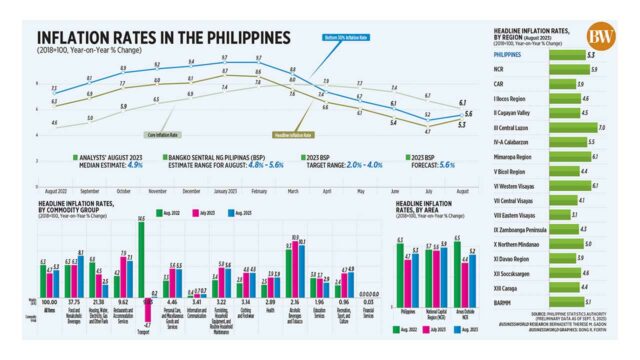
Headline inflation picked up to a two-month high of 5.3% in August from 4.7% in July, data released by the Philippine Statistics Authority on Tuesday showed.

August was the first time headline inflation quickened year on year in seven months, or since it quickened to 8.7% in January from 8.1% in December 2022.

Still, this was below the 6.3% print in August 2022, and was within the 4.8-5.6% forecast of the Bangko Sentral ng Pilipinas (BSP) for the month.

However, this was above the 4.9% median estimate in a BusinessWorld poll of 18 analysts conducted last week.

August also marked the 17th consecutive month that the consumer price index (CPI) was above the BSP’s 2-4% target for the year.

For the first seven months, inflation averaged 6.6%, well above the central bank’s 5.6% forecast for the year.

The BSP expects inflation to return to its target range by the end of the year, but its chief said policy easing remains far off amid lingering price risks.

Following the release of inflation data, the central bank said it “stands ready to adjust the monetary policy stance as necessary to prevent the further broadening of price pressures as well as the emergence of additional second round effects.”

The BSP last month kept benchmark interest rates steady for the third straight meeting in a “hawkish pause.”

The BTr wants to raise P180 billion from the domestic market this month, or P60 billion via T-bills and P120 billion via T-bonds.

The government borrows from local and foreign sources to help fund its budget deficit, which is capped at 6.1% of gross domestic product this year. — AMCS

Ensure the ITA balances regulation and MSME growth

TIRACHARDZ-FREEPIK

The unprecedented growth in e-commerce has necessitated the crafting of regulatory framework to govern the sector. In December 2022, the proposed Internet Transactions Act (ITA) was passed in the lower house and is now pending in the Senate. The aim of the ITA is to regulate the sector, protect consumer rights, and promote intellectual property rights, among other objectives.

The ITA bill is a top legislative priority in response to the country’s fast adoption of e-commerce, which enabled a bustling online marketplace that created both benefits and risks — mostly from transactional issues that have flooded government regulators with complaints from both buyers and sellers being victimized by fraud, scams, cybercrime, and data privacy rights violations.

With the accelerating pace of digital innovation, governments are confronted with unique regulatory challenges. The sheer pace of technological change itself fundamentally challenges regulation. Governments and regulators play a major role in encouraging digital innovation and in incentivizing the development of these technologies for the benefit of society. However, regulatory frameworks often lack the agility to accommodate the increasing pace of technological developments. Digital technologies also challenge deeply the manual and bureaucratic way governments regulate.

As the country quickly shifted to e-commerce to survive the pandemic, there was an irreversible trend towards a global digital economic system that is blurring the traditional definition of markets, challenging enforcement, and an urgency for systemic digital transformation that transcends administrative boundaries domestically and internationally.

The e-commerce ecosystem in the Philippines is booming and has become the fastest growing economic engine in the country. Filipino consumers have embraced online shopping, making it their preferred mode of purchasing. Virtually anything can be ordered and delivered directly to your doorstep through online marketplace platforms. These platforms rely on a robust logistics system, which has become an essential industry in the supply chain.

The ease and speed at which Filipinos adapted to e-commerce platforms resulted in significant growth. According to a US International Trade Administration Report, in 2021, the total market sales reached $17 billion, largely due to the impact of the COVID-19 pandemic. The US Department of Commerce predicts that by 2025, total sales will reach $24 billion.

The sectors that will potentially reap the greatest benefit are Micro, Small and Medium Enterprises (MSMEs) because of the low capital and easy access to the online marketplace. There are many platforms available like Lazada and Shopee, and also social media platforms where buyers and sellers are able to deal directly.

As the dynamics and disruptive nature of e-commerce technologies need a different mindset from the traditional bureaucratic concepts (that are often incompatible), there is a need to work closely with the stakeholders, especially the industry players whose global scope in terms of experience and expertise should be harnessed. However, large e-commerce platforms and MSMEs have expressed concerns about the current version of the proposed ITA pending in the Senate.

One of the concerns is the establishment of an online dispute resolution system for civil and administrative complaints filed by online consumers which can have both positive and negative impacts. Though this can help prevent scams, overly broad regulation could harm small players. The current definitions of violations, liabilities, and other terms are so broad that MSMEs could face numerous legal cases and high fines that they cannot afford. Unlike the well-established platforms that have their own legal departments to take on these issues, e-commerce-based MSMEs don’t have such capacity.

The proposed bill introduces additional administrative requirements or more red tape. It requires the registration of both platforms and merchants with the e-commerce bureau for transparency and legitimacy purposes. The information required for registration will be made public, which may violate data privacy rights.

Additionally, the bill outlines an extensive range of obligations for all online sellers such as detailed guidelines on marketing, on selling, how to issue invoices and receipts and invoices, and so on. MSMEs have very limited human resources and should not be burdened by too many guidelines. The ITA should align with the spirit of the Ease of Doing Business Law.

Instead of being able to engage the online marketplace with a few clicks and keystrokes with minimal information in the e-commerce platforms, imposing additional registration costs and requirements will be adding barriers to market entry, rather than fostering accelerated and inclusive growth that our economy needs to recover. This could turn off MSMEs and may lead to many MSMEs exiting the market. It is important to consider the potential impact of these regulations on MSMEs and their ability to thrive in the e-commerce sector.

In the Organization for Economic Co-operation and Development paper on “Regulatory Reform and Innovation,” it states that in the interest of economic efficiency and innovation, regulations should seek to remove duplicative, onerous, and inefficient regulations, particularly to aid small- and medium-sized enterprises.

The paper’s conclusions on “how to realize positive regulatory effects on innovation, while taking care not to jeopardize the original regulatory objectives” offer good guidance for our government legislators and regulators. It recommends understanding regulation-technology linkages, introducing competition, streamlining regulations, use technology-driving approaches, and harmonize internationally.

While the proposed Internet Transactions Act aims to provide much-needed consumer protection, it is important for the government to strike a balance between regulation and supporting the growth of MSMEs. Careful consideration must be given to ensure that the regulations do not create barriers to entry into the growing e-commerce space.


Victor Andres “Dindo” C. Manhit is the president of the Stratbase ADR Institute.

Archaeologists find ‘mystery’ ducts near biblical Jerusalem relics

JERUSALEM — An almost three millennia-old network of hewn-rock ducts unearthed in Jerusalem has baffled archaeologists, given the lack of comparable biblical finds, or obvious links to an ancient Jewish temple and palace that once stood nearby.

The knee-deep channels, dating back 2,800 years, are located outside Jerusalem’s walled Old City. They stand in two clusters, which were discovered 10 meters apart.

Forensic testing of the channels found no blood, the Israel Antiquities Authority said — potentially ruling out a role in animal slaughter for banquets or religious sacrifice.

The ducts also do not appear to have engineered a flow in a single direction, or debouched into any basin, suggesting they were not used to sluice out sewage or rainfall, added the authority, whose research partner is Tel Aviv University.

“We looked at the installation and realized that we had stumbled on something unique,” said archaeologist Yiftah Shalev in a joint statement, dubbing the discovery a “mystery.”

The channels may have been used to prepare a commodity “connected to the economy of the temple or palace,” said archaeologist Yuval Gadot in the statement.

“The production of linen, for example, requires soaking the flax for a long time to soften it. Another possibility is that the channels held dates that were left out to be heated by the sun to produce silan (date honey),” Gadot said.

The find, part of Israel’s City of David National Park, will go on public display, the statement said.

Inflation rates in the Philippines

HEADLINE INFLATION accelerated for the first time in seven months in August, amid a spike in the prices of rice, vegetables and fuel, the Philippine Statistics Authority (PSA) said on Tuesday. Read the full story.

Inflation rates in the Philippines

Ayala Land board names new CEO-president

Anna Ma. Margarita “Meean” B. Dy

AYALA LAND, Inc. (ALI) has appointed Anna Ma. Margarita “Meean” B. Dy as the listed property developer’s new president and chief executive after the retirement of her predecessor.   

In a stock exchange disclosure on Tuesday, ALI said Ms. Dy had been elected by the board during a special meeting. The move is set to take effect on Oct. 1. 

In a separate statement, the company said that Ms. Dy is the company’s first female chief executive officer (CEO), replacing Bernard Vincent O. Dy who retired after being with the company for 26 years, nine of which as president and CEO.

Mr. Dy will become senior advisor to ALI Chairman Jaime Augusto Zobel de Ayala starting Oct. 1.

Ms. Dy has since been included in the regular meetings of the Ayala group’s management committee and has been involved in key decisions since her appointment as ALI’s executive vice-president and chief operating officer.

“As Ayala practices deliberate and effective succession planning across its business units, next-generation leaders are given exposure to the entire Ayala ecosystem,” ALI said.

In a letter sent to employees, Mr. Zobel expressed his trust and confidence in ALI’s newly appointed president.

“Meean’s extensive experience encompasses pivotal leadership roles within the Strategic Landbank Management Group. She played a key role in launching critical projects in our portfolio, such as BGC, Nuvali, Vertis, and Arca South. Her journey continued as she led the Residential Business Group and, more recently, assumed leadership over the Malls, Offices, and the Hotels and Resorts Group,” Mr. Zobel said. 

“With Meean at the helm, I am confident that Ayala Land will continue to have meaningful impact in all the lives and communities we touch,” he added.

According to ALI, Ms. Dy graduated magna cum laude from Ateneo De Manila University’s Economics Honors Program in 1990. She earned her Master’s degree in Economics from the London School of Economics and Political Science in 1991, and her Master of Business Administration at Harvard Graduate School of Business Administration in 1996.

Meanwhile, Mr. Zobel said the outgoing Mr. Dy helped ALI maintain a strong balance sheet that allowed the company to recover from the challenges brought about by the pandemic. 

“During the pandemic years, Bobby guaranteed the health and safety of our employees, and supported our merchants, suppliers, and the local communities we operated in. He was at the forefront of our sustainability initiatives as he boldly implemented a five-year plan to achieve carbon neutrality for our commercial properties, which we achieved one year ahead of the target,” Mr. Zobel said.

On Tuesday, shares of ALI at the local market closed unchanged at P28.60 each. — Revin Mikhael D. Ochave

Banks’ assets climb in the first semester

THE TOTAL ASSETS of the Philippine banking sector rose in the first half of the year compared with a year ago, reflecting the continued recovery of the economy from the impact of the coronavirus pandemic.

Preliminary data from the Bangko Sentral ng Pilipinas (BSP) showed banks’ assets rose by 9.03% to P23.28 trillion as of end-June, from P21.35 trillion in the same period a year ago.

Deposits, loans, and investments mainly support banks’ assets.

The banking industry’s total loans inclusive of interbank loans receivable (IBL) and reverse repurchase (RRP) reached P12.29 trillion as of end-June, 8.6% higher than the P11.31 trillion in the same period in 2022.

Net investments climbed by 9.7% to P6.77 trillion from P6.17 trillion a year ago. These are financial assets and equity investments in subsidiaries.

Cash and due from banks inched up by 0.7% to P2.87 trillion in the first half of 2023 against the P2.85 trillion last year.

Net real and other properties acquired (ROPA) also increased by 1.9% to P101.58 billion from P99.67 billion in the same period in 2022.

Other assets amounted to P1.25 trillion, 36.5% higher than the P916.63 billion last year.

Meanwhile, the total liabilities of the banking system grew by 8.7% to P20.42 trillion in the first semester, from P18.77 trillion in the comparable year-ago period.

Rizal Commercial Banking Corp. Chief Economist Michael L. Ricafort said the continued growth in banks’ assets and overall business reflect the continued reopening of the economy following the pandemic, even though bank lending slowed due to high prices and borrowing costs.

“Nevertheless, continued growth in overall business/revenues and earnings of banks would further bolster capitalization, amid improved asset quality in terms of relatively lower NPLs (nonperforming loans) amid the economic reopening narrative,” Mr. Ricafort said.

The banking industry recorded a higher net profit in the first half of the year amid increased net interest income and loan growth, separate BSP data showed.

The cumulative net income of the banking system grew by 24.7% to P178.51 billion as of June from P143.12 billion in the same period in 2022.

Meanwhile, the gross NPL ratio of the Philippine banking industry slid to 3.42% in June, from 3.46% in May and 3.6% a year ago. It was the lowest since 3.41% in April. — Keisha B. Ta-asan

Embrace personalization, innovation in ‘ber’ months, expert tells MSMEs

MORALIS TSAI-UNSPLASH

By Patricia B. Mirasol, Reporter

INTEGRATING personalization and innovation into business strategies stands as a paramount move for micro, small and medium enterprises (MSMEs) looking to tap into the heightened consumer engagement and increased spending during the “ber” months, according to an expert.

The Philippines is known for its unique and extended holiday celebrations, which run from September through December.

This extended period of festivities results in heightened consumer activity and increased spending, making it a prime time for businesses to connect with their target market, said Armando “Butz” O. Bartolome, a business mentor and founder/president of GMB Franchise Developers.

“Opportunities are around, except that people would really need to identify which opportunities are there,” he said in an interview withBusinessWorld.

By customizing their offerings and embracing innovative approaches, MSMEs can effectively engage with consumers and make the most of the extended festive period, he noted.

Customization involves tailoring products and services to closely align with consumer preferences during the festive season, he noted.

“Innovation is very, very important here,” Mr. Bartolome said, highlighting the creativity underpinning products such as personalized gift hampers or refrigerator magnets with sensors.

“Offer samples,” Mr. Bartolome said. Business owners might be put off by the cost, but “sampling is very effective,” he added.

He also advised MSMEs to use online platforms to market or sell their products.

Collaborating with established e-commerce platforms, like Lazada and Shopee, provides MSMEs with a wider customer base, he noted.

Both platforms have a history of above-average numbers of orders during the season. This is buoyed by their 9.9, 10.10, 11.11, and 12.12 sales days.

Lazada, for one, reported that electronics sales surged 230 times during its 11.11 sale in 2022.Makeup and fragrance purchases were also up seven and six times, respectively, as compared to normal days.

Shopee, meanwhile, noted that orders from Shopee Mall, a by-invite-only premium retail space reserved for brand owners and authorized distributors, surged “14 times” from an average day in its 12.12 sale in 2021.

Sellers can entice customers through promotions, which may or may not necessarily mean discounts, Mr. Bartolome said.

He said that they can bundle products so that buyers who want to upgrade can have the second product at 50% off.

“That’s promoting your brand,” Mr. Bartolome noted. “Another way is to provide a coupon for a product they can buy even after the Christmas season… People will say, ‘Ok. I have a coupon from this store. I’ll probably redeem this coupon.’”

“You don’t have to give a massive discount because your profitability will be affected. It cannot be a do-or-die,” he added. “Know where your bottom line is.”

He said that it is also crucial to set up a realistic budget that accounts for logistics, manpower, and expenses such as participation fees in pop-up stores and bazaars.

Attentiveness to customer feedback, he also said, can differentiate a business from competitors. The success story of Coffee Buddy, a coffee business in Quezon City, showcases how customer focus can lead to growth and expansion, he added.

“The husband-and-wife owners are very attentive to customers. That’s one of the things I saw,” he said. “[Second of all,] they get testimonials from people who love their coffee.”

“There was a time during the season when they could hardly walk in their shop because of all the packages they had to prepare for pickup for all the food delivery platforms,” he noted. Even with the proliferation of competitors, it is still possible to “establish your unique selling proposition… if you put all your efforts in it.”

Mr. Bartolome also advised MSMEs against overstocking their inventories.

“Make sure you can move your goods. Make sure the people who are selling with you know how to move the products,” he said.

Those who end up understocking, meanwhile, can capitalize on the circumstance by turning it into a relationship-building exercise with consumers.

Instead of saying, “‘Sorry, this item is no longer available,’… have that clincher,” Mr. Bartolome suggested. “Say, ‘Give me your number. I will have this product delivered to you within the next two weeks,’ so then you have that promise you will never want to compromise.”

Don’t be afraid to start a business, Mr. Bartolome stressed.

“Be personal. You may have products that other sellers are also selling online, but you [can be] different because you have this personal approach. Start with whatever you want to sell but put your heart and soul into what you’re selling.”

ADVERTISEMENT
ADVERTISEMENT